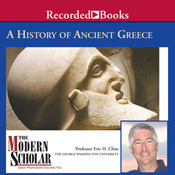
7 CDs with course guide, a 64 page full color booklet. In this intriguing series of lectures, prolific researcher, author, and George Washington University professor Eric H. Cline delves into the history of ancient Greece, frequently considered to be the founding nation of democracy in Western civilization. From the Minoans to the Mycenaeans to the Trojan War and the first Olympics, the history of this remarkable civilization abounds with momentous events and cultural landmarks that resonate through the millennia. Ancient Greece, indeed, lives on in modern culture, evidenced by an ever-present fascination with the tales of Homer, Greek drama, and the spectacular stories associated with Greek mythology. In the rise of Sparta and Athens, and the origins of democracy in Greek society, people today find a wealth of relevant material for understanding not only ancient Greece, but the modern world. And there is no greater fount of learning than that supplied by the immortal philosophers of Socrates, Plato, and Aristotle.
DR. ERIC H. CLINE is the former Chair of the Department of Classical and Near Eastern Languages and Civilizations and current Director of the Capitol Archaeological Institute at The George Washington University. A National Geographic Explorer, NEH Public Scholar, and Fulbright scholar with degrees from Dartmouth, Yale, and the University of Pennsylvania, he is an active field archaeologist with 30 seasons of excavation and survey experience in Israel, Egypt, Jordan, Cyprus, Greece, Crete, and the United States, including ten seasons at the site of Megiddo (biblical Armageddon) in Israel from 1994-2014, and seven seasons at Tel Kabri, where he currently serves as Co-Director. A three-time winner of the Biblical Archaeology Society's "Best Popular Book on Archaeology" Award (2001, 2009, and 2011) and two-time winner of the American School of Archaeology's "Nancy Lapp Award for Best Popular Archaeology Book" (2014 and 2018), he is a popular lecturer who has appeared frequently on television documentaries and has also won national and local awards for both his research and his teaching. He is the author or editor of 20 books, almost 100 articles, and three recorded 14-lecture courses. His previous books written specifically for the general public include "The Battles of Armageddon: Megiddo and the Jezreel Valley from the Bronze Age to the Nuclear Age" (2000), "Jerusalem Besieged: From Ancient Canaan to Modern Israel" (2004), "From Eden to Exile: Unraveling Mysteries of the Bible" (2007), "Biblical Archaeology: A Very Short Introduction" (2009), "The Trojan War: A Very Short Introduction" (2013), "1177 BC: The Year Civilization Collapsed" (2014), “Three Stones Make a Wall: The Story of Archaeology" (2017), and “Digging Up Armageddon” (2020). He has also co-authored a children's book on Troy, entitled "Digging for Troy" (2011). For a video of his "Last Lecture" talk, go to http://vimeo.com/7091059.
Brushing up on my Greek history before our trip. This was a solid overview, but I wished it contained more on the Golden Age and the arts. It was nice hearing the author's voice instead of the usual narrator. I'd listened to more of his books/lectures.
A short class on ancient Greece by one of my favorite lecturers. What was really nice is that this was essentially all review. I was impressed at how much I remember from the 1960's when I minored in ancient history and was even accepted at graduate school in ancient history. Instead of graduate school, I moved to West Virginia and had beautiful babies. By the time grad school came around again, it was library science not ancient history. I still love Greek history though - especially the Minoans. Probably good I never went any further though because it is the romantic part of history that I loved and there is nothing like grad school to put the kibosh on that.
This is a good set of lectures on Ancient Greece that cover the highlights of an entire different Modern Scholar course by Cline; Archaeology and the Iliad: The Trojan War in Homer and History, to the point that frankly you should skip that one (if you're thirsty for the details you probably want a scholarly reference source to begin with).
The course covers more than that of course, from the Minoans to Alexander's successors specifically. The dip into sources is a bit uneven, as expected, given that the availability of sources differ so much in this giant time span, but it also compresses rich material so much it's sometimes misleading - the Alexander lecture specifically. Cline wrote a great popular book on the Bronze Age collapse giving a broader full mediterranean view of both the bronze age trade networks as they existed and the fall; 1177 B.C.: The Year Civilization Collapsed, relevant to the bronze age and dark age sections of this course.
In this lecture series, Professor Cline covers Greek history from the Minoan civilization to the end of the Hellenistic period, which he defines as the death of Cleopatra. The material isn't high level (insufficient time in a lecture series of this length), but it is a good survey. I appreciated Professor Cline's knowledge of the material and his dry sense of humor.
This is a short but good series. It sticks to the bare bones narrative without much cultural information but is a perfect overview/summary/recap...which is what i wanted. Really like Eric H. Cline too, he's a good lecturer, would like to hear more from him.
This course is a survey of Greek geopolitical/military history with part dedicated to a review of major Greek philosophy. Good for beginner or refreshing memory.
Infuriatingly glib at times with some strange assertions, overall i enjoyed this rapid history. Clearly structured, and happy to zoom in on key events with detail and anecdotes, an easy listen.
A great summation and introduction to Greek history. The Minoans, Mycenaeans, Athenians and Spartans are discussed. The trojan war, dark ages archaic, renaissance and golden age periods are also covered leading into the Persian and Peloponnesian wars. Philosophy is covered before discussing Macedonia and Alexander the Great. Another fantastic presentation form Modern Scholar that gives a great starting point for a study of Greek history and culture.
From the Minoans to the Mycenaeans to the Trojan War and the first Olympics, the history of this remarkable civilization abounds with momentous events and cultural landmarks that resonate through the millennia.
Ancient Greece, indeed, lives on in modern culture, evidenced by an ever-present fascination with the tales of Homer, Greek drama, and the spectacular stories associated with Greek mythology. In the rise of Sparta and Athens, and the origins of democracy in Greek society, people today find a wealth of relevant material for understanding not only ancient Greece, but the modern world. And there is no greater fount of learning than that supplied by the immortal philosophers of Greece: Socrates, Plato, and Aristotle.
A good, concise overview of Greek history starting with the Minoans and the Mycenaeans in the bronze age, and ending with the Hellenic age. Would have preferred more time spent on Alexander and his successors.
Excellent lecture on Ancient Greece! Very informative and interesting - the perfect "prep material" for a grad course on this subject that I'm taking soon.