Why was the redoubtable King Henry, an aborigine from Western Australia, killed during a thunderstorm in New South Wales? — What was the feud that led to murder after nineteen long years had passed? — Who was the woman who saw the murder and kept silent? — This first story of Inspector Napoleon Bonaparte, the half-aborigine detective, takes him to a sheep station in the Darling River bush country where he encounters those problems he understands so well -- mixed blood and divided loyalties.
Arthur William Upfield (1 September 1890 – 13 February 1964) was an Australian writer, best known for his works of detective fiction featuring Detective Inspector Napoleon Bonaparte ('Bony') of the Queensland Police Force, a half-caste Aborigine.
Born in England, Upfield moved to Australia in 1910 and fought with the Australian military during the First World War. Following his war service, he travelled extensively throughout Australia, obtaining a knowledge of Australian Aboriginal culture that would later be used extensively in his written works. In addition to his detective fiction, Upfield was also a member of the Australian Geological Society and was involved in numerous scientific expeditions. Upfield's works remained popular after his death, and in the 1970s were the basis for an Australian television series entitled "Boney".
The first book in a mystery series starring Inspector 'Boney' Bonaparte who is half Aboriginal, half white.
The Barrakee Mystery was a mystery when it was written in 1929, but now it is also a great piece of historical fiction and social commentary as it describes so perfectly how people lived in the Australian outback at that time. We are shown the way of life of the station managers, their employees both white and indigenous, and also the women who I always consider were remarkable in their strength.
The mystery is excellent and convoluted enough to trick this reader at least. There is humour, danger, love and tears - in fact everything needed to create an excellent book. Attitudes to other races produce occasional jarring comments but that is how it was then. At least we can see we have made some progress over the last ninety years.
I read this book as an experiment and find I now wish to read more of the series. Boney is an exceptionally good character and one I want to see more of.
Author Arthur W. Upfield was born in Gosport, Hampshire, England on September 1, 1890. He moved to Australia and adopted it as his homeland. He is best known for his series of books featuring Detective Inspector Napoleon "Bony" Bonaparte of the Queensland State Police. He died on February 13, 1964.
“The Lure of the Bush” by Arthur W. Upfield, was First published in 1929, by Hutchinson, London as “The Barrakee Mystery”, this is the first of the Upfield books to feature the half-cast aborigine detective, Napoleon Bonaparte.
This is the Doubleday & Co., Crime Club edition, published in New York in 1965. This edition includes a new Introduction for the American market, containing an account of Upfield's meeting with 'a half-caste aborigine named Tracker Leon, a man of high intelligence and some education combined with surpassing bush lore' - the inspiration for the Bony character.
Why was King Henry, an aborigine from Western Australia, killed during a thunderstorm in New South Wales? Bony investigates in a historical Australia.
When King Henry was killed on Barrakee Station, the police were baffled by the mystery. It wasn't long before Inspector Napoleon Bonaparte - Bony - was sent from Queensland to solve the murder and find the killer. King Henry was an aboriginal from Western Australia, and had been on the run for nineteen years. When he heard someone was dead, he returned to Barrakee to continue where he left off all those years before. Bony immediately suspected a certain member of the workers of Barrakee, but it was proof he needed. Would he confirm his discovery of who had killed King Henry, and why?
The Barrakee Mystery is the first in the Inspector Napoleon Bonaparte series by Aussie author Arthur W. Upfield and it was a good start to the series. I've read some of the others, random ones here and there, and enjoyed them all. I'm looking forward to continuing the series in 2026. Recommended.
Having finished The Barrakee Mystery, I'm finding it difficult to determine my rating for the book. In terms of the originality of plot, characterisations and evocative setting, I'd rate it a solid 5. However, I found many of the attitudes voiced in the book, particularly those relating to indigenous characters and the Australian indigenous population generally, really jarring, and I feel that my rating should reflect that aspect of my reading experience.
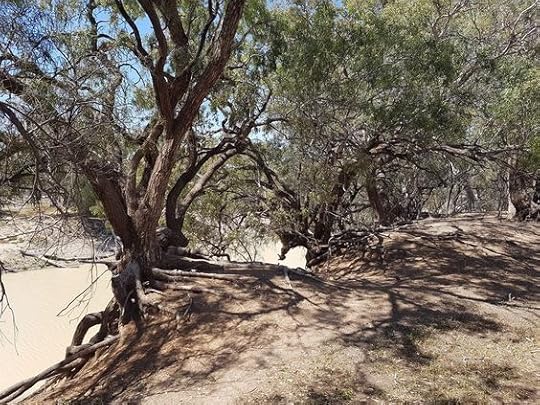
The book is set on a fictionalised sheep station - the titular "Barrakee", located on the Darling River near the town of Wilcannia in far western New South Wales. The landscape is harsh, with unrelenting summer heat and cold winters, and the potential for catastrophic flooding of the Darling Basin - an event that influences events later in the novel.
An Aboriginal man who goes by the anglicised name of "King Henry" returns to his ancestral lands at Barrakee, following years away working in Queensland and Western Australia. Meanwhile, a stranger - an agricultural labourer named William Clair - has started asking questions around the Wilcannia area, and is taken on by John Thornton to work at Barrakee. When King Henry is murdered during an electrical storm, local police are called and in due course, Inspector Napolean "Bony" Bonaparte arrives from Queensland, deputised to provide his specialised investigative skills.
While there's no huge mystery as to the identity of the killer, it's a thrilling story of deduction, tracking and psychology. There are several well-paced and rousing action scenes, including a riveting mission-pursuit through burgeoning floodwaters. The final solution, when Bony delivers it, is satisfyingly complex, but exposes the ugly underbelly of entrenched racism in Australian society. There's also a light romantic sub-plot, and themes of upward social mobility, what qualities make a "real man", family relationships and the camaraderie of an isolated community.
The Barrakee Mystery was first published in 1929, Arthur W. Upfield's prose displaying the elegant construction readers might associate with books of this vintage, yet his style is immediately engaging and his evocation of the Australian landscape is impressive. The dialogue is realistic and laced- yet not over-burdened - with laconic humour and local usage.
As regards the racist attitudes given voice in the book, I don't blame Arthur W. Upfield particularly for this, as I believe that the content is consistent with attitudes in the 1920s and 1930s. In fact, Upfield proved himself decades ahead of his time vis-a-vis Australian mainstream culture by employing a "half-caste" (in itself a dated and loaded term) indigenous man, Napoleon "Bony" Bonaparte, as his detective. Bonaparte is an impressive, compassionate and intuitive character, who displays many parallels with Agatha Christie's fictional sleuth, Hercule Poirot. As Christie's first novel, The Mysterious Affair at Styles was published less than a decade prior to Bony's debut in The Barrakee Mystery, we can entertain the possibility that Upfield may have read one or more of her books himself.
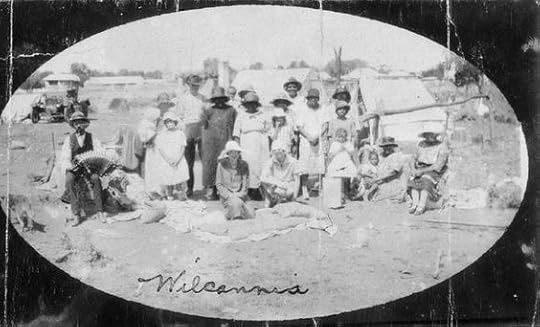
This 1925 photograph depicts European pastoralists with members of the local indigenous community and their families
Character attitudes aside, Upfield's authorial voice in his descriptions of the indigenous community, their interactions with the European population and their day-to-day preoccupations are also sensitive and evidently well-observed. A level of deep irony is also discernible in the way he depicts the hypocrisy of some of the European-Australian characters in expressing their prejudices against Aboriginal people, people of Chinese ancestry, and women generally. Upfield's characters frequently transcend the assumptions others have made about them. As readers, our sympathies are fully engaged and we really want certain characters to succeed against the odds.
All in all, I found The Barrakee Mystery a fascinating and engrossing read, with added interest in terms of its place in the very early days of Australian crime literature.
This book is really very difficult to rate with a number, because it was written in another time, another place and I think in today's world, people would frown on the out and out blatant racism that runs through the pages of this book. However, that being said, if you put this book in its proper perspective, and realize that it was first written in 1929, then the racism becomes part of the world at the time. Once you can get past that, there's some strange ideas at work in Arthur Upfield's head. But hey -- I want to focus only on the story itself and that one was fair to middling, the first in a series introducing the half aboriginal/half white Napoleon Bonaparte, detective (who goes by the name of Bony). Bony's strength lies in the fact that he knows the land, he knows the "psychology" of the aboriginals, and he has never been defeated in any case he's worked on. What is really very cool about this book is that the Australian outback is a character unto itself.
In this book, the story begins with the homecoming of one Ralph Thornton to his parents. Ralph has been away at college, and it's been some time since he's been home. Waiting there for him is his mother, who all and sundry call "the little lady," his father, John, and his cousin, Katie. But right away the reader knows all is not perfect and that Dad wants mom to tell Ralph about his parentage...it seems that Ralph is not really the little lady's child, but that of the cook whom the Thorntons adopted on the cook's death bed. Add into the mix a strange man who goes up and down the river looking for information on a certain person, a murder and other strange events, and you pretty much have a long mystery to untangle. And here we meet Bony, who is assigned to the case, who does not want to be known as a policeman but as a detective.
I absolutely LOVE these books and am going about collecting older copies as I can afford them. I would recommend that you start with this one; my first Upfield was Mr. Jelly's business and I had no clue who Bony was so decided to start over from the beginning.
The first book in the Napoleon “Bony” Bonapart series, The Barrakee Mystery was first published in 1929 and was later also published in the US under the title “The Lure of the Bush”. Bony is a part-aboriginal policeman gifted with some extraordinary abilities such as tracking, reading the land and an innate deductive ability. He’s also up against the extreme types of prejudice against the black man that was common for the day and a tightrope that must be carefully walked.
An aboriginal man is murdered on the Barrakee Station property, owned by the Thornton family, killed by a blow to the top of the head. The only witness is Frank Dugdale, the sub-overseer of Barrakee. He was returning from an evening’s fishing and heard what must have been the killing blow. But it was dark, a storm was approaching and he saw very little before finding the dead man.
Bony doesn’t make his appearance until at least the second third of the story. When he does there’s a definite change of pace. He’s confident, self-assured and even commanding in his presence. There’s little doubt in his mind that he will solve the murder and in short order we’re given a taste of his uncanny knack for uncovering the truth.
For us, there’s no real mystery surrounding the murder. We’re treated to all the information required in the lead up to the crime to easily figure out the whodunnit aspect. Where things get interesting is the process of running the man to ground. This is where Bony’s unique tracking skills come in handy and a protracted chase in deteriorating conditions ensures an eventful and tense story.
The story is set in the north-western part of outback New South Wales on the Darling River, somewhere near Wilcannia. The remote nature of the property means the landowners take on the role as the ruling class, everyone tends to look upon them as the community leaders. In many respects, the story centres around the family, their interpersonal relationships and the way they’re looked upon by the wider community. There’s a definite commentary on class and the perceived natural order of things, with the aboriginals at the bottom.
Secrets and scandals are key to much of the drama in the book. The motives for the main murder, the emotional turmoil being suffered by the members of the Thornton family and the angst over allocation of available land in the much sought after land lottery being conducted by the government dominate this intricate plot.
Once you excuse the racist attitudes and bigoted behaviour of the central characters in the book, after all, they’re representative of the views of the day, it’s possible to enjoy the skill with which the story is presented and developed.
Although this is the first time Bony appears, and although he clearly livens up every scene he appears in, his role is only a minor one. There’s a great deal more to enjoy in later books, I’m sure, and we only get a brief taste in The Barrakee Mystery but there’s enough here to compel me to track down and read more from the series.
If you are easily offended by reading something which includes the prejudices of the time, this is not the book for you. This is a first novel of a series. Written in 1929, it does reflect the thinking about the Aboriginal people by the White population in Australia. It was a little surprising as the MC is a "half-caste" man, which seems like a progressive choice for the author. For the most part, I could just glance & move on,but there were 1 or 2 lines that did stop me in my tracks.
I enjoyed the storyline, the characters and the picture of Australian ranching life that is presented. I figured out one of the secrets fairly early on, which was the motive for the murder of an Aborigine, but loved the character of Napoleon Bonaparte aka "Bony" so much that it was worth sticking with it to see how everything unfolds. "Bony" is a brilliant but little known bush detective that is brought in by law enforcement to solve the murder of King Henry on the large ranch of Barrakee. The dynamics of the family and many of the employees is soon on display and makes for an enjoyable read. I will probably read more of this series.
I think the important thing to remember when starting this book is that it was written in 1929 when outlooks and attitudes were different. There is racism throughout. It isn't mean racism; it's seen as a way of life by both sides....but it is there and obvious to us today. Despite that, Bony, the detective, has an aboriginal mother and a white father. He sits between the whites and the aboriginals. He's treated with respect and as an equal on both "sides". It may be that the author is a progressive man for his time and saying that we're all equal. I liked Bony. His character will entice me to look into the next of the series. The characters in this book are solid, real and enjoyable. They give a good idea of Australian back bush life in the 1920s. They are good people, trying their best in their world. The descriptions of the Australian landscape are wonderful. I could picture the land and see the characters move through it. This book is very Australian and reading it is at first a bit confusing......many colloquial words throughout. But these are soon sorted out and give a flavour to the story that would have been sorely missed if they weren't there. (there's a glossary at the back; since I read the ebook I didn't realize this until I reached the end....then I laughed) The mystery is intriguing and one "knows" the ending before the end (but there's a twist), so I'd say that if you read a mystery for the mystery itself, this may be a light story for you. I would say that this is a cozy, historical mystery with solid, enjoyable characters & scenery. Bony seems to be the Hercule Poirot of Australia. He's entertaining, smart and dedicated. I enjoyed this light, entertaining story.
The Barrakee Mystery by Arthur W. Upfield is the first book in the Inspector Napoleon Bonaparte mystery series. When King Henry, an aboriginal, is killed, Inspector Napoleon Bonaparte, also known as Boney and a half-caste aboriginal, is sent to investigate. I read these books 40 years ago and loved them and I used to love the television deries based on the books. It gives us a picture of the Australian outback back in the 1920s. It was fascinating to read of some of the tracking methods and how Bony can read a scene, even by determining where a suspect had travelled by finding and ant carrying a grain of sugar. An interesting reread, although a bit dated now.
"I leave Barrakee less vain, less sure of myself, a better man than when I came." This reflective sentiment is spoken by our protagonist who is supremely confident in himself and is recognized for his brilliance but is still learning. At the heart of Upfield's mystery series is the essential dignity and decency of Bony, the half Aboriginal detective who makes his first appearance in this novel. The characters are vibrant and memorable as they people the Australian outback of almost century ago. Be warned that there are tragic prejudices here but they are brought out to whither in the light of published material. To consider prejudice is to condemn it and Upfield was a trailblazer in this regard. Words and plot flow for Upfield, a story teller for the ages.
The Barrakee Mystery (1929) is the first book in the Inspector Napoleon (Bony) Bonaparte mysteries by Arthur W. Upfield. Even though this is Bony's first recorded case, the half-caste detective already has a formidable reputation--he has never left a case unsolved. When King Henry, an aborigine from Western Australia, is found dead at Barrakee Station, land belonging to John Thornton--a prominent sheep rancher, Bony is sent to investigate because it is thought that the motives, if any, may rest in the aboriginal community. What might have been an accident in the tremendous thunderstorm is soon proved by Bony to have been deliberate murder--a murder using that most Australian of instruments, a boomerang. He will have to use all of his detective abilities to discover why King Henry was on Thornton's land and who had a reason to kill him.
Upfield's novels are always enjoyable. He provides motives for murder that are uniquely Australian as well as introducing readers to Australian life and environs of the early 20th Century. The stories are peopled with memorable characters representing a time and place far removed from my own and he vividly portrays their concerns of the time. We may not agree with some of their concerns--particularly when it involves race relations--but we can't say that Upfield tries to hide anything. Except maybe the murderer. But then that's his job. And he does it well in this debut novel. I did not spot the murderer and was satisfactorily surprised in the wrap-up.
Well, the Australian setting is interesting anyway. This was published in 1929, and features a detective inspector of the Queensland police force who is half white, half Aboriginal. Author Tony Hillerman cited this series as the inspiration for his Joe Leaphorn/Jim Chee books, so I’m assuming that it improves after this rocky start.
I didn’t like the beginning, then I warmed up to it in the middle, and then the ending was absurd.
The mystery concerns the killing of an Aboriginal man by a white man, a crime which the white citizens hardly feel is worth pursuing. Even the mixed-race detective, “Bony”, is more interested in solving the puzzle than in justice.
The whole book has the casual racism you’d expect in this type of novel from this era, but it goes off the rails at the end. Rather surprisingly for a book featuring a mixed-race protagonist, much of the plot involves the horror of mixing the races. Bony just nods wisely; this is only to be expected, it matches his experience and solves all the mysteries.
"Bony" is a half-caste Aborigine with blue eyes, with "the degree of an A." (whatever that may be) from Brisbane University. He doesn't consider himself a policeman, but a detective. His creator, Upfield, seems to have a love-hate relationship with his creation. On the one hand he's a total Gary Stu genius, but on the other the author constantly ridicules him. Anything good about Bony is a product of his white blood, but he is "like a child". According to Bony, miscegenation is a cardinal sin. He says that dingos don't mate with rabbits, so his parents were lower than animals for going with someone who wasn't "their own kind." Blood will tell, according to the sleuth. And according to the author, the white population of Australia living in the outback was composed of "99% natural gentlemen" in 1926. Never mind the whole former-penal-colony thing, or that even at the time of writing, killing an Aborigine hardly merited an investigation--unless you just happen to be the only detective on the force with Aborigine blood.
The author uses his characters to work through race issues. The plotting was okay but very, very predictable. I knew where it was all going, subplots and all, before the train left the station. That, and the fistfights were described in far too much detail, literally blow-by-blow. Two and a half stars.
Not as good as #4 in the series, Mr. Jelly's Business or Murder Down Under, which was the first Upfield I read, or rather listened to on Youtube - as with this one. The motive for the murder, around which the whole story pivots, I found a bit weak. Yet overall convincing, original in setting, authentic in tone. I'm hooked.
This is the first book in a series of detective stories published in the 1920s, set in rural Australia, featuring Indigenous detective Napoleon “Bony” Bonaparte. The book is set on the fictional sheep station Barrakee, on the Darling River in far western New South Wales.
When an elderly Aboriginal man, King Henry, is killed in a thunderstorm, Inspector Bony is called in from Queensland to solve the crime. Bony is a sophisticated, well-read detective with astute observation skills and an understanding of Indigenous culture and bushcraft. Bony had an Indigenous mother and a white father, and has clearly had to learn to negotiate each of these worlds.
The second storyline involved the homecoming of college student Ralph Thornton to his family, his attempt at romance with his cousin Kate, and his discovery of the secret of his birth and true parentage.
I am really conflicted about how to review this book. I found the setting well-described, the story engaging and I really liked Inspector Bony as a character. What was particularly confronting was the out and out racism throughout the book, probably a reflection of the era. In particular there seemed to be a strong view that any intermixing of the races was abhorrent, and the offspring of such a match were somehow inherently marred. The only positive about this, was that I had not previously believed that we had made any progress in this area as a country, whereas reading this 1920s snapshot made me see that actually we have moved forward in our attitudes in some ways. Ironically though, despite the book feeling very outdated in terms of racial attitudes, in some ways it was also ahead of its time. 100 years later, I don't think there is another series of books out there featuring an Australian Indigenous detective.
The next dilemma for me is whether to read another of these? I would love to read more of Inspector Bony, he was a great character, but does this level of racism continue through the series?
Like many other readers, I have mixed feelings about this book. On the one hand, it's a good mystery and a great new detective. Boney is a mix-race Australian who has some authority with the Australian gov't to investigate crimes. He's unassuming and shows a large amount of grace, even to those he suspects of a crime. No one is very cartoonish and all the characters seem to have a humanity in them. Of course, this was when no one thought it was racist to think Aboriginals were not as important as whites. And that's the "however" in every review. This book is a product of it's time, and the sensibilities of both Whites and Aboriginals were very very different than today. No one was downright cruel or mean but they also couldn't understand all the "fuss" over the murder of a "black man." Even Boney waxes philosophically about how a character does something because the Aboriginal part of him is always going to win out over the White part of him.
If I find another one of these in audio I would read it. I really did like Boney and I liked submersing myself into early 20th Century Australia, even if it made me inwardly cringe several times.
This is the second time I have read The Barrakee Mystery. I gave it four stars after the first read (a few years before I joined Goodreads) but I have dropped it down to three after this one. While the story is gripping and the characters solid and entertaining, the racism is outrageous. I do acknowledge the book reflects the period of time in which it was written. And Upfield does make it frustratingly difficult for the modern reader to pigeonhole where he stands on issues of race. On the one hand his hero, Bony, is a half-caste Aborigine and a highly successful and intelligent detective. And there is a glimpse of Upfield’s attitude towards their treatment when Bony drops a comment about the genocide of one particular tribe describing it as “unhappily wiped out by you gentle white people”. On the other hand, most of the characters see no great crime in the murder of an Aboriginal man, and the segregation between white and black is taken for granted. Additionally, a common theme in the Bony books is the idea that no matter how “civilised” an Aborigine appears, he will always revert back to the wild ways of the bush. It’s something that we see Bony frequently battling throughout the Upfield’s books, and it is a key plot element involving one of the minor characters in this book. In the end I feel that it was not Upfield’s intention to be racist, although by modern standards he certainly was. I believe he had a great deal of respect for the Aboriginal people, but it was a respect that was tempered and developed in a world where racism was the accepted norm. From a modern perspective, the racism in his books is shocking. But perhaps at the time of writing what was shocking was that he showed any kind of deference to the Aboriginal people at all. As a quick note, The Barrakee Mystery does include several uses of the N word, which might offend some readers.
This is the first of the "Bony" books featuring the half-aboriginal Australian detective, Napoleon Bonaparte.
I remember as a child enjoying the TV series based on the Bony books, and was keen to read the novels it was based on.
The plot is great, there are great action sequences, and the descriptions of the Australian scenery are fantastic. It seems authentic - you may need to use the glossary at the back for definitions of many of the Australian slang terms used throughout. I felt very sympathetic towards Upfield's clever-but-somewhat-arrogant detective.
The problem is that this is a book written in a different time (the 1920s) in Australia, where the attitude towards race was very different. It's very difficult to stomach otherwise likable characters talk about and act towards Aborigines the way they do in this book. No-one seems to think it's too big a deal that a white person kills a black person. There are other examples of this abhorrent attitude towards the indigenous people, but I don't want to spoil the story.
Even so, as long as you can appreciate that you're seeing the story through the lens of that time period in Australia, you've got a really good book. I just kept wanting it to speak out against the racism, and it really didn't.
Australia in 1928 was a wild and dangerous place with islands of comfort (and hard work) called stations. This is the first in a series of mysteries about that world, The Lure of the Bush, also called The Barrakee Mystery, Barakee being a fictional station near the Darling River in NW New South Wales.
Detective Inspector Napoleon Bonaparte, "Bony," is part Aborigine or in the language of the day, a half-caste. He is the finest tracker in the commonwealth and when a black man is killed at Barrakee he is brought in to solve the case.
There are a dozen things that make this book unusual (to me anyhow) and enlightening, starting with insight into Aboriginal life, widely varying opinions and prejudices about the Aboriginal people, the workings of a sheep ranch with tens of thousands of sheep to look after, the drought and flood conditions in that part of the country, and the difficulties of getting around such large areas in what must have been the equivalent of a Model T Ford.
I learned about Arthur W Upfield and this series from Nan at the blog, Letters from a Hill Farm. Her comments on the series are here: http://lettersfromahillfarm.blogspot....
I must agree with most of the critics. The story is exciting; the characters are interesting; the racism pummels you in the gut. It is from another time and culture, though no one is immune from us vs. them thinking. The mystery is a good one, developed slowly and with increasing tension. It takes a while to enter the world of Upfield's characters, sheep herders in Australia in the 1920's. There is a glossary in the back of the book that helps a great deal. Once I got into the story, however, I had trouble putting the book down. Upfield is a good mystery developer. And we, as humans, have always had trouble with race issues. Their prominence in this mystery is part of the story, and one we cannot ignore in its reading. I am a fan of awareness and thought over invisibility and reaction. I don't know what Upfield's actual views were, but I know the book resulted in a lot of reflection on my part. And that makes it a good read.
A marvelous book. Not just a detective story but also a thriller and a love story set (incidentally) in a saga describing the appalling treatment of the indigenous people of Australia by the white settlers.
Although the attitudes of the characters show how cheaply the lives of Aboriginal Australians were held, I don't believe that Upfield was himself an out and out racist but as an English immigrant I think it would have been very difficult not to be swept along by the attitudes prevailing at the time. Indeed, he appears to me, to have a great admiration of and fascination for the Native population.
Bony is such a great invention and his character develops superbly in subsequent books.
I would imagine that some modern Australians find Upfield's books uncomfortable reading.
This was one wild ride of a book. The first in the Inspector Napoleon Bonaparte (Bony) mystery series, it is much more than a mystery. It is one part Western, one part romance, one part adventure, and there's some detecting thrown in to explain it all.
There is one disturbing element for which I must mark it down -- the attitude of the English (Australians) to the native aborigines. There is outright discrimination as well as stunned disbelief that the detective is going to search for the killer since the victim was black (a nobody).
I can't say whether or not this was exactly a "fair play" whodunit, because I was too fascinated with the story to search for clues, however there was only one slight surprise for me in the final revelations.
Worth looking for these in a used bookshop or on kindle.
I love a good mystery and have read the best...and the worst. Upfield ranks with the best, Agatha Christie, John Dickson Carr, Poe, Queen, Sayers, Marsh, and I could go on, but you get the idea. So what do you get with a Bony mystery? Careful plotting, realistic characterization, well-written English, Australian geography lessons, social commentary relevant to the 1930s to the 60s. Upfield balances the brain and the heart. He delivers the facts of each case through Bony, but he also makes you aware of the struggles the main characters face, especially the call of the bush on the mixed-parentage Bony. Each mystery is complete in itself, yet each adds to knowledge of fascinating Australia and people and their motivations. If you've never met him before, now's the time to add Bony to your collection.
Wow, this is painful in its relentless, casual racism. Though obviously a product of its time (1920s), it is nearly unreadable. The mc is a half white/half aboriginal detective who relishes his white, educated side and pretty near loathes his aboriginal side. The entire plot is a soap opera-ish screed against the mixing of races. The murder of a non-white person is constantly being discounted as akin to a traffic ticket.
I am assuming that the rest of the series will be very heavily weighted toward similar themes, and I am not going to read any more of these.
This entire review has been hidden because of spoilers.
Quite excellent mystery. I understand that the book and this series is quite old but some of the race related aspects of the book are not easy to read in modern times. Characters are quite good. Certainly held my attention the whole time- just didn’t love the handling of race, especially toward the end
It was an interesting read, with a lot to learn about 19th century Australia, but slow at first, and definitely a product of its time. There were some descriptions about natural phenomena that were really interesting and I get the sense that the author had a keen intellect and observation skills.
Why have I never heard of this author before!? Upfield's Boney is the second best detective I've come across. He beats every other detective, except Sherlock.
Nothing about this is an imitation. Completely original, set in outback Australia at a time when it was much like the Wild West. The detective is half aboriginal, half white, which in itself is controversial for the time. People discriminate against him and his two sides are constantly warring against one another. His detection methods focus mostly on Bushcraft.
This was a very interesting read about a half-Aboriginal, half-Caucasian detective solving a murder out on a property in western New South Wales. Given the time in which this was written, I found the general attitude toward the Aboriginal people surprisingly sensitive, although there were some disappointing aspects and ways of describing things as well. But overall I enjoyed it, and will continue with this series. 3.5✭