Delving into Japanese classics had always been a goal of mine since I started reading more frequently. Akutagawa Ryunosuke was the first Japanese author I've read of with his work Life of a Stupid Man, an incredible piece of literature in my opinion. So here I am delving into his more of his works.
Instead of talking about this book in general, I will make a weekly discussion to dissect each short stories in depth on my Instagram @agathachristiebells. I will try not to be spoilery but if you have read it or maybe wanted to know more, there are amazing reviews and analysis online that talked about the stories in more details.
CW: suicide
Akutagwa Ryunosuke was known as Japanese Father of Short Stories. His sharp literary style and usage of language were never stagnant: "it moves along like a living thing". He published Rashomon in 1916 at the age of 23-years-old and was praised by the legendary writer Natsume Soseki. Akutagawa brilliantly crafted a story from classical works into a contemporary modernist literature that transcend generation. Unfortunately, he commited suicide at the age of 35, in which he wrote actively for only twelve years in his career.
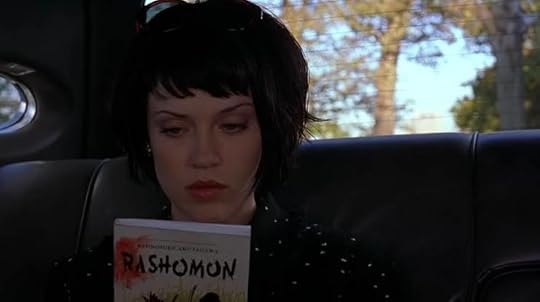
1.Rashomon (1915)
Rashōmon in Kyoto was the grander of the two city gates built during the Heian period (794–1185). In this story, calamity had struck the city of Kyoto caused a decline to the capital. Set in Heian Period, it is a tale of an ex-servant who in a precarious situation of being left homeless after he was fired from a job. In order to survive the night of a stormy weather, he decided to take cover in the abandoned gates filled with corpses. He then encountered an old woman suspiciously prodding around the corpses.
This was fairly short with 7 pages long of we looking at the unnamed character and his actions and decisions in the moment. There is an internal struggle of choices between surviving but with a price to pay or died alongside the corpses. There is symbolism in here that subtly present though not obvious and I found it on a reread, they are much clearer. This one was a good introduction in this book and sets the pace of the book well.
2. Hell Screen
Yoshihide was known to be the best painter but with an ugly face and not an ounce of compassion to others with an exception of his daughter. When he is tasked to create a painting of Hell Screen by Lord Horikawa, a powerful authority whom coveted his talent but despised Yoshihide's unseemingly arrogant behaviour who thinks he is above others and his disrespect towards culture and religion, Yoshihide fell into the dark abyss of hell on earth.
This story depicted artistic obsession and dilemma similarly Akutagawa was towards his writing. Yoshihide is obssesed with his art and the only emotion of love he had was for his adolescent daughter, a compassionate and mild mannered girl. Yoshihide's passion towards art border into madness as he painted from observation and gained the picture by real life depiction rather than imagination such as rotting corpses and dreams of his encounter with the Hell Wardens.
His tendencies to paint real life depictions gave the authentic feeling to his painting but he sacrificed many things in order to reach the state. His sacrilegious behaviour torturing his apprentices indicate his manic tendencies to achieve perfection even go as far as the act of a devil. This story blew my mind. Its so briliantly written with introduction to characters, the peak of insanity, unexpected and twisted climax which ends on a depressing conclusion. A well crafted story that showed human's greed and jealousy can burns the world as if hell exists even in the real life.
3. In a Bamboo Grove
A reread. I have read this short story three times and it still remains vague and ambiguous on the actual truth.
The story questioned on how our memory can be unreliable and each persons had their own subjective experiences on seeing the same things thus giving different answers to one question.
It started with the testimony of a woodcutter then a travelling priest, a policeman and an old woman on the killing of a 26-year-old Kanazawa no Takehiro who found stabbed in a bamboo grove. We then get a confession from the killer, the wife of Takehiro Masago and in the end, the spirit's confession himself through a medium. What really interest me was the fact all 3 people involved in this incident had different stories showed that they either embelish or exaggerate their stories according to their own principles. One in anger, another for honour and lastly to subdue the shamefullness because of lust. Its an interesting take on how we convey our words in order to make it look differently from others.
In the end, we don't know the absolute truth as we can only relies on the statements and confession given by the witnesses and suspect as each person gave their words according to their own advantage either to save honour or cover for others. It was left to our own interpretation.
TW: sexual assault, physical assault, animal cruelty, arson, suicide
The second section of the book titled Under the Sword comprised of 3 stories: Dr Ogata Ryosai's Memorandum, O-gin and Loyalty.
In this section, the stories mostly based during the period of rules by Tokugawa shogun. Tokugawa ruled the country with power and force in fear of any rebellion and being overthrown. This time, the fear or threat from Christianity religion which is starting to make an impact on the people, Tokugawa was afraid of this thus there are punishment and execution for those who practiced the faith.
4. Dr Ogata Ryosai's memorandum ( 1916)
Following the memorandum of Doctor Ogata, this reports on a widow named Shino who has a young daugther that fallen ill. She was a practising Kirishitan or Christian thus causing her to be abhored and pushed away from the neighbours. In desperate need for help, she seeks Dr Ogata to see her daughter's sickly state but due to her religion, the doctor refused unless she abandoned the faith.
Interestingly, this story pit religion and family together. Its a story that shows the choice between keeping your religion or choose your flesh and blood. Certainly, its a notion that is cruel but soon we will see what fate arrived to Shino as she decided on her own as she was pushed to commit an unwilling act for her daughter. In the end, there is a twist of fate and it may seems unbelievable but a miracle do occur.
5. O-gin
Opposite to the miracle in the earlier story, this one questioned the choice make by the character. O-gin is an orphan girl who lost both of her parents at young age and she was adopted by a couple who are Christian though not many people know about it. They however were caught by the Satan and brought to the magistrate for cruel punishment and forced to denounce their faith. At the time of execution, O-gin decision to back away from Christian crumbles down as she realized she can never go to Heaven and abandon her birth parents whom she believed are in the depths of Hell.
This story made me think a lot on the choice of religion and family again. Being loyal to the religion in here meaning you are abandoning your family but O-gin decided to not be selfish and instead chose her parents. Its a debate of choice and weighing the importance of these two things in life. This will make an interesting discussion.
TW: murder, decapitation, graphic violence
6. Loyalty
This is fascinating as the terms loyalty coined to the person served to a bloodline. In here, we see a head of a household, a samurai started to have fits and nervous breakdown that ultimately led him being out of boundary and potentially harming the family's name. The Elder of the House decided that the master should refrain himself from attending any events that take place in the castle in fear of him embarassing or bring disgrace to the family. The elder is more loyal to serve the house than his own master thus lead to him being almost killed but instead he left the house, no longer want to serve the family. The next elder appointed is more accustomed or acquaintard with the house master as he seen him grew up and here, he is more loyal to the master than the house itself. So you see there is a different loyalty in the same household. There is a disatrous event occured after the master decision to go to the castle for last time before he retired causing the destruction of his whole bloodline.
Around this time, Akutagawa himself seems to be having his own nervous breakdown. This story may reflected his own mental state as the main character seems to fear almost everything and lashed out whenever something ticks him.
7. The story of the head that fell off
Set in the backdrop of Sino-Japanese War where tension is rising between China and Japan, war destroyed many people. Xiao-er, a chinese man went to a fight with Japanese cavalrymen and as he clash swords with them, he felt a sword hit his neck and then he ran away atop of his horse to flee from the dire situation. He fell from the horse, on the verge of his death, his past life started to passed by him in shapes of the clouds, his mother's apron, the field of his home, the foot of a woman he loved and the festival he attended. Slowly, he startdd to regret his past actions and want to live a better life. Soon after, a newspaper stated an accident of a human head falls off after a brawl in a diner.
This story was sort of a dark comedy/humor because there is a twisted ending of the man. Regrets came too late for him despite many things. In a way, this story showed that humans somehow will always make bad decision even though they always said they will do better next time.
7/9/2021
8. Green Onions
Interestingly, in here Akutagawa breaks the fourth wall and was present in the story by saying he need to complete this story in order to meet a deadline. It gave a slight humor although as always, there is something to be taken from the story itself.
O-Kimi, a beautiful young waitress in a cafe had fallen in love with a young charming Tanaka. O-Kimi had this childlike or romantic notion of love , potraying the ideal image of Tanaka but she also knows that he could not possibly be perfect. However, when someone is in love, they tend to put a rose tinted glasses on and admire the person so much, they will look past their lacking. When both of them are on a date, Tanaka harbours an ill intent that may occur if not for O-Kimi's attention diverted to green onions on display in the street neighbourhood. What exactly is the significance?
Simple as it is, she was awaken to the reality of economic and financial situation she was in after seeing the green onions' price. She was worried about her rents, next meal payments, and obligations in her life other than romantic relationship with Tanaka. There is a potential danger when Tanaka invited O-Kimi to a house they are supposed to go but this was stopped by his sight of her with the green onions on her arms. As if all intent vanished the moment he sees her that way.
9. Horse Legs
This is fascinating. Hanzaburo suddenly passed away but turns out, this was a mistake by the grim reapers and they eventually returned him back to the living world. However, here's the problem, Hanzaburo had died three days ago, his legs had start to become rotten and in order to cover this mistake, the grim reapers replaced his legs with horse legs. Hanzaburo was devastated and in order to conceal this hideous facts, he kept his legs in boots all the time and never let other people see his legs.
Content warning: Death, suicide, attempted suicide, affairs
10. Life of a Stupid Man
"I am living now in the unhappiest happiness imaginable. Yet, strangely I have no regrets"
"I may wear the skin of an urbane sophisticate, but in this manuscript I invite you to strip it off and laugh at my stupidity"
I almost cried just by reading these words.
This was my 3rd time reading this stories. Its an autobiographical stories comprised of 51 short anthologies or rather I would call it Akutagawa's musings on his life and principles. It was published posthumously after his death by his close friend. Attached to the manuscript was his letter to him which said he is entitled to release this stories but must not identify or put a names to the people he spoke about.
Cadavers
"If I needed a corpse, I'd kill someone without the slightest malice. Of course, the reply stated where it was - inside his heart"
Man-made wings
"At twenty nine, life no ponger held any brightness for him, but Voltaire supplied him with man made wings.
"The higher he flew, the farther below him sank joyd and sorrows of a lifr bathed in the light of intellect"
We started with his descriptions of his mother whom he described as lunatic and whom he barely have any affection for but also afraid he becomes like her as he lives each days with fear. Then, we moved slowly as he grow to become a writer but pressured to concur with the writing industry, married to a woman he loves but end up in affairs, growing passion for arts and philosophy but also contradict most of them, become a father but felt he is useless and unsuitable and each time he muses on death and what does it mean to live.
The Birth
"Why did this one have to be born - to come into the worls like all the others, this world so full of suffering?"
Comic Puppet
"He wanted to live life so intensely that he could die at any moment without regrets"
Stuffed Swan (this particularly hits me the hardest)
"As he thought about his life, he felt both tears and mockery welling up inside him. All that lay before him was madness or suicide"
I couldn't put into words or make a proper dissection on this one because its personal and raw and basically him telling his own stories in the most vulnerable state he was in, secrets being unburied, darkest desires and emotions being poured out, philosophy shared and contradicted and generally him saying he is unable to be a man worth enough to live. Its quite painful in a away but subtly conveyed in each short passages he wrote.
Interestingly enough, he wrote these using third point of view as if it was another person but it was actually him. Maybe he tries to separate the creation he wrote about from his life but he knows so well it is him and will always be him.
11. Death Register
In here, we see his life in full lights with him describing the death of his insane mother, an elder sister he barely knew, and the father who left him when he was an infant but always tried to reconcile with him somehow. Akutagawa doesnt get love from his real parents but he was given plenty by his adoptive parents. This was poetic and lyrical piece of essay he wrotes on each of his family members and ones that I felt most attached to was his recall of his father's dying on his deathbed. Such a sad moment. The story ended with a haiku as went to visit the graves of his beloved, his thoughts of them dying as if they are fortunate enough to die rather than live.
12. Dragon: The Old Potter's Tale (1919)
- Similar to The Nose, this story also points out on appearance and religion where the Buddhist monk named E'in had a giant nose and this caused him to be the centre of jokes by many. In order to divert the attention from his looks, he concoct a revenge by putting a signboard saying that a dragon will ascend to heaven on the third month. The words spread around like wildfire, even if people had doubts, majority believed the news and soon anticipate the event. Eventually, the day come and thousand of people gather to see the dragon but does this dragon even exist?
The theme of religion and physical appearance were themes that Akutagawa explored most in his work and this one spark more interest in the question of whether the prank could actually be true. Jay Rubin mentioned "Dragon toys with the likelihood that religion is nothing more than mass hysteria, a force so powerful that even the fabricator of an object of veneration can be taken in by it."
The question whether the dragon does ascend remain vague as we are unsure whether it exist or the people in the midst of waiting for hours too invested in the notion of wanting and believing the dragon, conjure up the image of dragon. Its fascinating but as always the ending remain inconclusive.
13. The Spider Thread (1918)
Its a very short story but concise in conveying the message. Talked about sinner's and how one act of compassion lead to a help from the lord above but a greed will cause the downfall. Kandata, a vicious murderer was punished in the lowest of Hells but his action of letting a spider live ultimately gave him a help to climb to heaven by the spider thread. There are depiction of gruesome hell and its a terrifying scene. For someone as selfish as Kandata who won't share his help from above with others eventually lead to his eternal damnation in Hell
An interesting twist of fate is that I was surprised that an anime Erased I just finished watching had a connection with this story I read yesterday. The anime talked about this short story and it was so twisted in the mind of a person and I was pleasantly surprised by the coincidence.
It was published for children based on Taisho fairy tales
14. Spinning Gears