The history of Silicon Valley, from railroads to microchips, is a story of disruption and destruction, told for the first time in this comprehensive, jaw-dropping narrative.“Extraordinary.” ―Greg Grandin, Pulitzer Prize-winning author of The End of the Myth Palo Alto’s weather is temperate, its people are educated and enterprising, its corporations are spiritually and materially ambitious and demonstrably world-changing. Palo Alto is also a haunted toxic waste dump built on stolen Indian burial grounds, and an integral part of the capitalist world system. In Palo Alto, the first comprehensive, global history of Silicon Valley, Malcolm Harris examines how and why Northern California evolved in the particular, consequential way it did, tracing the ideologies, technologies, and policies that have been engineered there over the course of 150 years of Anglo settler colonialism, from IQ tests to the "tragedy of the commons," racial genetics, and "broken windows" theory. The Internet and computers, too. It's a story about how a small American suburb became a powerful engine for economic growth and war, and how it came to lead the world into a surprisingly disastrous 21st century. Palo Alto is an urgent and visionary history of the way we live now, one that ends with a clear-eyed, radical proposition for how we might begin to change course. Named One of the Year's Best Books by Vulture • The New Republic • Dazed • Wired • Bloomberg • Esquire • Salon • The Next Big Idea Club
As a Stanford alum, I spent serious portions of this book thinking, "Man, I really liked my four years in paradise. I don't want to reckon with the fact that its administrators in the 1930s used it as one big eugenics experiment." So I'm grateful for its clear-eyed history of a place that leans hard into its hagiography. Of course, if you didn't go to Stanford or spend significant time in Palo Alto, your mileage may vary here.
My main criticism is that while this book is ostensibly about Palo Alto — and large chunks of it are indeed laser-focused on its minutiae — its ambitions go far beyond a single city in California, often to its detriment. Long stretches are spent trying to bend huge parts of American history and world history into its Valley-focused anti-capitalist and anti-colonialist lens in a way that starts to feel repetitive. It succeeds here and there, but many portions felt like a slog, making a very long book feel even longer.
I was also so let down by its ultimate "radical proposition for how we might begin to change course" (spoiler alert: it's giving Stanford and Palo Alto back to the Indigenous peoples who originally inhabited the area). It's such a naïve suggestion — put forth quite seriously as a "modest action" — that all but ignores the preceding hundreds of pages about how capitalism won't let go of something productive once its claws are in it.
2.5 stars for me, rounded up to 3. Fascinated by some of it, bored by a lot of it, and I really felt like its conclusion was pulled straight from a sophomore-year essay.
A smart, funny, and maddening reevaluation of where the capitalist system truly lives and has existed since the 20th century. The whole time the reader knows where the story is going, but the nearly 700 pages are full of incredible vignettes of the seizure of power- of course, in literal capital, but far more importantly, through ideology. The first half is a fun history book, but as the Cold War starts, it feels like a blend of horror and true crime. Definitely a book you’ll want to check out
I lived near Palo Alto as a very young child and my father worked at Hewlett Packard for almost 30 years so I was very interested in reading this book. The book is 28 hours on audiobook and contains a ton of historical information, particularly about the Stanford family. The book eventually ended up in my DNF pile. It was too long, rambled at times, and didn't coherently pull all the threads together in a way that kept me engaged.
Audiobook….read by Patrick Harrison ….28 hours and 20 minutes
Welcome to my part of the woods: Palo Alto….. …..Silicon Valley technological HOT SPOT…preeminent high -tech hub corporations …. with lots of preppy-wealth… integrated circuit- highly educated and talented microcomputer geniuses, gorgeous expensive homes … great weather … Stanford University…hiking trails…bike friendly, yummy restaurants shopping….. a beautiful blend of business and residential living.
Now the ugly parts: Palo Alto was land stolen from the Indigenous grounds > and Malcolm Harris spills beans/the truth.
At 629 pages … or in my case 28 + hours of listening - it’s easy to recognize Malcom Harris’s enthusiastic and earnest aspirations for giving us a comprehensive history lesson of Silicon Valley…. media innovations, entrepreneurship, start-ups, electronic chips, multi-functional devices, political, social, and cultural developments, local farms, capitalism, the gold rush, the real estate, the opportunities, investments, sufferings and benefits from success, changes from luxury….etc.
Parts went over my head — (while baking banana oatmeal chocolate chip cookies) …..but I kept listening…. and listening for days. ….I could have used a ‘smart-birdie’ whispering quicker simplifications to me. ….Parts were intriguing and educational …..with interesting details I had not thought about but have experienced…. [the history of freeway crisis and school desegregation lines] …. And [community sacrifices due to ‘shopping centers’]…. etc. etc. etc.
“Palo Alto is an ‘all-inclusive’ big fat highly researched panoramic resourceful book.
Note … this non-fiction was incredibly researched and well written — not quite as individually personal as James Franco fiction book of ‘Palo Alto’….. but the more ingenious and systematically accomplished.
Serving up a few sips from the informational fire hose that is Harris' PALO ALTO....
A comprehensive Marxist history of this region of central California, and thereby the technological hub of human society in the last two centuries. Harris ingeniously ties seemingly disparate themes back to this region and its ethos, particularly back to Leland Stanford and Stanford University, and the land that is now the "heart" (is there truly a heart?) of Silicon Valley.
Major themes discussed here: - Colonialism / the Indigenous Ohlone and displacement - Bionomics: the organism in relation to its environment - and how this can me manipulated and meddled through genetics and adaptation - breeding in Stanford's horses, eugenics in late 19th/early 20th century, and many other permutations through 700+ pages - Capitalism as the (crumbling) foundation - the life blood of the Valley - Labor and exploitation: Indigenous slavery to 19th-century immigrants to build railroads to offshoring to FoxConn to make devices. Landmark labor and political movements discussed in detail. - Military Keynesianism and war economies: the policy based on the position that government should raise military spending to boost economic growth - permutations of this in the military-industrial complex, war technologies, and manufacturing war for economic gain.
"California's agricultural capitalists pedaled the state's nonwhite labor like a bicycle: When they pushed one group down, another rose to replace it, and the whole contraption moved a littler farther down the road." [page 123]
"... as usual, when global exploitation increased, California and Palo Alto thrived." [page 423]
Since the subject matter is SO dense and far-reaching, Harris outlines each chapter with a list of subchapters, and the format really helped this reader, especially with such a large book. Gloriously footnoted and annotated in the bibliography, this book could have been a hydra of notations and confusion, but the outlines created a clear path.
Will be ruminating on this one and the hundred tangents it took me on for some time.
I’ve always felt that Harris exudes a fairly obnoxious “Professor 20 Year Old” quality, so I really debated whether to bother picking this book up at all. California history and critique of modern Silicon Valley sit squarely at the intersection of my interests though, so I decided to give it a shot.
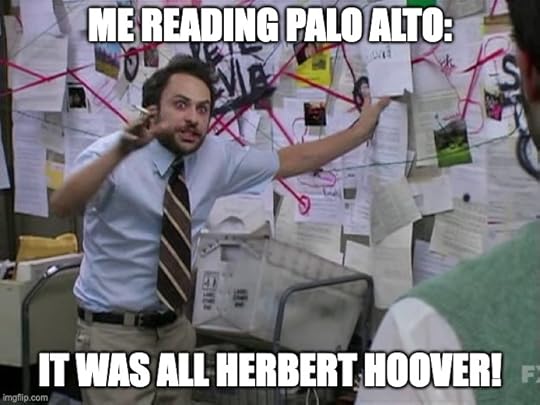
And it has its moments! It’s at its best when Harris hews close to his core thesis that there’s an ideological continuity stretching from the railroad barons who enriched themselves via the federal government’s largesse, to Leland Stanford’s obsession with scientific horse breeding programs and Stanford University’s promotion of eugenics, through Stanford alum Herbert Hoover’s cronyish “associative state,” and into modern day Silicon Valley with its government-funded origins, libertarian ideology, and fixation on optimization and automation. Even some of Harris’s frequent digressions can turn out to be pretty interesting—when they don’t stray too far from the point. For example, his discussion of how the Bay Area came to be a hotspot for late 19th Century Japanese, Korean, and Indian revolutionaries is pretty fascinating.
Ultimately, I got through about a quarter of the book before two issues finally got to me.
First, there’s the way Harris tends to spiral out into bewildering digressions that often frustrate the book’s core narrative momentum. As a person with ADHD, I can relate to the impulse to tie everything together into grand, world-historical theories, and how frustrating it can be to try to make everyone else see things the way they all fit together in your head—sort of. But it can be bewildering as a reader to try to make sense of what feel like frequent subject matter leaps.
Second, there’s Harris’s tone. As I said, I knew this was probably going to be an issue going in, and Harris’s prose is every bit as dripping with snark, condescension and sarcasm as I was expecting. It’s fine to have a point of view, and I know this is a polemic and not an “objective” work of history or journalism, but when an author goes out of his way to infuse every single sentence he writes—about, say, the Stanford family—with venom, it makes you question how fair and accurate he really is.
And indeed, Harris’s approach to history can feel a bit selective at times. Just to take one example, he spends a lot of time talking about private citizen Herbert Hoover’s WWI food relief efforts in Belgium (which he essentially portrays as collusion with both sides), but only obliquely refers to the similar food relief effort Hoover set up in famine-stricken post-revolutionary Russia. Not that I’m saying he’s off-base about Hoover per-se, but one is tempted to suspect that “famine-stricken post-revolutionary Russia” doesn’t fit his narrative as well as “imperialist war-torn Western Europe.”
Anyway, ultimately made it through about 25%, but I think I’m done.
So it is definitely a 600-page book in heft and spirit. You should know that before you go in. Harris' style is very glib and chatty (in a way I really appreciated!), so sometimes you forget that it's a 600-page book. But then you're like really deep into Revolutionary Communist Party intrapolitics and how it relates to silicon wafer production and you're like "oh, right, it's a 600-page book."
Harris gives his guides really clearly. Lots of Marx. A smattering of Ocalan. He takes this stuff seriously, and the history is better for it. There's no great men in Silicon Valley history, just a series of unwitting dupes who signify historical changes. The book is great for showing how capitalist modes of production gave us all this, and its strongest points are showing how capitalism marked everything it touched, like a 170-year flash flood. And there's definitely some really bleak parts of the book, but Harris does a great job concluding everything on an upbeat note and pointing out where the struggle is.
Palo Alto should be up there as one of those Great Books About California and is probably on par with Nature's Metropolis in Books About A Place And Also an Economy. I learned a lot reading it, and wish it came out years ago when I moved to the Bay, or even earlier when I was in high school and wondering what was up with the world. It's a great book for the curious, and is probably gonna get a ton of stick from the incurious because it asks good questions of history and comes up with answers that have a bag of critique attached to them.
You know when you start a 600+ page book it's going to have a LOT of detail, some of which may not seem super necessary. But looking past that, this actually felt like a fairly concise way to tell a history of capitalism using California and Silicon Valley as a vessel. Harris leaves no stone unturned, and offers interesting and provocative insights that don't just feel necessary as historical context, but adds fresh vocabulary to describe the present moment.
I have often wished for a decent history of the 20th Century, and I'm not alone. I hear plenty of folks -- especially younger people -- lament the lack of a narrative that isn't just bouncing from one war to the next one. I found what I was looking for in Harris's tome, which does not ignore the wars, but instead, really delves into the tech, science and philosophy -- and the profiteers -- behind them and other developments. It's a lot, as evidenced by the size of the book, but Harris provides the reader with plenty of momentum as he connects dots from the earliest colonies in the Bay Area right up to the present dot-coms. He offers humor and great storytelling along the way, and does a wonderful job of tracing the seemingly unstoppable path of capitalism, along with the inevitable genealogy of desperation that rose in its wake. While it would not be feasible to paint a full picture of every member of the cast of characters, he brings as many as possible into focus, and offers footnotes and close to forty pages of endnotes to help the reader chase down any threads that may seem to still dangle.
This is a quiet, thoughtful, occasionally snarky narrative, and for that reason, I'm afraid some might take the easy route and dismiss it for being leftist, Marxist, or -- perhaps the worst possible take -- "woke" (a term that has already been soundly beaten into meaninglessness). But I suspect those shortcuts are trod by people because of fear, as this is the book that the library cancelers and curriculum busybodies are so scared of: a real, people-centered, well-researched history -- which is something that the screechy people are trying so desperately hard to whitewash.
Young arrogant know-it-all marxist denounces capitalism without offering feasible alternatives. Angry young man angst makes for boring reading. I had hoped this book would be a penetrating insight into the development and current state of Silicon Valley. Not even close. For a good history of the early days of Silicon Valley of the PC era, I highly recommend “Fire in the Valley” by Michael swaine.
Only took me 1.5 years to finish but here I am 🥲 Honestly it’s a fantastic book and Harris’s writing is often funny and even occasionally poignantly beautiful — it’s just one of the most poorly edited nonfiction books I’ve ever read, and that’s wholly on the publisher. Having 60+ page chapters with only a subheading or two is just not a good way to organize a 700-page book with this density of information. I hope someday a second edition gets published with better organization and, god willing, reference pages listing the plethora of acronymed organizations and their most important figures.
(.5) So Harris is a hoot…he’s a Marxist which is like saying you’re a Luddite or a Whig…
How the philosophical musings about the working class 150 years ago has any application today is abjectly stupid…
Even if one didn’t notice that factory work has radically declined in that time span and that workers are no longer coal covered children, one would have to take note that worker deaths declined from 67/100k in 1913 to 3/100k today…
Workers are a whole lot safer obviously… Add to that the huge welfare state, the fact that approx 40% of those living below the poverty line are obese and it’s never been better to be poor than it is today…
Additionally, we come to the author’s hate for capitalism…which is just folks exercising their economic liberty.
For 300,000 years human life was nasty, brutish, and short and then capitalism and its handmaiden technology came along, added about 8 billion folks to the planet, pulled a billion of them out of abject poverty in the last 25 years, and gave even the lowly proletariat a better life than John D. Rockefeller, the world’s richest man of just 100 years ago.
Here’s a plethora of selected quote from the book and my commentary on the author as a first class fool…sorry mistaken, wrongheaded.
“South Bay when white settlers broke the mutualistic relationship of belonging between humans and the rest of the ecology.”
…Here’s the introduction to the oh so romanticized notion the author has for America’s First People…the almost Rousseau like idea that these folks were noble people, living in harmony with nature.
No, they were primitives who never developed writing or the wheel whose lives as semi-nomadic hunter gatherers had not changed in the 15,000 years since they came across the Bering Sea land bridge.
Had western civilization not arrived these folks would still be subsisting on roots and berries, while their southern cousins were engaged in the mass executions of thousands of their enemies…
“California Indian life appeared too easy to Europeans it’s because the former could rely on thousands of years of enduring knowledge about their environment.”
…Yes, unchanged living in small bands roving the countryside, making war, and following the seasons.
“they wielded the scientific power of white genericity”
…Or just wielded the power of science…
“Indians lived off the land efficiently, communing abundantly in small territories for countless generations.”
…so efficiently their populations never expanded bc these groups were left to the whim of nature from feast to famine.
“On the stolen land, miners planted wheat, barley.”
…the land was not stolen…the land was conquered. As the land had been for the 15,000 years the natives lived there…unless you believe native tribes lived in peace…see the Comanche and the Apache if you need to understand actual facts on this.
“Swiss psychopath Johann Sutter did”
…All I can say was I was a bit shocked by this less than academic characterizations and I asked AI and it didn’t agree with Harris.
“Starving the peasants into the factories is the classic narrative of proletarianization, the creation story of the industrial working class.”
…another theme of Harris the exploited poor. Those folks who ran from their peasant way of life to work in factories…Harris never recognizes that factory work, while rigorous and dangerous and a grind for us, was a huge step up from the poverty and toil of farm life…proof? Why did all the peasants run to the cities?
…This will be another structural problem Harris won’t accept …individuals have a better sense of what’s good for their lives than a guy in the 21st century sitting at Starbucks tapping out a screed against capitalism…
“Much of Ohlone material culture, like the reed huts and canoes they remade every year, was intentionally disposable.”
…yeah, right. Their canoes fell apart and they had to go to all the trouble to make a new one every year bc they were in such harmony with nature…nonsense
“the state’s advanced engineers looked to invent and develop new technologies as part of their plan to increase efficiency.”
…Harris thinks efficiency is a bad thing. Part of what he longs for is an unchanging economic landscape that guarantees all workers prosperous wages…he’s a high order reactionary in a very precise way.
“brittle system for feeding people.”
…most of Africa is kept alive by the huge amounts of food capitalism creates.
“path from the one imposed on Indians, Chicanos, and the California Chinese as well as on arriving Japanese, Filipinos, Punjabis, and some black migrants from the American South.”
…here’s Harris indirectly acknowledging all these folks willingly came to California, and they decided likely bc relatives and friends told them how much more opportunity there was in California compared to where they had lived…
“California’s white dictatorship literally prepared the ground for capitalism”
…and yet as above millions of brown and black folks came…hmmm And capitalism is just you picking the best sink faucet, car tire, chipotle burrito…it’s not the cinematic mustache twisting arms dealer.
“The impersonal force that animates this chapter, this book, this state, this country, this period of world history isn’t fate or human nature; it’s capitalism.”
…I agree, and that’s great, but please feel free to join a commune and attempt to live like folks did for those first 300,000 years
“That’s the name we’ve given to the particular system of domination and production in which landowners, on their own behalf, proletarianize the working class into being.”
…hard to deconstruct this without laughing…slaves and serfs were the norm for thousands of years. Capitalism freed these folks. That’s why they all left the farm for the city.
“A year after the golden spike, a passenger could telegraph his wife at home in Boston from the train and receive an answer before getting 50 miles farther down the line.”
..one of the bajilllion advances that capitalism created.
“They needed men who were estranged from the land.”
…Again, the quasi-mystical notion of farm life. Yeah, it was so wonderful almost no one does it anymore.
“The nation’s wealth was based on the expropriation of Indians, Africans, and now Mexicans”
…being a peasant adds almost zero value…see the history of Silicon Valley on this
“construction wages increased—and the railroad paid better than work to be had in the politically and economically unstable Chinese coastal districts of Fujian and Guangdong, where they sailed from”
Oops Harris makes a rhetorical boo-boo and admits that the working folks could exercise free will and make decisions about their economic future.
“Besides, Chinese workers were starting to become Chinese businessmen and farm owners, competing with white capital in addition to white labor.”
…what? These exploited immigrants were getting ahead
The Chinese Exclusion Act, which closed the door to immigration from the territory, passed in 1882…fell by nearly a third, from 133,000 before the Exclusion Act down to 90,000”
…here’s Harris talking out both sides of his ass. Immigrants are being exploited by the evil capitalists so you would think excluding them would be something he’d support, but no, he want to jump on his racism hobby horse and ride that around for awhile.
“Friedrich Engels wrote in an 1894 letter. “[ That] if a Napoleon had been lacking, another would have filled the place, is proved by the fact that the man has always been found as soon as he became necessary: Caesar, Augustus, Cromwell, etc.”
…Harris, like all Marxists, has a big problem with individualism…individuals don’t have free will. It’s all class warfare.
“investment flows drove invention toward profitable ends, fueling major technological efficiencies and advances in all aspects of life, which in turn spurred new colonial interventions.”
…invention from capitalism has worked out pretty well. What would Harris like investment directed toward? The Soviets Gosplan or Mao’s Great Leap Forward comes to mind. How’d those turn out?
“for workers skilled in book learning. The number of children per family shrank as adolescents and teenagers shifted from asset to liability in the domestic ledger.”
…The irony here was in agricultural life children were an asset: they had to work on the farm by age four or five and hundred years ago only about half got past 5 years old. Once capitalism started kicking ass, kids got to stay kids, got schooling, got an adolescence.
“Scientific racists hailed the army intelligence tests, which showed racial minorities performing measurably lower than whites…validity problems with the experiment are too numerous and basic to list (see Stephen Jay Gould, The Mismeasure of Man)
..Harris is unfortunately wrong here. Gould’s book is not a refutation of IQ. The book was retconned as a response to Charles Murray’s the Bell Curve, a book that’s been borne out by countless studies on IQ. IQ is real. Average IQ by race is regrettably also very real and has great explanatory power.
“It’s often said that under capitalism, relations between people appear as relations between things. The butcher, baker, and candlestick maker vanish into the Bed Bath & Beyond.”
…hard to understand what he’s saying here, but the butcher and baker didn’t make food bc they loved people. They did these actions bc they had acquired skills and could leverage those skills for their families.
“In the fascist system competition is external, between nations, its various components conceived as parts of a single body.”
Mussolini, the founder of fascism, was a lifetime socialist as was his father, and the Nazis were the workers socialist party. Fascism is just socialism with a strong dollop of nationalism.
“First, there’s exploitation, wherein capitalists extract bits of value from their employees’ work and gather it up into lumps to reinvest.”
Marxism can sound impressive until you ask yourself a simple question…how is the guy who works the fry basket at Mickey D’s being cheated by anybody? Or asked another way, does a poor person ever hire anybody?
“Companies began to offer stock options to employees, investing these workers directly in growth and keeping liquidity flowing back toward production.”
…Point to remember, even the fry basket operator can buy stock.
“During World War II, hundreds of thousands of black Americans moved out of rural areas in the southern states to seek industrial jobs, and a solid portion came west.”
…Harris needs to be careful here. He’s giving folks volition. You mean folks who came to California bc they decided whatever unfairness it was a better shot.
“Under capitalism, people couldn’t direct the nation’s societal surplus to useful ends.”
The only reason there is societal surplus is bc of capitalism. As for who gets to direct societal surplus, Harris always thinks it’s guys like him, instead of millions of people deciding to use their economic liberty to buy stuff they chose.
“In capitalist countries, capital could rely on the state to both respect and enforce its property rights, even in the face of workers who organize for land reform and confiscatory taxation.”
Yes, bc once you give the govt the power to confiscate your property you end up like Cuba, Russia, China, Venezuela..
“By the end of the Second World War, socialism was as global as capitalism…largely for the simple reason that the fascists were closer to capitalists than they were to communists.”
By the end of the Second World War the socialists had all of Eastern Europe and the entirety of mainland China under its tyrannical boot.
“30,000 California engineers were laid off in 1963–64. As the Vietnam War wound toward its close” …probably should fix this…Vietnam was not winding down in 1964
“Russia exited 1945 as battered as any nation ever was but triumphant, with a claim on the future at least as strong as capitalist America’s.”
Russia only survived the Nazis bc of Lend lease, capitalists giving them materiel, and oh btw Russia’s claim came after they made a deal with the Nazis to divide up Poland.
“U.S. betrayal shaped the Cold War world order.”
…huh…In the 18th century America created the blueprint for the modern world… …fought a war to end slavery in the 19th …then harnessed the power that fuels the sun, saved the world, and journeyed to a new one in the 20th… …and then went and created the 21st…
…America is the greatest country that’s ever existed…
“The Korean War—again, as it’s known to Americans—was the outcome of a structurally similar U.S. betrayal.”
…America saved South Korea from being overrun by the North… and check on how South Korea—the capitalist state, and N Korean—the communist have been doing since..
“Over outraged pleas from around the world, federal authorities executed Julius and Ethel Rosenberg on flimsy spying charges, alleging a nuclear conspiracy that didn’t exist.”
…All the files came out when the Soviet Union fell. The Rosenberg were dyed in the wool spies who used their access to confirm the traitor klaus Fuchs stolen atomic secrets.
“Kim Il-sung moved to unify Korea.”
…sure and Stalin was trying to unify Eastern Europe.
“Suddenly many white Americans felt they had a stake in the world struggle. They mourned not just the draw in Korea but the victory of the Mau Mau rebellion against British colonial control of Kenya, a fight the United Kingdom lost in the mid-1950s”
I’ve read a decent amount of Americana in the 50’s, and the hula hoop gets mentioned a lot but not the Kenyans…go figure.
“Black Panthers sold Mao’s little red book, trained in Algeria, and escaped to Cuba.”
The panthers had about 3k members at its peak. Their style and vibe certainly made an impact but their politics quickly became window dressing for bank robbery, police assassination, and cocaine use.
“The next month, Malcolm X was gunned down, and young activists took up his call of Black Power.”
…Harris leaves out Malcom’s killers were the Nation of Islam…no whites in that group.
“Only in the context of global decolonization can we understand how California became a worldwide revolutionary touchstone in the 1960s.”
Shrug, the state where Reagan was president…I’m astounded at the author’s hyperbole.
“the version of the Black Panther Party that developed in the Bay Area and became the most important American communist party since the Popular Front.”
…Again, a few thousand members..
“In 1969, a Panthers-inspired group called Indians of All Tribes occupied Alcatraz Island, claiming an American Indian treaty right to unused federal property”
Yes, occupying a deserted island really advanced American Indian causes..insert sarcasm here
“example was the San Jose Chicano playwright Luis Valdez, who as a San Jose State University student in the early ’60s developed a new form of street theater that he then brought into the grape fields to support farmworker organizing.”
Classic leftist twaddle. I’m sure the farm workers really enjoyed the street theater…sorry started laughing too much.
“Immigrant women in the Bay Area from Mexico and increasingly from Central America weren’t the right kind of “foreign,” and they found themselves relegated to domestic service work,”
Should they have been given jobs writing computer code?
“Between 1970 and 1988 the percentage of California workers represented by unions fell from 36 to 22, a nearly 40 percent drop.”
…Union membership has fallen throughout the US bc america has been forced to compete with countries after their reconstruction following WW2…those easy union jobs in Detroit went away bc America’s got fat and happy and too complacent and japan started making better cars.
“prop 13 framed the issue in terms of fairness for individual homeowners, but the benefits disproportionately accrued to organized capitalists.”
I was there. Old folks were beginning to lose their homes bc politicians had no check on how much they could raise property tax…similarly…when I was born in NorCal the sales tax was 5 cents. It’s now 10.25. Plz share with me what the state is doing now that it wasn’t doing then that justifies an over 100% increase on a tax on everything I buy.
“Shockley convinced him that IQ was something you either had or you didn’t, and some races tended to have more of it than others.” As mentioned earlier this is true
“which promoted fringe arch-capitalist thinkers such as Ludwig von Mises, Friedrich Hayek, Milton Friedman, and Ayn Rand.”
…both Hayek and Friedman won Nobel prizes, so much for the “fringe”
“workers’ pension assets into the booming equities market. Here was an alternative road to socialism: Workers could buy the companies, just like anyone else”
…yep…but somehow that doesn’t dent Harris’s worldview
“The rapid Soviet ascent in science and technology, culminating in Sputnik, proved that there wasn’t anything special or inherently faster about the capitalist developmental road.”
I’m sorry, did the Russians go to the moon? Did they invent anything after Sputnik? The Russians got to space first and had ICBMs and a giant military, but those workers that Harris allegedly cared about were sent to the gulags in the millions, starved at places like holodomor, and if they were lucky had a real treat by having orange to celebrate new year’s.
“meant that self-and family exploitation was the only way to make any money.”
Harris is so far up Marx’s ass he’s actually claiming that folks working for themselves, earning a living is “self exploitation”. Yeah , I wish LeBron would stop exploiting himself..
“believed in a free-market capitalist system in which people didn’t need to know what was going on for it to all work out.”
Harris disagrees but that’s the beauty of capitalism. Capitalism knows no master. The huge corporations that are on top today will disappear in another decade…or how’s yahoo, AOL, and blackberry doing?
“roping poor black and brown Americans into the Third World drugs-and-guns circuit. East Harlem, authorities were able to transmogrify the direct political and structural violence of class struggle into the decentered, depoliticized everyday violence of capitalist terror”
…notice the theme. Poor POCs aren’t responsible for their own actions…the bloods and the crips are murdering each other as some bizarre dance of capitalistic exploitation…not bc a Blood liked a Crips car and figured he’d kill the fool and take it.
“Confuse class relations by foregrounding the individual. Capital-gains tax cuts accomplish that, and so does shooting into a crowd of civilians with a helicopter gunship.”
…More antipathy for the idea of the individual…bc if you have to deal with a person you’re stuck with fry basket guy and you can’t make him some noble creature.
“Steve Jobs and Bill Gates are very important characters in the story, but they’re more meaningful as personifications of impersonal social forces.”
Notice the pattern? Individuals don’t matter…Caesar, Churchill , they’re all prisoners of this bizarre theory orbiting around some Dickensian view of late 19th century workers.
“If Jobs and Gates hadn’t been themselves, some other guys would have been them instead.”
…see above
“And despite the friendly interface, Apple computers were a signature commodity in a world that was getting rapidly worse for most people.”
…on every metric from life span to economic ease life has gotten vastly better over the last 300 years.
“Silicon Valley investor or board member or founder from the Third World, there was a family of refugees in a local basement performing the low-wage manufacturing”
…Oliver Twist meets high tech.
And When were silicon chips manufactured in basements?
You can't be neutral about your hometown. And Malcolm Harris hates his hometown.
Palo Alto is 250 pages of wonderful history that traces the development of an influential place in a way that is truly fascinating. Unfortunately, Palo Alto is a 600+ page book that suffers from too many flaws to redeem.
Harris is an Occupy Wall Street protestor who isn't writing a history of capitalism so much as a screed against it. In fact, the book often is so intent on lambasting capitalism that it wanders off for 50 pages at a time decrying greed, cronyism, eugenics, racism, sexism, environmental practices, morality, dishonesty, etc. that it loses its focus entirely and the reader is left to wonder what this book was supposed to be about. Many of the connections are so tenuous that even stretching to call it a history of California is no longer adequate. This isn't a history it's a vehicle for the author's ideology.
The writing in the first section is really strong (and the introduction is pretty interesting too) , which makes the rest of it even more maddening. Much of the book reads like a student paper, clumsily attempting to prove a thesis. It is full of citations and footnotes, but they too are clumsy and the author's sources reveal his intent to tell less than a full story.
The acknowledgments include "To everyone who helped me to get out of Palo Alto in one piece... and even my dickhead wrestling coaches." To me that captured some of the bias and immaturity Harris brought to the project.
I saw a review of Palo Alto that called it a critical history. If you want 600+ pages of critical you're in luck, but as a history Palo Alto is tremendously disappointing.
Stanford has long creeped me out. I can provide very concrete reasons for this - the obscene wealth of the campus bordered by a long line of RVs-doubling-as-homes along El Camino Real, the "black bouncing squirrels of death," as my high school friends called them, that frolic on the green lawns, the way the students zoom about on their bikes with their earbuds in, stopping only to enter a building and complete some sort of commercial exchange or human-capital-enhancement activity, each one ensconced in their own atomistic little world to the point that there are signs about people hit by bicycles. And I don't say this just because I'm a Berkeley person. I remember being haunted there too by a sort of apocalyptic gloom made all the more distressing by the consistent beauty of the weather. While in my college years I had largely attributed this haunting to the long shadow of the atomic bomb, in Palo Alto: A History of California, Capitalism and the World, Malcolm Harris has much more cogently and terrifying explained my intuitions. Palo Alto brilliantly weaves together a terrifying array of ostensibly diverse ways in which the Silicon Valley and "the California ideology" more broadly - from stud farms to Herbert Hoover to LSD to tech start-ups wall with the ever-present shadow of white supremacy and the military-industrial complex- have come to dominate not just the US and the world. One might cringe a bit at the somewhat pat ending after having previously followed Harris through 700+ pages of unending casually-linked questionability like someone rubber-necking at the world's largest car pile-up. However, Harris, like Marx whose intellectual framework he largely borrows, is much better at critiquing an existing problem than providing a solution. Likewise, this book is strongest in its revelation of the mechanism of capital and the networks of capitalists rather than its discussion of resistance. But what emerges is a compelling portrait of so many things that are questionable about our world. This is popularized agenda-driven history at its finest.
Did I actually finish this? No. I only got about 250 pages in. But for my own well being I have to move on with my life. Over 2 long months of my life lost to this. My brain would not let me read more than 200 words of this at a time. Sometimes the same 200 multiple nights in a row. For the last few weeks I would just pick up the book then dissociate and fall asleep without ever opening it, like it was some sort of sedative.
All due respect to this book because in theory it's great. But the heart wants what it wants, and my heart wants to stop. I feel like eventually I would have learned something but all I know is that there were men in California and they did business and they did policy. Their business was mean to workers, and their policy was mean to Chinese people. They made stuff for war eventually. That's as far as I got. I kind of already knew that but I'm happy it's in one place.
God forgive me for being ignorant. I didn't choose this life.
Read this monster book surprisingly quickly, hungry for the histories of the ghosts haunting the place and culture that formed me
I found the overall story helpful if extremely depressing - California as a genocidal frontier producing innovation due to lack of labor force, from the gold rush to agriculture. “Military Keynesianism” during and after WWII created an alliance between government and university and business, creating a demand for weapons in order to grow the economy, then w private tech industry that spun off from public investment, economic growth became based more in assets / reducing labor costs rather than production / rising wages
I think the most useful general concept I came away w was bifurcation - tech splitting the workforce and world into boss-aligned engineers compensated by stock options, and contractors, from Chinese railroad workers to vietnamese refugees assembling chips to offshored Foxconn workers. The crab theory of companies evolving toward an uber model. I found this quote personally resonant, “America imported a bifurcated cohort of immigrants to fit a bifurcating pattern of employment, and for every Silicon Valley investor or board member or founder from the Third Word, there was a family of low-wage refugees in a local basement performing the low-wage manufacturing labor that animated the computer industry’s numbers.”
But this book is also incredible for the side stories it tells along the way, even if they run away from Palo Alto, from the conspiracy around Leland Stanford’s wife’s murder (the accused cook comes back as the father of a Chinese American tap dancer in a story that implicates Hollywood and Japanese internment) to the radical movements of the 60s (a very juicy and unromanticized narrative of the BPP and the org it split from) to the uneasy South African apartheid roots of many of our favorite tech billionaire fascists…
Generally appreciated but occasionally cringed* at some of the poetic liberties, “the rhyming of history” as he puts it. That said “rhyming”/ themes is probably a better way of telling history than deterministic cause and effect! The connection between the railroad industry and tech as fueled by the same expansionist, speculative + monopoly-seeking profit motive makes sense, the parallel between Leland Stanford’s colt breaking and the breaking of youth at competitive public schools makes me very sad :(
*Cringing was mostly at the over neat ending calling for Stanford land to be returned back to indigenous people, which felt idealist or thematic rather than tied to an actual campaign, though his maintaining that it wasn’t just nostalgic bc of the way radical indigenous movements have been leading anticapitalist fights (in Bolivia, Standing Rock) was challenging. It just did not feel sufficient for the scope of the shit than he unearthed, but I guess it’s on us not him as a single writer to exercise “conscious force of will to remove one’s self from capitalism’s asset column and become a cost”
About a third of this book has some decent history and I learned some new things. The rest of the book is a snarky complaint about capitalism. Certainly some critiques are in order, but when the answer is communism and ignoring all of its even greater failures, I can’t take this book seriously. There is also a bunch of childish name calling of the sort I expect from internet trolls that was a huge turn off for me. 1.5 stars rounded down.
Epic in scope, impressive in depth, and materialist to its core, this is one of the best modern history books I've read in a long time. Even though it's a targeted history of a particular region, Harris's study of Silicon Valley takes such a systematic approach that it's probably the best follow up to Baran and Sweezy's Monopoly Capital that I've read for understanding American capitalism. A must read to understand why our idiot overlords keep succeeding, and the historical forces they represent.
I would actually give it 3.5/5 if GR allowed half-stars.
This is a frustrating read. I fundamentally agree with the underlying thesis and story about American capitalism and Silicon Valley. There is a lot of material here!
And that's sort of the problem. Even at 650 pages plus notes, Harris covers a lot of territory, possibly too much, especially in the recent section. He blitzes through topics at a rapid pace, unable to give them the space they deserve.
The other problem is that Harris' Marxist analysis gets tiresome at points. Everything is capitalism. Well, certainly, most things ultimately connect to our overarching economic system, but Harris is prone to ignoring intermediate steps, or subsuming everything to the overarching thesis. He doesn't fully commit the socialist error of dismissing racism as meaningless because all that matters is the class struggle, but he definitely views it as basically an iteration of capitalism. He's also pretty much silent on gender politics and sexism, and the more I think about it, the less impressed I am. There’s a lot to say, and not just about Elizabeth Holmes (or taking potshots at Nancy Pelosi for being wealthy).
The citations (which I largely recognized, and I've read many) were pretty much predictable. If I'd played a drinking game, I would have been smashed. He has an interest in exploring less-known radical niches, but he often fails to give sufficient context. This is in part because of his contempt for liberal-leftists. I have no idea, after reading this book, how influential the radical unions actually were in practice. I have his word that the Workingmen's Party could have blown up the two-party system, but he doesn't provide evidence to prove it. Several times, he says things along the lines of "most historians think ABC happened here, but I think it was XYZ," again, overstating his case without building a solid foundation.
As I say this is frustrating because this is such a good and important story and Harris does write with passion and verve. He would have benefited from a pushier editor, not because of length (If anything, this could easily have been longer) but to improve his organization and pacing. Some earlier sections go into great depth while the later ones speed along. I think this is partly because these events are better known, but going through the 1990s-2020s was incredibly rushed. You could write 750 pages just on that era, so trying to hit every major event in 100 pages was just not happening: Harris should either have made it longer, or been more selective.
The ending is a real fail. Harris (who, I will note, is a college-educated white man who grew up in Palo Alto) proposes giving Stanford back to the Ohlone. He dismisses potential criticism of this idea. But giving Stanford back would do nothing for the many, many other groups the Palo Alto System has harmed.
oh fantastic deep dive into silicon valley. a must read for anyone in san francisco and the US! i go outside and i see all the history of it all, especially the tech world. it does a great job chronologically as it takes you through the eras to see how we just haven’t changed, rather, rebranded/ forgotten/codified.
This book to me was like being in a wind tunnel tube where the wind blows the money around and you got 60 seconds to catch as much money as you can. It was so good very well written, I didn't get bored not once! I always thoroughly enjoy a book that teaches me lots of things.
I finished "Palo Alto" a day after the 2023 Kentucky Derby. In the week leading up to this year's race, SEVEN horses died, four of them euthanized after receiving injuries during training. The deaths are horrible and disgusting and probably won't mean anything to the sport's backers or followers. The Palo Alto system takes death in stride.
What does "Palo Alto" have to do with horses? Quite a bit, actually. Malcolm Harris's wide-lens history of Silicon Valley uses the example of Leland Stanford's horse-augmenting California farm/lab/film studio as both a symbol of a system that pushes living beings to the limit AND as the literal origin site of bionomics. And what is bionomics, you ask? Well, it's basically the theory that undergirds every shitty thing about your life now-- the use of science and data to produce more perfect animals and humans. There was a germ of this idea in the heads of white settlers as they murdered California's indigenous people, and a thread of this idea running throughout the 20th century-- through massive infrastructure projects built with immigrant labor, through wars that enabled the manufacturing of ever more deadly weapons, through a national suburbanization project that consigned millions of people to generations of poverty, through the eventual total computerization of life. The Palo Alto system, created in what we now know as Silicon Valley and later exported around the world, has completely altered the relation of labor to power, of government to business, of corporations to consumers. And it probably hasn't even reached it's apotheosis yet... not if its goon puppets ala Peter Thiel have their way.
Palo Alto is clearly a personal endeavor for Harris, a child of California, and it's full of fascinating personality sketches (Harris is adept at both bringing lesser known figures to life, like the weirdly unknown but shockingly influential Herbert Hoover, and taking well known, overrated creeps down with a quick sentence or two-- there is more here about Steve Jobs' smell than his brain). But this is a book that is finally about impersonal forces-- about THE impersonal force, capitalism-- and its power comes from how skillfully and wittily the author ties together so many things that only SEEM disparate. In this way, it's like a massive prequel to "Kid These Days," Harris' deathless book about the millennial generation. The concept of human capital must be understood to "get" what millennials are all about, Harris argued there; here, in "Palo Alto," we see the lineage of that concept.
And yeah, it's fucking dark! Capitalism doesn't give a fuck about humans! That's, like, the basic idea of capitalism! Once the railroad titans more or less invent the idea of getting rich for the sake of getting rich, there's no going back. Suddenly, every issue that might have complicated the goal of unlimited growth-- like workers being treated with respect, or minority groups being granted their rights, or achieving global peace, or taking care of the earth, our only home, or, hell, creating technologies that SERVE humanity, and don't just get us to buy more shit-- becomes secondary.
I'm simplifying an argument that is complex and unbelievably well-sourced, but it is important to note that "Palo Alto" is a super biased book (as in "this book is so bias!"). And that's a good thing! Harris takes sides here; in his view, you have to take a side if you want to tell the truth. If you tell this story the way Silicon Valley CEOS and their crony legions would like, and ignore all the genocides and suicides and the hundreds of thousands of North Koreans bombed during the war and deportations and imprisonments and activists being assassinated, and you say, hey, there were some bumps along the way, but wasn't it worth it to live in a country where half the population is in debt, millions of people are in prison, hundreds of thousands live on the street (subject to the wandering chokeholds of right wing psychos), and work gets shittier and shittier for all but a chosen few, but everyone is *connected*?... umm... if you tell the story that way, the system has won.
Harris doesn't thing THEY have won, not yet. The stakes are high and the task is daunting, but as we fight back and try to wrest control of our lives, it'll be good to have fascinating, funny, depressing but finally enlightening books like "Palo Alto" along for the ride.
This book is an excellent example of how NOT to write history! Both the title and the book are completely overblown. To view the history of the world for the last 150 years through the lens of Palo Alto, California, or even capitalism distorts history to such an extent that it made this book hard to read. As a result, I found this book to be too long and dull, and the author never succeeds in drawing together the huge number of threads that he's trying to weave into a cohesive story. Also, I don't understand the author's strange obsession with Herbert Hoover (other than he went to Stanford). So overall, for me, I definitely would NOT recommend this book - it doesn't hang together, it offers an incredibly biased perspective of recent history, and I personally found it very hard to get through.
It's hard to believe a book so detailed and meticulously researched could be so bad.
Harris is a journalist and it shows. I don't think he knows anything about history. He provides deep research and data and then comes up with a conclusion that is not remotely backed up by the facts presented or just false.
He is jocular, rude, and childish about historical figures he doesn't like and goes out of his way to extend, in his words, "intellectual empathy" to those he likes, even if they ran bombing campaigns of government buildings.
Another thing, and this is a pet peeve of mine, is his misuse of capitalism. I don't think he knows what it is at all. He uses it as a catchall for anyone in power in America. He calls monopolies, bribing government officials, and a whole host of definitively non-capitalist things capitalist.
The book is insanely long too. It could have been a quarter the length and just as bad.
Finally his "solution" at the end is absurd. I was going to give this book 2 or even 3 stars because it did contain a ton of facts and I learned a lot (if I did have to sort through Harris' very biased perspective) but to hear the ending. I literally laughed out loud, a joke.
Don't bother with this book, a complete waste of time.
i can’t begin to express my relief at having finished this book. a true albatross around my neck, if you will.
it’s difficulty to say how i felt about this book. at times fascinating, at other points, it reduced me to eye rolling. it’s undoubtably an impressive collection of research on the state of california and palo alto. i learned a lot, and my copy is littered with bookmarked and highlights from all the fun facts i learned. the fact that it is so exhaustive and has such good call backs/ thematic ties (in some places) probably inflates its score a bit.
but i found the moralizing tone and narration to be wearing and not something i would have liked to sustain for 630 plus pages. it’s hard for me at least to take an author seriously when they pepper their book with unfunny asides that wink at the reader rather than trusting us to interpret the material on our own. and don’t even get me started on the last chapter…..
I was intrigued by the idea of a Marxist history of Silicon Valley with an emphasis on the role of Stanford and Palo Alto, and as a graduate of Stanford Law School, I have my own ideas about the university and its town.
It's a long book that often wanders away from its core subject matter. It doesn't even get to computers or biotech until halfway into the book. It would have been better if it had been more focused. And Mr. Harris plows a lot of old ground. We all know already that that the early settlers oppressed and killed the Native Americans. We all know that labor conditions were horrible, particularly for the minority groups who made up the bulk of the work force, in the mines, railroads and ranches on which California's economy was built. Anybody who knows anything about Stanford knows of its shameful connection to eugenics and it's long tendency to tilt to the right politically. The tower of the right-leaning Hoover Institute is still the most prominent building on campus. (It was also the place where I used to go to read Pravda and Izvestia to practice my Russian back when I was a student there, so even at the Hoover Institute there is some room for a plurality of views.) I guess you can say that all of these things are impelled by the historical development of capitalism, but for me that doesn't add much to the analysis. Let's just own them as mistakes of the past and look for ways to move on from them. In contemporary times, we also have to acknowledge that high tech has promoted our problem of income and wealth disparity and has generally been bad for the working person, reducing and outsourcing jobs, eliminating job security, avoiding labor unions, forcing people to part time contractor positions without benefits and creating modern sweatshop working conditions where workers are constantly monitored and pushed until they break. These are things that need to be fixed. Are they impelled by the logic of capitalism? Maybe. But that doesn't mean that we have to accept them.
Throughout the book, Mr Harris consistently maintains a snarky tone, emphasizing the negative and mocking the people who built Silicon Valley. I'm not against a good polemic. It's OK to bash bad guys for being bad, but Mr. Harris should take a few lessons from his mentors, starting with Karl Marx. If you want to go after a bad guy, just lay into him with all that you have got, don't dance around it with snippy and ironic remarks. That just makes Mr. Harris look like a whiney child of privilege instead of a crusading reformer. And though you don't have to be fair and balanced when you are in attack mode, it's hard to deny that Silicon Valley has produced a lot of good along with the bad.
I still think that the basic idea of the book was a good one that I can get behind. It just wasn't executed in a way that I found satisfying.






![Profile Image for laurel [the suspected bibliophile].](https://i.gr-assets.com/images/S/compressed.photo.goodreads.com/users/1645808644i/7494844._UX200_CR0,6,200,200_.jpg)