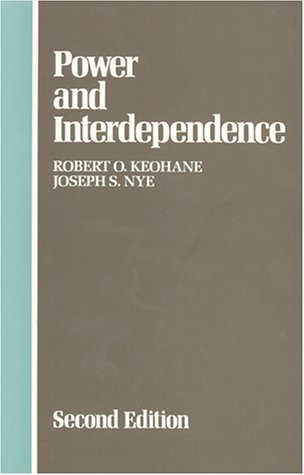
"Power and Interdependence," written by Robert O. Keohane and Joseph S. Nye, Jr., is a seminal text that has fundamentally influenced the study of international relations. The book explores the intricate web of global interactions and the shifting dynamics of power in an increasingly interconnected world. Here, I will provide a detailed review based on key themes and concepts from the book, incorporating the outlined content.
Interdependence in the Modern World
The authors begin by acknowledging that the world has become interdependent in economics, communications, and human aspirations. This interdependence is often referred to metaphorically as the creation of a "global village" and a "world without borders." Such descriptions highlight how advances in technology and globalization have shrunk the distances between nations, fostering closer ties and mutual dependencies.
However, Keohane and Nye caution against simplistic celebrations of this interdependence, a notion they refer to as "globaloney." They argue that interdependence is not merely an analytical concept but also a rhetorical device employed by publicists and statesmen. The real task is to analyze the politics of interdependence, not to celebrate it blindly.
National Security and Economic Relations
One of the critical discussions in the book revolves around national security symbolism and the realist mode of analysis. Traditionally, national security has been dominated by military concerns. However, as the descriptive accuracy of such views declined, so did their symbolic power. Keohane and Nye note that significant changes in economic relations among advanced industrialized countries often seemed insignificant in the traditional national security paradigm.
They argue that no nation or group of nations can gain by pushing beyond the limits that sustain world economic growth. The rhetoric of zero-sum and non-zero-sum games is employed to highlight that international relations are not merely a matter of one side's gain being another's loss.
Pure Dependence and Interdependence
The distinction between pure dependence and interdependence is essential. Power, they suggest, can be conceived in terms of control over outcomes and tolerable costs. In analyzing the politics of interdependence, the focus shifts to which actors can set the rules of the game. Sensitivity interdependence (how quickly and significantly changes in one country affect another) is often less critical than vulnerability interdependence (the relative costs of adjusting to changes).
Historical and Contemporary Examples
Keohane and Nye provide numerous historical and contemporary examples to illustrate their points. For instance, they reference Japan's use of military force in 1941 to address economic vulnerabilities and the United States' subtle threats during the 1975 oil crises. They also mention the superior position of Canadians in economic issues like oil and natural gas exports without fearing military retaliation from the United States.
In discussing various international policy areas including aid to less developed countries, environmental protection, and international trade the authors highlight the complexity of interdependence and the role of international organizations in managing these issues.
Distribution of Power and Regime Changes
The distribution of power in interstate systems is analyzed using analogies from economics, describing systems as unipolar, bipolar, multipolar, and dispersed. Keohane and Nye emphasize that regime changes in issue areas like international monetary policy and ocean governance have varied in their pace and impact. For example, significant changes in international monetary policy occurred in 1914, 1931, 1944, and 1971, while changes in ocean governance were more gradual but still significant.
The authors argue that politics does not stop at the waters’ edge, and intense relationships of mutual influence exist between countries where military force is irrelevant. They also address the increasing role of terrorism as a political weapon and the impact of socially mobilized populations and changing technology on global security dynamics.
Realism and Complex Interdependence
In contrasting realism with complex interdependence, Keohane and Nye highlight the limitations of realist thought, which traditionally overlooks economic interdependence and the multiplicity of channels through which international interactions occur. They argue that complex interdependence better captures the contemporary reality of international relations, characterized by multiple channels of contact and diverse issues that transcend traditional power politics.
The book also addresses the impact of communication and transportation technologies, such as jet aircraft and satellites, which have significantly reduced the physical and psychological distances between nations. This technological progress is part of a long-term historical trend that has reshaped the dynamics of international relations.
Conclusion
"Power and Interdependence" is a comprehensive and insightful analysis of the complexities of global interdependence and the shifting nature of power in international relations. Keohane and Nye's work remains highly relevant, offering valuable frameworks for understanding the politics of a world increasingly defined by interconnectedness and mutual dependencies. By challenging traditional realist paradigms and emphasizing the importance of economic and non-military issues, the book provides a nuanced perspective on the global village and the intricate interplay of power and interdependence.