Jump to ratings and reviews
Rate this book

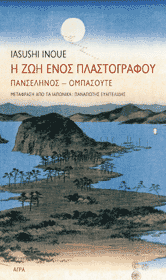
Η ζωή ενός πλαστογράφου/ Πανσέληνος/ Ομπάσουτε

Rate this book
«Όταν συνειδητοποίησα αυτήν την πραγματικότητα αισθάνθηκα για πρώτη φορά ότι αυτό που είχα δει στον Xόσεν δεν ήταν το ξετύλιγμα μιας ζωής που ήταν προορισμένη από τη γέννησή της να είναι μια πορεία σκοτεινή και θολή, αλλά η τραγωδία ενός μέτριου ανθρώπου, που είχε συνθλιβεί, σφυροκοπημένος από την επαφή με το βάρος της ιδιοφυΐας του ίδιου του του φίλου. H σκοτεινή μοιρολατρική αίσθηση που ένιωθα μέχρι εκείνη τη στιγμή για τη ζωή αυτού του πλαστογράφου σβήστηκε, και ο άνθρωπος που ήταν ο Xόσεν Xάρα αναδύθηκε μπροστά μου βαφτισμένος περισσότερο στα χρώματα μιας ανθρώπινης τραγωδίας.»

Τρία αφηγήματα. Τρεις τρόποι να κοιτάξει κανείς την ανθρωπότητα. Τρεις μελωδίες γλυκόπικρες. Με φόντο τη μοναξιά των ανθρώπων και τη βαρύτητα της μοίρας.
Υπάρχει πρώτα Η ζωή ενός πλαστογράφου, όπου ο Iνόουε προσεγγίζει την τέχνη μέσα απ' το αντίγραφο. Ένας δημοσιογράφος στον τομέα των καλών τεχνών προσλαμβάνεται από την οικογένεια ενός μεγάλου ζωγράφου, του Kεϊγκάκου Όνουκι, με σκοπό να γράψει τη βιογραφία του. Το εγχείρημα δεν φαίνεται να ενθουσιάζει τον δημοσιογράφο? το αναβάλλει, ως τη μέρα που ανακαλύπτει ένα προσωπικό ημερολόγιο. Εκεί ο ζωγράφος εκμυστηρεύεται ότι στη ζωή του είχε έναν και μοναδικό φίλο? ο φίλος αυτός έγινε πλαστογράφος κι έζησε επί σειρά ετών πουλώντας πλαστούς Kεϊγκάκου. Τότε, αντί να γράψει την επίσημη βιογραφία του μεγάλου καλλιτέχνη, ο δημοσιογράφος αρχίζει να ταξιδεύει με τη φαντασία του στην αποτυχημένη ζωή που μαντεύει πίσω απ' το όνομα του πλαστογράφου Xόσεν Xάρα. Κι αντί να συνεχίσει τις έρευνές του σχετικά με τον υπέρμετρα ταλαντούχο ζωγράφο, ερευνά τη ζωή του απατεώνα.
Προτού ταριχεύσει τη ζωή και το έργο του ζωγράφου, ο συγγραφέας ανατέμνει το λείψανο του παραχαράκτη Xόσεν Xάρα που θέλησε να βρει ένα χρώμα ανεξίτηλο, οραματίστηκε μια δέσμη πυροτεχνημάτων με χρώμα μπλε-μωβ μέσα στη μαύρη νύχτα και γύρεψε το χρώμα που κανείς ζωγράφος δεν κατέχει: το χρώμα της ομορφιάς που εξέπεσε. Γιατί ο πλαστογράφος, εκφυλισμένο και υποβιβασμένο alter ego μιας μεγαλοφυΐας, παραμένει παρ' όλα αυτά κυνηγός του απόλυτου.
Η μεταπολεμική Iαπωνία μπορεί να 'θελε ν' αποτίσει φόρο τιμής στις ένδοξες φυσιογνωμίες της, όπως εκείνη του Kεϊγκάκου, αλλά μάλλον στους ηττημένους κυνηγούς τού απόλυτου αναγνωρίζει το πρόσωπό της. Η ζωή ενός πλαστογράφου είναι η αυτοψία της μεταπολεμικής Iαπωνίας, η οποία αρνείται να αναλάβει τις ευθύνες της ήττας της και αποστρέφει με βδελυγμία το βλέμμα από το μπλε-μωβ χρυσάνθεμο που κατακλύζει τον ουρανό της.
Το ίδιο διαπιστώνουν και οι δύο άλλες νουβέλες. Η Πανσέληνος περιγράφει την εντυπωσιακή άνοδο και πτώση ενός ανθρώπου που πίστευε ότι ο κόσμος ακολουθούσε τη θέλησή του. Kι είναι ένα βράδυ με πανσέληνο όταν ο επιχειρηματίας, στο όριο φθοράς και αφθαρσίας, εκδραματίζει μια τελευταία χειρονομία νικητή. Το Oμπάσουτε επανέρχεται στον θρύλο για τις μικροκαμωμένες γριούλες που οι γιοι τους τις μεταφέρουν στην κορυφή του βουνού και τις εγκαταλείπουν εκεί. Οι γριούλες δεν έχουν άλλη καταφυγή από τη θέα της πανσελήνου που ανατέλλει.
Ο Iνόουε μας εισάγει στην Ιαπωνία των φεγγαριών, την Ιαπωνία των χαμένων, με τα βιολετιά πέταλα που ανθίζουν μέσα στη μαύρη νύχτα.

188 pages, Paperback

First published January 1, 1949

21 people are currently reading
871 people want to read

About the author

Yasushi Inoue

266 books217 followers
Yasushi Inoue (井上靖) was a Japanese writer whose range of genres included poetry, essays, short fiction, and novels.

Inoue is famous for his serious historical fiction of ancient Japan and the Asian continent, including Wind and Waves, Tun-huang, and Confucius, but his work also included semi-autobiographical novels and short fiction of great humor, pathos, and wisdom like Shirobamba and Asunaro Monogatari, which depicted the setting of the author's own life — Japan of the early to mid twentieth century — in revealing perspective.

1936 Chiba Kameo Prize --- Ruten,流転
1950 Akutagawa Prize --- Tōgyu,闘牛
1957 Ministry of Education Prize for Literature --- The Roof Tile of Tempyo,天平の甍
1959 Mainichi Press Prize --- Tun-huang,敦煌
1963 Yomiuri Prize --- Fūtō,風濤

(from Wikipedia)

Ratings & Reviews

What do you think?
Rate this book

Friends & Following

Create a free account to discover what your friends think of this book!

Community Reviews

5 stars
110 (16%)
4 stars
275 (40%)
3 stars
237 (34%)
2 stars
58 (8%)
1 star
6 (<1%)
Displaying 1 - 30 of 107 reviews
Profile Image for JimZ.
1,297 reviews759 followers
April 22, 2021
I can only give this collection of three stories 2.5 stars. On the inside cover this is said of the works: “…form the focus of Yasushi Inoue’s tenderly observed, elegantly distilled short stories…” I have a problem with the term “elegantly distilled”. The stories, to me, were tedious and dragged on and on, and so often I was asking “What is the point of this story…. where is it going?” or “What is the point of this sentence…this paragraph”? I would strongly recommend this work by Inoue, “The Hunting Gun”, but then I have a problem with endorsing other things I have read by him. The “The Hunting Gun” was so interesting and cleverly written, told from three different points of view. Anyway, this collection has 3 stories…the first is actually a novella. A man counterfeits a famous artist’s paintings. The counterfeiter and famous artist know one another from when they were young….I think at one point he thought he was as good as the artist, and maybe if he had not known the famous artist, he too would have become an artist in his own right, and not a counterfeiter, who gets lonely in his own age and makes fireworks in his house and blows up his hand in the process and that is certainly weird, isn’t it? 😐

“Reeds” is about a man who has memories of events when he was a child, and later on in life a lake he is at jogs back one of those memories. And “Mr. Goodall’s Gloves” is about an older woman who was once a geisha and shown little respect by the family of the man who had her as his geisha, and a Westerner one day gives her a pair of gloves because he pities her, and she keeps them with her, because she was grateful for his kindness.

I think I just do not have an appreciation for this kind of writing —he is revered in Japan for his writing, and so it’s probably just me… After all, I did like his earliest work.

“Life of a Counterfeiter” was originally published in 1951 as “Aru gisakka no shogai”; “Reeds” was originally published in 1956 as “Ashi”; and “Mr. Goodall’s Gloves” was originally published in 1953 as “Gudoru-shi no tebukuro”. Michael Emmerich selected and translated these stories for the Pushkin Press edition (2014). The latter two stories had not been translated into English prior to this work.

Reviews (these reviewers all liked this collection, so there ya go! 😊 )
https://www.nytimes.com/2015/04/05/bo....
https://michaeljanairo.com/2015/01/13...
https://tonysreadinglist.wordpress.co...
https://www.japantimes.co.jp/culture/...
Profile Image for George Ilsley.
Author 12 books314 followers
June 26, 2024
The longest story, "The Counterfeiter," might be considered a novella. A writer has been commissioned by the family of a famous artist, recently deceased after a long and successful career, to write his biography. This work progresses fitfully; even the end of the war is an obstacle.

Researching the artist's career, the writer discovers the presence of a counterfeiter, named Hana, who has been producing and selling fakes. In the art world, as in life: value is a matter of perception. The writer becomes more interested in the life of this counterfeiter, and ultimately, perhaps, glancing at the title of this novella, writes Hana's biography.

I was reminded of Andre Gide's The Counterfeiters, about "Faux-Monnayeurs" (the makers of counterfeit money), but in addition the theme of being "counterfeit" (a kind of falseness, a lesser imitation, or imposter) takes on multiple layers of meaning in the text. Here, too, Inoue moves in subtle directions, adding layers of resonance to the work. Perhaps it is the writer himself who is the fake, the pretender, who is not doing the job he was commissioned to perform.
>>

The first of the three I read was "Obasute" which is a family drama with a background of legends and stories of "Mount Obasute" or the practice of Obasute — taking one's elderly parents to be left on the mountain when they turn 70.

One of my favourite Japanese movies, "The Ballad of Narayama" (1983), is set in a struggling village in historical times, where Obasute was practiced. At the age of 70, one's relative was taken to the mountain. The movie is both earthy and ethereal; Inoue's short story is rooted more in standard matters of family drama—however, abandonment (and attachment) is a recurring theme. Besides the idea of parting from one's parents, the sister in the story has left her husband and children. The mythic and the commonplace thereby commingle.
>>

The third story, "The Full Moon" follows the ascension of a "Managing Director" to being President of a large company. Each year the company hosts a moon viewing party and this tradition continues. Inoue's theme here appears to be loyalty, but the firmness of loyalty paired with impermanence. Like the moon, power and influence waxes and wanes.
>>

Rounded up to 5 stars because each of these 3 stories is thought-provoking and quietly complicated.
Profile Image for Smiley .
776 reviews18 followers
November 14, 2018
I first read his novel The Samurai Banner of Furin Kazan (Tuttle, 2006) in 2013 [https://www.goodreads.com/review/show...] and later I read and found his short story Passage to Fudaraku in The Oxford Book of Japanese Short Stories (Oxford University Press, 2010) and novella The Hunting Gun (Tuttle, 1961) arguably readable since I rarely heard of him but he has written something stylish and humane that inspired me to look forward to reading his other works, e.g. The Bullfight (1950). This made me wondered why any of his works was not selected and included in Donald Keene's Modern Japanese Literature: From 1868 to Present Day (Grove Press, 1994). However, reading and enjoying this three-story book finely translated by Michael Emmerich made me, again, to rethink on his literary stature since he was so outstandingly creative and recognized that he won five prizes as well as his wide readership as we can see various novel and short story titles in his biography (https://en.wikipedia.org/wiki/Yasushi...), we simply can't help doubting if his fame has been honorably justified.

Life of a Counterfeiter is the first story in this copy; the other two being Reeds and Mr. Goodall's Gloves. Seemingly revealed from the titles, each one has been meant to portray human life in different contexts and hardships as seen in contemporary Japan sometime before and within the narrator's lifetime. Saying something brief and moral related to some key characters from each story, I think, should be inspiringly informative in some sense to posterity.

As for the first one, it deals with a counterfeiter, a fraud, named Hara Hosen whose painting expertise is so excellent that he can deceive most viewers of famously outstanding paintings by eminent artists as the genuine ones. In the end, the narrator traces and finds his latest whereabouts and content means of living as a notable maker of fireworks. Whereas the second one deals with a young child (baby boy) with his dimly flashback-like reminiscence as recalled by the innocent narrator himself, in another episode and context, probably as a toddler in a boat who vaguely recalls seeing his aunt and her mate do something seemingly romantic but curiously inexplicable on the canal bank with the green reeds as the lush background.

The third story Mr. Goodall's Gloves nostalgically traces back with the narrator's fond memories of his Grandma Kano, great-grandfather's mistress, who has raised him as a young boy with tender loving care. Before Meiji 22 (1887), she once attended a grand event with Matsumoto Jun and the boy's great-grandfather named Kiyoshi; however, she was unable to enter and had to wait outside in the snow. Mr. Goodall happened to pass by and out of pity lent her two large white gloves. For some reason, the gloves have still been kept in Grandma Kano's house and found after Mr. Goodall's death in 1889. They remind her of various stories kindly told to the boy on such close, intimate and friendly relationships in that his great-grandfather respected Matsumoto Jun as his mentor.

In conclusion, this book is highly recommended since the author has revealed a variety of human characters out of his deep understanding on Japanese people and culture, that is, we can sense something inexplicably unique, impressive and inspiring. We can't help admiring his writing expertise that allows us to read and enjoy his novels and short stories; many still being not translated into English, French, German, etc. for his readers worldwide.
Profile Image for Sharon Barrow Wilfong.
1,135 reviews3,969 followers
January 23, 2019
I really believe that Yasushi Inoue has become one of my favorite writers. This small book contains a novella, Life of a Counterfeiter, and two short stories, Reeds and Mr. Goodall's Gloves.

Each story is told in a calm thoughtful and also compassionate way. Inoue based his stories on real life and his deep interest in other people shows as he describes, in the first story, his journey to discover who the mysterious Hosen is, a counterfeiter who sold his own paintings under the name of a famous Japanese artist.

In the second story he hearkens back to fragments of a memory of an aunt who lived with his family when he was very young. She apparently had "compromised" herself and was sent to live in Inoue's small village with his family until she married the father. This aunt is written about in his book Shirobamba.

The final story begins with Inoue walking through a Western Cemetery and coming across the gravestone of a man with the name of someone who helped his grandmother years ago. This granny, not really his grandmother but the mistress of his great- grandfather, is another character in Shirobamba. I'm glad I read Shirobamba first, a story about Inoue's childhood in pre-WWI Japan, before this book, because it enabled me to better appreciate the characters.

None of these stories are adventurous, but each one contains a quiet memory, perhaps not exciting, but profound to the author and, thanks to his poetic writing, becomes as profound and beautiful to us as a biographical haiku.
Profile Image for Sam Quixote.
4,801 reviews13.4k followers
January 10, 2015
This book collects three short stories by the renowned Japanese novelist Yasushi Inoue: Life of a Counterfeiter, where a man commissioned to write a biography of a famous artist finds himself instead drawn to the artist’s friend and forger’s life; Reeds, where a journalist explores memories of his childhood, in particular why his aunt was ostracized; Mr Goodall’s Gloves, where another journalist sent to report on Nagasaki after the atomic bomb explosion becomes side-tracked with memories of his grandmother after seeing the grave of Mr Goodall.

The title story is definitely the best but, seeing how all three stories were very boring, that’s not saying much. We learn about the counterfeiter who made a living travelling from one town to another, selling his “friend’s paintings”, before giving up forging art to make fireworks until his death. I suppose the story is meant to underline the fine line between what is and isn’t considered art – the counterfeiter clearly had enormous skill but he chose poorly in using it to copy another’s work instead of creating his own. As a result, he’s not remembered by many while the artist is celebrated nationally.

That said, the biographer mentions that the counterfeiter’s paintings are still treasured by the people in the country who bought them and it doesn’t really matter to them whether they’re true originals or not. And the fact that the biographer became more interested in the counterfeiter than the artist he was supposed to be writing about is perhaps an indication that the counterfeiter’s life wasn’t a “waste”.

Reeds and Mr Goodall’s Gloves both look at Japanese social mores with regards women (which closely resemble Western society’s at the same time, circa first half 20th century). The journalist’s “aunt” didn’t get married but still had relationships with men and as such became a social pariah. The journalist’s grandmother was the mistress of a Westerner and became ostracized as a result. Ok - and?

This was my first (and probably last) encounter with Inoue’s work and, while they’re not without literary merit, I can’t say I enjoyed reading them in the least. Inoue’s style is rambling for the most part, sashaying from one subject to another, which I felt was irritating, especially as his touch is so light (like many “literary” writers) that his stories leave little impression on the reader. Apparently Inoue is considered to be one of the great writers of Japan though I’m not sure why.
Profile Image for Katie Lumsden.
Author 3 books3,771 followers
June 5, 2016
I really enjoyed these three short stories; Inoue has a lovely calm writing style, and his stories always have a fascinating premise. He has a great way of capturing characters, and somehow manages to create a brilliant sense of characters that are out of the foreground as well - not just our narrators but the people in the world and memory of the narrators. A great read.
Profile Image for Dawne L.
155 reviews11 followers
January 13, 2019
Melancholy and bittersweet short stories that really touch on how fleeting life and memories are. I like the way some moments are described in great detail while others are simply passed over; it very much reflects how memories expand or shrink in our minds as life rolls on.
Profile Image for Ends of the Word.
543 reviews145 followers
April 22, 2021
This volume, issued in the attractive "Pushkin Collection" series, includes three stories by Yasushi Inoue (1907-1991), one of the leading Japanese authors of the 20th Century. Two of the pieces - "Reeds" and "Mr Goodall's Gloves" appear in English for the first time in a translation by Michael Emmerich, who also provides a new translation of "Life of a Counterfeiter".

"Life of a Counterfeiter" is the longest - and by far the most compelling - of the featured tales. Its narrator is an Osaka arts journalist who is commissioned to write the biography of the artist Onuki Keigaku. The task turns out to be more difficult than envisaged and years pass without the narrator concluding his job. During his research he comes across the shadowy figure of Hara Hosen, a one-time friend of Keigaku who falls out with him after Hosen starts forging Keigaku's works. Ironically, it is Hosen who takes hold of the narrator's imagination, displacing Keigaku who should be the subject of the biography. Through a mixture of dogged research and serendipitous discoveries, the narrator starts piecing together the story of Hara Hosen and his life's obsessions - art for a start but, later, also fireworks manufacturing and the quest for an elusive sort of deep-violet 'chrysantemum' firework.

The story is conceptually interesting and well-executed. The contrast between the "authentic" art and forgeries prompts ruminations about fact and fiction, memory and authorship. As the narrator teases out more details about Hosen, our perception starts changing - from a roguish, despicable figure Hosen almost takes on the stature of a tragic anti-hero. "Life of a Counterfeiter" is also likely the first story I ever read which made me feel some of the excitement which leads fireworks manufacturers to risk life and limb in pursuit of their dreams.

The other two pieces included in this collection have similar themes but are more autobiographical in nature. This time it is the author himself who sifts through half-forgotten childhood memories, trying to understand and, possibly, retain a grip, on a past which is slipping out of reach. Unfortunately, however, I did not warm to these two vignettes. Inoue's approach here seems rambling and erratic and whilst this was also partly the case with "Life of a Counterfeiter", there was an overarching thrust to that story which I thought missing in "Reeds" and "Mr Goodall's Gloves". I found myself thinking - rather unreasonably and unfairly, I admit - that there could have been a good reason why they had remained untranslated to date...
Profile Image for Leggendolibri.
187 reviews49 followers
February 4, 2020
È la storia di un eroe e di un antieroe dove, ad un certo punto il secondo prende il sopravvento sul primo. Credo che questo racconto di 70 pagine appena si possa riassumere nella frase: "... Ho cominciato a vedere in Honsen, piuttosto che l'evoluzione torbida e cupa di un destino che portava in sé dalla nascita, la tragedia di un uomo mediocre che si era logorato a contatto con un genio...".
Il sunto di tutta questa bella e delicata storia è tutto qui: quando l'eroe crea l'antieroe. Bello e delicato, e libro davvero amato
Profile Image for Artù.
225 reviews7 followers
June 5, 2022
Vengo da un periodo in cui ho letto pricipalmente saggi. Cercavo un libro di narrativa semplice e scritto in modo piacevole. Direi che questo testo non ha deluso le mie aspettive, in più il titolo era accattivante.
Il libro contiene tre racconti ambientati nel giappone del dopoguerra che parlano della vita di un artista, di una leggenda popolare giapponese e dell'ascesa di un direttore di azienda.
Profile Image for Sue.
1,438 reviews651 followers
January 19, 2015
In this collection of three short stories, Yasushi Inoue has presented a subdued world of pre- and post-World War II Japan through the lives of fairly ordinary people--well perhaps ordinary is overstating a bit. Using writers (biographers, journalists), he investigates the details of individual lives in small towns far from the center of city life.

In the title story, a journalist has been commissioned to write a biography for the anniversary of a famous artist's death. He has already missed the designated date and as the 13th anniversary approaches, he knows he will miss that deadline also. But why? Because he has become sidetracked in his search for knowledge of this great man's life and found himself caught up in the life of another man, connected yet not intended to be part of the book. A man he finds very interesting. His investigation of this man is triggered by memories of everyone he talks to, works of art hanging on walls.

The other two stories also involve trips away from the city, travel to the countryside, visual memories triggering thoughts of people long gone from the narrators' lives but somehow begging to be remembered.

While initially my response to the stories was one of relative interest without enthusiasm, the 2nd and 3rd stories brought home the multi-layered themes more completely and more lyrically for me than the did "Life of a Counterfeiter". Ultimately, I found the stories to be about memory, relationships, people, places, landscapes. Simple but more layered than I originally realized.

From "Reeds":


As I read this article, a scene rose up in my mind's
eye of a father and a boy sitting together in a room in
a temple lit by soft winter sunlight, each holding a
fan of cards, concentrating on a game of picture-
matching


Was this memory real? or the place? or the game? The game itself leads to some fascinating writing.


they had shared, but the fact that the boy had only
three cards made this tricky....
In N.'s case, an extraordinary disruption of his life
had stolen his memory, leaving him only those three
cards, but to some extent we are all in this position:
each of us holds one or two cards that have been in
our hands for years, who knows why, while the cards
that should be paired with them have disappeared,
instilling in us the desire to try and learn, through
our own games of picture-matching, which particular
section of that larger design they might make up.


The final story, Mr Goodall's Gloves, also works with memory and a very strong sense of place and visual recall...questions of whether this vision is accurate followed by attempts to verify the early childhood memory.

These stories were all originally published shortly after World War II.

I do recommend this book for those who enjoy short stories of subtlety and also the element of Japanese customs and codes of behavior.


A copy of this book was provided by the publisher through NetGalley for the purpose of an honest review.
Profile Image for Nafiza.
Author 8 books1,280 followers
July 21, 2015
This was my first Yasushi Inoue title but it will definitely not be my last. Life of a Counterfeiter is a collection of three short stories including the titular story, “Reeds,” and “Mr. Goodall’s Gloves.” All three stories are excellent and go a long way in establishing the kind of storyteller Mr. Inoue is. There is a certain stream of consciousness-esque element to these stories that I really liked. In Life of a Counterfeiter the main character is supposed to be a biographer of a famous painter Onuki Keigaku but while researching Keigaku, the narrator comes across Keigaku’s former friend Hara Hosen who he discovers is a counterfeiter of Keigaku’s works. The narrator is unwillingly fascinated by this counterfeiter and exerts considerable effort to find out more about him, driven perhaps by more than just curiousity about this counterfeiter. He feels an empathy for Hosen, the counterfeiter, inferring that Hosen’s brush with Keigaku’s genius may be what propelled the man down such a dark lane and then to his tragic end. The story is told in anecdotal bursts and the narrator relays his findings while he goes around living his life and surviving the war that Japan is in the middle of losing at the time. I could well imagine myself seated in a cafe or some such place listening to the story. The tone is welcoming, a bit self-deprecatory, and entirely wonderful. The other two stories continue much in the same vein.

In “Reeds” the same narrator talks about fragments of memories a person has that is usually matched with the fragment of memory someone else has and illustrates his point by elaborating in some detail his memories about his grandmother, and a couple he remembers from when he was very young but whom he can’t identify. “Mr. Goodall’s Gloves” concerns the same narrator’s grandmother, who was a mistress of his grandfather and not his true wife, and her interaction with a foreigner, Mr. Goodall, who gave her his gloves when she was left outside in the cold to wait for his grandfather. The stories concern the human condition and are characterized by the gentleness that I have come to associate with Japanese literature. Michael Emmerich’s translation is superlative and there is never an instance where I felt that anything was lost in translation.

If you enjoy Murakami, you will enjoy Yasushi Inoue. Though Inoue’s work does not have elements of magical realism that Murakami’s is famous for, it has the same vibrancy and earnestness that make Murakami’s work so fantastic. Strongly recommended.
Profile Image for Rosalind Minett.
Author 25 books52 followers
October 30, 2020
I'd recommend this book - particularly in these Covid times - for anyone needing a very gently thought-provoking read. What is it that draws us to read on without trauma, car chase, murder, shocking revelation? Aren't we programmed to expect this every time we switch on a drama or pick up a novel?
The quiet voice of the narrator following the route of one painting after another through different stories brings us to another time, other preoccupations.
Yasushi Inoue was a Japanese writer of high repute in his country, best known for his novels Sword for Hire (1952) and Samurai Banners (1969) These short stories are more personal and carry the light touch of homely truth. Why shouldn't a painting, which could have been famous and seen in a prestigious gallery, hang on the unpainted wall of a simple cottage in an unvisited rural outpost? Does a painting give the same pleasure if the current owner is oblivious to the fact that it was created by someone different than what is generally believed?
This is a small volume, beautifully presented by Pushkin. It will fit in a pocket or handbag and absorb you as the world rushes around you.
Profile Image for Cleopatra.
30 reviews25 followers
October 25, 2013
Ιαπωνική λογοτεχνία στα καλύτερά της, οι ιστορίες είναι αρκετά αργές, εσωτερικές και γεμάτες αντικρουόμενα συναισθήματα και σκέψεις. Η πλοκή στους Ιάπωνες παίζει δευτερεύοντα ρόλο (ιδίως στους κλασικούς) ωστόσο προσωπικά με κεντρίζει η εσωτερικότητα της γραφής τους, η ακινησία και η διακριτικότητά τους, ακόμα κι αν περιγράφουν τη φαυλότητα της ανθρώπινης φύσης.
Profile Image for Leland Cacayan.
43 reviews
July 11, 2025
As I'm prone to do, I changed my mind on how I feel about this book. I felt initially that the writing was uninteresting; the prose felt like that of a journalistic account, and the plots of the stories seemed to meander around pointlessly like a blind mouse.

However, after the last story, I realized that the meandering was purposeful, and the writing, introspective and nostalgic, because the themes of all the stories, Life of a Counterfeiter, Reeds, and Mr. Goodall's Gloves, center on memory and the unretrievable past. The past is gone, Inoue asserts, and the only vessel we have to go back is memory, and even then, memory is only a partial measure of what happened.

And so while I found this the least interesting of the stuff that I read by Inoue, it was still pretty good. 3 stars.
Profile Image for Demetra Stavridou.
112 reviews5 followers
August 7, 2020
Πέντε αστεράκια -- εντάξει, μπορεί να είναι 4,5 αλλά λατρεύω την ιαπωνική λογοτεχνία κι έτσι βάζω πάντα ένα τσικ παραπάνω. Αδυναμίες είναι αυτές, τι να κάνουμε....

Ακολουθούν αποσπάσματα από μία παρουσίαση που είχα κάνει παλιότερα εδώ
https://www.kefalonitikanea.gr/2017/0...

[...]

Θα ξεκινήσω από το τελευταίο αφήγημα, το «Ομπασούτε» που στρέφεται γύρω από έναν, κατά πάσα πιθανότητα βουδιστικό, θρύλο σύμφωνα με τον οποίο, οι μεγάλοι γιοι της οικογένειας ήταν επιφορτισμένοι με το θλιβερό καθήκον να οδηγήσουν τις γριές μητέρες στους στο συγκεκριμένο βουνό και να τις εγκαταλείψουν εκεί, όταν αυτές είναι πια υπερβολικά ηλικιωμένες ή ανήμπορες ώστε να προσφέρουν οτιδήποτε στην οικογένεια. Επιπλέον, το όρος Ομπασούτε είναι διάσημο για τη φεγγαράδα του και όταν η μητέρα του αφηγητή αναφέρει πως «αν η συνήθεια της εγκατάλειψης των γέρων στο βουνό ίσχυε ακόμα και σήμερα, εγώ θα πήγαινα πολύ ευχαρίστως», όχι μόνο για να απολαύσει, λίγο πριν τον θάνατό της, το αναπάντεχο δώρο της ενατένισης της σελήνης αλλά και για να δηλώσει την παραίτηση και την κούρασή της από τη ζωή, ο αφηγητής αποφασίζει να ξορκίσει τους παιδικούς του εφιάλτες, ξεκινώντας ένα ταξίδι με προορισμό το θρυλικό βουνό.

Μια γλυκόπικρη ιστορία που πέρα από το «εξωτικό» της θέμα αφορά ουσιαστικά στην κατάσταση που βίωναν οι άνθρωποι στη μεταπολεμική Ιαπωνία: απογοήτευση, παραίτηση, εγκατάλειψη και ντροπή σε μία χώρα όπου όλες οι πολιτικές, κοινωνικές και ηθικές δομές της είχαν ηττηθεί, ταπεινωθεί ή καταρρεύσει. Αυτό το κλίμα γενικεύεται όταν κατά τη διάρκεια της αφήγησης αποκαλύπτεται ότι δεν είναι μόνο η μητέρα του αφηγητή που επιζητά την απομόνωση: όλα τα μέλη της οικογένειας, με τον έναν ή τον άλλον τρόπο, επιθυμούν να φύγουν, να χαθούν, να εξαφανιστούν κάπου μακριά προκειμένου να μην αναγκαστούν να διαχειριστούν την απογοήτευσή τους. Διαβάζοντας αυτήν την ιστορία, δεν μπόρεσα να μην σκεφτώ τη σύγχρονη τάση του «χικικομόρι», ένα φαινόμενο που αφορά πάνω από ένα εκατομμύριο Ιάπωνες που επιλέγουν την ακραία κοινωνική απομόνωση ως τρόπο ζωής μπροστά στα αδιέξοδα που δημιουργεί η υιοθέτηση του λεγόμενου «δυτικού» τρόπου ζωής και οι εξαντλητικές εργασιακές απαιτήσεις.

Στον ίδιο καμβά της μεταπολεμικής Ιαπωνίας κινείται και η «Πανσέληνος», η δεύτερη ιστορία του βιβλίου. Σε αυτήν παρακολουθούμε την άνοδο και την πτώση ενός μεγαλοστελέχους επιχείρησης σε μία εποχή που η ιαπωνική κοινωνία υιοθετεί εξ’ ολοκλήρου τα αμερικανικά οικονομικά μοντέλα και με σκυμμένο το κεφάλι εργάζεται σκληρά για να ξαναχτίσει την οικονομία της. Η απληστία, η αλαζονεία και ο καιροσκοπισμός νοούνται ως απαραίτητα συστατικά στο χτίσιμο καριέρας όμως η ζωή είναι ένας δρόμος παράδοξος που δεν προσφέρει εγγυήσεις, ακόμα κι όταν παίζεις πιστά το παιχνίδι που σου ζητούν.

Κι έρχομαι στην ιστορία που δίνει τον τίτλο της στο βιβλίο: «Η ζωή ενός πλαστογράφου». Ο αφηγητής εδώ είναι ένας δημοσιογράφος που προσλαμβάνεται για να γράψει τη βιογραφία του εμβληματικού Ιάπωνα ζωγράφου Κεϊγκάκου. Πρόκειται για μία βαρετή εργασία, μέχρι που ο δημοσιογράφος ανακαλύπτει το ημερολόγιο του ζωγράφου. Εκεί διαβάζει για την ύπαρξη του Χόσεν Χάρα, ενός παλιού φίλου του Κεϊγκάκου, ο οποίος έζησε το μεγαλύτερο μέρος της ζωής του ως πλαστογράφος του φίλου του. Η προσωπικότητα του Χόσεν Χάρα ελκύει αμέσως το ενδιαφέρον του δημοσιογράφου, ο οποίος αποφασίζει να εξερευνήσει τη δική του ζωή. Έτσι αρχίζει να ξετυλίγεται λογοτεχνικά η διαρκής σύγκρουση ανάμεσα σε δύο άντρες που ο ένας φαίνεται να είναι το άκρο αντίθετο του άλλου. Ο Κεϊγκάκου, τα έχει όλα: επιτυχία, αναγνωρισιμότητα, πλούτο. Ο Χάρα, ακριβώς τα αντίθετα: αποτυχημένος, κυνηγημένος, στη σκιά του φίλου του αλλά αποφασισμένος να καταδείξει ότι είναι περισσότερο ταλαντούχος από αυτόν. Παρασυρμένος από το κυνήγι της τελειότητας, γεμίζει την Ιαπωνία με πλαστογραφημένους πίνακες του Κεϊγκάκου εξαπατώντας ειδικούς και μη, και αποδεικνύοντας το ταλέντο του έστω και ανώνυμα.

Το τέλος της ζωής του όμως, βρίσκει τον Χόσεν Χάρα να έχει επιστρέψει στο χωριό του. Έχει πια εγκαταλείψει τη ζωγραφική και έχει επινοήσει μία καινούρια ταυτότητα για τον εαυτό του: δεν είναι πια ο παραχαράκτης αλλά ο κατασκευαστής πυροτεχνημάτων. Εκεί, στο μικρό του εργαστήρι, εξαντλεί την τελειομανία του επιχειρώντας να κατασκευάσει ένα πυροτέχνημα απόλυτης ομορφιάς, χρώματος μπλε- μωβ μέσα στη μαύρη νύχτα. Μόνο που, στις ατέλειωτες δοκιμές του έχει πάντα στραμμένη την πλάτη προς τον ουρανό. Σύμφωνα με το εξαιρετικό επίμετρο που περιέχεται στο βιβλίο, αυτή ακριβώς η στάση του ήρωα ενσαρκώνει την απροθυμία της Ιαπωνίας να «αναλάβει τις ευθύνες της ήττας της και αποστρέφει με βδελυγμία το βλέμμα από το μπλε – μωβ χρυσάνθεμο που κατακλύζει τον ουρανό της».

Ο Γιασούσι Ινόουε, όπως και οι περισσότεροι Ιάπωνες συγγραφείς της γενιάς του, δεν ενδιαφέρεται για τη δράση, την εξέλιξη, την πλοκή. Η γραφή του εξερευνά περισσότερο τις εσωτερικές ατραπούς και τη διαπλοκή τους στον ψυχισμό των ηρώων του δίνοντάς μας εξαιρετικά δείγματα μιας γνήσιας, χαμηλόφωνης και μάλλον μελαγχολικής λογοτεχνίας, στην οποία το πιο λαμπερό κομμάτι αναδεικνύεται από την αντίθεσή του με το σκότος.

[...]
Profile Image for Laurel.
1,249 reviews7 followers
January 7, 2023
Life of a Counterfeiter presents three different character studies that captures a particular sense of nostalgia perfectly. All three stories are quietly meandering, the way memories ideally should be.
Profile Image for Tonymess.
486 reviews47 followers
December 20, 2014
My third Yasushi Inoue instalment and the latest release from Pushkin Press, the three short stories presented under the title story “Life of a Counterfeiter” – it is available to buy online although the release date says 15 March 2015!

As per “Bullfight” and “The Hunting Gun” this is again a beautifully presented book, Typeset in Monotype Baskerville, litho-printed on Munken Premium White Paper and notch-bound by the independently owned printer TJ International in Padstow. The covers, with French flaps, are printed on Colorplan Pristine White Paper and both the paper and the cover board are acid-free and Forest Stewardship Council (FSC) certified. Beats the iPad every time.

This volume is made up of three short stories, and we open with the title story “Life of a Counterfeiter”. We have another newspaper reporter (as we saw in “Bullfight”) and our narrator this time, is an Osaka arts reporter who has been commissioned to write the biography of artist Onuki Keigaku. We join him thirteen years into his seven year commission and he still has nothing more than a half formed (or is it empty?) timeline. His research though leads him to the forger of Keigaku’s work, Hara Hosen:

For my full review go to http://messybooker.blogspot.com
Profile Image for Jackson Cyril.
836 reviews92 followers
September 25, 2017
A biographer goes out in search for materials for his book and comes across another personage-- the guy who made a living selling forgeries of the paintings of the artist whose biography the narrator is writing. He begins by disliking this fraud and then comes to a strange sort of appreciation for the old fellow.
Profile Image for Nadia Costa.
329 reviews12 followers
November 18, 2019
2.5
Not a prose style that taps into my reading tastes despite its subtlety and elegance.
There is too much contemplation, not only in Inoues writing style but mostly in all his characters who carry their unsatisfied lives with a total resignation to their fate. There is definitely a niche of Japanese literature that does not match with me...am probably way too much of an individualist.
Profile Image for Guerino.
133 reviews1 follower
January 19, 2021
Che delicatezza, Inoue.

Tre storie molto diverse in questa raccolta, tutte estremamente delicate. A tratti anticlimatici, I racconti di Inoue esplodono in maniera diversa. Non è la sequenza degli eventi a colpire, ma il senso di malinconia che pervade ciascuno di essi.

Che il protagonista sia un falsario che si perde nell’ombra proiettata dalle luci della fama del suo migliore amico artista, la montagna di un racconto per bambini, l’Obasuteyama, luogo in cui, secondo la leggenda, le ultrasettantenni della famiglia venivano abbandonate o un colletto bianco che ha conosciuto il successo, ma che ormai trova conforto solamente in un ricordo giovanile in realtà mai accaduto, Inoue è sempre narratore, ma mai giudice. Le sue riflessioni sono puntuali, ma non prevaricanti. Non si ha mai la sensazione di leggere una favola con una morale più o meno spicciola o di essere al cospetto di una fonte di saggezza da cui abbeverarsi. Il finale dei racconti arriva senza preavviso, ma la sensazione non è quella di una storia monca, bensì quella di aver osservato un quadro d’autore. Ogni frase (pennellata) è pensata per contribuire alla sensazione generale che si avrà dalla fruizione dell’opera.

Consigliatissimo.
Profile Image for Adriana Chen.
55 reviews8 followers
March 21, 2022
Life of a Counterfeiter
The narrator was a writer commissioned to finish a biography on the famous deceased painter, Keigaku, and after procrastinating for ten years, he ends up telling us this story about a Keigaku counterfeiter named Hōsen. The narrator never meets Hōsen, but tells the story through episodes in his life where he had come in contact with the forgeries or the history of this obscure man. I couldn’t understand it at first, for it is a storytelling style that I am not used to. But the intrigue the narrator had for this man only increased my desire to know more about him, creating the perfect atmosphere of mystery that made the book hard to put down.

The other two stores are told in variations of this form. “Reeds” was an account of the narrator’s own fragment of a memory, and of him trying to put together the pieces he found from himself and other people. “Mr. Goodall’s Gloves” I especially liked, for the narrator depicted his grandmother’s life and personality in a way that she flew up from the page even though she had long passed away before the story itself.

All three of the stories speak of memory, the various ties people make that continue on after their death. They made me think of eternity, of relationships however trivial, and of what matters. Inoue has an exquisite way of slowly seeping into your mind, for we only get a half understanding of those delivered to us through the veil of memory, yet they are the ones that remain. And maybe the half understanding is what makes it so real and so penetrating.

“Each of us holds one or two cards that have been in our hands for years, who knows why, while the cards that should be paired with them have disappeared”(88).


Profile Image for Lynn.
223 reviews33 followers
April 29, 2023
The title story of this book is a novella, and it is followed by two short stories. Inoue will have an emotional connection to the thread he weaves through his stories. Usually he speaks in the first person as an observer of other people's lives. He will meander through several seemingly unrelated events and memories, but in the end they all connect as they strike the same emotional note. One thing that makes this meandering journey so fascinating is that for him the present is post- WW2 Japan. He does things like visit a cemetery in Nagasaki that was partially damaged by the bomb. While there he reminisces about his adopted grandmother who raised him for about seven years. She was a geisha who was the "second wife" of his great grandfather. These little tid bits of history are merely the prelude for the actual short story.

Michael Emmerich is the translator. I have now read three books by the Emmerich/Inoue team and think they are all very good.
Profile Image for hans.
1,157 reviews152 followers
May 11, 2025
Three tales including a melancholic titular novella centered on the theme of artistic legacy, of loss, memory and nostalgia with a plotline that set during the pre and post-war. Loved Inoue’s writing style— bit dramatic and minimalist with a moody emotional weight (in a good way) and offered a reflective and profound perspective towards human relations.

A well written for Life Of A Counterfeiter for its searching on identity plot that followed a journalist cum biographer who is doing a research about a famous painter. He came across a counterfeiter who once connected to the painter and was intrigued to dig into this mysterious man’s life story. A premise that explored imitation vs authenticity, having a lifestyle driven and bit poignant. Both Reeds and Mr. Goodall’s Gloves carried the same central themes but more focusing on familial and grief exploration. Loved the characterization for both stories and how the narrators sentimentally exploring their past; of reminiscing on the loss and remembering the fragments they left.
Profile Image for Cicì.
6 reviews1 follower
December 29, 2024
All’apparenza sembrano tre racconti scollegati tra di loro, ma penso che il filo conduttore sia la mediocrità che accomuna i tre protagonisti nel corso delle proprie vite e che sembra essere connotato da una sorta di destino o predestinazione. Mi ha dato molto a cui pensare, inoltre è una lettura che si finisce in mezza giornata. Tutto sommato consigliato.
Profile Image for Jim.
2,414 reviews798 followers
April 18, 2016
I had read the main story, "Life of a Counterfeiter," in another edition and remember loving it. A man is commissioned to write the biography of a beloved painter named Onuki Keigaku, but over the year gets sidetracked by the life of his onetime friend, Hara Hosen, who was caught counterfeiting Onuki's work. The narrator follows the threads that remain to Hara's life, and discovers that he ended his life making illegal fireworks. He blew off three of his fingers in an accident with gunpowder, and his wife separated from him around this time. The narrator concludes:
I have set down what I know of the counterfeiter Hara Hosen. Nothing but fragmentary stories heard from others. And yet, somewhere along the way, as I strung these pieces together, I had come to hold in my mind an image of this counterfeiter's sixty-seven-year life as a sort of flow -- a dark and frigid stream. There was no rhyme or rhythm to that painful surging, the dark and turbid motion of some essence the man known as Hara Hosen carried within him from the moment of his birth that rendered it impossible for him to live otherwise than he did. Painful, yes, but the pain was matched by the peculiar sadness of our karma, so that whenever I found myself reflecting upon the sorrows of human life I would remember that thin, swarthy man with his weak and gloomy air -- this is how I imagined Hara Hosen now -- softly drawing his counterfeiter's brush across a sheet of paper, hiding what he was doing from his wife, or slipping out so she wouldn't find him twisting gunpowder up in pieces of paper and setting them on fire.
This litle collection by the Pushkin Press of three of Yasushi Inoue's stories concentrate on the author's great interlocking themes of memory, history, and nostalgia. The other stories -- "Reeds" and "Mr. Goodall's Gloves" -- are both searches in the narrator's past of names and events which are only partially remembered.

Life of a Counterfeiter is a good place to start reading Inoue. But remember, other great works are also worth trying: Shirobamba, Lou-Lan, and The Samurai Banner of Furin Kazan. There is a particular sympathetic sadness, a mono no aware, of reading Inoue's work. It is not an unpleasant feeling.
Profile Image for Lisa.
3,784 reviews491 followers
February 1, 2016
Late last year, I found myself unable to resist the tantalising reviews at Winston’s Dad and JacquiWine’s Journal, and so I lashed out and bought myself a subscription to Pushkin Press. The first title arrived today…

It’s a selection of three short stories by Japanese author Yasushi Inoue (1907-1991) but the story that gives the selection its name is at 82 pages by far the longest. Life of a Counterfeiter is ostensibly about a journalist’s failure to fulfil a commission to write a biography of a famous painter called Keigaku, but it becomes a quest to find out more about Keigaku’s forger, a man called Hösen. The lives of both men are difficult to trace, but the narrator finds the forger a more captivating subject. Through his research he learns that Hösen was very clever at avoiding detection, and that he had wasted his genuine talent as an artist even though he probably made more money selling famous poor quality fakes than he would have selling his own good quality artworks. Hösen was also a keen hobbyist in the art of making fireworks, and yearned to create one that is a perfect semblance of a bell flower.

The prose is spare and simple, and the narrator’s voice is self-aware and introspective. Occasionally he is quite hard on himself.

To read the rest of my review please visit http://anzlitlovers.com/2016/02/01/li...
Profile Image for Christy Baker.
410 reviews17 followers
May 17, 2019
I had randomly picked up this small volume from a library shelf and discovered the sheer delight that is Yasushi Inoue's storytelling. Each of the three tales are very loosely connected by the narrator's voice. The titular tale had me empathizing with the narrator for taking on a project that then gets sidetracked by his interest in a side story and becomes his main focus of interest. The subtle strokes of character build up felt like a Japanese print in their careful choosing, attending to what was left out as much as what has been printed. The ability to draw interest to a character that we only meet through others memories and through glimpses of paintings, never directly, added to the feeling of secrecy and quiet slipping past notice of the counterfeiter.
the other two tales explored gender, time, memories in an interesting manner through objects and place and what gets passed down and told to another or omitted. Each was as well crafted as the first story. All in all, a lovely collection to pass an evening with.

One additional note on this particular edition: I adored the care and attention given to the printing/publishing that Pushkin Press has shown. The thick, cream paper, choice of Baskerville font, small size for holding in one's hand and nice cardstock, french fold flap covers gave me an extra reason to love the act of reading and not just the consumption of the story. Physically holding this book was an extra pleasure on its own.
Profile Image for Ocean G.
Author 11 books62 followers
November 26, 2020
"Each of us holds one or two cards that have been in our hands for years, who knows why, while the cards that should be paired with them have disappeared."

I read one other book by this author (The Samurai Banner of Furin Kazan), but it was very different in style, while these three short stories all have a very similar feel. I really enjoyed this short collection a lot. A book about reminiscences and a study in characters.

Below my notes:
1. An interesting story. A man is supposed to be researching the life of a famous painter in order to write his biography, but he starts hearing about a man who forged his paintings, and starts to learn more and more about this man who probably doesn't deserve that much insight into his history, and likely would never have gotten it, had it not been for the narrator himself.
2. Probably my favorite story, all about distant childhood memories.
3. Another story about a family's past (the same narrator's family?). These three stories all have that similar feel, and this story seems to feature the same 'grandmother' (geisha-concubine of the narrator's great-grandfather) as the second story. Regardless, this deals with memories of the grandmother that coincidentally pop up when visiting Nagasaki.


I look forward to reading more by this author.


4.5 stars
Displaying 1 - 30 of 107 reviews

Can't find what you're looking for?

Get help and learn more about the design.