Herzlichen Glückwunsch! Die Regierung hat Sie ausgewählt... in den nächsten 24 Stunden zu sterben! Der Todesbote ist unterwegs und es gibt kein Entkommen. Das Auswahlverfahren ist rein zufällig: Bei Schuleintritt werden alle Kinder geimpft, in jeder 1000. Spritze befindet sich eine tödliche Nano-Kapsel, die sich an einem bestimmten Datum selbst zerstört. Diese drastische Maßnahme − offiziell der "Nationale Wohlfahrtsakt" − ist ein Gesetzeserlass der Regierung zum Schutz der Gesellschaft vor Unzufriedenheit, Faulheit und Chaos. Die Opfer sind junge Menschen zwischen 18 und 24 Jahren.
In unterschiedlichen Szenarien durchdenkt und durchspielt Autor und Zeichner Motoro Mase mit beklemmender Genauigkeit die Situationen, in die die Betroffenen katapultiert werden. Und er begleitet den Todesboten Fujimoto, in dem sich nach und nach Zweifel an seinem Job regen...
I wish GR had two systems: one showing how much you actually like a book -- that is, how much pleasure it gave you -- and one showing how good you think the book is. Because this book is brilliant, but considering how incredibly harsh and depressing it is, I feel weird saying "I really liked it."
The premise is simple:
In our country, there is a law that preserves the welfare of the people. Obedience is the key to happiness, our government tells us. The law is called...the National Welfare Act.
(Cut to double-spread picture of blandly smiling women holding the shoulders of seated, frightened-looking children receiving injections. Are these women reassuring the little ones, or making sure they don't get up until they've had their shots?)
Each citizen, upon entering elementary school, is immunized against certain infectious diseases. This is called the national welfare immunization. But for our purposes, what's important is that 0.01 percent of the syringes contain a special nano-capsule. About 1 in 1,000 citizens are injected with this capsule. It moves through their body, eventually coming to rest in the pulmonary artery. When the citizen is between 18 to 24 years old, the capsule ruptures on a predetermined date, killing them.
Why?
Citizens never know who has been injected with the capsule. They grow up wondering if, and when, they will die. This uncertainty makes them value life more and increases social productivity.
(Cut to creepy, kitschy-looking picture of smiling men, women, and children. A young man standing in front points inspiringly up and forward. His arm is around a woman who must be his wife. Her gaze follows his gesture. She smiles contentedly, cuddling their baby.)
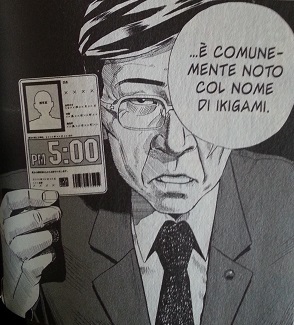
The narrator is a young man whose job it is to deliver an "ikigami" to people who are going to die. (Ikigami: death note.) These cards are printed with the name and a photograph of the victim, along with the exact time and date of their death, which always occurs within 24 hours after receipt of the ikigami.
The ikigami serves as a ticket allowing the recipient free use of public facilities and transportation. It's also the family's claim check for their bereavement pension.
This volume contains the stories of two such "recipients." The second story was the kind of thing I expected. It's the story of how one young man responds to the news of his impending and utterly undodgeable death. It was brilliant, beautiful, and devastating. It made me decide to read more volumes in this series.
But as I mentioned in my first "I'm reading this book" comment, I almost didn't get to that second story, because the first one made me feel ill. Literally, for several days after reading it I couldn't think about it without feeling a wrench of nausea -- and it was hard for me to think about much else for several days.
The ghastliness wasn't in the premise of the series. It was in an all-too-believable scene in which a high-school boy is "bullied," and I'm putting that in quotes because this was so foul that I think "tortured" is a much better word for it. The injuries he suffered were the most bearable part of the scene. The casual sadism, the degradation -- hackneyed words like "vile" and "filthy" keep coming to mind as the only ones that can apply.
My husband recommended this series to me. I ran into the next room and practically whacked him on the head with this volume after reading the scene in question. "Why didn't you warn me?" I demanded.
He didn't warn me, so I'll be a good friend and warn you. That first story is hard to take. To put it mildly. If you have trigger issues, give this book a miss.
But that first story is also kind of a baptism of fire. The next one in the book is nothing like it, in terms of content or intensity. And my husband swears that the rest of the series doesn't contain anything nearly so intense.
So this was pretty fucked up, depressing, and I couldn't put it down.
So what's a Ikigami? It's a letter you receive when it's your time to die. Pretty screwed up, huh? So when you're a child you are injected with a capsule that'll kill you if the government so chooses it. Why do they do this? To keep people proactive in life. To try and achieve great things. With the looming feeling of death coming you are pushed to do better. Don't worry though, your death isn't meaningless. If you do get picked to die your family will be well compensated as long as you don't go on doing something stupid in your last 24 hours of life. You know, like murder or rape.
Good: I really enjoyed the first story despite it's dark outlook on things. Basically the first guy chosen to die had a shitty childhood. Beaten and tortured as a kid in high school he decides when he has 24 hours left to take revenge. He goes on to (I believe) rape one of the girls who humiliated him in HS and then nearly kill another and ruin his entire career. It's fucked up but realistic. The other story is about two guys who were growing up together to become great musicians. Sadly, everything goes wrong and they break apart. Then one day one is chosen to die, this is also a interesting idea.
Bad: The art sometimes makes it hard to tell who is who. I kept getting confused on two characters. I also thought the 2nd story was a little too slow at times.
Overall this was really interesting, screwed up, yet I kept wanting to read it. I'm going to go with a really solid 4 out of 5. I thought it was great!
I giapponesi sono dei veri maestri con le distopie e questo manga ne è una prova esemplare. In originale ikigami è scritto con due ideogrammi che significano uno “carta”, l’altro “dipartita dalla vita terrena”.
Mungkin kau baru saja naik jabatan atau mendapat pekerjaan yang kau inginkan. Mungkin kau baru saja berdamai dengan pacarmu setelah pertengkaran hebat. Mungkin kau sedang sibuk mengejar impianmu menerbitkan buku, menggubah lagu, atau menjadi atlit profesional. Atau mungkin kau menjalani hari-hari dengan biasa dan sederhana saja, tidak memusingkan apa-apa selain mau makan apa hari ini.
Lalu pada suatu hari, seseorang mengetuk pintu rumahmu dan berkata, "Maaf, besok Anda akan meninggal."
Dunia distopia di Death's Notice (Ikigami) menampilkan skenario seperti itu: sebuah negara di mana sebagian penduduknya ditakdirkan mati pada usia 18-25 tahun. Pemerintah menjalankan program penyuntikan 'kapsul bom waktu' secara acak dan rahasia, mengirim petugas untuk memberitahukan orang-orang yang tidak beruntung saat kapsulnya H-1 sebelum meledak, dan mengumumkan kematian orang-orang tersebut sebagai pengabdian untuk negara. Tujuannya untuk 'menyejahterakan negara dan membuat rakyat lebih memaknai kehidupan', karena sebelum melewati umur 25 tahun mereka tidak tahu apakah mereka yang 'terpilih'.
Kebijakan yang sinting dan mengerikan, tapi komik ini dengan sangat cerdik menampilkannya sebagai bagian dari sistem yang sudah mengakar dan diterima sebagai 'kewajaran'. Banyak bagian yang mengingatkan saya pada 1984-nya George Orwell (*buku yang sangat saya rekomendasikan untuk dibaca sebelum atau sesudah baca komik ini), terutama ketika plot menjadi semakin genting dan nasib si tokoh utama berada di ujung tanduk.
Tokoh utama tersebut bernama Fujimoto, sang kurir Ikigami/surat pemberitahuan kematian. Mayoritas bab menyorot 24 jam terakhir dari orang-orang yang ia datangi secara episodik, tetapi tidak pernah repetitif karena variasi penokohannya yang sangat luas. Di antara orang-orang tersebut, ada yang pasrah. Ada yang mengamuk dan melakukan tindak kriminal. Ada yang memanfaatkan momen-momen terakhirnya untuk melakukan hal yang berguna bagi orang lain. Ada yang memutuskan melakukan hal yang selama ini tertunda. Bahkan ada yang malah bahagia dan merasa jadi 'pahlawan negara', menandakan otaknya yang sudah habis tercuci oleh propaganda.
Pertanyaan-pertanyaan semakin banyak muncul, dan plot utama pun berjalan pelan tapi pasti di tengah berbagai kisah episodik yang terjadi. Secara perlahan, Mase-sensei menyelipkan berbagai dampak sosial, politik, dan psikologi dari premis ini, sehingga dunianya jadi semakin terasa hidup. Walau 'Ikigami' sendiri adalah konsep fiksi, banyak sekali yang paralel dengan hal-hal di dunia nyata:
-Analogi antara Ikigami dengan kebijakan wajib militer dan surat perintah untuk pergi ke perang
-Jingoisme dan pemahaman 'semua untuk satu' yang mendasari pemikiran ultra-nasionalis, tanpa repot-repot mempertanyakan apakah konsep negara itu sendiri memang layak untuk diperjuangkan
-Penggunaan seni dan media sebagai alat propaganda cuci otak oleh golongan berkuasa, sekaligus sebagai alat protes dan penyuaraan aspirasi rakyat yang sudah 'sesak napas'
-Konsep Budhisme dan beberapa kepercayaan lainnya yang memaknai kematian sebagai sesuatu yang tidak seharusnya ditakuti
Di tengah semua tema besar itu, aspek humanis dari komik ini tetap terasa kuat. Hubungan antar manusia ditampilkan dengan sangat baik; kadang menyentuh, kadang mengenaskan, kadang mengerikan, dan kadang ketiga-tiganya sekaligus. Saya pun mengagumi penulisnya yang memberi 'kekuatan' tersendiri pada sekian banyak karakter yang akan ditewaskan (*pada dasarnya, sebagai penulis akan selalu terasa berat menciptakan karakter yang ujungnya akan kita 'bunuh').
Secara keseluruhan, Death's Notice adalah cerita tentang titik balik; tentang jeritan kemarahan melawan sistem yang tak boleh dipertanyakan; tentang 'kematian jiwa' yang lebih mengerikan daripada 'kematian fisik'; dan tentang secercah harapan dan kemanusiaan di tengah lautan gelap kebohongan dan kemunafikan.
Wow, I wasn't sure what I was going to make of this manga.
Each day, someone in the country is given a notice that they will die in exactly 24 hours. A list is kept of vaccinations given and 1 in 1,000 vaccines given to the children contain a nanocapsule that will kill them at a predetermined day and time.
Creepy. (I suspect the anti-vaxers would be all over this!)
Creepy. All for the welfare of the people. If they know they might die at any time, they will better serve the State.
The interesting part is what people do when they receive their 24 hour notice. Go on a crime spree? Create one last beautiful work of art? Spend the time alone? Or with loved ones?
This is also the story of a man whose job it is to hand out the death notices and his conflicting emotions. (Can't be too conflicted, though. Enemies of the state are also killed.)
Gambar bagus banget! Ceritanya pun sangat 'gila' (^_^;) Antara "wah premis gini ini menarik tapi ga mungkin lah bisa ada peraturan segila ini", dan "nggak! kegilaan macam apapun bisa terjadi di peraturan sebuah negara". (*Konteks: Ini negara antah-berantah ya, bukan negara yang ada di peta, kok (o^^o)).
I don't think I've ever read a dystopian story quite like this. It's bleak and depressing, but it's excellently told and you can't look away. There's so much more I'd like to know about the world. I'll have to continue this manga series.
I have to admit that I feel a bit disappointed after finishing this this first volume. I had spotted this serie quite some time ago, because the concept sounded interesting : in a near future, the government enforces a system where one person in a 1000 (I think that's the right figure?) get injected a vaccine that will kill them bometimes between their 18-24rd year. One day before their scheduled death, they receive an Ikigami, an advanced notification of death. Each chapter will then follow one of those people that had the misfortune to receive the Ikigami.
The underlying principle of this dystopian system of governance is supposed to be that if people are under threat of death, they will live more fully and appreciate every moment. Why not as far as extreme imaginary governement methods goes this is not such a bad justification ! My problem with it (cause of course I found a problem!)? They "only" kill young adults, so besically if you're over 25, you can be sure you didn't receive one of the deadly vaccine, so you should no longer be affected by that than we in the real word. Is there some implicit rules somewhere that dictate that in dystopian universe you should kill the young adults ? For another Japanese story with many similarities, think of Battle Royale for example (the film was also great btw). If you wan't someting more occidental, then Hunger Games is another example... Is there some kind of taboo that dystopian government cannot kill middle-aged or seniors ? Well, I guess I should be happy, I'm past the critical age, should the world explode into one of those science-fiction style system. See, at last I found a perk of aging :D !!!!
But back to Ikigami. Actually, what bothered me most was the way the story was told with flash-back and flash-forward, it was confusing. I wasn't really hooked by the Ikigami recepient in this volume. Except maybe the last story which was a notch above the rest. Finally, let's talk about Fujimoto, the one recurring charachter, who is tasked to deliver Ikigami (quite a choice of occupation). I feel that he will be important at some point, but really in this volume he wasn't exceptionally useful or interesting.
So will I read next volume ? Probably, but more out of curiosity than because of some love of this first volume.
I've been looking into more horror manga lately, and the basic premise of Ikigami inspired me to grab it on a whim: It's a dystopian tale about an alternate version of Japan that plants a ticking time bomb in the hearts of 1/1000th of the population (via an otherwise innocent immunization shot). Of course, the system is no secret, and, thanks to its setting in Japan, this population control program requires a massive, multi-level bureaucracy to function. This manga series follow one of its many rank-and-file workers, with the protagonist responsible for delivering an official notice to the damned 24 hours before they're scheduled to die. He's not the biggest fan of the status quo, though.
In this first volume, the premise doesn't seem to matter all that much—and the main character is such a non entity that I can't even recall his name. Still, it provides just enough of a framing device to tell short stories about what people do with the remaining 24 hours of their lives, which is certainly some high-stakes storytelling. Ikigami offers intense melodrama, for sure, but, in this first volume, the outcomes are just a bit too predictable. And while certain events make it clear that dissent in this society is eliminated pretty much instantly, I was honestly more interested in seeing how these people act in a setting with government-controlled, impartial death sentences as a fact of life—it seems the concept of "Ikigami" only comes into conversation when the main character enters people's lives. Ikigami has a bit of a rough start, but I think I'll stick with it to see if any of Mase's dark short stories ever reach the heights of Twilight Zone material. It definitely has potential!
To tell you the truth, I would've given it a ten stars out five, but that would be at a young age not now. These kind of stories made living easier for me but I'm coped with my life now. I don't deny the second story was quite touching, but the people or characters displayed in this volume are good not bad or evil this might turn into a boring cliche in the next volumes to come. There's a strong point though the ikigami bureau office's delivery man Fujimoto there's something about him I cannot grasp, maybe he has an ikigami on him, or he will make an end to this movement I'm not sure but I'll follow the story and see what happens..
This manga is about a very different concept that drew me to try it with the synopsis alone.
A national prosperity law has been passed in dystopian Japan resulting in citizens between the ages of 18-24 being randomly selected to die for the good of the nation. These citizens are given 24 hour notification of their impending death. These notifications are known as "ikigami".
The first volume at-least was about characters reacting differently knowing it was their last day on this earth. It was a good solid read and enough to try the next volume.
This is what a great manga should be. Chilling to the bone. Messy with the mind. Great, fantastical art. Not to mention a touch of sci-fi. Ikigami has a great concept. It really reminds me of "The Giver" more than anything. They're trying to make the best Utopian society, but it's far from it. The system is incredibly flawed, and through this book, we see the flaws in action. Although I don't know if I'll see more of the series, it's definitely a must read.
Content warning for this volume: on-page bullying and rape.
In this version of Japan, there's something called the National Welfare Act. In elementary school, all children are vaccinated against various diseases. Some of the injections include a special nanocapsule that eventually comes to rest in the child's pulmonary artery, where it ruptures on a specified day and time, at some point between their 18th and 24th birthday. No one knows who has a capsule inside them, and the goal is to make citizens value their lives more and increase their productivity. Any citizens who object to this system are immediately injected with a capsule.
Fujimoto has just started working as a messenger, one of the people whose job is to deliver ikigami, death papers. These are given to citizens 24 hours before they're scheduled to die, so that they may better appreciate their last 24 hours. The families they leave behind will be given a bereavement pension, unless they choose to spend their last 24 hours committing crimes, in which case there is no bereavement pension and the family must pay large fines as compensation.
This particular volume features the delivery of two ikigami, one to a man who was bullied so severely when he was in high school that it derailed his entire life, and one to a young singer/guitarist who has lost sight of what's really important to him in his quest to become famous.
I don't know what I think about this series. The art was good, and the stories were fairly interesting, but I'm not entirely sure what the author is going for. On the one hand, it was clearly a horrible system that didn't make people appreciate their lives any more than the average person who could die at any time from a non-nanocapsule-related incident. People died, and it was senseless, and sometimes they harmed other people on their way out, despite the whole "your family will be ostracized and have to pay for your crimes" thing. On the other hand, in both ikigami incidents so far, the characters were depicted as managing to achieve something worthwhile in their last moments that they probably wouldn't have under other circumstances. Were readers supposed to view the system as beneficial in some way?
Fujimoto struggled with his job as well. He saw the harm his ikigami deliveries could cause, and he had to deal with people's grief and rage. He couldn't openly criticize the system or even talk about his concerns without risking being killed, so the only person he'd cautiously mention any of it to was his boss, who'd learned over the years to look at the bright side of ikigami.
Will I continue this series? Maybe, if only to see whether the author does something more with it than make it a bunch of standalone ikigami delivery stories. It's definitely not the kind of thing I'd want to binge read, though, so interlibrary loan and its periods of waiting might actually be a good thing this time around.
İkigami yani ölüm bildirisi toplumdaki bin kişiden bir kişiye nasip olmaktadır. İlkokula başlayan çocuklara yapılan aşıların çok ama çok az bir kısmında bulunan nanoçip, enjekte olduğu kişiyi belirli bir tarihte öldürmektedir. Aşıyı olanlar da yapanlar da kimde bu çipin olduğunu bilmemektedir. Hükümet uyguladığı bu programla kişilere hayatın kıymetini öğretmeyi amaçlamaktadır. Faydasını da almaktadır. Suç ve intihar oranları azalmakta gayrisafi milli hasıla ve doğum oranları artmaktadır.
Ana karakterimiz Fujimoto çip talihlilerine ölmelerine yirmi dört saat kala ölüm bildirilerini iletmekten sorumlu bir memurdur. Bu bildirileri iletirken zorlanmakta ve hükümetin bu politikasını kendi içinde sorgulamaktadır.
Asıl hikaye bu bildirileri ilgili sahiplerine ilettikten sonra başlıyor. Bildirileri edinen kişilerin yaşadıkları şoklar ve sonrasındaki yirmi dört saatlerine tanık oluyoruz. Tabi öncesinde bu kişilerin hayatlarını ve yaşadıklarını da öğreniyoruz ki bu tecrübelerin ışığında şekillenen son yirmi dört saatlerindeki trajik olaylara şahit oluyoruz.
İlk hikayede; okulda gördüğü zorbalıktan kalan iyileşmeyen yaralardan dolayı sinir krizi geçirip geçmişteki zorbalarından intikam alan bir adamın hikayesini okuyoruz. İntikam hikayelerinden bildiğimiz şekilde karakterimizin amacını gerçekleştirdikten sonra içindeki boşluğun dolmadığını anlamasını ve ardından yaşadığı tatmin olmamışlık hissini görüyoruz.
İkinci hikayede; sokakta müzik yapan iki müzisyenin bir plak şirketi tarafından keşfedilmesi ama kısa sürede şöhret olmak isteyen vokalin açgözlülüğün ve bencilliğinin bedelini ödemesini görüyoruz. Besteci arkadaşına kulak vermediği yetmezmiş gibi onu küçük de görüp kendine yol çizmeye kalkan vokal, tek başına başarı elde edemediği gibi başka bir vokalin arkasında gitaristlik yapmaya başlar. Bunu da sevmediği bir müzik türünde icra eder. Ölüm bildirisi eline geçince kariyerini ve arkadaşlığını nasıl mahvettiğini düşünür ve pişmanlık yaşar.
Hiç beklenmeyen bir anda yirmi dört saat ömür kaldığını öğrenmenin verdiği kabullenememe, geçmişten getirilen yüklerin bir anda çöken ağırlığı gibi noktaları güzel şekilde veren bu manga güzel çizimleriyle de herkesçe okunması gereken bir hikaye sunuyor.
I officially love this series - and at the moment this is probably my favourite manga series. The overall premise is that, in a future oppressive world, children are given an injection that protects them from all diseases. However to improve national welfare, 1 in 1000 children will also die by this injection between the age of 18-24. They will be given an Ikigami (aka a death note) around 24 hours before they die, so they have time to say goodbye and do anything that they want to do within the day. Although there is an overarching story of a young man who delivers ikigami’s and is coming to terms with that role, each book is separated into 2 stories of people that receive an Ikigami, and what they do during that time.
There are about 10 books in the series (so far) and at the point of this review I have read 3 books (6 stories) and I honestly love the different tone/themes that are covered. You have characters that go on immediately look for revenge against childhood bullies, or commit acts of violence, but then you have other stories where you see characters do something they have always dreamed of, or make an incredible sacrifice. Each story is incredible as it looks at relationships, love, anger, family, friendship, and so many other things as you watch what people choose to do in their final 24 hours of life. I honestly can’t wait to read more in this series.
La idea de la que parte este cómic es potencialmente brutal.
Para motivar a la población e impulsarla a esforzarse al máximo, se inocula a los niños una vacuna especial. Una de cada mil contiene una nanocápsula que eliminará al portador al llegar a la edad adulta, entre los 18 y los 24 años. A los afectados se les entrega 24 horas antes el "ikigami", u hoja de muerte, que les permitirá de disfrutar a placer de su último día.
A partir de un funcionario repartidor de ikigamis, se ven las diferentes reacciones de los personajes ante la muerte. Se reflexiona también sobre esta práctica gubernamental, surgiendo una trama de rebelión encubierta en la que se verá envuelto el protagonista.
Sin embargo, de los seis tomos que he leído hasta el momento, la trama de rebelión avanza lentamente, y el análisis del comportamiento de los personajes ante su súbito final no llegan a convencer del todo, del mismo modo que el dibujo, bastante malo.
Se trata de una idea genial que hubiera dado una obra maestra si se hubiera llevado a cabo de otro modo.
A dystopian society where one in a thousand children are injected with a deadly capsule that will send them into cardiac arrest when they turn 22. And no one knows who been injected, so the idea is that with the knowledge that you 'might' be one in a thousand, youd end up doing your all to live the best life you could and would end up being a very productive member of society. As a sign of grace, or pity, the government gives a 24 hour notice to those who about to expire, and the two stories in this volume follow those characters.
I like narratives with hypothetical storylines like this, the whole 'what if?' scenario. I was a bit mixed about this one however. It was interesting to see the characters react to being the Ikigami, and how the agents of the government also think and react to the aspects of their jobs. The first storyline I did not like at all but the second one was good.
Well written and illustrated, and while the premise was interesting, it just ultimately was not my cup of tea. I'll be interested in reading the other entries to the series to see how other characters deal with the dilemma of their impending death.
3.49* Imagine Shirley Jackson's The Lottery and Blade Runner had a baby in 2007. On the surface, the story is based on that old trope, "if you only had 24 hours to live what would you do?" But we also get to see behind the scenes, the alienating logic behind death for "the greater good". The French edition contains a postface that draws parallels to the Nazi death machine, separating the act of killing into different steps so that the individual doesn't feel responsible. We also see through the eyes of the main character that even trying to question if this random selection of individuals to be killed has the intended effect, or questioning the logic behind the process isn't tolerated. Which is why it can be so difficult to fight a system from within.
The wheels of justice go round and round... Definitely curious to read v. 2...
That was so deep. It has 2 stories that made me stop and reflect. It discussed how vengeance is meaningless when it comes after a while. Speak up for your rights now or never. The second story made me remember something I always thought about, what to do when you are trying to be loyal to a friend, yet you can't both get the first place?? Is it selfish to leave your friend behind??Does your friend has the right to be mad?? This is the first manga I have ever read. I loved how few words and amazing graphics made me feel, will definitely read the other 9 volumes.
This entire review has been hidden because of spoilers.
Ce manga très immersif basé dans un Japon alternatif, mais si proche, nous invite à suivre les destins non seulement des personnes qui reçoivent l'ikigami, cet avis de décès les concernant à court terme, mais les interrogations de celui qui est chargé de leur remettre. A mi-chemin entre des nouvelles et un récit qui leur sert de lien, j'ai été prise aux tripes.
the first act of the story was horrific. it rlly makes u question your morals & think but is so distrubing. it made me so uneasy but im glad i continued on. to me, this felt very thought-provoking & the premise is very dystopian & interesting. i feel like i might read one more volume to see if im interested in continuing