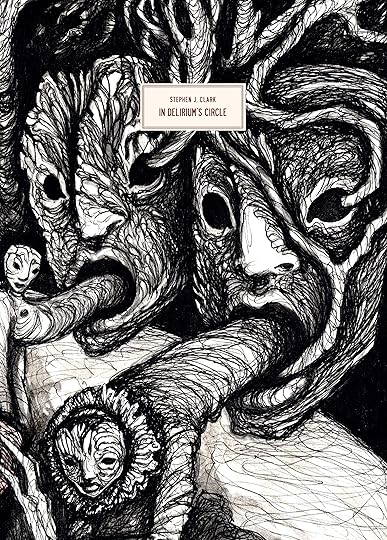
Set amongst the fogbound and beleaguered streets of post-war Newcastle Upon Tyne, In Delirium's Circle documents the obscure fate of William Fetch, artist and seer, in his pursuit of the truth behind a secret society of sinister game-players and the nebulous masters to whom they are enthralled. Fetch sees in these shadowy individuals perhaps his final chance to know the hidden worlds he has devoted his life to discovering. But are the choices he is making really his own?
In Delirium's Circle is Stephen J. Clark's first novel, an unsettling tale of secrecy and obsession, of haunting memories and spiraling madness. It contains 21 original illustrations as well as full colour endpapers by the author.
Stephen J. Clark’s stories have appeared in numerous anthologies. Frequent collaborations with Tartarus Press have notably featured Clark’s cover illustrations for a complete series of Robert Aickman’s strange tales.
In Delirium’s Circle, Clark’s debut novel, was published by Egaeus Press in 2012. The Satyr and Other Tales, a collection of novellas was released by Swan River Press in 2015. His second novel The Feathered Bough was published by Zagava in 2018. A third illustrated novel, The Mirror Remembers (also from Zagava) was published in 2024.
A Mythology of Masks, a collection of short stories and novellas was published by Egaeus Press in 2025.
On the surface of it, this is merely a very creepy tale, extremely well told. But, like the plot itself, this is a multilayered artifact. The cover itself has a beautiful burgundy floral design embossed with a sinuous abstraction of theatrical masks that swirls in a . . . well, a delirious circle. In fact, the novel is illustrated throughout with sinister, ghostly drawings by the author himself, making the artifact a lavish affair worth the high asking-price. The cover is indicative of the story itself - a whirlwind of shadows that leaves the reader wondering who is good and who is evil, or even what is "good" and what is "evil", in the philosophical sense of the words. The effect on me has had one benefit: I've been studying existentialism lately, and this book makes it *really* easy to slip right into existential mode.
But this is so much more than just another straight-faced Ligotti-esque foray into darkness. Stephen J. Clark has crafted some dark playfulness into the text. Take this sentence, for instance:
"In short, the author playfully alluded to the identifiable characteristics of the lives of bookish people as though in essence all are monsters, pariah and exiles."
Clark here gives a sharp elbow to the reader, breaking the fourth wall, while maintaining the character of the book. This sort of metafictional playfulness is not something you'll find in most horror literature, at least not done with this kind of subtlety.
As the borders between dream and reality fray, it's easy to go into a kind of opiate slumber as one is reading. Then, all of a sudden, Clark pulls out a chase scene worthy of Alfred Hitchcock that grabs the reader by the shirt collars and shakes one into wakefulness. It's a sharp slap in the face, but rather than throwing the reader out of their suspension of disbelief, it draws the reader further in, enveloping one just as Mr. Fetch, the main character (or is he, really?) is folded into layers of uncertainty and psychic vertigo.
As Fetch is thrust under the dark, roiling waters of doubt and deceit, he, along with the reader, becomes aware that he is being used by The House of Sleep, a mysterious cabal of . . . well, that is a mystery.
"I was entering another circle, where the world seemed suddenly caught in amber, where the inhabitants of nightmares lingered just out of sight in the wings."
And later . . .
"I had acted as if hypnotized, finding the paint and brush, following the instructions to the letter, all the while with a sense that I was completing an inevitable action. The game played me."
One of the tropes that is hinted at throughout, but never made explicit (nothing is made explicit In Delirium's Circle, which is part of the awful wonder of it all), is the idea that doppelgangers may or may not have replaced one's friends, one's enemies, or one's self, at any time.
"Sooner or later your own shadow will rise up and join you as a guest at your table."
In context, this is one of the most horrifying lines of the book. But I can't, unfortunately, contextualize it without relating the book in its entirety. The haunting effect of this novel is far more than the sum of its parts. Clark and Egaeus Press has created one for the ages, the dark, unsure ages when even solipsism itself must be questioned. Is there really a "self" at all? Mr. Fetch, for one, has his doubts . . . and these doubts are about all that he can claim as his own. All else is distorted by the gyrations of delirium's circle.
Here's the cover of the (much more reasonably-priced) 2019 Zagava paperback, 246 pages. ISBN 9783945795521 in case a librarian feels like adding it. ETA: Well that was fast. Thanks Sean! ------------------------------------------ Often it seems modern weird fiction works get automatic 5 star ratings from those heavily involved in the community. I'm sure much of it is because those readers really enjoyed these books, as they are predisposed towards liking them (like me). But at times I wonder if it's some sort of club where you're supposed to give any collection or novel by an emerging or underappreciated author in the field a perfect rating to help promote the genre as a whole.
This is not one of those. Surreal, freaky as hell (including the many illustrations), eerie/foggy atmosphere so thick you can feel it weighing down on you, reality slowly breaking down...what more can a fan of horror and weird fiction ask for? Frankly, it's among the best novels in any genre I've read in recent years. Check out Forrest's and Ronald's reviews if you don't believe me. They're much more erudite and capable of encapsulating this reality-bender than me.
This is the kind of book that I search for, but rarely find. Thank you Mr. Clark for writing it. A letter tucked away in the pages of an old book is the starting point of this dream-like tale of secrets and secret societies, conicidences and synchronicities. The protagonist finds the long-lost letter and is compelled to respond to it by writing his own letter, leading him on a mysterious journey full of equally mysterious characters and events. Immerse yourself in this one; the mystery is its own reward...
_In Delirium's Circle_ by Stephen J. Clark is about 50 percent traditional narrative, the other 50 percent comprised of documents such as letters, journal entries, and illustrations.
The time is not long after World War II. The protagonist is an oneiromancer who, in a used bookstore, finds a letter tucked in a book.
The letter refers to a remarkable experience of some British soldiers in a town in Czechoslovakia on Victory in Europe Day. The soldiers participated with some townsfolk in what the soldiers call "games" but apparently were occult rituals.
Our protagonist makes contact with the circle, and eventually becomes a valued member. By performing strange actions in certain locations--and this circle's efforts are experimental, this group keeps photos, journal entries, etc about their activities, they seek "...gnosis, of insight through poetic revelation...."
Here is a paragraph from the book which strikes me as Ligottian in content and style:
"...It is clear that we were not actually within what could be conventionally defined as an hypnotic trance state, however if it can be described at al the it would be more apt to say that, for several days at a time, we were capable of self-inducing an acute receptivity comparable with the delirium that often occurs as a symptom of sleep deprivation. In that rapture we recorded what experiences and encounters we could, sometimes scribbling notes or taking photographs individually or keeping a written report of what our fellow travelers observed or felt about a certain crumbling doorway, for example, or the sight of an umbrella lying twisted in a gutter. This material, this poetic evidence, as we can to call it, soon accumulated to form an archive of findings that we need The Archive of Vanished Maps. We realized that what we had at first considered obsession promised far greater things: indeed we came to believe that it constituted a new way of living."
A story is about a conflict. In this story, the conflict arises about mid-way when another occult group, with older origins, seeks to undermine our protagonists's circle. The ending of this novel is like a creepy scene from a David Lynch movie.
This is the creepiest book I've read in a long time. It has fastened into me like no other book of recent memory. Like smoke through my fingers, I have read and re-read through its cryptic passages, studied its twisted, narrative paths, and puzzled over its pronouncements of "facts" and "visions". It is hauntingly translucent, unpredictable, quite terrifying in its conduct and assumptions of so-called reality. It is either a transcendental insight or insanity substantiated.
Its bearing is on a line with Arthur Machen, Robert Aickman, Thomas Ligotti. For a Gorrorfest, look elsewhere. This is that skulking terror of hearing footsteps behind you when there's nobody there but your shadow, or that amorphous horror lurking in the slightly-opened closet from your childhood's bedtime. Unfortunately, this is going to be a hard book to find after its 300 printed copies are sold out.
It starts out serendipitously enough. Our first-person narrator discovers an unposted letter in a book he's perusing at some dusty bookstore. Mr. Fetch, a disseminator of automatism—"automatic drawing and writing and their interpretation used as auguries"(p.17)—plus spooking up the occasional seance, finds no correlation with this event, yet after reading its scrawl, arranges to deliver it in person as if he was Alice mumbling "curiouser and curiouser"(1) heading off into Wonderland.
The letter, which is dated two years back, attests to an incident that happened just as WWII "seemed to fizzle out in [a] small idyllic town in Czechoslovakia"(p.13). Four soldiers witnessed the townfolk in a cellar of an old ruin exchange masks and evoke "something else" initiating "strange games" and "demanded sacrifices." The letter writer—a Mr. Eyles—refers to the beauty, the "boundless intimacy" of the ongoing experience, concluding "that we must find that ecstasy again at all costs"(p.15).
Mr. Fetch is understandably intrigued and heads off for bombed-out Newcastle to meet the letter's recipient, Miss Norfoot, who turns out to be the researcher and chronicler of a small and very exclusive sect who are overwhelmed yet diligent upon uncovering an immeasurable world hidden amongst our own.
That's the plot hook, which sounds reasonably cliche these days. Hell, even master novelist Peter Straub's latest—A Dark Matter, c. 2010(2)—looks into a similar horrorscope; however, since author Clark appears unshackled from a publisher with more mainstream interests of a larger, target audience, the story's undulations between sanity and madness, trust and betrayal, human or extrinsic to humanity, furthers its separateness from the contemporary banalities and engenders genuine disquietude, in this reader, anyway.
Clark uses a technique more favored from the past to entangle his audience. Epistolatory like Stoker's Dracula plus entries from Circle members' notebooks while being stitched together with the victim hero's 1st-person narration, we begin at the end, similar to many H.P. Lovecraft's tales. It's an intriguing device playing to the audience's accepted disbelief, because when you reach the end, you know your fictional guide is going to be as disappeared as this book is inanimate. From the beginning hope is lost, your conformities become chew toys for deviance; you are going to sleep ascertaining the possibility that those unmanageable dreams are curtains hiding a far hideous sensibility.
The unconscious was not simply some private reservoir of repressed impulses and lost dreams within us, it waited all around us, in the surfaces and crevices of these forgotten ruins of the real. After all, that had been the abiding obsession of the Circle: to find the hidden poetry of the world. . . [But] what if the ancient secrets of the Earth and its wonders, the dreaming fire at its core and the shadows that live here in the ruins, what if it was all closely guarded and we were prevented from entering? . . . My friends and I were only ever given enough to be left troubled by riddles, to play the same perplexing games and rituals again and again.
—Mr. Cutler's journal, p.219
Are these merely the mad ravings of a man sitting at his writing desk given over to the phantasmagorical while he loses purchase with our familiar, agreed-upon reality? That is an easy solution judiciously rebuffed with characters met, artifacts bandied, unaltered photographs seen, transmutations witnessed. If Mr. Fetch is truly delusional, he has imprisoned himself in a devilishly-persuasive labyrinth. No, his denouement is far more unnerving as, one by one, Circle members just, ah, disappear. It becomes questionable—especially with Mr. Eyles—if their identities were ever unfeigned representations. One character alligns their steadily-nearing misfortune as anxious children who improvidently "knocked on a door . . . and now they were . . . hiding around the corner, awaiting the answer"(p.180) Another, unwitted, suspects he is "leaking out . . . like some hideous telepathic infection"(p.177). For another, the answer has come closer as his "long, lost you . . . that part of you that has learned to speak through your dreams and wakes in your madness. . . The assassin awakes. Having been instructed in sleep, he enters a world that is no longer divided from dreaming"(p.226). Further, another diarist within the novel, a Mr. Cutler writes,
We have been walking into a trap. . . My own thoughts terrify me, as if they belong to a stranger. I fear I am being overpowered, my willpower corroded so that I can be corrupted from within. I suspect that I am being secretly tutored in ways to annihilate myself. I'll tear myself apart for reasons I cannot remember or never comprehended. . . I am becoming a device for destroying all those around me. I am convinced that we are all becoming unwilling agents, unknowing servants for others who hide from us.
—p.220
Originally campaigned as discovering the "lineaments of the unconscious emerging from the furrows and lacunae of everyday life"(p.99) as evidence of a deeper reality, a world of energy, thought, and unknown corporeality. The "poetry of dreams" is the language, the key; it is the visage of intersections, of byways, where the earthly leaves hints of the ethereal. The world we know is a mask and it takes putting on a different mask of other arrangements to see beyond it. The methodology becomes a kind of "wandering somnambulism"(p.56), a state of delirium likened to sleep deprivation where the neophyte wanders the city, usually surrounded by a fog "along the cobbles like a blind man on his belly"(p.178), and experiences the dream phantoms' clues and rumors among the ruins, usually around bombsites from the recent war.
Mr. Fetch begins his initiation into the Circle by agreeing to stay in a large, somewhat vacant house, where, by roaming through its bric-a-brac and debris, he becomes further estranged from the life he's left. Members of the Circle take him out for excursions to find these "totemic assemblages"(p.58) as proof of their prodigious conclusions. During these explorations Mr. Fetch has his moment of penetration:
I felt the sudden surge of the dream in the crowd. That was the paradise they would hide from us: the ecstasy of the moment. There was no need for any other kind of heaven. That was the world's hidden wonder that the circle spoke of, latent in the here and now. . . It once belonged to everyone, this poetry of being alive. It can only be lived again in the ruins of what has been. We must not allow them to erase these ruins.
—p.121
But this wonderment of discovery soon turns into anxious recession when another furtive voice—even using the same methods of communication through letters dropboxed in an untended bookstore—threateningly emerges. Known as The House of Sleep, the hunters suddenly become the hunted as a Mr. Stejskal solicits the group—in their calamitous ignorance—to become "the breaches and abysses of common understanding. . . The messengers of nightmares"(p.187). Mr Eyles as the Circle's director by default, confesses to prior awareness and alludes to inescapable absorption into its "promise of untold knowledge in the form of ecstasy and fear"(p.189). Already members Mowbray and Malone have become Mr. Stejskal's provocateurs, or, more likely, his unrelenting doppelgangers.
In the end, all are vacated from this waking yet visionless world except Mr. Fetch, our narrator; however, it is made clear he will soon follow the others as "ghosts of the living"(p.245), but in a different semblance. What is revealed are more doors, more theater stages, more cracks in the multi-layered edifice for the Circle's imminent mastication. Proving to be the true emissary from that shadowed reach, Miss Fretwell, shamming as Mr. Elyes' nursemaid, delivers the next atrocity for merging into the next befogged carapace by revealing a vision of a man "violently spinning like a top. . . He remained conscious as he span on, threads of frayed flesh . . . seeking to be weaved into another fabric"(p.244), and, presumably, on to another realm of abomination(3).
But for Mr. Fetch, there's another scenario. He becomes the King-killer, unconsciously tumbling Mr. Stejskal from his ferris wheel of supervision and himself into a "sacred yet unwelcome confidence"(p.246) he has yet to fully realize. Before his demise, Mr. Stejskal gives the final portentous yet poignant soliloquy, puzzling out the completion of the circle into further ambiguities while solidifying the reality contained in dreams over the waking world.
When a real man assumes the role of leader he dies as an individual. From that moment the shadow he's become belongs to another order . . . he is both stranger and father . . . Only then can he enter the dreams of a nation. He can cast shadows against the skies and call them gods. He can summon nightmares out of rumours. . . The mythologies that enthrall us . . . tales of forbidden knowledge, of sorcery or necromancy . . . it is all the same in the end . . . the influence that one man might have over another . . . There is no other power than this, Mr. Fetch. It is the power of the servant to refuse the master . . . to break the spell or suffer the consequences"
—p.251
The assassin therefore becomes king of his own narrative as Mr. Fetch—congruous with his own dreams and fears—trembles in his blind corner, waiting to "become something else, something monstrous"(p.254).
Now, I often wonder if I'll find a manuscript like this in some dingy bookstore, its homemade covers molded and worm-chewed, its pages yellowed and mysteriously stained. And will I open its spine, my nostrils filling with the stench of decay as I recognize my own signature on its title page?
1)this is the opening chapter title of this book.
2) I am not hinting at plagiarism, as Straub's version of reality compromised is on an entirely different path and full of novelistic embellishments that plasticize the read, as compared to this work.
3) Other than our narrator's sweeping, psychotic terror, there is little evidence to assume these transformative layers are necessarily evil. Succumbing to the novel's main disbelief—that of acceptance past agreed reality—why stop there? No one's been murdered; death and valueless vapors ascend from the bombsites created by man, not demons. Fear comes from unknowing, from ignorance of alien methods and beliefs deemed extraneous and therefore suspect and dangerous. The buried irony is that this is the real delirium's circle. It is our fabrication set upon the world, not visa versa.
This entire review has been hidden because of spoilers.
In Delirium's Circle has got to be one of the toughest books I've ever tackled. I first bought the Egaeus Press version in 2016 if memory serves, followed by the Zagava hardcover edition in 2019, because who isn't a sucker for well-made books? In the intervening 4 years I have attempted to finish it several times, without avail thus far. Not because this is a bad work by any means - far from it!
It took me four attempt over 4 years to finish the read, and consistent with my previous ventures I appreciate this as an exquisitely well-told, darkly haunting story that should be right up my alley. And yet, there was just something impenetrable, something forbidding about it. I found myself distracted *by* the book, even while concentrating *on* it. Even more disorientating, with every re-read I seemed unable to find passages / plot sections I could've sworn I'd seen in previous reads - damnedest thing, really!
I do wonder if this was intentional, on the author's part. Doesn't really matter anyhow - I'd managed to finish with the book this time. It wasn't an easy read, some parts were not very enjoyable truth be told, and yet all things considered it was oddly, immensely satisfying. Not quite as good as Clark's following novel, "The Feathered Bough", but certainly worthy of a solid 4 stars.
An utterly compelling and genuinely unnerving occult novel. Set just after WWII, the seemingly chance discovery of a letter in a second hand book leads our protagonist, Mr. Fetch, medium and automatist extraordinaire, into contact with a small sect that promises him esoteric knowledge of the beyond.
He moves to fog-bound, bombed-out Newcastle to join the titular occult circle. They soon include him in their secretive rituals and games. There’s something proto-Situationist about the Circle itself, almost like a Marxist cell. They aim to undermine the quotidian world and circumvent the rational mind in order to access the metaphysical reality, with rituals and techniques that would not be out of place in surrealist or psycho-geographers circles.
This ornate hardbound Egaeus Press edition, with illustrations by the author, adds to the reading experience and enhances the weaving of the novel’s dark spell on the unsuspecting reader.
I am in LOVE with this one. A wonderful (even for the big size of nearly DINA4!) haunting story about the unknown - the delirious spirit world overwhelming the senses. The Protagonist seems to be an well educated poor man with the desire of experiencing the underworld.... The scetches and the writings-skills are unquestionable. The Protagonists and their actions nearly overflow with honesty and sincerity. The way they see the world with its depths and spiritual wetlands was not only refreshing but also comforting aswell. Its worth every Penny.