

What do you think?

French Decadent Tales
'He had become the dandy of the unpredictable.' A quest for new sensations, and an avowed desire to shock possessed the Decadent writers of fin-de-siècle Paris. The years 1880-1900 saw an extraordinary, hothouse flowering of talent, that produced some of the most exotic, stylized, and cerebral literature in the French language. While 'Decadence' was a European movement, its epicentre was the French capital. On the eve of Freud's early discoveries, writers such as Gourmont, Lorrain, Maupassant, Mirbeau, Richepin, Schwob, and Villiers engaged in a species of wild analysis of their own, perfecting the art of short fiction as they did so. Death and Eros haunt these pages, and a polymorphous perversity by turns hilarious and horrifying. Their stories teem with addicts, maniacs, and murderers as they strive to outdo each other. This newly translated selection brings together the very best writing of the period, from lesser known figures as well as famous names. Provocative and unsettling, these extraordinary, corrosive little tales continue to cast a cold eye on the modern world.
CONTENTS
JULES BARBEY D'AUREVILLY
Don Juan's Crowning Love Affair
LÉON BLOY
A Dentist Terribly Punished
The Last Bake
The Lucky Sixpence
GUSTAVE GEFFROY
The Statue
RÉMY DE GOURMONT
Danaette
Don Juan's Secret
The Faun
On the Threshold
JULES LAFORGUE
Perseus and Andromeda
JEAN LORRAIN
An Unidentified Crime
The Man with the Bracelet
The Student's Tale
The Man Who Loved Consumptives
PIERRE LOUYS
A Case without Precedent
GUY DE MAUPASSANT
At the Death-Bed
The Night
A Walk
The Tresses
CATULLE MENDÈS
What the Shadow Demands
OCTAVE MIRBEAU
The Bath
The First Emotion
The Little Summer-House
On a Cure
JEAN RICHEPIN
Constant Guignard
Deshoulières
Pft! Pft!
GEORGES RODENBACH
The Time
MARCEL SCHWOB
The Brothel
The Sans-Gueule
52 and 53 Orfila
Lucretius, Poet
Paolo Uccello, Painter
VILLIERS DE L'ISLE ADAM
Sentimentalism
The Presentiment
The Desire to be a Man
CONTENTS
JULES BARBEY D'AUREVILLY
Don Juan's Crowning Love Affair
LÉON BLOY
A Dentist Terribly Punished
The Last Bake
The Lucky Sixpence
GUSTAVE GEFFROY
The Statue
RÉMY DE GOURMONT
Danaette
Don Juan's Secret
The Faun
On the Threshold
JULES LAFORGUE
Perseus and Andromeda
JEAN LORRAIN
An Unidentified Crime
The Man with the Bracelet
The Student's Tale
The Man Who Loved Consumptives
PIERRE LOUYS
A Case without Precedent
GUY DE MAUPASSANT
At the Death-Bed
The Night
A Walk
The Tresses
CATULLE MENDÈS
What the Shadow Demands
OCTAVE MIRBEAU
The Bath
The First Emotion
The Little Summer-House
On a Cure
JEAN RICHEPIN
Constant Guignard
Deshoulières
Pft! Pft!
GEORGES RODENBACH
The Time
MARCEL SCHWOB
The Brothel
The Sans-Gueule
52 and 53 Orfila
Lucretius, Poet
Paolo Uccello, Painter
VILLIERS DE L'ISLE ADAM
Sentimentalism
The Presentiment
The Desire to be a Man
231 pages, Paperback
First published May 1, 2013
Ratings & Reviews
Friends & Following
Create a free account to discover what your friends think of this book!
Community Reviews
Displaying 1 - 30 of 34 reviews

March 13, 2017

This book is a collection thirty-six French decadent tales written by fourteen different authors where most of the authors, with the exception of Guy de Maupassant, will probably be unfamiliar to many readers. But don't be put off by your unfamiliarity. Why? Because poet/scholar Stephen Romer has written a clear, insightful twenty-seven page introduction providing the historical/cultural/literary context as well as a detailed bibliography, a chronology of the major events and literary publications of the French Fin de siècle, and, lastly, extensive explanatory notes on each of the tales. Thank you Stephen Romer and Oxford Press! I couldn't imagine a more informative and more enjoyable book to read for anyone interested in the literature of this period.
So what can we expect to find in a turn-of-the-century French decadent tale? In a nutshell, a tale usually set in Paris, told with an acid bite, focusing on the morbid, macabre, perverse, unclean, unnatural side of life, all told without a hint or suggestion of moral instruction. One way to look at these stories is how the decadent authors, outlined by Stephen Romer in his introduction, follow Baudelaire when "he broke apart the perennial parings: virtue--reward, vice--punishment, God--goodness, crime--remorse, effort--reward, future--progress , artifice--ugliness, nature--beauty." Think about it: these pairing are the very glue holding conventional society together. And that is exactly the point: the decadents wanted to turn conventional society upside down and shake vigorously.
And why, you may ask, would the decadent writers want to engage in such turning and shaking? Because these authors saw themselves as outsiders set apart from the uncultured, unrefined mass of bourgeois (what we call nowadays "middle-class" or "middle-brow" society), as individuals capable of intense, refined aesthetic pleasure and literary cultivation. Stephen Romer points out how an aristocrat/aesthete from a Huysmans novel served as a model for the decadent writers when he travels to a nearby town and recoils in horror when he comes across a group of pot-bellied bourgeois with sideburns. Keep in mind these decadent writers greatly admired pessimistic German philosopher Arthur Schopenhauer, a thinker who highly valued aesthetic experience and urged people to rise above the murky turmoil of everyday life to reach a kind of release. Schopenhauer even went so far as to say how one's character is stamped on one's face, and subsequently finds it remarkable how most people can walk the streets without a bag over their heads. Oh, my goodness - cynicism and disdain, anyone?
With all this in mind, here is a sampling of three tales and how they each break apart a perennial parings:
THE DESIRE TO BE A MAN by Villiers de I'Isle-Adam (crime--remorse)
Walking down a Paris street alone at night, the main character, an old actor, realizes his acting days are over. He will no longer be able to play the role of other men and will be forced by age to live his own life as a man. But what is a man? He reflects that to be a man one needs strong feelings. But, aghast, he recognizes right there on the Paris street he has no such feelings! He surmises he will have to commit a heinous crime to feel the powerful sensations of remorse and be haunted by the ghosts of the souls he murdered. So, resolving on-the-spot action is required, that night he sets a residential section of the city on fire, resulting in the death of many men, women and children and creating great tragedy for multiple families. The old actor see the aftermath of the fire as he rides by in his coach and retires to a remote lighthouse to experience his remorse and be haunted by ghosts. But, alas, to his amazement and disappointment, no ghosts, no remorse, not even the slightest feeling of regret.
CONSTANT GUIGNARD by Jean Richepin (virtue--reward)
After experiencing repeated bouts of bad luck as a boy, the author tells us, "Such inauspicious beginnings in life would have turned a lesser nature vicious. But Constant Guignard had a soul of the higher type, and convinced that happiness is the reward of virtue, he resolved to conquer his ill-fortune by sheer force of heroism." Although this young man holds the values and world-view most dear to conventional society, alas, his tale is told by a decadent. The more decent and honorable and charitable he becomes, the more fate drags him down until he faces his last dark days. Can his equally decent, honorable, charitable friend save Constant Guignard's reputation and let the world know what a fine man Constant Guignard truly was by having his tombstone inscribed with an honorable epitaph? Well . . . let me just say Jean Richepin is a decadent with a lively sense of humor.
DANAETTE by Remy de Gourmont (God--goodness)
Is Danaette thinking holy thoughts as she is surrounded by angels taking the form of snowflakes? Not quite - for she is a complete sensualist and seasoned adulteress. When on one evening Danaette falls into a semi-trance, we read, "Deliciously icy, the snow kisses passed through her clothes, and in spite of all her defenses they found her skin and gathered in declivities: it was wonderfully gentle, and procured her a voluptuous pleasure she had most certainly never felt before." Remy de Gourmont combines the language and imagery of sensuality and perversion with images of religious holiness. Quite a combination! Ah, the decadents.
These tales of the French decadent writers not only turn the values of conventional society upside down but also give their tales a bit more spice with a twist at the end. After all, these writers are French. If you are a fan of short-stories, you will not find a collection more entertaining and engaging - each story is a delicious treat. This is fine literature told in a highly polished language.

April 29, 2020
I’ve dabbled in decadence, read some stories here and there and a novel or two by those writers known as “Decadent” writers. By today’s standards, many of these works have been, if not dry, so restrained as to make one wonder what makes the work decadent at all? This presupposes, of course, a certain notion of what decadence should be. Given our upbringing with cinema, our having been inured to violence and transgressive acts from our very birth, I don’t know that we of the current generation have a particular sensitivity to what was and was not historically considered decadent. You might be surprised, for example, at the many references to Greek and Roman classic literature and history found in these works, until you realize that many of the stylistic flourishes of these decadent tales were inspired by later Roman literature, when Roman civilization had passed its zenith and was, well, decaying. Decadence oftentimes does not equate with depravity, though there is plenty of that to be found throughout these tales. Nor is it always synonymous with indulgence and hedonism. In fact, some of these tales portray the very act of strict self-denial, a sort of spartan asceticism, as the ultimate expression of decadence itself! Decadence does not fit neatly into any particular box, except that of writers, generally of the late 19th-century, who held to a certain poetic style (not a strictly-metered style, but works that seethe wish poesis, generally). Many of these were French writers, hence the current volume. The introduction to this volume, which is quite good, lays out the different “flavors” of Decadence, along with some of the commonalities among decadent authors. But I will leave that for your reading.
I will also leave for your own reading and assessment, several of the stories throughout, particularly those that didn’t strike my fancy as well as the others. All of the stories were good at least, most were excellent, and a surprisingly large number were absolutely fantastic. Rather than waste your (okay, my) time on the more hackneyed pieces – which may have not appeared so hackneyed at the time, but which have not held up as well – I would like to concentrate on the best stories in the volume. And there are many!
Villiers de L'Isle-Adam's "The Presentiment" is fabulous and fabulist. A nicely chilling tale of death and the sacred where the line between occult and the veneration of holy artifacts is blurred like stitched-on patches on an old coat. A very old coat, indeed. Five dark stars!
"The Desire to be a Man," the second story by Villiers de l'isle-Adam should have been an episode of the Twilight Zone. I would not be surprised to learn that Rod Serling, at some point, read this tale while camping in the woods of the Finger Lakes region of New York and took furious notes. In my own imaginary world, that is exactly what happened. Thematically, Adams examines the emptiness of a man's soul and how his wish to fill his soul with meaning(?) have exactly the opposite effect. Artificiality is a hell that leads one to hell. An insightful, disturbing story that leads one to a lot of self-examination of person vs persona. Just the sort of thing Serling would have tackled!
Villiers’ "Sentimentalism" might as well be a primer for dandies, and not for the veneer of fine clothes and expensive tastes, but for the inner dandy, the emotional landscape and mind of the devotee. It is a strange sort of machismo, feeling deeply, yet not expressing reaction save through poetics. A sad story, both for the antagonist and his lover. Five stars. And I must say, Villier's work is powerful.
The stylistic accents and pacing make Mirbeau's "On a Cure" a very solid story. Existentialism, and the rejection of stark nihilism, is the philosophical current that runs throughout. This is a brooding little tale worth five stars, if you can see them for the height of the black mountains surrounding it.
Mirbeau’s "The First Emotion" is a story of desire, desire so intense it kills. A morbid, but wonderfully quaint story about the awakening of an inner life that leads to . . . Five stars.
The seemingly innocuous title of "The Little Summer-House," Mirbeau’s last story in this collection, is disarming. This is decadence in all its horror and brutality. Not a dainty story, but the narrator proves so, in a most cowardly and practical way. Though it's a story about "rich people problems," it is highly unsettling. An emotionally complex tale, once one gives a little thought to it.
If you ever enjoyed "Spy vs Spy" in mad magazine, you will love Jean Richepin’s "Constant Guignard".
Richepin’s sense of humor (and self-deprecation?) shines brightly in "Deshoulières,” which is simultaneously an outright mockery and perfect summation of dandyism.
Half of Guy de Maupassant’s stories in this collection were amazing. The other half were definitely lesser works. "The Tresses," one of the better ones, is woven through with themes of obsession, longing, unattainable desires, and . . .necrophilia sans corpus? This is a truly decadent tale: hedonistic, possessive, and without shame.
I very much liked Maupassant’s story "Night," but I can already hear the naysayers questioning the validity of the narrator. Some works don't need justification as their cold beauty over-rides the jaded modern desire for pure logic. Screw your logic. Five stars, impossible narrator and all!
Geffroy's "The Statue" is a cautionary tale about getting exactly, precisely what you want when self-centeredness and vanity are at the root of your desires. It is an intriguing bit of fiction, so rooted in realism that it's denouement must, of course, be rooted in poetic fantasy. Five stars for this very clever, but never "cutesy" story.
Lorrain's "An Unsolved Crime" lies, as might be imagined by the title, somewhere on a line between decadence and noir. There's a sort of de-sexualized "Eyes Wide Shut" conspiracy vibe here, replete with masked, robed figures, but this one featuring ether, rather than sex, as the lure. But then, it's not quite so straightforward as all that. Much of the mystery remains obscured. The way I like it!
Lorrain follows with "The Man with the Bracelet". It is truly what most people would call "decadent," forbidden pleasures in a sea of decay, squalor, whores, and cut-throats and the people who try to exploit them, all mixed together in a stew of self-loathing. This story puts the "decay" in decadence.
Both timely and "too soon," in "The Man Who Loved Consumptives" Lorrain’s characters debate whether the subject in question is a near-necrophiliac or a tender elegiac. Of course, given the Decadent's penchant for objectifying women, he is viewed as wise, a person who feels more deeply than the rest of humanity, and is lauded for his cleverness. Though I disagree heartily with the sentiment, this is a convincing story.
Rodenbach's "The Time" is a bit of chaos magic, but rather than sigils and ecstacy, it is time and death that cast the spell for the hapless narrator. Only after he has forgotten the weaving of synchronicities that would realize one desire, but only in the absence of another. Five stars.
"Danaette" is exactly what I signed up for when I picked up this volume. I should have known Remy de Gourmont would deliver such a work of exquisite beauty. After all, I included one of his stories in the Leviathan 3 anthology, so, I suppose I wear my love of de Gourmont on my sleeve. The prose is absolutely stunning. The imagery is jaw-dropping. The co-mingling of sin and innocence is a precise hallmark of decadence, in my mind, at least. This is the gold-standard. Five stars like white snowflakes, if you catch my drift.
Never have I seen Eros and Thanatos so intertwined as in Gourmont's story "Don Juan's Secret". In that little sub-sub-sub-genre of stories about death and sex, this has to top them all. My goodness, what a writer! I already knew that, but this clinches it: Remy de Gourmont has ascended to stand side by side with Marcel Schwob as the decadents' Decadent.
Given my previous experience with Marcel Schwob, I had high expectations going into this section. "The Brothel," a transgressive ghost story, if I ever read one, met those expectations. Five stars.
Schwob delivers the grue in "The Sans-Gueule," a story about two soldiers that have had their faces blown completely off and the woman who takes them home to try to determine which is her husband. This story was disturbing even for Schwob, which is saying something. I felt like I was watching a Tool music-video in my head while reading this. Really off-kilter stuff here. Five stars worth, in fact.
I would swear that the literary seeds that sprouted Italo Calvino and Jorge Luis Borges were planted firmly in Schwob’s story, "Paolo Uccello, Painter". This is a precognizant proto-echo to those two great writers' work, combining the best of both before either was even born. It is an anachronistic miracle. Five transcendental stars.
The strengths of these stories more than make up for the weakest of tales in the book (and, to be fair, they are few). They elevate into something nearing the sublime, especially the works of Lorrain, de Gourmont, Schwob, and my newfound decadent crush, Villiers. Can decadence elevate? Absolutely. But, like the fable hero’s journey, one must pass through the underworld to attain heaven, comprehending existence in all its beauty and ugliness, thrilling and banal. The Decadents open a portal onto the path of this journey. Take a step . . .
I will also leave for your own reading and assessment, several of the stories throughout, particularly those that didn’t strike my fancy as well as the others. All of the stories were good at least, most were excellent, and a surprisingly large number were absolutely fantastic. Rather than waste your (okay, my) time on the more hackneyed pieces – which may have not appeared so hackneyed at the time, but which have not held up as well – I would like to concentrate on the best stories in the volume. And there are many!
Villiers de L'Isle-Adam's "The Presentiment" is fabulous and fabulist. A nicely chilling tale of death and the sacred where the line between occult and the veneration of holy artifacts is blurred like stitched-on patches on an old coat. A very old coat, indeed. Five dark stars!
"The Desire to be a Man," the second story by Villiers de l'isle-Adam should have been an episode of the Twilight Zone. I would not be surprised to learn that Rod Serling, at some point, read this tale while camping in the woods of the Finger Lakes region of New York and took furious notes. In my own imaginary world, that is exactly what happened. Thematically, Adams examines the emptiness of a man's soul and how his wish to fill his soul with meaning(?) have exactly the opposite effect. Artificiality is a hell that leads one to hell. An insightful, disturbing story that leads one to a lot of self-examination of person vs persona. Just the sort of thing Serling would have tackled!
Villiers’ "Sentimentalism" might as well be a primer for dandies, and not for the veneer of fine clothes and expensive tastes, but for the inner dandy, the emotional landscape and mind of the devotee. It is a strange sort of machismo, feeling deeply, yet not expressing reaction save through poetics. A sad story, both for the antagonist and his lover. Five stars. And I must say, Villier's work is powerful.
The stylistic accents and pacing make Mirbeau's "On a Cure" a very solid story. Existentialism, and the rejection of stark nihilism, is the philosophical current that runs throughout. This is a brooding little tale worth five stars, if you can see them for the height of the black mountains surrounding it.
Mirbeau’s "The First Emotion" is a story of desire, desire so intense it kills. A morbid, but wonderfully quaint story about the awakening of an inner life that leads to . . . Five stars.
The seemingly innocuous title of "The Little Summer-House," Mirbeau’s last story in this collection, is disarming. This is decadence in all its horror and brutality. Not a dainty story, but the narrator proves so, in a most cowardly and practical way. Though it's a story about "rich people problems," it is highly unsettling. An emotionally complex tale, once one gives a little thought to it.
If you ever enjoyed "Spy vs Spy" in mad magazine, you will love Jean Richepin’s "Constant Guignard".
Richepin’s sense of humor (and self-deprecation?) shines brightly in "Deshoulières,” which is simultaneously an outright mockery and perfect summation of dandyism.
Half of Guy de Maupassant’s stories in this collection were amazing. The other half were definitely lesser works. "The Tresses," one of the better ones, is woven through with themes of obsession, longing, unattainable desires, and . . .necrophilia sans corpus? This is a truly decadent tale: hedonistic, possessive, and without shame.
I very much liked Maupassant’s story "Night," but I can already hear the naysayers questioning the validity of the narrator. Some works don't need justification as their cold beauty over-rides the jaded modern desire for pure logic. Screw your logic. Five stars, impossible narrator and all!
Geffroy's "The Statue" is a cautionary tale about getting exactly, precisely what you want when self-centeredness and vanity are at the root of your desires. It is an intriguing bit of fiction, so rooted in realism that it's denouement must, of course, be rooted in poetic fantasy. Five stars for this very clever, but never "cutesy" story.
Lorrain's "An Unsolved Crime" lies, as might be imagined by the title, somewhere on a line between decadence and noir. There's a sort of de-sexualized "Eyes Wide Shut" conspiracy vibe here, replete with masked, robed figures, but this one featuring ether, rather than sex, as the lure. But then, it's not quite so straightforward as all that. Much of the mystery remains obscured. The way I like it!
Lorrain follows with "The Man with the Bracelet". It is truly what most people would call "decadent," forbidden pleasures in a sea of decay, squalor, whores, and cut-throats and the people who try to exploit them, all mixed together in a stew of self-loathing. This story puts the "decay" in decadence.
Both timely and "too soon," in "The Man Who Loved Consumptives" Lorrain’s characters debate whether the subject in question is a near-necrophiliac or a tender elegiac. Of course, given the Decadent's penchant for objectifying women, he is viewed as wise, a person who feels more deeply than the rest of humanity, and is lauded for his cleverness. Though I disagree heartily with the sentiment, this is a convincing story.
Rodenbach's "The Time" is a bit of chaos magic, but rather than sigils and ecstacy, it is time and death that cast the spell for the hapless narrator. Only after he has forgotten the weaving of synchronicities that would realize one desire, but only in the absence of another. Five stars.
"Danaette" is exactly what I signed up for when I picked up this volume. I should have known Remy de Gourmont would deliver such a work of exquisite beauty. After all, I included one of his stories in the Leviathan 3 anthology, so, I suppose I wear my love of de Gourmont on my sleeve. The prose is absolutely stunning. The imagery is jaw-dropping. The co-mingling of sin and innocence is a precise hallmark of decadence, in my mind, at least. This is the gold-standard. Five stars like white snowflakes, if you catch my drift.
Never have I seen Eros and Thanatos so intertwined as in Gourmont's story "Don Juan's Secret". In that little sub-sub-sub-genre of stories about death and sex, this has to top them all. My goodness, what a writer! I already knew that, but this clinches it: Remy de Gourmont has ascended to stand side by side with Marcel Schwob as the decadents' Decadent.
Given my previous experience with Marcel Schwob, I had high expectations going into this section. "The Brothel," a transgressive ghost story, if I ever read one, met those expectations. Five stars.
Schwob delivers the grue in "The Sans-Gueule," a story about two soldiers that have had their faces blown completely off and the woman who takes them home to try to determine which is her husband. This story was disturbing even for Schwob, which is saying something. I felt like I was watching a Tool music-video in my head while reading this. Really off-kilter stuff here. Five stars worth, in fact.
I would swear that the literary seeds that sprouted Italo Calvino and Jorge Luis Borges were planted firmly in Schwob’s story, "Paolo Uccello, Painter". This is a precognizant proto-echo to those two great writers' work, combining the best of both before either was even born. It is an anachronistic miracle. Five transcendental stars.
The strengths of these stories more than make up for the weakest of tales in the book (and, to be fair, they are few). They elevate into something nearing the sublime, especially the works of Lorrain, de Gourmont, Schwob, and my newfound decadent crush, Villiers. Can decadence elevate? Absolutely. But, like the fable hero’s journey, one must pass through the underworld to attain heaven, comprehending existence in all its beauty and ugliness, thrilling and banal. The Decadents open a portal onto the path of this journey. Take a step . . .

June 16, 2015
Acknowledgements
Introduction
Note on the Selection
Select Bibliography
Chronology of Major Events and Literary Publications of the French fin de siècle
Jules Barbey d'Aurevilly (1808-1889)
--Don Juan's Crowning Love-Affair
Villiers de l'Isle-Adam (1838-1889)
--The Presentiment
--The Desire To Be a Man
--Sentimentalism
Catulle Mendès (1841-1909)
--What the Shadow Demands
Lèon Bloy (1846-1917)
--A Dentist Terribly Punished
--The Last Bake
--The Lucky Sixpence
Octave Mirbeau (1848-1927)
--On a Cure
--The Bath
--The First Emotion
--The Little Summer-House
Jean Richepin (1849-1926)
--Constant Guignard
--Deshoulières
--Pft! Pft!
Guy de Maupassant (1850-1893)
--At the Death-Bed
--A Walk
--The Tresses
--Night
Gustave Geffroy (1855-1926)
--The Statue
Jean Lorrain (1855-1906)
--An Unsolved Crime
--The Student's Tale
--The Man with the Bracelet
--The Man Who Loved Consumptives
Georges Rodenbach (1855-1898)
--The Time
Remy de Gourmont (1858-1915)
--Danaette
--The Faun
--Don Juan's Secret
--On the Threshold
Jules Laforgue (1860-1887)
--Perseus and Andromeda
Marcel Schwob (1867-1905)
--The Brothel
--The Sans-Gueule
--52 and 53 Orfila
--Lucretius, Poet
--Paolo Uccello, Painter
Pierre Louÿs (1870-1925)
--A Case Without Precedent
Explanatory Notes
Introduction
Note on the Selection
Select Bibliography
Chronology of Major Events and Literary Publications of the French fin de siècle
Jules Barbey d'Aurevilly (1808-1889)
--Don Juan's Crowning Love-Affair
Villiers de l'Isle-Adam (1838-1889)
--The Presentiment
--The Desire To Be a Man
--Sentimentalism
Catulle Mendès (1841-1909)
--What the Shadow Demands
Lèon Bloy (1846-1917)
--A Dentist Terribly Punished
--The Last Bake
--The Lucky Sixpence
Octave Mirbeau (1848-1927)
--On a Cure
--The Bath
--The First Emotion
--The Little Summer-House
Jean Richepin (1849-1926)
--Constant Guignard
--Deshoulières
--Pft! Pft!
Guy de Maupassant (1850-1893)
--At the Death-Bed
--A Walk
--The Tresses
--Night
Gustave Geffroy (1855-1926)
--The Statue
Jean Lorrain (1855-1906)
--An Unsolved Crime
--The Student's Tale
--The Man with the Bracelet
--The Man Who Loved Consumptives
Georges Rodenbach (1855-1898)
--The Time
Remy de Gourmont (1858-1915)
--Danaette
--The Faun
--Don Juan's Secret
--On the Threshold
Jules Laforgue (1860-1887)
--Perseus and Andromeda
Marcel Schwob (1867-1905)
--The Brothel
--The Sans-Gueule
--52 and 53 Orfila
--Lucretius, Poet
--Paolo Uccello, Painter
Pierre Louÿs (1870-1925)
--A Case Without Precedent
Explanatory Notes

December 31, 2016
This being an anthology, I'll do my usual overall review but precede it, for the casually interested, with a summation.
This is honestly one of the best anthologies of Decadent short fiction I have ever read - compact, well-curated, annotated, affordable, lots of bang for your buck- at a slim 231 pages you get 35 stories from 14 figures in the field, chronologically arranged. And, as I said, well-curated and annotated (not to mention newly translated), so you get the whole swathe of material encompassed by the movement - the conte cruel, crime stories, psychological horror, blasphemy, bawdy/saucy tales, grim nihilism, Satanic filigree - it's all here! If you have any interest in exploring Decadent short fiction, this would be a wise starting point.
And now for the details....
We get only one story from Jules Barbey d'Aurevilly, whose collection Les Diaboliques I've already reviewed (in my earlier, non-intensive style). Here is "Don Juan's Crowning Love Affair" (aka "The Greatest Love Of Don Juan") in which a notorious, but aging, roue is treated to a grand banquet thrown by all his female conquests - and at one point he is questioned as to his greatest triumph in seduction. He tells a bittersweet tale of a past lover and her daughter who despised him. To tell you the truth, I found this one charming & entertaining but also found the ending kind of opaque. If any other readers would like to enlighten me (with a spoiler warning, of course) - I mean, I *think* I know what the ending implied but I'd like confirmation.
Villiers de L'Isle-Adam, the creator of the conte cruel, is represented by 3 stories. "The Presentiment" in which a man at fireside recounts an impulsive trip he made to visit a friend priest in a rural parish and get in some autumn hunting. It's a spooky psychic premonition story, in the end, but interestingly gloomy and dripping with atmosphere (there's a very nice bit where the narrator becomes overcome by melancholy on observing the October sunset). "The Desire To Be A Man" features Chaudral, an aging actor walking through Paris late at night (some wonderful scene setting here) who has recently accepted a position as a lighthouse keeper in order to retire and live life "as a man" after acting his whole life. But he wonders, has he ever felt any real emotion? He undertakes a devilish, murderous plan, but discovers that it does not have the intended outcome. I really liked this tale - there's some charming moments (contemplating himself in a street mirror) and the truly twisted psychological underpinnings of the "cruel story." "Sentimentalism" plays out the age old story of jaded aesthetes, breaking up their romantic affair, musing on the depths of aesthetic feelings, burnout and disdain for the common rabble. The ending is a nice, ironic sucker punch after so much emotional distance!
Catulle Mendès' "What The Shadow Demands" is an excellent piece - like a cross between Guy de Maupassant and E.T.A. Hoffmann with a little of Nikolai Gogol's "Diary Of A Madman" to boot. It's an epistolary monologue by a man on his way to the guillotine, explaining how during his whole life (since his first kiss!) he observed that his own shadow lacked a head (Freudian theory, line starts to the right) and how this eventually gained significance during Paris' notorious "warm winter" following the explosion of Krakatoa. He became convinced that nature was unbalanced and mankind doomed, unless he could fix his own decapitated shadow. An excellent illustration of madness/schizophrenia in the weird tale.
Léon Bloy's style, in his three stories here, has a certain clinical approach, sketching out the bare bones of the narratives. "A Dentist Terribly Punished" features a dentist (who has read & been influenced by too many trashy romantic thrillers) plagued by guilt over a murder he committed out of love, and his subsequent manipulation of the police. It has an inevitably dark ending. "The Last Bake" is a strange story of a wealthy coffin maker who retires (plaudits from Belgium, Illinois & Michigan!) and intends to help the rich (the poor need to be poor, you see) through manufacturing crematoriums, only to fall prey to a scheming son. Hard to puzzle this out - a screed against cremation & the untrustworthy wealthy? "The Lucky Sixpence" is like some kind of 1894-era TALES FROM THE CRYPT story as an established cheese merchant, terribly afraid of cuckoldry, finds extensive evidence of exactly that after the death of his young wife. So he throws a sombre funeral dinner for his late wife, inviting 20 specific guests, to whom he serves a very unique cake. Surprisingly morbid!
I've enjoyed Octave Mirbeau's bitter stories since encountering him in The Decadent Reader: Fiction, Fantasy, and Perversion from Fin-de-Siècle France, an enormous overview anthology. "On A Cure" has a man visit his friend Roger (a dedicated aesthetic intellectual) who has retired to a remote Pyrenees mountain village after embracing Schopenhauer's nihilism. But Roger, while un-aged, now has dead eyes, ashen skin, and he speaks no more of authors and artists, owns no paintings. Why not stay in isolation when you are already dead? "The Bath" is interesting as a near-predecessor to the Alfred Hitchcock styled "domestic homicide" subgenre, in which a man (who married his wife not out of love but social expectation, and who treats her as an unknowable beauty object) is asked one day to take a bath... "The First Emotion", meanwhile, features an unimaginative bourgeois man who has trudged through life with no variations in his patterns, suddenly and profoundly disturbed by the erection of the Eiffel Tower, which triggers in him the faint memory of an unfulfilled desire. Bloy's best story here, "The Little Summer-House", has a wealthy man deciding, after a financial downturn, to sell off his belongings and rent out his rural cottage as a pied-à-terre. An older gentleman expresses interest but then fails to arrive and take tenancy. Airing out the place, the owner discovers the twisted, strangled corpse of a young girl. After projecting all the frustrating legal probabilities, he takes a form of action and later absolves himself of any responsibility.
Jean Richepin (whose The Crazy Corner is due for a read soon), works in the area of grotesque black humor in his three pieces presented here. "Constance Guignard" (which is something like Marquis de Sade's Justine without the sex) features the titular pollyanna ("happiness is the reward of virtue") who stumbles through a reductio-ad-absurdum life of interminable bad luck in which every positive action he takes results in negative consequences. "Deshoulieres" features a dandy who has perfected the art of being unpredictable: he varies his clothes, manners, voice and physical appearance at all times. But while "potentially he possessed every human genius" he never follows through on any pose, thought or idea. His "life as performance art" credo leads him to commit the most outre crimes (homicide and necrophilia), confess after they remain unsolved, testify against himself and then puzzle out how to be guillotined "unpredictably" - at which he succeeds! "Pft! Pft!" features a dismissively fickle female gadabout who an obsessed but rejected suitor commits murder for, only for him to find that even in death and beyond she manages to be disdainful and cavalier.
Of course this book had to feature some works by Guy de Maupassant, and the selections are well chosen. A man encounters an older fellow at the beach who is reading Schopenhauer, and who tells him of his personal deathwatch "At The Death-Bed" (aka "The Smile Of Schopenhauer") of the famed pessimistic philosopher, who after passing has one final grim message. In "A Walk" an unmarried bookkeeper who has worked 40 years in his job and rarely varied his schedule decides to take an unprecedented walk through Paris on a fine afternoon, treats himself to a meal and drinks, reflects on his loneliness, observes young lovers while rejecting the offers of streetwalkers, sits in a copse of trees in the park, listening to all the sounds of life and the city, and then the next morning.... ."The Golden Braid" (aka "The Tresses", "The Hair", "The Head Of Hair") shows how adept Maupassant is in sketching out the roots of sexual fetishes, as a clipped knot of woman's hair becomes the focus for an obsession ("something like necrophilia") recorded in a lunatic's diary. A compulsive collector (in love with the past and afraid of the future) discovers the evocative object hidden in an old desk. Finally, the supremely weird "Night" (aka "A Night In Paris" & "During The Night") has an enthusiastic night-walker become disorientated at 2am in Paris as the gas jets shut off and the few other strollers seem to disappear - unable to read his watch, or elicit any response by pounding on doors, in this strange space of no people and no time (church bells do not ring) he makes his way to the Seine (to make sure it still flows) and his ultimate fate. Excellent!
The only story here by previously-unknown-to-me Gustave Geffroy, "The Statue", is a good example of how one focus of decadence was not just "art" but the concerns of the artist, as a fashionable and artistic woman marries a young sculptor (so as to remove the temptation of other models) and becomes his muse. But a mid-life crisis sees him shift to a realistic style, which forces her to face her own aging, which drives her to distraction. Perhaps intended as a warning about the decadent worldview poisoning beauty?
I quite liked everything I've previously read by the marvelously perverse ether-freak and arch-decadent Jean Lorrain (in The Dedalus Book of French Horror: The 19th Century, The Second Dedalus Book of Decadence: The Black Feast & The Decadent Reader: Fiction, Fantasy, and Perversion from Fin-de-Siècle France) and I'm really looking forward to tackling a full collection at some point. "An Unsolved Crime" is a nightmarish tale in which a recovering ether addict spies on a couple of Mardi Gras revelers in the next hotel room and sees a terrible enforced overdose enacted. In "The Student's Tale", an excellent conte cruel, a poverty stricken law student becomes interested in a wealthy woman who rents rooms for a month but only ever tenants for a week. The solution to the mystery is a trifle (after he imagines many scandalous and conspiratorial possibilities) but in pursuing it he is exposed to the women's actual cold, unfeeling, haughty character. "The Man With The Bracelet" is an interesting example of how Decadent writers took advantage of the envelope they had stretched to address commonplace subjects which previously had been underrepresented in literature - in this case, prostitution (and a little more). A mythical, exquisite brothel that shifts from city to city is described, that one experiences only once in their youth, then rediscovers somewhere else, much later, only to find the women aged and hideous and upon fleeing are told "you will return" - "we return to our vice, always in the hope of a return of the original." The story then deviates to an interesting anecdote about a trap for wealthy libertines baited with the white, powdered, hairless arm that beckoned to prowling men in the street below, and the scam they encountered on pursuing it. Interesting record of conflicted sexual mores of the time. In "The Man Who Loved Consumptives" we are shown a fetishist ("a fervent adherent to love's funeral rites" - or is he just "a doomed romantic besotted with mourning who wears black crepe in his thoughts"?) who fixates on the beauty of terminally ill women - and we are shown how his approach is morbidly pragmatic (he never needs to break up with them!). Is he a monster, a wretch or "a great sensualist and wise man...for he has confined Death to work for him in the amorous exploits of his life?"
Georges Rodenbach (whose Bruges-La-Morte is a marvelous extended exercise in melancholy), has a single story here: "The Time", which has a convalescent man become fixated on clocks (a nice paragraph on the history and design of clocks is a great bit of decadent ornamentation) and their synchronization, eventually finding one that he *must* possess from an antiques dealer, whose daughter he loves. An interesting examination of the modern phenomena of "collectors" and objectification of love.
Rémy de Gourmont (who I previously reviewed in The Angels of Perversity), has four stories here - some featuring his skill at portraying women in unprotected or tender moments. "Danaette" is a dreamy piece in which madame at her toilette becomes entranced by an early afternoon snowfall, distracting her from her décolletage and mental kvetching over her adultery. She drifts into a symbolic reverie in which she is absolved of all guilt. "The Faun" has a young woman complaining about the sensual expectations of the Christmas season, upon which she imagines a seduction/assault by a satyr, which terminates in an interesting way. An amazingly modern take on rape culture is found in "Don Juan’s Secret", as the famed (and soul-vacant) rake reveals his secret skill - to take from each of his conquests an emotional detail or gesture which he adds to his repertoire of seduction (the "best" of which is "a dark look"- "the cornered animal look" he stole from a girl he once raped. Now at the end of his life, he offers Death his seduction skills, but their original owners are waiting to reclaim them. Excellent! "On The Threshold" sketches a man who decided early in life that achieving one's desires inevitably ruins them, so he lives his whole life always bringing things to the edge of satisfaction, but never committing (it ends badly for the woman who loves him, as well as creating an odd psychological fixation) - an interesting inversion of the preceding Don Juan tale.
While I'm looking forward to the Jules Laforgue book awaiting on my shelf (Moral Tales) his cute and archly clever "Perseus And Andromeda" here was my least favorite piece in the book - a Schopenhaueresque fable in which bored, teenage Andromeda tires of her island prison and endless conversations with her sea monster, but who also rebuffs Perseus when he arrives, mourning the now slain monster. Not bad, but not in the same head space as the rest of the book.
Five stories by Marcel Schwob showcase his weird, gruesome imagination and his false biographies. "The Brothel" gives us a children's view of the mysterious establishment, which no one ever enters or exits. Striking and enigmatic. "The Sans-Gueule" is a gruesome puzzle about two soldiers rendered literally faceless by an explosion and how they are taken in by a woman who is wife to one of them....but which one? "52 and 53 Orfila" borders on investigative reporting as it describes the shuffling, corpse-like patients at a retirement home who are segregated by class, and how the romantic rivalry between two old women eventually affects the whole ward. Grotesque. "Lucretius, Poet" and "Paolo Uccello, Painter" are odd biographical sketches.
Finally, the book finishes with "A Case Without Precedent" by Pierre Louÿs in which a retired judge poses his doctor a complex question of odd jurisprudence involving multiple crimes in a marriage situation which, because of extenuating circumstances, cannot be charged. It's cute but a bit overdone in its desire to shock.
This is honestly one of the best anthologies of Decadent short fiction I have ever read - compact, well-curated, annotated, affordable, lots of bang for your buck- at a slim 231 pages you get 35 stories from 14 figures in the field, chronologically arranged. And, as I said, well-curated and annotated (not to mention newly translated), so you get the whole swathe of material encompassed by the movement - the conte cruel, crime stories, psychological horror, blasphemy, bawdy/saucy tales, grim nihilism, Satanic filigree - it's all here! If you have any interest in exploring Decadent short fiction, this would be a wise starting point.
And now for the details....
We get only one story from Jules Barbey d'Aurevilly, whose collection Les Diaboliques I've already reviewed (in my earlier, non-intensive style). Here is "Don Juan's Crowning Love Affair" (aka "The Greatest Love Of Don Juan") in which a notorious, but aging, roue is treated to a grand banquet thrown by all his female conquests - and at one point he is questioned as to his greatest triumph in seduction. He tells a bittersweet tale of a past lover and her daughter who despised him. To tell you the truth, I found this one charming & entertaining but also found the ending kind of opaque. If any other readers would like to enlighten me (with a spoiler warning, of course) - I mean, I *think* I know what the ending implied but I'd like confirmation.
Villiers de L'Isle-Adam, the creator of the conte cruel, is represented by 3 stories. "The Presentiment" in which a man at fireside recounts an impulsive trip he made to visit a friend priest in a rural parish and get in some autumn hunting. It's a spooky psychic premonition story, in the end, but interestingly gloomy and dripping with atmosphere (there's a very nice bit where the narrator becomes overcome by melancholy on observing the October sunset). "The Desire To Be A Man" features Chaudral, an aging actor walking through Paris late at night (some wonderful scene setting here) who has recently accepted a position as a lighthouse keeper in order to retire and live life "as a man" after acting his whole life. But he wonders, has he ever felt any real emotion? He undertakes a devilish, murderous plan, but discovers that it does not have the intended outcome. I really liked this tale - there's some charming moments (contemplating himself in a street mirror) and the truly twisted psychological underpinnings of the "cruel story." "Sentimentalism" plays out the age old story of jaded aesthetes, breaking up their romantic affair, musing on the depths of aesthetic feelings, burnout and disdain for the common rabble. The ending is a nice, ironic sucker punch after so much emotional distance!
Catulle Mendès' "What The Shadow Demands" is an excellent piece - like a cross between Guy de Maupassant and E.T.A. Hoffmann with a little of Nikolai Gogol's "Diary Of A Madman" to boot. It's an epistolary monologue by a man on his way to the guillotine, explaining how during his whole life (since his first kiss!) he observed that his own shadow lacked a head (Freudian theory, line starts to the right) and how this eventually gained significance during Paris' notorious "warm winter" following the explosion of Krakatoa. He became convinced that nature was unbalanced and mankind doomed, unless he could fix his own decapitated shadow. An excellent illustration of madness/schizophrenia in the weird tale.
Léon Bloy's style, in his three stories here, has a certain clinical approach, sketching out the bare bones of the narratives. "A Dentist Terribly Punished" features a dentist (who has read & been influenced by too many trashy romantic thrillers) plagued by guilt over a murder he committed out of love, and his subsequent manipulation of the police. It has an inevitably dark ending. "The Last Bake" is a strange story of a wealthy coffin maker who retires (plaudits from Belgium, Illinois & Michigan!) and intends to help the rich (the poor need to be poor, you see) through manufacturing crematoriums, only to fall prey to a scheming son. Hard to puzzle this out - a screed against cremation & the untrustworthy wealthy? "The Lucky Sixpence" is like some kind of 1894-era TALES FROM THE CRYPT story as an established cheese merchant, terribly afraid of cuckoldry, finds extensive evidence of exactly that after the death of his young wife. So he throws a sombre funeral dinner for his late wife, inviting 20 specific guests, to whom he serves a very unique cake. Surprisingly morbid!
I've enjoyed Octave Mirbeau's bitter stories since encountering him in The Decadent Reader: Fiction, Fantasy, and Perversion from Fin-de-Siècle France, an enormous overview anthology. "On A Cure" has a man visit his friend Roger (a dedicated aesthetic intellectual) who has retired to a remote Pyrenees mountain village after embracing Schopenhauer's nihilism. But Roger, while un-aged, now has dead eyes, ashen skin, and he speaks no more of authors and artists, owns no paintings. Why not stay in isolation when you are already dead? "The Bath" is interesting as a near-predecessor to the Alfred Hitchcock styled "domestic homicide" subgenre, in which a man (who married his wife not out of love but social expectation, and who treats her as an unknowable beauty object) is asked one day to take a bath... "The First Emotion", meanwhile, features an unimaginative bourgeois man who has trudged through life with no variations in his patterns, suddenly and profoundly disturbed by the erection of the Eiffel Tower, which triggers in him the faint memory of an unfulfilled desire. Bloy's best story here, "The Little Summer-House", has a wealthy man deciding, after a financial downturn, to sell off his belongings and rent out his rural cottage as a pied-à-terre. An older gentleman expresses interest but then fails to arrive and take tenancy. Airing out the place, the owner discovers the twisted, strangled corpse of a young girl. After projecting all the frustrating legal probabilities, he takes a form of action and later absolves himself of any responsibility.
Jean Richepin (whose The Crazy Corner is due for a read soon), works in the area of grotesque black humor in his three pieces presented here. "Constance Guignard" (which is something like Marquis de Sade's Justine without the sex) features the titular pollyanna ("happiness is the reward of virtue") who stumbles through a reductio-ad-absurdum life of interminable bad luck in which every positive action he takes results in negative consequences. "Deshoulieres" features a dandy who has perfected the art of being unpredictable: he varies his clothes, manners, voice and physical appearance at all times. But while "potentially he possessed every human genius" he never follows through on any pose, thought or idea. His "life as performance art" credo leads him to commit the most outre crimes (homicide and necrophilia), confess after they remain unsolved, testify against himself and then puzzle out how to be guillotined "unpredictably" - at which he succeeds! "Pft! Pft!" features a dismissively fickle female gadabout who an obsessed but rejected suitor commits murder for, only for him to find that even in death and beyond she manages to be disdainful and cavalier.
Of course this book had to feature some works by Guy de Maupassant, and the selections are well chosen. A man encounters an older fellow at the beach who is reading Schopenhauer, and who tells him of his personal deathwatch "At The Death-Bed" (aka "The Smile Of Schopenhauer") of the famed pessimistic philosopher, who after passing has one final grim message. In "A Walk" an unmarried bookkeeper who has worked 40 years in his job and rarely varied his schedule decides to take an unprecedented walk through Paris on a fine afternoon, treats himself to a meal and drinks, reflects on his loneliness, observes young lovers while rejecting the offers of streetwalkers, sits in a copse of trees in the park, listening to all the sounds of life and the city, and then the next morning.... ."The Golden Braid" (aka "The Tresses", "The Hair", "The Head Of Hair") shows how adept Maupassant is in sketching out the roots of sexual fetishes, as a clipped knot of woman's hair becomes the focus for an obsession ("something like necrophilia") recorded in a lunatic's diary. A compulsive collector (in love with the past and afraid of the future) discovers the evocative object hidden in an old desk. Finally, the supremely weird "Night" (aka "A Night In Paris" & "During The Night") has an enthusiastic night-walker become disorientated at 2am in Paris as the gas jets shut off and the few other strollers seem to disappear - unable to read his watch, or elicit any response by pounding on doors, in this strange space of no people and no time (church bells do not ring) he makes his way to the Seine (to make sure it still flows) and his ultimate fate. Excellent!
The only story here by previously-unknown-to-me Gustave Geffroy, "The Statue", is a good example of how one focus of decadence was not just "art" but the concerns of the artist, as a fashionable and artistic woman marries a young sculptor (so as to remove the temptation of other models) and becomes his muse. But a mid-life crisis sees him shift to a realistic style, which forces her to face her own aging, which drives her to distraction. Perhaps intended as a warning about the decadent worldview poisoning beauty?
I quite liked everything I've previously read by the marvelously perverse ether-freak and arch-decadent Jean Lorrain (in The Dedalus Book of French Horror: The 19th Century, The Second Dedalus Book of Decadence: The Black Feast & The Decadent Reader: Fiction, Fantasy, and Perversion from Fin-de-Siècle France) and I'm really looking forward to tackling a full collection at some point. "An Unsolved Crime" is a nightmarish tale in which a recovering ether addict spies on a couple of Mardi Gras revelers in the next hotel room and sees a terrible enforced overdose enacted. In "The Student's Tale", an excellent conte cruel, a poverty stricken law student becomes interested in a wealthy woman who rents rooms for a month but only ever tenants for a week. The solution to the mystery is a trifle (after he imagines many scandalous and conspiratorial possibilities) but in pursuing it he is exposed to the women's actual cold, unfeeling, haughty character. "The Man With The Bracelet" is an interesting example of how Decadent writers took advantage of the envelope they had stretched to address commonplace subjects which previously had been underrepresented in literature - in this case, prostitution (and a little more). A mythical, exquisite brothel that shifts from city to city is described, that one experiences only once in their youth, then rediscovers somewhere else, much later, only to find the women aged and hideous and upon fleeing are told "you will return" - "we return to our vice, always in the hope of a return of the original." The story then deviates to an interesting anecdote about a trap for wealthy libertines baited with the white, powdered, hairless arm that beckoned to prowling men in the street below, and the scam they encountered on pursuing it. Interesting record of conflicted sexual mores of the time. In "The Man Who Loved Consumptives" we are shown a fetishist ("a fervent adherent to love's funeral rites" - or is he just "a doomed romantic besotted with mourning who wears black crepe in his thoughts"?) who fixates on the beauty of terminally ill women - and we are shown how his approach is morbidly pragmatic (he never needs to break up with them!). Is he a monster, a wretch or "a great sensualist and wise man...for he has confined Death to work for him in the amorous exploits of his life?"
Georges Rodenbach (whose Bruges-La-Morte is a marvelous extended exercise in melancholy), has a single story here: "The Time", which has a convalescent man become fixated on clocks (a nice paragraph on the history and design of clocks is a great bit of decadent ornamentation) and their synchronization, eventually finding one that he *must* possess from an antiques dealer, whose daughter he loves. An interesting examination of the modern phenomena of "collectors" and objectification of love.
Rémy de Gourmont (who I previously reviewed in The Angels of Perversity), has four stories here - some featuring his skill at portraying women in unprotected or tender moments. "Danaette" is a dreamy piece in which madame at her toilette becomes entranced by an early afternoon snowfall, distracting her from her décolletage and mental kvetching over her adultery. She drifts into a symbolic reverie in which she is absolved of all guilt. "The Faun" has a young woman complaining about the sensual expectations of the Christmas season, upon which she imagines a seduction/assault by a satyr, which terminates in an interesting way. An amazingly modern take on rape culture is found in "Don Juan’s Secret", as the famed (and soul-vacant) rake reveals his secret skill - to take from each of his conquests an emotional detail or gesture which he adds to his repertoire of seduction (the "best" of which is "a dark look"- "the cornered animal look" he stole from a girl he once raped. Now at the end of his life, he offers Death his seduction skills, but their original owners are waiting to reclaim them. Excellent! "On The Threshold" sketches a man who decided early in life that achieving one's desires inevitably ruins them, so he lives his whole life always bringing things to the edge of satisfaction, but never committing (it ends badly for the woman who loves him, as well as creating an odd psychological fixation) - an interesting inversion of the preceding Don Juan tale.
While I'm looking forward to the Jules Laforgue book awaiting on my shelf (Moral Tales) his cute and archly clever "Perseus And Andromeda" here was my least favorite piece in the book - a Schopenhaueresque fable in which bored, teenage Andromeda tires of her island prison and endless conversations with her sea monster, but who also rebuffs Perseus when he arrives, mourning the now slain monster. Not bad, but not in the same head space as the rest of the book.
Five stories by Marcel Schwob showcase his weird, gruesome imagination and his false biographies. "The Brothel" gives us a children's view of the mysterious establishment, which no one ever enters or exits. Striking and enigmatic. "The Sans-Gueule" is a gruesome puzzle about two soldiers rendered literally faceless by an explosion and how they are taken in by a woman who is wife to one of them....but which one? "52 and 53 Orfila" borders on investigative reporting as it describes the shuffling, corpse-like patients at a retirement home who are segregated by class, and how the romantic rivalry between two old women eventually affects the whole ward. Grotesque. "Lucretius, Poet" and "Paolo Uccello, Painter" are odd biographical sketches.
Finally, the book finishes with "A Case Without Precedent" by Pierre Louÿs in which a retired judge poses his doctor a complex question of odd jurisprudence involving multiple crimes in a marriage situation which, because of extenuating circumstances, cannot be charged. It's cute but a bit overdone in its desire to shock.

November 23, 2014
Fantastique. Magnifique.
The closest I'll ever get to experiencing 19th century France. You can almost taste the absinthe and visualize the symbolist paintings. I especially liked the stories by Octave Mirbeau, Gustave Geffroy, Jean Lorrain, Remy de Gourmont and Marcel Schwob.
The closest I'll ever get to experiencing 19th century France. You can almost taste the absinthe and visualize the symbolist paintings. I especially liked the stories by Octave Mirbeau, Gustave Geffroy, Jean Lorrain, Remy de Gourmont and Marcel Schwob.

June 18, 2015
This left me astounded.
Certainly the kind of book you read only by request. The introduction is wonderful, Mr Romer has a defined love for the material which is a joy.
Now the stories, there are a few I will return to while others shall be left by the side. Mr Romer has done fine work on the translations, capturing the essence of the period.
At this point I must say thank you to Glenn Russell for this, a beautiful recommendation when asked for what is now my first foray into decadent fiction.
Certainly the kind of book you read only by request. The introduction is wonderful, Mr Romer has a defined love for the material which is a joy.
Now the stories, there are a few I will return to while others shall be left by the side. Mr Romer has done fine work on the translations, capturing the essence of the period.
At this point I must say thank you to Glenn Russell for this, a beautiful recommendation when asked for what is now my first foray into decadent fiction.

February 3, 2017
Maybe I'm a bit twisted but I really loved this stuff, and read the book far quicker than I intended. Frankly it left me really wanting more. I was also surprised how funny a lot of these stories are -- the humor is as dark as used motor oil, but some of the stories made me laugh out loud. They're stories of paranoia, fear, crime and madness.
Often the protagonists are detached from society, seemingly cursed by their own solitary, slightly mad nature. This appears in stories like Mirbeau's "On a Cure," "The First Emotion," Maupassant's "A Walk" and de Gourmont's "On the Threshold." A few stories even explored what I could almost call cosmic horror such as Schwob's "Paolo Uccello, Painter" and "Lucretius, Poet." There's a handful of just good, eerie stories like Schwob's "The Brothel" de l'Isle-Adam's "The Presentiment" and Maupassant's "The Tresses" and his excellent atmospheric tale "Night."
I would say my favorites were generally the stories of l'Isle-Adam, Mirbeau, Lorrain and Maupassant. But it was probably the works of Schwob that surprised me the most, partly because it was an author I'd never heard of. His stories are philosophical and full of original ideas and original ways of expressing them.
The 10,000~ word intro is pretty illuminating, putting the French decadent movement in context, showing what to watch for. If you want zero spoilers though, I'd always recommend reading the intro last.
JULES BARBEY D’AUREVILLY (1808–1889)
Don Juan’s Crowning Love-Affair - I thought this was a good story, full of beautiful description and anticipatory pacing, but it was among my least favorite in the book. The big theme here is using people and not caring about the consequences. A Don Juan recounts his most memorable love affair to his mistresses.
VILLIERS DE L’ISLE-ADAM (1838–1889)
The Presentiment - Decadent yes, and a bit Gothic too! This is an excellent psychological "ghost story," I suppose you could call it that, it is full of subtle insight. It reminds me of the stories of Walter de la Mare. A man needing to get away from Paris visits an Abbé in the country, only to be plagued by increasingly disturbing visions.
The Desire To Be a Man - A shorter story, but still quite effective. About a man who has left the stage and wants to feel something real, so he is driven to horrific extremes of self-sabotage to do so.
Sentimentalism - A far more philosophical story, in which an artistic young man explains to his lover the difference between his over-studied view of emotions, versus the common, vulgar's direct experience of them.
CATULLE MENDÈS (1841–1909)
What the Shadow Demands - A very dark, obsessive tale of a man who cannot see his heads' shadow, and becomes convinced it is a harbinger of disaster.
LÉON BLOY (1846–1917)
A Dentist Terribly Punished - Another especially grim tale, and excellently told for it's brief length. A man is haunted by the mental image of the man he murders, so he can marry a woman he loves.
The Last Bake - This is like something straight out of Tales From the Crypt. This one exhibits a bit of black humor, or perhaps it's just me. A coffin-maker retires and turns to a new order of business with his efficient young son; crematories.
The Lucky Sixpence - I thought this was among the most humorous in the book, a grim conte cruel. A man takes a cruel vengeance on the many lovers of his unfaithful wife.
OCTAVE MIRBEAU (1848–1927)
On a Cure - Another of my favorites, great setting and mood, with a bleak Schopenhauerian philosophy. A man goes to visit an old friend who has become a hermit in an isolated, desolate village.
The Bath - This story seems mostly focused on the decadents' misogyny, certainly it's one of the funniest in the book too. A content man decides he needs some discontent in his life, and chooses to marry for the sheer novelty of it.
The First Emotion - This story is a bit like the previous, with a bland protagonist venturing out of his safe, boring life. A humble clerk who never thinks of anything finds himself stirred to try his hand at something new which causes him great mental stress.
The Little Summer-House - I liked this one a lot, it has a great, frenzied, first person narration, and a powerful conclusion. In need of money a man rents out a summer-house, only to discover something horrific there soon after.
JEAN RICHEPIN (1849–1926)
Constant Guignard - A genuinely hilarious story, really good black comedy. A man who attempts to do good in life seems cursed to cause evil.
Deshoulières - An amusing poking-fun at the dandy and his need to be original in all things, yet shallow.
Pft! Pft! - This has to be the funniest story in the book -- horrific yes, but hilarious. The end is so hysterically absurd and is set up so perfectly. A man is driven to extremes by a woman's indifference to his, or anyone else's passion.
GUY DE MAUPASSANT (1850–1893)
At the Death-Bed - I like everything I've read by Maupassant, this one has a nice gory humor to it. A man dying of tuberculosis describes his acquaintance with Schopenhauer, the great destroyer of mankind's illusions, and how he sat up with the philosopher's corpse.
A Walk - This story is very much like "The First Emotion," except even more effective, cutting deeper to the point. It's about a poor clerk who "...because he had never much enjoyed anything, there was very little he desired." But taking a walk one day he is envious of the life others are living around him.
The Tresses - One of the more horrific stories in the collection, partly because it is told without humor. This one certainly is one of the more memorable ones too and the theme of obsession comes through well. A man who collects antiques is overcome by an erotic longing when he discovers a long plait of woman's hair hidden in an old desk.
Night - This is one of the best stories by Maupassant I've ever read, it has a very simple concept, but the execution is so perfect and effective. A noctivagant gets lost in more solitude and darkness than he hopes for.
GUSTAVE GEFFROY (1855–1926)
The Statue - Interesting story, very short and philosophical. A woman insists her sculptor husband use his as his model, but becomes increasingly disturbed by his portrayal of her.
JEAN LORRAIN (1855–1906)
An Unsolved Crime - A very strange story, fascinating imagery and some definite homosexual overtones. A man recovering from ether addiction witnesses something very sinister when he spies on his neighbors.
The Student’s Tale - This was among the least impactful in the book, still an interesting, and very brief episode. A poor student tries to discover why a woman rents a room in the same building as his poor lodgings.
The Man with the Bracelet - This is a story of such beautiful, elaborate description of the filth of the nocturnal backstreets, the vice and sin therein. Excellent. Prostitutes lure men into their homes from windows, but one lures men just using an arm that dangles out alluringly.
The Man Who Loved Consumptives - A sort of grotesque romance, very weird. A group of men discuss an acquaintance who only courts and falls in love with dying young women.
GEORGES RODENBACH (1855–1898)
The Time - I recently read Rodenbach's short novel Bruges-la-Morte, and this story appears to be about the same character. It has a similar feel as the novel, about a melancholy man living in the muted town of Bruges, and here becoming obsessed with synchronizing a collection of clocks.
REMY DE GOURMONT (1858–1915)
Danaette - This is nearly a prose poem, very brief and dream-like. Finally a story that isn't dark! A woman planning to visit her lover reflects on the hassle of it, and sits to drowsily watch the snow outside her window instead.
The Faun - A story quite similar to the previous one. I do like the vague mingling of dream and reality in these stories. A woman frustrated on Christmas Eve goes to her room for some solitude and has an encounter there with a faun.
Don Juan’s Secret - An interesting story, a sort of dark fairy tale. Don Juan takes gestures and skills from all the women he sleeps with, so he can sleep with ever-more.
On the Threshold - I didn't care too much for the other stories by de Gourmont, but this one was excellent. The setting reminds me something out of Poe, with a feverish, half-mad narration. The Marquis of a decaying, depressing chateau tries to explain the presence of a heron which stalks about the place, connected with his life of inaction.
JULES LAFORGUE (1860–1887)
Perseus and Andromeda - I liked this story overall, but thought a couple parts were lacking a bit. It mingles mythology, Schopenhauerian cosmic insignificance and sad romance into a very poetic story. Andromeda waits on a deserted island with only a dragon for company, terribly bored and wanting to be rescued, or so she thinks.
MARCEL SCHWOB (1867–1905)
The Brothel - This is another favorite of mine, so short but very mysterious, with an excellent setting and mood. One of the most eerie in the collection. Neighbors try to discover who lives in an old house from which there are mysterious sounds and smells.
The Sans-Gueule - This probably the most grotesque story in the collection, really an amazing concept too. I couldn't help being reminded of "Johnny Got His Gun." A woman takes home two men disfigured by war, to discover which is her real husband.
52 and 53 Orfila - A cruel tale of old age, perhaps not as fascinating as Schwob's others here, but still quite interesting. Two old women in a home for the elderly are bitter rivals, over the smallest, most petty things.
Lucretius, Poet - I wasn't sure where this one was headed at first, but it's actually quite impressive. It really delves into the nihilistic philosophy of the decadents. A poet struggles with love he cannot gain by seemingly reconciling himself to the meaninglessness of life, struggle and love itself, a philosophy which seems ingrained in his family heritage.
Paolo Uccello, Painter - Another story of a obsessive hermit/artist who forsakes life for his art which no one understands. He tries and fails to find a key to the universe.
PIERRE LOUŸS (1870–1925)
A Case Without Precedent - A very weird little conte cruel to end the collection. A retired lawyer recounts a very strange circumstance in which a couple's marriage results in a laundry list of crimes automatically.
Often the protagonists are detached from society, seemingly cursed by their own solitary, slightly mad nature. This appears in stories like Mirbeau's "On a Cure," "The First Emotion," Maupassant's "A Walk" and de Gourmont's "On the Threshold." A few stories even explored what I could almost call cosmic horror such as Schwob's "Paolo Uccello, Painter" and "Lucretius, Poet." There's a handful of just good, eerie stories like Schwob's "The Brothel" de l'Isle-Adam's "The Presentiment" and Maupassant's "The Tresses" and his excellent atmospheric tale "Night."
I would say my favorites were generally the stories of l'Isle-Adam, Mirbeau, Lorrain and Maupassant. But it was probably the works of Schwob that surprised me the most, partly because it was an author I'd never heard of. His stories are philosophical and full of original ideas and original ways of expressing them.
The 10,000~ word intro is pretty illuminating, putting the French decadent movement in context, showing what to watch for. If you want zero spoilers though, I'd always recommend reading the intro last.
JULES BARBEY D’AUREVILLY (1808–1889)
Don Juan’s Crowning Love-Affair - I thought this was a good story, full of beautiful description and anticipatory pacing, but it was among my least favorite in the book. The big theme here is using people and not caring about the consequences. A Don Juan recounts his most memorable love affair to his mistresses.
VILLIERS DE L’ISLE-ADAM (1838–1889)
The Presentiment - Decadent yes, and a bit Gothic too! This is an excellent psychological "ghost story," I suppose you could call it that, it is full of subtle insight. It reminds me of the stories of Walter de la Mare. A man needing to get away from Paris visits an Abbé in the country, only to be plagued by increasingly disturbing visions.
The Desire To Be a Man - A shorter story, but still quite effective. About a man who has left the stage and wants to feel something real, so he is driven to horrific extremes of self-sabotage to do so.
Sentimentalism - A far more philosophical story, in which an artistic young man explains to his lover the difference between his over-studied view of emotions, versus the common, vulgar's direct experience of them.
CATULLE MENDÈS (1841–1909)
What the Shadow Demands - A very dark, obsessive tale of a man who cannot see his heads' shadow, and becomes convinced it is a harbinger of disaster.
LÉON BLOY (1846–1917)
A Dentist Terribly Punished - Another especially grim tale, and excellently told for it's brief length. A man is haunted by the mental image of the man he murders, so he can marry a woman he loves.
The Last Bake - This is like something straight out of Tales From the Crypt. This one exhibits a bit of black humor, or perhaps it's just me. A coffin-maker retires and turns to a new order of business with his efficient young son; crematories.
The Lucky Sixpence - I thought this was among the most humorous in the book, a grim conte cruel. A man takes a cruel vengeance on the many lovers of his unfaithful wife.
OCTAVE MIRBEAU (1848–1927)
On a Cure - Another of my favorites, great setting and mood, with a bleak Schopenhauerian philosophy. A man goes to visit an old friend who has become a hermit in an isolated, desolate village.
The Bath - This story seems mostly focused on the decadents' misogyny, certainly it's one of the funniest in the book too. A content man decides he needs some discontent in his life, and chooses to marry for the sheer novelty of it.
The First Emotion - This story is a bit like the previous, with a bland protagonist venturing out of his safe, boring life. A humble clerk who never thinks of anything finds himself stirred to try his hand at something new which causes him great mental stress.
The Little Summer-House - I liked this one a lot, it has a great, frenzied, first person narration, and a powerful conclusion. In need of money a man rents out a summer-house, only to discover something horrific there soon after.
JEAN RICHEPIN (1849–1926)
Constant Guignard - A genuinely hilarious story, really good black comedy. A man who attempts to do good in life seems cursed to cause evil.
Deshoulières - An amusing poking-fun at the dandy and his need to be original in all things, yet shallow.
Pft! Pft! - This has to be the funniest story in the book -- horrific yes, but hilarious. The end is so hysterically absurd and is set up so perfectly. A man is driven to extremes by a woman's indifference to his, or anyone else's passion.
GUY DE MAUPASSANT (1850–1893)
At the Death-Bed - I like everything I've read by Maupassant, this one has a nice gory humor to it. A man dying of tuberculosis describes his acquaintance with Schopenhauer, the great destroyer of mankind's illusions, and how he sat up with the philosopher's corpse.
A Walk - This story is very much like "The First Emotion," except even more effective, cutting deeper to the point. It's about a poor clerk who "...because he had never much enjoyed anything, there was very little he desired." But taking a walk one day he is envious of the life others are living around him.
The Tresses - One of the more horrific stories in the collection, partly because it is told without humor. This one certainly is one of the more memorable ones too and the theme of obsession comes through well. A man who collects antiques is overcome by an erotic longing when he discovers a long plait of woman's hair hidden in an old desk.
Night - This is one of the best stories by Maupassant I've ever read, it has a very simple concept, but the execution is so perfect and effective. A noctivagant gets lost in more solitude and darkness than he hopes for.
GUSTAVE GEFFROY (1855–1926)
The Statue - Interesting story, very short and philosophical. A woman insists her sculptor husband use his as his model, but becomes increasingly disturbed by his portrayal of her.
JEAN LORRAIN (1855–1906)
An Unsolved Crime - A very strange story, fascinating imagery and some definite homosexual overtones. A man recovering from ether addiction witnesses something very sinister when he spies on his neighbors.
The Student’s Tale - This was among the least impactful in the book, still an interesting, and very brief episode. A poor student tries to discover why a woman rents a room in the same building as his poor lodgings.
The Man with the Bracelet - This is a story of such beautiful, elaborate description of the filth of the nocturnal backstreets, the vice and sin therein. Excellent. Prostitutes lure men into their homes from windows, but one lures men just using an arm that dangles out alluringly.
The Man Who Loved Consumptives - A sort of grotesque romance, very weird. A group of men discuss an acquaintance who only courts and falls in love with dying young women.
GEORGES RODENBACH (1855–1898)
The Time - I recently read Rodenbach's short novel Bruges-la-Morte, and this story appears to be about the same character. It has a similar feel as the novel, about a melancholy man living in the muted town of Bruges, and here becoming obsessed with synchronizing a collection of clocks.
REMY DE GOURMONT (1858–1915)
Danaette - This is nearly a prose poem, very brief and dream-like. Finally a story that isn't dark! A woman planning to visit her lover reflects on the hassle of it, and sits to drowsily watch the snow outside her window instead.
The Faun - A story quite similar to the previous one. I do like the vague mingling of dream and reality in these stories. A woman frustrated on Christmas Eve goes to her room for some solitude and has an encounter there with a faun.
Don Juan’s Secret - An interesting story, a sort of dark fairy tale. Don Juan takes gestures and skills from all the women he sleeps with, so he can sleep with ever-more.
On the Threshold - I didn't care too much for the other stories by de Gourmont, but this one was excellent. The setting reminds me something out of Poe, with a feverish, half-mad narration. The Marquis of a decaying, depressing chateau tries to explain the presence of a heron which stalks about the place, connected with his life of inaction.
JULES LAFORGUE (1860–1887)
Perseus and Andromeda - I liked this story overall, but thought a couple parts were lacking a bit. It mingles mythology, Schopenhauerian cosmic insignificance and sad romance into a very poetic story. Andromeda waits on a deserted island with only a dragon for company, terribly bored and wanting to be rescued, or so she thinks.
MARCEL SCHWOB (1867–1905)
The Brothel - This is another favorite of mine, so short but very mysterious, with an excellent setting and mood. One of the most eerie in the collection. Neighbors try to discover who lives in an old house from which there are mysterious sounds and smells.
The Sans-Gueule - This probably the most grotesque story in the collection, really an amazing concept too. I couldn't help being reminded of "Johnny Got His Gun." A woman takes home two men disfigured by war, to discover which is her real husband.
52 and 53 Orfila - A cruel tale of old age, perhaps not as fascinating as Schwob's others here, but still quite interesting. Two old women in a home for the elderly are bitter rivals, over the smallest, most petty things.
Lucretius, Poet - I wasn't sure where this one was headed at first, but it's actually quite impressive. It really delves into the nihilistic philosophy of the decadents. A poet struggles with love he cannot gain by seemingly reconciling himself to the meaninglessness of life, struggle and love itself, a philosophy which seems ingrained in his family heritage.
Paolo Uccello, Painter - Another story of a obsessive hermit/artist who forsakes life for his art which no one understands. He tries and fails to find a key to the universe.
PIERRE LOUŸS (1870–1925)
A Case Without Precedent - A very weird little conte cruel to end the collection. A retired lawyer recounts a very strange circumstance in which a couple's marriage results in a laundry list of crimes automatically.

June 25, 2016
"He's in the grip of a macabre, erotic passion - something like necrophilia"
Romer has pulled together an interesting collection of short stories by French Decadent writers which give a broad flavour of the literary and aesthetic movement which fits, roughly, between nineteenth-century Romanticism and Gothic, and twentieth-century Modernism.
I'm fairly familiar with the poetry of the Symbolists and Aesthetes associated with fin-de-siècle Decadence (Baudelaire, Mallarmé, Rimbaud, Nerval) but haven't read much prose apart from Huysman's A Rebours (Against Nature in English), so this is an interesting introduction.
Decadence as a literary movement covers a lot of ground: influenced by responses to Darwin, Freud and, to a lesser extent, Marx, it is anti-capitalist, pessimistic, frequently neurotic, and passionately interested in excessive sensations and pathological mind states. Mental and physical extremes are sought to overcome the effete ennui of bourgeois life, and moral transgressions are tested, resulting in some of the more fetishistic elements of the stories here.
Many of these are short, often written to be published in literary journals, and shift between the frightening, the weird, the darkly humorous, and the strangely beautiful (for the latter, see Danaette by de Gourmont).
Romer's introductory essay is nicely scholarly but accessible to frame this collection, and the notes are useful: a good volume for anyone seeking a closer acquaintance with French Decadent prose fiction.
Romer has pulled together an interesting collection of short stories by French Decadent writers which give a broad flavour of the literary and aesthetic movement which fits, roughly, between nineteenth-century Romanticism and Gothic, and twentieth-century Modernism.
I'm fairly familiar with the poetry of the Symbolists and Aesthetes associated with fin-de-siècle Decadence (Baudelaire, Mallarmé, Rimbaud, Nerval) but haven't read much prose apart from Huysman's A Rebours (Against Nature in English), so this is an interesting introduction.
Decadence as a literary movement covers a lot of ground: influenced by responses to Darwin, Freud and, to a lesser extent, Marx, it is anti-capitalist, pessimistic, frequently neurotic, and passionately interested in excessive sensations and pathological mind states. Mental and physical extremes are sought to overcome the effete ennui of bourgeois life, and moral transgressions are tested, resulting in some of the more fetishistic elements of the stories here.
Many of these are short, often written to be published in literary journals, and shift between the frightening, the weird, the darkly humorous, and the strangely beautiful (for the latter, see Danaette by de Gourmont).
Romer's introductory essay is nicely scholarly but accessible to frame this collection, and the notes are useful: a good volume for anyone seeking a closer acquaintance with French Decadent prose fiction.
March 16, 2018
Like an early 90s straight-to-video soft-core film you find at Blockbuster, proud that you needn't stray to that "other" video store with the curtained room, a VHS tape whose cover promises much but whose content delivers little, "Decadence" as a movement is terribly disappointing. What might have seemed uncouth or perverse to a tittering Frenchman, Dr. Evilling his pinky to his rouged, wine-stained lips in the 1890s, seems now like the worst of the banal garbage that you probably tried to write in 9th grade English class. And that would be okay, were the stories of any actual merit, and there are good authors here: Maupassant, d'Aurevilly, Bloy, Lorrain--but the selections are just terrible.
Exactly the sort of thing you'd hear recited at a costume ball while a midget reeking of onions and turpentine walks around from guest to guest rapping on their codpieces with a cane, the head of which is shaped like a jackal.
Exactly the sort of thing you'd hear recited at a costume ball while a midget reeking of onions and turpentine walks around from guest to guest rapping on their codpieces with a cane, the head of which is shaped like a jackal.

June 29, 2013
This newly translated collection of thirty-six tales by fourteen authors captures a very eclectic and psychoanalytical time in French Literature. Seducers, seers, psychopaths, suicides, sadists and sybarites run rampant in these tales, not of the fantastic, but of the everyday. Monsters lurk behind human masks. Lovers lie and die. Eccentrics look up from their own world for a moment to find that only death awaits them outside of it.
The years 1880-1900 saw a great shift in ideas and literary thought, shown through the progression of these stories. They are very much in the spirit of À rebours by Joris-Karl Huysmans, and help to bridge the gap between such literary giants as Victor Hugo and Marcel Proust.
Included in this collection are stories by Jules Barbey D’Aurevilly, Villiers de l’Isle-Adam, Catulle Mendès, Léon Bloy, Octave Mirbeau, Jean Richepin, Guy de Maupassant, Gustavo Geffroy, Jean Lorrain, Georges Rodenbach, Remy de Gourmont, Jules Laforgue, Marcel Schwob and Pierre Louÿs.
The years 1880-1900 saw a great shift in ideas and literary thought, shown through the progression of these stories. They are very much in the spirit of À rebours by Joris-Karl Huysmans, and help to bridge the gap between such literary giants as Victor Hugo and Marcel Proust.
Included in this collection are stories by Jules Barbey D’Aurevilly, Villiers de l’Isle-Adam, Catulle Mendès, Léon Bloy, Octave Mirbeau, Jean Richepin, Guy de Maupassant, Gustavo Geffroy, Jean Lorrain, Georges Rodenbach, Remy de Gourmont, Jules Laforgue, Marcel Schwob and Pierre Louÿs.
May 27, 2015
Every new page is better than the last.

July 10, 2022
I read several of these and found them only thematically decadent. Stylistically they're entirely conventional: you'll find no excesses. The tone of most is almost spritely, the voice of a gentleman amusing his friends with a glass in his hand and a twinkle in his eye. No disillusion, no world weariness. Decadence worthy of the name should be an all-encompassing experience of lassitude and excess.

July 12, 2023
Much alike Black Mirror, the beloved series of our times, this volume reads as a collection of tales which map the ridiculous anxieties of a generation. Tales of mystery, gloom, misery, dread, obsession, decay, mold, necrophilia, and the chimneys of the industrial revolution spreading black smog over everything, all could be found in this collection of decadent vignettes. The parade of tales seems to be presided over by the spiritual father of the movement and of the times, the most beautiful of the fallen angels, Baudelaire himself. Romer's translation worked just fine for me, bitter as I was about my incompetence regarding the French language - a very immersive experience into the Symbolist cess-pool, which brought to mind the visual world of Aubrey Beardsley's gargoyles in drag and Wilde's decomposing-in-the-attic Belle Epoque flamboyant portrait. Completely recommend.

September 13, 2016
Entertaining, pleasant, easy read. Good introduction to Decadent short stories, themes, authors.

January 13, 2018
An excellent collection of short stories from a range of authors associated with the decadent movement. This would function as a great starting point along with the two Dedalus anthologies.

August 1, 2025
'He had become the dandy of the unpredictable.'
The decadent movement—how quaint of a movement it is! It is devoid of any literary traditions; it's just the main character showered with the sensualities of artifice, like that of Danaë and her shower of gold.
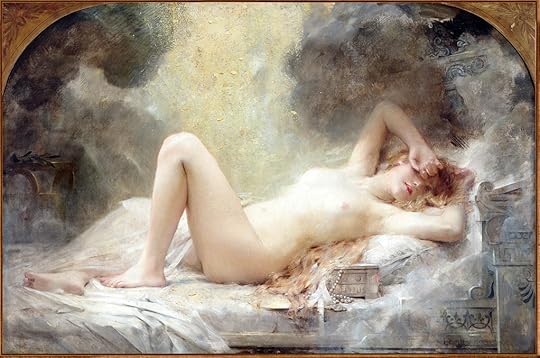
Léon Comerre - Danaë and the Shower of Gold (1908)
And this anthology does this movement no injustice! It is haunted with remnants of the perversities of life: of Eros (love) and Thanatos (death), of moral ambiguity, of the exotic and the horrifying. The tales it holds are told in the eyes of maniacs, addicts, murderers and harlots, all with the desire for lust and bloodshed. Though not all is gloom and doom; there are a few sprinkles of humor here and there. All in all, this anthology pictures Decadence in the best light, and hence it is recommended if you want to dip into the waters of such a rich literary movement.
Personally, out of all the tales listed in this collection, there are a few which piques my interest:
1. Danaette by Remy de Gourmont - This tale is essentially a modern rendition of the myth of Danaë: instead of the showers of gold, the character, named only as 'Madame', is showered with flakes of snow in all her nakedness. She is pleased, for she suspects the shower of snow is from the plucking of beautiful angels.
2. What the Shadow Demands by Catulle Mendès - This story concerns the main character's confusion as to why his shadow does not have a head. He wanders and wonders, until he hears news of the eruption of Krakatoa, to which he believes that the Day of Reckoning is nigh. To him, the only way to attain the salvation of humanity is to be like his shadow: headless; and what way to achieve that but through the guillotine—reserved only for the most monstrous of murderers.
3. The Tresses by Guy de Maupassant - Maupassant, the master of short stories, mustn't be introduced. In this story of his, the main character discovers inside his desk a plait of reddish-blonde tresses (a long lock of a woman's hair), which throughout the narrative, entrances him and drives him to the brink of madness.
4. Deshoulières by Jean Richepin - Out of all the decadent tales, Richepin's is the most comical. Especially Deshoulières , the character of the same name makes it his life's mission to be as unpredictable as possible, resulting in some ridiculous scenes worthy to laugh at.
5. The Little Summer-House by Octave Mirbeau - A tale of mysterious murder, Mirbeau recounts the interaction between two individuals: the main character wishing to sell his summer-house, and Jean-Jules-Joseph Lagoffin wishing to buy it. The purchase is made, and all is well until, some time surpasses, and the strangled body of a delicate girl is found in the house, with Lagoffin nowhere to be found. Should the main character tell the police of the crime? Or will he silence himself, lest the furniture of the summer-house confess against him—the licentious paintings of Fragonard, what grotesquerie could they tell?
Jean-Honoré Fragonard - The Bathers (1765)
What a movement Decadence is! The stories it tells, the sensations upon the readers it spells, never disillusions me. Like Danaë, it should be showered with showers of glistening gold—with praises of love and wonderment.

June 21, 2020
A fascinating collection, elegantly and excellently translated, edited, and curated by Stephen Romer. His footnotes, in particular were a surprisingly useful feature of the collection as gives not just the usual tidbits and citations but clues on interpretations as well. This may have been crossing an unwritten rule in the art of footnotes, but I found it added a fun element of dialogue between the reader and editor, as if he were whispering in our ears the whole time. His introduction is better read after the stories, which truly need no introduction to be appreciated. However, it reads very well as an aftermath to this deceptively short collection.
I say deceptively because, though it was so short, it took me about a month to read it. Perhaps because of the Covid ennui, but perhaps also because of the density of each tale--some only a couple of pages long--each was pretty heavy, and I needed time to digest. The introduction helped with this process, reminding me of each tale and it made me thoughtfully go over each one again.
I disagree with some of Romer's evaluations--I don't seem to find Bloy very funny and Mirbeau is meh to me. A lot of the ones I didn’t care for seem to be either too obsessed with being transgressive with body/corpse humor and/or were basically ‘be careful what you wish for’ stories ala Goosebumps.
Others, however, were glimmers of the “purple and gold” mentioned in Ducrey’s description of decadence quoted in the introduction. Maupassant is always fun to me, even when he’s not at his best. Romer calls him dark, but I find other storytellers have a far more cynical perspective. Schwob’s “The Sans-Gueule” a story about a woman who takes home two men that have had their faces blown off in a war and does not know which is her husband until one of them dies, is far darker and more uncomfortable. Jean Lorrain’s “The Man Who Loved Consumptives” would likely be one I’d assign in an intro course for undergrads on decadence—the title says it all.
In my humble opinion, the best tale of the collection is Jules LaForge’s “Perseus and Andromeda, or the Happiest of the Three.” It is a retelling of the myth with Andromeda trapped on an island by a monster awaiting her rescuer Perseus. But, in the retelling, the Monster is quite a nice guy, Andromeda is a bored teen, and Perseus is a Gaston-level fool—it has a sparkle of humor mixed with decadent descriptions and pure weirdness. The fun and unexpected ending is yet another wink at the camera.
Honorable mention goes to the opening story “Don Juan’s Crowning Love-Affair” for also having a sense of humor and panache. And Gustave Geffroy’s “The Statue” for being the best of the “be careful what you wish for” story. Overall, an excellent collection, even though I didn’t always enjoy every story. As Dorian says about the yellow book which poisons him: “I didn’t say I liked it….I said it fascinated me. There is a great difference.”
I say deceptively because, though it was so short, it took me about a month to read it. Perhaps because of the Covid ennui, but perhaps also because of the density of each tale--some only a couple of pages long--each was pretty heavy, and I needed time to digest. The introduction helped with this process, reminding me of each tale and it made me thoughtfully go over each one again.
I disagree with some of Romer's evaluations--I don't seem to find Bloy very funny and Mirbeau is meh to me. A lot of the ones I didn’t care for seem to be either too obsessed with being transgressive with body/corpse humor and/or were basically ‘be careful what you wish for’ stories ala Goosebumps.
Others, however, were glimmers of the “purple and gold” mentioned in Ducrey’s description of decadence quoted in the introduction. Maupassant is always fun to me, even when he’s not at his best. Romer calls him dark, but I find other storytellers have a far more cynical perspective. Schwob’s “The Sans-Gueule” a story about a woman who takes home two men that have had their faces blown off in a war and does not know which is her husband until one of them dies, is far darker and more uncomfortable. Jean Lorrain’s “The Man Who Loved Consumptives” would likely be one I’d assign in an intro course for undergrads on decadence—the title says it all.
In my humble opinion, the best tale of the collection is Jules LaForge’s “Perseus and Andromeda, or the Happiest of the Three.” It is a retelling of the myth with Andromeda trapped on an island by a monster awaiting her rescuer Perseus. But, in the retelling, the Monster is quite a nice guy, Andromeda is a bored teen, and Perseus is a Gaston-level fool—it has a sparkle of humor mixed with decadent descriptions and pure weirdness. The fun and unexpected ending is yet another wink at the camera.
Honorable mention goes to the opening story “Don Juan’s Crowning Love-Affair” for also having a sense of humor and panache. And Gustave Geffroy’s “The Statue” for being the best of the “be careful what you wish for” story. Overall, an excellent collection, even though I didn’t always enjoy every story. As Dorian says about the yellow book which poisons him: “I didn’t say I liked it….I said it fascinated me. There is a great difference.”

March 18, 2019
An admirable anthology of French fiction from the pens of fourteen finisecular authors, encompassing giants like Guy de Maupaussant (whose life wound up comparable to that of one of his creations) and the celebrated dandy Jules Barbey d’Aurevilly, as well as slighter figures like Pierre Louÿs, the érotomane (whose darkly comic ‘A Case Without Precedent’ belies his own preoccupations), and Remy de Gourmant whose lyrical tales linger somewhere between malaise and Mallarmé. These stories display distinctly Decadent continuities: madness, murder, decay, the sterility of routine and the boredom of bourgeois existence, a hypersensitivity to the passage of time; but each reveals a unique perspective on these persistent themes, some using contemporary settings (the brothel, the asylum, Paris) to fathom the fin-de-siècle, and others exploring the present through a mythological past as in Jules Laforgue’s ‘Perseus and Andromeda’. Like all good collections it sent me scrambling away to search for more from the collected; internet shopping may have its dangers but beyond four walls and one screen I’m at least safe from toppling into the Seine under a befuddling blanket of preternatural darkness or having my every act of charity, like Jean Richepin’s Constant Guignard, inverted into my own misfortune.

July 4, 2017
A very enjoyable—and at times disturbing—collection of French short stories from the Decadents. There is a good dose of madness to be found in these tales, a bit of the supernatural, crimes aplenty, myths, drugs, sex, and a general all-pervading bizarreness. This is a 19th century Decadent playground offering glimpses by gaslight into the unknown and the absurd.
There are some great French storytellers and stylists represented here, and some of these tales will surely point you in new literary directions, inspiring you to follow the authors of your choice down their own strange winding cobblestone alleys of scribbling.
An illuminating introduction and detailed notes provided by translator Stephen Romer sets the scene, and you will feel you are in good hands as you embark on this rather dizzying and dazzling literary journey into the dark heart of the Decadent Movement.
There are some great French storytellers and stylists represented here, and some of these tales will surely point you in new literary directions, inspiring you to follow the authors of your choice down their own strange winding cobblestone alleys of scribbling.
An illuminating introduction and detailed notes provided by translator Stephen Romer sets the scene, and you will feel you are in good hands as you embark on this rather dizzying and dazzling literary journey into the dark heart of the Decadent Movement.

July 10, 2019
Reviewing a collection of short stories is never easy because it really depends on the choices of stories and the authors and how they all mix together and how they stand apart. That said, I love decadence tales. I truly love the rich and thoroughly dark sense of humor that defines the Fin de Sicle era of literature and this collection is full of exactly that. If you loved 90s style satire, irony and sarcasm, this is definitely going to be up your alley. And then there's also the tales that are just so beautiful and twisted to read and they have a kind of haunting afterglow. Of course, I can't rave enough about Guy de Maupassant because he was one of the best of the time period but there is a lot more to enjoy in there. Some of it shines brighter than others and some is a little bit on the dull side but it's a great collection.

July 26, 2022
What a delightful discovery! Is it weird to get such enjoyment from a collection of stories that includes (but isn't limited to) murder, obsession, cannibalism, voyeurism, and necrophilia? Yes, these stories are "transgressive" in many ways, and embody the decadence advertised in the collection's title. But many of these tales also seem to have a whimsical or fairy-tale quality about them, as if they don't take themselves too seriously or are even surreptitiously winking at the reader. There is often such an over-the-top fixation on style and sinfulness that there almost seems to be an underlying allegorical lesson that instead advocates for the soul and salvation. But that contradictoriness is just part of the fun! My favorites include "Don Juan's Crowning Love Affair", "The Desire To Be A Man", "What The Shadow Demands", "Deshoulieres", and "The Time".

Read
July 9, 2024JULES BARBEY D'AUREVILLY Don Juan's Crowning Love Affair 1874
LEON BLOY A Dentist Terribly Punished The Last Bake The Lucky Sixpence
GUSTAVE GEFFROY The Statue
RÉMY DE GOURMONT Danaette Don Juan's Secret The Faun On the Threshold
JULES LAFORGUE Perseus and Andromeda
JEAN LORRAIN An Unidentified Crime The Man with the Bracelet The Student's Tale The Man Who Loved Consumptives
PIERRE LOUYS A Case without Precedent
GUY DE MAUPASSANT At the Death-Bed The Night A Walk The Tresses
CATULLE MENDES What the Shadow Demands
OCTAVE MIRBEAU The Bath The First Emotion The Little Summer-House On a Cure
JEAN RICHEPIN Constant Guignard Deshoulières Pft!
Pft!
GEORGES RODENBACH The Time MARCEL SCHWOB The Brothel The Sans-Gueule 52 and 53 Orfila Lucretius, Poet Paolo Uccello, Painter
VILLIERS DE L'ISLE ADAM Sentimentalism The Presentiment The Desire to be a Man
LEON BLOY A Dentist Terribly Punished The Last Bake The Lucky Sixpence
GUSTAVE GEFFROY The Statue
RÉMY DE GOURMONT Danaette Don Juan's Secret The Faun On the Threshold
JULES LAFORGUE Perseus and Andromeda
JEAN LORRAIN An Unidentified Crime The Man with the Bracelet The Student's Tale The Man Who Loved Consumptives
PIERRE LOUYS A Case without Precedent
GUY DE MAUPASSANT At the Death-Bed The Night A Walk The Tresses
CATULLE MENDES What the Shadow Demands
OCTAVE MIRBEAU The Bath The First Emotion The Little Summer-House On a Cure
JEAN RICHEPIN Constant Guignard Deshoulières Pft!
Pft!
GEORGES RODENBACH The Time MARCEL SCHWOB The Brothel The Sans-Gueule 52 and 53 Orfila Lucretius, Poet Paolo Uccello, Painter
VILLIERS DE L'ISLE ADAM Sentimentalism The Presentiment The Desire to be a Man
June 29, 2022
Great compilation from a very specific period and authors. Totally recommended to anyone interested in the french decadent writers.
Not all stories are amazing but most of them are, at the very least, beautifully written, and that's exactly what I was looking for, I'm thoroughly satisfied.
A warning, some stories are a bit concerning about their treatment of women, I didn’t like that very much though I understand it's from a different time. Still, it was dissapointing.
Anyways, as stated earlier the manner in which these stories are written is beautiful and varied. You can use this compilation as stepping stone for reading more material from the writers that interest you.
Not all stories are amazing but most of them are, at the very least, beautifully written, and that's exactly what I was looking for, I'm thoroughly satisfied.
A warning, some stories are a bit concerning about their treatment of women, I didn’t like that very much though I understand it's from a different time. Still, it was dissapointing.
Anyways, as stated earlier the manner in which these stories are written is beautiful and varied. You can use this compilation as stepping stone for reading more material from the writers that interest you.

March 11, 2020
Just when I thought the German decadents had outdone their masters, along comes this anthology to make me question my life choices. A stellar collection, exceeding "The Dedalus Book of Decadence"

August 2, 2023
I love collections of short works and this is a good one. Although Huysman, Blok, or Des Esseintes work is not included as they were well known at the time, this collection of B list writers is rather enjoyable. Some good laughs, some maudlin thoughts, some weird tales all are great.
October 18, 2025
Vraiment intéressant de lire des histoires de la fin du siècle. And the extensive introduction, notes and chronological history details really enhance the experience of reading these tales of decadence (though mild they may be in the context of today's crazy).

March 13, 2018
Ambassador to Sodom!

July 17, 2019
Ambassador to Sodom!
August 11, 2019
An engaging, bizarre and sometimes macabre collection. I had not previously read most of the selected authors.

October 10, 2019
An excellent collection of decadent fiction with fantastic notes. A great starting point for some looking for more obscure writers in the style
Displaying 1 - 30 of 34 reviews