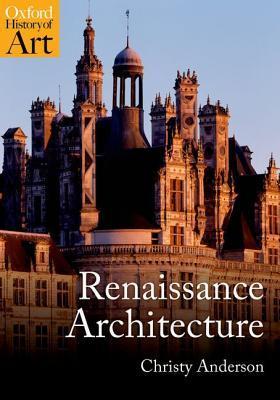
The Renaissance was a diverse phenomenon, marked by innovation and economic expansion, the rise of powerful rulers, religious reforms, and social change. Encompassing the entire continent, Renaissance Architecture examines the rich variety of buildings that emerged during these seminal centuries of European history.
Although marked by the rise of powerful individuals, both patrons and architects, the Renaissance was equally a time of growing group identities and communities -- and architecture provided the public face to these new identities. Religious reforms in northern Europe, spurred on by Martin Luther, rejected traditional church function and decoration, and proposed new models. Political ambitions required new buildings to satisfy court rituals. Territory, nature, and art intersected to shape new landscapes and building types. Classicism came to be the international language of an educated architect and an ambitious patron, drawing on the legacy of ancient Rome. Yet the richness of the medieval tradition continued to be used throughout Europe, often alongside classical buildings.
Examining each of these areas by turn, this book offers a broad cultural history of the period as well as a completely new approach to the history of Renaissance architecture. The work of well-known architects such as Michelangelo and Andrea Palladio is examined alongside lesser known though no less innovative designers such as Juan Guas in Portugal and Benedikt Ried in Prague and Eastern Europe. Drawing on the latest research, it also covers more recent areas of interest such as the story of women as patrons and the emotional effect of Renaissance buildings, as well as the impact of architectural publications and travel on the emerging new architectural culture across Europe. As such, it provides a compelling introduction to the subject for all those interested in the history of architecture, society, and culture in the Renaissance, and European culture in general.
Interesting account with great pictures. Very inclusive, dealing with much outside what would typically be considered 'Renaissance' architecture (i.e. Italian and Classical). This expands the account to traditions that were slower to abandon the Gothic tradition and to take up Classicism, with some particularly interesting results in Portugal, Germany and France, and Anderson concludes by questioning the perception of a discrete 'Renaissance' period within the Early Modern Era. As an engaging account for an intelligent outsider, it perhaps lacks something; there's little interest, say, in creating a narrative of development which would really provide explanatory depth in accounting for aesthetic change in the period. This perhaps reflects the work's expansion of scope from the traditional focus of certain architects (particularly Palladio) within the Italian trecento and quattrocento. I was vaguely tempted to knock off a star if it weren't for the academic virtue of an eclectic and inclusive account and for the occasional flashes of deep insight that are apparent when the ambitious breadth of focus gives a little and Anderson has some time for detail.
Christy Anderson’s Renaissance Architecture is useful, but it is a strange book if you come to it wanting a strong architectural argument or sustained building analysis. It often feels less like a history than a survey inventory organized by themes, with examples hopping from Italy to France to the Low Countries to England in a way that is meant to prove range. It dilutes force.
The central claim is that the Renaissance was not just a Florentine invention exported outward and later monumentalized in Rome, but a broader international phenomenon with multiple local expressions. That is a respectable argument in principle. It pushes back against the usual schoolbook version where everything begins with Brunelleschi, matures in Alberti and Bramante, and then radiates outward to the provinces. Anderson wants a wider map and a more plural story.
The problem is that the argument is simply inflated. Once the net gets cast too wide, “Renaissance” starts becoming a very baggy term, more a badge of period inclusion than a precise architectural condition. If Beaune’s town hall and the chateau Chambord are getting pulled into the case, you start wondering whether the category is being stretched to fit the thesis rather than the thesis emerging from the evidence. The internationalism is fine as a historical condition, but the book seems eager to flatten differences in order to prove it.
That flattening shows up in the treatment of major works. Only four sentences on Brunelleschi’s Ospedale degli Innocenti is a good example of what is frustrating here. That building is not just another stop on the itinerary. It is one of the clearest early statements of Renaissance order in built form: rhythm, measured proportion, civic dignity, the controlled use of classical language, and a new relation between facade and urban space. To brush past it so quickly demonstrates the book is more committed to coverage than judgment. You get a lot of examples, but not discrimination.
And that, to me, is the real weakness. A history of architecture needs selection. It needs hierarchy. It needs the confidence to say this building changed the game, this one adapts the language in an interesting way, this one is peripheral, this one is transitional, this one is being overclaimed. Anderson is reluctant to do any of that. So the book moves briskly, thematically, and comparatively, but at the cost of depth and weight.
There is still value in it. For a reader already grounded in the Italian core, the book is a useful corrective. It reminds you that architectural language traveled through courts, patrons, masons, prints, and diplomatic networks, and that “Renaissance” was perhaps never a neat, sealed Italian package. But as a reading experience it’s restless, even thin. You keep waiting for the moment when the book will stop cataloguing and really look. It moves on instead.
The book is too diffuse and too eager to internationalize the Renaissance at the expense of architectural seriousness. It broadens the map, but that’s it.
Christy Anderson writes with clear and direct prose, and broadens the scope of typical Renaissance architecture surveys in both geographical extent and analytical framework. She looks beyond the Italian peninsula to look at simultaneous gothic architecture flourishings in Northern Europe and the incredible legacy and continuities of Istanbul of Ottoman empire; while also expanding a wider survey of building types and protagonists. The ambitious scope of her work inevitably leads to a lighter read of the many buildings she cover; and although she covers in more detail the interconnection of architectural though via architectural treatises, sometimes, the buildings she looks at seem like islands because the connection between historical past is not explicitly stated.