

What do you think?
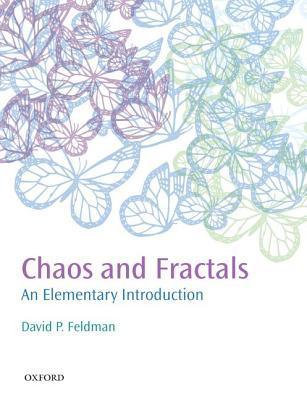
Chaos and Fractals: An Elementary Introduction
This book provides the reader with an elementary introduction to chaos and fractals, suitable for students with a background in elementary algebra, without assuming prior coursework in calculus or physics. It introduces the key phenomena of chaos - aperiodicity, sensitive dependence on initial conditions, bifurcations - via simple iterated functions. Fractals are introduced as self-similar geometric objects and analyzed with the self-similarity and box-counting dimensions. After a brief discussion of power laws, subsequent chapters explore Julia Sets and the Mandelbrot Set. The last part of the book examines two-dimensional dynamical systems, strange attractors, cellular automata, and chaotic differential equations.
The book is richly illustrated and includes over 200 end-of-chapter exercises. A flexible format and a clear and succinct writing style make it a good choice for introductory courses in chaos and fractals.
To request a copy of the Solutions Manual,
The book is richly illustrated and includes over 200 end-of-chapter exercises. A flexible format and a clear and succinct writing style make it a good choice for introductory courses in chaos and fractals.
To request a copy of the Solutions Manual,
408 pages, Hardcover
First published August 9, 2012
About the author
David P. Feldman
3 books7 followersDavid Feldman is Professor of Physics and Mathematics at College of the Atlantic. He is the author of two books: Chaos and Fractals: An Elementary Introduction (Oxford University Press, 2012), a textbook for non-math/science majors; and Chaos and Dynamical Systems (Princeton University Press, 2019), a contribution to the Primers in Complex Systems series. Dave has developed two MOOCs, one on Chaos and Dynamical Systems and one on Fractals and Scaling. These free, online classes are part of the Santa Fe Institute's Complexity Explorer project and have been taken by thousands of students. He is currently working on a textbook on renewable energy.
Dave has taught over twenty different classes in physics, math, and computer science at College of the Atlantic. He served as COA's Associate Dean for Academic Affairs from 2003-07. Dave served as Co-director of the Santa Fe Institute's Complex Systems Summer School (CSSS) in Beijing, China from 2006-08 and since 2017 has directed the Santa Fe CSSS. From December 2018 to August 2019 he was the Interim Vice-President for Education at the Santa Fe Institute. Dave was a U.S. Fulbright lecturer in Rwanda in 2011-12.
Dave is a theoretical and computational physicist whose research interests lie in the fields of statistical mechanics and nonlinear dynamics. He is the author of "Chaos and Fractals: An Elementary Introduction," Oxford University Press (2012), a textbook for non-science majors. This book is based on a course he has taught at College of the Atlantic for over a decade.
Dave has taught over twenty different classes in physics, math, and computer science at College of the Atlantic. He served as COA's Associate Dean for Academic Affairs from 2003-07. Dave served as Co-director of the Santa Fe Institute's Complex Systems Summer School (CSSS) in Beijing, China from 2006-08 and since 2017 has directed the Santa Fe CSSS. From December 2018 to August 2019 he was the Interim Vice-President for Education at the Santa Fe Institute. Dave was a U.S. Fulbright lecturer in Rwanda in 2011-12.
Dave is a theoretical and computational physicist whose research interests lie in the fields of statistical mechanics and nonlinear dynamics. He is the author of "Chaos and Fractals: An Elementary Introduction," Oxford University Press (2012), a textbook for non-science majors. This book is based on a course he has taught at College of the Atlantic for over a decade.
Ratings & Reviews
Friends & Following
Create a free account to discover what your friends think of this book!
Community Reviews
Displaying 1 - 2 of 2 reviews

June 3, 2013
I suppose not many people read books on mathematical equations, but if you do, I highly recommend this book!!! The author explains the concepts as clearly and simply as possible and you don't have have a degree in mathematics to follow the ideas. If you are a mathematician, the book is also excellent and you can skim through the first few chapters quickly. Simply an excellent book. I will soon be reading some of the books he suggests for further study.

September 15, 2026
What a wonderful textbook. Truly, chapeau to Feldman. He showed that an entry-level introduction to chaos and fractals is possible. Not only that, but I’m pretty sure it is a very good entry point whether or not you have the math background to dive right into a university-level presentation. Personally, I’m glad I agreed to go “below” my level (I took university math courses) because Feldman’s approach is so pedagogical that I believe it helped me grasp very well elementary and fundamental concepts that tend to be glossed over in university-level textbooks.
The key notions and equations are well explained and deconstructed, with a lot of graphs and figures to support them. Contrary to many math textbooks, logical jumps that leave you wondering if there’s a page missing are really rare. Chapters are short, and their purpose clear. Moreover, the exercises at the end of each one are really helpful. More than helpful: they often contain discoveries that you will make on your own! So they often anticipate material to come in a clever way. The exercises are also close enough to the examples provided in the text to be manageable.
As for proofs, they are often only sketched since the target audience is not assumed to have all the required tools to follow their full, rigorous versions. That said, the author always makes sure to provide the reader with a source where such full proofs can be found.
Chaos and fractals naturally bring up philosophical questions, many of which Feldman doesn’t shy away from, but rather gives a quick overview of what is at stake. It is not in every math textbook that one finds articles from the Stanford Encyclopedia of Philosophy referenced in the Further Reading section at the end of chapters!
On the negative side, two things have stood out to me. First, the second part of the text (on fractals) feels less fluid, a bit more disjointed. Second, I wish the link between chaos and fractals had been made clearer.
Overall, going through the book felt like a discovery journey, full of awe and insights. Highly recommended.
The key notions and equations are well explained and deconstructed, with a lot of graphs and figures to support them. Contrary to many math textbooks, logical jumps that leave you wondering if there’s a page missing are really rare. Chapters are short, and their purpose clear. Moreover, the exercises at the end of each one are really helpful. More than helpful: they often contain discoveries that you will make on your own! So they often anticipate material to come in a clever way. The exercises are also close enough to the examples provided in the text to be manageable.
As for proofs, they are often only sketched since the target audience is not assumed to have all the required tools to follow their full, rigorous versions. That said, the author always makes sure to provide the reader with a source where such full proofs can be found.
Chaos and fractals naturally bring up philosophical questions, many of which Feldman doesn’t shy away from, but rather gives a quick overview of what is at stake. It is not in every math textbook that one finds articles from the Stanford Encyclopedia of Philosophy referenced in the Further Reading section at the end of chapters!
On the negative side, two things have stood out to me. First, the second part of the text (on fractals) feels less fluid, a bit more disjointed. Second, I wish the link between chaos and fractals had been made clearer.
Overall, going through the book felt like a discovery journey, full of awe and insights. Highly recommended.
Displaying 1 - 2 of 2 reviews