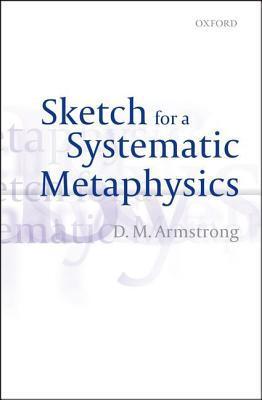
David Armstrong sets out his metaphysical system in a set of concise and lively chapters each dealing with one aspect of the world. He begins with the assumption that all that exists is the physical world of space-time. On this foundation he constructs a coherent metaphysical scheme that gives plausible answers to many of the great problems of metaphysics. He gives accounts of properties, relations, and particulars; laws of nature; modality; abstract objects such as numbers; and time and mind.
David Malet Armstrong (born 8 July 1926), often D. M. Armstrong, is an Australian philosopher. He is well-known for his work on metaphysics and the philosophy of mind, and for his defence of a factualist ontology, a functionalist theory of the mind, an externalist epistemology, and a necessitarian conception of the laws of nature. He was elected a Foreign Honorary Member of the American Academy of Arts and Sciences in 2008.
This little book on Metaphysics was an absolute joy to read. D. M. Armstrong is without a doubt one of the most interesting philosophers. This book is, essentially, a simplified overview of the important claims of his metaphysical system. He begins by noting that he takes Naturalism as a basic assumption, and then proceeds to develop, as coherently as possible, a metaphysical system that is based upon this basic assumption. This is a enjoyable read that covers almost all of the basic subjects that are debated in contemporary metaphysics.
Throughout the book he states his position, his reasons for it and a few alternative positions on the same topic.
Chapter 5, the longest chapter, is on laws of nature and requires a great deal of concentration. The chapter on states of affairs is also difficult.
He offers a theory of propositions in his chapter on truthmakers. He does not believe, like Frege, that there is a realm of prepositions. “I think that propositions are best understood as what appears after such phrases as “believes that“, “opposes that“, “entertains the thought that“, “doubts that“. There is something abstract about propositions but abstract in a more ordinary way than Quine’s “abstract objects“. I identify propositions as what is believed, what is supposed, entertained, doubted, etc. it is important to notice that propositions in this sense can include impossibilities. “
I like the use of limits. I do think his explanation of negative facts and absences is overly complicated and doesn’t work.
In his discussion of logic and mathematics he disagrees with Quine on the distinction between necessary and contingent truths. He agrees with Cantor that there are actual infinities in the world. I find that bizarre.
In the chapter on time, he disagrees with presentism and generally agrees with the growing block theory.
Of course, being a committed materialist, the mind poses a problem for Armstrong. He takes it up in the last chapter. He thinks he can partly explain away intentionality by linking perception to intentionality and then noticing the resemblance of intentionality to dispositions.
He does think that it is obvious that introspection developed because any acting system needs feedback.
In the end, he admits that he cannot refute the claims of quails and intentionality as an irreducible phenomenon.
And there the book ends. This a great refresher or introduction to the issues in contemporary metaphysics.
David Armstrong (d.2014) was an eminent professor of Philosophy who has focused on metaphysical issues throughout his academic career. He is well known for arguing a sparse ontology which insists that everything that exists does so within the spatial temporal framework of the universe. This means that he is opposed to abstract entities (like Platonic forms) and the book explores what the implications of that vision looks like, in terms of a systematic overview of metaphysics.
The book seems pitched as an introductory book. It is certainly relatively short and simple, and the chapters cover the main aspects (or ontology) of metaphysics, with separate chapters on properties, relations, dispositions, particulars, etc. In places the book even provides support for introductory readers, such as explaining counterfactuals (p61). However, in other places the book uses logical notation and moves relatively quickly in explaining philosophical concepts. This is because the book is also a statement of the author's mature philosophy after a lifetime of working within metaphysics.
While ideas are generally presented clearly, they move at pace on topics that are interesting but which do not directly support or impact upon the author’s systematic philosophical vision which he is outlining. For example, chapter 3 on relations ends by noting that there is certainly more that can be said on relations, but he is not going to say any more. This means that the chapter is not an exploration of the concept of relations. It is just an outline of the specific narrowly focused aspects of the topic which are involved in his wider systematic thinking.
While most chapters proceed with an unmistakable confidence, due to the author's lifetime of thinking about the issues, there are occasional places where the author is less confident. For example in chapter 4 he is explicit in admitting that the metaphysical status of ‘kinds’ is not entirely clear to him. Kinds are the categories (or universals) which are instantiated with particulars, like a piece of gold instantiates the kind (or category) of gold. The insistence that existents must have a spatio-temporal existence encounters difficulties with kinds because clearly there is a sense in which they cannot exist without an instance, and yet should we say that kinds can come in and out of existence (such as ceasing to exist when the last dodo died)? There are complications with differing approaches, some of which are explored, but some of which are ignored as they are not central to the vision which is being set forth.
The final chapter on the mind is where there are most problems. This is unsurprising for a philosophy which is trying to be firmly physicalist. The author is absolutely honest about the difficulties which his philosophy has in explaining mental phenomena like qualia and intentionality. He offers some suggestions towards an answer but they are tentative and fully recognise that this is the point where his (materialist) philosophical system is most challenged.
Overall, this is a particularly informative book for readers who want to engage with a complete and systematic view of metaphysics, especially from the analytic perspective. Many philosophy books just present problems and issues. It is refreshing to see an attempt to explore a coherent worldview and readers looking for that more rounded perspective will enjoy the presentation here, even if they do not agree with all aspects of it.