Jump to ratings and reviews
Rate this book

Memoirs

Rate this book
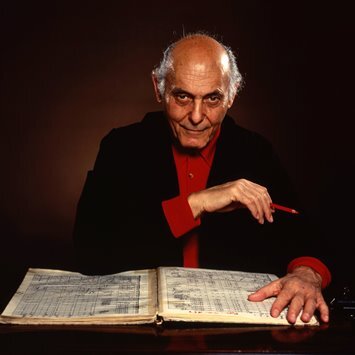
One of the great music makers of our time has written a memoir as rich in event and adventure as it is in its reflections on, and insights into, music.        


Sir Georg Solti, in these pages, relives an unparalleled musical life. He tells the story of a musical education that began in his native Budapest when his mother recognized and helped foster his talent. It continued with his studies at the rigorous Liszt Academy with Dohnányi, Kodály, Bartók, and Weiner, and a performance he heard of Beethoven's Fifth Symphony, conducted by Erich Kleiber, that forever set his destiny.          


He recounts his prewar experience coaching opera in Budapest, his exile in Zurich during World War II, and his work as music director of the Bavarian State Opera and life in postwar Munich. He then moves on to similar posts in Frankfurt and in London at Covent Garden. We watch as he continues his journey through the top ranks of the musical world and becomes, in 1969, director of the Chicago Symphony, a post he holds with brilliance and renown for twenty-two years. We follow him from 1991 on as he pursues for the first time the challenges and joys of the freelance conductor, working in Salzburg, Paris, Vienna, Berlin, New York, and St. Petersburg.        


Solti expresses his feelings and thoughts about Richard Strauss, Igor Stravinsky, and other great composers. He writes about conducting, and about Wagner's Ring cycle as well as operas by Mozart and Verdi, and symphonies by Mahler, Beethoven, and Bruckner. We see him continuously developing as an artist, constantly probing the composer's He describes how he found new insights into Beethoven's Ninth Symphony upon returning to it after many years, and how he approached new recordings of the Mozart operas and Wagner's Die Meistersinger ("This time I would come to it with my heart as well as my head ).          


His memoirs are filled with both hilarious and touching scenes of rehearsal and performance, as well as with stories of musical controversies. He speaks about the great musicians he has worked with, among them Toscanini, Walter, Furtwängler, Klemperer, Nilsson, Hotter, Domingo, and Rostropovich. Throughout, he reveals the pleasure of interpreting the composer's design, and the satisfying act of making a score come to life.        


Writing these memoirs, Solti has created yet another splendid musical event.

258 pages, Hardcover

First published October 21, 1997

2 people are currently reading
83 people want to read

About the author

George Solti

4 books

Ratings & Reviews

What do you think?
Rate this book

Friends & Following

Create a free account to discover what your friends think of this book!

Community Reviews

5 stars
30 (37%)
4 stars
34 (43%)
3 stars
13 (16%)
2 stars
2 (2%)
1 star
0 (0%)
Displaying 1 - 12 of 12 reviews
Profile Image for Quo.
343 reviews
April 14, 2022
As conductors go, Sir Georg Solti stands on hallowed ground; as autobiographies go, Solti's Memoirs is one of the best I've encountered. I speak as someone who doesn't play an instrument & can't decipher the notations on a musical score but who is enamored of classical music & what it takes to translate a composition into a fusion of sound that will uplift an audience.


I heard Sir Georg Solti conduct the Chicago Symphony Orchestra on many occasions but hadn't delved very deeply into his personal background, other than knowing that he was Hungarian & escaped the ravages of WWII & possible annihilation as a Jew in a country soon to be overrun by Nazis.

He fled to Switzerland in 1939 at his father's suggestion, thus delaying the development of a career, bereft of money & feeling exceedingly alone but very likely saving his life in the process. He never saw his father again.

He was born Gyögy Stern, with his name altered at his father's suggestion to make him appear "more Hungarian", thus bettering his opportunities as the son of a poor but loving family. From an early age, Solti excelled as a pianist, entering the Liszt Academy in the land of Bartok & Kodàly.

But even before the rise of Hitler & his Hungarian sympathizers, there was inherent prejudice against Jews within Hungary. Beyond that, his concentration on music caused Solti to feel shallow later in life.
What I did not realize as a boy was that my wonderfully concentrated musical education had a serious drawback: the neglect of my non-musical education. At 17, I was told "we're passing you as a favor both to you & to ourselves. We don't want to see you again." Everything I have learned since, I've learned on my own, by reading & through experience but there are still tremendous gaps in my education. I love literature & the humanities but I've had to learn about them piecemeal.
Solti spent the remainder of his life attempting to become an excellent pianist & especially a great conductor but also someone who called upon himself to fill the gaps in his narrowly-focused education. He had an insatiable love of music that was matched by his curiosity about life well beyond the concert hall.
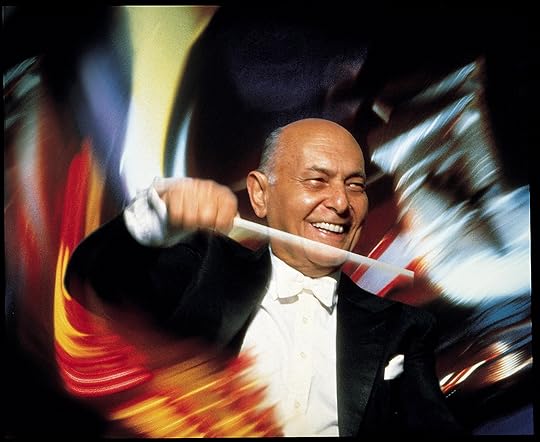


With the end of WWII, Solti took a position in Germany with the Bavarian State Orchestra & as a Jew, was asked to justify this by some fellow Jews. He responded that his desire to conduct represented an irresistible force, one stronger than anything else.
Sometimes I think, like Faust, I would have been prepared to make a pact with the devil & go to hell with him in order to conduct. This does not mean that I had chosen to ignore the atrocities of the Holocaust, or what had happened to my fellow Jews & indeed to members of my own family. However, in terms of my career I was effectively in a hopeless situation. With Europe in ruins, there was little need for another apprentice conductor.

I was strongly influenced by the words of Winston Churchill who said that Germany & France should work as partners to build a new Europe. Despite the horrors that had been perpetrated, we could not alter the past & 50 years later, I still believe that the only way forward was through a united Europe.
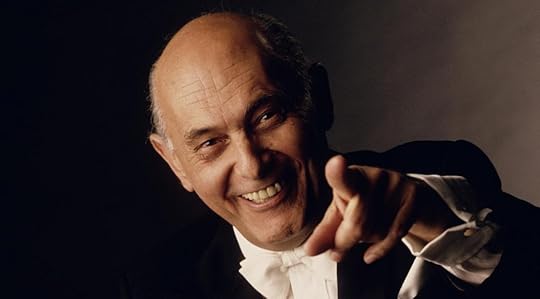
Solti's Memoirs teems with a sense of the fragility of life and a corresponding hope for a better future for mankind, which for him held music at its core.

Much of this book reflects the intersections with those who assisted Solti on his path to becoming a master at the art of conducting, among them Antal Dorati and Richard Strauss, the latter who befriended & counseled the fledgling conductor in 1949 just before the great composer died, this by way of a memorable meeting at the home of Strauss.


Additionally, Solti's progress was augmented by time with Kurt Herbert Adler in San Francisco during Solti's first visit to America and especially while serving as an understudy to Arturo Toscanini. But, echoing his desire to broaden himself, he was also moved by interconnections with Thomas Mann, Herman Hesse & Theodor Adorno.

As Solti moves on to Frankfurt & then Convent Garden, his conducting career expands but with a focus primarily on opera. In moving on to Chicago & the directorship of the CSO, he is determined to devote the bulk of his conducting to orchestral work, with an eye to to further enhancing & expanding his musical repertoire via new challenges.

He suggests that his three principal opera directorships involved a period of struggle while at Munich, a period of development in Frankfurt & a period of mature productivity at Covent Garden in London.

Solti's time with the Chicago Symphony becomes his most exalted time as a conductor because he brings that orchestra to a most esteemed level, seemingly knowing just what to reform & what to leave intact in replacing but not duplicating Fritz Reiner as its conductor.

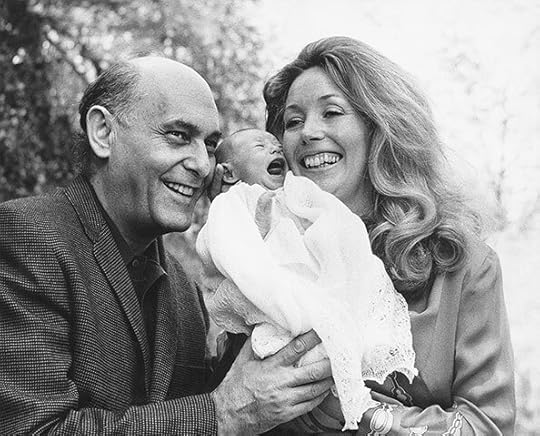
At the age of 57, Solti's life changes dramatically with the birth of his first child, this after a marriage to his new wife Valerie.


Part of the autobiography represents Solti's commentary on fellow conductors as well as composers, with an appraisal of almost every major classical composer. I found the section entitled "Music, First & Last" the best part of the book, a review of many of the key works of the western canon, including Beethoven's 9 symphonies + an admission that after 50 years conducting Strauss's Also Sprach Zarathustra, he still didn't fully know the work.

Solti completed the manuscript for Memoirs just a month or so prior to his death, at a point in his mid 80s when he continued to set new goals for himself. In summing up, Sir George Solti declared:
I have worked with colleagues of all nations, races & creeds and firmly believe that racial persecution & discrimination are evil forces that hamper the progress of the human race. The only way forward is for all citizens of the world to learn to respect & live alongside each other, embracing democratic principles such as freedom of speech & equal rights.

More than anything else, performing the Shostakovitch 13th Symphony, "Babi Yar", made me realize that a musician has a responsibility not to remain silent about political oppression.
Georg Solti's highly recommended autobiographical work combines the significant details of his life, acts as primer on classical music but perhaps most of all,conveys the late conductor's great hope for humanity.

*Among the excellent DVD collections displaying Sir Georg Solti's prowess as a conductor as well as his humanity are: The Maestro, a 4 DVD set with Solti conducting the Chicago Symphony & the Vienna Philharmonic Orchestras and also Orchestra!, a 2 DVD set with Solti demonstrating a very playful side in tandem with Dudley Moore.
23 reviews
March 18, 2019
This year I've been delving into biographies of conductors, starting with Leonard Bernstein, and I was so impressed by this autobiography from Sir Georg Solti. One of the most important conductors of the 20th century, Solti conducted the Chicago Symphony Orchestra for over 20 years and won 31 Grammy Awards from 74 nominations-the most that has ever been won by any musical artist in any genre. He still holds the record for Grammy wins in a lifetime.

Solti died when I was 5 years old, but I imagine his personality was much the way he comes off in his book: good-humored, patient, and fairly humble for a conductor, but decisive and direct without any fluff. By all accounts, Solti was a no-nonsense conductor known for his clarity of gesture and his book is also detailed and straightforward but concise. He could have gone on and on about productions but he tends to just state the facts, give details about the cast and how the performance went, and move on. I mostly knew him as a symphonic conductor from my years living in Chicago and because of the CSO's release of his complete works with them for the 20th anniversary of his death in 2017, so I was surprised and pleased to hear so much about opera, which I adore.

The fact that he sat down to write this at 80 years old and could still recount dozens of productions in minute detail decades later is incredible and I loved hearing about his impressions of players' and singers' abilities, the administrative intrigue of different venues, and his funny anecdotes about what goes on between the quirky personalities that often fill the opera pit. A personal favorite is near the end, when he describes stabbing himself with his own baton on accident...twice.

In particular, I enjoyed reading about Solti's long struggle to get anywhere as a musician, surrounded by the backdrop of early 20th century Europe. Living as a Hungarian Jew through World War II, working in post-war Germany, the struggles of getting work in Switzerland and having visas denied for America-all of it. Solti was a lucky son of a gun and often in the right place at the right time, but I could understand his frustration when he was working hard, developing his talent and understanding of music, and simply not the right man in the right time yet. The frustrated waiting is something I think all musicians can empathize with.

The book is pretty much chronological, with the very last chapter providing a large chunk of his pedagogy regarding individual works in his repertoire, with an excellent, concise (he's so consistent!!) appendix. Even though the book is mainly chronological, he does pause sometimes to complete an idea that begins at the point where it's being told but comes to full fruition several years down the line, which guides the reader a bit I think.

Solti is generally diplomatic and elegant, but sometimes gets his little final word in, but never too spitefully. In fact, the majority of the words on others in his memoirs are kind. The loving words and recollections in the book make for a very human portrait of Solti, and I was particularly touched by his love for his family, friends, and important colleagues.

There are only three or four books about Solti out there, and that's probably because the main one worth reading was written by the man himself, and fittingly completed just hours before his death in 1997. Conversational, affectionate, and amazingly detailed with great insights, and a lovely appendix, I would wholeheartedly recommend this book to all musicians, but it is a can't-miss read for aspiring conductors.

Chapter 1: Budapest
Chapter 2: Zurich
Chapter 3: Munich
Chapter 4: Frankfurt
Chapter 5: London
Chapter 6: Chicago
Chapter 7: The World (Freelance, Post-Chicago)
Chapter 8: Music, First and Last (Final Thoughts and Pedagogy)
Appendix: Works Conducted with Munich Opera, Frankfurt Opera, and Chicago Symphony
Profile Image for Evan.
1,086 reviews903 followers
September 17, 2011
"Toscanini once told his orchestra, 'I hate you all, because you destroy my dreams.' It was an overstatement, not least because he really loved his musicians, but it perfectly expresses the conductor's plight: You have a dream and you try to realize it; if your dream is destroyed, you suffer. Rehearsals exist in order to realize dreams." --Sir Georg Solti

Sir Georg Solti was one of the most feted musical conductors of the 20th century; director of one of America's Big Five orchestras -- The Chicago Symphony Orchestra -- for 22 years and winner of 31 Grammy awards, the most ever won by any single musical artist in any genre. This is his own story and it is written clearly and without pretense.

Books about conductors form an odd subgenre of interest for me, sort of in the same vein as books about mountaineers and mountaineering. In a sense I think both of these avocations appeal to me for the same reason: the idea of conquering a looming, unwieldy mountain; for surely that must be what it's like to tame a collective mass of 100 individual egos that make up a symphony orchestra. The challenge is to show them you are better than they are and make them ultimately bend to your will; orchestras are merciless entities that easily detect weakness and deficiences in their erstwhile leaders, and if you don't establish control early and decisively, they will break you.

Solti talks about that challenge and how long it took him to become the master that he did. But it was a long and hard struggle. In his own story, as we see here, there was a lot of luck involved, too. He was born and grew up in Hungary and thanks to a number of fortuitous circumstances managed to survive and eventually leave Europe as it plunged into war. He was a Jew and a nonestablished artist when he fled to Switzerland in the 1930s; he often was dependent on the kindness of strangers. He also found himself in the right places at the right times. He was able to quickly advance his career by exploiting the shortage of available conductors in Germany after World War II. While most of the major veteran conductors of Nazi Germany were out of commission in "de-Nazification" trials, Solti, a relative newcomer, was able to take a major music director's post at the Bavarian State Opera, something that would never have been offered to a non-German and to someone who was so young with such a brief portfolio.

The book is mainly chronological, though Solti frequently goes forward into time to complete a thought, which is the way I like biographical works to be done.
He recounts his career from the standpoint of his major posts in Munich, Frankfurt, London, Chicago and finally as a free-lance international conductor. Along the way, he dishes out some juicy anecdotes and even reveals some regrets.

For instance, he admits to treating his sister badly after she'd fled Communist-controlled Hungary for a brief period; he was too preoccupied with his career to provide the attention she needed. Similarly, he reminisces with regret about the lack of time to be with his children while being a famous conductor. A good deal of the book recounts various opera productions or symphonic concerts and recording sessions; these may be of less interest to the general reader but are of great interest to a music maven like myself. There are marvelous anecdotes interwoven along the way. In one, Solti recalls watching Sputnik with Herman Hesse from the roof of a Swiss hotel. In one he talks about his ravenous appetite causing him to eat too much fondue. There's a hilarious anecdote where Solti totally calls out Carl Orff -- to the composer's consternation -- for stealing a passage from Stravinksy's Oedipus Rex. He reveals that Stravinsky once told him he altered and simplified his score for the Rite of Spring simply because he was too old to conduct the original version. Solti gets in undoubtedly deserved digs at bitchy Chicago Tribune music critic Claudia Cassidy as well as the asshole musicians of the New York Philharmonic and the Orchestre de Paris.

He reveals behind-the-scenes details on building great orchestras, working with various egomaniacal producers and stage directors, benefactors and art mavens and the various quirks of prima donna opera singers, and the deficiencies of certain singers, who he mentions by name, especially when he conducted Wagner's Ring at Bayreuth in 1983. There's the inevitable clash with the diva, Maria Callas. He says that Renata Tebaldi was a better singer. He describes an amazing 80th birthday bash in 1992 hosted by Prince Charles and Lady Di and attended by a star studded entourage who performed for him, including Placido Domingo.

The book paints a charming portrait of musicmaking and education in Budapest in the pre-war era, including his experiences learning under such luminaries as Zoltan Kodaly and Bela Bartok. Solti learned in the grand tradition, rising through the ranks in opera house settings, which is the best trial by fire in forging a podium talent. The organizational and musical complications of working in opera are far more intense than merely working in a purely symphonic context.

It was interesting to read this only a couple of weeks after finishing a biography about Wilhelm Furtwanger, especially to see how his life intersected with places, people and institutions mentioned in that book, including Arturo Toscanini and Richard Strauss, with whom the young Solti had professional collaborations.

Solti is less forthcoming about his domestic life; he somewhat glosses over the last days of his marriage to Hedi and the circumstances of his second marriage to Valerie. This did not bother me as much as I might have thought; Solti manages to be deftly diplomatic, and in any case I was more interested in the musical aspects of his career.

In the last chapter, he offers revealing insight into matters of musical interpretation and the re-thinking of approaches to a musical score; on conducting being a constant learning experience.

There's a certain poignancy to the fact that Solti just barely managed to complete this book before his death in 1997. It reflects to some degree the good timing that marked his entire career.

The book is not especially cerebral. It is clear, direct and hits the highlights and moves along. Solti's musical conducting was largely no-nonsense and the hallmark of clarity, and this autobiography is very much like that. A recommended read for devotees of classical music.
12 reviews
April 15, 2025
Solti my goat😍😍😍🐐🐐🐐
Profile Image for Kay.
83 reviews6 followers
March 19, 2020
This memoir is organized by the major cities where Maestro Solti lived and worked, each city making a lasting impact on his life and career. He writes clearly and makes great characterizations of the people who enter his life. It is a book for opera lovers as he details every opera and opera star that he has conducted and/or coached. His experiences are broader than opera but very much wrapped up with music throughout his life. Bits of his personal life show up from time to time. His chapter on Chicago is very complimentary to the city and especially to the Chicago Symphony Orchestra. A good read.
Profile Image for Vince C.
96 reviews8 followers
July 8, 2022
A fascinating book. I found it very informative. I enjoyed learning about his life while starting out in the Operatic, and then Classical Music world. It was interesting to read about the exiled musicians in WW2, with Solti being one of them. I would recommend this one to anyone who has a love for music and the humankind.
Profile Image for Francis Martinez.
42 reviews
August 26, 2022
Sir George Solti lead the Chicago Symphony Orchestra for over 20 years. He was quite the celebrity in town. His memoirs are a good overview of his life but also a good primer on classical music. A fun read for me.
Profile Image for Kathleen.
94 reviews14 followers
March 29, 2012
This is one of the most honest and profound memoirs I have ever read, and gives incredible personal insight into the life and career of a conductor. Solti was one of the most competent and revered musical figures in the twentieth century, and deserved every ounce of praise he received. Humble, conversational, and constantly reverent of the composers music he performed, Solti's voice in his Memoirs is both comfortable and enlightening. A must-read for musicians, and indeed for anyone who has ever loved great art.
Profile Image for Ed.
364 reviews
June 8, 2009
An intereting life tale. Always interesting to get a peek behind the gold curtain, as it were. I have the Solti Ring, and Culshaw's book is on my reading list. I'm not much of a conductor connoisseur. Anywho, it's a good read. Hence this website. Bienvenidos!
Profile Image for Chip.
50 reviews2 followers
June 16, 2012
Pretty interesting book and definitely a good read for aspiring conductors.
Displaying 1 - 12 of 12 reviews

Can't find what you're looking for?

Get help and learn more about the design.