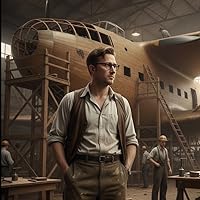
Chuck Yeager tells his whole life story, from childhood with a hard working father, to breaking the sound barrier, to being a test pilot with the "right stuff."
Brigadier General Charles Elwood "Chuck" Yeager, USAF.
Veteran of WWII and the Vietnam War. Achieved "ace" status during WWII, and post-war became the first pilot to break the sound barrier.
His decorations include the Air Force Distinguished Service Medal, Silver Star, Legion of Merit, Distinguished Flying Cross, Bronze Star Medal, Purple Heart, Air Medal, Air Force Commendation Medal, and the Presidential Medal of Freedom.
Chuck Yeager grew up poor facing hardships and personal tragedies, but his family provided for his necessities through a strong work ethic and the tough times were put in the rearview mirror. When he started school he was seated alphabetically noting:“I sat in the back in the daydreamer’s row with the other Ys.”. He professed that his dreams were not about flying, but like a fish to water he landed in aviation. Full of ambition and gifted with keen eyesight he literally soared to uncharted territory with success following his exhaust trail.
He was self motivated, consumed by aviation to the point that there was nothing he world rather do than fly a plane. Although he lacked a college education Yeager was so intrigued by every aspect of aviation including engineering that throughout life he remained his best mechanic. The WWII ace and Vietnam commander of 5,000 is best remembered for being the first test pilot to break the sound barrier. Dedicated to serving his country he rose to become an Air Force general. The man with “the right stuff” was presented Collier Trophy by President Truman, the Harmon International Trophy by President Eisenhower and the Peacetime Congressional Medal of Honor by President Ford.
The autobiography is just as much a testament to Yeager’s wife Glennis, whose name prominently graced his aircraft. In short order his young bride became a mother of four constantly moving from one remote airbase to another. With the understanding that her own gifts and talents may never be realized she gracefully accepted her lot in life. As a role model for military spouses she deserved her own award.
Yeager’s life story including Operation Golden Trout is a great historical account.
Chuck Yeager was one of my boyhood heroes, ever since I saw the IMAX movie "Speed" in the summer of 1986 at age 10. It was shortly after seeing that movie that I first read this autobiography, and I was absolutely enthralled to read bout Chuck's exploits such as (1) becoming an ace in a day by downing 5 Me-109s in a single engagement, (2) shooting down an Me-262 German jet fighter while flying a prop-driven P-51D Mustang, and of course, (3) breaking the sound barrier.
Now, reading it 33 years later, this time with the perspective of an adult who served as an Air Force officer in my own right (albeit not as a fighter pilot, as alas my depth perception was the polar opposite of Chuck's), I have an even greater appreciation for both the book and Chuck's exploits, something I'm reminded of every workday during my job at the Pentagon as I view the segment of the 4th floor wall dedicated to General Yeager's accomplishments.
Favorite passages:
--p. 3: "When President Truman presented me with the Collier Trophy in 1948 for breaking the sound barrier, my Dad attended the White House ceremonies, but refused to shake hands with the President. He glowered at Truman, acting like a revival preacher trapped into meeting the pope. s far as Dad was concerned, the first good Democrat had yet to be born." Ha, ha!
p. 322: "The way the best of us fought in Europe so many years ago is how the best of us fought in Korea and Vietnam. World War II may have been the last popular war, but that made no difference to guys who flew balls-out in Korea or up north in Vietnam. Military guys don't get to veto what wars we fight. Once a policy is decided, we are sent to enforce it. Sure, there are some wars that are easier to get behind than others, but for the most part, the guys fighting are only concerned with two things: winning them and staying alive while doing it."
p. 330: "Living to a ripe old age is not an end in itself; the trick is to enjoy the years remaining."
This was a summer read for me and a good one. The idea of the "as told to" autobiography did not appeal to me. For whatever reason it works here. Although this book burned up bestseller lists for months around the time I read it, I knew little about Yeager except for his supersonic flight in 1947. I also read this book before getting a chance to see "The Right Stuff," one of my favorite 1980s films. The man in this book comes off as a country boy who just lived to fly and cared little for fame. A great life story told by a likable companion.
2021-08-10 I read this in the 1980s, (date read is approx) probably not too long after it was published. I remember liking it very much, especially after finding out about him via Tom Wolfe's "The Right Stuff," book and movie.
What an amazing guy.
His WWII piloting experiences, and avoiding capture after being shot down in France. Being a military test pilot. Breaking the sound barrier. NOT being chosen as an Astronaut, because he did not fit the "criteria" despite having the "Right Stuff" that all looked up to.
Read this after Tom Wolfe's "The Right Stuff" and was drawn to the character of Chuck Yeager. Written in the first person Yeager's (with co-write Leo Janos) style is spare and lean. This is an easy read and would be recommended to anyone with an interest in the history of the US Air Force, NASA, and flying. Yeager appears to be a likeable, but somewhat taciturn guy whose courage and loyalty to his colleages, family and country is unquestionable.
I really liked this book. I had read Yeagers Wikipedia page and thought him a fascinating character. I really like autobiographies of interesting people and he certainly was that. It certainly isn’t warts and all but maybe he hasn’t any warts. If you like hunting, shooting, fishing, fighting, fast cars, fast planes, fast women, alpha male bonding, heroism, history and a nice unchallenging read, then this is the book for you. I do, and I liked this book.
I read this a lot of yeaars ago and really liked it, not only for Chuck Yeager's modesty while at the same time recognizing his achievements, but for his generally positive attitude. It's difficult to strike a balance atr times and I think this book does it well.
As soon as seeing the title of this book, people might think that it’s not their cup of tea. Many (who aren’t interested in aeroplanes and engineering) wouldn’t know who Chuck Yeager is. People who know about him don’t know him well — they think that he’s just a man who enjoyed his life by flying expensive toys. Many don’t understand what a legend he is. But, for the ones who know him well, he’s beyond a happy and successful human. He is a role-model. A hero. A man who shed light upon the dark path that led the world to the future of aviation.
People who had escalated themselves to this level of importance would be special people. So is General Chuck Yeager. This book doesn’t only make us realise how special he is. It also makes us understand the making of someone special. The book starts with the stories from Chuck’s notorious childhood that puts a smile on the readers face, while making a point that childhood is the most important part of anyone’s life. Chuck wasn’t an easy child that most parents of today desire to have. He was a real pain in arse. But as we progress into reading about his adulthood, and his early success stories, we begin to realise the fact that the only reason for his swift success is the individualism sculptured by his naughty and rough childhood — totally fearless adventure seeker who’s always thirsty for knowledge.
“The secret of my success is that I always managed to live to fly another day,” says Chuck. Throughout the book, he constantly speaks about the art of staying safe while exploring the limits of man and the machine. In Chuck’s vocabulary: “Being careful while busting arse.”
“Being careful” has a different meaning in Chuck’s dictionary. It just means “being aware” to him. In his life, Chuck Yeager accepted missions that many pilots refused to accept because of fear. The reason for that is, Chuck knew about the machines that he flew more than anyone else. He knew exactly about what they can do, and what they can’t do. He also knew what to do to make them do what he wants to do. He’s the perfect “aeroplane whisperer.” As a reader, while reading these episodes of days as a test pilot, we will realise the fact that nothing other than deep knowledge can propel a man towards success. Sensible work yields more than hard work.
Pages that tell the romantic story between Chuck Yeager and Glennis sound fantastic than most of the films and imaginary novels. Why wouldn’t it be, because it’s a story of a hero meeting an intelligent beauty and falling deeply in love with her — perfect recipe for making butterflies flutter in the heart of the reader. Chuck meets Glennis for the first time in a Gymnasium at Oroville. Glennis was a 18 year old high school graduate working at the gym’s office at that time, and Chuck was a 19 year old Airforce trainee pilot. He went to Glen’s gym to arrange an USO dance event, and this is how the conversation went:
Glennis: “You expect me to whip up a dance and find thirty girls on three hours’ notice?” Chuck: “No. you’ll only need to come up with twenty-nine, because I want to take you.”
It’s a custom for airforce pilots to choose a name for their aeroplanes. Pilots decorated their aeroplanes by painting those chosen names on the noses of their aeroplanes. Many pilots chose many different names, but Chuck always chose to paint “Glamorous Glenn” in the noses of the aeroplanes that he flew. Kids, that’s how real men do it.
Chuck was a spirited warrior. He loved dogfighting in the skies. He loved his duty in World War 2. He loved his duty in West Germany. He loved his duty in Korea and Vietnam. He never bothered about politics and other stuff. He loved flying, and he did it without questioning. Nothing reflects his attitude more than his days in Pakistan. During the 1971 India-Pakistan war, because of the Cold War and the crazy stir it caused in the global politics, USA and China supported Pakistan, and USSR supported India. As a token of support, USA decided to send Chuck Yeager as an advisor to Pakistani airforce. Chuck admits that he knew nothing about Pakistan or its history or anything. He admits that he didn’t know on whose side the righteousness was. He says, he went to Pakistan looking forward to adventure, and eager to complete the task assigned by his country’s leaders. “You’re not to question why. You’re just to do or die!” — the kind of spirit every nation expects its soldiers to have.
He wasn’t only a spirited warrior. He had the qualities of a great soldier as well. “How he reacts to defeat” is the yardstick that measures the greatness of a soldier. The way he reacted to the Pakistani defeat in the 1971 India-Pakistan war defines his greatness. Indians kicked the Pakistani butts in every humiliating way possible in the 1971 war. Chuck Yeager wasn’t annoyed by this humiliating defeat. Instead, he, throughout the war, was admiring India’s fighting skills. While bombing the Islamabad airport, an Indian Sukhoi Su-7 bomber reduced Chuck Yeager’s personal Beechcraft plane to ashes. He reacts to this humiliating event cooly by saying: “Well, that’s the Indian way of showing Uncle Sam the finger.” He almost said, “Well done, India,” after the war. Admiring the adversary — only great soldiers have this quality. This quality made him become friends with many of India’s finest fighter pilots after the war, when the relationships between India and USA took a turn and started becoming friendly.
The way he dealt with the politics in the Airforce gives us many life lessons. I personally learned: “No matter what the situation is, just tell what is in your mind. What you say might get you enemies. At the same time it will also get you admirers who’ll support you! Speaking your mind gets you people who love you for what you are.”
This autobiography is a great read not only for engineering and aeronautics enthusiasts. It’s a great read for regular recreational readers as well. The story it says is fantastic than many imaginary novels out there. The man it speaks about is a real life hero. The lessons it teaches are worthy. If I ever become a father in future, this book would be in the “must read” list of my kids.
Man, what a fun ride this book was! I felt like I flew every flight with Yeager, and stood in tears next to him for his farewell salute. It’s a great rags to ‘riches’ story, yet the riches are life experiences, and I was reminded how full life is when you make outdoor activities and fun a priority. Yeager was a fighter pilot to the hilt, so there’s a lot of wild living covered that I wouldn’t share with young readers. But I’d still put it on a list of books everyone must read, because it’s a great piece of history.
Gen. Yeager is undoubtedly extraordinary in many ways, but also very much a product of his upbringing and the cutthroat life he pursued. He makes no effort to mask or comment on his morals or biases and tells his story at face value. To that end, his book is very insightful not only to his personal experiences, but to the time and place they come from.
Yeager's remarkable career in the Air Force serves as a profound source of inspiration for me. In this book, he maintains a refreshing humility, crediting his successes to luck and chance. I aspire to achieve even a fraction of what he has accomplished in his life. Ultimately, I hope to echo his sentiment and be able to say that I, too, have “had a ball.”
Chuck Yeagers story is so extreme that if you made it up nobody would believe you. His attitude towards everything is refreshing and instructive and could best be described as pedal right though the metal
If I could jump inside one person's head Being-John-Malkovich style and experience their entire life, beginning-to-end, without regard to anything but the sheer roller coaster thrill of it, I'd probably pick Chuck Yeager. (Granted, the guy's not dead yet. But unless he meets a truly horrendous end--eaten alive, say, by Bengal Tigers, while slow-roasting over a barbecue pit--I'd consider myself a truly lucky man to see everything he's seen and do everything he's done.)
Ripping through the sound barrier in a bullet-shaped orange rocket plane, battling Messerschmitts in the cold European skies, testing exotic aircraft of all shapes and sizes in the bleak Mojave desert, hunting and fishing and hiking the high Sierras, hooting and hollering with friends on crazy drunken misadventures--it all sounds too fun to be legal, and except for the hooting and hollering part, I haven't done any of it.
What's more, he lived the kind of life that people don't seem to believe in anymore, the life of the self-made man who rises from nothing, who picks himself up by his own bootstraps and succeeds through good ol' Yankee Doodle initiative, ability and gumption. One of the nice things about this book, though, is that he doesn't rub it in. He's the first one to acknowledge how lucky he's been to live the life he's lived and live to tell about it. An upside-down-bolt on an airplane aileron, parachute shroud lines that almost burnt through after an ejection gone awry--any of these things could have ended this remarkable life long before old age, and he knows it.
Beyond the good luck, though, he knew enough not to press his luck. One realizes, reading this book, that Yeager's flying career's remarkable not because he took chances, but because he didn't get so cocky and full of himself that he took one chance too many. In the test pilot business, it's better to fade away than to burn out (or up).
I last read this when I was a kid, not long after it came out--I'd been blown away by "The Right Stuff" and was nuts about everything aviation-and-space related. I don't think I've seen it in twenty years, but I've had a hankering to read it for a while now, so I picked it up, put down the boring weighty intellectual tomes I usually read, and ripped through it in a couple days, eagerly smuggling it into the bathroom at work to steal some pleasure out of the boring workday. I'll never live this life, never get a pilot's license--with my narcolepsy and my bad eyes, I probably shouldn't even have a driver's license--but thanks to this book I can live Chuck Yeager's life vicariously, for a couple days, anyway.
Flying fighters in WWII over Europe, he already made a name for himself, but his real 'fame' came after WWII by breaking the soundbarrier. Yes, this was a historical moment in history and for himself, but there is so much more that was important and groundbreaking. It was an era that saw new technology pop up almost every day, so they often developed next to each other. Over his career he flew more than 10,000 flight hours and 300+ aircraft or so. This also means that he has a lot to tell.
In this book we get to know the young Chuck Yeager and follow his adventures during the war, his escape from occupied Europe, and his return to the air war over there. Something that was usually not permitted. Next we see how his career developed after the war. He states himself that he was lucky to be born in 1923 so he could witness, and take part in, the development of the jets and rocket aircraft, and be part of the people to see humankind go to space. The stories are well told, hair raising at times, but also filled with humor. He flew with all kinds of people and encountered many obstacles, but his sure will to perform made him go on. Obviously he did things that could be considered reckless, but on the other hand his understanding of the aircraft he flew and the way they ticked made him a very special pilot. Probably the best of his time!
The stories as told by Chuck are accompanied by those of other pilots and friends which show how special this man was.
Loved the WWII dogfight scenes, and just about all of the action scenes for that matter. He certainly had guts, and I appreciate his long military service. His personal life, and his comments looking back on it as a 60+-year-old, was much less appealing.
The book was written like an autobiography with commentary from his wife and associates. That structure was brand new to me, and I didn't like it--made for lots of repetition and strange "Oh he was so amazing!" moments on the one hand while he unconvincingly feigns humility on the other. When his wife comments, some of it is really unsettling. She and Yeager were certainly candid, I'll give them that. She writes, for instance, that when fighter pilots were gone from home a lot, they most likely took advantage of the situation and "shacked up" with other women along the way. She advised fellow military wives, though, that as long as they ignored the conduct and convinced themselves it wasn't important, the marriage was fine. Though Yeager thankfully doesn't go into detail about it, he confirms this free-for-all lifestyle several times. Seems like an awful way to live as husband and wife, but what really surprised me was that they even wrote about that at all, and unapologetically too. I guess he wasn't trying to portray himself as someone he wasn't, laying everything out on the table, warts and all, but it was definitely disturbing.
I saw General Yeager speak at the Pacific Aviation museum and he was absolutely hilarious and that was what prompted my reading this book - that and I liked that movie The Right stuff - and my little brother is in the AF so... gotta represent! I really enjoyed this book but I must admit that the parts I enjoyed the most were not about Yeager - they were about two extraordinary and unique women in his life - Pancho Barnes and Jackie Cochran. I'm wondering if there are biographies of them because I couldn't get enough. I also found it interesting that while Yeager spoke so brilliantly about these two ladies, and painted such a vivid picture of their unique characters, I walked away from this book feeling as though his wife, Glennis was a stranger. Even the parts that were in 'her voice' (from her writings and interviews etc) left a colorless rendition of Yeager's longtime wife. Sometimes the reading got a little too technical for the non aviator me, and I couldn't keep any of the airplane acronyms straight (I didn't really expect to...) but I enjoyed Yeager's bluntness and humor and he tells his stories with that typical Air Force swagger that makes you admire those pilots no matter what their faults are.
This book moved me. From General Yeager's humble West Virginia upbringing to getting shot down in WW2 & evading the Germans, breaking the speed barrier, helping train NASA pilots, fighting in Vietnam and his UNREAL wife raising the family. It really is a must-read. Oh wait, he is still living too!!
#LIVINGLEGEND
"He was, without question, the best pilot this country ever produced" Dick Frost
"If you love the hell out of what you're doing, you're usually pretty good at it, and you wind up making your own breaks. Other than being forced by circumstances to live apart from Glennis, I was happy as I ever was... Rank didn't mean a whole helluva lot, except that I needed more money. If they had decided to make me a general, my first question would've been: Do general get to fly? I wasn't a deep sophisticated person, but I lived by a basic principle: I did only what I enjoyed. I wouldn't let anyone derail me by promises of power or money into doing things that weren't interesting to me. That kept me real and honest." Gen. Chuck Yeager
So good. I grew up next to Wright field but didn't realize Yeager had tested planes here before the program moved to Edwards. I had an uncle who also tested planes there in the sixties and I really wondered if it overlapped at all.
Yeager's calm under pressure is amazing. Upon landing a plane on a farm and hitting a chicken coop, smokehouse and coming to rest alongside the house's kitchen window where the wife was doing dishes he simply opened the canopy, smiled and said, "Morning ma'am, Can I use your telephone?"
He's also tough. After being in a helicopter that went in a lake and having his head laid open down to bone he got tired of waiting for a General hiking nine miles to get help and set off with three other guys before dropping them four miles in and arriving just as the General was making the call for help. He ended up with 138 stitches.
Yeager does a great job making you feel like you're with him throughout his amazing career.
I've heard the name, but knew almost nothing about him until I read this book. He was famous for being the first pilot to break the sound barrier in an experimental aircraft when even scientists were unsure it was possible, but before that he was a combat dogfighter pilot in World War Two who had been shot down and even managed to get back to friendly lines after a long struggle, and went back to his old career when he decided to stop being a test pilot after too many near-fatalities, that he had unusually sharp eyesight and he attributed his survival to long piloting experience but also to sheer good fortune, and his accounts of rivalries between different test pilots and military officers. He also gives plenty of credit to his family and friends for their support and patience.
While there are plaster saint and heroes who have turned out not to be so heroic, there is nothing to indicate that Yeager was anything but real.
I read a lot of astronaut and pilot autobiographies, and a lot of times the authors include way too much jargon and dry technical details, losing a lot of the impact of the story. In this book, however, General Yeager assembled an incredibly well-written and engaging account of his life and flying career that is also a joy to read. He is confident and unapologetic yet humble about his incredible accomplishments, and the sections contributed by his wife, colleagues, and friends add interesting perspective to many of the events.
This book really gives great perspective on the evolution of fighter aircraft. Though a bit technical at times, he never loses you. Great stories on WWII, and how Yeager was the best out there. Really enjoyed hearing about the toll on his family life and all the inherent risks involved with doing a dangerous job, but doing something that you love.
I enjoyed this interesting, well written and modest biography. Including the perspective of his friends, wife and colleagues was entertaining and helped give insights into his character. I appreciated being introduced to aviatrixes Jacqueline Cochran and Pancho Barnes too.
Rollicking Robin - what a life! General Yeager is real-life living legend. Amazing achievements, attitude and guts. Truly made of the right stuff. Highly recommended.
Before I flew a plane myself I didn't fully appreciate how dangerous and deadly flying actually is. Maybe I got used to the surety and simplicity of the large commercial turbo fan jet that takes us on our holidays. I hadn't experienced first hand that if we go too slow or adopt the wrong angle at the wrong speed our plane will literally drop from the sky. I hadn't thought too much about deadly crosswinds, engine failures or electrical fires, or about finding an emergency landing strip while flying 1000 feet over a city. So perhaps I would not have been so interested in this book. I would not have appreciated in any practical sense what an extreme experience was pretty much the whole of Chuck Yeager's life!
Chuck Yeager was a country boy from West Virginia. He grew up shooting and hunting and always had a passion for adventure. He flew Mustang P51s during WW2 over Europe and was shot down shortly after becoming an ace (5 enemy kills). He hid out in occupied France, was rescued by the French Marquis and made it all the way to Spain. He could have returned to the US a war hero at this point but he forced a military exception by being allowed to return to England to fly again against the Luftwaffe. By the end of the war he was a double ace and returned to the US a double war hero.
Although the end of WW2 should have marked an era of peace, it only led to a new conflict with the Soviet Union which resulted in the Korean War and Vietnam. During this time there were great leaps in technology. A battle for speed and lethal effectiveness. During this time Yeagar became a test pilot and literally risked his life on a daily and hourly basis to prove the scientists either right or wrong. Many other young men were tragically killed when their lives were wiped out by a design flaw or by trying to do something impossible at that time on the plane spec checklist. Detailed in this book are Yeager's own experiences with the Lockheed P80, the P84 Thunderjet, the F86 Sabre, the F104 Starfigher and the Phantom F4. In addition to this is ample detail about the events Chuck Yeager is most famous for. That of being the first to break the sound barrier in the X1 test plane.
Outside of the pure flying there are alot of details concerning the life of Chuck Yeager. Despite his lack of education he made it all the way to Brigadier General. He lived to 97 and continued to be active until his last days. He saw personal tragedy during this time including the loss of his dear wife Glennis, married from 1945 to 1990. He recognised that there were 'all kinds of courage in life'. 'You back up, but you don't give up'. 'Just keep doing what you can for as long as you can'.
If you are looking for a true 'American Hero' I recommend you look no further than this book. Exciting and inspiring.
If you want to read a book about an absolute rip-roaring, hell-raising badass, read this autobiography of Chuck Yeager, the best fighter pilot that has ever lived.
I don't even know where to start with this book - the most fun I've had reading in a long time. Yeager grew up a poor country boy in West Virginia, where he developed a lifelong love of hunting and fishing, the outdoors, and machines. Though not educated past high school, Yeager had an engineer's mind and obsession with machinery and how things work - that, along with his extraordinary eyesight and coordination and calm under pressure, is what made him such a great pilot. He understood his planes the way that great equestrians understand their horses - and when things went wrong (as they often did when he became a test pilot), he could figure out how to fix them, even in the midst of a spin-out, drawing on that catalogue of knowledge and experience, and his instinctive sense for how planes work.
As Yeager says, he was born at exactly the right time - he graduated high school right before the US entered WWII, and despite his extraordinary accomplishments over a lifetime, he still says he never had as much fun as he did dogfighting in WWII. He then became an Air Force test pilot at the most exciting period of the Golden Age of Aviation - when supersonic jets were being developed, and he was test-flying them all. He was also lucky to come up through the Air Force at a less regimented time, when his hell-raising ways were tolerated. If Yeager had not joined the military, he surely would have ended up in jail - the guy is just a complete animal.
And it was that aggressive, wild spirit that also made him a great pilot - he loved risk, and pushing things to the absolute limit, and that combined with his precision, and careful study of the mechanics of flying made him the absolute best.
I really liked the way this book is structured - a chapter by Yeager, and then an interlude from someone who knew him - fellow pilots, military brass, and his wife. Though probably not a feminist (he was a man of his time and place), its interesting how much space Yeager gives in the book to the important women in his life - his wife, who he discusses with real respect for her strength and the sacrifices she made to enable his career, and two female pilots - Jacqueline Cochran (the WWII head of the Womens Airforce Service Pilots and later an extremely wealthy and powerful figure) and Pancho Barnes (the owner of an infamous bar - and maybe brothel - in the desert frequented by pilots at Edwards Air Base).