

What do you think?

History of Imperial China #6
China's Last Empire: The Great Qing
In a brisk revisionist history, William Rowe challenges the standard narrative of Qing China as a decadent, inward-looking state that failed to keep pace with the modern West.
The Great Qing was the second major Chinese empire ruled by foreigners. Three strong Manchu emperors worked diligently to secure an alliance with the conquered Ming gentry, though many of their social edicts―especially the requirement that ethnic Han men wear queues―were fiercely resisted. As advocates of a “universal” empire, Qing rulers also achieved an enormous expansion of the Chinese realm over the course of three centuries, including the conquest and incorporation of Turkic and Tibetan peoples in the west, vast migration into the southwest, and the colonization of Taiwan.
Despite this geographic range and the accompanying social and economic complexity, the Qing ideal of “small government” worked well when outside threats were minimal. But the nineteenth-century Opium Wars forced China to become a player in a predatory international contest involving Western powers, while the devastating uprisings of the Taiping and Boxer rebellions signaled an urgent need for internal reform. Comprehensive state-mandated changes during the early twentieth century were not enough to hold back the nationalist tide of 1911, but they provided a new foundation for the Republican and Communist states that would follow.
This original, thought-provoking history of China’s last empire is a must-read for understanding the challenges facing China today.
The Great Qing was the second major Chinese empire ruled by foreigners. Three strong Manchu emperors worked diligently to secure an alliance with the conquered Ming gentry, though many of their social edicts―especially the requirement that ethnic Han men wear queues―were fiercely resisted. As advocates of a “universal” empire, Qing rulers also achieved an enormous expansion of the Chinese realm over the course of three centuries, including the conquest and incorporation of Turkic and Tibetan peoples in the west, vast migration into the southwest, and the colonization of Taiwan.
Despite this geographic range and the accompanying social and economic complexity, the Qing ideal of “small government” worked well when outside threats were minimal. But the nineteenth-century Opium Wars forced China to become a player in a predatory international contest involving Western powers, while the devastating uprisings of the Taiping and Boxer rebellions signaled an urgent need for internal reform. Comprehensive state-mandated changes during the early twentieth century were not enough to hold back the nationalist tide of 1911, but they provided a new foundation for the Republican and Communist states that would follow.
This original, thought-provoking history of China’s last empire is a must-read for understanding the challenges facing China today.
368 pages, Paperback
First published January 1, 2009
About the author
William T. Rowe
12 books8 followersWilliam T. Rowe is an historian of China, and John and Diane Cooke Professor of Chinese History, Department of History, The Johns Hopkins University.
Ratings & Reviews
Friends & Following
Create a free account to discover what your friends think of this book!
Community Reviews
Displaying 1 - 30 of 49 reviews

January 23, 2022
I think this book was my favorite of Harvard University Press’s History of Imperial China series. Which is a bit irritating as it’s also the last. But they finally got the formula right. The thematic and anti-narrative approach of the early books was just too dogmatic to really work, but sticking all narrative in the first third the way The Age of Confucian Rule did wasn’t much better. Here we start off with a very clear, if not overly detailed, account of the Qing takeover. The passage of time is obvious throughout the book, as it must be given the slow disintegration of later Qing as they come into conflict with the imperialist powers of the West. Yet it manages to maintain its thematic focus by carefully selecting which themes to cover when. Society and commerce, for example, are covered at the beginning when the Qing are firmly in command and unchallenged by rival cultures. Then, after a series of chapters on unrest (internal and external) we get one on their attempted reforms and Qing imperialism. The latter topic may seem oddly placed here, but the point of its argument is that the Qing were not just victims but rival imperialists in their own right, and much of how they later failed to adapt was due to that incongruity.
The book promises to redirect the focus away from descriptions of decline and external conflict that define other books. Its success on this is mixed. In the first half, before the rot really starts to set in, it does well at engaging with the Qing on their own terms. We see how they organized their society and the way that Qing society hardly represented an unchanging traditional way of life lasting millennia. They were busy little bees, with a booming internal market and prospering external trade (despite restrictions. When we get to the second half though... well, it’s really hard to avoid making the story one of failure to adapt and foreign conquest when that’s pretty much what happened. Oh, the focus is different. We’re not told the story from a European perspective. But while it looks a little different in presentation it’s not a huge change from the traditional account. I probably wouldn’t have even commented on this if he hadn’t stated in his introduction that one of his goals was to avoid this stereotypical presentation. The danger of needing to seem more radical a revision than it is I suppose.
The book also has a clear thesis. The last book had one too, which is kinda funny, but none of the others did. I found that it really helps as these two are my favorite of the bunch. The thesis is that the Manchus did not represent a clear and distinguishable race compared to the Han Chinese, and that they only started to develop their conception of themselves as a race apart late in the dynasty in response to perceived threats. The irony in this of course is that the creation of a Manchu racial identity ensured that they would have that identity crushed once China started to absorb Western ideas of nationalism and ethnically-pure nation-states. Once you start to see how effective your enemies are organizing based on nationalism it becomes very easy to identify your foreign rulers as the cause of all your failings.
I really enjoyed this book and wish that there were more. I find the lack of books on pre-imperial China quite striking – where are our accounts of the Warring States Period? And while there are many good books on modern China, it might be nice to see some that are presented as the culmination of millennia of history. But as the conclusion to this series it does its job well. We learn a lot about how Qing China operated and see why the reforms of the earlier period were ineffective in the later period. For a lot of the other books I always say you need to read a general history book to really understand where things fit in, but with this book I think you’re fine on your own. A very good mix of narrative and thematic topics grouped together logically and insightfully.
The book promises to redirect the focus away from descriptions of decline and external conflict that define other books. Its success on this is mixed. In the first half, before the rot really starts to set in, it does well at engaging with the Qing on their own terms. We see how they organized their society and the way that Qing society hardly represented an unchanging traditional way of life lasting millennia. They were busy little bees, with a booming internal market and prospering external trade (despite restrictions. When we get to the second half though... well, it’s really hard to avoid making the story one of failure to adapt and foreign conquest when that’s pretty much what happened. Oh, the focus is different. We’re not told the story from a European perspective. But while it looks a little different in presentation it’s not a huge change from the traditional account. I probably wouldn’t have even commented on this if he hadn’t stated in his introduction that one of his goals was to avoid this stereotypical presentation. The danger of needing to seem more radical a revision than it is I suppose.
The book also has a clear thesis. The last book had one too, which is kinda funny, but none of the others did. I found that it really helps as these two are my favorite of the bunch. The thesis is that the Manchus did not represent a clear and distinguishable race compared to the Han Chinese, and that they only started to develop their conception of themselves as a race apart late in the dynasty in response to perceived threats. The irony in this of course is that the creation of a Manchu racial identity ensured that they would have that identity crushed once China started to absorb Western ideas of nationalism and ethnically-pure nation-states. Once you start to see how effective your enemies are organizing based on nationalism it becomes very easy to identify your foreign rulers as the cause of all your failings.
I really enjoyed this book and wish that there were more. I find the lack of books on pre-imperial China quite striking – where are our accounts of the Warring States Period? And while there are many good books on modern China, it might be nice to see some that are presented as the culmination of millennia of history. But as the conclusion to this series it does its job well. We learn a lot about how Qing China operated and see why the reforms of the earlier period were ineffective in the later period. For a lot of the other books I always say you need to read a general history book to really understand where things fit in, but with this book I think you’re fine on your own. A very good mix of narrative and thematic topics grouped together logically and insightfully.

February 18, 2019
This is sadly the sixth and last book in Harvard's 'History of Imperial China' series, edited by Timothy Brook. If only there were further dynasties following the Qing the saga could continue. Although the series featured several different authors, it has held together as a whole in style and content. Most of the previous features of the series are well represented in the present volume.
William T. Rowe does a good job in just under 300 pages synopsizing the past and current historiography of the Qing. In the 20th century seen as a failed state, stagnant and insular, the Qing are re-interpreted as an expansionist multi-ethnic enterprise. Rowe takes us through the Ming overthrow , the 'Golden Age', the Taiping Rebellion, and the Republican challenge, 300 years in all.
True to form, thematic chapters on government and economy follow the chronological material. Noticeably absent are the sections on religion, family, and literature that figured prominently in previous volumes. This is unfortunate as those parts transformed the series from standard texts into something more holistic. It's curious editor Timothy Brook didn't demand more.
This last installment is nonetheless well written and up to date. If it does not quite measure up to the breadth of the prior books, it is still worth reading if you've come this far and don't know how the story ends. Altogether six volumes of roughly 350 pages each combine to a work of over 2000 pages. It is not an inconsequential contribution to recent surveys available.
William T. Rowe does a good job in just under 300 pages synopsizing the past and current historiography of the Qing. In the 20th century seen as a failed state, stagnant and insular, the Qing are re-interpreted as an expansionist multi-ethnic enterprise. Rowe takes us through the Ming overthrow , the 'Golden Age', the Taiping Rebellion, and the Republican challenge, 300 years in all.
True to form, thematic chapters on government and economy follow the chronological material. Noticeably absent are the sections on religion, family, and literature that figured prominently in previous volumes. This is unfortunate as those parts transformed the series from standard texts into something more holistic. It's curious editor Timothy Brook didn't demand more.
This last installment is nonetheless well written and up to date. If it does not quite measure up to the breadth of the prior books, it is still worth reading if you've come this far and don't know how the story ends. Altogether six volumes of roughly 350 pages each combine to a work of over 2000 pages. It is not an inconsequential contribution to recent surveys available.

November 9, 2018
Very readable and enjoyable overview of the Qing dynasty, starting with its origin in Manchuria and ending with its sudden disappearance in the republican era. A lot of attention is paid to addressing ethnic and cultural ideas (the Qing emperor's were not Han Chinese) but in broad terms. Rowe asserts that there was a visible, recognisable distinction between 'Manchu' Qing as late as the 19th century, but there's no attempt at justifying this distinction between the Han seeming to resent the Manchu. It would have been interesting to see how deep this distinction was - whether the Manchu subjects had a sense of superiority over the Han. But this isn't really addressed. I would also have appreciated more focus on the origins of the dynasty as its overview is fairly cursory, but this is a book about the Qing dynasty that ruled China, not the Jurchen people they originated in.

April 20, 2024
This is a particularly readable and well referenced overview of the Qing dynasty, and definitely worth the time of anyone interested.
Rowe is a very talented and well-read scholar, and fortunately is a good writer as well; this is a very readable book that's approachable regardless of your preexisting knowledge of China's fascinating histories. Mostly aiding this readability is the decision to tackle the period thematically in a way that still ebbs and flows in a mostly chronological fashion - there isn't too much jumping forwards and back, and Rowe helps you build the thematic schemas to digest a dynasty that was geographically vast and internally both complex and often contradictory.
I finally read it in entirety, having previously encountered it as dislocated chapters as part of my history degree, and enjoyed recognising the body of the secondary sources Rowe utilised on this full read through. Rowe's weaknesses peak out a bit towards the end of the book; his otherwise impressive bibliography weakens as the dynasty collapses, and he bizarrely references anti-communist hack Frank Dikotter in a throwaway comment citing Mao alongside Yuan Shikai as dictators that hid their intentions beneath a veneer of radical "nationalism". A few other throwaway comments are also suggestive of this odd blind spot, and contributed to me knocking it down to four stars. Still, despite this blip the book is mostly very successful at curating a bibliography offering excellent jumping off points for further exploration.
Overall this is a very solid book that I wish I read fully while still at university.
Rowe is a very talented and well-read scholar, and fortunately is a good writer as well; this is a very readable book that's approachable regardless of your preexisting knowledge of China's fascinating histories. Mostly aiding this readability is the decision to tackle the period thematically in a way that still ebbs and flows in a mostly chronological fashion - there isn't too much jumping forwards and back, and Rowe helps you build the thematic schemas to digest a dynasty that was geographically vast and internally both complex and often contradictory.
I finally read it in entirety, having previously encountered it as dislocated chapters as part of my history degree, and enjoyed recognising the body of the secondary sources Rowe utilised on this full read through. Rowe's weaknesses peak out a bit towards the end of the book; his otherwise impressive bibliography weakens as the dynasty collapses, and he bizarrely references anti-communist hack Frank Dikotter in a throwaway comment citing Mao alongside Yuan Shikai as dictators that hid their intentions beneath a veneer of radical "nationalism". A few other throwaway comments are also suggestive of this odd blind spot, and contributed to me knocking it down to four stars. Still, despite this blip the book is mostly very successful at curating a bibliography offering excellent jumping off points for further exploration.
Overall this is a very solid book that I wish I read fully while still at university.
December 10, 2021
The Great Qing is the final volume of the History of Imperial China series and also the last imperial dynasty that ruled China before being overthrown by the Republic of China. A foreign dynasty that replaced the Chinese Ming, this particular period is more universally known than other dynasties and perhaps what we commonly associated Imperial China with. Sadly, I don’t think the quality of this last book is up to par with the previous volumes. Somehow, William T. Rowe—the author of this book—never drew his own conclusion depicting the Qing and only presented us with various studies of other historians. The result is a very dry and informative book but without purpose. Merely explaining and summarising the different historians’ views of how they depict the rise and fall of the Qing dynasty. It didn’t help either to just choose three emperors (Kangxi, Yongzheng, and Qianlong) out of the twelve ruling emperors to illustrate the prosperous Qing era, not even empress dowager Cixi and the last emperor Puyi got the same treatment despite being the major players in the Qing’s last dynastic decline.
The most important highlight in this book is definitely the Opium Wars. This is the tipping point that started to strip the Qing’s legitimacy to rule China by the predatory western nations, notably the British. The Qing’s failure to protect its interest and people against the exploitation of Opium trade by the British resulted in a heightened anti-Manchuism movement and sparked few rebellions by the Chinese society as they felt powerless from the encroachment of the British on their coastal territories. The main cause of British aggression in thrusting opium into China was the demands for tea (the British used opium as their exchange payment) and the profits it gathered from this trade.
By losing these important wars, the Qing ceded to Britain its many economic, diplomatic, and territorial rights. The gradual decline of the Qing thus can’t be reversed or even reformed as Britain and their western allies weren’t satisfied still and further forced the Qing to grant them additional rights to the detriment of Qing’s Chinese society. All things considered, these six volumes on Imperial China are delightful to read although they do have a major flaw. Its thematic style is interesting and gave different insights but skipped too many important major events.
The most important highlight in this book is definitely the Opium Wars. This is the tipping point that started to strip the Qing’s legitimacy to rule China by the predatory western nations, notably the British. The Qing’s failure to protect its interest and people against the exploitation of Opium trade by the British resulted in a heightened anti-Manchuism movement and sparked few rebellions by the Chinese society as they felt powerless from the encroachment of the British on their coastal territories. The main cause of British aggression in thrusting opium into China was the demands for tea (the British used opium as their exchange payment) and the profits it gathered from this trade.
“Chinese tea caught on like wildfire on the British domestic market, growing from an unknown beverage to one that commanded nearly five percent of the annual income of the average British household in the nineteenth century. The East India Company’s imports of Chinese tea grew exponentially, from around 200 pounds per year in the late seventeenth century, to around 400,000 pounds just a few decades later, to over 28,000,000 pounds in the early nineteenth century. The question, for the mercantilist-minded British, was how to pay for this.
Desperate for a substitute, the British turned to Indian opium.
Cultivated on East India Company plantations in South Asia, it quickly replaced cotton as the company’s major import to China.” ~Chapter 6: Crises, page 165-167.
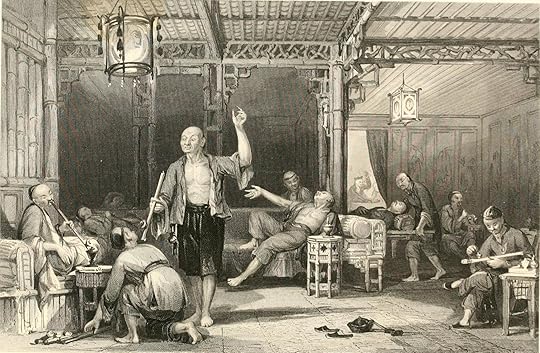
Opium den in the Qing period. The Qing government tried to ban the substance, restricted its circulation, and declare it illegal for trade commodity, causing the Britain to push for war by citing the principle of “free trade“.
By losing these important wars, the Qing ceded to Britain its many economic, diplomatic, and territorial rights. The gradual decline of the Qing thus can’t be reversed or even reformed as Britain and their western allies weren’t satisfied still and further forced the Qing to grant them additional rights to the detriment of Qing’s Chinese society. All things considered, these six volumes on Imperial China are delightful to read although they do have a major flaw. Its thematic style is interesting and gave different insights but skipped too many important major events.

October 7, 2026
A fantastically thorough and well written survey of the Qing Dynasty — probably the best place to start for anyone interested in this time period.
I’ve mentioned before that I think the Qing Dynasty is one of the most important historical civilizations to study: not only is it directly responsible for much of modern China, but it also makes perhaps the best historical mirror for better comprehension of our own time.
The Manchu ‘conquest organization’ that brutally replaced a collapsing Ming government went on to expand the size of China to its current borders by conquering neighboring regions (including current hotspots like Xinjiang and Taiwan) in a rapid process that was remarkably similar to the American conquest of the Western United States. In so doing, it created the current borders of China, and much of its administrative and cultural legacy remains to this day.
At its peak, the Qing era presided over a major efflorescence of Chinese culture despite its political domination by Manchus. Great works of art, literature, and philosophy were created under the ‘High Qing’ era, which roughly corresponds to the reigns of the Kangxi, Yongzheng, and Qianlong Emperors. Commerce flourished under a ‘light touch’ administration that would undoubtedly stir the admiration of present day ‘small government’ conservatives. China seemed poised to perpetuate indefinitely its place as one of the world’s Great Powers after the decrepitude of the late Ming era — and so it did throughout the highwater mark of the 18th century.
Unfortunately, the very successes of these reigns sowed seeds of future decay: the lax fiscal structure of the empire and its overextended borders led to an inability of the state to respond to new challenges from industrializing Western powers and internal rebellions. Combined with the corruption and nepotism that festered under a senile emperor, the Qing dynasty was set for a truly disastrous 19th century that was to become the infamous “century of humiliation.”
Hampered by its weak central tax structure and an inability to find productive work for educated youth (among other factors) the Qing government oscillated between passivity and heedless aggression toward Western powers, especially Britain, the superpower of that era. Entrenched corruption at the highest levels of government left the feckless emperors of the early 19th century unable to make progress even when they recognized increasingly obvious problems. Radicals began to saber rattle against foreign trade and cultural influence, which caused the government to lurch toward an aggressive stance that soon spelled even worse disasters.
In the world economy of the time, British India (then under Company Rule rather than direct British suzerainty) relied on the opium trade with China to balance its trade accounts. The Qing government recognized the horrible social toll that this drug was beginning to take and attempted to ban it, seizing British warehouses and punishing their local intermediaries. This threat to a major link in the British economic system provoked the notorious First Opium War, which Britain handily won, using their modern navy to devastate Chinese ships and port cities. The humiliation sent shockwaves through China and forced both financial and territorial concessions. It also caused a reckoning in neighboring Japan, accelerating the Meiji Restoration that rapidly industrialized that country and eventually led to further Chinese suffering.
The vultures began to circle a hobbled Qing government: other Western powers extracted concessions and a rising Japan started to throw its weight around in the East. Revolts occurred with more regularity, sometimes driven by growing anti-Manchu prejudice and sometimes by… other factors. The most damaging of all was the truly unbelievable Taiping Heavenly Kingdom, when a dejected scholar declared himself Jesus’s younger brother and eventually attracted enough followers or fellow travelers to found a rival government in Southern China. The resulting civil war may have been the worst conflict in human history before World War One.
Worse outcomes lay ahead: after the Taiping kingdom was finally snuffed out, the Qing fell into a dispute with newly industrialized Japan over dominance in Korea. Diplomatic machinations and Korean revolts eventually resulted in the First Sino-Japanese War, which truly marked the beginning of the end for the imperial regime. China’s vast momentum had allowed it to survive even the previous heavy blows, but total defeat by a neighboring Asian power and loss of a major tributary state (Korea) sent it into a long death spiral. The consequences of this brutal defeat would play out for generations; indeed, they still cause bitterness that lingers in East Asia and may flare up again in our near future.
As history often shows, the decline of a major empire can proceed remarkably slowly. Civilizations as strong as China can weather all kinds of storms — until they can’t. Like the apocryphal Hemingway quote about bankruptcies, great nations tend to die very gradually, then all at once. And so it was with the Great Qing Empire: the Chinese Revolution in 1911 brought the ancient imperial system to an end within a few months as the people finally abandoned it en masse. The resulting, short-lived Chinese Republic eventually fell to Japanese conquest, and then takeover by the Communists, producing the current regime. But the effects of Qing rule — from its geographical expansion to its foreign relations to the emergence of Chinese nationalism to its early steps of industrialization — still impact the current incarnation of China that is growing increasingly assertive in our own time. Perhaps the greatest lingering effect is psychological: Chinese nationalists continue to be haunted by the legacy of the ‘humiliation’, which spurs a touchiness and aggression that regularly appear in ongoing disputes over, say, Taiwan or other territorial issues.
There are numerous warnings and lessons for us in this book, far more than I can recount here. So many of the symptoms of Qing decay feel uncannily familiar, including calamitous factors like rampant drug addiction, disaffected and underemployed youth, outmoded fiscal structures, and erratic, mindless aggression toward rivals.
Above all, Chinese history has shown me the importance of maintaining a strong *cultural* (not merely technical) education, which is the primary reason that its remarkable civilization has survived despite millennia of cyclical collapses and rebirths. A delicate balance of cultural continuity and progressive adaptation must always be maintained, never veering too far in either direction, in order to weather the tempests of time. The latter Qing dynasty erred first through vacillation, then by swinging too far in one direction, then the other, before it eventually wore away the very foundations of imperial legitimacy. For us, it is not yet too late, but we would do well to heed the many mistakes of the Great Qing and work not to repeat them in our own context.
I’ve mentioned before that I think the Qing Dynasty is one of the most important historical civilizations to study: not only is it directly responsible for much of modern China, but it also makes perhaps the best historical mirror for better comprehension of our own time.
The Manchu ‘conquest organization’ that brutally replaced a collapsing Ming government went on to expand the size of China to its current borders by conquering neighboring regions (including current hotspots like Xinjiang and Taiwan) in a rapid process that was remarkably similar to the American conquest of the Western United States. In so doing, it created the current borders of China, and much of its administrative and cultural legacy remains to this day.
At its peak, the Qing era presided over a major efflorescence of Chinese culture despite its political domination by Manchus. Great works of art, literature, and philosophy were created under the ‘High Qing’ era, which roughly corresponds to the reigns of the Kangxi, Yongzheng, and Qianlong Emperors. Commerce flourished under a ‘light touch’ administration that would undoubtedly stir the admiration of present day ‘small government’ conservatives. China seemed poised to perpetuate indefinitely its place as one of the world’s Great Powers after the decrepitude of the late Ming era — and so it did throughout the highwater mark of the 18th century.
Unfortunately, the very successes of these reigns sowed seeds of future decay: the lax fiscal structure of the empire and its overextended borders led to an inability of the state to respond to new challenges from industrializing Western powers and internal rebellions. Combined with the corruption and nepotism that festered under a senile emperor, the Qing dynasty was set for a truly disastrous 19th century that was to become the infamous “century of humiliation.”
Hampered by its weak central tax structure and an inability to find productive work for educated youth (among other factors) the Qing government oscillated between passivity and heedless aggression toward Western powers, especially Britain, the superpower of that era. Entrenched corruption at the highest levels of government left the feckless emperors of the early 19th century unable to make progress even when they recognized increasingly obvious problems. Radicals began to saber rattle against foreign trade and cultural influence, which caused the government to lurch toward an aggressive stance that soon spelled even worse disasters.
In the world economy of the time, British India (then under Company Rule rather than direct British suzerainty) relied on the opium trade with China to balance its trade accounts. The Qing government recognized the horrible social toll that this drug was beginning to take and attempted to ban it, seizing British warehouses and punishing their local intermediaries. This threat to a major link in the British economic system provoked the notorious First Opium War, which Britain handily won, using their modern navy to devastate Chinese ships and port cities. The humiliation sent shockwaves through China and forced both financial and territorial concessions. It also caused a reckoning in neighboring Japan, accelerating the Meiji Restoration that rapidly industrialized that country and eventually led to further Chinese suffering.
The vultures began to circle a hobbled Qing government: other Western powers extracted concessions and a rising Japan started to throw its weight around in the East. Revolts occurred with more regularity, sometimes driven by growing anti-Manchu prejudice and sometimes by… other factors. The most damaging of all was the truly unbelievable Taiping Heavenly Kingdom, when a dejected scholar declared himself Jesus’s younger brother and eventually attracted enough followers or fellow travelers to found a rival government in Southern China. The resulting civil war may have been the worst conflict in human history before World War One.
Worse outcomes lay ahead: after the Taiping kingdom was finally snuffed out, the Qing fell into a dispute with newly industrialized Japan over dominance in Korea. Diplomatic machinations and Korean revolts eventually resulted in the First Sino-Japanese War, which truly marked the beginning of the end for the imperial regime. China’s vast momentum had allowed it to survive even the previous heavy blows, but total defeat by a neighboring Asian power and loss of a major tributary state (Korea) sent it into a long death spiral. The consequences of this brutal defeat would play out for generations; indeed, they still cause bitterness that lingers in East Asia and may flare up again in our near future.
As history often shows, the decline of a major empire can proceed remarkably slowly. Civilizations as strong as China can weather all kinds of storms — until they can’t. Like the apocryphal Hemingway quote about bankruptcies, great nations tend to die very gradually, then all at once. And so it was with the Great Qing Empire: the Chinese Revolution in 1911 brought the ancient imperial system to an end within a few months as the people finally abandoned it en masse. The resulting, short-lived Chinese Republic eventually fell to Japanese conquest, and then takeover by the Communists, producing the current regime. But the effects of Qing rule — from its geographical expansion to its foreign relations to the emergence of Chinese nationalism to its early steps of industrialization — still impact the current incarnation of China that is growing increasingly assertive in our own time. Perhaps the greatest lingering effect is psychological: Chinese nationalists continue to be haunted by the legacy of the ‘humiliation’, which spurs a touchiness and aggression that regularly appear in ongoing disputes over, say, Taiwan or other territorial issues.
There are numerous warnings and lessons for us in this book, far more than I can recount here. So many of the symptoms of Qing decay feel uncannily familiar, including calamitous factors like rampant drug addiction, disaffected and underemployed youth, outmoded fiscal structures, and erratic, mindless aggression toward rivals.
Above all, Chinese history has shown me the importance of maintaining a strong *cultural* (not merely technical) education, which is the primary reason that its remarkable civilization has survived despite millennia of cyclical collapses and rebirths. A delicate balance of cultural continuity and progressive adaptation must always be maintained, never veering too far in either direction, in order to weather the tempests of time. The latter Qing dynasty erred first through vacillation, then by swinging too far in one direction, then the other, before it eventually wore away the very foundations of imperial legitimacy. For us, it is not yet too late, but we would do well to heed the many mistakes of the Great Qing and work not to repeat them in our own context.

July 17, 2014
I am intrigued with Qing's history ever since I was small. Starting from kids book in Chinese, I read more and more about it. I thought I knew most minute details, events and even anecdotes of Qing.
That said, I am no historian. Educated in Hong Kong, the sinocentric nationalist narrative shapes my understanding about Chinese history, like the vast majority of (ethnic Chinese) Hong Kong students. I heard about an alternative narrative "New Qing History" which gets more and more coverage due to the recent tension between China and Hong Kong. I thought I knew the gist of this revisionist narrative, but only after reading this entire book cover to cover did I have a basic understanding.
It isn't fair to paint this book as a "New Qing History" book. It fairly treats different narratives, old and new, Chinese and Western, and discusses impartially. It's eye opening to see how alternative narratives place the turning points at different events. Instead of the 1841 opium war, the first "unequal" treaty signed between Qing and Western power, newer narratives often moves it after Taiping uprising, which saw a thorough change in social structure. The 1911 revolution used to be a history turning event whose importance and significance couldn't be overstated. In the newer narratives, however, it's just a transition point. The transition was much smoother than history changing events within the Qing empire like Taiping uprising and Boxer rebellion.
I read Crossley's "The Manchus" right before this book, therefore, the narrative before Qianlong was familiar to me, but I'd imagine I'd have been awed by the newer narratives as well. The fact that Qing has been a multinational empire almost since the very beginning, especially before the conquest of China.
This book is a must read for anyone serious about the nation building of China.
That said, I am no historian. Educated in Hong Kong, the sinocentric nationalist narrative shapes my understanding about Chinese history, like the vast majority of (ethnic Chinese) Hong Kong students. I heard about an alternative narrative "New Qing History" which gets more and more coverage due to the recent tension between China and Hong Kong. I thought I knew the gist of this revisionist narrative, but only after reading this entire book cover to cover did I have a basic understanding.
It isn't fair to paint this book as a "New Qing History" book. It fairly treats different narratives, old and new, Chinese and Western, and discusses impartially. It's eye opening to see how alternative narratives place the turning points at different events. Instead of the 1841 opium war, the first "unequal" treaty signed between Qing and Western power, newer narratives often moves it after Taiping uprising, which saw a thorough change in social structure. The 1911 revolution used to be a history turning event whose importance and significance couldn't be overstated. In the newer narratives, however, it's just a transition point. The transition was much smoother than history changing events within the Qing empire like Taiping uprising and Boxer rebellion.
I read Crossley's "The Manchus" right before this book, therefore, the narrative before Qianlong was familiar to me, but I'd imagine I'd have been awed by the newer narratives as well. The fact that Qing has been a multinational empire almost since the very beginning, especially before the conquest of China.
This book is a must read for anyone serious about the nation building of China.

December 11, 2024
While I've already done a fair share of reading about the last imperial dynasty, there are a number of things that Rowe does very well, such as critiquing what is now considered old-school thinking about the nature of Chinese culture and showing how modern Chinese nationalism emerge out of the chrysalis of the Qing state. The Qing having started out with a vision of leading a universal empire, where the monarch ruled a series of self-contained nations in parallel, to being the sovereign of a unified national state, simply referred to as China, with the end coming largely due to Chinese society finding the Qing irrelevant. In between, Rowe also provides the reader with a lot of nuts-and-bolts about how the administrative systems created by the Qing worked in their prime, and how, over changes in circumstances, they failed to work; not helped by the great race for world empire kicking off in the second half of the 1800s. Rowe dryly considers malice aforethought to have a great deal to do with the Qing failure.
About the only thing that I'd mark this book down for is that, having come out in 2009, it's starting to be overtaken by circumstances. At the time Rowe was writing the rise of the PRC to dominant power status was still taken for granted, and this book reflects that sense. Now, with the regime of Xi Jinping apparently floundering, and it being unclear whether Beijing can overcome its demographic and economic challenges, the question is whether we're watching the modern equivalent of an old-fashioned Chinese dynastic crack-up. This could be "interesting" in a bad way.
About the only thing that I'd mark this book down for is that, having come out in 2009, it's starting to be overtaken by circumstances. At the time Rowe was writing the rise of the PRC to dominant power status was still taken for granted, and this book reflects that sense. Now, with the regime of Xi Jinping apparently floundering, and it being unclear whether Beijing can overcome its demographic and economic challenges, the question is whether we're watching the modern equivalent of an old-fashioned Chinese dynastic crack-up. This could be "interesting" in a bad way.
July 16, 2026
Kind of a weird one. Instead of giving a general historical overview it segments the history into different categories like culture, economy, military etc… while this gives some neat tidbits here and there it skips over way too much of the history in my opinion, and the segmentation often leaves “teasers” to larger impactful events that are never wholly flushed out. Its a decent book if you already know the general history of 大清。

December 19, 2025
i would love this a lot more if i didnt have to die on an exam.. i can probably recite this book start to end
November 28, 2024
Been reading this every night before going to sleep. Managed to get through 4 pages a night before drifting off for 100 days or so, especially the chapters on economic reforms really knocked me out.
This book is a great introduction to modern Chinese history and I'll be reading more about it!
This book is a great introduction to modern Chinese history and I'll be reading more about it!

August 1, 2013
This is an absolutely excellent book! It covers a vast period and very capably examines many diverse historiographical themes in a relatively slim volume. It's written with exceptional clarity (even though I found myself tripping over and having to re-read the occasional, unfamiliar 'Americanism' here and there) and is even quite pacy in parts. It provided a good overview of certain events, and provided a clear and balanced discussion on its main 'revisionist' points, with a great bibliography for delving further into areas of specific interest. I used it mainly for an MA essay on the rise and fall of the Qing, however, I'm more familiar with the transitional era around the end of the Qing Dynasty and so was surprised to find no mention of the May 4th movement, nor Yuan Shikai's failed attempt to establish himself as Emperor in the final chapter which looks at the revolution and the early Republican era (perhaps very minor and largely inconsequential quibbles given that the book is meant to be a general history of the Qing). It is certainly a work which I know I shall return to for reference for quite some time to come, and one which I would without hesitation highly recommend.

October 16, 2013
This book covers the epic history of the Qing Empire from bloody start to bloody finish. It does an excellent job of getting the nitty gritty without missing out on the big picture of things. The only issue I had was that the material could be quite dense in some areas. Maybe a little less on the views of the numerous scholars and literati and a bit more on the history of daily life and the incredible events of the various rebellions that occurred.

May 28, 2024
A perfectly solid general history of the Qing. Informative and broad, but not worth reading unless you have a particular interest in Chinese historiography
April 15, 2020
Perhaps slightly too brief in its focus on some subjects, which is understandable given such a broad and complicated topic. There are a number of forgettable paragraphs, partly owing to the publisher’s requirement for a short book, but I would prefer Rowe to have selected fewer focus points and given them more room to breathe. I can only imagine how difficult it is to strike a balance with this sort of thing. Yet what comes through is a quiet fascination with the vibrant and intricate world of the Great Qing, and this is deftly conveyed to the reader.
The Qing dynasty ruled a society which was powerful, carefully organised and balanced, and full of lively variety. Rowe provides descriptions of it which are sometimes brilliantly revealing. On the long-standing Confucian examination system, which allowed for very few passes and yet offered great financial and social reward for those who attained one:
If the civil service examination system provided the regime with a competent pool of personnel for official service and, to a far more limited extent, allowed its subjects some prospect of upward mobility, its greatest advantage for the ruling house was something different again. Across the vast expanse of empire and its myriad local cultures, the exams produced a large group of persons who had voluntarily submitted to an intensive and common course of indoctrination in an orthodox ideology approved by the government. Still more useful was the fact that this group was also the most wealthy and influential individuals in their respective local communities. This wondrous educational institution, more than any other factor, may have held the late Qing empire together. (p. 48)
This is brilliant history, which in a few lines is able to illuminate one of the subtle but critical ways in which an impossibly large empire maintained itself.
Indeed, much of the book serves to demonstrate the ways in which the Qing was a highly-functional and intelligent polity. The Manchu dynasty appropriated and then expanded and adapted the incredible legacy of the ancient Chinese empire. They still believed that Beijing was basically the centre of the universe, and had little knowledge of or interest in anything outside their immediate geographical area. And why not? As with today, the population of China was far greater than that of Europe. That population was ruled by a single man, who was also considered the overlord of rulers in neighbouring areas such as Korea, Japan, and Indochina. As Rowe says, the levels of wealth and life quality were probably higher on average in China than in Europe, before the industrial revolution in the West. Generally speaking, they were thriving, even if the Qing dynasty was unlikely to last any longer than average within the great dynastic cycle. They were focused not on commerce and discovery, but on social harmony under the leadership of an intellectually and philosophically stimulated elite.
The strongest ultimate effect of this is that when the Westerners begin to really interfere with China, the sudden and complete collapse of such a confident and prosperous civilisation is genuinely bewildering to behold. It is impossible not to wonder at the level of horror and disbelief that the educated historians and magistrates of China must have felt as they witnessed thousands of years of tradition and development crumbling around them. And this at the hands of a small number of obscure barbarians on boats, not even a single empire but many, seemingly squabbling amongst themselves. This may be sentimentally Sinophilic and somewhat unfair to all the other such victims of world history, but the brutal colonisation of China seems particularly tragic, perhaps even more because it was so indirect. And this victim had been so vast, and splendid, and magnificently organised, seemingly unlike anything else in history.
Yet this emotional reaction doesn’t emanate from any strong emotion in Rowe’s text. Rather, he writes in a mostly professional and dry manner throughout. On the one hand, this seems to present the possibility of understating the shocking story of the civilisation’s decline. But perhaps the fact that this impression may be produced (as it was in me) merely through Rowe’s cold treatment of the events is a great achievement. To me, the Treaty of Shimonoseki seems like Napoleon’s annihilation of the Holy Roman Empire, but on a motorbike and jumping through a flaming hoop. And this all comes from the format of the book, which provides in short order a description of the creation of the Qing, its successes, and its devastating decline. That decline was also an end to thousands of years of imperial development. Rowe does an excellent job of letting this fascinating story emerge.
The Qing dynasty ruled a society which was powerful, carefully organised and balanced, and full of lively variety. Rowe provides descriptions of it which are sometimes brilliantly revealing. On the long-standing Confucian examination system, which allowed for very few passes and yet offered great financial and social reward for those who attained one:
If the civil service examination system provided the regime with a competent pool of personnel for official service and, to a far more limited extent, allowed its subjects some prospect of upward mobility, its greatest advantage for the ruling house was something different again. Across the vast expanse of empire and its myriad local cultures, the exams produced a large group of persons who had voluntarily submitted to an intensive and common course of indoctrination in an orthodox ideology approved by the government. Still more useful was the fact that this group was also the most wealthy and influential individuals in their respective local communities. This wondrous educational institution, more than any other factor, may have held the late Qing empire together. (p. 48)
This is brilliant history, which in a few lines is able to illuminate one of the subtle but critical ways in which an impossibly large empire maintained itself.
Indeed, much of the book serves to demonstrate the ways in which the Qing was a highly-functional and intelligent polity. The Manchu dynasty appropriated and then expanded and adapted the incredible legacy of the ancient Chinese empire. They still believed that Beijing was basically the centre of the universe, and had little knowledge of or interest in anything outside their immediate geographical area. And why not? As with today, the population of China was far greater than that of Europe. That population was ruled by a single man, who was also considered the overlord of rulers in neighbouring areas such as Korea, Japan, and Indochina. As Rowe says, the levels of wealth and life quality were probably higher on average in China than in Europe, before the industrial revolution in the West. Generally speaking, they were thriving, even if the Qing dynasty was unlikely to last any longer than average within the great dynastic cycle. They were focused not on commerce and discovery, but on social harmony under the leadership of an intellectually and philosophically stimulated elite.
The strongest ultimate effect of this is that when the Westerners begin to really interfere with China, the sudden and complete collapse of such a confident and prosperous civilisation is genuinely bewildering to behold. It is impossible not to wonder at the level of horror and disbelief that the educated historians and magistrates of China must have felt as they witnessed thousands of years of tradition and development crumbling around them. And this at the hands of a small number of obscure barbarians on boats, not even a single empire but many, seemingly squabbling amongst themselves. This may be sentimentally Sinophilic and somewhat unfair to all the other such victims of world history, but the brutal colonisation of China seems particularly tragic, perhaps even more because it was so indirect. And this victim had been so vast, and splendid, and magnificently organised, seemingly unlike anything else in history.
Yet this emotional reaction doesn’t emanate from any strong emotion in Rowe’s text. Rather, he writes in a mostly professional and dry manner throughout. On the one hand, this seems to present the possibility of understating the shocking story of the civilisation’s decline. But perhaps the fact that this impression may be produced (as it was in me) merely through Rowe’s cold treatment of the events is a great achievement. To me, the Treaty of Shimonoseki seems like Napoleon’s annihilation of the Holy Roman Empire, but on a motorbike and jumping through a flaming hoop. And this all comes from the format of the book, which provides in short order a description of the creation of the Qing, its successes, and its devastating decline. That decline was also an end to thousands of years of imperial development. Rowe does an excellent job of letting this fascinating story emerge.

July 10, 2026
5/5: easy read and very good history of the Qing dynasty, really great considering how much material and time is well-covered in such a relatively short book. Rowe has a clear command of ongoing questions in Chinese Studies/history and the footnotes alone teed up a lot of interesting further reading. He does well balancing the presentation of diverse historiographical/political/geographic viewpoints while remaining unafraid to highlight or favor a specific conclusion, especially with regards to the still-open questions around Qing political structure and identity.
The whole book is fascinating, as is the history of the Qing in general. I came in with a ~decently~ informed general knowledge of Chinese history for a Westerner and felt like Rowe provides the right amount of context anywhere needed while remaining concise. The book excels in presenting a solid general history without self-consciously leaning away from traditional (and often overwrought) English-language focuses from the events in question; I definitely had an overblown sense of the relative scale of the Boxer Rebellion, but on the other hand had really missed the Tonkin War and broader (now-obvious) Chinese dimensions to French colonization in Vietnam.
I particularly appreciated the analysis of late Qing interactions with Western colonizers and the resulting economic/sociopolitical shockwaves. Among other things that stuck out: Rowe's analysis of how the Darwinian logic of nationalism prompted the end of Western comity in the concessions after the Sino-Japanese war prompted the further dismemberment of China and East Asia more broadly; the measured (but (perhaps technically still revisionist?) analysis of Sun Yat-Sen; and the combined incentives towards regionalism or increased provincialism that clearly presaged the Warlord Era.
There were a few specific areas like the Ming-Qing transition and early modern Chinese political thought that I would have liked more information or context on, but I really can't fault the author for the choices made in terms of emphases. The lesser focus on the pre-Qing milieu makes sense given both the Last Empire framing and the Ming having had a (pretty unexciting) long decline, and-as I've started to learn from those aforementioned footnotes-understanding Chinese political theory in the early modern era requires quite a bit of engagement with the preceding 1500 years of it. Overall I give it a strong recommend: among the best general/national histories I've ever picked up, and maybe the best ever on a words-per-years/topics-covered basis.
The whole book is fascinating, as is the history of the Qing in general. I came in with a ~decently~ informed general knowledge of Chinese history for a Westerner and felt like Rowe provides the right amount of context anywhere needed while remaining concise. The book excels in presenting a solid general history without self-consciously leaning away from traditional (and often overwrought) English-language focuses from the events in question; I definitely had an overblown sense of the relative scale of the Boxer Rebellion, but on the other hand had really missed the Tonkin War and broader (now-obvious) Chinese dimensions to French colonization in Vietnam.
I particularly appreciated the analysis of late Qing interactions with Western colonizers and the resulting economic/sociopolitical shockwaves. Among other things that stuck out: Rowe's analysis of how the Darwinian logic of nationalism prompted the end of Western comity in the concessions after the Sino-Japanese war prompted the further dismemberment of China and East Asia more broadly; the measured (but (perhaps technically still revisionist?) analysis of Sun Yat-Sen; and the combined incentives towards regionalism or increased provincialism that clearly presaged the Warlord Era.
There were a few specific areas like the Ming-Qing transition and early modern Chinese political thought that I would have liked more information or context on, but I really can't fault the author for the choices made in terms of emphases. The lesser focus on the pre-Qing milieu makes sense given both the Last Empire framing and the Ming having had a (pretty unexciting) long decline, and-as I've started to learn from those aforementioned footnotes-understanding Chinese political theory in the early modern era requires quite a bit of engagement with the preceding 1500 years of it. Overall I give it a strong recommend: among the best general/national histories I've ever picked up, and maybe the best ever on a words-per-years/topics-covered basis.
October 28, 2020
Most of my knowledge of Chinese history and culture comes from the news and this Asian Society class I took back in high school (c. twelve years ago). I did not retain much from the class; additionally, the news can serve as a decent window into the world as it is today, but we depend on the news reporters being more of specialists than they actually are. Understanding the narrative as it has been spun and identifying additional facts requires more specialization in... basically every field. Unsurprisingly, I underestimated the technical nature of historiography - I thought I could jump in and just go and getting through this book in a flash, but I had to take more time to put the information into context. Lesson learned! Humility engaged.
Context: I used this book to start my more in-depth study of "modern" "Chinese" history (which... the first two books I've read raise the issue of how we define both of those things, together or separately).
Therefore, this book really opened my eyes to different ways and frameworks for understanding the Qing dynasty. It isn't organized in a purely linear chronology. Instead, the book focuses on particular elements (governance, culture, commerce, crises, etc.) that led from the Manchu gaining prominence in Manchuria before spending about half a century taking over the Ming's territory and then some up to the 1911 revolution. As you go through the book, each chapter builds on events and statuses from previous chapters. This builds to a more complete picture of each Qing emperor. It was a little confusing at first; I'm sure Mr. Rowe considered doing a breakdown by emperor, but I suspect the logic was in seeing how each emperor's policy in a particular area changed the Qing's power and authority over time - how each emperor's China compared.
In these uncertain political moments, it's disquieting and thought-provoking to see phenomenon we can see on social media and hear within our own discussions today. People's standard of living, stances on religion, interracial tensions, questions of identity, size and function of government, propriety of power. These issues are not novel. It's so easy to think we're beyond this - too highly evolved and experienced and learned. Yet we will run this rigmarole once more.
Context: I used this book to start my more in-depth study of "modern" "Chinese" history (which... the first two books I've read raise the issue of how we define both of those things, together or separately).
Therefore, this book really opened my eyes to different ways and frameworks for understanding the Qing dynasty. It isn't organized in a purely linear chronology. Instead, the book focuses on particular elements (governance, culture, commerce, crises, etc.) that led from the Manchu gaining prominence in Manchuria before spending about half a century taking over the Ming's territory and then some up to the 1911 revolution. As you go through the book, each chapter builds on events and statuses from previous chapters. This builds to a more complete picture of each Qing emperor. It was a little confusing at first; I'm sure Mr. Rowe considered doing a breakdown by emperor, but I suspect the logic was in seeing how each emperor's policy in a particular area changed the Qing's power and authority over time - how each emperor's China compared.
In these uncertain political moments, it's disquieting and thought-provoking to see phenomenon we can see on social media and hear within our own discussions today. People's standard of living, stances on religion, interracial tensions, questions of identity, size and function of government, propriety of power. These issues are not novel. It's so easy to think we're beyond this - too highly evolved and experienced and learned. Yet we will run this rigmarole once more.

March 30, 2022
This is a good book in a very good series, but limited by the huge task that it sets itself. Like the rest of the series, it provides an excellent overview of the main themes of the dynasty's history, and in particular gives a real sense of how the government and administration of China changed under the Qing. Again like the rest of the series, it's not a narrative history, but synthesises the main themes; it might be good to read something with a more narrative focus first if you haven't done so.
It does synthesise the results of modern historical work on the dynasty well, and is an enjoyable read. It isn't as satisfying as the rest of the series, but that doesn't feel like the author's fault - the encounter with the West and the slow fall of the dynasty inevitably take up so much space that could be devoted to a richer picture of the dynasty itself and of contemporary culture, which is covered in far less detail than previous volumes. That's a real loss, as so much happened culturally in this period.
The closing sections, on the encounter with the imperialist Western powers and the decline of the dynasty, make painful reading, perhaps especially for a British person. We did some appalling things in the Nineteenth Century, and the Opium wars are just so egregiously selfish...
Stepping back from that, Rowe works very hard to synthesise scholarship that's very varied and very antagonistic, on a period that is still highly politicised.
Overall, it's a good synthesis of the main themes of the Qing centuries, even if a longer book would have been more satisfying.
It does synthesise the results of modern historical work on the dynasty well, and is an enjoyable read. It isn't as satisfying as the rest of the series, but that doesn't feel like the author's fault - the encounter with the West and the slow fall of the dynasty inevitably take up so much space that could be devoted to a richer picture of the dynasty itself and of contemporary culture, which is covered in far less detail than previous volumes. That's a real loss, as so much happened culturally in this period.
The closing sections, on the encounter with the imperialist Western powers and the decline of the dynasty, make painful reading, perhaps especially for a British person. We did some appalling things in the Nineteenth Century, and the Opium wars are just so egregiously selfish...
Stepping back from that, Rowe works very hard to synthesise scholarship that's very varied and very antagonistic, on a period that is still highly politicised.
Overall, it's a good synthesis of the main themes of the Qing centuries, even if a longer book would have been more satisfying.

May 27, 2018
This might well be the only concise book written about the Qing dynasty in the past decade. Rowe divides his book into twelve chapters, all featuring one-word titles such as "Conquest," "Commerce," "Rebellion," and "Revolution." The one exception to this one-word nomenclature is Chapter 3, "High Qing," which focuses on the long reigns of the Kangxi, Yongzheng and Qianlong emperors from the mid-17th Century to the late 18th Century. Curiously, given that this is considered the height of the dynasty's power and dynamism, this section of the book seems insufficiently detailed. To my mind, Rowe is stronger in the economic social aspects of Manchu rule from 1644-1911, and less so on the political side of things. While a useful "revisionist" account (according to the back cover of the paperback edition), the standard by which all other accounts of Early Modern and Modern China should be judged very much continues to be Immanuel C.Y. Hsu's massive The Rise of Modern China, of which something like 45% of its 1,000 plus pages is devoted to the Qing, with the remainder covering China in the 20th Century. While I have so far only read bits and pieces of Jonathan D. Spence's The Search for Modern China, the other classic in this field, I don't think Hsu's work will be surpassed any time soon. Rowe's work, while compact, is not enough on its own to be considered the definitive account of China's final dynasty.

December 13, 2023
Rowe gives the reader an accounting of the last imperial dynasty of China that looks beyond the Chinese and American ideological battles and that places it alongside other Eurasian empires that met their end shortly into the 20th century. He recounts the history of the dynasty paying attention to the context of its rise, challenges, resurgence and final demise. He is less concerned with who succeeded whom as emperor and more with the ambiguous racial definitions that sought to split Han from Manchu, or the halting steps towards industrialization, or its blundering response to Western imperialist aggression. In every aspect he tries to go beyond the twisted logic of ideological viewpoints and present complex people, events and policies that do not correspond to any preconceived notion. Definitely an interesting and reasonable concise read.

January 25, 2020
A very good reference for the specific period of the Manchu Dynasty of China.
One of the main points I liked about the book is that it's ordered by topics rather than the usual chronological chronicle you often find in history books covering relatively huge periods. Whether you're interested in bureaucracy, the wars, or another aspect, you can get a relatively concise description of the state it was, and its evolution across the decades and centuries.
The Qing's history is of course majorly shaped by the increasing Western encroachment, but it remains a very good view of the decline and end of the Mandate of Heaven.
One of the main points I liked about the book is that it's ordered by topics rather than the usual chronological chronicle you often find in history books covering relatively huge periods. Whether you're interested in bureaucracy, the wars, or another aspect, you can get a relatively concise description of the state it was, and its evolution across the decades and centuries.
The Qing's history is of course majorly shaped by the increasing Western encroachment, but it remains a very good view of the decline and end of the Mandate of Heaven.

May 8, 2022
Revisionist, anti-narrative history of China's Qing dynasty, which ruled China from 1644 to 1912. The book consists of 10 thematically-organized chapters (for example, "Governance," "Society," "Commerce," and "Crises"), which are shoehorned between an introduction and conclusion. I read this book slowly over several weeks; it's a dense, academic read, probably better suited for a college course. Despite that, I found the book to be balanced and persuasive in its conclusions. All in all, a thoughtful and compelling overview of the history of Late Imperial China, with less emphasis on narrative and more emphasis on central themes.

April 30, 2021
My second favorite of the series. Lots of information to pass on from all the happenings of this dynasty. Due to the constraints of the series it tends to fall short in last 100 years or so. It is a solid entry, very well written, and fun to read. Again this is a breakaway from the format of the first four books. It works, but since the author lingers more in the beginning and middle of the dynasty there just isn't room to be more in depth towards the end. As with all the books in the series, it is a great starting point for anyone interested in learning about Chinese history.

July 27, 2024
This is an excellent concise textbook of the Qing empire. It is concise, meaning that the reader does not get any biographical details, any negotiation details etc. However, the author does cover all important aspects of Qing China and includes a rich bibliography for people who want to know more. Organization of the material is superb. I particularly liked the discussion of competing historiographies, a must for an empire that saw both an incredible economic and territorial expansion and utter humiliation.

February 14, 2026
Could this be seen as a synthesis of New Qing History research from recent years? It feels more like a work that poses questions rather than providing definitive conclusions. The book covers a remarkably comprehensive range of historical perspectives, many of which are quite novel—such as the discussions on ethnic identity, particularly the descriptions of the Hakka and Subei people. It is an excellent resource for those accustomed to traditional works on Qing history to supplement and expand their conceptual horizons.

December 4, 2020
Of all the books in this series on the imperial history of China, this is perhaps my pick of the lot. I found this a whole lot more interesting than the previous books (this may be due to the fact that I’m much more familiar with Qing Dynasty history than all the others).
Though still a quick overview rather than a dedicated full history, this still offered me more information than I knew especially with respect to the Opium Wars, Hong Kong and Taiwan.
Though still a quick overview rather than a dedicated full history, this still offered me more information than I knew especially with respect to the Opium Wars, Hong Kong and Taiwan.
August 30, 2025
Decent overview of the Qing dynasty, the last of China's dynasties. Beset from within and without; constant rebellions, rapacious European powers circling, the Qing fell and with it ended 2000 years of dynastic rule in China.
This is the last entry in this series; it is well worth reading for an in-depth look at Chinese history, civilization, and culture, with some relevance to the modern global landscape.
This is the last entry in this series; it is well worth reading for an in-depth look at Chinese history, civilization, and culture, with some relevance to the modern global landscape.

February 9, 2023
I’ve used this book before to look up information and the like but I just finally read it all the way through. I think it would be tough going for someone without at least some background in Chinese history, but for someone with some prior knowledge but isn’t a specialist, it does a great job laying out interpretive debates in the literature.

September 17, 2022
I’m going to be honest and say I didn’t finish this book. But it’s very useful for an overview of the Qing dynasty, and definitely one I will keep going back to when I want to check my history, or doing research.

February 6, 2026
Excellent! Splitting the chronology into themes greatly enhances the readability of this book, compared to some others in the series. Perhaps in the future, the same framework could be applied to other lesser books in the series if at all possible.
Displaying 1 - 30 of 49 reviews