

What do you think?
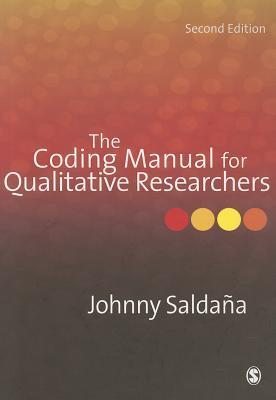
The Coding Manual for Qualitative Researchers
The Coding Manual for Qualitative Researchers is unique in providing, in one volume, an in-depth guide to each of the multiple approaches available for coding qualitative data.
In total, 29 different approaches to coding are covered, ranging in complexity from beginner to advanced level and covering the full range of types of qualitative data from interview transcripts to field notes. For each approach profiled, Johnny Saldaña discusses the method’s origins in the professional literature, a description of the method, recommendations for practical applications, and a clearly illustrated example. Also included in the book is an introduction to how codes and coding initiate qualitative data analysis, their applications with qualitative data analysis software, the writing of supplemental analytic memos, and recommendations for how to best use the manual for particular studies.
The Coding Manual for Qualitative Researchers is an invaluable reference for all students, teachers, and practitioners of qualitative inquiry, and a useful textbook for beginning and advanced qualitative research methods courses in such disciplines as education, sociology, communication, anthropology, psychology, and health care.
In total, 29 different approaches to coding are covered, ranging in complexity from beginner to advanced level and covering the full range of types of qualitative data from interview transcripts to field notes. For each approach profiled, Johnny Saldaña discusses the method’s origins in the professional literature, a description of the method, recommendations for practical applications, and a clearly illustrated example. Also included in the book is an introduction to how codes and coding initiate qualitative data analysis, their applications with qualitative data analysis software, the writing of supplemental analytic memos, and recommendations for how to best use the manual for particular studies.
The Coding Manual for Qualitative Researchers is an invaluable reference for all students, teachers, and practitioners of qualitative inquiry, and a useful textbook for beginning and advanced qualitative research methods courses in such disciplines as education, sociology, communication, anthropology, psychology, and health care.
328 pages, Paperback
First published February 1, 2009
Ratings & Reviews
Friends & Following
Create a free account to discover what your friends think of this book!
Community Reviews
Displaying 1 - 30 of 56 reviews

October 15, 2018
I perfected my coding knowledge through this book. Recommended!

October 26, 2018
This is a very useful book for qualitative researchers, or for students learning about qualitative research. Saldaña clearly outlines the philosophies between the different types of coding and the ways to transition between coding stages. Though I was instructed to read the book from cover to cover, it is a manual and as such would be more useful as a guide to refer to throughout the coding process. Even Saldaña writes that the book may be used in multiple ways as a tool, and will be less useful read consecutively.

March 26, 2024
honestly...this book slayed so hard
Read
November 29, 2023Summary: This is a frequently cited opus on qualitative research and how to code for it. The book is divided into three parts: An Introduction to Codes and Coding; Writing Analytic Memos; and First Cycle Coding Methods. It is loaded with examples and differentiates practices so the newbie can interpret and explicate on their own.
Evaluation: I have also read Yin (Yin, R. K. (2015). Qualitative research from start to finish. Guilford Publications.), Marshall (Marshall, C., & Rossman, G. B. (2014). Designing qualitative research. Sage publications.) and Creswell (Creswell, J. W. (2002). Educational research: Planning, conducting, and evaluating quantitative. New Jersey: Upper Saddle River.) Saldana is most helpful in getting new researchers up and running and stepping them through the process and product of coding.
Reflection: While Creswell really gives a theoretical comparison of concepts and practices, Yin gives a overview of all the things to cover in many kinds of qualitative research, and Marshall gives a really good drill down of setting up your research study, I find that Saldana has given me the most help (and confidence) in moving my action research practices into more systematic coding for future publication.
Evaluation: I have also read Yin (Yin, R. K. (2015). Qualitative research from start to finish. Guilford Publications.), Marshall (Marshall, C., & Rossman, G. B. (2014). Designing qualitative research. Sage publications.) and Creswell (Creswell, J. W. (2002). Educational research: Planning, conducting, and evaluating quantitative. New Jersey: Upper Saddle River.) Saldana is most helpful in getting new researchers up and running and stepping them through the process and product of coding.
Reflection: While Creswell really gives a theoretical comparison of concepts and practices, Yin gives a overview of all the things to cover in many kinds of qualitative research, and Marshall gives a really good drill down of setting up your research study, I find that Saldana has given me the most help (and confidence) in moving my action research practices into more systematic coding for future publication.

August 24, 2025
literally zorunda olduğum research taskleri için gerekli kitapları düzgün okuyabilmek amaçlı son kez düzenli goodreads kullanmayı denemeye karar verdim, belki bu sefer yaparım...
bu cok kullanıslıydı, metodoloji zekası için de
ama ai sonrası baya bosa dusen/cek zırt pıtlarla da dolu biraz
bu cok kullanıslıydı, metodoloji zekası için de
ama ai sonrası baya bosa dusen/cek zırt pıtlarla da dolu biraz

August 16, 2022
The best qualitative analysis book that was ever made.

June 3, 2026
If you need a book on how to code for qualitative research, I have a recommendation for you. Pretty helpful stuff. First book of the year too wow

February 25, 2019
This manual made my life so much easier! As a graduate student in the midst of their research, I was hesitant to take the time to read through almost 300 pages of coding methods, but I’m so glad I did. As a novice researcher, having an understanding of many different types of coding methods really gave context to what I was being advised to do, and the included citations for each method gives the reader additional sources to further their understanding of codes. Definitely a solid groundwork of the material, and helped me develop my own thoughts and writing.

June 25, 2025
Very helpful reference book. I read most of it, looking for the kind of coding I have been doing for my dissertation. It was thorough and surprisingly engaging (something I have found isn't said about many reference books). It has examples of the coding throughout and is consistent in how it explains each coding style. It covers foundations of coding qualitative research, first cycle coding, and second cycle coding. It's appendix is particularly helpful as it has a quick guide to all the types of coding in the book and different types of analysis. It even has an end section for the book owner, a researcher, to add other kinds of coding they have come across in other books/papers.
I did find the information about thematic analysis a bit sparse -- or maybe...just a little confusing. I'm following the Braun and Clark method and there was a mind map that followed that in the book, but I will need to buy a second book to facilitate that particular kind of analysis.
I did learn from this book though that I am doing at different stages in my research holistic coding, context coding, and then thematic analysis. And that is very helpful. They also have examples of putting together a code book that I'm going to use.
I did find the information about thematic analysis a bit sparse -- or maybe...just a little confusing. I'm following the Braun and Clark method and there was a mind map that followed that in the book, but I will need to buy a second book to facilitate that particular kind of analysis.
I did learn from this book though that I am doing at different stages in my research holistic coding, context coding, and then thematic analysis. And that is very helpful. They also have examples of putting together a code book that I'm going to use.

August 18, 2017
This book is more in line with the " methods sourcebook" by the same author. It catalogs a set of coding profiles for first and second cycle of coding. While catalog is interesting and useful as a reference, the postscript about how to use the coding profiles and how to manage the coding process in each cycle is most useful. For me, it kind of reaffirmed the certain beliefs about qualitative research and the involved techniques. The exposition about the relations between coding profiles is also useful but a bit lacking; specifically, more comparative description of profiles would have helped to understand seemingly similar coding profiles, e.g., holistic coding vs concept coding vs themeing of data.
A good reference about coding profiles.
A good reference about coding profiles.
November 20, 2021
I appreciate the complete list of the coding methods described in here, but I suggest to go for the other resources the author mentioned on the book once you want to deep dive into a certain coding method for more depth.
Your field and framework also matters I think, because mostly what is described here is a general approach which is expected from a book dedicated for beginning researchers from all fields.
Your field and framework also matters I think, because mostly what is described here is a general approach which is expected from a book dedicated for beginning researchers from all fields.

March 26, 2023
Never did I think that I would read a book on qualitative coding, yet here I am. And I actually enjoyed it. I found it very useful to me as I embark upon my qualitative-based dissertation project. The how to think about coding, themeing the data, and synthesis were especially helpful as I devise a plan to handle the massive quantity of data that will accumulate as part of a multi-base data analysis.

April 1, 2018
Super useful guide to the actual processes of coding and possible approaches to coding data. I liked the structure of this guide and it actual felt like it was meant to be used as a guide. I could see myself returning to this book with different projects for help approaching multiple sets of data or ways to employ simultaneous coding.

October 4, 2023
This was an incredible useful guide to coding for qualitative research. I highly recommend it. It should be viewed as reference material but I read it cover to cover. Saldaña offers clear descriptions and examples of a plethora of coding schemes at different stages of research. It was overwhelming to read but overall I am glad I did because now I have a better grasp of the methodology.

November 30, 2017
An outstanding guide that provides an incredibly clear discussion of first- and second-cycle qualitative coding methodology. I regularly assign and recommend this book to my students, and find that it is a useful reference that I often return to.
May 28, 2018
As someone whose field is adjacent to the social sciences but who uses social science methods, this is hands-down the most comprehensive, clear, and helpful book for qualitative coding. I have recommended it to several graduate students, all of whom have found it invaluable.

July 3, 2019
Incredibly helpful, I recommend this for anyone doing qualitative research. Saldana offers far more options than I could use in one project, which I love because I can rule out the types of coding that don't suit me and find ones that are strewn throughout dozens of other texts.

January 20, 2021
Excelent in-depth reference for inexperienced and experienced researchers alike. Very well written, very comprehensive. A great companion book for those who seek to very thorough in their analysis of qualitative research.

March 8, 2021
This book gives an excellent overview of coding methods and is a great resource for qualitative researchers. It is easy to read and clear throughout. From chapter three on I didn't read the whole chapter, instead picking and choosing certain coding methods to read thoroughly.

October 14, 2021
Saldaña does a really good job of making a potentially dry textbook engaging. Dare I say, I even chuckled once or twice. Which coding method(s) is (are)appropriate for your particular study? Read this book to find out!

April 7, 2025
Great book for novice qualitative researchers. Saldana’s approach is pragmatic and therefore he doesn’t treat qualitative coding as a mechanical activity. Rather coding helps in landscaping and supporting the analysis.

May 26, 2017
Oof...

November 13, 2017
What a great introductory text!

October 17, 2018
Well written and easy to understand, with lots of examples and tips for novice researchers.

December 9, 2018
Concise explanations of the 33 coding methods and helpful suggestions for beginning researchers planning to code and analyze data.

January 16, 2019
A great text that breaks down coding techniques into manageable chunks of information

March 15, 2019
I would say this is required reading for anyone using qualitative research methods

April 30, 2019
Great handbook for those interested in qualitative research and all that it entails, with a specific focus on coding of various types.
October 10, 2019
Great as both an introduction, and inspiration for different ways to approach qualitative coding

March 12, 2020
I have not read the entire book but I'm super impressed. Going to keep this book as a reference for my research projects in the future.
Displaying 1 - 30 of 56 reviews