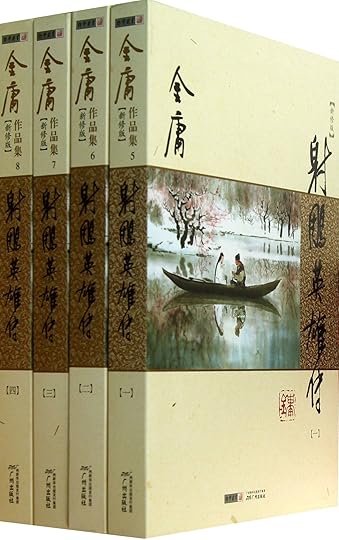
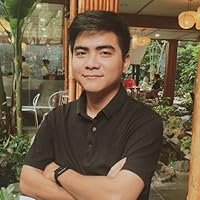
Louis Cha, GBM, OBE (born March 10, 1924), better known by his pen name Jin Yong (金庸, sometimes read and/or written as "Chin Yung"), is a modern Chinese-language novelist. Having co-founded the Hong Kong daily Ming Pao in 1959, he was the paper's first editor-in-chief.
Cha's fiction, which is of the wuxia ("martial arts and chivalry") genre, has a widespread following in Chinese-speaking areas, including mainland China, Hong Kong, Taiwan, Southeast Asia, and the United States. His 15 works written between 1955 and 1972 earned him a reputation as one of the finest wuxia writers ever. He is currently the best-selling Chinese author alive; over 100 million copies of his works have been sold worldwide (not including unknown number of bootleg copies).
Cha's works have been translated into English, French, Korean, Japanese, Vietnamese, Thai, Burmese, Malay and Indonesian. He has many fans abroad as well, owing to the numerous adaptations of his works into films, television series, comics and video games.
金庸,大紫荊勳賢,OBE(英語:Louis Cha Leung-yung,1924年3月10日-2018年10月30日),本名查良鏞,浙江海寧人,祖籍江西婺源,1948年移居香港。自1950年代起,以筆名「金庸」創作多部膾炙人口的武俠小說,包括《射鵰英雄傳》、《神鵰俠侶》、《鹿鼎記》等,歷年來金庸筆下的著作屢次改編為電視劇、電影等,對華人影視文化可謂貢獻重大,亦奠定其成為華人知名作家的基礎。金庸早年於香港創辦《明報》系列報刊,他亦被稱為「香港四大才子」之一。
Could not put it down. Breathtaking story-telling! This was one of the first full-length novels I ever read in a foreign language. It helped me learn how to let go of my English thoughts, think in Chinese, and follow my imagination into another world.
It happened. It really happened. I just finished the longest book I've ever read, and in Chinese no less!
About 155 and a half weeks ago, I stumbled on an article on some tech news site about Chinese dramas being a big hit. I was interested in a title they named, Rakshasa Street, and found it on YouTube with English subtitles and decided to give it a chance. Didn't like it, never finished it, but I learned about Ever Night and started that and was quickly hooked, then about a dozen episodes in I learned about The Legend of the Condor Heroes and I was completely smitten. A month later, before I'd even finished my first full Chinese drama, I decided if Guo Jing can speak Chinese, why couldn't I? I downloaded a bunch of apps and began to toy with it. By the end of February, I had a game plan. My goal: To read 射雕英雄传 in the original.
Almost three years to the day (I think it was January 2nd that I started Rakshasa Street), I've completed the greatest challenge I've ever undertaken. Nobody else thought I'd get here. On too many occasions, I didn't think I would either. But I'd spent all my money on Chinese books, so I had no excuse but to persevere.
Unlike some of the other books I've read in Chinese leading up to this, I didn't have an English translation to help me through the tough parts. It was the horribleness of the translation that truly kick-started my studies in the first place, so I wasn't going to swallow my pride and use it. But the 2017 drama was close enough to the book that I could always call upon my memory to help me through a challenging scene. I'm surprised how infrequently that was necessary. Despite the rather difficult style, I almost never felt out of my league, at least until 黄蓉 and 瑛姑 started talking about math.
Mình thích tiểu thuyết này (cùng với bản phim truyền hình năm 2003) có lẽ vì nó bám sát yếu tố lịch sử. Bao trùm từ đầu đến cuối câu truyện là không khí chiến tranh loạn lạc, trải dài từ chiến tranh Tống-Kim cho tới cuộc xâm lược nhà Tống của Mông Cổ. Chiến tranh khiến gia đình Quách Tĩnh tan vỡ, đẩy mẹ con anh lưu lạc lên Bắc Mạc. Cũng chính chiến tranh là yếu tố khiến Quách Tĩnh trưởng thành. Và cuối cùng, chiến tranh anh thức tỉnh và cho ra đời một người anh hùng Quách Tĩnh trung dũng, nhân nghĩa. Kim Dung bày tỏ sự lên án chiến tranh, thương cảm sâu sắc với nỗi đau khổ của bách tĩnh thời loạn lạc, và đặt ra định nghĩa cho người anh hùng thời loạn.
One of the most popular martial art fiction or wuxia in Indonesia, too! It was translated from the Cantonese Chinese "Sia Tiau Enghiong" into Indonesian "Memanah Burung Rajawali". Its sequels especially the story of Yo Ko "Pendekar Rajawali Sakti" established Jin Yong (or Chin Yung in Indonesia) as the master of wuxia or "cerita silat" in Indonesia.
Jin Yong writes strong female characters. These are not characters who need the male lead to save them, nor are they there just are accessories. They have their own mind, are written to be as capable as the male characters, and not once in the book do any of the male characters discriminate against them because of their gender.
a.k.a. Sia-tiauw-eng-hiong a.k.a. Pendekar Memanah Rajawali a.k.a. The Legend of the Condor Heroes
This, along with the other two parts of the Jin Yong's Trilogy, is one of my favorite books ever. It follows the story of the good-hearted, thick-headed, righteous Kwee Ceng (Guo Jing), along with his lover, the quick-witted and mischievous Oey Yong (Huang Rong). The story is set in the Southern Song period, when the Jin dynasty is pressing from the north, and later on the Mongols also threatens the Chinese.
I don't think I can give this book anything but 5 stars. I will forever be grateful to my mum for introducing me to the world of Jin Yong and other wuxia authors when I was little. His books helped me in learning to read Chinese, an ability that I was able to maintain all these years later.
This particular book, The Legend of the Condor Heroes, has been adapted into numerous movies and TV series over the years. The most memorable for me is the 1983 TV version shown in Hong Kong. Apparently, it got 99% of the TV audience at the time!
The book was originally a serial written for a newspaper between 1957 and 1959 and has been revised by the author in the 1970s. This is the revised version which I believe has been shorten to exclude certain unnecessary scenes and characters. It's still a very long book though. So, I'm glad I was able to use a text to voice app to listen to the book rather than trying to read it. And although the AI voice lacks emotional inflections, it did allow me to visualize the scenes quite well, thanks to the abovementioned TV series.
The story is set in imperial China and revolves around a young boy and girl and their adventures during the times of Genghis Khan, (around 1200 AD) when the Jurchen-led Jin Empire was trying to subjugate the Han Song Empire. It's a blend of historical facts and fiction as the boy and girl meet different wuxia masters who taught them martial arts. It's a coming-of-age story as our main characters eventually use the skills they acquired to become defenders for the Han Song people. I would probably classify this one as a YA historical fantasy romance. :)
Guo Jing is a little han chinese boy grown up next to the greatness of Genghis Khan. Even though his life starts in Mongolia, his dreams of revenging his fathers death in mainland China cease to remind itself. So once he turned eighteen he and his tutors left Mongolia to get back to China and Guo Jings adventures begins. The fun part doesn't start till he meets Huang Rong. Together they meet wushu legends and enemies that they in one or another way learn wushu from and before anyone could believe it, Guo Jings techniques is one of the best in the known world.
I find it difficult to narrow this book down and translate all the wushu culture and names. I first saw this series in the 90's with Julian Cheung and Athena Chu. And that was the second time the series was made, and since then it's been made over several times. The faces of the characters are the same in the book for me as in the series but after the book, it feels, like always, that I understand them way better.
It was indeed a very long journey. Who would have thought that things would turn out like this?
Guo Jing finally understood the meaning of his strength (which makes him look more mature and smarter, haha), the affair between him and Huazheng had been finally settled (although a life must be sacrificed), how the Meeting at Mount Hua suddenly didn't look that appealing, the encounter with Mu Nianci and her son, then everything about this matter with Mongolia, especially Toulei and Genghis Khan, and how Ouyang Feng's fate shows that one always reaps what s/he sows, as well as shows how greed will always lead to disaster, either for oneself or people around.
This is indeed a very long and beautiful journey. I don't have any more comments about this, I guess. I give this book 5 stars because, despite the inconsistent translation (since there are more than one person translating this work) and the slow pace of the story, it is absolutely my taste.
I love kungfu movies. One of the reasons I started studying Chinese history was because I liked the films so much and wanted to know all about the settings and the politics. I found an online translation of this and just couldn't get in to it. I think part of the problem may be have been reading it online in a strange format rather than reading it as a book, but it didn't do much for me. I found reading about the kungfu fights rather than watching them to be quite difficult as it is such a visual medium to me. So I gave up. When my Chinese gets good enough I would like to try reading this in the original. One of the things that made me sad in Beijing was seeing ALL the kungfu novels in the shops and not being able to read them. Hopefully one day...
Đây là lần đọc lại thứ 3. Có khi là đọc thuộc lòng được. Vẫn là người kể chuyện trác tuyệt khiến người ta chỉ muốn đọc nữa đọc mãi. Có người chê loại văn chương này là tầm thường, mình chỉ cười nhạt. Côn trùng mùa hạ, sao hiểu được băng tuyết mùa đông. Một là đọc hai là không, đọc sách độc lai độc vãng quyết vì cái thú cá nhân chứ không phải lấy bồ chữ nghĩa đi tranh hay dở cùng thiên hạ.
Captivating, lively, and epic (but not too much), definitely a 4-star from me.
One good thing about the story is that Jin Yong had compressed different subjects into his novel which made the story captivating and real. He combined Chinese philosophy (Confucianism, Buddhism, Laoism, Yi-King) and Chinese history (Mongolian too) to create a magical world where people with mastery in martial arts follow their own way of life. Of course, there are other factors used by the author, but those mentioned above are the most typical one in my opinion. For example, heroes in the wuxia world had been competed - killed and harmed - each other for year to obtain "Cuu Am Chan Kinh" (The True Book of the Nine Yin - or probably Jiu Yin Zhen Jing in English) which was believed to make the book owner invincible under the sun. After a long time, the book was acquired by Vuong Trung Duong - the founder of the Toan Chan Giao / Quanzhen school - after he defeated four other masters of martial arts during his time. After having the book, Vuong Trung Duong wanted to destroy it, as it had caused many hamrs and sufferings in the wuxia. However, he thought "water can carry the boat but it can also turn the boat over. So, the problem is not in the water but how we decide to use it." Therefore, he decided not to destroy but to keep the book. What he thought was kinda true. When "good", virtuous people like Guo Jing or Hong That Cong learned the knowledge in the book, they used it for good purposes like defending themselves from evil people like Ouyeng Feng. So, that kind of thinking is related to Taoism (and Yi King too), and the Quanzhen school was influenced majorly from Taoism. Therefore, all the details, events, characters in the book were lively and realistic, because they are backed up by a good system of philosophy and psychology.
The contrast between the brothers Guo Jing - Yang Kang is interesting as well. Guo Jing - stupid (I mean, literally low IQ and EQ) but brave, honest, loving, and a man of his promise. He is a person living to many virtures defined by Chinese philosophy or human moral in general, not to sacrifice his ideaology or other people even in hard times. Yang Kang, on the other hand, smart, sophisticated, but evil, did not hesitate to harm/kill or lie to other people just to achieve his aims. These brothers are tied together by the string of fate, and the high constrast between them highlights the virtures from the vices, in an epic and mythological way.
Love is another special topic in this story. It has many facets and tones, as people are traumatized or happy in different ways, even though all those ways have been caused by love. Many women in the story, though weak and dependent on the men (the influence of Confucianism and the context of a patriachal history, what else do you expect?), have their own virtures as well. For example, even though Mu Nianci loved Yang Kang deeply, she did not give in when his sexual desire was aroused (she did give in later though). Moreover, she was not blinded by love, as she always told Yang Kang to stop taking his enemy as his father, give up all the luxury of a prince of another country and go back to contribute to his own country. These stories highlight the virtures and therefore, the beauty of the female characters in the story.
I give it a 4-star because I think the story is still quite simple for me. I could not find a detaile reason why. Another thing that I do not like is because Jin Yong's ideology is about contributing to a Chinese dynasty at that time, in the context of the story. Of course, there is nothing wrong with that, especially when the story takes place a long time ago in the history. However, for me, I would prefer everyone to live happily and peacefully with each other, no matter which country they come from. This is just a blabbing from me, because it is really impossible to have this way of thinking when the neighbouring countries are trying to acquire that of your own. But anyway, it is fine. A very entertaining and enjoyable read.
Thích nhân vật Lão Ngoan Đồng Chu Bá Thông nhất, lúc ổng kể chuyện về cuộc Hoa Sơn luận kiếm, về truyền thuyết Cửu Âm Chân Kinh cho Quách Tĩnh nghe thiệt đã. Hai nhân vật kẻ thì chân chất, thật thà như anh nông phu, người thì trong sáng vô lự như đứa trẻ thơ này gặp nhau thì có nhiều chuyện vui phải nói và hay phải biết.
Câu chuyện về Hoàng Thường qua lời kể của Lão Ngoan Đồng, người viết nên bộ Cửu Âm Chân Kinh làm mình khá ấn tượng và thích thú. Ông Hoàng Thường này vì có quá nhiều kẻ thù đều là cao thủ vang danh nên quyết tâm cất công bỏ ra bốn chục năm ẩn trong núi nghiên cứu, tu luyện tất thảy các loại võ công có trong thiên hạ, tìm đường hoá giải mọi chiêu thức có thể để ra giang hồ dù cho có gặp kẻ thù lợi hại đến bao nhiêu cũng đánh bại được họ. Cuối cùng ông cũng luyện thành. Rồi ông vô cùng vui vẻ, lại nghĩ tới bấy nhiêu địch nhân cho dù cùng xông lên một lúc thì một mình ông cũng đối phó được, lúc ấy ông ra đi báo thù rửa hận, không ngờ ông không tìm gặp được một ai. Hoá ra, những kẻ thù của ông năm xưa giờ hầu như đã chết cả rồi. Hoàng Thường tìm khắp bốn phương, rốt lại tìm được một kẻ thù, người này là đàn bà, năm động thủ với ông chỉ mới là một cô nương mười sáu tuổi, nhưng lúc ông tìm được thì cô nương ngày xưa ấy giờ đã thành lão bà bà sáu mươi. Ông thấy cô nương nhỏ kia đã biến thành lão thái bà, trong lòng rất xao động, chỉ thấy lão bà bà ấy gầy quắt, nằm trên giường thở khò khè, cũng không cần động thủ với bà ta, qua mấy ngày thì bà ta đã tự mình chết rồi. Ông mấy mươi năm ôm mối thâm cừu đại hận trong lòng, đột nhiên tiêu tan không còn bóng hình.
Lúc kể đến đó, Chu Bá Thông cười khoái chí mà bảo rất chí lý rằng: “Thật ra y không cần phí tâm nghĩ cách hóa giải gì, nghiền ngẫm võ công gì cả, chỉ cần tỷ thí công phu dưỡng sinh với kẻ thù thôi, sau bốn mươi năm tỷ thí rồi, ông trời tự nhiên sẽ thu thập đám kẻ thù kia cho y.” Ờ thì phàm ở đời ai chẳng phải trải qua sanh-già-bệnh-chết đâu, kẻ thù của anh, anh khỏi phải đuổi cùng giết tận làm gì, khỏi phải khư khư ôm oán cừu trong dạ làm chi. Anh là quân tử, anh đợi mười năm được thì thử đợi hai mươi, ba mươi, thậm chí bốn mươi năm xem sao, anh ráng sống cho tốt đi, anh sống cho thọ hơn kẻ thù của anh đi, làm được vậy là anh báo cừu được rồi đó, sao phải cứ lăng xăng, lao tâm khổ tứ cả cuộc đời chi cho nhọc cho khổ vậy. Cuối cùng thì chúng ta cũng đều trở về cùng làm cát bụi cả thôi mà. Ha ha!
Cái đạo lý đơn giản vậy, nhưng mà, có khi sống cả một kiếp người đâu phải ai cũng nhận ra, mà khi đã nhận ra rồi chắc gì ta đã chịu chấp nhận nó! Thế nên, nhân sinh lắm kẻ trầm luân là lẽ đó...
The story begins with a wager between Qiu Chuji and the Seven Freaks of Jiangnan. They bet on whose disciple would turn out to be better. Both sides set out to find and teach martial arts to two orphaned boys: Yang Kang and Guo Jing. Yang Kang turns out to be the son of a prince from the Jin Dynasty. Raised in luxury, he becomes arrogant and cunning. Meanwhile, Guo Jing is raised by his mother in Mongolia, growing up in a life of simplicity and camaraderie.
As the story unfolds, Guo Jing travels to the Central Plains, the Southern Song Dynasty. There, he meets Huang Rong, the daughter of the Peach Blossom Island’s master, and falls in love with her. The novel follows their journey through the Southern Song lands, chronicling their adventures and Guo Jing’s growth into one of the most skilled martial artists of his time.
Reading this novel, it’s clear that this is one of Jin Yong’s classic works. His writing is simple, accessible, and engaging. The balance of drama, humor, and romance makes the story rich and enjoyable. The relatively small cast of characters keeps the plot easy to follow, while still giving each character a memorable presence.
Jin Yong skillfully explains every plot point in detail, often through dialogue, making the story easy to understand, just like many other great Chinese classics. The romance between Guo Jing and Huang Rong feels heartfelt, and the challenges they face together add emotional depth to the narrative.
Having read other works by Jin Yong, such as Demi-Gods and Semi-Devils and The Smiling, Proud Wanderer, I personally find The Legend of the Condor Heroes more compelling than both. The writing style is consistent with his other novels, but this book's plot is more exciting and harder to predict.
I highly recommend this novel to readers who appreciate clear storylines, satisfying endings, and well-developed characters. It’s especially great for those new to classic wuxia literature, thanks to its approachable narration and vivid storytelling. A must-read for anyone looking to dive into the world of Jin Yong.
This is my first Jin Yong novel. It took me more than a year of on and off reading to finish this slow, majestic journey of a martial arts centered bildungsroman. It has all the usual components of fantasy - episodic adventures, humor, vivid characters, choices between good and evil (and a lot of ambiguity), more wholesome than modern fantasies but still shows that vivid lessons can be extracted without a need to resort to gratuitous violence. The historical period that form the backdrop is pretty accurate (as far as I can tell, and I study this :P), and Jin Yong's mastery of Chinese culture (history, poetry, humor, ethics, wordplay etc) is something to behold. I'll definitely seek out the sequel after a break.
Finishing this made me reconsider the productivity-oriented approach we take to leisure activities, such as setting reading goals. It took me so long to finish partly because I had reading goals to meet and reading a 4-volume novel in Chinese (and the other fat history book I'm working through right now, The Silk Roads: A New History of the World) will have to wait until I finished that arbitrary goal. Thinking back, there were definitely a few books I skimmed and sped through 'til the end just so it could count towards my book count (mostly those books I rated 3-stars). They weren't awful but also not so good that I wanted to savor every word, the way I did with this one. After a while I don't think I can even remember what happened.
For next year I'm going with a new approach: read slowly and carefully the first 50 pages of a book, and only finish reading what I truly enjoyed. However I'll still mark as Read those books I quit 50 pages in and in the review put why I chose not to continue.
This took me a long time............. I enjoyed it but I was kind of glad by the end....
Its a weird book, I enjoyed it, but it has certain genre features that make it a strange read to someone unaccustomed to the genre I guess. For instance the MASSIVE amount of coincidental meetings. The characters seem to roam all over China, but all the important characters just seem to "bump into" each other more or less constantly. Just at the end of the book, the two main characters are returning to South China after a period in the North and they just "bump into" one of their best friends injured in a bush, and this sort of thing happens ALL THE TIME.
Still its quite good fun in a sort of....... "Boys own adventure" kind of way, its all quite innocent really, the story follows two in love late teenagers/ early 20 somethings, but they never seem to kiss or really show anything over than "chivalrous love", I mean the book kind of goes out its way to tell us they know nothing about sex. Likewise, people are fighting all the time, but no one ever really dies, everyone just ends up running away cursing revenge like a 90s kids cartoon.
I do kind of like the genre "WuXia", just the WHOLE of China being full of kungfu badasses who can still kick total ass with semi-magic kung-fu despite being blind, or having no legs, with everyone following the "jianghu" code of chivalry.
Its pretty epic as well, ranging from the campaigns of Ghengis Khan, the fall of the song dynasty, the Jin dynasty, though that stuff is really more a backdrop than the story driver, but you can tell the author loves history and is well versed it in (RIP Jin Yong).
Anyway, mental book, too long, but apparently the archetypal wuxia story.
It took me weeks to finish reading this book. At nearly 2000 pages and filled with historical and Chinese literature references, it is a daunting task for any English native reader. Not for me! I grew up among classmates who enjoyed beating me while yelling out moves from 降龍十八掌 or 九陰白骨爪. Having never read these books before, I was clueless to the charm of Jin Yong's novels.
Now that I have finished this book, I get the appeal of his stories. It is action-packed, full of intrigue and romanticism, stories of justice and heroes with clear cut ethical standards. However, many of the plots and martial arts moves are slapstick-funny and outdated for today's readers, especially for people like me who know a thing or two abuot martial arts like muay thai and judo. The description of romance may also be slightly old fashioned for the modern world.
In any case, I did enjoy it enough to finish reading it. I'm sad to report that I don't enjoy it as much as many of my peers, and I hope this won't disqualify me from being a true asian, but I feel immensely privileged that my cultural heritage allowed me to enjoy such a "difficult" book as light entertainment.
It's been almost 30 years since I last read this book. I was in elementary school. It was summer. Books were rented from a book stand at 10 cents a book a day, not exactly cheap. That summer, I devoured the book twice, often finishing one volume a day.
Fast forward, I came to appreciate the characters a lot more. Louis Cha was still a young writer when he penned Guo Jing and Huang Rong (he was only 34). At places, it was evident that his writing was a bit raw and reads more like a play than a complex novel (for instance, when everyone gathered around Niu Village when Guo Jing was recovering from a major injury). But none of this diminishes the idealism that shone through the book. The historical and literary references are often perfect, too.
I do not know when the next occasion might come up for me to reread these books, perhaps in another 30 years when I retire? If Goodreads still exists, I may come back to this and see what I have to add.
Mình thích vì nhân vật chính (anh hùng Quách Tĩnh) được xây dựng rất rõ ràng và nhất quán ngay từ đầu: ngu độn, đơn thuần =))
Đọc thì vui, mình không nhận xét về nội dung nữa. Chỉ muốn nói riêng về character development như sau.
Trong các tiểu thuyết kiếm hiệp (mà mình đã đọc qua), thường không có quá nhiều sự phát triển nhân vật (character development), đa số nhân vật chỉ trưởng thành lên và hoàn thiện hơn vai trò và tính cách sẵn có (mature to a fuller version of themselves). Các nhân vật ở độ tuổi trưởng thành rồi thì không bàn đến, vì thường thì tính cách cũng ổn định rồi nên ít khi phát triển đáng kể. Tuy nhiên các nhân vật ở độ tuổi thiếu niên (như Quách Tĩnh, Hoàng Dung, Dương Khang, Âu Dương Khắc) mà cũng không thay đổi gì mấy. Kể ra đây cũng là 1 chỗ có thể cải thiện, để khiến câu chuyện chân thực và có chiều sâu hơn.
Tính ra nhân vật có sự phát triển đáng kể nhất trong bộ này là Nam Đế (Đoàn Trí Hưng hay Nhất Đăng đại sư).
(wieder) angefangen, weil eine neue englische Übersetzung herausgekommen ist, die aber leider schon irgendwo im fünften Kapitel oder so wieder aufhört. Will ich nicht auf den zweiten Band der Übersetzung warten wollte (angekündigt für Februar 2019), habe ich eben zum Original gegriffen.
Bei der Lektüre wurde mir wieder klar, warum man Jin Yong nicht übersetzen kann: übersetzbar ist die Handlung - die ist zwar auch spannend, aber das schönste sind die Dialoge, die Mal altertümlichen, mal umgangssprachlichen Formulierungen, die ganzen historischen und kulturellen Verweise (die in der Übersetzung oft per Fußnote eingefügt sind, was den Lesefluss erheblich stört) und der ganze kulturelle Unterbau, mit dem Jin Yong immer wieder die Großartigkeit und die Einzigartigkeit des "chinesischen Volkes" hervorhebt.
Mình còn nhớ những ngày tháng chỉ suốt ngày đọc kiếm hiệp, nhớ đầy đủ tất cả, từng chi tiết nhỏ. Như trong cuốn Anh Hùng Xạ Điêu này, ngày xưa mình thuộc tên của từng người trong Giang Nam Thất Quái, Toàn Chân Thất Tử, tên chiêu thức, ngoại hiệu của các nhân vật...
15 năm đọc lại, dĩ nhiên, không gắng làm việc ngớ ngẩn kiểu lẩm nhẩm học thuộc các chi tiết nhỏ, hay ép mình nhớ những câu Đường Thi kiểu
Đào hoa ảnh lạc phi thần kiếm Bích hải triểu sinh án ngọc tiêu
hay
Bốn khung cửi dệt uyên ương Muốn chắp cánh bay Đáng thương chưa già tóc đã bạc Cỏ bích la xuân biết nơi giá lạnh Áo đỏ thắm cùng ai
nhưng cảm xúc và say mê khi đọc, thì vẫn như thuở nào.
I used to spend hours listening to the audiobook on the car with my dad. It seemed that every time, we would end our car ride on a cliffhanger, so I would spend hours more pleading for spoilers at the dinner table.
The story is fairly fast paced, full of sparkling characters (ft. a beggar with a weakness for good food -- willing to reveal his martial arts secrets for a dish of sufficient quality, a mischievous young girl with a mysterious family background, a boy who sets off to fulfill a bet his seven masters made more than ten years ago) and unexpected plot developments.
Requires some suspension of disbelief, but I guarantee it won't be a boring read.
Xem phim từ bé tới lớn mới mò tiểu thuyết của bác Kim Dung đọc. Mê cái cách cốt truyện được xây dựng một cách công phu, mê cái cách các nhân vật được bác Kim Dung xây dựng một cách hoàn hảo. Hồi bé, mê chú Quách Tĩnh hiền lành thật thà chất phác, học được nhiều võ công chính tông, lấy được cô Hoàng Dung lanh lợi mưu trí. Nghiện xem phim kiếm hiệp tới mức bắt chước các động tác võ công như thể đang tu luyện cùng nhân vật, thật vô tri. Cách lồng ghép lịch sử hiện thực Trung Hoa vào trong tác phẩm cũng là một điều mà Việt Nam ta vẫn chưa làm được trọn vẹn. Đây cũng là một cách giáo dục lịch sử hay mà mang ấn tượng sâu sắc tới người học và đọc.
Nghĩ cũng ngộ cho tiểu tử ngốc Quách Tĩnh. Yêu thích Hoàng Dung vậy mà kẻ thù là Đông Tà Hoàng Dược Sư thì căm hận đến tận xương nhào vô báo lấy báo để bất kể sống chết, còn là Tây Độc Âu Dương Phong thì lại cứ một hai Âu Dương Tiên Sinh nói thế nào cũng có phần cả nể. Chắc lúc đó lòng căm thù nó đã vơi bớt đi nhiều.
Bởi vậy mới có trường đoạn tự vấn lương tâm "Sống để làm gì? Biết võ công để làm gì? Chết không phải tốt hơn ư? Ủa vậy chết rồi thì ngay từ đầu mẹ ta sinh ra ta để làm gì? v.v..." Hihi.