Since the middle of the eighteenth century, political thinkers of all kinds--radical and reactionary, professional and amateur--have been complaining about "bureaucracy." But what, exactly, are they complaining about?
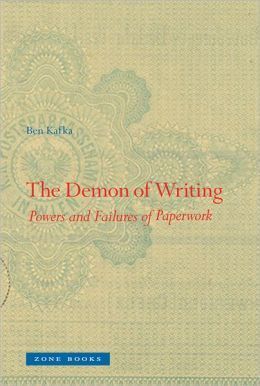
In "The Demon of Writing," Ben Kafka offers a critical history and theory of one of the most ubiquitous, least understood forms of media: paperwork. States rely on records to tax and spend, protect and serve, discipline and punish. But time and again, this paperwork proves to be unreliable. Examining episodes that range from the story of a clerk who lost his job and then his mind in the French Revolution to an account of Roland Barthes's brief stint as a university administrator, Kafka reveals the powers, the failures, and even the pleasures of paperwork. Many of its complexities, he argues, have been obscured by the comic-paranoid style that characterizes much of our criticism of bureaucracy. Kafka proposes a new theory of what Karl Marx called the "bureaucratic medium." Moving from Marx to Freud, he argues that this theory of paperwork must include both a theory of praxis and of parapraxis.
What happened was that I saw that an author would be giving a talk on "How Not to Be Wrong" at Harvard Bookstore on June 9, 2014; this was Jordan Ellenberg on his book subtitled The Power of Mathematical Thinking. This anti-wrongness title had a magnetic pull on me that I could not quite put my finger on. So there I was at Harvard Bookstore, and there were quite a lot of other people too, such that I was standing in an overflow crowd, but this was actually quite nice, as the lecture was delivered into a microphone whose audio was piped throughout the bookstore and so I set about my new mission to browse all the books while still listening to the talk.
One of the books I handled contained, inserted in its pages, something I have never before seen in a bookstore. It was a laminated card printed "Do Not Reshelve" in approximately font size 48; it was double-sided, lest one overlook the message. I wondered what the booksellers intended to communicate to each other via this card. Did they deliberately put the book in an unusual place for promotional purposes? Was the book returned damaged by a customer and was it not supposed to be resold? Then it occurred to me: This is not a message to the bookstore staff. This is a message to me. Well and good, I said to myself, "Do Not Reshelve" and such-not, but suppose I am, of my own volition, inclined to reshelve this twenty-nine-dollar book? I closed it. The cover had the word "Demon" on it. Fuck. Meanwhile Professor Ellenberg was still lecturing at maximal volume on How Not to Be Wrong. Crap. Crap. Crap. Why do these things always happen to me when I am minding my own business?
(By the way, I remembered where I'd heard this injunction before; "How Not to Be Wrong" was precisely the title of the third issue of Moral Relativism Magazine, printed by yours truly. It is terrible to get old and forget things.)
So there I was, supernaturally coerced into buying a copy of The Demon of Writing: Powers and Failures of Paperwork and reading it on the bus on the way home. Upon my arrival, there was -- believe it or not -- a book-shaped package in my mailbox. There is really no use resisting the tide. Typically I buy a book online because it is something I want exceedingly much, but then I forget all about it, and when the package arrives two weeks later I open it with curiosity and then when I see what it is I do a big happy dance because it is exactly my favorite book (and if I have a can of party string I squirt some of that) and then I put the book on my shelf where there is a 50 percent chance I might eventually read it because I might have to read something else first. Well, the outside of this envelope indicated that, sadly, it was not a book I'd purchased for myself. It was a book I'd recently sold -- in this case, my used paperback The Righteous -- and mailed to the oddly configured address specified by the buyer, which turned out to represent a state prison inmate a few thousand miles away, and so the package bounced back as undeliverable. The prison mailroom taped to the back of the package a form list of 40-odd admonitions, and helpfully highlighted in yellow was #26: "All books, magazines, and newspapers must come directly from the publisher, bookstore, or book distributor." Well, I am a book distributor insofar as I sold my used book for a buck-ninety-eight plus shipping and distributed it, and yet, according to the bureaucratic logic of the prison, I must become a book distributor before I can distribute books.
(As per the additional non-highlighted rules, "padded, cushioned, or bubble envelopes" are forbidden, and the envelope may not be taped or glued shut, nor have stamps pasted onto it. Evidently, if the package reaches the mailroom, it is in violation of the rules. Other things that are not allowed: money, candy, baseball cards, human hair; maps and codes; material that "portrays, displays, or represents" anything in which a person under 18 is a "participant" in "conduct," although apparently references to completely inactive, non-agentic children are OK; incitement to murder, riot, escape, or hack computers; references to sex; and, of course, lest we forget, glitter.)
The last part of this episode beautifully illustrates the very point of Ben Kafka in The Demon of Writing, which is that paper-pushing is a form of power. Bureaucracy is not merely a manifestation of the power of individuals; this is supported by the observation that, often, there is no one who can cut through the red tape and intercede on behalf of those who are frustrated by the system. There is not always a single human being who is standing behind all the paperwork rules who has the authority to waive the requirements when they are counterproductive or contradictory. The red tape comes to have its own power, and there may be no human being who is empowered to act contrary to its rules. When we are frustrated by paperwork, sometimes the best we can do is to weave myths about it and blow off steam to "get it out of our system" -- but we are, assuredly, still inside its system.
The Demon of Writing is a good book with some amusing turns of phrase. The coolest thing I learned was that, in the late 1700s during the French Revolution, a clerk named Charles-Hippolyte Labussière stole some documents that contained accusations against actors and actresses that would have sent the lot of them to the guillotine, and he soaked the documents in water and pulped them and threw them out the window into the Seine, and the result was that the guillotine had to be called off because the bureaucracy didn't have the official documents it required of itself before it executed someone, and then the French Revolution ended so there was no need to pursue the executions anyway. Labussière saved hundreds of lives, maybe over a thousand, in this manner. This is very useful knowledge, but now I must come up with a creative plan for The Demon of Writing, as I received clear instruction that I am not to reshelve it.
This is really, really good historical analysis. Kafka's voice is lively and informative, taking time to do the right historical homework while keeping the pace of each chapter upbeat, mixing serious and humorous observations with judicious grace. In terms of scope, we're either focused on the events pre- and post- French revolution, or with Marx looking at early journalistic ventures. Uniformly, I found Kafka's analysis enlightening and his objects of study well chosen. An excellent book!
And, lastly, it's a book by a man named Kafka on the subject of paperwork. That eerie quality alone should be a sufficient quality to read it!
This book really forced me to step back and examine some of my own bias for rules-based processes. The priority of bureaucratic norms and clerical expertise is so ingrained in me that I have a hard time conceiving of alternative. Kafka's book does a great job of personalizing the considerations of the history and life of paperwork from the French Revolution to the beginning of the digital age. The bureaucratic hell of a disgruntled ex-employee seeking restitution as France overthrows itself and the tyranny of a busy, disinterested notary whose signature is needed on a wedding announcement left me feeling palpably frustrated.
Towards the end of the book, the examples from Freud and Marx help bring the quandry of expertise and circumstance into focus, with an especially fun (to me) dissection of Freud's over-analysis of a simple written error on his bank slip.
I really enjoyed this book, more than I thought I would based on the introduction and the sometimes indulgent self-inserts.
pretty light on substance for a book with so much methodological wheel-spinning in the introduction. if this were argued more compactly, it could probably all fit into a single article. nor sure why we need these New Yorker-style narratives about kooky characters in revolutionary France. probably we can chalk that up to Kafka's academic idiom—he is a practicing psychoanalyst, rather than a committed theoretician or humanities scholar. that's not a criticism. but i did need to skim this book pretty heavily to find the handful of sentences that do actual argumentative/theoretical work. i suspect that if you put those back to back in a powerpoint presentation, the argument would come through just as clearly. if not more so.
This book is more limited in scope then the title suggests, because three of four chapters are very specifically focused on the French Revolutionary period. That's not a problem, because those chapters are fascinating in their exploration of how paperwork develop to solve particular problems and, inevitably, how new problems emerged from the development of paperwork. The fourth chapter, in fact, is the odd man out here — it's primarily concerned with Freud and his slips (both memory slips and bank slips, in fact), and seemed tangential to the rest of the book in a way that left the arguments of the whole feeling unresolved. I would have preferred another chapter — or more — about bureaucratic paperwork in France and perhaps elsewhere rather than the more limited, idiosyncratic examples from Freud (which, frankly, seemed like a lot of overreaching on the part of the analyst, not the author of this book). Overall, then, I was compelled and fascinated by The Demon of Writing up until that final chapter, so the first three made the book very much worth reading regardless.
Kafka's argument: Bureaucratic paperwork as we know it today is one of the manifest outcomes of the French Revolution, a position validated with evidence and sound interpretation, but by which chapter 4 becomes overdetermined, and seems to go on only as a requirement of dissertation length, not argumentative strength.
Overall an enjoyable history of paperwork and its relationship to rights. It gives a refreshing take on the reign of terror, if such a thing were needed.
To conclude a work with some charming anecdotes about Barthes interacting with administration and paperwork is just my kind of happy ending.