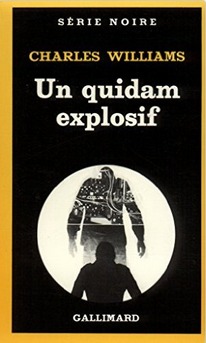
Il n'y a pas que les chiens qu'on promène en laisse. Les hommes aussi, parfois. Tel mon père, ce cavaleur, ce vieux loup de mer, ce dur à cuire que des ordures avaient promené en laisse, jusqu'à l'assassiner, et après l'avoir soulagé de toutes ses économies. Mais de quoi était faite cette laisse mystérieuse, invisible, incompréhensible ? C'est ce que je résolus de découvrir au risque de me faire piéger à mon tour.
Librarian Note: There is more than one author in the Goodreads database with this name. Please see:Charles Williams
Charles Williams was one of the preeminent authors of American crime fiction. Born in Texas, he dropped out of high school to enlist in the US Merchant Marine, serving for ten years (1929-1939) before leaving to work in the electronics industry. He was a radio inspector during the war years at the Puget Sound Navy Yard in Washington state. At the end of World War II, Williams began writing fiction while living in San Francisco. The success of his backwoods noir Hill Girl (1951) allowed him to quit his job and write fulltime.
Williams’s clean and somewhat casual narrative style distinguishes his novels—which range from hard-boiled, small-town noir to suspense thrillers set at sea and in the Deep South. Although originally published by pulp fiction houses, his work won great critical acclaim, with Hell Hath No Fury (1953) becoming the first paperback original to be reviewed by legendary New York Times critic Anthony Boucher. Many of his novels were adapted for the screen, such as Dead Calm (published in 1963) and Don’t Just Stand There! (published in 1966), for which Williams wrote the screenplay.
After the death of his wife Lasca (m. 1939) from cancer in 1972, Williams purchased property on the California-Oregon border where he lived alone for a time in a trailer. After relocating to Los Angeles, Williams committed suicide in his apartment in the Van Nuys neighborhood in early April 1975. Williams had been depressed since the death of his wife, and his emotional state worsened as sales of his books declined when stand alone thrillers began to lose popularity in the early 70s. He was survived by a daughter, Alison.
A bit of a miss from Charles Williams. This was his final novel in which his two beloved worlds (the sea and the backwoods small town) converge. Eric Romstead is a sailor who has arrived in a small American town after his aloof father Gunnar Romstead is shot to death. He discovers that the murder might have involved heroin, a prostitute, the stock market and could be related to an old incident in which his father, who was the captain of a vessel, cracked a drug racket involving one of his crew. Paulette Carmody, an attractive, cheerful and god fearing 45-year-old woman, who was his father’s girlfriend, is the perfect foil for the alpha male Romstead.
Romstead is markedly different from other Williams’ heroes. Romstead, who has Viking blood running through his veins is a cold-blooded revengeful character with a dark past that might have involved committing kidnappings/sinister missions for both the CIA and the FBI. He is unlike the tormented Maddox in The Hot Spot or the ageing John Ingram in Aground, both of whom want to retreat from the world. Romstead could also have republican leanings as his liberal girlfriend keeps taunting him. His ultimate dream after making some money is the same as Maddox or Ingram – to sail across the world with a beautiful woman by his side. But only after settling scores with the men who killed his father.
The book came out in the early 70s, a decade in which Hollywood would unleash a wave of surveillance movies involving technological gadgets like The Anderson Tapes, The Parallax View and The Conversation. This is one Charles Williams novel where the villain uses quite a lot of gadgetry to settle scores with Romstead and his father. But it is also the novel’s failing. I would have thought that Williams, who is a master of complicated plots involving detailed procedures to commit crimes and mislead one’s pursuers, would have used the new technology to create an ingenious plot involving many twists and misdirection’s. But what we get is an over the top action revenge thriller with a prolonged and unconvincing ending that is pretty hard to believe.
I did enjoy the descriptions of the dirt roads and the desert. There are a couple of entertaining flashback scenes set in the ocean. Unlike many other crime fiction writers, Williams is clearly a man who knew a lot about all sorts of stuff – right from yawls to small town swamps to surveillance gadgets. Even a lesser novel like Man on a Leash is leagues ahead of most of the crime thrillers that are too thin on attention to detail.
I think the book could be made into a good action thriller. There are so many Netflix series set in small towns. I wish somebody would do a standalone movie based on one of the Williams novels.
Charles Williams was at the top of the mountain when it comes to writing pulp noir novels in the fifties. His best novels were so pulpy, so good, that few could hold a candle to his work. Man On A Leash was his very last published novel in 1973 and simply does not have that pulpy, noir feel of his earlier work. Don’t look for it here except in some flashes in the beginning of the book. The first half of the story is about Romstead’s appearance in this mysterious town, his encounter with his father’s home there, and the hell-for-leather Valkyrie that lived next door. The second half of the book knits a lot of the loose ends and clues together and is more of a mid-seventies type men’s adventure story than an old-fashioned noir story that Williams was known for. I certainly enjoyed reading this adventure story, but it was not the pulpy goodness of the earlier works that Williams bequeathed to us.
Boring. The only redeeming quality is when they strapped explosives to a donkey and tied tin cans to his tail, thus letting him gallop to his heroic death.