"Le Mariage de Figaro" de Beaumarchais est la suite du Barbier de Seville ; on retrouve Figaro en lutte avec le Comte Almaviva à l’occasion de son mariage tout proche avec Suzanne. Le Comte voudrait bien connaitre l’amour avec la jeune femme, ceci avant que Figaro ne fête ses noces. Il fera tout pour contrarier le dessein du Comte, même s’il doit lutter contre les privilèges nobiliaires de l’Ancien régime. Après quatre ans de censure, la pièce fait un triomphe quand elle sort en 1784. Le Mariage de Figaro annonce la Révolution Française.
Pierre-Augustin Caron de Beaumarchais, a musician, diplomat, horticulturalist, satirist, and American revolutionary, made watches, invented, inventor, fled, spied, published, dealt arms, and financed.
Born a son to a provincial watchmaker , Beaumarchais rose in society as an influential inventor and music teacher in the court of Louis XV. He made a number of important business and social contacts in various roles as a diplomat and spy,and earned a considerable fortune before a series of costly court battles jeopardized his reputation.
An early supporter of American independence, Beaumarchais lobbied the government on behalf of the rebels during the war of independence. From the Spanish government, Beaumarchais oversaw covert aid to supply arms and financial assistance to the rebels in the years before formal entry of into the war in 1778. He personally invested money in the scheme but later struggled to recover it . Beaumarchais also participated in the early stages of the revolution. People probably remember especially his three theatrical pieces.
At the culmination of this brilliant play, written just a few years before the beginning of the French Revolution, the all-powerful Comte de Almaviva challenges Figaro to answer his questions. Figaro, superbly, retorts:
“Eh! Qui pourrait m’en exempter, Monseigneur? Vous commandez à tout ici, hors à vous-même.”
That is the perfect definition of a tyrant: being in command of everything, except for himself. The play, which celebrates esprit and cunning intrigues to out-manoeuvre the abuse of privilege and power, is probably more well-known in its opera adaptation by Mozart. But the original by Beaumarchais is well worth reading in its own right, displaying a more acid political focus, which has proven to be relevant as a societal mirror over time, - leading to its being forbidden by the Vichy régime in the 1940s for example. A late honour - chapeau Beaumarchais!
I remember the first time I read it in a literature class at university. My professor had a predilection for humorous enlightenment thinkers, and Figaro was a character he loved to quote.
"Noblesse, fortune, un rang, des places, tout cela rend si fier! Qu'avez-vous fait pour tant de biens? Vous vous êtes donné la peine de naître, et rien de plus.”
When he read those famous lines from Figaro’s soliloquy, they stuck in students’ minds. All the arrogance and ridicule of a privileged position were highlighted in the hilarious idea of “Vous vous êtes donné la peine de naître, et rien de plus”.
Reading the play again, with a different focus now, the character of Figaro is still fascinating, but his companion, the intelligent young woman Suzanne, is even more striking. She is threatened by the institutionalised rape culture of the privileged class, fearing the Comte de Almaviva’s “droit de seigneur”, which “allows” him to claim the first night with the bride, should she marry Figaro. Not willing to submit to that cruel tradition, the plot develops around the various steps to be taken in order to outwit the power of the Comte. Add some confusion over identities, parental relationships, adultery and tricks, and you have the perfect 18th century play in a nutshell.
Just like Leontes in The Winter's Tale, Almaviva is rehabilitated in the end, reconciled with his wife, not opposing Figaro and Suzanne anymore:
“J’ai voulu ruser avec eux; ils m’ont traité comme un enfant!”
Oh, the luxury of a dictator who is able to detect his own childlike foolishness! The cheerful ending does not weaken the serious arguments raised in the play, however, as they are repeated in a final song, sung by different characters taking turns. The ideas of injustice and power abuse are accentuated and discussed, reflecting on the topics in the preceding action. Beaumarchais’ Suzanne sings out loudly what Shakespeare’s women hinted at implicitly:
“Qu’un mari sa foi trahisse; Il s’en vante et chacun rit: Que sa femme ait un caprice, S’il l’accuse on la punit. De cette absurde injustice Faut-il dire le pourquoi? Les plus forts ont fait la loi.”
The inequality between men and women plainly called “cette absurde injustice”, Figaro’s monologue denouncing the privileges of the nobility, a side discourse on the role of the child born out of wedlock: all these themes show the groundbreaking modernity of Beaumarchais’ political vision put on stage for wide reception. In pre-social media times, the theatre held an important role in spreading ideas. With Figaro praising wit (“l’esprit”) as the way to change an unjust, unequal society, he sets the task for centuries to come:
“Par le sort de la naissance, L’un est roi, l’autre est berger: Le hasard fit leur distance; L’esprit seul peut tout changer. De vingt rois que l’en encense, Le trépas brise l’autel, Et Voltaire est immortel.”
As Figaro closes with Voltaire, I will join him with the philosopher’s famous quote against intolerance:
“Écrasez l’infâme!”
Celebrating l’esprit of 18th century Enlightenment thinkers, light spreads! Fiat lux!
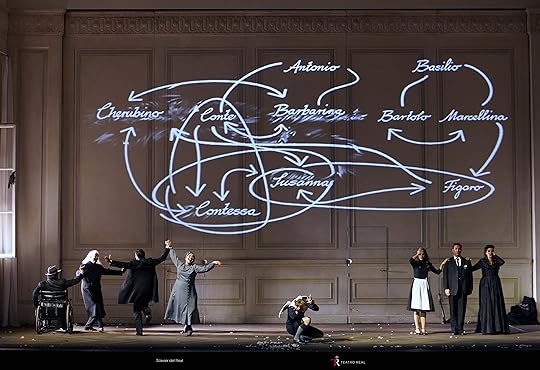
There are three works to consider under this title. There is Beaumarchais play (1778), which I read several times in the past since it was a set text when I was a student. Then there is the Mozart opera which I have watched recently in the Teatro Real. And there is also the Libretto to the opera, by Lorenzo da Ponte, which deserves to be considered on its own.
Pierre-Augustin Caron de Beaumarchais, (1732-1799)
The life of Beaumarchais deserves several volumes, with his marriages, his involvement in the American revolution and his diplomatic role in Spain. It was the latter that led him to write his Figaro trilogy, from 1775 with the Le Barbier de Séville ou La Précaution Inutile (based on Tirso de Molina’s El burlador de Sevilla, from 1620), followed by Mariage three years later, until the weakest of La mère coupable in 1792.
The Mariage was not performed in public, though, until April 1884, and after sixty performances it was forbidden. These were dangerous times in Paris, and the five-act play was loaded with political references, with the famous Figaro ‘tirade’ in Act 5, and the many references (critiques) to the judicial system in place. Of the three plays, this is probably the most provocative, and the most powerful in its dramatic qualities. The story takes place just a few years after the Barbier, at the end of which the Count marries Rosine. Most productions make the mistake of, now that Rosine has become the Countess and the Count goes back to his philandering, of showing her ‘of a certain age’. A striking aspect of Mariage is that of the couple Figaro-Suzanne, it is the latter who pulls the action, in spite of the action and of the crucial role that Figaro played in The Barbier.
In the opera world of the 18th century, the librettist Pietro Metastasio (1698-1782) had been the dominant figure, and indeed one of the shapers of the genre ‘opera seria’, dominance that he exerted from his seat in Vienna. His demise offered space to Salieri, who in his turn backed Da Ponte once he had to leave Venice and settled in Vienna in 1781 – just after the death of Metastasio. At the time, the liberal Joseph II (1741/65-1790), eldest brother of Marie Antoinette, was the Habsburg Emperor. This is important because among other reforms he considerably neutralized censorship and allowed civil marriages without the consent of the parents. Da Ponte succeeded in gaining Joseph’s attention.
It was through his patron the banker Raimund Wetzlar, who also supported Mozart, that Da Ponte collaborated with the composer. They produced three operas, identified as the Trilogy of Desire (Mariage, Don Giovanni and Così fan tutte), that are all in the current repertoire in the major opera venues. But it was Da Ponte who succeeded in getting the emperor’s approval to produce Mariage, a play that was forbidden. The librettist adroitly pruned the play (the Figaro tirade is completely cut out), synthesized it into a four-act work, simplified its plot and number of characters, and cunningly, when he presented the opera to Joseph II, he included a few extracts of the wonderful music. The emperor could not say no.
Wolfgang Amadeus Mozart (1756-1791)
When in 1785 Mozart met Da Ponte, he had already written, with success, a few operas. But he had also moved away from the genre to concentrate on composing for the keyboard. This he then moved somewhat to the side and engaged in opera again, and in string ensembles.
The premiere of this opera in Vienna was just over a year after Beaumarchais had has his in Paris. It may help to understand this very daring step when it is realized that after the French was forbidden, about twelve translations into German were published around the still fragmented German lands. But Mozart wanted to produce something that belonged to the opera italiana subgenre, and indeed the opera has an Italian title Le nozze di Figaro.
The first run of Le Nozze in Vienna was a great success – about five to seven numbers were “encored”. When it then moved to Prague, the success was even greater, and this explains that the premiere of Don Giovanni took place there.
Mozart’s musical and dramatic skills he deployed in the way he matched the musical structure to the play. There are symmetries and contrasts, in formats and tonalities, when for example he uses the same tonality for the Duchess and for Susanna when she disguises as the former, and then reserves one particular tonality to be used only in the sections in which there is some simulation.
That this play received the blessing of the emperor also accounts for the survival of the Fandango at the end of Act 3. Ballet was forbidden in opera but what the troupe did when the first performed in front of Joseph II was to mime, in a ridiculous fashion, the section that corresponded to the dance, to the consternation of the emperor. After his inquiry, the fully fledged Fandango was restored to the work.
Although I enjoyed the production at the Teatro Real, it is a wonderful opera and it was well sung, it was nonetheless a disappointment. The Real chose to present an old production, the one from the Salzburg Festival of 2006, which can be found in YouTube, with Anna Netrebko, Ildebrando d’Arcangelo and Dorothea Roschmann among others.
LAS BODAS DE FÍGARO O LA LOCA JORNADA, de Beaumarchais
"¡No soy más, esa Rosina que has perseguido tanto! Soy la pobre Condesa Almaviva, la triste mujer abandonada, que tú ya no amas."
Bueno por increíble que parezca el conde de Almaviva que lo vimos en la anterior obra de esta trilogía "El barbero de Sevilla" luego de desposar a Rosina (convertida en condesa de Almaviva) ahora la repudia y ha puesto sus ojos en la bella Susana quien comparte un romance con nuestro personaje principal Fígaro. Ahora que el conde de Almaviva ha formado su residencia Fígaro funge de conserje y ayuda de cámara del castillo del Conde quien así pagó sus servicios. Aunque debo decirlo desde la anterior obra intuía que algo iría mal pues el Conde no parecía realmente buena persona. En sí nuevamente la personalidad jovial y desenvuelta de Fígaro tratará de resolver los problemas. En principio el de frenar el asedio que el conde de Almaviva ha puesto sobre su enamorada Susana. La condesa misma estará de aliada de la pareja. Pero por otro lado está el tío de Susana, Antonio, quien no está de acuerdo con la pareja que ha elegido su sobrina e incluso Marcelina, quien enamorada de Fígaro desea que él cumpla una antigua "promesa". El resultado es realmente como dice el título un día de locos y hay un giro por lo menos que no lo vi venir y que resulta bastante sorprendente e hilarante. Me terminó de gustar bastante. Esta obra fue la inspiración para Mozart para componer su famosa ópera "Le nozze di Figaro".
"Par le sort de la naissance, L'un est roi, l'autre est berger ; Le hasard fit leur distance ; L'esprit seul peut tout changer. De vingt rois que l'on encense, Le trépas brise l'autel ; Et Voltaire est immortel..." - acte V, scène 7
J'ai toujours eu tendance à confondre Marivaux et Beaumarchais, mais si j'avais fait l'effort de lire "le Mariage de Figaro" plus tôt, j'aurais certainement pu mieux les distinguer. Depuis que je me suis lancée dans la biographie de Beaumarchais et la lecture de son cycle de pièces, je vais de surprise en surprise : et ce sont de bonnes surprises ! J'aime la place qui est faite aux femmes dans son œuvre, et particulièrement ici les tirades progressistes à cet égard. J'aime que la place des puissants soit si discutée, non seulement par les mots, mais par les personnages même : quel plaisir de voir en Figaro non pas un traditionnel valet de comédie, mais un personnage sensible et intelligent, qui se joue de son maître pour lui apprendre. L'héritage voltairien de Beaumarchais est bien présent dans ses lignes. L'intrigue est entraînante, les mises en scène très détaillées et osées (le dernier acte, dans l'obscurité, est une belle trouvaille).
Ça n'a pas vraiment de sens de chroniquer un dramaturge classique comme Beaumarchais aujourd'hui, mais pour moi, il est une véritable découverte.
Seville Berberi veya Nafile Tedbir'i bundan birkaç ay önce okumuş ve çok beğenmiştim. Figaro'nun Düğünü veya Çılgın Gün'ü de yayımlanır yayımlanmaz alıp okumak istedim. Tıpkı Seville Berberi gibi Figaro'nun Düğünü de son derece eğlenceli bir oyundu. Büyük bir keyifle okudum. Sadece biraz daha kısa olabilirmiş diye düşündüm.
Figaro'nun Düğünü, Seville Berberi'nden hatırladığımız karakterler üzerinden ilerliyor. Seville Berberi'nin çaresiz âşıkları Kont Almaviva ve Rosina'yı -namıdiğer Kontes Almaviva- bu sefer evli olarak okuyoruz. Oyunun diğer ana karakterleri ile Seville Berberi'nden hatırlayacağımız üzere Figaro ve hikâyeye Kontes Almaviva'nın hizmetçisi olarak dâhil olan Susanna. Hikâye, Figaro ve Susanna'nın evlenmeye çalışması üzerine kurulu. Evlenmeye çalışması diyorum; çünkü bir önceki oyunca Rosina için ölüp biten Kont, evlilik hayatının durağanlığından ötürü "yeni hazlar" peşinde ve bu yolda Susanna'yı baştan çıkarmayı kafasına koymuş olarak karşımıza çıkıyor. Bu durumun farkında olan Kontes de tabii ki boş durmuyor. Bu süreçte yine pek çok eğlenceli entrika, yanlış anlaşılma okuyoruz.
This is a crazy and sparkling comedy, a form of absurd theatre (in a way a precursor of Beckett and Pirandello). Figaro is the master schemer here, but he's not master of the plot at all: all his plans and tricks fail. He has more the allure of Sancho Pancha, Don Quichote's loyal servant. I was struck by the remarkable role of the female characters; they take over the intrigue. The moral of the story has a distinct social flavour: money will replace birth as the foundation of power. No wonder this was written in the 18th century, the time of the upcoming bourgeoisie. (rating 3.5 stars)
Figaro is worldwide famous and appreciated as a masterpiece, but much more because of the music composed by Mozart and less for the contribution of the “original” author, Beaumarchais.
For all its strengths, the comedy is not one of the greatest works man has ever created. It is funny, witty and made glorious by the work of the genius of Mozart.
Speaking of which, Malcolm Gladwell comes to mind, with his amazing book- Outliers. In it he analyses the concept of genius and the importance of hard work. In Gladwell’s view, it is not so much “innate genius” so much as hard work and practice that make a man or woman great.
In his study of Mozart, The Beatles, bill Gates, top athletes and other Outliers, Malcolm Gladwell reaches the conclusion that 10,000 hours of work and practice, over ten years, will send the apprentice on the top of the world and at the peak of his profession.
Mozart, known as a child prodigy, has composed worthwhile music only at the age of about twenty six, if I remember well. This makes Mozart a kind of a late bloomer, in the light of the ten years theory.
Coming back to Il Nozze di Figaro, the plot reminds me of a soap opera, genre which got its inspiration from the likes of Figaro and Oedipus. At one point, we barely miss a wedding between the son and his unknowing mother.
I remember seeing Amadeus, directed by Milos Forman, with a wonderful Abraham Murray as Salieri, for which he won the Academy Awards, in competition with Tom Hulce, for his role as Amadeus.
At one point in the film, Mozart brings up the idea of using an Italian comedy for the libretto, which raises more than eyebrows and opposition…met with his funny laugh:
- Hahahha
Everybody seems to be in love with everyone else in Il Nozze di Figaro. The count Almaviva loves Suzanne, but she loves Figaro, who is also wanted by Marceline. Cherubin is in love with everyone and has an aria which is quoted here, below.
There are unexpected turns of events, Cherubin has to hide in the closet, which is a scene we get in many movies ever since. Deceit is used by almost all parties involved and the feeling is uneasy at times.
Promises are made only to be broken and all in the name of love, which seems to conquer all and justify all, perhaps more so in the South, where the blood is hot.
Figaro borrows some money from Marceline and the condition is that he will either pay back or marry the woman, who is old enough to be his mother…
The affair comes up in court, where there is laughter:
- How can I make a promise to marry the woman And pay her money…it’s crazy
- It is marry or pay not – marry and pay
- It is not… and so on
Then there is a disguise, a jump from the bedroom and various disputes and quarrels, but if you ask me, all this is nice and good with music, without it is not so much fun…not for this reader, but hey, you may love it.
“Voi che sapete che cosa e amor, Donne, vedete, s'io l'ho nel cor, Donne, vedete, s'io l'ho nel cor. Quello ch'io provo, vi ridiro, E per me nuovo capir nol so. Sento un affetto pien di desir, Ch'ora e diletto, ch'ora e martir. Gelo e poi sento l'alma avvampar, E in un momento torno a gelar. Ricerco un bene fuori di me, Non so chi il tiene, non so cos' e. Sospiro e gemo senza voler, Palpito e tremo senza saper, Non trovo pace notte ne di, Ma pur mi piace languir cosi. Voi, che sapete che cosa e amor Donne, vedete, s'io l'ho nel cor, Donne, vedete, s'io l'ho nel cor, Donne, vedete, s'io l'ho nel cor.”
Le Mariage de Figaro est une comédie qui pousse les thèmes du Barbier de Séville jusqu'au ridicule. L'intrigue se fonde sur une histoire d'amour contrariée autour de laquelle viennent se greffer tout plein d'autres intrigues. Figaro veut se marier avec Suzanne, mais il est jaloux du Comte qui réclame "le droit de cuissage".
A Séville, Figaro, le valet du comte Almaviva prépare ses noces avec la jeune Suzanne, mais il doit affronter un dangereux rival dans la personne de son maître, dont la flamme pour son épouse décroit. Les futurs mariés auront besoin de toute les ressources de leur prudence et de leur astuce pour triompher de la passion du comte. Mais leurs machinations vont être perturbés par l'intempestif et aimable Chérubin, qui brûle pour la comtesse délaissée. Je m'étais régalé plus d'une fois avec la version de Mozart et de Da Ponte, mais je n'avais toujours pas lu la pièce originale de Beaumarchais, qui ne m'a pas déçue.
I had to read this book for my European Humanities class ,and I'm so glad my professor assigned it. This book was hilarious. I wondered why my professor assigned the class the second book in the series but the book was easily understandable. It was easy to find out what happened in the previous book. The story is like a Twelfth Nights mixed with Midsummer Nights Dream. It was very entertaining.
The only reason why I gave it 4 stars is because it felt a little rush at the end and I didn't really like the connection they made between Figaro and Marceline. It felt as if the author took an easy way out, but overall it was still enjoyable.
Wow, I've actually enjoyed it! The characters were amazing, and this is exactly the type of comedy I love. It actually made me chuckle a couple of times. Plus, Suzanne was fucking great and had some of the best comebacks! And was a little bit feminist-ish. Sort of. In a way. Figaro was also cunning and funny, so I appreciated him a lot.
Overall, very glad I haven't decided to skip this one.
Figaro’nun maceraları bu sefer kendi düğünü ile devam ediyor! ilk kitap olan Sevilla Berberi veya Nafile Tedbir’de karşımıza çıkan karakter kadrosu bu kitapta da karşımıza çıkıyor, tabii birçok yeni karakterle birlikte.
kitabın tek olumsuz yanı bazen çok çok uzayan replikler... yoksa yine ve yine çok güzel bir oyundu. ama kendi içinde karşılaştırma yaparsam ben ilk kitabı daha çok sevdim. izlemesi de okuması da müthiş keyifliydi.
I was looking for this book in my country very long. I finally found it and ordered immediately, because first time I got known to this story was Russian musical with my favorite singer Philip Kirkorov. He played Count Almaviva. Since that New Year night when I saw that musical, I got obssesed with this story. And I started reading this book in Lithuanian after so many years after that musical's premiere on TV. And I love this book. Drama, intrigues, jokes, passion- everything I love. I so love passionate dramas full of jealousy, love, missing parents and wegginds. It is a story of times when I wish I could live. But, unfortunately, I cannot return back in time. That's how I imagine 18th century, just like in this book.
Count Almaviva of course is my favorite. Just like me: jealous, furious and unfaithful. He is my favorite character in the play. And, of course, because of that Russian musical. My favorite singer played his role perfectly! In fact all these Russian singers and actors made the best show ever created by this book. They played all the characters just like the author showed them in this book.
I feel so happy I read this play finally after so many years. It was so entertaining and it gave me so much feelings and joy.
I read Beaumarchais’ play since I recently discovered that it was a big hit in 1784 prior to the French Revolution. Louis the XVI hated it and Danton and Napoléon praised it!
The story is about Figaro, a valet who will soon get married to a maid. The Count for which they both work wants to exercice his « Droit du seigneur », a supposed medieval right allowing lords to have sexual relations with subordinate women on their wedding nights. While historians are not sure this « Droit du seigneur » really existed at that time, the entitlement of the lords was real. The play acted as a catalyst for change and freedom from the unfair power of the feudal lords and the monarchy.
What is particularly interesting in « Le Mariage de Figaro » is the rendition of the context of pre-revolutionary France. You can really feel the Enlightenment ideas floating around : « Without the freedom to criticise, there is no true praise » and the insolent and at once brillant wordsmith of Beaumarchais reflecting the desire for political change. It has some good quotes as well about the unfairness against women : « treated as children for our assets, punished as adults for our faults ». A nice and easy play to delve into revolutionary France.
que 3 étoiles pour l'instant mais sûrement plus plus tard, j'ai eu du mal à comprendre qui était qui et certaines intrigues dans l'acte I mais de toutes façons je vais le relire (lol)
UPDATE dcp j'ai effectivement relu (et je vais encore le relire, tiens !) ; je comprends mieux les intrigues, mais en vrai je comprends tjs pas tous les sous-entendus (même si j'ai reperé le chiasme coquin) effectivement les épingles sont d'une importance cruciale, mon mauvais Figaro quel gros baiseur n'empêche
UPDATE ptn je comprends enfin tellement de choses, y'a TELLEMENT d'échos et de sous-entendus (pas uniquement sexuels, ceux-la je les avais), vasy je crois que je les aie presque tous, mais c'est tellement normal que je comprenais rien la première fois sinon, la pièce est SUPER drôle et intelligente, jcrois que je préfère à Goldoni finalement jpense que je vais faire une tier list des persos, ce qui est sûr c'est que Suzanne et Marcelline sont mes chouchous, et Bazile je le hais absolument
Read this for my French lit class about "dangerous women." Not sure I picked up on all the nuances of the play, but I enjoyed it nevertheless. The last act is particularly fun because all of the women basically get together and say "all right, we're tired of this crap" and manipulate the men into doing what they want them to do.
Kitap kulübü sayesinde keşfettiğim, güzelce zaman geçirmeme sebep olan bir oyun oldu.
Bir soylunun, kontun, ilk gece hakkını kullanmak üzere niyetini sergilemesi üzerine, Figaro ve sevdiceği Suzanne iç içe geçen oyunlar kurarak kontu durduruyorlar. Kitap ilk seviyede, karakterlerin hak savunusunu dolaylı, zekice ve kıvrak bir zekayla yapması üzerinden bir güldürü sunuyor.
Kitabın diğer seviyelerde gösterdikleri ise, yazarın kimliğinin ve hayatını çokça yansıtan noktalardan oluşan bir zenginlik ortaya koyuyor. Yazarın kendisindeki pek çok özelliği Figaro'da tecessüm ettirdiğini de görüyoruz. Bu haliyle Beaumarchais (ve Figaro) aslında monarşiyi ve soylular erkini kurdukları oyunlarla kırabilecek bir zekaya ve niyete sahip olduklarını da ortaya koyuyor.
Sahne sanatı için ortaya konan bir eserin bu kadar devrimci niyetler sergilemesi mümkün mü noktasında, yazarın karakteri, Fransa ve Amerika devrimlerindeki rolü bu yorumu yapmamı mümkün kılıyor. Fransız ihtilaline ramak kala yazılan bu eser aslında sivri ve şakacı bir dilli soyluluk yaklaşımının geçersizleşmeye başlayan, tahakküm ilişkilerinin zayıfladığını da göstermekte. Mutlakiyetin çoğu zaman mutlak olamadığını, komşularla iyi ilişkiler geliştirme yaklaşımıyla aslında tahakkümden ziyada bürokratik bir olanı koruma ortama dönüştüğünü de ara diyaloglarda ortaya koyuyor.
Kitapta Suzanne, Kontes ve Figaro'nun yaklaşımları, çevik düşünceleri, muzip yapıları çok düşündürücü ve keyif verici. Karakter detaylarına yazarın gösterdiği özen kitabın keyif veren bir eser olmasında çok önemli bir katkı sağlamış.
Çeviri kaynaklı bazı yerlerde dil daha ılımlı hale gelmiş, ancak burada çevirmenin akıcılık anlamında bir müdahalede bulunduğu görülebiliyor. Eserin güldürü ağırlıklı birincil anlamı ağır bastığı, ve ikinci anlamlara dair bakış açısının aslında biraz da niyet okumaya dönebilecek olması sebebiyle, çevirmenin çeviriyi bu şekilde konumlandırmasında doğru bir karar verdiği söylenebilir.
Il faut absolument lire cet ouvrage afin de comprendre les attitudes sociales et les conflits intellectuels qui ont existe en France pendant la periode juste avant la Revolution francaise. Les gens de classes moyennes et les aristocrates adoraient leur pays et leur monarchie, mais ils avaient le sentiment il y avait des choses au pays que l'on devait change. La tragedie, c'est qu'une fois sortie de sa bouteille, le genie s'averait incontrolable.
Il va sans le dire qu'il faut au moins une fois dans sa vie assister a une representation de l'opera.
Comedie assez classique avec quiproquo, cachettes dans les armoires, etc. L'intrigue est basée sur le "droit de cuissage", heureusement que le monde change... ! Très XVIIIe avec le thème du libertinage très en vogue
ფიგაროს ქორწინებასთან დაკავშირებული მხიარული თავგადასავლები ხომ სახალისოა, მაგრამ აქ ბომარშეს კიდევ სხვა, საუკუნის გათვალისწინებით განსაკუთრებით მნიშვნელოვანი, ჩანართი აქვს ფიგაროს მონოლოგის სახით, რომელიც მის წარსულს ეხებდა და, რაც მთავარია, გადამწყვეტია ქალების როლი შეშლილი დღის მშვიდობიანად დასრულებაში. ალბათ ამიტომაა, რომ ასეულობით წლის მერეც კი არ მოძველებულა.
Je dois avouer que mon ressenti est assez mitigé. Si cette pièce est souvent louée pour son esprit satirique et son audace critique envers la société de son époque, elle ne m'a malheureusement pas captivée comme je l'aurais espéré. D'abord, l'histoire ne m'a pas particulièrement attirée. Certes, les intrigues amoureuses et les manipulations entre les personnages offrent un jeu dynamique, mais j'ai trouvé l'ensemble assez prévisible et parfois répétitif. Figaro, bien que rusé et plein d'esprit, ne m'a pas semblé aussi attachant que ce que j'attendais d'un personnage principal. De même, le Comte Almaviva, en tant qu'antagoniste, manque à mes yeux de profondeur, et ses tentatives de séduire Suzanne deviennent lassantes à force de répétition. Ce qui m'a le plus déçue, cependant, c'est mon manque d'investissement dans la lecture. C'est la première fois que je ressens de l'ennui en lisant une pièce de théâtre. Malgré des dialogues vifs et une critique sociale intéressante, le rythme ne m'a pas convaincue. Certaines scènes m'ont paru trop longues ou trop bavardes, et l'humour, bien que présent, ne m'a pas toujours touchée. Cela dit, je reconnais l'importance historique de la pièce et son audace dans la dénonciation des privilèges de l'aristocratie. Il est fascinant de voir comment Beaumarchais a osé critiquer les injustices sociales à une époque où la censure pesait lourdement. En cela, Le Mariage de Figaro reste une oeuvre marquante.