

What do you think?

Alone on the Ice: The Greatest Survival Story in the History of Exploration
On January 17, 1913, alone and near starvation, Douglas Mawson, leader of the Australasian Antarctic Expedition, was hauling a sledge to get back to base camp. The dogs were gone. Now Mawson himself plunged through a snow bridge, dangling over an abyss by the sledge harness. A line of poetry gave him the will to haul himself back to the surface.
Mawson was sometimes reduced to crawling, and one night he discovered that the soles of his feet had completely detached from the flesh beneath. On February 8, when he staggered back to base, his features unrecognizably skeletal, the first teammate to reach him blurted out, “Which one are you?”
This thrilling and almost unbelievable account establishes Mawson in his rightful place as one of the greatest polar explorers and expedition leaders. It is illustrated by a trove of Frank Hurley’s famous Antarctic photographs, many never before published in the United States.
Mawson was sometimes reduced to crawling, and one night he discovered that the soles of his feet had completely detached from the flesh beneath. On February 8, when he staggered back to base, his features unrecognizably skeletal, the first teammate to reach him blurted out, “Which one are you?”
This thrilling and almost unbelievable account establishes Mawson in his rightful place as one of the greatest polar explorers and expedition leaders. It is illustrated by a trove of Frank Hurley’s famous Antarctic photographs, many never before published in the United States.
Paperback
First published January 21, 2013
About the author
David Roberts
62 books239 followersLibrarian Note: There is more than one author in the GoodReads database with this name.
See this thread for more information.
David Roberts is the award-winning author of twenty-nine books about mountaineering, exploration, and anthropology. His most recent publication, Alone on the Wall, was written with world-class rock climber Alex Honnold, whose historic feats were featured in the film Free Solo.
See this thread for more information.
David Roberts is the award-winning author of twenty-nine books about mountaineering, exploration, and anthropology. His most recent publication, Alone on the Wall, was written with world-class rock climber Alex Honnold, whose historic feats were featured in the film Free Solo.
Ratings & Reviews
Friends & Following
Create a free account to discover what your friends think of this book!
Community Reviews
Displaying 1 - 30 of 652 reviews

March 11, 2022
Why I chose to listen to this audiobook:
1. GR friend, Cheryl, wrote a most intriguing review; and,
2. March 2022 is my self-appointed "Memoirs & Biographies Month"!
Positives:
1. author David Roberts covers, in great detail, the Australasian Antarctic Expedition (AAE) led by Douglas Mawson from 1911-1914 that explored a huge section of uncharted coast of this continent due south of Australia. I was most fascinated by the massive planning involved and the issues of finding suitable teammates as well as landing sites for the ship, "Aurora", setting up communication systems, the constant inhospitable weather conditions, finding and maintaining food supplies, handling of Huskies needed to pull sledges, keeping hygienic, morale boosting and mental instability, including polar depression and even insanity 😱. I also learned about each specific team's difficulties with terrain (e.g. snow bridges covering hidden crevasses - scary stuff!), weather, health issues, loss of equipment and/or dogs, and food depletion, but the detailed tragic events concerning Mawson's three-man team were the most devastating; and,
2. some interesting tidbits (at least for me):
- Antarctica has several volcanoes with two of them being active;
- that Mawson is considered to be Australia's greatest explorer, and that his image was on the country's former $100 bill; and,
- as I was listening to this audiobook, news sources reported the recent discovery (March 5, 2022) of Shackleton's ship "Endurance" beneath the Antarctic ice, found in remarkable condition! This particular ship is mentioned in the book.
Niggles:
Although background information is relevant in nonfiction, I felt, at least in this book, that it was quite overwhelming, with some of this information skipping around in a most confusing manner. I may have been able to follow the gist of it in print form a little better than with the audiobook format.
I highly recommend this book for readers greatly interested in polar expeditions. As for me, stories like these remind me why I never want to visit the Antarctic, except through books or film!
1. GR friend, Cheryl, wrote a most intriguing review; and,
2. March 2022 is my self-appointed "Memoirs & Biographies Month"!
Positives:
1. author David Roberts covers, in great detail, the Australasian Antarctic Expedition (AAE) led by Douglas Mawson from 1911-1914 that explored a huge section of uncharted coast of this continent due south of Australia. I was most fascinated by the massive planning involved and the issues of finding suitable teammates as well as landing sites for the ship, "Aurora", setting up communication systems, the constant inhospitable weather conditions, finding and maintaining food supplies, handling of Huskies needed to pull sledges, keeping hygienic, morale boosting and mental instability, including polar depression and even insanity 😱. I also learned about each specific team's difficulties with terrain (e.g. snow bridges covering hidden crevasses - scary stuff!), weather, health issues, loss of equipment and/or dogs, and food depletion, but the detailed tragic events concerning Mawson's three-man team were the most devastating; and,
2. some interesting tidbits (at least for me):
- Antarctica has several volcanoes with two of them being active;
- that Mawson is considered to be Australia's greatest explorer, and that his image was on the country's former $100 bill; and,
- as I was listening to this audiobook, news sources reported the recent discovery (March 5, 2022) of Shackleton's ship "Endurance" beneath the Antarctic ice, found in remarkable condition! This particular ship is mentioned in the book.
Niggles:
Although background information is relevant in nonfiction, I felt, at least in this book, that it was quite overwhelming, with some of this information skipping around in a most confusing manner. I may have been able to follow the gist of it in print form a little better than with the audiobook format.
I highly recommend this book for readers greatly interested in polar expeditions. As for me, stories like these remind me why I never want to visit the Antarctic, except through books or film!

September 2, 2017
Alone on the Ice: The Greatest Survival Story in the History of Exploration by David Roberts is a detailed account of the Antarctic of 1913. A brief description of other trips and the men who went there is in here also. Then the details of little things I would never have thought about being trapped in a tent with other people and how an A personality and a B personality could really get on each others nerves and how they dealt with it. Small things, but magnified when you are trapped in a tent for hours. Survival techniques are discussed, in the tent and out, amazing things they did. I would die for sure because I would never have thought of these things. Other more unpleasant things they did to live, ugh! It is all very fascinating, especially if you love history or exploration. If you don't, then this would be a long dull read for you. The amazing trek Mawson made, by himself after his team mates died, and he almost died, to go back to camp and hope they hadn't left him. It took 37 days alone, falling in deep abyss, no food, feet in near shreds, deep despair, no tools, and starving. Some men had waited for him as the ship had just sailed off a couple of hours before. It is a very interesting read.
I think the horrible treatment of the dogs was appalling, and still, the dogs today are treated poorly, but media doesn't show this.
I think the horrible treatment of the dogs was appalling, and still, the dogs today are treated poorly, but media doesn't show this.

January 25, 2014
I read more than 40 books last year and only gave two 5 star reviews so I don't give them out too often. Those who have read about the exploration of Antarctica are much more likely to have read about Shackleton, Scott, and Amundsen, but this engaging story of Australian Douglas Mawson deserves equal attention.
The central story covers how after a tragic accident, Mawson returned 300 miles to base without adequate supplies and only enough food for 10 days. It took him nearly two months to return. No less an explorer than Sir Edmund Hillary, the first climber of Mt. Everest called it "The greatest survival story in the history of exploration."
When you finish the book you may wonder if modern men could match the feats of Mawson and his companions. In the epilogue the book tells the story of a modern day adventurer who tried to recreate Mawson's desperate 300 mile journey. It was a worthy effort, but it only proved all the more the amazing accomplishment made by Mawson.
Highly recommended.
The central story covers how after a tragic accident, Mawson returned 300 miles to base without adequate supplies and only enough food for 10 days. It took him nearly two months to return. No less an explorer than Sir Edmund Hillary, the first climber of Mt. Everest called it "The greatest survival story in the history of exploration."
When you finish the book you may wonder if modern men could match the feats of Mawson and his companions. In the epilogue the book tells the story of a modern day adventurer who tried to recreate Mawson's desperate 300 mile journey. It was a worthy effort, but it only proved all the more the amazing accomplishment made by Mawson.
Highly recommended.

March 12, 2013
The writing was engaging, and I understand the need to set this specific story in the context of Antarctic exploration as a whole. But I am 1/3 of the way through, and we've barely gotten to the expedition that is supposed to be the focus. Instead, we keep jumping back and forth in time in WAY too much detail to other expeditions. I've lost any sense of urgency, and the book has lost me as a reader before I've even gotten to what I assume is the good stuff--the gripping adventure I was expecting when I picked this up. I wanted to like it, but I'm really disappointed in the pacing.

April 9, 2020
That was the longest epilogue I’ve ever endured

November 21, 2022
Free for Audible Plus members in both the UK and the US!!!!
This is a nonfiction book. It recounts events of the Heroic Age of Antarctic Exploration (1897-1922).
It tells of the Australasian Antarctic Expedition (AAE) led by the Yorkshire, England, born Australian geologist-cum-polar-explorer Douglas Mawson (1882-1958). Although not as well-known as Ernest Shackleton, Robert Falcon Scott or Roald Amundsen, he too was one of the great polar explorers of the era.
Mawson’s adventures and his personal survival story on the Antarctica is related, just as the book’s title indicates. A great deal of background information and stories about other exploratory missions are covered as well. The book is not simply about Mawson’s exploits! Keeping the different expeditions organized and straight in my head was not easy. Having read half, I went back and started all over again. I needed the repetition to organize the different trips in my head. Not only are numerous expeditions spoken of, but also the expeditions themselves are split into teams working separately from different locations, each carrying out smaller expeditions simultaneously. The numerous arrival and departure dates and places can be confusing!
I understood much better what was going on second time around. I think this is a book that might be easier to absorb in a paper rather than the audio format. Maps would help too. I enjoyed the story very much on the second reading. In my view, you get a thorough understanding of Mawson’s personality, and not just his character but also the traits of the other expedition members. Many sources are compared and quoted in a valiant effort to discover underlying truths.
I sat on the edge of my seat and tried to calm myself down during the exciting survival episodes. They come both at the start and near the end, before the epilog. If you have even just a smidgen of empathy, you are going to feel for these guys….as well as their Greenland huskies.
Lots of interesting information is included. Do you know that the magnetic poles are not stable, that they move?! Glaciers, icebergs, ice formations caused by erupting gases, grottos, crevasses, snow bridges and lids, as well as the birds and the animals inhabiting the wide expanses are all put visibly before our eyes. The lives of the Greenland huskies are described. These sections are not easy reading. The competition existing between big name polar explorers is emphasized because this was the nature of the game. Reality is drawn. Conditions are harsh!
The reader is told of Mawson’s entire life--his youth, his studies and his marriage too. In the epilog, we hear of his death.
I do think the book would benefit from further editing, particularly as it approaches the end. It drags on too long. The epilog is extremely long. It reads as a eulogy. The author wants more attention given to Douglas Mawson’s valor, merits and accomplishments. Although I do think Mawson to be worthy of such acclaim, this doesn’t mean the author should blab on forever. He repeats information, speaks of other books he has written and sidetracks into a discussion of a movie on Mawson. A conclusion should be brief and concise.
I still think the book is worth four stars, just shorten the end.
The narration of the audiobook by Mathew Brenher is clear and distinct. Being very well done, I have given the narration four stars.
This is a nonfiction book. It recounts events of the Heroic Age of Antarctic Exploration (1897-1922).
It tells of the Australasian Antarctic Expedition (AAE) led by the Yorkshire, England, born Australian geologist-cum-polar-explorer Douglas Mawson (1882-1958). Although not as well-known as Ernest Shackleton, Robert Falcon Scott or Roald Amundsen, he too was one of the great polar explorers of the era.
Mawson’s adventures and his personal survival story on the Antarctica is related, just as the book’s title indicates. A great deal of background information and stories about other exploratory missions are covered as well. The book is not simply about Mawson’s exploits! Keeping the different expeditions organized and straight in my head was not easy. Having read half, I went back and started all over again. I needed the repetition to organize the different trips in my head. Not only are numerous expeditions spoken of, but also the expeditions themselves are split into teams working separately from different locations, each carrying out smaller expeditions simultaneously. The numerous arrival and departure dates and places can be confusing!
I understood much better what was going on second time around. I think this is a book that might be easier to absorb in a paper rather than the audio format. Maps would help too. I enjoyed the story very much on the second reading. In my view, you get a thorough understanding of Mawson’s personality, and not just his character but also the traits of the other expedition members. Many sources are compared and quoted in a valiant effort to discover underlying truths.
I sat on the edge of my seat and tried to calm myself down during the exciting survival episodes. They come both at the start and near the end, before the epilog. If you have even just a smidgen of empathy, you are going to feel for these guys….as well as their Greenland huskies.
Lots of interesting information is included. Do you know that the magnetic poles are not stable, that they move?! Glaciers, icebergs, ice formations caused by erupting gases, grottos, crevasses, snow bridges and lids, as well as the birds and the animals inhabiting the wide expanses are all put visibly before our eyes. The lives of the Greenland huskies are described. These sections are not easy reading. The competition existing between big name polar explorers is emphasized because this was the nature of the game. Reality is drawn. Conditions are harsh!
The reader is told of Mawson’s entire life--his youth, his studies and his marriage too. In the epilog, we hear of his death.
I do think the book would benefit from further editing, particularly as it approaches the end. It drags on too long. The epilog is extremely long. It reads as a eulogy. The author wants more attention given to Douglas Mawson’s valor, merits and accomplishments. Although I do think Mawson to be worthy of such acclaim, this doesn’t mean the author should blab on forever. He repeats information, speaks of other books he has written and sidetracks into a discussion of a movie on Mawson. A conclusion should be brief and concise.
I still think the book is worth four stars, just shorten the end.
The narration of the audiobook by Mathew Brenher is clear and distinct. Being very well done, I have given the narration four stars.
June 19, 2022
DNF at 35% I usually love these adventure stories. Shackleton was one of my favorites. However this audiobook was as dry as chapped lips. The story jumped around between characters and events so frequently that it was hard to keep up. There were so many details such as dates, names, conversations that made the plot choppy. I ended up losing interest.

April 3, 2013
In 1911, a young university professor from Australia named Douglas Mawson, assembled a group of explorers and scientists to form the Australasian Antarctic Expedition whose mission was to map, photograph, and collect geologic samples from the continent of Antarctica. After arriving and building a base camp, they wintered there before beginning their expedition. Mawson divided the entire group into smaller teams to conduct the research and mapping. Mawson’s team of three men was fit and able. They set out on a journey south of the camp in November with a goal of returning by mid January. At the end of January, all team members had returned to base except Mawson’s team. On January 29, base camp members who had remained behind saw a figure approaching. It was Mawson. His two companions had suffered tragic fates. Mawson had walked more than 300 miles alone across barren, icy surface interspersed with hidden crevasses as well as bitter subzero temperatures and blizzard conditions. He was unrecognizable and near starvation. This is an astonishing story of perseverance, endurance, and survival that Sir Edmund Hillary called, “The greatest survival story in the history of exploration.” It’s one you won’t soon forget.

May 20, 2014
I got sucked in by the "Greatest in history" subtitle. Roberts is a dirty rotten liar in that respect. A relatively interesting story? Sure. A harrowing tale? Not so much. Greatest ever? not by 700 Antarctic miles in winter. Delete the over-promising title and the underwhelming story may have rated an unenthusiastic three stars.
Survival is this case means walking across a dangerous cold landscape and making the decision to not turn back when you should, because eating your dogs is less distasteful than curbing your ambition (something the men were prepared for and had done on many occasions along the way) and hoping the get away vehicle makes some allowances for your suicidally intense aspirations. The "greatest survival story in the history of exploration" is actually just getting up most days on half rations or less and continuing to walk back the way you came and hoping someone will be there to save your sorry ass when you arrive. It takes up one chapter in the book. Actually two- because the author sucks you in during the first chapter, then pads the book with personal histories, expedition details, and returns later for the uninspiring payoff. Had he stuck to the story of survival it would hardly make a magazine article.
The padding is the one bright point. Like most books on early arctic explorers it is full of background on family life, acquiring funding and competition to be first among pretty ruthless men - it takes a stunningly strong backbone and appalling lack of compassion to strive to achieve firsts in an environment as inhospitable as the polar regions- fierce competition comes as no surprise. In adventure tales of the early 1900s human weakness was not an acceptable part of the story and dirty laundry was kept to yourself if you expected to be glorified upon your return. This book does a good job of humanizing the explorers through excerpts from surviving diaries.
The personal nature of the interactions is well documented and presented in an easy to read, even sided, well developed fashion that did connect me to the explorers and their lines of supply. The authors own editing - what belongs in the book and what is superfluous is well done and I commend him for his talent in that aspect. It is a fine line many fail to straddle, either boring the reader to tears or making connections that aren't sufficiently documented. Kudos to Roberts for superbly executing that facet.
If, like me, you are fascinated with people who do stuff that's probably going to get them killed in the coldest darkest flattest places for seemingly no reason except to prove their manhood this is another one for the shelf, but only after you're tired of reading Endurance for the fourth time.
Survival is this case means walking across a dangerous cold landscape and making the decision to not turn back when you should, because eating your dogs is less distasteful than curbing your ambition (something the men were prepared for and had done on many occasions along the way) and hoping the get away vehicle makes some allowances for your suicidally intense aspirations. The "greatest survival story in the history of exploration" is actually just getting up most days on half rations or less and continuing to walk back the way you came and hoping someone will be there to save your sorry ass when you arrive. It takes up one chapter in the book. Actually two- because the author sucks you in during the first chapter, then pads the book with personal histories, expedition details, and returns later for the uninspiring payoff. Had he stuck to the story of survival it would hardly make a magazine article.
The padding is the one bright point. Like most books on early arctic explorers it is full of background on family life, acquiring funding and competition to be first among pretty ruthless men - it takes a stunningly strong backbone and appalling lack of compassion to strive to achieve firsts in an environment as inhospitable as the polar regions- fierce competition comes as no surprise. In adventure tales of the early 1900s human weakness was not an acceptable part of the story and dirty laundry was kept to yourself if you expected to be glorified upon your return. This book does a good job of humanizing the explorers through excerpts from surviving diaries.
The personal nature of the interactions is well documented and presented in an easy to read, even sided, well developed fashion that did connect me to the explorers and their lines of supply. The authors own editing - what belongs in the book and what is superfluous is well done and I commend him for his talent in that aspect. It is a fine line many fail to straddle, either boring the reader to tears or making connections that aren't sufficiently documented. Kudos to Roberts for superbly executing that facet.
If, like me, you are fascinated with people who do stuff that's probably going to get them killed in the coldest darkest flattest places for seemingly no reason except to prove their manhood this is another one for the shelf, but only after you're tired of reading Endurance for the fourth time.

February 19, 2013
Having been a long-time devourer of books on polar exploration, I was more than interested when I saw that a new book on the topic had been recently published. Alone on the Ice focuses on the story of Douglas Mawson, an Australian who led the Australasian Antarctic Expedition (AAE) from December, 1911 to 1913. While Mawson's name might be recognizable from his time serving under Ernst Shackleton, his work was eclipsed largely due to the other Antarctic expeditions under way at the time, especially the race between Amundsen and Scott to be the first to the south pole during what is now referred to as the "Heroic Age of Antarctic Exploration."
Based on science, the expedition would prove arduous at best, but when tragedy strikes Mawson and his small sledging party of three, things go from bad to worse in a very short amount of time. Mawson's incredible feat of survival is documented here, but it is not the entire story. Author David Roberts has quite obviously put in a lot of time and energy as far as research; not only does he explore Mawson's background and what led him to the Antarctic in the first place; he also examines what it was like for the entire group of men (some of whom had never even seen snow before) living in such a forbidding environment, isolated from the rest of the world. He then provides an epilogue as well as notes and his sources.
Unlike other Antarctic explorers of the time, Mawson had no interest in reaching the South Pole; the AAE was primarily a scientific expedition and one of Mawson's intentions was to fill in some of the "terra incognita," comprising a "2,000-mile-long swath of ice and land" in the part of the continent due south of Australia. The expedition members left Australia on the Aurora and first reached Macquarie Island in December, 1911, where a five-person contingent was left behind to a man a wireless relay station to be used for communication with Mawson's group. Originally Mawson had planned to split the remaining men into three groups, but time, ice and weather permitted only two. Mawson and one group were dropped at Cape Denison, while the other, under the command of Frank Wild, were brought by the Aurora further west to a point on the Shackleton Ice Shelf.
Both groups had several scientific missions scheduled and split into mini-expedition parties; at Cape Denison, Mawson formed "the Far Eastern Party" sledging/exploration group to begin exploring the "terra incognita" which included himself, Swiss explorer Xavier Mertz and Belgrave Edward Sutton Ninnis, a lieutenant in the Royal Fusiliers. Each party not remaining back at their respective bases had a firm return date so as not to miss the Aurora and the journey back to Australia. It was during Mawson's "Far Eastern Party" enterprise that tragedy struck: first in a crevasse where much of the group's supplies (including tent) were completely lost, and second, a slow, lingering death when the expedition was already down to only two people. These catastrophic events prompted a harrowing solo 300-mile journey back to Cape Denison in beyond-adverse conditions -- but would it be completed in time to eventually make it back home?
Alone on the Ice is an intriguing and compelling read that brings to life some of the hazards faced by the expedition members. Mr. Roberts details the tough conditions both on the ice and inside the huts where the men lived in probably the windiest place in all of Antarctica. While being outside had its own set of problems, sometimes the safety of the base hut was compromised as well. For example, one of the most interesting stories is that of Sidney Jeffryes, who served as the Cape Denison radio operator. Jeffryes was the only member of the crew who knew how to use the radio, but during an overwinter his mental condition started to deteriorate. While "polar madness" was a known malady at the time, Jeffryes' condition was unlike anything the rest of the crew had ever experienced -- he began to exhibit signs of paranoia, convinced that the men were talking about him or plotting to kill him, and worse.
It was Sir Edmund Hillary who labeled the survival story in this book "the greatest survival story in the history of exploration." I don't know if that's exactly true, but the book makes for some great reading. It also includes some fascinating photos by expedition member and Australian photographer Frank Hurley, whose picture of Shackleton's Endurance stuck in Antarctic ice is world famous.
If you are already interested in expeditions to Antarctica, especially during their heyday in the "Heroic Age of Antarctic Exploration," this book is one that should not be missed. I have only two minor issues regarding Alone on the Ice: first there are two and only two maps throughout the entire volume, one of the Aurora's journeys between Australia and Antarctica, the other a very undetailed map of the Far Eastern Party's exploration trek. While reading about the various expeditions taken by the sledging parties, it would have been quite helpful to have maps of their respective forays to gain a better feel for where all of this action was taking place. When I wanted to know more about the locations mentioned by the author, I had to go online so as to get a better picture in my head mapwise and featurewise. Second, there are a few places where the author repeats himself in terms of one of his sources, a work known as Vixere Fortes, a memoir written by the son of one of the expedition members. Each memoir reference is accompanied by a statement along the lines that it was written by the son, and must be considered as unreliable. One time would have certainly sufficed; I take it as an error in editing. But heck -- these are such minor little niggles that they're almost negligible, considering how well written this book is overall. I certainly gained a lot of information that a) added to my understanding of Antarctic exploration and b) prompted me to start looking up other sources of information on Mawson and the AAE. As I've so often said, when a book can do both of those things, most especially encouraging me to dive further into a topic, then it's definitely one I can recommend.
Based on science, the expedition would prove arduous at best, but when tragedy strikes Mawson and his small sledging party of three, things go from bad to worse in a very short amount of time. Mawson's incredible feat of survival is documented here, but it is not the entire story. Author David Roberts has quite obviously put in a lot of time and energy as far as research; not only does he explore Mawson's background and what led him to the Antarctic in the first place; he also examines what it was like for the entire group of men (some of whom had never even seen snow before) living in such a forbidding environment, isolated from the rest of the world. He then provides an epilogue as well as notes and his sources.
Unlike other Antarctic explorers of the time, Mawson had no interest in reaching the South Pole; the AAE was primarily a scientific expedition and one of Mawson's intentions was to fill in some of the "terra incognita," comprising a "2,000-mile-long swath of ice and land" in the part of the continent due south of Australia. The expedition members left Australia on the Aurora and first reached Macquarie Island in December, 1911, where a five-person contingent was left behind to a man a wireless relay station to be used for communication with Mawson's group. Originally Mawson had planned to split the remaining men into three groups, but time, ice and weather permitted only two. Mawson and one group were dropped at Cape Denison, while the other, under the command of Frank Wild, were brought by the Aurora further west to a point on the Shackleton Ice Shelf.
Both groups had several scientific missions scheduled and split into mini-expedition parties; at Cape Denison, Mawson formed "the Far Eastern Party" sledging/exploration group to begin exploring the "terra incognita" which included himself, Swiss explorer Xavier Mertz and Belgrave Edward Sutton Ninnis, a lieutenant in the Royal Fusiliers. Each party not remaining back at their respective bases had a firm return date so as not to miss the Aurora and the journey back to Australia. It was during Mawson's "Far Eastern Party" enterprise that tragedy struck: first in a crevasse where much of the group's supplies (including tent) were completely lost, and second, a slow, lingering death when the expedition was already down to only two people. These catastrophic events prompted a harrowing solo 300-mile journey back to Cape Denison in beyond-adverse conditions -- but would it be completed in time to eventually make it back home?
Alone on the Ice is an intriguing and compelling read that brings to life some of the hazards faced by the expedition members. Mr. Roberts details the tough conditions both on the ice and inside the huts where the men lived in probably the windiest place in all of Antarctica. While being outside had its own set of problems, sometimes the safety of the base hut was compromised as well. For example, one of the most interesting stories is that of Sidney Jeffryes, who served as the Cape Denison radio operator. Jeffryes was the only member of the crew who knew how to use the radio, but during an overwinter his mental condition started to deteriorate. While "polar madness" was a known malady at the time, Jeffryes' condition was unlike anything the rest of the crew had ever experienced -- he began to exhibit signs of paranoia, convinced that the men were talking about him or plotting to kill him, and worse.
It was Sir Edmund Hillary who labeled the survival story in this book "the greatest survival story in the history of exploration." I don't know if that's exactly true, but the book makes for some great reading. It also includes some fascinating photos by expedition member and Australian photographer Frank Hurley, whose picture of Shackleton's Endurance stuck in Antarctic ice is world famous.
If you are already interested in expeditions to Antarctica, especially during their heyday in the "Heroic Age of Antarctic Exploration," this book is one that should not be missed. I have only two minor issues regarding Alone on the Ice: first there are two and only two maps throughout the entire volume, one of the Aurora's journeys between Australia and Antarctica, the other a very undetailed map of the Far Eastern Party's exploration trek. While reading about the various expeditions taken by the sledging parties, it would have been quite helpful to have maps of their respective forays to gain a better feel for where all of this action was taking place. When I wanted to know more about the locations mentioned by the author, I had to go online so as to get a better picture in my head mapwise and featurewise. Second, there are a few places where the author repeats himself in terms of one of his sources, a work known as Vixere Fortes, a memoir written by the son of one of the expedition members. Each memoir reference is accompanied by a statement along the lines that it was written by the son, and must be considered as unreliable. One time would have certainly sufficed; I take it as an error in editing. But heck -- these are such minor little niggles that they're almost negligible, considering how well written this book is overall. I certainly gained a lot of information that a) added to my understanding of Antarctic exploration and b) prompted me to start looking up other sources of information on Mawson and the AAE. As I've so often said, when a book can do both of those things, most especially encouraging me to dive further into a topic, then it's definitely one I can recommend.

May 27, 2025
Fascinating but mildly deceptive read, as all the book's blurbs (including the one on GR) imply that this is the story of Douglas Mawson's epic solo trek across the Antarctic…and okay, it is — but only for around 50 pages of this 300-page tale. The rest is taken up by the overall "Australasian Antarctic Expedition" (AAE) and its various component explorations.
Unlike the numerous, single-minded Scott/Shackleton/Amundsen expeditions that can neatly be summed up and lumped together as "The Race to the Pole," the AAE was a complex assortment of true explorations whose goal was to fill in many of the blanks on the Antarctic map, and indeed establish once and for all that this was a seventh continent, not a mere collection of ice-covered islands. As such, it is not a simple story to tell, but Roberts does a commendable job, introducing us to not just Mawson but a whole cast of memorable characters, including the Franks Wild and Hurley, who — based on their roles in the AAE — would go on to greater fame as key members of Shackleton's ill-fated (but legend-making) "Endurance" expedition.
I've read a lot of books on the various polar expeditions, but somehow had never heard of either Mawson or the AAE — terrible, I know, but apparently I'm not alone. In his excellent "where are they now?" (or more correctly, "where were they then?") epilogue, Roberts notes that "for the rest of his life, Mawson was regarded in his home country as the greatest explorer in Australian history…Today, sadly, there are many young people in Australia who have never heard of Douglas Mawson," due in no small part to his face on the Australian $100 bill (which it had graced since 1984) being replaced in 1996 with that of WWI General John Monash, so that anyone born after the early '90s is most likely an idiot, (a belief I more-or-less hold for more reasons than one).
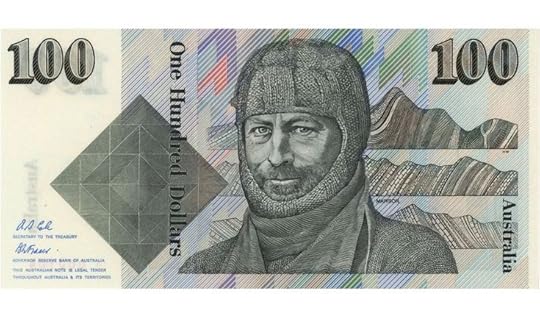
Anyway…an outstanding, heroic, and truly memorable* addition to any polar library, and one I should have gotten to much sooner (it had apparently been on my TBR list since 2013).
* Yeah, I don't think I'll ever get over the mental image of the calloused soles of Mawson's feet LITERALLY falling off, to be replaced with new and sensitive skin, on which he had to trek for an additional 100 or so miles. Which brings me to my one complaint with the book: while Roberts does a great job documenting Mawson's hardships and physical suffering, as soon as he finally makes it back to camp, the story moves on with little description of his what-must-have-been-excrutiating recovery...just kind of "then he had to rest up for a while before taking back command of the expedition." Just a little...odd.
Unlike the numerous, single-minded Scott/Shackleton/Amundsen expeditions that can neatly be summed up and lumped together as "The Race to the Pole," the AAE was a complex assortment of true explorations whose goal was to fill in many of the blanks on the Antarctic map, and indeed establish once and for all that this was a seventh continent, not a mere collection of ice-covered islands. As such, it is not a simple story to tell, but Roberts does a commendable job, introducing us to not just Mawson but a whole cast of memorable characters, including the Franks Wild and Hurley, who — based on their roles in the AAE — would go on to greater fame as key members of Shackleton's ill-fated (but legend-making) "Endurance" expedition.
I've read a lot of books on the various polar expeditions, but somehow had never heard of either Mawson or the AAE — terrible, I know, but apparently I'm not alone. In his excellent "where are they now?" (or more correctly, "where were they then?") epilogue, Roberts notes that "for the rest of his life, Mawson was regarded in his home country as the greatest explorer in Australian history…Today, sadly, there are many young people in Australia who have never heard of Douglas Mawson," due in no small part to his face on the Australian $100 bill (which it had graced since 1984) being replaced in 1996 with that of WWI General John Monash, so that anyone born after the early '90s is most likely an idiot, (a belief I more-or-less hold for more reasons than one).
Anyway…an outstanding, heroic, and truly memorable* addition to any polar library, and one I should have gotten to much sooner (it had apparently been on my TBR list since 2013).
* Yeah, I don't think I'll ever get over the mental image of the calloused soles of Mawson's feet LITERALLY falling off, to be replaced with new and sensitive skin, on which he had to trek for an additional 100 or so miles. Which brings me to my one complaint with the book: while Roberts does a great job documenting Mawson's hardships and physical suffering, as soon as he finally makes it back to camp, the story moves on with little description of his what-must-have-been-excrutiating recovery...just kind of "then he had to rest up for a while before taking back command of the expedition." Just a little...odd.

December 28, 2019
This is an amazing story of survival and persistence—and getting places just a bit too late. I find it fascinating and incomprehensible what drives men to spend two or three years of their lives on single expeditions to hostile, uncharted places where they're always cold and mostly bored and sometimes in mortal danger, where there's absolutely no rescue possible and they have to survive on wits alone. Okay, so it's sort of comprehensible. And I can't get enough of these sorts of stories.
This particular book could have been a bit shorter, I felt, as it did sometimes get bogged down in details, and I confess I got a lot of the secondary characters confused.
The best part was the harrowing tale of Mawson's team's tragic trek. But I also liked the parts of the book that talked about the less glamorous aspects of polar survival, like how they kept themselves entertained and sane.
Very interesting.
This particular book could have been a bit shorter, I felt, as it did sometimes get bogged down in details, and I confess I got a lot of the secondary characters confused.
The best part was the harrowing tale of Mawson's team's tragic trek. But I also liked the parts of the book that talked about the less glamorous aspects of polar survival, like how they kept themselves entertained and sane.
Very interesting.
April 7, 2017
A thrilling account of Douglas Mawson's Australasian Antarctic Expedition from 1911-1913. You're probably familiar with Roald Amundsen, first to reach the South Pole; Robert Scott, who arrived at the Pole five weeks after Amundsen, and then tragically perished on the way back; and Ernest Shackleton and his heroic open-boat journey to rescue the ice-bound Endurance expedition. Douglas Mawson is at least as deserving of fame for the incredible journey against crushing obstacles. David Roberts' narrative is peppered with interesting details, but never gets bogged down, making me wish there was more.

October 29, 2017
Roberts structured this book well. The first chapter covers the outward half of Mawson’s trek and ends with the expeditions first tragedy. We then jump back to Mawson’s experiences on Shakleton’s first Antarctic excursion and proceed up to the launch of the AAE. While Mawson’s story does not quite compare to Shackleton’s incredible story of his 1914-1917 expedition, it is undoubtedly an impressive tale. Mawson deserves more recognition than he currently receives. I’m a big fan of polar exploration stories so I may not be the most reliable judge, but I would call this an excellent read.

June 20, 2019
I was long overdue on reading a book about Douglas Mawson, Australian polar explorer during the Heroic Age of Polar Exploration. My general knowledge of Mawson prior to reading the book was that while leading an Australian expedition, something happened that caused him to be alone, enduring unimaginable hardships to ultimately survive. (And I knew one physical thing that happened to him, so horrible that I won't mention it so it won't be stuck in your head forever if you don't want it to be. I was nervous about even reading about that part.) Alone on the Ice tells not only the story of Mawson's incredible survival, but the story of the expedition.
The hardships that early polar explorers endured, even on the best, most comfortable days, are horrible. On sledging journeys, it's worse, and men are constantly fighting for survival as they run out of food and face the elements. Mawson was part of a three man sledging team when one sled crashes through a crevasse (which they were falling into all the time without serious injury, somehow) and takes with it one of the men, all their best dogs, and most of their food and supplies. The other two men continue; one of them dies along the journey home. Mawson survives. Amazing.
What I didn't expect from the story was the second over wintering in Antarctica, when one of the seven men in the hut has a psychotic break. I was up reading late at night and had to stop and finish in the morning because it was so disturbing. Stories of Antarctic exploration never fail to stretch so far into the extreme of human endurance that if they were fiction, people would never consider them realistic.
While Scott is often praised for his commitment to science, Mawson was south during the same time period with no goals for the South Pole. He was truly committed to science and exploration only, exploring and mapping land never before visited by humans. The book was in no way just a boring science lesson; it was all high adventure and struggle for survival at its harshest.
Ultimately these stories never get old for me. Of course there is overcoming unbelievable, seemingly unsurvivable odds. But I also love the details of polar life; what will they eat for Midwinter day this year! There are always takeaways of inspiration- (quoting the Senior Collection Manager of the Mawson Center) "His emphasis on work kept the team together during the terrible winters. By urging the men to go out of the hut in the strongest winds, he tried to keep them from succumbing to apathy and depression." You can bet "go out of the hut in the strongest winds" is one of my new mantras.
The hardships that early polar explorers endured, even on the best, most comfortable days, are horrible. On sledging journeys, it's worse, and men are constantly fighting for survival as they run out of food and face the elements. Mawson was part of a three man sledging team when one sled crashes through a crevasse (which they were falling into all the time without serious injury, somehow) and takes with it one of the men, all their best dogs, and most of their food and supplies. The other two men continue; one of them dies along the journey home. Mawson survives. Amazing.
What I didn't expect from the story was the second over wintering in Antarctica, when one of the seven men in the hut has a psychotic break. I was up reading late at night and had to stop and finish in the morning because it was so disturbing. Stories of Antarctic exploration never fail to stretch so far into the extreme of human endurance that if they were fiction, people would never consider them realistic.
While Scott is often praised for his commitment to science, Mawson was south during the same time period with no goals for the South Pole. He was truly committed to science and exploration only, exploring and mapping land never before visited by humans. The book was in no way just a boring science lesson; it was all high adventure and struggle for survival at its harshest.
Ultimately these stories never get old for me. Of course there is overcoming unbelievable, seemingly unsurvivable odds. But I also love the details of polar life; what will they eat for Midwinter day this year! There are always takeaways of inspiration- (quoting the Senior Collection Manager of the Mawson Center) "His emphasis on work kept the team together during the terrible winters. By urging the men to go out of the hut in the strongest winds, he tried to keep them from succumbing to apathy and depression." You can bet "go out of the hut in the strongest winds" is one of my new mantras.

March 7, 2021
I don’t doubt that this book was informative and well-written, but man, was it slow. I listened to this on audio and I think part of my frustration was the inability to see the timeline of all these expeditions referenced by the author. Each “trip out onto the ice” felt the same — none of the expeditions felt incredibly unique and it all seemed to blur together (which is what I imagine it felt like for the explorers themselves honestly, if this book is anything to go by).
This was not the kind of adventure and survival story like what we’d expect from Krakauer, recalling events on Everest or something similar. (This is what I expected and now I know better!). There was a point where I wanted to just DNF it but I was already halfway through and figured I’d stick it out.
If you’re looking for a fast-paced adventure story about dangerous expeditions through Antarctica, this one isn’t for you. If you don’t mind a slow, non-chronological recounting of said expeditions in Antarctica (which DO qualify as dangerous and bleak and a bit depressing), then definitely give this one a chance.
Content Warning: There is significant recounting of animal death (specifically huskies) throughout the book and is not for the faint of heart.
This was not the kind of adventure and survival story like what we’d expect from Krakauer, recalling events on Everest or something similar. (This is what I expected and now I know better!). There was a point where I wanted to just DNF it but I was already halfway through and figured I’d stick it out.
If you’re looking for a fast-paced adventure story about dangerous expeditions through Antarctica, this one isn’t for you. If you don’t mind a slow, non-chronological recounting of said expeditions in Antarctica (which DO qualify as dangerous and bleak and a bit depressing), then definitely give this one a chance.
Content Warning: There is significant recounting of animal death (specifically huskies) throughout the book and is not for the faint of heart.

January 7, 2022
I rarely read non-fiction, but since we're heading to Antarctica next week, I decided to read up on the frozen continent.
If you're looking to read textbooks, this one will fit right in. The writing is smooth, but technical. There isn't a lot of emotion from the author, just an accurate telling of the events. I learned quite a bit about Antarctica, but it took some extra effort to keep reading.
If you're looking to read textbooks, this one will fit right in. The writing is smooth, but technical. There isn't a lot of emotion from the author, just an accurate telling of the events. I learned quite a bit about Antarctica, but it took some extra effort to keep reading.

March 17, 2021
This incredible story of Douglas Mawson's survival in the Antarctic in 1912/13 is so thrilling and so deeply engaging, I gripped the book so hard I thought I'd pull a muscle in my hand. Highly recommended!

May 28, 2016
I love to read about explorers. Not the ones who traversed the world murdering indigenous people to fill the coffers of their respective countries, but those men who were larger than life, fighting against the elements in the name of science, discovery and documentation. Men like Sir Edmond Hillary and Tenzing Norgay struggling up Mount Everest, or Ernest Shackleton striking out across the ice to find the South Pole. Men struggling to fulfill their dreams, fighting to survive dangerous conditions while striving to go where no human being has ever been before.
Alone on the Ice is about Douglas Mowson and other explorers who struggled and died in the early 1900's exploring Antarctica. Many of their names are forgotten, overshadowed by the larger than life legends of Shackleton, Scott and Amundsen. I had never heard of Mowson before I read this book. I'm sure I had read his name before as part of Shackleton's Nimrod Expedition in 1907, but other than a name listed as part of Shackleton's party, I knew nothing about him. Mowson's story grabbed my complete attention immediately because he was driven, not by a sense of competition to be first (as Shackleton, Scott and others), but by a deep sense of wonder at being the first human being to traverse and scientifically document unexplored areas of the world.
The main portion of the story is about the Australasian Antarctic Expedition led by Mowson from 1911-1913. But it also gives information about other earlier expeditions, such as Shackleton's Nimrod Expedition, because the background is essential to understanding Mowson and the difficulties he and others had already faced in Antarctica. Roberts provides many details and excerpts from several explorer's personal journals, plus photographs.
I can't even imagine what it was like for these men struggling to walk miles each day, pulling sledges filled with supplies. These sledges could weigh 600-1000 lbs. Sometimes they had to move only part of their equipment at a time. That meant walking several miles, dumping off equipment and supplies, then doubling back to get the rest of their gear and walking those same miles again. All in subzero weather, across dangerous ice. Not only was the weather dangerously cold, but there was the constant threat of injury or illness. Many times they lost men, supplies and dogs when they broke through thin ice sheets covering deep crevasses in the arctic ice. Desperation and starvation brought about dangerous physical illnesses. At times when food stores were low, the men were forced to eat sled dogs. The men didn't know that husky liver contains too much vitamin A,and if ingested can cause severe illness. They were starving and ate injured or weak sled dogs to stay alive, not knowing that this very desperation was only making them more ill.
This book is not a fictionalized account. It is a non-fiction, true account of these men and their expeditions in Antarctica, giving lots of details about their daily challenges, deaths and extreme conditions. Roberts did an excellent job pulling information from various explorer's personal journals to give a true sense of who Mowson was and to document the expeditions leading up to the AAE and Mowson's survival after losing the rest of his party in 1913.
I highly recommend this book to anyone w ho enjoys reading about polar exploration. I definitely want to read more about the polar explorers who got lost in the shadow of more famous men like Shackleton and Scott. I want to know about the men who were out of the limelight and more focused on science and exploration. This story was a joy to read, and I am still in awe of men like Mowson who were willing to put their lives on the line over and over again to learn all they could about the Earth and its wonders.
Alone on the Ice is about Douglas Mowson and other explorers who struggled and died in the early 1900's exploring Antarctica. Many of their names are forgotten, overshadowed by the larger than life legends of Shackleton, Scott and Amundsen. I had never heard of Mowson before I read this book. I'm sure I had read his name before as part of Shackleton's Nimrod Expedition in 1907, but other than a name listed as part of Shackleton's party, I knew nothing about him. Mowson's story grabbed my complete attention immediately because he was driven, not by a sense of competition to be first (as Shackleton, Scott and others), but by a deep sense of wonder at being the first human being to traverse and scientifically document unexplored areas of the world.
The main portion of the story is about the Australasian Antarctic Expedition led by Mowson from 1911-1913. But it also gives information about other earlier expeditions, such as Shackleton's Nimrod Expedition, because the background is essential to understanding Mowson and the difficulties he and others had already faced in Antarctica. Roberts provides many details and excerpts from several explorer's personal journals, plus photographs.
I can't even imagine what it was like for these men struggling to walk miles each day, pulling sledges filled with supplies. These sledges could weigh 600-1000 lbs. Sometimes they had to move only part of their equipment at a time. That meant walking several miles, dumping off equipment and supplies, then doubling back to get the rest of their gear and walking those same miles again. All in subzero weather, across dangerous ice. Not only was the weather dangerously cold, but there was the constant threat of injury or illness. Many times they lost men, supplies and dogs when they broke through thin ice sheets covering deep crevasses in the arctic ice. Desperation and starvation brought about dangerous physical illnesses. At times when food stores were low, the men were forced to eat sled dogs. The men didn't know that husky liver contains too much vitamin A,and if ingested can cause severe illness. They were starving and ate injured or weak sled dogs to stay alive, not knowing that this very desperation was only making them more ill.
This book is not a fictionalized account. It is a non-fiction, true account of these men and their expeditions in Antarctica, giving lots of details about their daily challenges, deaths and extreme conditions. Roberts did an excellent job pulling information from various explorer's personal journals to give a true sense of who Mowson was and to document the expeditions leading up to the AAE and Mowson's survival after losing the rest of his party in 1913.
I highly recommend this book to anyone w ho enjoys reading about polar exploration. I definitely want to read more about the polar explorers who got lost in the shadow of more famous men like Shackleton and Scott. I want to know about the men who were out of the limelight and more focused on science and exploration. This story was a joy to read, and I am still in awe of men like Mowson who were willing to put their lives on the line over and over again to learn all they could about the Earth and its wonders.

June 12, 2017
This book conveys the true story of the Australasian Antarctic Expedition (AAE), led by Australian explorer Douglas Mawson. Mawson was a key contributor to the Heroic Age of Antarctic Exploration; however, many people do not carry his name on the “tip of the tongue” as they do the names of Shackleton, Scott, and Amundsen. While the title suggests this is the story of Mawson’s miraculous survival in the wake of the death of his two companions while on an exploratory excursion, it is, in fact, a great deal more comprehensive. It provides the background and context for the AAE, including past experiences, preparations for the trip, and details about the lives of several of the participants. The author is adept at selecting passages from the diaries of the crew without getting carried away with extraneous details. We get a sense of Mawson as a scientist at heart, not concerned with the competitive race to the pole, but interested in mapping uncharted territory and conducting experiments to understand this frozen continent. Overall, I enjoyed the book very much. To me, the most engrossing chapters were related to the survival story. The other parts were interesting but understandably not quite as riveting. Recommended to readers interested in survival stories and the history of polar exploration.

April 11, 2021
This was a good book, but much like what some other reviewers have pointed out, the author spends several chapters discussing other Antarctic expeditions and not the one the book is supposed to be about. I think this subject is so esoteric that the author would have done well to assume that readers were already familiar with the expeditions of Amundsen, Scott, Shackleton, etc.
February 4, 2018
I vacillated between wanting to be in the snowy, icy vastness of untouched and unexplored land and wanting to be a sideline cheerleader.

Read
June 17, 2021DNF. Nope, dogs dying left and right. This is par for the course in these stories but damn the detail. I am in pain.

February 5, 2020
I was pretty disappointed in this book, even though I only checked it out while waiting for something better to come in. I was drawn by the title and my usual enjoyment of books about the accomplishments of great feats. However, the reader for this audiobook nearly put me to sleep several times with his monotonous tone. It was a long time before I picked out who the main explorer is, and it was challenging to keep the secondary ones straight until well past halfway. I think this would have been an easier read as a paper book, as I see from the reviews of others that there are photos and maps in the hard copies, and possibly more interesting as well. For some reason, we start with the great expedition, then switch to an earlier expedition (possibly to introduce other explorers?), then finally go back to the other one. I only became interested about 2/3 of the way through the book, and stopped after 3/4 because a new one has come in. I doubt I'll be tempted to return to the conclusion....

January 14, 2019
I'm a big fan of the Heroic Age of Antarctic Exploration, and I've read several books on the more famous Shackleton and Scott expeditions. This book chronicles the less well known, yet in many ways more ambitious AAE expedition led by Douglas Mawson. Unlike previous expeditions, where the goal was always to be the first to reach the South Pole, the AAE expedition set out with a goal of true exploration and discovery. They were literally trying to fill in the blanks on the map. Up until this time, people didn't really know if Antarctica was one solid continent, or a series of larger islands. The Mawson team set out to explore land where no man had ever set foot before.
Unfortunately, things didn't go exactly according to plan. Mawson barely made it back to the hut alive, and missed the boat home by a mere 5 hours!
While I don't agree with the subtitle "The Greatest Survival Story in the History of Exploration", it was certainly a great story and one worth reading.
Unfortunately, things didn't go exactly according to plan. Mawson barely made it back to the hut alive, and missed the boat home by a mere 5 hours!
While I don't agree with the subtitle "The Greatest Survival Story in the History of Exploration", it was certainly a great story and one worth reading.
This entire review has been hidden because of spoilers.

November 16, 2018
Very impressive!
This is an incredible story of Australian geologist Douglas Mawson and his 100-mile solo hike back to base after a geological exploration expedition goes terribly wrong and both of his companions die. Although calling it a "hike" is a stretch, considering his bad health, gruelling weather conditions, food shortage and several serious near-death experiences. Mawson later ended up on Australia's 100$ bill.
A big part of the book (probably ~50%) is also about Heroic Age of Antarctic Exploration in general - about other expeditions, life in the hut and in the tent in general, and years/events before and after the expedition.
Made me want to explore the Antarctic explorers, so next in the line are "Endurance: Shackleton's Incredible Voyage" and "Alone in Antarctica".
This is an incredible story of Australian geologist Douglas Mawson and his 100-mile solo hike back to base after a geological exploration expedition goes terribly wrong and both of his companions die. Although calling it a "hike" is a stretch, considering his bad health, gruelling weather conditions, food shortage and several serious near-death experiences. Mawson later ended up on Australia's 100$ bill.
A big part of the book (probably ~50%) is also about Heroic Age of Antarctic Exploration in general - about other expeditions, life in the hut and in the tent in general, and years/events before and after the expedition.
Made me want to explore the Antarctic explorers, so next in the line are "Endurance: Shackleton's Incredible Voyage" and "Alone in Antarctica".

September 17, 2020
A perfectly serviceable account of the Australian Antarctic Expedition, I was a little surprised how little of the book was about Mawson’s ordeal, which is ostensibly what the book is about.
On the whole a fine book, I just didn’t think it lived up to its billing and couldn’t hold a candle to The Worst Journey in the World or Endurance.
On the whole a fine book, I just didn’t think it lived up to its billing and couldn’t hold a candle to The Worst Journey in the World or Endurance.

September 29, 2020
A bit ponderous, but I enjoyed it. Having read 3 "disaster" stories lately it definitely makes you wonder what kind of person you'd be under situations like these. In so many people it definitely brings out the best in them. And I honestly love the stiff upper lip mentality of British/Australian explorers. They were so tough!

June 25, 2017
Excellent adventure book. What the men endured on this exploration was unbelievable. Very good book that I found very interesting.

September 6, 2020
A great story, but the book was poorly organized. So much foreshadowing and the very little payoff.
Displaying 1 - 30 of 652 reviews