
What do you think?
Rate this book

464 pages, Paperback
Published July 22, 2011


When I started grad school in ethnomusicology, I was blessed to be given a teaching assistantship which paid my way through school. But the bigger gift than the money was the opportunity to learn about teaching, through teaching one or two sections of the course Music as a World Phenomenon each semester for four years. When I began I was fresh out of college, younger than some of my students, and terrifyingly unprepared for the task. Despite all that, it was a fantastic experience, and I think my students had a great time, too.
Because when I started I lacked confidence in all aspects of the job, I initially looked around for a textbook that would help guide my teaching and give me something to rely on day by day. At that time there were only a couple of textbooks that were current: Jeff Todd Titon’s Worlds of Music, and Bruno Nettl’s Excursions in World Music. I knew Nettl’s name—his Study of Ethnomusicology: 29 Issues and Concepts (later revised to 31 issues and concepts) was the first ethnomusicology book I ever read. So I chose Excursions in World Music, 2nd edition.
Throughout that first semester, I was frequently disappointed by or frustrated with Excursions. At key points I (and my students) found it confusing, incomplete, or dull. As a guide for a semester-long non-major survey course, it was less than perfect. Because of that, and because of the extremely high price students had to pay for the book and cassettes/CDs, and because by the second semester I was more in the groove and able to bring information from my grad seminars into my teaching, by the second year of teaching I had left Nettl et al. behind. So now, 15 years and several editions later, looking again at Excursions in World Music (6th edition) brings back a lot of memories; and it makes me wonder: Is the 6th edition as disappointing as the 2nd was?
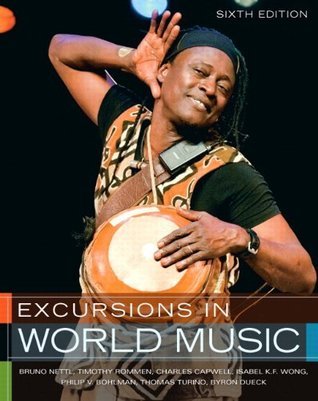
It’s most definitely better than it was, but it’s still not the choice for me, if I ever get to teach an undergrad world music survey again. Excursions now faces competition both from the rest of the textbook market—still Worlds of Music, but also several more recent entries—and from the phenomenal availability of information—for free!—online. Excursions—book and CDs—currently sells for $167.06 on Amazon; if I’m to ask each student in the class to pay that, then I had better be totally confident that this is a worthwhile book. There are a lot of good things about the book, but they don’t add up to $167.06. Here is some of what I see as the good and the bad:
The good: Most of the chapters now feature more audio examples, and in some cases more recent examples or more variety in the examples have been introduced. This is all good, as in the 2nd edition I found some of the examples lacking in lustre. It was frustrating to have interesting, exciting musical traditions represented by examples that didn’t show them off to their fullest appeal. Some of that has now been remedied.
I remember the chapter on European folk music in the 2nd edition being especially disappointing—for me, the folk music chapter was almost unteachable. It seems to have been significantly revised in the years since, and I enjoyed Philip Bohlman’s way of introducing the chapter through a stroll through Vienna’s soundscape. Discussing European musical traditions in a single intro-level chapter is always going to be a challenge—and the chapter has its ups and downs, but is generally pretty good, if at times a bit distanced or unfocused. But I could teach from this one, with some supplementary study and resources.
The 2nd edition had no chapter about the Caribbean, and Timothy Rommen’s contribution to the 6th edition is really nice. I enjoyed it especially because Caribbean musical traditions aren’t part of the expected “canon” of musics in introductory texts. Rommen’s personal experiences with these musical genres came through in his writing, and I can imagine students latching onto this chapter with its variety of musical styles, and its hints at the history and politics of the region (which invite the teacher to flesh them out into fuller class sessions).
Byron Dueck has the difficult task of writing about “Music of Ethnic North America.” It’s a challenge, but I think he brings up some excellent points for further discussion. He suggests a range of different perspectives for looking at North American musical traditions. I believe that the African traditions and influence in North America merit much more than just one section of a longer chapter (jazz alone could well be its own chapter, and the treatment of the blues here is nothing like the depth that Jeff Todd Titon brings to the subject in Worlds of Music). But this was a good chapter that could easily become multiple chapters in future editions.
The bad: As I looked through my notes about Excursions, I felt that everything I liked about the book came with a “however” attached. For example, I love the amazing lists of resources at the end of each chapter. However, I dislike the way they are presented: as imposing, indecipherable blocks of text. It is a formidable task to locate a particular reference from the chapter within these walls of bibliography. It’s hard to imagine an undergrad being excited about getting into the bibliographies to do further research.
Presentation is a consistent problem throughout the entire book. I was amazed at the number of typos in every chapter—for a book that’s in its sixth edition! The sidebar information is usually simply telling the reader to go find something on mymusiclab.com, but sometimes the sidebars include definitions of terms in the text. What’s annoying about this is that the definitions in the sidebars don’t line up with where in the body text those terms are located. Many times I was distracted from my reading by seeing something in a sidebar, and then scanning to see what part of the page it actually relates to.
Pronunciation guides will always be awkward, unless everyone learns to read the IPA. But in Excursions there is no attempt made to help out with pronunciation. I could see this being a problem for students, and even for teachers who don’t have much ethnomusicology background.
I wanted to see the date of each recording listed somewhere in the listening guides. Especially for the pop songs, this seems like a necessary piece of information that is usually absent. It also bothered me that the banner photos at the beginning of each chapter are unidentified. Also, while the two-page spread is a nice design, some photos don’t come out well. Sometimes the focal point of the photo is lost in the center crease (pp. 2–3, 310-311), and in the Native American drumming photo (354-355), the drums are entirely covered up by the text.
Because the book is a multi-author work (and I have highest respect for each of the authors), there are some inconsistencies in style. Some chapters are very good, but others (particularly Isabel Wong’s chapters on China and Japan—these could use significant revision) are not up to the same standard. In Nettl’s introduction, he introduces the organological framework of –phones (membranophone, chordophone, and so forth), but other authors don’t use it. In Thomas Turino’s chapter on Africa, for example, we find instruments categorized as “Percussion Instruments,” “Drums and ‘Drum Languages,’” “Wind Instruments,” and “Stringed Instruments” (222-224).
The authors all make an effort to tone down the academic jargon, and for the most part they are successful. But writing for a general audience, or undergrads, is difficult. Some authors are better at it than others, but the overall impression I have of the book (trying to see it from an undergrad student perspective) is that it’s a bit dull and dry. There are occasional awkward terms (p. 176: “obstreperously”?) and sentences. One of my favorites:
“Another example of this tendency is the musical effects that follow from the artistic interactions that occur between musicians from various locations throughout the Caribbean in places like New York.” (346)
Of course in any survey textbook like this there will be areas I wish were covered in more depth—I’d like more space given to Brazilian carnival; more depth in the coverage of sub-Saharan Africa; more about Indonesian pop music; anything at all about the Pacific, other than Nettl’s odd out-of-nowhere comment on p. 369—but that’s all just personal opinion. No single book will be the perfect presentation of everything I might like to teach.
What do I want in a textbook? I think I’m looking for a new formula. Maybe I’m just tired of chapters that aim for “relatability” by starting with diary-like stories: “It’s a balmy Saturday evening in San Juan, as I stroll down the main street, listening to the varied sounds of music coming from street musicians, from speakers blaring pop songs from local clubs, from taxis driving by in an endless and noisy traffic jam that is typical of a Saturday night, etc. etc. etc.” As a literary device, after a short while it becomes (for me) clichéd and predictable: that odd present-tense-even-though-this-happened-in-1982 voice. I don’t know what the solution is, but I’m eager for a different gimmick, and I think it has to be possible.
One final comment: In the introduction, Nettl asks the reader to believe that the title of the book is meant in a somewhat ironic or critical way. “The title of this book, Excursions in World Music, then,” he says, “is chosen in order to question the overarching category ‘World Music’” (xvii). I find that hard to accept, and I think it’s too much to ask an undergrad, already in the introduction, to contemplate the very title of the book (which is a pretty simple, straightforward title) as a postmodern stance against a bigger category.
Of the world music survey textbooks I’ve looked at over the past year, Excursions is my least favorite. But I have yet to find the single textbook that I would be comfortable requiring students to purchase—so the search continues! Up next will be Jeff Todd Titon’s Worlds of Music (5th edition).


