

What do you think?

City of Fortune: How Venice Won and Lost a Naval Empire
Drawing on first-hand accounts of crusaders, sea captains and merchants, as well as the state records, renowned historian Roger Crowley's City of Fortune is a rich narrative about commerce and empire, seafaring and piracy, which ranges across the Mediterranean from the Adriatic to Alexandria, from Crete to Constantinople and the Black Sea.
405 pages, Paperback
First published September 1, 2011
About the author
Roger Crowley
11 books903 followersRoger Crowley was born in 1951 and spent part of his childhood in Malta. He read English at Cambridge University and taught English in Istanbul, where he developed a strong interest in the history of Turkey. He has traveled widely throughout the Mediterranean basin over many years and has a wide-ranging knowledge of its history and culture. He lives in Gloucestershire, England.
Ratings & Reviews
Friends & Following
Create a free account to discover what your friends think of this book!
Community Reviews
Displaying 1 - 30 of 445 reviews

March 2, 2016
Venice was the Blockbuster Video of medieval empires.
Like Blockbuster, Venice’s nigh-maniacal embrace of cultural homogeneity and prioritization of brand and bottom line at the expense of individual recognition and initiative led to it achieving categorical economic dominance on what, at the time, constituted a global scale. Also like Blockbuster, whose ubiquity and be-kind-rewind hegemony were obliterated in an instant by a single innovation (namely, streaming video over high-speed internet connections), Venice’s mighty trade empire went the way of VHS tapes when the enterprising Portuguese rounded the Cape of Good Hope and found a better way to bring spices and other goods from the East to insatiable Western markets (okay, to be fair, Venetian dominance was already on the wane due to marauding Ottomans, but, still—talk about having the wind taken from your sails (that’s an apt nautical joke, people—commence guffawing).
Crowley’s account of the improbable rise of a lagoon-based collection of maritime entrepreneurs is a compelling one, even if it occasionally bogs down in the details of various sea battles. As a fairly well read student of medieval and renaissance history, I was frankly shocked at just how innovative and dominant an entity the Republic of Venice was at its height.
I confess that my growing frustration with reading about the sheer stupidity involved in starting wars ostensibly for religious reasons (never a good idea) but, in actuality, for reasons of profit and plunder made me grind my teeth a bit at various points during the narrative, but that’s not Crowley’s fault—the man’s writing history, not making it.
If you’re looking for a really interesting primer on medieval Venice, maritime trade, and the rise of merchant empires, this is a pretty delightful starting point.
If you’re looking for a list of videos I frequently rented from Blockbuster, you’ll need to look elsewhere (and no, I don’t mean the rooms that video stores tried to close off from the under-18 crowd by hanging a couple of slatted swinging doors to prevent easy access).
(I always loved walking into Blockbuster after a hot new movie came out on video; there was nothing quite like seeing a wall of 718 copies of Independence Day hanging out, lonely and eager to be rented.)
Like Blockbuster, Venice’s nigh-maniacal embrace of cultural homogeneity and prioritization of brand and bottom line at the expense of individual recognition and initiative led to it achieving categorical economic dominance on what, at the time, constituted a global scale. Also like Blockbuster, whose ubiquity and be-kind-rewind hegemony were obliterated in an instant by a single innovation (namely, streaming video over high-speed internet connections), Venice’s mighty trade empire went the way of VHS tapes when the enterprising Portuguese rounded the Cape of Good Hope and found a better way to bring spices and other goods from the East to insatiable Western markets (okay, to be fair, Venetian dominance was already on the wane due to marauding Ottomans, but, still—talk about having the wind taken from your sails (that’s an apt nautical joke, people—commence guffawing).
Crowley’s account of the improbable rise of a lagoon-based collection of maritime entrepreneurs is a compelling one, even if it occasionally bogs down in the details of various sea battles. As a fairly well read student of medieval and renaissance history, I was frankly shocked at just how innovative and dominant an entity the Republic of Venice was at its height.
I confess that my growing frustration with reading about the sheer stupidity involved in starting wars ostensibly for religious reasons (never a good idea) but, in actuality, for reasons of profit and plunder made me grind my teeth a bit at various points during the narrative, but that’s not Crowley’s fault—the man’s writing history, not making it.
If you’re looking for a really interesting primer on medieval Venice, maritime trade, and the rise of merchant empires, this is a pretty delightful starting point.
If you’re looking for a list of videos I frequently rented from Blockbuster, you’ll need to look elsewhere (and no, I don’t mean the rooms that video stores tried to close off from the under-18 crowd by hanging a couple of slatted swinging doors to prevent easy access).
(I always loved walking into Blockbuster after a hot new movie came out on video; there was nothing quite like seeing a wall of 718 copies of Independence Day hanging out, lonely and eager to be rented.)
February 14, 2017
"City of Fortune: How Venice Ruled the Seas" by Roger Crowley is a fascinating account of the Venetian empire between the years 1200 and 1500. This book is not a dry recitation of dates, names, and battles. I found it to be an engaging narrative about a remarkable city and its exploits throughout the Mediterranean.
Constantinople was the key to Mediterranean commerce during this time period. Whoever controlled Constantinople controlled Mediterranean commerce. The Venetians were the dominant power in the Mediterranean from the year 1204 (when they sacked Constantinople) until the year 1453 (when the Ottomans conquered Constantinople). Before 1204 the Venetian empire had grown steadily for several centuries. After 1453 – because of the rise of the Ottomans and the dawn of the Portuguese and Spanish trade routes to India and the Americas - the Venetian naval empire experienced a long, slow decline.
Crowley covers in detail how the Venetian naval empire grew and operated. He discusses the strategic importance of their many trading posts and ports - especially Crete. He also describes many aspects of Venetian commerce and public life, the Venetian role in the Fourth Crusade, the ongoing rivalry with Genoa, and the rise of the Ottoman Empire in the Mediterranean.
I strongly recommend this book to anyone interested in world history, naval history, the Mediterranean, or the history of commerce.
Rating: 5 out of 5 stars
Notes:
Alternate title: City of Fortune: How Venice Won and Lost a Naval Empire
Audiobook:
City of Fortune: How Venice Ruled the Seas
Written by: Roger Crowley
Narrated by: Edoardo Ballerini
Length: 14 hours and 10 minutes
Unabridged Audiobook
Release Date: 2013-04-26
Publisher: Recorded Books
Constantinople was the key to Mediterranean commerce during this time period. Whoever controlled Constantinople controlled Mediterranean commerce. The Venetians were the dominant power in the Mediterranean from the year 1204 (when they sacked Constantinople) until the year 1453 (when the Ottomans conquered Constantinople). Before 1204 the Venetian empire had grown steadily for several centuries. After 1453 – because of the rise of the Ottomans and the dawn of the Portuguese and Spanish trade routes to India and the Americas - the Venetian naval empire experienced a long, slow decline.
Crowley covers in detail how the Venetian naval empire grew and operated. He discusses the strategic importance of their many trading posts and ports - especially Crete. He also describes many aspects of Venetian commerce and public life, the Venetian role in the Fourth Crusade, the ongoing rivalry with Genoa, and the rise of the Ottoman Empire in the Mediterranean.
I strongly recommend this book to anyone interested in world history, naval history, the Mediterranean, or the history of commerce.
Rating: 5 out of 5 stars
Notes:
Alternate title: City of Fortune: How Venice Won and Lost a Naval Empire
Audiobook:
City of Fortune: How Venice Ruled the Seas
Written by: Roger Crowley
Narrated by: Edoardo Ballerini
Length: 14 hours and 10 minutes
Unabridged Audiobook
Release Date: 2013-04-26
Publisher: Recorded Books

March 18, 2026
"City of Fortune" was excellent. Having visited and enjoyed Venice, I found this book to be utterly fascinating. It is the story of the once-powerful Venetian trade Empire.
Venice has always been a unique and interesting city-state. Due to its location and the swampy, waterlogged lands that surrounded it, Venice had always been linked to the sea. During its development stage as a Trading powerhouse, 1000-1198 AD, the Venetians used their superior ships, experienced sailors, and a society of merchants who worked towards Venetian dominance on the seas. But the trade-obsessed city also developed something of a poor reputation among its fellow Christian nations.
But Venice truly rose to prominence during the era of the Fourth Crusades, 1204-1500 AD Venice ended up sacking Constantinople and became a superpower. Yet, it was this era that weakened the Byzantine Empire fatally, which led to the final section, which is their eclipse by the Ottoman Empire that would conquer that region of the world.
A fascinating story of Venice and the period in which it was a true powerhouse of a Nation-State. Yet, it also serves as a superb history for anyone who plans to spend a few days in this beautiful city and soaking up the history and architecture.
Venice has always been a unique and interesting city-state. Due to its location and the swampy, waterlogged lands that surrounded it, Venice had always been linked to the sea. During its development stage as a Trading powerhouse, 1000-1198 AD, the Venetians used their superior ships, experienced sailors, and a society of merchants who worked towards Venetian dominance on the seas. But the trade-obsessed city also developed something of a poor reputation among its fellow Christian nations.
But Venice truly rose to prominence during the era of the Fourth Crusades, 1204-1500 AD Venice ended up sacking Constantinople and became a superpower. Yet, it was this era that weakened the Byzantine Empire fatally, which led to the final section, which is their eclipse by the Ottoman Empire that would conquer that region of the world.
A fascinating story of Venice and the period in which it was a true powerhouse of a Nation-State. Yet, it also serves as a superb history for anyone who plans to spend a few days in this beautiful city and soaking up the history and architecture.

March 17, 2026
Ca și Dan Jones (cel care a scris despre cruciați și formarea regatelor creștine), și autorul acestei cărți este un adept al „istoriei epice”. Asta înseamnă narațiune (practici retorice, enumerări complicate, extrase din cronicari) și nu încercare de a explica un eveniment, formarea imperiului maritim al Veneției (Stato da Mar) sau cruciadele (în special Cruciada a IV-a, cea mai cinică dintre ele). Trebuie să apreciem îndeosebi aspectul pur literar al cărții și nu încercarea de a interpreta faptele și întîmplările.
Nici Crowley nu ne va spune ceva semnificativ despre cruciade (la care Veneția a avut o contribuție notabilă), va reține din ele doar asediile, jafurile, faptele josnice sau de bravură. Va relata luptele, încleștările. Îl va prezenta, astfel, pe dogele Enrico Dandolo, un bătrîn curajos de 90 de ani, orb, stînd în picioare la proră, sub steagul sfîntului Marcu, pe o galeră stacojie, și căutînd să-și conducă armata sub zidurile Constantinopolului (în 17 iulie 2003).
Așadar, nu vom încerca să explicăm mărirea și decăderea Veneției (nici Crowley nu o face), specificul statului întemeiat de ea: un stat bazat pe comerț, pe negociere și tranzacții monetare, cu o flotă de peste 3.000 de nave, stăpîn pe Mediterana și pe o puzderie de colonii, în arhipelagul grec, în Bizanț, în Cipru, cu o graniță aproximativă, în care hotărîrile sînt luate de popor, de Senat și de Consiliul celor Zece și validate în basilica San Marco. Veneția a fost o republică, un oraș-stat și un polipier de colonii. N-a fost interesată de teritorii, ci de afaceri și negocieri comerciale, de trafic de mărfuri exotice, greu de procurat în Apus și, mai ales, scumpe: mirodeniile.
În acest sens aș transcrie un fragment semnificativ. Veneția avea acces în Levant: „Orașul Tripoli era renumit pentru țesutul mătăsii, Tir - pentru transparența sticlei sale, pentru țesăturile sale purpurii și roșii vopsite în cuvele meșteșugarilor evrei, pentru trestie de zahăr, lămîi, portocale, smochine, migdale, măsline și susan. Prin portul Acra, se putea achiziționa rubarbă medicinală, adusă de pe fluviul Volga, mosc tibetan, scorțișoară și piper, nucșoară, cuișoare, aloe și camfor, fildeș din India și Africa și curmale din Arabia; în Beirut, se vindeau indigo, tămîie, perle și lemn de fernambuc [un arbore cu lemn prețios, din care se făuresc arcușuri și mobilă de lux]” (p.48). Pentru niște negustori pricepuți nu era nevoie de mai mult.
Să nu uităm: Veneția a depins de Bizanț. A încheiat tratate cu basileii, i-a jefuit bogățiile (în aprilie 2004) și i-a urmat soarta după căderea Constantinopolului în 29 mai 1453. În 1499, Vasco da Gama a inaugurat un drum nou spre Indii. Portughezii au adus mirodenii (și alte mărfuri) mult mai ieftine. În acest chip, caravelele și galioanele cu pînze au învins greoaiele galere venețiene cu rame. Velele i-au înlocuit pe vîslași. (8.09.26.marți).
Nici Crowley nu ne va spune ceva semnificativ despre cruciade (la care Veneția a avut o contribuție notabilă), va reține din ele doar asediile, jafurile, faptele josnice sau de bravură. Va relata luptele, încleștările. Îl va prezenta, astfel, pe dogele Enrico Dandolo, un bătrîn curajos de 90 de ani, orb, stînd în picioare la proră, sub steagul sfîntului Marcu, pe o galeră stacojie, și căutînd să-și conducă armata sub zidurile Constantinopolului (în 17 iulie 2003).
Așadar, nu vom încerca să explicăm mărirea și decăderea Veneției (nici Crowley nu o face), specificul statului întemeiat de ea: un stat bazat pe comerț, pe negociere și tranzacții monetare, cu o flotă de peste 3.000 de nave, stăpîn pe Mediterana și pe o puzderie de colonii, în arhipelagul grec, în Bizanț, în Cipru, cu o graniță aproximativă, în care hotărîrile sînt luate de popor, de Senat și de Consiliul celor Zece și validate în basilica San Marco. Veneția a fost o republică, un oraș-stat și un polipier de colonii. N-a fost interesată de teritorii, ci de afaceri și negocieri comerciale, de trafic de mărfuri exotice, greu de procurat în Apus și, mai ales, scumpe: mirodeniile.
În acest sens aș transcrie un fragment semnificativ. Veneția avea acces în Levant: „Orașul Tripoli era renumit pentru țesutul mătăsii, Tir - pentru transparența sticlei sale, pentru țesăturile sale purpurii și roșii vopsite în cuvele meșteșugarilor evrei, pentru trestie de zahăr, lămîi, portocale, smochine, migdale, măsline și susan. Prin portul Acra, se putea achiziționa rubarbă medicinală, adusă de pe fluviul Volga, mosc tibetan, scorțișoară și piper, nucșoară, cuișoare, aloe și camfor, fildeș din India și Africa și curmale din Arabia; în Beirut, se vindeau indigo, tămîie, perle și lemn de fernambuc [un arbore cu lemn prețios, din care se făuresc arcușuri și mobilă de lux]” (p.48). Pentru niște negustori pricepuți nu era nevoie de mai mult.
Să nu uităm: Veneția a depins de Bizanț. A încheiat tratate cu basileii, i-a jefuit bogățiile (în aprilie 2004) și i-a urmat soarta după căderea Constantinopolului în 29 mai 1453. În 1499, Vasco da Gama a inaugurat un drum nou spre Indii. Portughezii au adus mirodenii (și alte mărfuri) mult mai ieftine. În acest chip, caravelele și galioanele cu pînze au învins greoaiele galere venețiene cu rame. Velele i-au înlocuit pe vîslași. (8.09.26.marți).

February 25, 2025
The Ironies of History
City of Fortune was the first book by Roger Crowley I ever read, but it will not be the last because even before I finished it, Crowley hooked me for his book on the fall of Constantinople as well as his book on the rise of Portugal as a sea power since both events also played a role in the volume discussed here. Although I studied history in Germany, I have always had a predilection for English-speaking historiography as historians like Kershaw, Clarke, Blanning or Richard J. Evans have a knack for writing which is quite rare with their German counterparts, who tend towards fact-hoarding and statistics-bathing. Crowley is outstanding in making history come to life before a reader’s eyes, especially when he deals with the Fourth Crusade or the Siege of Chiogga by the Genoese, and yet he seems to stick to the data, not indulging in a novelist’s flights of fancy. The result is a fast-paced narrative history starting with Pietro II. Orseolo, who secured Venetian dominance over the Adriatic coast by wiping out the pirates near the Narenta River, and covering the development of Venice as a naval power until its end in the early 16th century. Three major themes Crowley deals with are the sack of Constantinople by Venetian and Frank crusaders, the embittered fight for hegemony between Venice and Genoa in the Mediterranean and the Black Sea and the fickle relationship between Christian, especially Italian traders and the Muslim world. If there is something I missed in Crowley’s history – apart from footnotes and careful references –, it is these two points: Firstly, as the title of the book promises, the book is focused on the naval expansion of Venice, but still I would have liked there to be more information on how the Terra Firma empire of Venice in Northern Italy was established and on how relations of its inhabitants to Venice differed from the relations of people in Crete, or other parts of the naval empire, towards their overlords. With regard to the latter, we learn that Venetians ruled with an iron hand, exercised a rigid control over their administrative personnel that should discourage them from fraternizing with the native population, and tried to wield their power there solely for the purpose of Venetian trade and economy. Now, what was it like with regard to the Terra Firma territories? Another thing that Crowley neglects is to give us a structured picture of the Venetian political system. We can glean some information every now and then but nowhere is there a neat discussion of this topic, like, for instance in Adrian Goldsworthy’s history of the Punic Wars, which starts with a structured description of Roman and Carthaginian government and military.
Crowley’s power, though, lies in narrative history, and here he is top-notch at giving you insight into the ironies that underlay the rise and fall of Venetian naval power. The one looming largest is probably that the key to Venetian grandeur also unlocked the door of its eventual downfall: When the Venetians, under their blind doge Enrico Dandolo, financed and accompanied the Fourth Crusade, Dandolo first of all used the newly-gathered force to secure Venetian control over Zara, which was not what the Pope had in mind when he proclaimed this crusade. Still, things got even more out of hand in that it was on the Adriatic coast that the crusaders let themselves be talked into beleaguering Constantinople, helping the son of an imprisoned Emperor back on the throne. The Byzantines did not take this attempt in good grace, and the end was a battle of Christians against Christians around the walls of Constantinople, in the course of which the city was burned, looted and sacked. For the time being, this greatly enhanced Venetian power, amongst other things by giving them access to the Black Sea, ousting their Genoese rivals and endowing them with power over several islands and coasts of the Aegean Sea. Nevertheless, it also considerably weakened Constantinople, which made it easier, centuries later, for Mehmet II., to capture the city in 1453, dealing a hard blow to Venetian trade, which was only the first one in a series of hard blows.
There are also other ironies Crowley explores, for example the tension between religions that Venice always had to navigate. Itself a Catholic city, it was regarded with suspicion by the Pope because of its being situated near the lands of Orthodox Christianity, but also because it had a keen interest in trading with Muslim powers. Venice, like Genoa, entertained so-called fondachi in Alexandria, i.e. trading posts that also served as living quarters for merchants. In order to entertain these, and their trading rights in general, Christians had to be extremely careful with the whims of Muslim rulers, and whereas Genoese traders often resorted to sheer force and piracy, Venice was more often ready to tread the path of diplomacy and soft-spokenness. All this made Venice seem an untrustworthy partner in the eyes of the Pope, and yet it was Venice that, when the Ottomans under Mehmet tried to expand their power, kept warning the Christians and that spent loads of money in order to establish a shield against Muslim encroachments on Europe, whereas in earlier centuries the city had only supported Christian crusades when there was some profit in these enterprises for Venetian economy.
As you can see, Crowley is aware of the underlying subtleties of Venetian history and brilliantly turns them into a highly readable book.
City of Fortune was the first book by Roger Crowley I ever read, but it will not be the last because even before I finished it, Crowley hooked me for his book on the fall of Constantinople as well as his book on the rise of Portugal as a sea power since both events also played a role in the volume discussed here. Although I studied history in Germany, I have always had a predilection for English-speaking historiography as historians like Kershaw, Clarke, Blanning or Richard J. Evans have a knack for writing which is quite rare with their German counterparts, who tend towards fact-hoarding and statistics-bathing. Crowley is outstanding in making history come to life before a reader’s eyes, especially when he deals with the Fourth Crusade or the Siege of Chiogga by the Genoese, and yet he seems to stick to the data, not indulging in a novelist’s flights of fancy. The result is a fast-paced narrative history starting with Pietro II. Orseolo, who secured Venetian dominance over the Adriatic coast by wiping out the pirates near the Narenta River, and covering the development of Venice as a naval power until its end in the early 16th century. Three major themes Crowley deals with are the sack of Constantinople by Venetian and Frank crusaders, the embittered fight for hegemony between Venice and Genoa in the Mediterranean and the Black Sea and the fickle relationship between Christian, especially Italian traders and the Muslim world. If there is something I missed in Crowley’s history – apart from footnotes and careful references –, it is these two points: Firstly, as the title of the book promises, the book is focused on the naval expansion of Venice, but still I would have liked there to be more information on how the Terra Firma empire of Venice in Northern Italy was established and on how relations of its inhabitants to Venice differed from the relations of people in Crete, or other parts of the naval empire, towards their overlords. With regard to the latter, we learn that Venetians ruled with an iron hand, exercised a rigid control over their administrative personnel that should discourage them from fraternizing with the native population, and tried to wield their power there solely for the purpose of Venetian trade and economy. Now, what was it like with regard to the Terra Firma territories? Another thing that Crowley neglects is to give us a structured picture of the Venetian political system. We can glean some information every now and then but nowhere is there a neat discussion of this topic, like, for instance in Adrian Goldsworthy’s history of the Punic Wars, which starts with a structured description of Roman and Carthaginian government and military.
Crowley’s power, though, lies in narrative history, and here he is top-notch at giving you insight into the ironies that underlay the rise and fall of Venetian naval power. The one looming largest is probably that the key to Venetian grandeur also unlocked the door of its eventual downfall: When the Venetians, under their blind doge Enrico Dandolo, financed and accompanied the Fourth Crusade, Dandolo first of all used the newly-gathered force to secure Venetian control over Zara, which was not what the Pope had in mind when he proclaimed this crusade. Still, things got even more out of hand in that it was on the Adriatic coast that the crusaders let themselves be talked into beleaguering Constantinople, helping the son of an imprisoned Emperor back on the throne. The Byzantines did not take this attempt in good grace, and the end was a battle of Christians against Christians around the walls of Constantinople, in the course of which the city was burned, looted and sacked. For the time being, this greatly enhanced Venetian power, amongst other things by giving them access to the Black Sea, ousting their Genoese rivals and endowing them with power over several islands and coasts of the Aegean Sea. Nevertheless, it also considerably weakened Constantinople, which made it easier, centuries later, for Mehmet II., to capture the city in 1453, dealing a hard blow to Venetian trade, which was only the first one in a series of hard blows.
There are also other ironies Crowley explores, for example the tension between religions that Venice always had to navigate. Itself a Catholic city, it was regarded with suspicion by the Pope because of its being situated near the lands of Orthodox Christianity, but also because it had a keen interest in trading with Muslim powers. Venice, like Genoa, entertained so-called fondachi in Alexandria, i.e. trading posts that also served as living quarters for merchants. In order to entertain these, and their trading rights in general, Christians had to be extremely careful with the whims of Muslim rulers, and whereas Genoese traders often resorted to sheer force and piracy, Venice was more often ready to tread the path of diplomacy and soft-spokenness. All this made Venice seem an untrustworthy partner in the eyes of the Pope, and yet it was Venice that, when the Ottomans under Mehmet tried to expand their power, kept warning the Christians and that spent loads of money in order to establish a shield against Muslim encroachments on Europe, whereas in earlier centuries the city had only supported Christian crusades when there was some profit in these enterprises for Venetian economy.
As you can see, Crowley is aware of the underlying subtleties of Venetian history and brilliantly turns them into a highly readable book.

December 3, 2017
Most of the places where we live are obstinately, resolutely earth bound: think of maundering suburbs, the plate-glass high rises of financial centres, the re-gentrified areas of inner cities. None of these suggest anything other than themselves: places where people live, sealed off from heaven above and oblivious of hell below. But there are a few places where the places of this world are suggestive of and open to the worlds above and below. Most of these are natural places, thin places where the boundaries are ill defined, but there are a few that are man made, and none more so than the city that is the subject of this wonderful history: Venice.
Even now, living off its beauty, with most Venetians reduced to living on the mainland in Venezia Mestre, Venice is not like anywhere else on earth. It has always been so, as Crowley ably tells in this book. People, outsiders, have always looked at Venice and wondered, how could it exist? A city without land, without anything in the way of natural resources, and yet for centuries it was the node of the Mediterranean, the eye at the centre of a virtual empire that tied together with the invisible thread of trade and money a state that stretched over the shifting miles of sea and penetrated deep into the trade routes that linked Christendom, the Islamic world and beyond. Venice, built on water, lived on money and sold itself as a dream.
Today, the dream lingers, and the wanderer, turning a corner into a quiet piazza or a still canal, can never entirely escape the feeling that the next turn might take him over an invisible boundary and into another Venice, one that still draws to itself all the trades of the unseen worlds, and sends them out again into all the different realms. Ghosts walk quietly alongside the water, heard in the slap of wavelet on quay and the drift of wind over the lagoon. Walk here and you walk among multitudes unseen.
One day, I will go back. I'm not sure if I will return.
Even now, living off its beauty, with most Venetians reduced to living on the mainland in Venezia Mestre, Venice is not like anywhere else on earth. It has always been so, as Crowley ably tells in this book. People, outsiders, have always looked at Venice and wondered, how could it exist? A city without land, without anything in the way of natural resources, and yet for centuries it was the node of the Mediterranean, the eye at the centre of a virtual empire that tied together with the invisible thread of trade and money a state that stretched over the shifting miles of sea and penetrated deep into the trade routes that linked Christendom, the Islamic world and beyond. Venice, built on water, lived on money and sold itself as a dream.
Today, the dream lingers, and the wanderer, turning a corner into a quiet piazza or a still canal, can never entirely escape the feeling that the next turn might take him over an invisible boundary and into another Venice, one that still draws to itself all the trades of the unseen worlds, and sends them out again into all the different realms. Ghosts walk quietly alongside the water, heard in the slap of wavelet on quay and the drift of wind over the lagoon. Walk here and you walk among multitudes unseen.
One day, I will go back. I'm not sure if I will return.

March 22, 2023
Not as much of a page-turning blockbuster history as Crowley's previous work Empires of the Sea that covers a much tighter timespan and also concentrates mainly on military affairs. Still a very interesting survey of the Venetian way of life, Empire and business during turbulent times. One takeaway is how successfully and deviously the Most Serene Republic was able to economically leverage diplomacy and the strategic application of force to achieve its aims at a time when most kingdoms and states were, at least publicly, "All or Nothing" affairs committed to crusading ideals or territorial conquest, though it was notably the most All of Nothing potentate of them all, Ottoman Sultan and conqueror of Constantinople Mehmet II, was the one who finally burst their bubble of seeming invincibility via his intractable hostility in all directions.
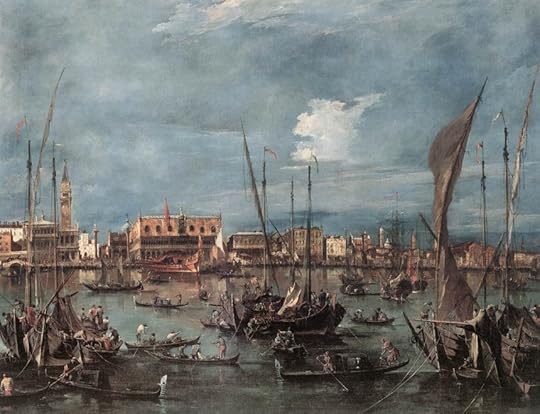
The Venetian lagoon in its Heyday
I refuse to have too much sympathy for the Venetians, however, as the book also spares no detail in how ruthless a tyrant state it was abroad pretty much from its inception, treating its Greek Orthodox subjects as little more than serfs and never missing an opportunity to trick or cajole others into fighting their battles for them, as with the case of the farcical 4th Crusade to take back the Holy Land that ended in a sack of Constantinople centuries before the Turks ever entered the neighbourhood.
The Venetian lagoon in its Heyday
I refuse to have too much sympathy for the Venetians, however, as the book also spares no detail in how ruthless a tyrant state it was abroad pretty much from its inception, treating its Greek Orthodox subjects as little more than serfs and never missing an opportunity to trick or cajole others into fighting their battles for them, as with the case of the farcical 4th Crusade to take back the Holy Land that ended in a sack of Constantinople centuries before the Turks ever entered the neighbourhood.

January 27, 2026
”Venice seemed self generated. The only Italian city not in existence in Roman times, its inhabitants had created their own antiquity out of theft and borrowings. They manufactured their foundation myth and stole their saints from the Greek world. It was, in a sense, the first virtual city, an off-shored bonded warehouse with no visible means of support, almost shockingly modern. The city rested on an abstract. It was an empire of cash — the ducat, the small golden roundel on which a succession of doges knelt before Saint Mark, was the dollar of its day. It was the only state in the world that had government policies solely geared to economic ends. There was no gap between its political and merchant class. It was a republic, run for and by entrepreneurs and regulated accordingly.”
Any time, while reading histories, I’ve run across mentions of Venice as a major power and empire, I have always wondered how such a thing was possible. How is it that this strange city built on the water became a major power in the medieval world? Roger Crowley thoroughly explains that in this history of the rise and fall of this once powerful medieval empire.
Crowley splits his story into three sections. Part one tells the story of how Venice (already a successful mercantile republic) became involved in the infamous Fourth Crusade, and led the assault on Constantinople. The subsequent sack of that city, along with its conquest by Venice and the Franks was the event that established Venice as an empire. They gained not only the riches from the plunder of Constantinople, but several island and port territories that became the backbone of a mighty, mercantile, naval empire.
In part two, Crowley writes of how Venice established their naval superiority, but largely concentrates on the Venetian-Genoese Wars. These wars, fought over which power would dominate the waves and the markets they connected to were particularly brutal. They raged through four distinct conflicts between the years 1256 and 1381. In this section, Crowley also examines the structure of Venice — its commitment to due process in law, its obsession with preventing graph and official misconduct, and its development of a bureaucracy to record and organize these efforts.
Part three examines the downfall of the empire, brought about by the rise of the Ottoman Turks as a sea power. Venice’s naval wars with the Turks broke their naval dominance. The Turks conquered their territories, and replaced Venice as the major power on the Mediterranean.
This book was informative, and parts were fascinating, but other parts dragged. While Crowley was able to bring individual incidents to vibrant life, the overall narrative following the centuries long rise and fall of Venetian power was less compelling than I had hoped for. Still, an informative book, worth a solid “three stars I liked it” rating.
Any time, while reading histories, I’ve run across mentions of Venice as a major power and empire, I have always wondered how such a thing was possible. How is it that this strange city built on the water became a major power in the medieval world? Roger Crowley thoroughly explains that in this history of the rise and fall of this once powerful medieval empire.
Crowley splits his story into three sections. Part one tells the story of how Venice (already a successful mercantile republic) became involved in the infamous Fourth Crusade, and led the assault on Constantinople. The subsequent sack of that city, along with its conquest by Venice and the Franks was the event that established Venice as an empire. They gained not only the riches from the plunder of Constantinople, but several island and port territories that became the backbone of a mighty, mercantile, naval empire.
In part two, Crowley writes of how Venice established their naval superiority, but largely concentrates on the Venetian-Genoese Wars. These wars, fought over which power would dominate the waves and the markets they connected to were particularly brutal. They raged through four distinct conflicts between the years 1256 and 1381. In this section, Crowley also examines the structure of Venice — its commitment to due process in law, its obsession with preventing graph and official misconduct, and its development of a bureaucracy to record and organize these efforts.
Part three examines the downfall of the empire, brought about by the rise of the Ottoman Turks as a sea power. Venice’s naval wars with the Turks broke their naval dominance. The Turks conquered their territories, and replaced Venice as the major power on the Mediterranean.
This book was informative, and parts were fascinating, but other parts dragged. While Crowley was able to bring individual incidents to vibrant life, the overall narrative following the centuries long rise and fall of Venetian power was less compelling than I had hoped for. Still, an informative book, worth a solid “three stars I liked it” rating.

May 22, 2024
The wealth of fascinating detail makes this a compelling read. That and the fact it's excellently written.

August 16, 2018
Crowley's book on Venice is about the Stato da Mar, and as such, is exactly one of the things I've been on the lookout for.
The first section starts with Venice's mercantile rise, and then goes into the story of the Fourth Crusade. He's fairly neutral on everyone's participation later on, but it's interesting to see a version that's sympathetic to Venice for the beginning of it all. He doesn't quite out-and-out blame Villehardouin for it either, but his over-inflated request for transport to the Middle East is the beginning of it all. Crowley points out that Venice effectively stopped all trade for a year to gather and build sufficient transport for the promised crusading army, which put them in a profit-or-perish position when the bill came due.
The second part talks about the small empire Venice picked up from this... and the long series of wars with Genoa, including a fairly lengthy description of the War of Chioggia. This is even more the centerpiece of the book than the Fourth Crusade's taking of Constantinople, and almost felt like it got a little drawn out, though I'm sure that's nothing compared to how the Venetians felt. At any rate, the entire subject is one I wish I could find more on in English.
The last part of the book is on Venice's thankless war against the Ottomans, and is every bit as interesting as the rest of the book. As ever, there are interesting missed opportunities, but here the entire conflict is one I don't know much of. Certainly, the loss of Negroponte and the Battle of Zonchio aren't anything I recall hearing of before. At any rate, Crowley concentrates on this part, and finishes in 1503, before things like the loss of Crete, and finishes with some prescient quotes from a couple of Venetians on what the Portuguese discovery of a route to India was going to do to trade.
As ever, this is a very engaging narrative history, and is full of anecdotes and quotes to help it all come alive. This time his subject is one that gets less attention in English, which makes it even better.
The first section starts with Venice's mercantile rise, and then goes into the story of the Fourth Crusade. He's fairly neutral on everyone's participation later on, but it's interesting to see a version that's sympathetic to Venice for the beginning of it all. He doesn't quite out-and-out blame Villehardouin for it either, but his over-inflated request for transport to the Middle East is the beginning of it all. Crowley points out that Venice effectively stopped all trade for a year to gather and build sufficient transport for the promised crusading army, which put them in a profit-or-perish position when the bill came due.
The second part talks about the small empire Venice picked up from this... and the long series of wars with Genoa, including a fairly lengthy description of the War of Chioggia. This is even more the centerpiece of the book than the Fourth Crusade's taking of Constantinople, and almost felt like it got a little drawn out, though I'm sure that's nothing compared to how the Venetians felt. At any rate, the entire subject is one I wish I could find more on in English.
The last part of the book is on Venice's thankless war against the Ottomans, and is every bit as interesting as the rest of the book. As ever, there are interesting missed opportunities, but here the entire conflict is one I don't know much of. Certainly, the loss of Negroponte and the Battle of Zonchio aren't anything I recall hearing of before. At any rate, Crowley concentrates on this part, and finishes in 1503, before things like the loss of Crete, and finishes with some prescient quotes from a couple of Venetians on what the Portuguese discovery of a route to India was going to do to trade.
As ever, this is a very engaging narrative history, and is full of anecdotes and quotes to help it all come alive. This time his subject is one that gets less attention in English, which makes it even better.

September 4, 2022
'City of Fortune' is a fun book of popular history telling the story of the rise and fall of the Venetian seafaring empire. It covers the period roughly from 1200 to 1500. It is part of a 3 book series with the other two covering the Fall of Constantinople and the Ottoman-Christian sea battles of the XVI century.
The book is very easy to read as the author is a very talented storyteller. It feels more like reading a story rather than a history book.
It is important to note that this is not a history of Venice but rather of the Venetian sea empire. As such the book focuses on a few major events in the colonial history of Venice and then glosses over the rest. About a quarter of the book deals with the Fourth Crusade, the siege of Zara and the siege and fall of Constantinople in 1204. While this is indeed a momentous event that launched Venice's empire, it seems to take up way too much space. The other conflicts that are detailed are the Genoese-Venetian wars, especially the War of Choggia and the Venetian-Ottoman wars. The post 1500 period is very briefly mentioned with events such as the fall of Crete and the fall of Cyprus. However, there is no mention of the major Venetian-Ottoman Morean war (1684-1699) when Venice recaptured the Morea and some Aegean islands as well the Second Morean war of 1714-1718 when the Venetian sea empire in the Aegean effectively ended.
When it comes to more serious historical details the book is quite lacking. For example, the author uses the moniker of 'Wolf of Rimini' when referring to Sigismondo Pandolfo Malatesta. However, there is no evidence to show that he was actually called that, it is actually a modern invention from the XXth century from a historical fiction book written by Edward Hutton.
Overall this book can be read as an introduction to to the history of Venice. But it is by no means complete or exhaustive.
The book is very easy to read as the author is a very talented storyteller. It feels more like reading a story rather than a history book.
It is important to note that this is not a history of Venice but rather of the Venetian sea empire. As such the book focuses on a few major events in the colonial history of Venice and then glosses over the rest. About a quarter of the book deals with the Fourth Crusade, the siege of Zara and the siege and fall of Constantinople in 1204. While this is indeed a momentous event that launched Venice's empire, it seems to take up way too much space. The other conflicts that are detailed are the Genoese-Venetian wars, especially the War of Choggia and the Venetian-Ottoman wars. The post 1500 period is very briefly mentioned with events such as the fall of Crete and the fall of Cyprus. However, there is no mention of the major Venetian-Ottoman Morean war (1684-1699) when Venice recaptured the Morea and some Aegean islands as well the Second Morean war of 1714-1718 when the Venetian sea empire in the Aegean effectively ended.
When it comes to more serious historical details the book is quite lacking. For example, the author uses the moniker of 'Wolf of Rimini' when referring to Sigismondo Pandolfo Malatesta. However, there is no evidence to show that he was actually called that, it is actually a modern invention from the XXth century from a historical fiction book written by Edward Hutton.
Overall this book can be read as an introduction to to the history of Venice. But it is by no means complete or exhaustive.

January 4, 2020
Crowley az ismeretterjesztő könyvek szerzői közül abba a szűk csoportba tartozik, akiknek az újabb munkáit lelkesülten lehet várni, hogy aztán összemérve az elsővel, a csúcsok csúcsával, azt mondja az ember: hát, egy pöttyet kevésbé jó. De ettől még várjuk tovább lelkesülten az újabb munkáit.
A Kalmárköztársaság Velence históriája – de ne számítsunk lineáris aprómunkára, ami ától cettig végigveszi egy városállam történetét. Crowley három gócpontot emel ki: 1.) a negyedik keresztes háborút, amelyben Velence álnok módon elintézte, hogy a keresztesek a Szentföld helyett Zárában, aztán pedig Konstantinápolyban kössenek ki, és ha már ott vannak, a két szép szemükért (meg az aranydukátokért) Velence nagyobb dicsőségére prédálják is fel őket, ezzel megteremtve azt a hatalmi űrt, amibe aztán a kalmárköztársaság beslisszolhatott 2.) a velenceiek Genovával vívott váltakozó, de mindig kíméletlen csatározásait, amelyek végtére is lehetővé tették, hogy a városállam önmagát tekinthesse a Földközi-tenger urának 3.) az oszmánok megizmosodását, amely birodalom végül is bevitte a mélyütést szegény kereskedőknek, elindítva őket a lejtőn. A szerző szokásos stratégiája ebből jól kirajzolódik: Crowley ugyanis egy drámai gépezet felépítésében érdekelt, amiben a főszereplő (jelesül: Velence) sajátos tulajdonságokkal rendelkezik (demokratikus, pénzéhes, a globális kereskedelem fontosabb neki, mint az ideák, gondolkodásmódja világosan elkülönül tehát a korabeli európai zömtől*) – szinte már személynek, nem is városnak tekintjük őt. A drámai gépezet pedig úgy működik, hogy okot okozat követ**, és az események íve fontosabb, mint hogy minden adatot megjelenítsünk. És ebben lehet megragadni a kötet effektíve gyenge pontját: a szerző ugyanis felemelkedés és hanyatlás eposzi léptékű krónikáját alkotja meg az én legnagyobb örömömre, de ezen cél érdekében lefarag mindent, ami ezt az ívet elcsúfítaná. Ő Velence porba hullásának zárómomentumaként az 1500-as évek elejét jelöli meg, mert így kerek a sztori – hogy hetven évvel később volt egy Lepantó, ahol a velenceiek masszív résztvevői voltak a török flotta tönkrezúzásának, ebbe a freskóba már nem fér bele. Mint ahogy nem fér bele a könyvbe az sem, ami a szárazföldön történt – Crowley-t a mediterráneum érdekli, a tengeri csaták szerelmese, a talpasok csatározásai úgy fest, nem izgatják fel***. (Az már csak az én heppem, hogy érzésem szerint Crowley indokolatlanul használja a „nacionalizmus” szót a térség Velence-ellenes mozgalmaival kapcsolatban – de ebbe ne is menjünk bele.)
De elvenni nem akarom senkinek kedvét a könyvtől, mert még ezekkel a hibákkal is káprázatos olvasmány volt: lendületes történet a kapzsiság bűneiről, melyek végül elnyerik zsoldjukat. Csak a mérce magas. De addig jó, amíg nem kell lentebb rakni.
* Itt valóban tetten érhető némi párhuzam a Brit Birodalommal.
** Jellemző, hogy Konstantinápoly felprédálását is mintha úgy interpretálná Crowley, mint kozmikus bűnt, ami nem csak Velence felemelkedését tette lehetővé, de az oszmánokét is – akik aztán, jó háromszáz évvel később, el is hozták az ítéletet a múltbéli bűnökért.
*** Mondjuk erre a hiányosságra gyógyír, hogy a Park Kiadó (jó szokása szerint) ismét egy alapos tanulmányt illesztett a szöveg végére, nem kisebb történész, mint B. Szabó János tollából, aki szépen kiegészíti a kötetet a maga esszéjével a magyar-velencei konfliktusról.
A Kalmárköztársaság Velence históriája – de ne számítsunk lineáris aprómunkára, ami ától cettig végigveszi egy városállam történetét. Crowley három gócpontot emel ki: 1.) a negyedik keresztes háborút, amelyben Velence álnok módon elintézte, hogy a keresztesek a Szentföld helyett Zárában, aztán pedig Konstantinápolyban kössenek ki, és ha már ott vannak, a két szép szemükért (meg az aranydukátokért) Velence nagyobb dicsőségére prédálják is fel őket, ezzel megteremtve azt a hatalmi űrt, amibe aztán a kalmárköztársaság beslisszolhatott 2.) a velenceiek Genovával vívott váltakozó, de mindig kíméletlen csatározásait, amelyek végtére is lehetővé tették, hogy a városállam önmagát tekinthesse a Földközi-tenger urának 3.) az oszmánok megizmosodását, amely birodalom végül is bevitte a mélyütést szegény kereskedőknek, elindítva őket a lejtőn. A szerző szokásos stratégiája ebből jól kirajzolódik: Crowley ugyanis egy drámai gépezet felépítésében érdekelt, amiben a főszereplő (jelesül: Velence) sajátos tulajdonságokkal rendelkezik (demokratikus, pénzéhes, a globális kereskedelem fontosabb neki, mint az ideák, gondolkodásmódja világosan elkülönül tehát a korabeli európai zömtől*) – szinte már személynek, nem is városnak tekintjük őt. A drámai gépezet pedig úgy működik, hogy okot okozat követ**, és az események íve fontosabb, mint hogy minden adatot megjelenítsünk. És ebben lehet megragadni a kötet effektíve gyenge pontját: a szerző ugyanis felemelkedés és hanyatlás eposzi léptékű krónikáját alkotja meg az én legnagyobb örömömre, de ezen cél érdekében lefarag mindent, ami ezt az ívet elcsúfítaná. Ő Velence porba hullásának zárómomentumaként az 1500-as évek elejét jelöli meg, mert így kerek a sztori – hogy hetven évvel később volt egy Lepantó, ahol a velenceiek masszív résztvevői voltak a török flotta tönkrezúzásának, ebbe a freskóba már nem fér bele. Mint ahogy nem fér bele a könyvbe az sem, ami a szárazföldön történt – Crowley-t a mediterráneum érdekli, a tengeri csaták szerelmese, a talpasok csatározásai úgy fest, nem izgatják fel***. (Az már csak az én heppem, hogy érzésem szerint Crowley indokolatlanul használja a „nacionalizmus” szót a térség Velence-ellenes mozgalmaival kapcsolatban – de ebbe ne is menjünk bele.)
De elvenni nem akarom senkinek kedvét a könyvtől, mert még ezekkel a hibákkal is káprázatos olvasmány volt: lendületes történet a kapzsiság bűneiről, melyek végül elnyerik zsoldjukat. Csak a mérce magas. De addig jó, amíg nem kell lentebb rakni.
* Itt valóban tetten érhető némi párhuzam a Brit Birodalommal.
** Jellemző, hogy Konstantinápoly felprédálását is mintha úgy interpretálná Crowley, mint kozmikus bűnt, ami nem csak Velence felemelkedését tette lehetővé, de az oszmánokét is – akik aztán, jó háromszáz évvel később, el is hozták az ítéletet a múltbéli bűnökért.
*** Mondjuk erre a hiányosságra gyógyír, hogy a Park Kiadó (jó szokása szerint) ismét egy alapos tanulmányt illesztett a szöveg végére, nem kisebb történész, mint B. Szabó János tollából, aki szépen kiegészíti a kötetet a maga esszéjével a magyar-velencei konfliktusról.

January 4, 2017
Excellent tale of Venice – concentrating on its maritime empire. The book starts with the Fourth Crusade and how Venice first of all diverted the crusade to clearing the Dalmatian coast and so gaining mastery of the Adriatic and then profited greatly from the division of the spoils from the sack of Constantinople where it used its existing maritime and commercial knowledge to ensure it took control of key ports and waterways (while eschewing the land based pseudo-kingdoms that its rivals established) and started the construction of a maritime based empire. The book then goes through the change in focus of the empire to the Black Sea caused by the Pope cutting down on trade that was aiding Muslim advances (and leading tot eh sack of the Crusader states) and a Byzantine Empire weakened and no longer reserving this trade for itself. The book then covers the fight near to the death with Genoa (which lengthy war effectively killed off any chance of a Crusader and enabled the Ottoman threat to grow). After that period Venice entered something of a golden period and Crowley devotes some chapters to the organisation of the empire, of trade and of maritime affairs and to showing how Venice was uniquely focused on commerce and profit with no division of aristocratic, political, legal and trading classes. The finishing chapters cover the Ottoman threat and eventual series of defeats leaving Venice’s naval power largely gone – Crowley clearly subscribes to a view that a greater focus of Venice and its aristocracy on wealth and land holdings were ultimate causes of its defeat. However the books end is when the Portuguese discover a sea route to the Indies so destroying much of the case for Mediterranean sea power and trading access to the Levant and Egypt. The very last pages of the book divert into speculation that as well as setting up trade routes Venice gradually began to import raw materials to the West changing the balance of payments and contributing the rise of the West over the East.

November 17, 2011
I loved the subject matter of the book. I am glad to have read it. But it was not an enjoyable read. Something about the order bothered me. It seems that he was going chronologically, ( he was) but all of a sudden he would go back and forth. I have read many history books in my life, and studied history, but something about his back and forth lost me. It felt disjointed.
It was however a book based on original sources and I appreciated the effort and the information, it was just not fun, and usually history is fun for me.
It was however a book based on original sources and I appreciated the effort and the information, it was just not fun, and usually history is fun for me.

January 27, 2012
Roger Crowley's Empire of the Sea: The Siege of Malta, the Battle of Lepanto, and the Contest for the Center of the World was one of my top ten reads in 2011. His latest book, City of Fortune: How Venice Won and Lost a Naval Empire provides the prelude to the events described so well in Empire of the Sea. In telling the story of Venice's rise from backwards lagoon to the dominant commercial martime empire in the 1400s he tells the story of the Mediterranean and all of the powers which contested for dominance.
Crowley's relation of the Fourth Crusade, which in 1201 was intended to proceed to the liberation of Jerusalem, is astonishing. The Crusaders essentially travelled on ships rented from the Venetians as they were the only power capable of providing the quality and quantity of shipping necessary for the journey. Although the Venetians constructed enough ships to carry a crusader army of more than 30,000 men, only 12,000 men showed up in Venice, the others travelling from other ports. As the Venetians had halted much of their commercial trade to build and crew the fleet they were now short of money. The Venetians demanded that the crusaders who had shown up in Venice pay the entire amounf owing. Some knights reduced themselves to poverty in an effort to pay. The Venetians then had an idea. Why not do some looting on the way to Jerusalem? Despite admonitions from the pope to not make war on Christian nations, the Venetians diverted the fleet to lay siege to Zara, a city in nearby Dalmatia, that was now allied with Hungary. After reducing Zara and being excommunicated by thr Pope (a fact the Venetian command neglected to pass on to their passengers) they putatively set sail for the Holy Land, There was just one more stop to make. Before anyone quite understood how the fleet was now besieging Constantinople. On April 13, 1204 the Crusaders succeeded in breeching the walls and sacking Constantinople. None of the Crusaders ever made it to the Holy Land but the stage was set for the final schism between the eastern and western wings of Christianity.
Despite this lamentable behavior, the story of the sack of the city was indescribably brutal, the tale of the Venetians and their commercial republic is fascinating. Unlike any other city in Europe there was no feudalism, no king, and because it was a lagoon there were no big landed estates. Crowley shows us how Venice dominated trade in the Mediterranean for more than 250 years. The enterprise only collapsed when the Portuguese and other west Europeans began sailing around the horn of Africa and eliminating the need for the Venetian middlemen. City of Fortune and Empire of the Sea are both great histories. Crowley's style is energetic and much of the book has a velocity more common to a fictional thriller. I'd recommend reading City of Fortune first and following that with Empire of the Sea. Through both books is the thread of the simmering and then open conflict with Islam that was to dominate the western world for so many centuries.
Crowley's relation of the Fourth Crusade, which in 1201 was intended to proceed to the liberation of Jerusalem, is astonishing. The Crusaders essentially travelled on ships rented from the Venetians as they were the only power capable of providing the quality and quantity of shipping necessary for the journey. Although the Venetians constructed enough ships to carry a crusader army of more than 30,000 men, only 12,000 men showed up in Venice, the others travelling from other ports. As the Venetians had halted much of their commercial trade to build and crew the fleet they were now short of money. The Venetians demanded that the crusaders who had shown up in Venice pay the entire amounf owing. Some knights reduced themselves to poverty in an effort to pay. The Venetians then had an idea. Why not do some looting on the way to Jerusalem? Despite admonitions from the pope to not make war on Christian nations, the Venetians diverted the fleet to lay siege to Zara, a city in nearby Dalmatia, that was now allied with Hungary. After reducing Zara and being excommunicated by thr Pope (a fact the Venetian command neglected to pass on to their passengers) they putatively set sail for the Holy Land, There was just one more stop to make. Before anyone quite understood how the fleet was now besieging Constantinople. On April 13, 1204 the Crusaders succeeded in breeching the walls and sacking Constantinople. None of the Crusaders ever made it to the Holy Land but the stage was set for the final schism between the eastern and western wings of Christianity.
Despite this lamentable behavior, the story of the sack of the city was indescribably brutal, the tale of the Venetians and their commercial republic is fascinating. Unlike any other city in Europe there was no feudalism, no king, and because it was a lagoon there were no big landed estates. Crowley shows us how Venice dominated trade in the Mediterranean for more than 250 years. The enterprise only collapsed when the Portuguese and other west Europeans began sailing around the horn of Africa and eliminating the need for the Venetian middlemen. City of Fortune and Empire of the Sea are both great histories. Crowley's style is energetic and much of the book has a velocity more common to a fictional thriller. I'd recommend reading City of Fortune first and following that with Empire of the Sea. Through both books is the thread of the simmering and then open conflict with Islam that was to dominate the western world for so many centuries.

January 14, 2022
Well.
I visited Venice a number of years ago, and was entranced by it. I often wondered how it stayed so "classical" - how did it retain so many of the medieval buildings so many centuries later...
Because it became obsolete and a backwater no one wanted to invest in...
This is the story of how this impossible city - with no land, no agriculture, and no way of supporting its population - became the richest and most important city in europe... and then fell to nothing.
This is a city and culture that was unapologetically capitalist. The entire state was run like a huge financial enterprise, it's government was composed of the richest merchants, and everything was run to optimise their profit. They trader with everyone (even when threatened by excommunication for trading with muslims), they "hijacked" a crusade to raid their commercial competitors and supported foreign rulers who gave them trade agreements.
It almost feels like a cautionary tale - although who in today's world should take the most notice I am not sure (everyone?)
Not quite as enjoyable as Conquerors: How Portugal Forged the First Global Empire as this book covers a longer time period, and there are more diverse personalities the author tries to follow. But still very engrossing.
I visited Venice a number of years ago, and was entranced by it. I often wondered how it stayed so "classical" - how did it retain so many of the medieval buildings so many centuries later...
Because it became obsolete and a backwater no one wanted to invest in...
This is the story of how this impossible city - with no land, no agriculture, and no way of supporting its population - became the richest and most important city in europe... and then fell to nothing.
This is a city and culture that was unapologetically capitalist. The entire state was run like a huge financial enterprise, it's government was composed of the richest merchants, and everything was run to optimise their profit. They trader with everyone (even when threatened by excommunication for trading with muslims), they "hijacked" a crusade to raid their commercial competitors and supported foreign rulers who gave them trade agreements.
It almost feels like a cautionary tale - although who in today's world should take the most notice I am not sure (everyone?)
Not quite as enjoyable as Conquerors: How Portugal Forged the First Global Empire as this book covers a longer time period, and there are more diverse personalities the author tries to follow. But still very engrossing.
September 9, 2013
If you are thinking of reading this, be forewarned: this is strictly a military history of Venice. If you like battles described in play-by-play detail with all of the gory details (and there was a lot of gore), then this book is for you. Otherwise, there is relatively little time spent on art, architecture and social evolution. More ink is spilled describing battles at Constantinople then on Venice itself. Venice is mostly mentioned as the source of orders for military leaders at the distant battle sites.
I was most disappointed with the 'decline' section of the book. The author details the incompetence of Venetian leaders at this time without really discussing why this occurred. What was going on, socially, back in Venice that produced this lot of indecisive leaders? What had changed?
I was most disappointed with the 'decline' section of the book. The author details the incompetence of Venetian leaders at this time without really discussing why this occurred. What was going on, socially, back in Venice that produced this lot of indecisive leaders? What had changed?

June 13, 2026
Confirmed every bias I had against the Venetians and more.

October 1, 2014
You have to give Roger Crowley his due: he is a great writer of narrative history. City of Fortune details Venice's golden age from 1200-1500, when the city-state ruled the seas in the the eastern Mediterranean and was powerful enough to conquer the Byzantines. With multiple European nations' armies participating in the Fourth Crusade, and with Venice providing the transport and the navy, the Crusaders sacked Constantinople in 1204. With the loot, the territories and the trading rights that the crushing of the Byzantines brought to Venice, the Venetian empire was on its way. Venice was essentially a commercial empire, which acquired ports and islands all over the the Adriatic, the Aegean, the Black Sea and stretching all the way to Cyprus and the Mediterranean coast of the Middle East. But they were not interested in acquiring a land empire. They never cared to rule the hinterland of Greece or Croatia or Albania or Syria -- they just wanted the coastal ports where they could trade and provision their ships. They were a great naval power, the most powerful one of their age in the entire Mediterranean, but for them military spending on fortresses and warships was just a cost of doing business. As an imperial power, their model was more like that of the Dutch (we just want to make money as global traders) and less like that of the British (we want to claim as much of the planet as we can in order to be self-sufficient in our empire on which the sun never sets).
Crowley focuses by far the greater part of his narrative on goings-on outside of Venice itself. He talks about events throughout their far-flung outposts and the seas over which they sailed, but the institutions and politics of the city itself are for the most part just backdrop. The reader gets a lot of commercial history -- trade routes, commercial practices, goods traded, commercial rivalries with other trading nations -- and even more military history -- lots and lots of naval battles and sieges of coastal fortresses -- but not so much about the political institutions that made Venice such an almost unique republic in its age.
As to why Venice eventually waned as a great power, that is as interesting as why the city rose in the first place. Two primary factors led to Venice's decline. First, the Ottoman Empire conquered the remnants of the Byzantine Empire (primarily Constantinople itself) in 1453 and then proceeded to conquer most of the lands surrounding the eastern Mediterranean, from the Middle East to almost the gates of Venice itself, and in the process took away the city's trading ports and its access to markets. Second, the Portuguese (and in short order the Dutch and British as well) pioneered new sea routes to the Orient and took over the trade in luxury goods, particularly spices, that had filled Venice's coffers for centuries. By the beginning of the 1500's, Venice's sun was setting, even though it endured as an independent state until 1797, when Napoleon's armies put an end to it.
I enjoyed the book very much and finished it within a day. Although not the primary focus of the book, it was fascinating to learn why it was that Venice was a republic with strong rule of law and a set of quasi-democratic (for the hereditary elite if not for the common people) institutions. Sometimes, it's a good thing to be an island state with very little land but lots of trading acumen and a very large fleet, for both war and trade. It spares you all the drawbacks of a landed aristocracy with standing armies always at hand to put down unruly peasants and merchants alike. Instead, you get something that begins to look like the modern world: strong political institutions, well-defined rules, and a focus on making money through trade instead of accumulating land to make money through grinding down the peasants. It's a great read.
Crowley focuses by far the greater part of his narrative on goings-on outside of Venice itself. He talks about events throughout their far-flung outposts and the seas over which they sailed, but the institutions and politics of the city itself are for the most part just backdrop. The reader gets a lot of commercial history -- trade routes, commercial practices, goods traded, commercial rivalries with other trading nations -- and even more military history -- lots and lots of naval battles and sieges of coastal fortresses -- but not so much about the political institutions that made Venice such an almost unique republic in its age.
As to why Venice eventually waned as a great power, that is as interesting as why the city rose in the first place. Two primary factors led to Venice's decline. First, the Ottoman Empire conquered the remnants of the Byzantine Empire (primarily Constantinople itself) in 1453 and then proceeded to conquer most of the lands surrounding the eastern Mediterranean, from the Middle East to almost the gates of Venice itself, and in the process took away the city's trading ports and its access to markets. Second, the Portuguese (and in short order the Dutch and British as well) pioneered new sea routes to the Orient and took over the trade in luxury goods, particularly spices, that had filled Venice's coffers for centuries. By the beginning of the 1500's, Venice's sun was setting, even though it endured as an independent state until 1797, when Napoleon's armies put an end to it.
I enjoyed the book very much and finished it within a day. Although not the primary focus of the book, it was fascinating to learn why it was that Venice was a republic with strong rule of law and a set of quasi-democratic (for the hereditary elite if not for the common people) institutions. Sometimes, it's a good thing to be an island state with very little land but lots of trading acumen and a very large fleet, for both war and trade. It spares you all the drawbacks of a landed aristocracy with standing armies always at hand to put down unruly peasants and merchants alike. Instead, you get something that begins to look like the modern world: strong political institutions, well-defined rules, and a focus on making money through trade instead of accumulating land to make money through grinding down the peasants. It's a great read.

September 19, 2017
A difficult book to rate. While the subject matter is fascinating, if you're not inclined towards detailed histories the 425 page blow-by-blow details can become tedious or worth skimming over.
The subject matter is one I was previously ignorant of:
Venice in it's heyday (1200 CE to mid 1400's CE) was the preeminent trading power of Europe, the preeminent maritime power of the Mediterranean, and the preeminent colonizer of the Mediterranean.
Venice built a merchant empire based on the spice trade. Spices went overland from India and China to the Middle East from where the Venetians sailed them back to Venice. In Venice the city traded and bartered them in international trade "fairs" to buyers from across Europe.
As a maritime power, Venice built troop transports and ferried troops for the rest of Europe to the crusades. Or, if it suited Venice, it diverted those crusaders for its own military goals, e.g. Venice rerouted crusaders to sack Constantinople (at that time still the seat of the Eastern Orthodox church) during the fourth crusade.
To support its trading empire, Venice colonized and ruled over many Greek and Mediterranean harbours and islands, including a long harsh rule over Crete.
Spoiler alert: For me one of the most interesting aspects of the story was how Venice lost its power. The current business jargon is to speak of "business disrupters", particularly in the jargon of today's hi-tech industry, as though this was a new concept. Venice's decline is just one of a string of examples of how old the concept of business disruption really is. In Venice's case, the disrupters came from two sources. The Ottaman empire broke their naval power and took away many of their land bases. And, Portugal opened up the direct sea route to India, making the expensive overland spice route obsolete.
So, a great subject, if you have the patience. If long histories and patience are not your strong suit, this book may not be for you.
The subject matter is one I was previously ignorant of:
Venice in it's heyday (1200 CE to mid 1400's CE) was the preeminent trading power of Europe, the preeminent maritime power of the Mediterranean, and the preeminent colonizer of the Mediterranean.
Venice built a merchant empire based on the spice trade. Spices went overland from India and China to the Middle East from where the Venetians sailed them back to Venice. In Venice the city traded and bartered them in international trade "fairs" to buyers from across Europe.
As a maritime power, Venice built troop transports and ferried troops for the rest of Europe to the crusades. Or, if it suited Venice, it diverted those crusaders for its own military goals, e.g. Venice rerouted crusaders to sack Constantinople (at that time still the seat of the Eastern Orthodox church) during the fourth crusade.
To support its trading empire, Venice colonized and ruled over many Greek and Mediterranean harbours and islands, including a long harsh rule over Crete.
Spoiler alert: For me one of the most interesting aspects of the story was how Venice lost its power. The current business jargon is to speak of "business disrupters", particularly in the jargon of today's hi-tech industry, as though this was a new concept. Venice's decline is just one of a string of examples of how old the concept of business disruption really is. In Venice's case, the disrupters came from two sources. The Ottaman empire broke their naval power and took away many of their land bases. And, Portugal opened up the direct sea route to India, making the expensive overland spice route obsolete.
So, a great subject, if you have the patience. If long histories and patience are not your strong suit, this book may not be for you.

November 1, 2017
Not as good as his book on Constantinople. For one thing it does not really start at the beginning. Only later in passing we learn that the city was found in 482. But how did she emerge? Because Venice is already a powerful republic in 1200 when the action starts with the preliminaries to the Fourth Crusade. So Venice had the ships and the crusaders did not have the promised money. So Venice made them attack a christian rival city at the Dalmatian coast. And then they decide to take the City of Constantinople. Instead of going to Cairo as the original plan was.
It may have seemed like a good idea. A former Emperor of Byzantine wanted his empire back with the help of the crusaders and he made a lot of promises. To bring his people to the catholic faith amongst others. The story is rather complicated but in the end the city was sacked by Fellow christians. And the doge of Venice Dondolo at age 95 or so took an active part in it. A remarkable man. In the long run it was a bad move. It left a vacuum that would first end Constantinople 250 years later and would leave the Ottomans the first power in the Mediterranean, although it would still take a few centuries before Venice lost Crete and Cyprus (both gained in the conquest of C.).
We do not learn much about the society except that they had reasonable laws and that they were very greedy. And like pigs (whereas Genoese were like donkeys meaning the Venetians were less individualistic). Republic first. Stato da Mar. The Colonies.
And the story ends in 1500 when they had lost a battle at Lepanto. (Because of an incapable general da Canal who was not even executed afterwards).
Of course there was also Portugal and the route around Africa that had something to do with the downfall.
It may have seemed like a good idea. A former Emperor of Byzantine wanted his empire back with the help of the crusaders and he made a lot of promises. To bring his people to the catholic faith amongst others. The story is rather complicated but in the end the city was sacked by Fellow christians. And the doge of Venice Dondolo at age 95 or so took an active part in it. A remarkable man. In the long run it was a bad move. It left a vacuum that would first end Constantinople 250 years later and would leave the Ottomans the first power in the Mediterranean, although it would still take a few centuries before Venice lost Crete and Cyprus (both gained in the conquest of C.).
We do not learn much about the society except that they had reasonable laws and that they were very greedy. And like pigs (whereas Genoese were like donkeys meaning the Venetians were less individualistic). Republic first. Stato da Mar. The Colonies.
And the story ends in 1500 when they had lost a battle at Lepanto. (Because of an incapable general da Canal who was not even executed afterwards).
Of course there was also Portugal and the route around Africa that had something to do with the downfall.

July 25, 2018
在讀了羅傑.克勞利的幾本書之後,我覺得這本介紹威尼斯共和國的書,或許算是比較遜色的一部。本書描述威尼斯共和國在公元 1000 成功掃蕩亞德里亞海的海盜、成為達爾瑪提亞領主一事,作為威尼斯興趣的標誌事件。其後,跳至那充滿醜聞與爭議的「第四次十字軍東征–入侵君士坦丁堡」,讓威尼斯成了東地中海的帝國霸主。其後,十四世紀後半,熱那亞組織「反威尼斯聯盟」,差點將他們給滅國,最後奇蹟似地逆轉戰局。十五世紀,威尼斯展現出它的成熟外交手腕,憑藉海上武力在國際之間捭闔縱橫。但在鄂圖曼土耳其興起後,共和或勢力卻節節敗退,以內格羅蓬特與勒班托的失敗,作為共和國國運一去不復返的象徵。
威尼斯共和國,一直都是史學界很有興趣的研究目標——侷困在一個幅員極小的潟湖內,卻能在歐洲的數百年歷史之中發揮不可思議的影響力、並累積令當時與後世都難以想像的財富。再加上威尼斯的史料豐富完整,以致於後世得以直接讀到這個共和國運作的第一手資料。在這麼一個處處都充滿極端的地方,使得鑽研威尼斯的各個方面都充滿了魅力。
本書並不能算是一部「通史」,因為作者並未平均分配各個時代的篇幅,而只是「挑選某個大時代來細細講述」。因此即使威尼斯在本書所述的 1499 年的宗奇奧(Zonchio)海戰結束(並丟失了勒班陀)之後,便草草交待了其後三百年的歷史作為結束,這點倒是令我感到有些遺憾。
無論如何,本書還是值得一讀。
=======
以下是兩段閱讀之中的胡亂雜感︰
【小筆記1】克里特島的「聖提多起義」
十四世紀威尼斯統治克里特島的期間,克里特公民因為母邦所課徵的稅捐太重,普遍有所不滿。後來這群義大利人(即威尼斯的後裔)聯合了本土希臘人,推翻威尼斯派來的總督,宣佈獨立,成了聖提多共和國。
故事到此,以今日鬼島的 PC(Political Correctness)標準來看,十分值得稱讚頌揚。
威尼斯政府當然不是吃素的,立刻準備平息克里特的分離主義。母邦派來的使者先採綏撫的談判,宣稱「孩子偶爾會生父母的氣,但畢竟是血脈相連,孩子終究還是會回歸父母的懷抱。浪子回頭,既往不咎。」
後來國際局勢不佳,沒有任何國家願意承認或支持這個克里特的共和國政府。於是革命團體中,逐漸出現「重新歸順威尼斯」的聲音,包括領導獨立政府的首任總督 Gradenigo。
但後來,革命派政府內出現了愛國純化的激進主義,主張殺光一切不支持獨立的人,甚至連總督也殺掉了。在威尼斯軍隊還沒登陸之前,甘地亞的革命政府早已自己殺來殺去不亦樂乎。最後,克里特又重新回歸威尼斯的直接統治
#KMT不敢告訴你的獨立革命真相 #殺同伴永遠比殺敵人更熱心
---
【小筆記2】學習方言的重要性
1378 ~ 1380 三年間,「威尼斯共和國」與「反威尼斯聯盟」爆發了長達三年的戰爭。威尼斯的世仇「熱那亞」,曾在戰爭中期將威尼斯本島給圍困了將近一整年,讓威尼斯人民困乏悽慘、幾乎亡國。後來局勢逆轉,被包圍的威尼斯反過來包圍了熱那亞的海軍,最終大逆轉取得了勝利。
戰後處理俘虜。威尼斯要求俘虜唸出「山羊」這個詞。一般的義大利語都讀作「Capra」,只有熱那亞方言習慣將山羊讀成「Crapa」。因此威尼斯便將他們最痛恨的熱那亞戰俘給分離出來,施以特別的「照顧」;至於其它反威聯盟的俘虜(能正確讀出標準 Capra 的義大利人),威尼斯並沒有太多仇恨,因此單純地將他們釋放了。
嗯……Capra 或 Crapa,上天堂或下地獄。所以學習交戰敵國的語言(方言)是非常重要的。
威尼斯共和國,一直都是史學界很有興趣的研究目標——侷困在一個幅員極小的潟湖內,卻能在歐洲的數百年歷史之中發揮不可思議的影響力、並累積令當時與後世都難以想像的財富。再加上威尼斯的史料豐富完整,以致於後世得以直接讀到這個共和國運作的第一手資料。在這麼一個處處都充滿極端的地方,使得鑽研威尼斯的各個方面都充滿了魅力。
本書並不能算是一部「通史」,因為作者並未平均分配各個時代的篇幅,而只是「挑選某個大時代來細細講述」。因此即使威尼斯在本書所述的 1499 年的宗奇奧(Zonchio)海戰結束(並丟失了勒班陀)之後,便草草交待了其後三百年的歷史作為結束,這點倒是令我感到有些遺憾。
無論如何,本書還是值得一讀。
=======
以下是兩段閱讀之中的胡亂雜感︰
【小筆記1】克里特島的「聖提多起義」
十四世紀威尼斯統治克里特島的期間,克里特公民因為母邦所課徵的稅捐太重,普遍有所不滿。後來這群義大利人(即威尼斯的後裔)聯合了本土希臘人,推翻威尼斯派來的總督,宣佈獨立,成了聖提多共和國。
故事到此,以今日鬼島的 PC(Political Correctness)標準來看,十分值得稱讚頌揚。
威尼斯政府當然不是吃素的,立刻準備平息克里特的分離主義。母邦派來的使者先採綏撫的談判,宣稱「孩子偶爾會生父母的氣,但畢竟是血脈相連,孩子終究還是會回歸父母的懷抱。浪子回頭,既往不咎。」
後來國際局勢不佳,沒有任何國家願意承認或支持這個克里特的共和國政府。於是革命團體中,逐漸出現「重新歸順威尼斯」的聲音,包括領導獨立政府的首任總督 Gradenigo。
但後來,革命派政府內出現了愛國純化的激進主義,主張殺光一切不支持獨立的人,甚至連總督也殺掉了。在威尼斯軍隊還沒登陸之前,甘地亞的革命政府早已自己殺來殺去不亦樂乎。最後,克里特又重新回歸威尼斯的直接統治
#KMT不敢告訴你的獨立革命真相 #殺同伴永遠比殺敵人更熱心
---
【小筆記2】學習方言的重要性
1378 ~ 1380 三年間,「威尼斯共和國」與「反威尼斯聯盟」爆發了長達三年的戰爭。威尼斯的世仇「熱那亞」,曾在戰爭中期將威尼斯本島給圍困了將近一整年,讓威尼斯人民困乏悽慘、幾乎亡國。後來局勢逆轉,被包圍的威尼斯反過來包圍了熱那亞的海軍,最終大逆轉取得了勝利。
戰後處理俘虜。威尼斯要求俘虜唸出「山羊」這個詞。一般的義大利語都讀作「Capra」,只有熱那亞方言習慣將山羊讀成「Crapa」。因此威尼斯便將他們最痛恨的熱那亞戰俘給分離出來,施以特別的「照顧」;至於其它反威聯盟的俘虜(能正確讀出標準 Capra 的義大利人),威尼斯並沒有太多仇恨,因此單純地將他們釋放了。
嗯……Capra 或 Crapa,上天堂或下地獄。所以學習交戰敵國的語言(方言)是非常重要的。

October 12, 2015
entertaining account of crucial moments from Venice's past and its heyday as a sea power until history (in the guise of the Ottoman Empire dominance of the seacoast and later subjugation of Egypt which under the Mameluke regime was the main commercial partner of Venice after Byzantium lost its Eastern trade and Portuguese voyages to India and the east which opened the Oceanic route for the Atlantic powers) turned against it in the 1500's and it slowly descended into a minor also-ran state by the 1600's, though still flourishing as a playground for the new powerful masters of Europe like the English, French or Austrian nobility
not a comprehensive account but more of a vignette based story featuring colorful characters, naval battles, internal turmoil, diplomacy and spying
part of a "tetralogy" - so far - that also covers the Fall of Constantinople (very good book), the rise of the Portuguese Empire (good though i expected better) and the battle of Lepanto (which surprisingly turned out to be less important than thought at the time - for that see the Noel Malcolm book Agents of Empire as I have not yet read the author's take on it)
popular history as "non-fiction" - fiction that keeps one turning the pages; definitely recommended with the caveat not to expect a "serious, in depth" history
not a comprehensive account but more of a vignette based story featuring colorful characters, naval battles, internal turmoil, diplomacy and spying
part of a "tetralogy" - so far - that also covers the Fall of Constantinople (very good book), the rise of the Portuguese Empire (good though i expected better) and the battle of Lepanto (which surprisingly turned out to be less important than thought at the time - for that see the Noel Malcolm book Agents of Empire as I have not yet read the author's take on it)
popular history as "non-fiction" - fiction that keeps one turning the pages; definitely recommended with the caveat not to expect a "serious, in depth" history

March 6, 2022
I decided to read this book after really enjoying Crowley’s “Conquerors”, a history of the forging of the Portuguese mercantile empire. While interesting this book was definitely more than a bit verbose. Crowley tracks the growth of the Venetian maritime empire between their part in the Latin conquest of Constantinople in the early 13th century and the Venetian losses to the Ottoman empire by the end of the 15th century. While his desire to instill suspense by detailed descriptions of the many battles fought by Venetian forces is understandable, the sum of this style over several hundred pages is more than a bit tiring. He tacitly acknowledges the messy history of Venetian gains and losses by choosing to describe some battles while simply listing the ports gained/lost at other points. I couldn’t help but feel that the book could have been equally useful and a better reading experience if he had avoided detailing any of the battles and simple kept the focus on the discussions of the larger push/pull factors that enabled this small Italian city to carve one of the first mercantile maritime empires.

September 16, 2012
The history of Venice is fascinating, but Crowley seems intent on missing the point. he acknowledges that Venice's real power was in its trade, but rather than focusing on how that developed and grew, growing Venice's power in other areas, he focuses on Venice's great wars—the Fourth Crusade against Constantinople, the rivalry with Genoa and the final, fatal inclusion by the Ottomans. Absolutely missing the point.

August 5, 2015
190212改為kobo繁體版
--
碰上鄂圖曼帝國
歐陸沒有一個國家有辦法
尤其是義大利的城邦共和國
威尼斯硬撐了快一世紀已經很不容易了
但最後還是輸給了土耳其人
這本也沒提多少威尼斯的政治制度
還是只能看海都物語QQ
--
碰上鄂圖曼帝國
歐陸沒有一個國家有辦法
尤其是義大利的城邦共和國
威尼斯硬撐了快一世紀已經很不容易了
但最後還是輸給了土耳其人
這本也沒提多少威尼斯的政治制度
還是只能看海都物語QQ
September 4, 2018
It's not kidding about being a naval history.

July 19, 2026
Кожна імперія врешті-решт розпадеться. Автор описує Венеційську Stato da Mar з її колоніями як передтечу Британській і Голландській імперіям, з такими ж наслідками - заморські колонії з часом стає неможливо контролювати з метрополії, як-от Британії не вдалося втримати свої американські володіння. Епічний екскурс в історію Венеції, дуже сподобалося, хоч і не сподівалася дізнатися про чорнушну реальність поза позірною розкішшю Венеції. Це десь так само, як читати в Олівії Ленг про розкішні сади в Англії, гроші для яких надходили з експлуатації рабів в американських володіннях заможних бритів. Так само венеційці фактично загнали в рабство жителів Криту, тероризували кіпріотів, вогнем і мечем просували імперію вздовж Адріатики, і нищили сотні тисяч генуезців у столітніх війнах конкурентів за неподільне панування в Середземному морі. Генуезці платили тією ж монетою, але зазнали невдачі і під кінець 14 ст. Генуя віддалася на милість французьким королям. А Венеція продовжувала свою 'міжнародну' діяльність аж до кінця 15 ст., коли Оттоманська імперія поклала цьому остаточний край.
Зліт Венеції вражає, враховуючи, що як поселення вона з'явилася аж у 5 столітті - і взялася надолужувати втрачені віки, звозячи до себе античну мистецьку спадщину, переймаючи візантійську мозаїку й ісламські впливи, торгуючи і єгипетськими муміями, і християнськими реліквіями, рабами з російських (чи не з українського Півдня насправді?) земель і залишаючи за собою слід з муранського скла, вироби з якого досі розкопують українські археологи на наших теренах.
Дуже багатогранний текст, суцільна насолода, хоч і з потужним домішком шоку від несподіваних відкриттів чорного минулого прекрасної Венеції. Дуже раджу
Зліт Венеції вражає, враховуючи, що як поселення вона з'явилася аж у 5 столітті - і взялася надолужувати втрачені віки, звозячи до себе античну мистецьку спадщину, переймаючи візантійську мозаїку й ісламські впливи, торгуючи і єгипетськими муміями, і християнськими реліквіями, рабами з російських (чи не з українського Півдня насправді?) земель і залишаючи за собою слід з муранського скла, вироби з якого досі розкопують українські археологи на наших теренах.
Дуже багатогранний текст, суцільна насолода, хоч і з потужним домішком шоку від несподіваних відкриттів чорного минулого прекрасної Венеції. Дуже раджу

July 26, 2019
Roger Crowley and Venice, you can just hear my money flying away from me, but I don't care. I knew after finishing 1453 that I just had to read this man's collected work because I have yet to find a popular history writer who has the level of depth, narrative ability, balanced historical bias, and general concern for the puplic and professional face of History. Plus, I mean, like, it's Venice dude.
City of Fortune did have the same level of Dynamism that 1453 had, but this book is still an amazing introduction to the most serene republic of Venice and history. Taking a wealth of scholarly work and producing a history that feels relevant and dynamic and interesting but Crowley has an ability with words as much as he does with facts and information. This book tells a story about the Republic of Venice and contextualizes it with its time and tries to understand why the leaders and average peoples managed to create a mythos of themselves that last for centuries. Venice is, according to Crowley, the first modern city and he argues it quite effectively
My only real beef with this book is that Crowley's endnotes only apply for his direct quotes and I would have liked to have seen more concern for tracing certain details back to their sources, and his ending feels a bit abrupt.
Still, I loved this book and it's only inspired me to learn more about the Serene Republic. I would offer this book to anyone beginning the history of Venice because it's not only a satisfying and effective introduction, it's an incredible book, and Crowley remains, indefinitely, my man.
City of Fortune did have the same level of Dynamism that 1453 had, but this book is still an amazing introduction to the most serene republic of Venice and history. Taking a wealth of scholarly work and producing a history that feels relevant and dynamic and interesting but Crowley has an ability with words as much as he does with facts and information. This book tells a story about the Republic of Venice and contextualizes it with its time and tries to understand why the leaders and average peoples managed to create a mythos of themselves that last for centuries. Venice is, according to Crowley, the first modern city and he argues it quite effectively
My only real beef with this book is that Crowley's endnotes only apply for his direct quotes and I would have liked to have seen more concern for tracing certain details back to their sources, and his ending feels a bit abrupt.
Still, I loved this book and it's only inspired me to learn more about the Serene Republic. I would offer this book to anyone beginning the history of Venice because it's not only a satisfying and effective introduction, it's an incredible book, and Crowley remains, indefinitely, my man.

April 8, 2022
3.5 stars
Who knew Venice was such a player for much of the last millennium.
Some very brief notes:
flying bridges and shipboard catapults
In 1204 Constantinople and the Byzantine emperor were divided amongst the crusaders and the Venetians made out the most handsomely. Many of the artifacts that they carefully pillaged ended up back home in Saint Mark's Basilica.
For the next several centuries they were the princes of the sea. The Venetians were given most of the Eastern Mediterranean to govern including western Greece and 3/8 of Constantinople. Over the next two centuries the people of Crete would foment no less than 27 revolutions and uprisings against the controlling Venetians.
The Bosporus is the seventeen mile strait that connects the Black Sea and the Mediterranean and Constantinople only existed because of the great fisheries and the strategic value of connecting these two great waterways. In the 13th century the Genoese and Venetians fought over the Bosporus.
In the 14th the Black Death had greatly decimated the civilized world. In 1350 and the 3rd Genoese-Venetian War, the Venetians only had thirty-five ships in Constantinople as opposed to hundreds just a few decades prior.
But for the next several centuries it was the Venetian boat building prowess and mercantilism that kept them at the top of Italy's regions.
Who knew Venice was such a player for much of the last millennium.
Some very brief notes:
flying bridges and shipboard catapults
In 1204 Constantinople and the Byzantine emperor were divided amongst the crusaders and the Venetians made out the most handsomely. Many of the artifacts that they carefully pillaged ended up back home in Saint Mark's Basilica.
For the next several centuries they were the princes of the sea. The Venetians were given most of the Eastern Mediterranean to govern including western Greece and 3/8 of Constantinople. Over the next two centuries the people of Crete would foment no less than 27 revolutions and uprisings against the controlling Venetians.
The Bosporus is the seventeen mile strait that connects the Black Sea and the Mediterranean and Constantinople only existed because of the great fisheries and the strategic value of connecting these two great waterways. In the 13th century the Genoese and Venetians fought over the Bosporus.
In the 14th the Black Death had greatly decimated the civilized world. In 1350 and the 3rd Genoese-Venetian War, the Venetians only had thirty-five ships in Constantinople as opposed to hundreds just a few decades prior.
But for the next several centuries it was the Venetian boat building prowess and mercantilism that kept them at the top of Italy's regions.
Displaying 1 - 30 of 445 reviews