Jump to ratings and reviews
Rate this book

American Umpire

Rate this book
Commentators call the United States an occasionally a benign empire, sometimes an empire in denial, often a destructive empire. In American Umpire , Elizabeth Cobbs Hoffman explores key turning points in history from George Washington to Barack Obama. She challenges the notion that the United States is an empire, and asserts instead that America has performed the role of umpire since 1776, compelling adherence to rules that gradually earned broad approval, even though it also violated these rules on occasion. Over time, prosperity spread, wars declined in ferocity, and human life expectancy doubled worldwide. But security came at a cost that was not shared equally by all. The United States is the world's most powerful country--and one of its richest--but more exposed to criticism and hazards than ever. Umpiring is a weighty responsibility. With all eyes upon them, umpires cannot win.

448 pages, Hardcover

First published November 1, 2012

5 people are currently reading
71 people want to read

About the author

Elizabeth Cobbs

44 books222 followers

Ratings & Reviews

What do you think?
Rate this book

Friends & Following

Create a free account to discover what your friends think of this book!

Community Reviews

5 stars
11 (34%)
4 stars
6 (18%)
3 stars
6 (18%)
2 stars
6 (18%)
1 star
3 (9%)
Displaying 1 - 4 of 4 reviews
Profile Image for Owlseyes .
1,805 reviews304 followers
Want to read
December 20, 2016
UPDATE
Now that's solid (after the known results of the Electoral College vote), Trump to be the USA president, I wonder about the word "empire"...in a Trump age.
20th December 2016

I just had this scary thought after hearing her lecturing*; it was something like this: "just let all the US abroad-military installations be dismantled, troops gotten home...and let's see what ISIS will do about it".

But then another question popped up: "US-cop gone, who's next in line"? I mean, "who would replace cop number one?
who would like to?...".

November 27th 2015


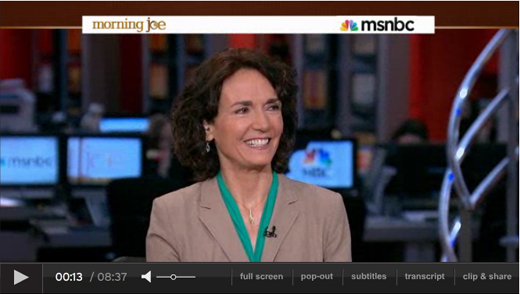
ECH wondered: lots of folks speaking about bringing home troops from Iraq and Afghanistan; she boldly added: why not those in Germany and Japan??


She calls it "Umpire"; an "insight" she had, even before finding out that the founding fathers used the expression. The Umpire was a sort of (super/above the states) entity--call it federal government-- which had the power to decide , and upon whose decision should the states abide by. Squabbling among the 13 original states would be circumvented, I have understood.


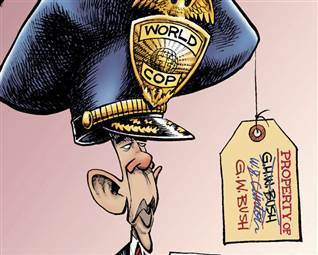
"Since 1947, when President Harry S. Truman set forth a policy to stop further Soviet expansion and “support free peoples” who were “resisting subjugation by armed minorities or by outside pressures,” America has acted as the world’s policeman".

in the New York Times

But, over time, the Umpire has turned into an Empire, it appears. Especially after WWII, the USA became a sort of world-police whose job was to guarantee that certain rules were obeyed/respected. Now, time has arrived for this job to be "reconsidered". Her article in the NY Times** of 2013 looks quite clear: "Come Home, America". She calls it a "correction" , a time to move to a next phase; the USA has been on a "detour".


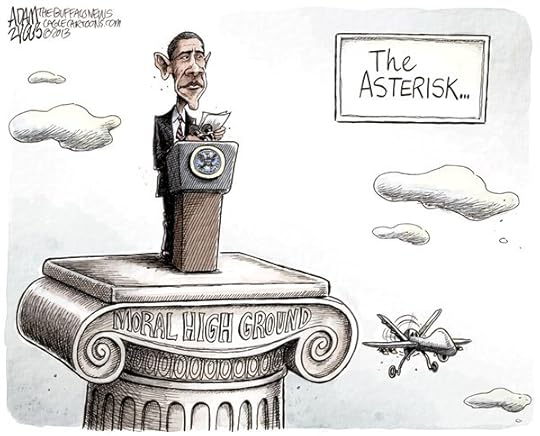
It's interesting her critique on the present-day administration; that of Obama not differing much from previous ones. Though Obama acknowledges the USA job has been "law enforcement" for 70 decades, he denied the nation as a "global policeman". In the eyes of ECH: it's the opposite. Obama has a "double-speak".


Apparently, her "next phase" won't involve "fighting".

Despite being polemic, her historical analysis brings some positive lines for the "world cop". Because the USA brought and enforced, over the years, certain ideals/principles common to (and cherished by) several nations: Access (to markets and citizen-rule), Arbitration (law,regulation,negotiation) and Transparency (freedom of information and free speech).

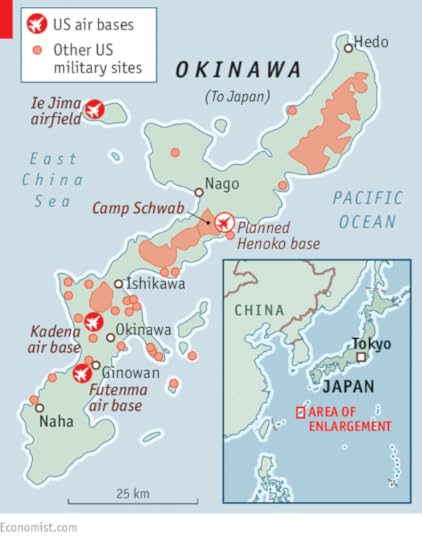
She claims her view has many supporters: Noam Chomsky (Imperial ambitions), Howard Zinn (A People's History of American Empire), Chalmers Johnson, Andrew Bacevich,.... ;and she provides evidence for a rethinking (my expression): namely the 1967 France's "kicked us out" or, more recently, the Philippines case. Of course, Okinawa always polemic; even its recent plans of expansion...


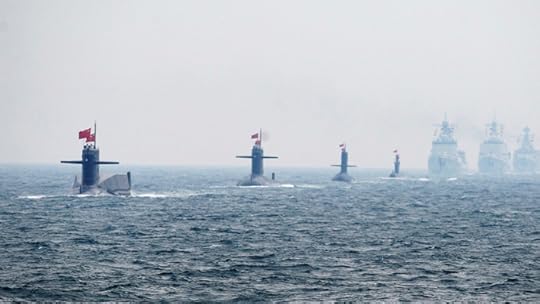
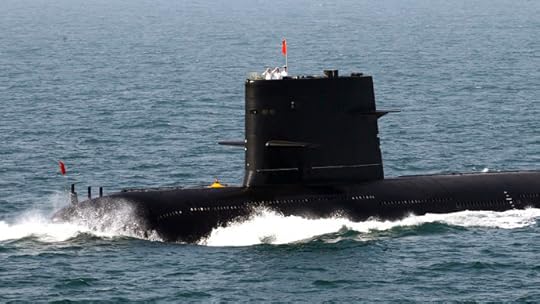
(no, they're not yankees', rather, chinese subs, nuclear ones, likely)

To ECH, the expansionist USA "messed up". So, logically,it's time for a correction.

She said two other things: (1) Empires go Dodo-way; (2) nations replace Empires.

I think Chomsky’s vision on the issue is a bit more radical than ECH's. To him it is as if things were twisted from the very beginning of the USA history. Therefore he quotes the “father of the nation”, George Washington's expression “nascent empire” ; and summarizes the very beginning as a story of “wars of extermination …murder,…deceit,…lying…and plunder”; all in the interest of “expansion of the colonies”. Later on J. Quincy Adams views were followed, (“Cuba would fall under the laws of political gravitation”) even by Bush (on preemptive wars): expansion is a way to secure the nation. Chomsky gives the example of the intervention of Andrew Jackson in Florida; he deplores a “stolen Hawaii”; …and the Philippines,... and Puerto Rico.


*https://www.youtube.com/watch?v=7nWUC...

**http://www.nytimes.com/2013/03/05/opi...
Profile Image for Joseph Stieb.
Author 1 book240 followers
January 19, 2019
A fascinating, if occasionally overstated, reframing of the U.S. global role since 1776. It has became almost unquestioned in academic circles that America was and still is an empire. Dissatisfied with the loose and politicized application of this term, Cobbs argues that the American global role should be understood more as umpire, or really a player-umpire that has built a world oder based on access (mainly free trade, but also formal equality among states), arbitration (non-violent settlement of disputes), and transparency (democratic openness and accountability). She argues that this role originated in the structure of the original colonies relating to the federal government. She shows how the founders, or at least most of them, conceived of the new government as an umpire between the states: designed to coordinate, remove trade and communications barriers, provide for common defense and foreign relations, standardize, and arbitrate disputes. At the time of the founding, it was not yet clear if the umpire would be supreme over the "players," and the next 100 or so years of American history was largely the process of adjudicating this.

So when the United States emerged as a global power around 1900, it very much saw its role as "refereeing" the rest of the world by establishing organizations and standards of behavior that comported with access, arbitration, and transparency. The US promulgated the Open Door (a subject on which she brilliantly refutes William Appleman Williams' argument), the League of Nations, and the Washington Treaty, but not until after WWII did it really take on the role of umpire by building a liberal international system and guaranteeing the security of that system against the Soviet Union. She shows just how thankless a task this has been for the United States, drawing the ire of the world and tremendous self-doubt even as the world order it has constructed has largely succeeded (until now, maybe). She ends with a brilliant coda about the dismal failure of the European Community to handle the 1990s Balkans Crisis and the eventual, and successful, US intervention there. To her, this shows that the United States still has to be ump, even in the backyard of the European powers.

Cobbs makes probably the clearest and strongest argument I've yet heard that the word "empire" does not explain the U.S. global role, at least not as well as empire. She acknowledges that the United States did have an imperial phase, but she frames it as a temporary "keeping up with the Europeans" thing at the end of the 19th century. The Philippines, for example, was from very early on not meant to be a permanent colony, and the US even limited how much US economic investment could happen there. The United States was a stark critic of other empires, including the far more obviously imperialist Soviet and European empires. She makes a good point that US interference in Latin America has largely been about enforcing the Monroe Doctrine (by ensuring the payment of sovereign debts, an "umperial" function if I've ever seen one), although I'd like to hear her say more about why this isn't imperial. U.S.-Latin American relations seem to be a perfect example of the blending of imperial and umperial roles. Today, she says that the US global role still fits the umpire role. After all, who has done the overwhelming majority of the fighting against the global menace of terrorism? Are you an empire, Cobbs argues, if relatively powerless countries ask you to pack up your bases and go home and you do? I'm not totally convinced by her argument, but she raises lots of good questions and should be a useful for coming up with a sharper usage of the word empire.

Before you jump down Cobbs' throat (as I'm sure has happened to her 100 times as she has promulgated this distinctly unfashionable argument), take note that this is an explicitly comparative argument. She's comparing the US global role to that of European countries and other superpowers in terms of the global orders they constructed. In comparison, the US global order has been remarkably open, peaceful, and prosperous. Of course, she also shows how the United States built on the British precedent of freedom of navigation, policing piracy and slave trading, balancing the EU continent, etc.

My main criticism of Cobbs is her tendency to split hairs in order to keep her thesis intact. Was, for example, Manifest Destiny imperial? Well, she's right that it wasn't in the sense that the acquired territories became incorporated on an equal footing into the union. Was it, however, settler colonialism, and a violent version at that? Well, yes. Occasionally Cobbs needs to nod to the other side a little more rather than being overly thesis bound. I'd still say she does this more than the left-wing historians of the Wisconsin school with whom she's arguing. Overall, I'd like to see her make a Venn diagram between the definitions of umpire and empire; I think there would be considerable overlap, although I think that the distinction would remain important.

I'd recommend this for A. People who think that America was/is an empire but are open to thoughtful counterpoints. Quite simply, if all you have read on the US global role is Wisconsin school historians and Noam Chomsky types, you should try this book out. B. People who lean toward a Robert Kagan type "Superpowers don't get to retire" argument but want a less polemical and more historically rigorous version of this argument. C. People who are interested in the deeper roots of the post-Cold War liberal international system as described by scholars like Tony Smith and G. John Ikenberry. Overall, I'd say there's a lot of food for thought in this book, and I'm disappointed to see that it hasn't garnered more attention.
Profile Image for Jeff.
279 reviews4 followers
August 9, 2022
Really enjoyed this book that meticulously documents the evolution of the role of the USA as an "umpire", even as the age of empires (Roman, British, French, and others) came to an end. The main reason it took me 3 months to get through it was because I was far too easily distracted by the 2016 presidential election, so don't let the length of time deter you from reading if you enjoy learning more about American History. It was recommended to me by a friend at work (from Northern Ireland, actually!) who had seen and enjoyed an hour-long public television documentary about it (go to http://www.americanumpire.com/ for more info on that). As a reader, I was interested in the "long-version" so I got the book and I'm glad I did.

To give you some perspective, I think my 241 highlights might be a personal record for a history book!
Profile Image for The American Conservative.
564 reviews268 followers
Read
September 9, 2013
'Terminating American Umpire in the 1990s is the equivalent, say, of publishing a history of American statecraft in 1950 and disregarding everything that had happened since 1938. It’s a tad too convenient.
How, for example, might Hoffman incorporate the Bush Doctrine of preventive war or the Obama Doctrine of targeted assassination into her themes of access and arbitration? As for transparency, how does that mesh with Washington’s growing appetite for secret surveillance?
Finally, in the wake of the Iraq debacle, is it really still possible to speak, as Hoffman does, of “the military harmlessness of the United States”?
No, it’s not. Whatever the implications for American morale, let’s not pretend otherwise.'

Read the full review, "Umpire Strikes Out," on our website:
http://www.theamericanconservative.co...
Displaying 1 - 4 of 4 reviews

Can't find what you're looking for?

Get help and learn more about the design.