Roger Matthews is the Vicar of picturesque village, Little Stanton. He happily tends to his friendly flock and is almost ready to retire but his spirit is restless . . . Roger is pulled towards the slums of London, determined to help the poor and depraved, and arrives in fog-drenched Woodbank. But the people are as unfriendly as the weather, greeting him with slammed doors and suspicious eyes. After months of being ignored, a chance drunken encounter and an abandoned Boat House finally offer hope.
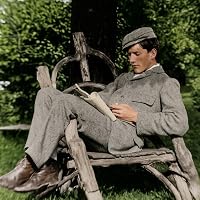
By the outbreak of the First World War, Robert ”Bob” Cedric Sherriff had left school and begun work as a clerk at the Sun Fire Office, the same company as his father. Although his employers preferred for Sherriff not to enlist, he joined up in November 1915. He served in France until he was wounded in action on 2 August 1917 during the Battle of Passchendaele (Third Battle of Ypres), and was sent back to England for treatment. Later while on home service he was promoted firstly to Lieutenant on 5 March 1918, and then later to Captain on 8 January 1919.
In 1928 came ‘Journey’s End‘, his first and most spectacular dramatic success, which was produced by the Incorporated Stage Society and performed for just two nights at the Apollo Theatre in London on 9 and 10 December 1928. The play was set in the trenches in March 1918, and was based on his own experiences and comrades at the Western Front.
During the 1930s Sherriff went on to write several more plays which reached the West End, but never equaled that achieved by ‘Journey’s End‘, He also published the novels ‘The Fortnight in September‘ (1931), which proved popular with readers, ‘Greengates‘ (1936) and ‘The Hopkins Manuscript‘ (1939), which saw Sherriff tackle the science fiction genre. However, it was his work as a screenplay writer which yielded his most notable successes during the post-World War Two phase of his career. He was nominated for an Academy Award for Best Writing (Adapted Screenplay) and two British Academy of Film and Television Arts.
Sherriff’s memoir, ‘No Leading Lady‘, was published in 1968. He never married, and remained devoted to his mother, with whom he lived, latterly at his Esher house ‘Rosebriars’, which he had bought in March 1930.
I enjoyed reading this quite a bit although I did have to suspend my disbelief slightly more than I would typically like.
Sherriff is a better, more nuanced writer than this (like in A Fortnight in September), but if you are after mid-century British with a vicar that reads more like D.E. Stevenson, then this might your cup of tea.
Going into this, I was aware that at some point the main character(s) would be transplanted to Hollywood, and part of the appeal was in imagining the means by which the author might make this happen. How does an idealistic middle-aged vicar, who has exchanged a comfortable country parish for a rundown part of London so he can better the lives of the underprivileged, get to California? Others have objected to the unreality of the plotting here, which I understand, but there is also an eccentric consistency to it. Being discovered by Hollywood for potential stardom; what is that but a sort of secular miracle?
This is the fourth of R.C. Sherriff’s novels I’ve read – after The Fortnight in September, The Hopkins Manuscript and Greengates – and I’ve thoroughly enjoyed them all. Write about what you know is common advice, and since Sherriff spent from 1932 to 1944 working on scripts in Hollywood, his account of life there, and of travelling on ocean liners and cross-continental trains is lively and authoritative. In following the advice, he yields also to wish-fulfilment, fantasy, subconscious wishes – whatever you want to call it – and gets into a bit of a pickle, leaving a number of narrative elements unresolved at the end. I didn’t particularly mind: it adds psychological interest to the personality behind the writing.
Sherriff can be rather funny in a dry way, as with our hero Roger Matthews’ conversation with Mr Benfleet, talent scout for Paragon Pictures, about the company’s proposed film version of the Children’s Crusade:
‘Hundreds died on the way, hundreds got kidnapped and taken by pirates and sold into slavery. Just ten of ’em got through to the Holy City, Mr Matthews… ten out of all those thousands… ten heroic kids…’ ‘I didn’t know that any actually got there,’ said Mr Matthews. ‘Ten do in our picture,’ retorted Mr Benfleet rather sharply.
You can always rely on RC Sherriff to tackle life’s dilemmas in a very satisfactory way. Here we have an experienced vicar trying to do some good in a deprived community only to come up against the local church hierarchy. Sherriff uses his life experiences to add to the story, rowing, travelling to Hollywood in the 1930’s and getting involved in the film industry all things that he has done in real life . He is such a good storyteller even when bordering on the incredible. He also deals with the problems of his daughter becoming a childhood film star and the social problem of alcohol and manipulation of young people. His fight with the church the local church hierarchy is particularly real and poignant. If you haven’t read his books try him they are such gentle yet thought provoking books
Not as inspired as Sherriff's other work, this is maybe best seen as a spoof of a postwar Ealing Studios movie, not quite a comedy but amiable and bittersweet. I resented the sudden lurch into a different gear just when Sherriff had lined up the challenges for Mr Matthews to face: the intimidating Joe Briggs, the monstrous Mrs Bannister Paget, the surly urban youths -- and then we're off in the sun. I see why Sherriff did it (the story was lurching along too predictably) and I admire the abrupt ending, which resolves the character arc but not the plot. Still, not his best.
An odd book. I have previously greatly enjoyed 'The Hopkins Manuscript' and absolutely loved 'The Fortnight in September' so was well prepared to sympathise with Sherriff as an author. The book is odd beacuse it is unclear when it is set. Published in 1948 it makes no mention of the war or any contemporary events other than the names of film stars and the use of the Queen Mary. It is also odd as it shifts gear half way through and has a somewhat unusual ending. Perhaps only one for fans of mid 20th century British fiction. Fortunately I am and I thoroughly enjoyed this book.