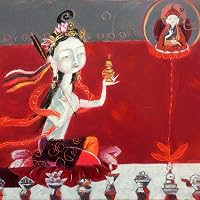
Chögyam Trungpa explores the the vajrayana teachings of the tantric path in this final volume of his masterpiece on Tibetan Buddhism
This three-volume collection presents in lively, relevant language the comprehensive teachings of the Tibetan Buddhist path of the hinayana, mahayana, and vajrayana. Considered Chögyam Trungpa’s magnum opus, The Profound Treasury of the Ocean of Dharma will resonate with new and senior students of Buddhism.
In this third and final volume, Chögyam Trungpa’s examines the vajrayana teachings of the tantric path. The vajrayana, or "diamond vehicle," also referred to as tantra, draws upon and extends the teachings of the hinayana and mahayana. As with the hinayana and the mahayana, the formal acceptance into the vajrayana is marked by a vow, in this case the samaya vow. There is an emphasis at this stage on the student-teacher relationship and on the quality of devotion. Generally, students must complete preliminary practices, called ngöndro , to prepare themselves for initiation into the vajrayana path before going further. Having done so, they then receive the appropriate empowerments to begin tantric practices. There are empowerment ceremonies of many kinds, called abhishekas . The vajrayana includes both form practices, such as visualizations and sadhanas (ritual liturgies), and formless practices based on allowing the mind to rest naturally in its inherent clarity and emptiness. Although on the surface, there is much greater complexity in tantric practices, the principles of mindfulness and awareness and the cultivation of compassion and skillful action continue to be of central importance.
The tantric path requires complete engagement and fierce dedication. It is said to be a more rapid path, but it is also more dangerous. There is a quality of directness, abruptness, and wholeheartedness. Tantrikas , or vajrayana practitioners, recognize that the most challenging aspects of life, the energies and play of confused emotions and frightening obstacles, can be worked with as gateways to freedom and realization. Other topics covered in detail in this volume include the four reminders, the mandala principle, mahamudra, atiyoga, and more.
Vidyadhara Chögyam Trungpa Rinpoche (Tibetan: ཆོས་ རྒྱམ་ དྲུང་པ་ Wylie: Chos rgyam Drung pa; also known as Dorje Dradul of Mukpo, Surmang Trungpa, after his monastery, or Chökyi Gyatso, of which Chögyam is an abbreviation) was a Buddhist meditation master, scholar, teacher, poet, and artist. He was the 11th descendent in the line of Trungpa tulkus of the Kagyü school of Tibetan Buddhism. He was also trained in the Nyingma tradition, the oldest of the four schools, and was an adherent of the rimay or "non-sectarian" movement within Tibetan Buddhism, which aspired to bring together and make available all the valuable teachings of the different schools, free of sectarian rivalry.
Trungpa was a significant figure in the dissemination of Tibetan Buddhism to the West, founding Naropa University and establishing the Shambhala Training method, a presentation of the Buddhadharma largely devoid of ethnic trappings. In 1963, he moved to England to study comparative religion, philosophy, and fine arts at Oxford University. During this time, he also studied Japanese flower arranging and received an instructors degree from the Sogetsu school of ikebana. In 1967, he moved to Scotland, where he founded the Samye Ling meditation centre.
Shortly thereafter, a variety of experiences—including a car accident that left him partially paralyzed on the left side of his body—led him to give up his monastic vows and work as a lay teacher. In 1969, he published Meditation in Action, the first of fourteen books on the spiritual path published during his lifetime. The following year he married Diana Pybus and moved to the United States, where he established his first North American meditation centre, Tail of the Tiger (now known as Karmê-Chöling) in Barnet, Vermont.
In 1986, he moved to Nova Scotia, Canada, where hundreds of his students had settled. That Autumn, after years of heavy alcohol use, he had a cardiac arrest, and he died of heart failure the following Spring. His legacy is carried on by his son, Sakyong Mipham Rinpoche, under the banner of Shambhala International and the Nalanda Translation Committee.
'It is impossible to present vajrayana in its fullest sense. If there is enough general confusion, hinayana can be presented; and if there is enough confusion about benevolence, love, and religiosity, mahayana can be presented; but nobody would be crazy enough to present or to listen to vajrayana anywhere on this earth. Nonetheless, at this point, society has gone crazy, confusions dawn everywhere, and spiritual disciplines have gotten corrupted; and because of that, somehow or other, it is possible to present the vajrayana. In this land of North America, this beautiful land, it has become possible to present the vajrayana. That possibility has come about because of the ancestors of my tradition.
I realized I should not be too methodical or scholarly in expounding the vajrayana, but that I should speak from my heart... I could weep, cry, or burst into tears, or I could dance and explore. And that seems to be the feeling of the vajrayana, actually: it is both of these at once.
Once a teaching is received, whatever yana it may be, you might find that it is very comfortable and you can relax in it. That becomes a problem. With each new yana, you may have to give up the feeling of protection or security of the previous yanas. And you need to keep doing this until you have actually exhausted everything completely, until you no longer need to rely on any form of security. So even though the yanas are vehicles, you have to abandon those vehicles. You have to get into a diamond jet at some point.
The vajrayana is referred to as the imperial yana. It is a coming down rather than a going up, like relating with snowfall or rain, as opposed to relating with grass, flowers, and trees. Coming down is much more immediate and personal. The imperial yana is associated with the view that postmeditation practice is important.
You might feel that the approach of vajrayana is complete hype or a complete exaggeration, or else you might feel that it is the real thing. Because of that sharp boundary, there is need for fundamental trust. You could experience either trust or distrust when such truth is told. You might have doubts, but distrust and doubt are not the same: distrust means condemning the whole thing, whereas doubt is knowing that there are possibilities. Doubt is knowing that something is happening, but not knowing exactly what is going on. It provides you with the possibility of questioning yourself as to whether you have the faculties and capability to understand the vajrayana.
In order to become decent vajrayana people, we need to establish a strong foundation through hinayana discipline AND mahayana benevolence. The foundation of the path is hinayana discipline... out of [shamatha and vipashyana], you learn how to synchronize your mind and body. The point of hinayana discipline is to make sure that you are not hurting yourself or others. It is based on recognizing your own confusion and suffering and wanting to [actually] end it. The hinayana discipline of shamatha [sitting meditation] actually tames individuals: it creates an environment of discipline.
With that foundation, you can take the bodhisattva vow and enter the mahayana, [in which] you recognize others' suffering and want to [actually] end it... you are shifting from self-help to helping others, or at least opening to others. Your attitude begins to change, and you develop an understanding of the mahayana principle of exchanging oneself for others.
Lojong, or "mind training", and the practice of tonglen, or "sending and taking", begin to become very powerful... you realize that you can send out pleasure AND take in pain. This is definitely a very moving experience, and you can actually do it... Learning how to let go of our pleasure and receive other's people's pain is truly a noble gesture. It allows us to become soft people, genuine people, extraordinarily good people. And with that merit, we begin to become worthy of receiving the vajrayana teachings.
You can develop the gentle, compassionate, and soft mind of relative bodhichitta, AND with ultimate bodhichitta, you can learn how to rest your mind in the basic goodness of alaya, the fundamental ground. You can develop bodhi, or wakefulness, which is the lessening of ego fixation and grasping.
With the benevolence of the bodhisattva, we can give to others AND build a foundation for ourselves at the SAME time. We can build a solid foundation for tantra. It is like building a house out of rocks: you get a lot of exercise and good health, but the house is built for somebody else rather than for you. Of course, you might occasionally walk into the house once it is built, but it is not yours. It is for ALL people, and it is as limitless as the sky. We are going in that direction.
In the vajrayana, we learn how to respect our world. We realize that this particular world we live in is not an evil world, but a sacred world. It is filled with sacredness altogether. We learn how to develop sacred outlook. As we develop still further, we receive transmission. And from that, we develop a sense of how we COULD actually perceive phenomena WITHOUT TRYING to perceive. We realize how we could APPRECIATE PHENOMENA INSTANTLY, without a struggle.
The vajrayana journey is short and concentrated, but... We never really abandon the previous yanas, [instead] we constantly go back and forth... By studying and practicing the three yanas, you are NOT graduating from hinayana to vajrayana, but you are doing the same thing all along... You need to keep going back to square one.
We keep trying to understand ourselves by realizing the gentleness of shamatha, the wakefulness of vipashyana, the reasonableness of lojong, and the greater warriorship of the bodhisattva path. Beyond that, we have to be willing to surrender ourselves to the state of intoxication of vajrayana. But we CANNOT MAKE OURSELVES intoxicated; it will only happen spontaneously. So working with the basic approaches of the three yanas takes place spontaneously and always.
So far we have been almost humanizing the gorilla [i.e., you the practitioner, the one whose mind must be tamed due to the original impetus of existential suffering]. However, if the gorilla becomes [too] highly humanized, we are in trouble: we are simply producing another anthropomorphic existence. So instead of that, [at the vajrayana level] we take the gorilla back into the jungle. We finally let it loose to reassume its own habitual pattens and style of relating with the world. After its existence, the gorilla is finally liberated. The gorilla begins to teach the dharma and to manifest dharma qualities to the world of gorillas and monkeys.
That is the end of the story. However, after the gorilla has been freed into the world, it might slip back into untamed gorillahood. That is why the vajrayana is very tricky, AND why it is very special. The vajrayana tells you how to be yourself, but at the same time, it tells you how to NOT be yourself.
In the vajrayana, we want to liberate all and everything, yourself and others TOGETHER. But in order to be ready for the vajrayana, you first need to become excellent... You need to have an understanding of the journey, of the fruition, as well as the ground. Vajrayana practice is like adding salt and pepper to your food - but first you have to cook the food and bring it to the table.
If we use the analogy of a mirror, in the hinayana stage you are working to free [clean?] the mirror of dust, in the mahayana you are working to keep [prevent] more dust from landing on the mirror, and at the vajrayana level you look directly into the mirror. You see that it is alpha pure, primordially pure, NOT pure AS OPPOSED TO dirty. You see that it is basic goodness. [That] does not mean that you are bad, and you finally find something good, but it is a natural quality of being. That naturalness means that YOU HAVE NOTHING TO DILUTE OR DELETE. You just REMAIN AS WHAT you are.
The three-yana journey is like plowing a field, sowing seeds, letting the crop grow, and finally harvesting it. Whether you are fruit or grain or flower or berries, you have been TOO EMBEDDED IN THE GROUND. If we let you stay that way, when winter comes you will fall apart. So you have to be CUT OUT OF THE GROUND. In that way, everybody can eat the crops; they can make use of you.
This process is not regarded as sabotage or killing. Nonetheless, we HAVE to cut you from the earth and make you space-bound. It is like harvesting wonderful peaches and oranges and making marmalade, jam, and pies. So in the spring, you blossom, then you have a fantastic summer, and finally you have a good autumn. After that, it is time for you to gather your seeds and keep them carefully. In that way, future generations could continue the process by sowing the seeds we have collected from this particular farm. And if the altitude and the land that you are living on are too harsh, you HAVE TO SAVE the seeds SO YOU CAN SOW THEM LATER. That is one analogy of the three-yana principle.
In another analogy, the three yanas are said to be like building a house. The hinayana is the foundation... the mahayana is like erecting the walls of our house. Finally, we are concerned with how we can finally make our house livable [dwell - Heidegger], with a ceiling inside and a roof on top. We need to have a roof, and with the vajrayana we are building that roof and ceiling out of GOLD.
Fundamentally, we start with vajra mind, our inherent intelligence, and that keeps growing constantly in our environment through our training... When this building is complete, we can connect with the natural environment around us. It is an ideal structure or state of existence to be involved in. Altogether, this state of existence is based on the idea of discriminating awareness wisdom, not on a conceptualized notion of what should be happening.
It is like knowing that at a certain stage in the change of seasons, we are going to open our windows and let the fresh air come in, and at another point, we have to exclude that possibility. But we need to get away from air-conditioning. If we want to take part in the reality of nature, we need to shut off the air-conditioning and just maintain ourselves.
Maintaining our existence in this way is a form of protecting the mind. It is a way we can ensure that our mind does not create an unusual leakage. But we are not particularly holding ourselves back, in case there is a problem; we are simply maintaining ourselves intact, as it were. We are MAINTAINING our EXISTENCE IN the teachings.
In talking about protecting the mind, we do NOT mean [PROTECTING] COGNITIVE MIND. The cognitive mind picks and chooses; it pushes away certain things that you do not like, and it keeps certain things that you do like. But if you cease to do that, then you really have your own mind back. So this is more like having mind rather than protecting mind, because mind is not regarded as an obstacle. You are not warding off any problems or dangers, but you are just maintaining your mind.
[Key:] If your mind has been protected, when you speak you are NOT misunderstood. Mind consists of wise, confused, or neutral discursive thoughts. It includes anything that moves, flips, interprets, or goes into a deeper world. Mind appreciates and has tremendous understanding; it has passion. It ALSO has incredible aggression: it can destroy you and others in great depth, boundlessly. Mind ALSO has incredible generosity, which allows it to let go and appreciate nonduality and emptiness. That is the description of mind, and THE VAJRAYANA TEACHINGS PROTECT ALL THOSE FACULTIES AND POSSIBILITIES, SO THAT YOU CAN USE THEM ALL. The idea is that your intelligence should be preserved within your own capability, rather than babbling around or just schmoozing.
If you are able to maintain yourself as what you are, that also allows a lot of compassion and kindness in relating to others. So maintaining yourself at the same time as you are letting go is something that happens very naturally within you. It is not some kind of schizophrenia... Learning how to be yourself and simultaneously how NOT to be yourself seems to be asking quite a lot. It may sound like a joke. It is letting go AND not letting go at the SAME TIME, which is quite exciting.
We have been trying to shield off life for so long, for centuries, and we have been trying to be so polite. Pain is ugly and gross, and we keep trying to avoid it, which is somewhat of a problem. The interesting thing about real discipline is that you are actually willing to face facts properly, on the spot. You are even willing to face your own gross state of mind... rather than seeing the world through rose-tinted glasses.
Throughout the three volumes [of The Profound Treasury of the Ocean of Dharma], we have been working with three basic themes: discipline, meditation, and knowledge; or shila, samadhi, prajna.
Discipline has to become the naked discipline of reality. With true discipline, there is NO such thing as getting outside of the dharmic environment, even if you are scrubbing the floor in a factory. No matter what you may be doing, you are not particularly excluded.
Samadhi is quite simple: it is meditation or sitting practice. Wherever you are, even if you are commuting on a train or traveling in an airplane - whatever you are doing - meditation practice is always the key point.
If you would like discipline and meditation to take place properly, you HAVE to have intelligence.
Practicing dharma is not difficult; it comes naturally. It is free from hassle, and it brings a lot of health. As you practice more and more, you find that practice begins to grow inside your bones, in the marrow. Practice becomes natural. It is like a horse used to being ridden: that horse begins to like the rider rather than feeling resentful. That is why we sometimes call practice "riding the mind"... When mind is healthier, then synchronizing body and mind becomes natural. Therefore, you have no problems and no obstacles. You have good health.
Actually, the vajrayana is an UNBROKEN lineage. And we will carry on this lineage and tradition for a long time.
[Thus have I heard:] The Buddha taught the mahayana later in his life, and he taught the vajrayana teachings toward the end of his life... the last one to three years. When he introduced the mahayana, it is said that he asked some of his hinayana disciples to leave, so he could father the students who were more perceptive and would be more receptive to the [introduction of] the mahayana. It is said that he did a similar thing in introducing vajrayana to his mahayana students. [Two Rounds of Filtering]
What we are discussing here is not anything of an extraordinary nature, but just a kind of TWIST that exists IN REALIZING the phenomenal WORLD in ITS OWN LIGHT and ITS OWN PERSPECTIVE. By entering the vajrayana, we are actually getting ourselves into the enlightened side of this particular world. We are hearing more about the truth of the teachings of Lord Buddha, who should be greatly admired and respected.
The same respect is due the lineage holders; they worked so hard for us, to the extent of sacrificing their comfort and their lives. We should realize that it took immense time, space, and dedication to present the vajrayana teachings. As a spokesperson for the lineage, I would like you to realize how much pain, problems, discomfort, and outright obstacles have been a part of presenting vajrayana in this world... Considering how few people work for a greater vision, it is a very moving feeling to realize how many have actually worked with genuine compassion.
My ancestors, persons of Tibetan blood, possessed the Oriental gut, which is the great sun of the East, or the Great East. If there were no such thing as the Great East, the vajrayana could not be presented. In the image of the Great East, if you do not have the East, you cannot have the sun shining out of the East. In this case, the East is mahayana, and the sun shining out of the East is vajrayana. The vision is mahayana, and executing the vision is vajrayana - always. In fact, there is NO vision in the vajrayana, because you do not need it. Vision is a futuristic experience, whereas execution is the present situation, so you ONLY need execution. And if you do not execute properly, you cut your finger, which is bad vision.
There IS such a thing as the Great West as well, but that Great West has become the symbol of the setting sun, the destroying of light. [see Heidegger's Nietzsche lectures, especially Vol. IV (1940), which has two parts: "European Nihilism and "Nihilism as Determined by the History of Being".] Century after century, that great setting sun, [the West]... has created conditions that block ANY possibilities of presenting enlightenment. The great setting sun of the West has provided us with beautiful, comfortable conditions for living our life, like central heating, air-conditioning, taxicabs [rather Doordash & Uber], and numerous other conveniences. But that setting-sun approach has provided us purely with a comfortable way to die. [c.f. Adorno on "self-preservation" in late modern capitalist society]
All those things we have in the Great West - including warfare, economic development, philosophy, psychology, and economic plans as well - have been about learning how to die rather than learning how to rise. So unfortunately, I have to say that the possibility of vajrayana involves the idea of the Great East as distinguished from the wretched West. Hopefully you will not take this as a personal insult, but the West, AT THIS POINT, is equivalent to the setting sun. It is equivalent to anti-enlightenment, and it is very wretched. There is too much poverty mentality.
The Great East, or Tai Tung in Chinese, has three qualities: it is primordial, eternal, and self-existent.
...the primordial quality [in Tibetan döma: also "original mother, original existence"]... is general sanity. The present CANNOT be manipulated, and the past ALSO CANNOT be manipulated, so you live longer because you are not hampered by manipulation.
Eternity [takpa] can exist independent of manipulation.
The third quality is lhündrup, which means "self-existence", or "spontaneously present". It could also be described as simplicity. Lhündrup means that in the vajrayana, the basic nature is continuous, and at the same time, self-existent.
The Vajrayana discipline can also be presented in terms of these three qualities. You could view the three characteristics as the transformation of the three marks of samsaric existence: suffering, change, and egolessness. Suffering is transformed into döma, primordial existence or bliss. Change becomes takpa, the continuous freshness of eternal existence. And egolessness becomes lhündrup, unborn self-existing being.
You are giving up your connection to the West... [it's] the dawn of Vajrasattva. The setting sun is related with theism, and the rising sun with nontheism. Rising is saner because it is giving birth; setting is dwelling on depression.
So in the vajrayana, instead of regarding practices such as benevolence and so forth in the context of an embryonic state from which you could reawaken your buddha nature, you realize that YOUR BUDDHA NATURE IS PRESENT ALREADY: IT IS FULLY AWAKENED RIGHT NOW. Therefore, the mahayana is known as the yana of seed, and the vajrayana the yana of fruition.'
Very fascinating. I don’t think I’m ready to understand it yet, but the practices presented in the prior texts are clearly laying the foundation for a healthy empowerment