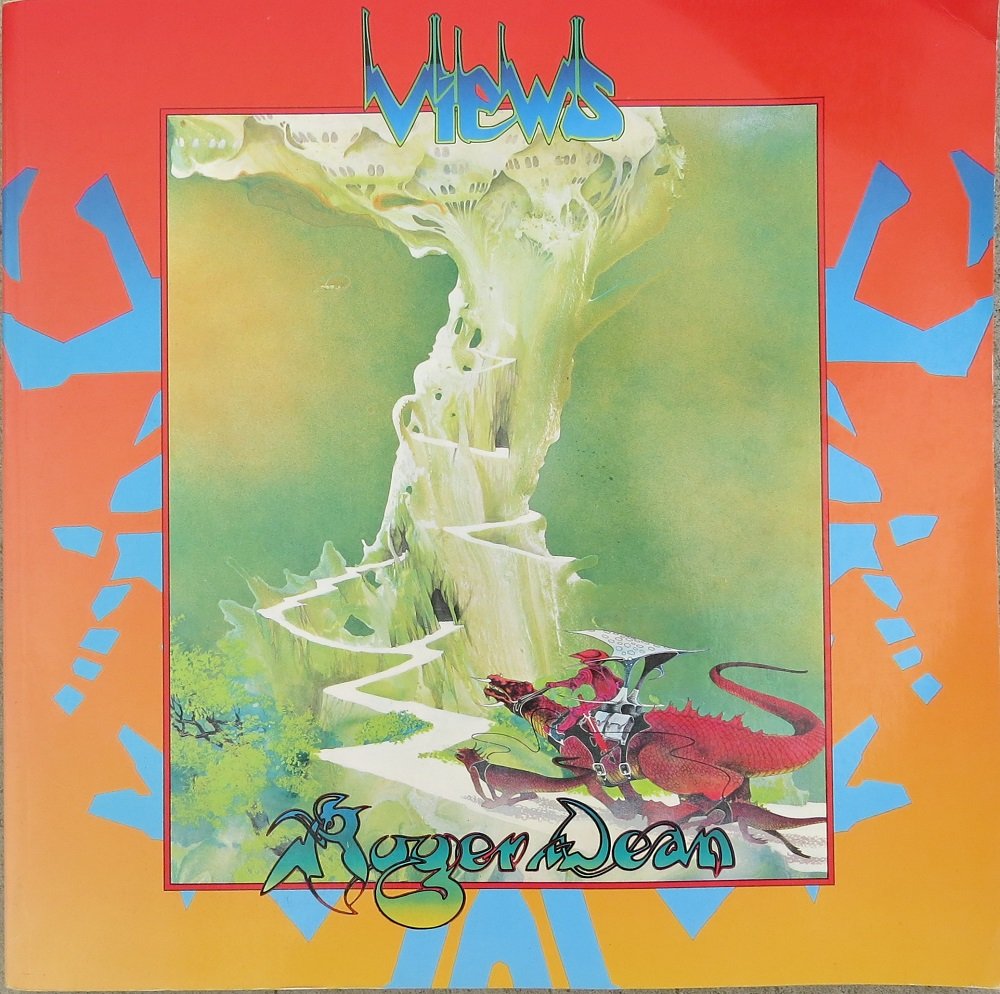
The first two volumes chronicling the unique art and design of Roger Dean met with huge critical and popular success. Views (1975) went straight to number one in the Sunday Times bestseller list and went on to sell over a million copies. Magnetic Storm (1984) sold over 650,000 copies. These new editions, reworked to accompany the publication of the third book in the trilogy, Dragon's Dream, showcase the instantly recognizable work of Roger Dean.
Views showcases the first seven years of Roger Dean's work after his graduation from the Royal College of Art in 1968. It includes paintings and graphics; branding such as the Yes typography and the first Virgin Records logo; groundbreaking stage sets; and album art including iconic early Yes covers such as the award-winning Tales From Topographic Oceans. The new edition streamlines the original square format and retains the combination of concept sketches and brilliantly displayed finished work. Featuring a new foreword, revised typography, and graphic openers and identifying icons, Views showcases and celebrates the art that defined an era.
An English artist, designer, architect, and publisher. He is best known for his work on posters and album covers for musicians, which he began painting in the late 1960s. The covers often feature exotic, fantasy landscapes. His work has sold more than sixty million copies world-wide, and his fantasy landscapes seem to have inspired those used in the film Avatar.
I've loved Roger Dean's artwork from the various Yes albums, and this book provides beautiful reproductions of his artwork from that period, along with insight into his ideas and work techniques.
No one who grew up listening to rock music in England in the 1970s can be ignorant of the work of Roger Dean. He is the artist responsible for a huge number of highly distinctive album cover and record label designs of the period, including those he created for bands as diverse and legendary as Osibisa, Yes, and Uriah Heep - as well as beautiful work for now-obscure outfits like Budgie and Badger - and for groundbreaking 'rebel' record companies Virgin and Vertigo. The version of this book which I have just revisited is the 1976 third edition, a large-format paperback which contains well-coloured, high-definition reproductions of most of Dean's major work in this area, plus preliminary sketches and some drawings and paintings from the artist's notebook which had never previously seen the light of public day. For that alone it would be worth consideration, if only as a splendid period-piece. But it is actually far more than that.
I suppose if I'd been put to summing up the style and 'genre' of Dean's art prior to reading the accompanying text, and before seeing some of the drawings and other renderings of his design and speculative architectural work, I would have said he was a 'fantasy' artist. This would be to do him a great discredit. Although much of the content of his album-cover work is indeed 'fantastic', in the sense of arising from a powerful juxtapositional and synaesthetic imagination, with a strong infusion of mythological and mystical imagery, he is very far removed from the 'Conan the Barbarian' school of pointy-breasted warrior-maidens molested by dragons. As Dean associate Donald Lehmkuhl points out in a brief introduction (which, I fear, verges at times on the kind of pretentious hyperbole typical of the era) the artist is too focused on the image and its potentialities to be carried away by fantasy, and although clearly informed by the psychedelic sensibility of the period, his pictures emerge from a solid sense of the real, albeit one which combines elements of diverse landscapes, environmental conditions, the organic and inorganic - all rendered with brilliant clarity and detail.
As a guide to Roger Dean's pre-1975 work, the text which accompanies the plates and illustrations is exemplary - well informed, concise, and close enough to its subject (the authors had all worked closely with Dean) to elucidate without overexplaining or fetishising it. There is a lovely story about how Dean's cats had marched across the final artwork for one of the images on Yes's "Yessongs" live album, leaving paw marks which the artist then attempted to disguise as clouds with an airbrush, not entirely successfully. I can confirm that if you look closely enough, Tiddles's signature is still quite visible, and I will never be able to look at that painting again without appreciating her contribution to a very substantial, though often sadly ignored body of 20th century art and design.
Dean's paintings are fascinating. Views details the development of his style from an art student to The Artist Who Painted the YES album covers. Some of the narration is esoteric, talking about Truth and Objectness, while others refer me to paintings 100 pages away from the text. You don't pick up a Roger Dean book for the writing, though. You read it for the amazing pictures. These are presented on 12"x12" panels. I borrowed this from a friend, and I may not give it back. ;)
A favourite of the band YES he was commissioned for many of the Albums. Fragile, Topographic Oceans, Close to the Edge and probably several others. I love the music, Rick Wakeman is a master of the Keyboards. I saw them live in Glasgow during the "Going for the One" tour. Roger is an endless source of inspiration for me.