

What do you think?
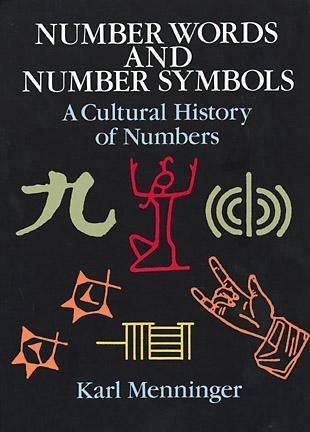
Number Words and Number Symbols: A Cultural History of Numbers
'The historian of mathematics will find much to interest him here . . . while the casual reader is likely to be intrigued by the author's superior narrative ability." — Library Journal
This book is not only a fascinating introduction to the concept of number and to numbers themselves, hut a multifaceted linguistic and historical analysis of how numbers have developed and evolved in many different cultures. Drawing on evidence from history, literature, philosophy and ethnology, noted German scholar Karl Menninger. recounts the development of numbers both as they are spoken (and written as words) and as symbolic abstract numerals that can he readily manipulated and combined.
Despite the immense erudition the author brings to the topic, he maintains a light tone throughout, presenting much of the information in anecdotal form. Moreover, almost 300 illustrations (photographs and drawings) and many comparative language tables serve to enhance the text. The author begins with a lucid treatment of number sequence and number language, including the formation of number words in both Indo-European and non-IndoEuropean languages, hidden number words and the evolution of the number sequence. He then turns to written numerals and finger counting, folk symbols for numbers, alphabetical numerals, the "German" Roman numerals, the abacus and more. The final section concerns the development of our modem decimal system, with its place notation and zero, based on the Indian number system, and its introduction to the West through the work of the Italian mathematician Fibonacci. The author concludes with a review of spoken numbers and number symbols in China and Japan.
"The book is especially good on early counting and calculating primitive tally sticks, the knotted cords of ancient Peru, the elaborate finger symbols once used for numbers, counting boards with movable counters, and of course the abacus." — Martin Gardner, Book World
This book is not only a fascinating introduction to the concept of number and to numbers themselves, hut a multifaceted linguistic and historical analysis of how numbers have developed and evolved in many different cultures. Drawing on evidence from history, literature, philosophy and ethnology, noted German scholar Karl Menninger. recounts the development of numbers both as they are spoken (and written as words) and as symbolic abstract numerals that can he readily manipulated and combined.
Despite the immense erudition the author brings to the topic, he maintains a light tone throughout, presenting much of the information in anecdotal form. Moreover, almost 300 illustrations (photographs and drawings) and many comparative language tables serve to enhance the text. The author begins with a lucid treatment of number sequence and number language, including the formation of number words in both Indo-European and non-IndoEuropean languages, hidden number words and the evolution of the number sequence. He then turns to written numerals and finger counting, folk symbols for numbers, alphabetical numerals, the "German" Roman numerals, the abacus and more. The final section concerns the development of our modem decimal system, with its place notation and zero, based on the Indian number system, and its introduction to the West through the work of the Italian mathematician Fibonacci. The author concludes with a review of spoken numbers and number symbols in China and Japan.
"The book is especially good on early counting and calculating primitive tally sticks, the knotted cords of ancient Peru, the elaborate finger symbols once used for numbers, counting boards with movable counters, and of course the abacus." — Martin Gardner, Book World
510 pages, Paperback
First published September 15, 1958
About the author
Karl A. Menninger
83 books53 followersKarl Augustus Menninger (July 22, 1893 – July 18, 1990) was an American psychiatrist and a member of the Menninger family of psychiatrists who founded the Menninger Foundation and the Menninger Clinic in Topeka, Kansas.
Ratings & Reviews
Friends & Following
Create a free account to discover what your friends think of this book!
Community Reviews
Displaying 1 - 4 of 4 reviews
April 14, 2017
If you're one of those people suffering from apophenia, who delight in finding patterns in things, especially numbers, than this volume, latter-day (and wackily sympathetic) kabbalists and numerologists, you'd probably love this book.
Conversely, lovers of more precise--I hesitate to use the word 'real', but, fuck it--'real' sciences, like math and linguistics, will also love this book.
For me, a layman, or, ahem, layperson it was tangentially interesting in both the latter senses. Math-wise, you get an immense and obsessive, almost fanatical, exploration of the inherent logic of numbers, where numbers came from, how we think of numbers, ways of counting--all sorts of weird stuff you'd never considered about a basic fundament of our lives. Language-wise, you get even more fanatical delvings-into of cognates, word origin, word sense, 'hidden' numbers, and all that.
A little too detailed for my tastes to the point of drudgery, but in an overall sense, satisfying in the way that the Cliff Notes to 'Finnegan's Wake' might be, with the same, muted sense of achievement.
Conversely, lovers of more precise--I hesitate to use the word 'real', but, fuck it--'real' sciences, like math and linguistics, will also love this book.
For me, a layman, or, ahem, layperson it was tangentially interesting in both the latter senses. Math-wise, you get an immense and obsessive, almost fanatical, exploration of the inherent logic of numbers, where numbers came from, how we think of numbers, ways of counting--all sorts of weird stuff you'd never considered about a basic fundament of our lives. Language-wise, you get even more fanatical delvings-into of cognates, word origin, word sense, 'hidden' numbers, and all that.
A little too detailed for my tastes to the point of drudgery, but in an overall sense, satisfying in the way that the Cliff Notes to 'Finnegan's Wake' might be, with the same, muted sense of achievement.

July 29, 2019
Karl Menninger seemed like a very interesting person to me, based on him being mentioned in Joan Didion's Blue Nights, except it wasn't for this book, it was for Man Against Himself. Nonetheless, what interested me was the big difference in topic since this book is about Numbers/Counting and the latter about Self-Mutilation/Suicide.
Well, being someone who deals with numbers at home and at work, I sort of was drawn to this textbook for that reason too. You learn a lot about how as a species we developed numbers from having the need to count and record things, all the way to how we symbolized those recordings for easy interpretations and how we derived words and meaning for those numbers/symbols.
He goes through the history of both the west and the east, but its mostly focused on the west and middle east- with Romans, Vikings, Greek, etc... to Arabs, before he gives a glimpse into China and Asia in general. The dive into language formation was super informative, and you learn A LOT about language and how language came to form alongside how numbers came to form. Without being able to properly count or symbolize numbers, we wouldn't be where we are today - as a species, we wouldn't even be able to think the way we now do by default. We owe so much for all the transfer learning set upon us by our ancestors when it came to this.
I think one thing I really wanted to learn was more about the myths behind certain numbers, like the number 13 or 7. There were some unexplored topics there I would have loved for more information on.
Read this if you really love numbers, language, are naturally curious about how we developed those things, and want to better understand how we came to the state we are in today in terms of the culture of numbers, counting numbers and symbolizing numbers.
See my full review here
See all my reviews here
Well, being someone who deals with numbers at home and at work, I sort of was drawn to this textbook for that reason too. You learn a lot about how as a species we developed numbers from having the need to count and record things, all the way to how we symbolized those recordings for easy interpretations and how we derived words and meaning for those numbers/symbols.
He goes through the history of both the west and the east, but its mostly focused on the west and middle east- with Romans, Vikings, Greek, etc... to Arabs, before he gives a glimpse into China and Asia in general. The dive into language formation was super informative, and you learn A LOT about language and how language came to form alongside how numbers came to form. Without being able to properly count or symbolize numbers, we wouldn't be where we are today - as a species, we wouldn't even be able to think the way we now do by default. We owe so much for all the transfer learning set upon us by our ancestors when it came to this.
I think one thing I really wanted to learn was more about the myths behind certain numbers, like the number 13 or 7. There were some unexplored topics there I would have loved for more information on.
Read this if you really love numbers, language, are naturally curious about how we developed those things, and want to better understand how we came to the state we are in today in terms of the culture of numbers, counting numbers and symbolizing numbers.
See my full review here
See all my reviews here

August 31, 2018
An excellent book if your interested in numbers or etymology.

August 29, 2016
By having read this book, I know, for instance, how some Chinese words are written, where some of common Dutch proverbs come from, how to bugger my friends with riddles they will most likely never be able to solve. Not to mention it can teach you to count in every significant language, both dead and alive. Number Words and Number Symbols can be a dense read at times, but it is a veritable treasure box of knowledge.
Displaying 1 - 4 of 4 reviews