

What do you think?

The Poetic Edda Volume II Mythological Poems Edited and translated with introduction and commentary by The late Ursula Dronke
This volume presents a wholly new edition of five of the most brilliant and celebrated poems of the Poetic Edda: 'The Sibyl's Prophecy', 'The Rigmarole of Rigr', 'Wayland's Poem', 'Skirnir's Lay', and 'Loki's Quarrel'. New textual readings and interpretations are established. New light is shed on the Franks Casket and on King Alfred's interest in Wayland; new links are found between the Viking and Christian worlds. A close translation accompanies the text to give the non-specialist reader a transparent and rhythmic sense of the original. For each poem the sequence of ideas is traced in the introduction and the interpretation substantiated by a detailed commentary. Much consideration is given to the themes of the poems and the ancient ideas in which they are rooted: analogues come from many sources - Irish, Anglo-Saxon, Sanskrit, African, and Finnish. The excellence and variety of the poems give a rare insight into the genius of oral poets of the Viking age.
Readership: Students and scholars of Old Norse and Old English literature; early medieval history and medieval German literature; Anglo-Saxon and Viking historians and archaeologists; and comparativists in mythology and religion.
Readership: Students and scholars of Old Norse and Old English literature; early medieval history and medieval German literature; Anglo-Saxon and Viking historians and archaeologists; and comparativists in mythology and religion.
458 pages, Hardcover
First published January 1, 1969
Ratings & Reviews
Friends & Following
Create a free account to discover what your friends think of this book!
Community Reviews
Displaying 1 - 30 of 46 reviews

June 20, 2015
It feels undoubtedly strange to review this book. In a manner of speaking, like e.g. rating the Bible; the book had (and still has) such an enormous impact on the Western history and culture that rating it feels utterly wrong.
It is somewhat similar with the Edda. Its influence in literature cannot be put into proper words.
However, the Edda is not a smooth read. In the translation of Bellows one can more often than not encounter archaic words or sentence structures that are unusual not only in English but generally since epic poetry has a unique style one finds nowhere else.
Firstly, one has to get used to it. Secondly, it is necessary to pay attention to the footnotes and process what is said due to the complicated language. Thirdly, it takes time. A lot of it actually, despite the fact that this book is comparatively short.
I still loved it though. From the very first page and until the very last. And after my class where we compared several translations I also feel obliged to note that Bellows translation is among the best in its precision and beauty of language. Several recent translations lack the same charm and attention when it comes to minor details of the poems, so a recommendation - if you want a beautiful and more precise translation of the Poetic Edda read Bellows.
It starts off with the prophecy of the Vǫluspá who talks about the creation of the world, the world-ash Yggdrasil, the fate of the Gods, Ragnarök and the creation of a new, better world.
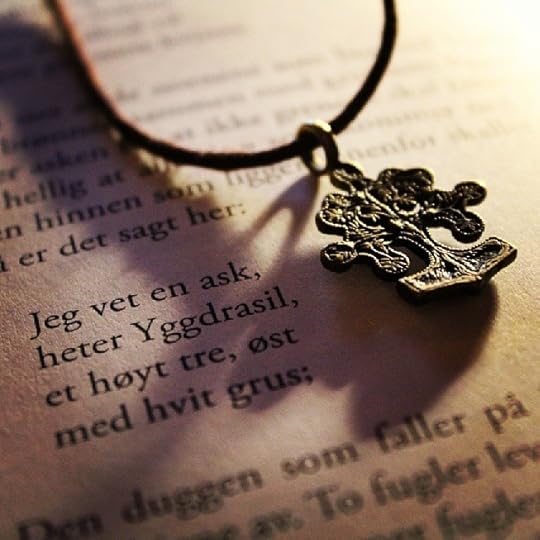
The Vǫluspá was also one of my personal favourites. Plenty of myths, names, descriptions of the nine worlds that the ash Yggdrasil harbours and in the end a rather epic battle with all kinds of gods and monsters.
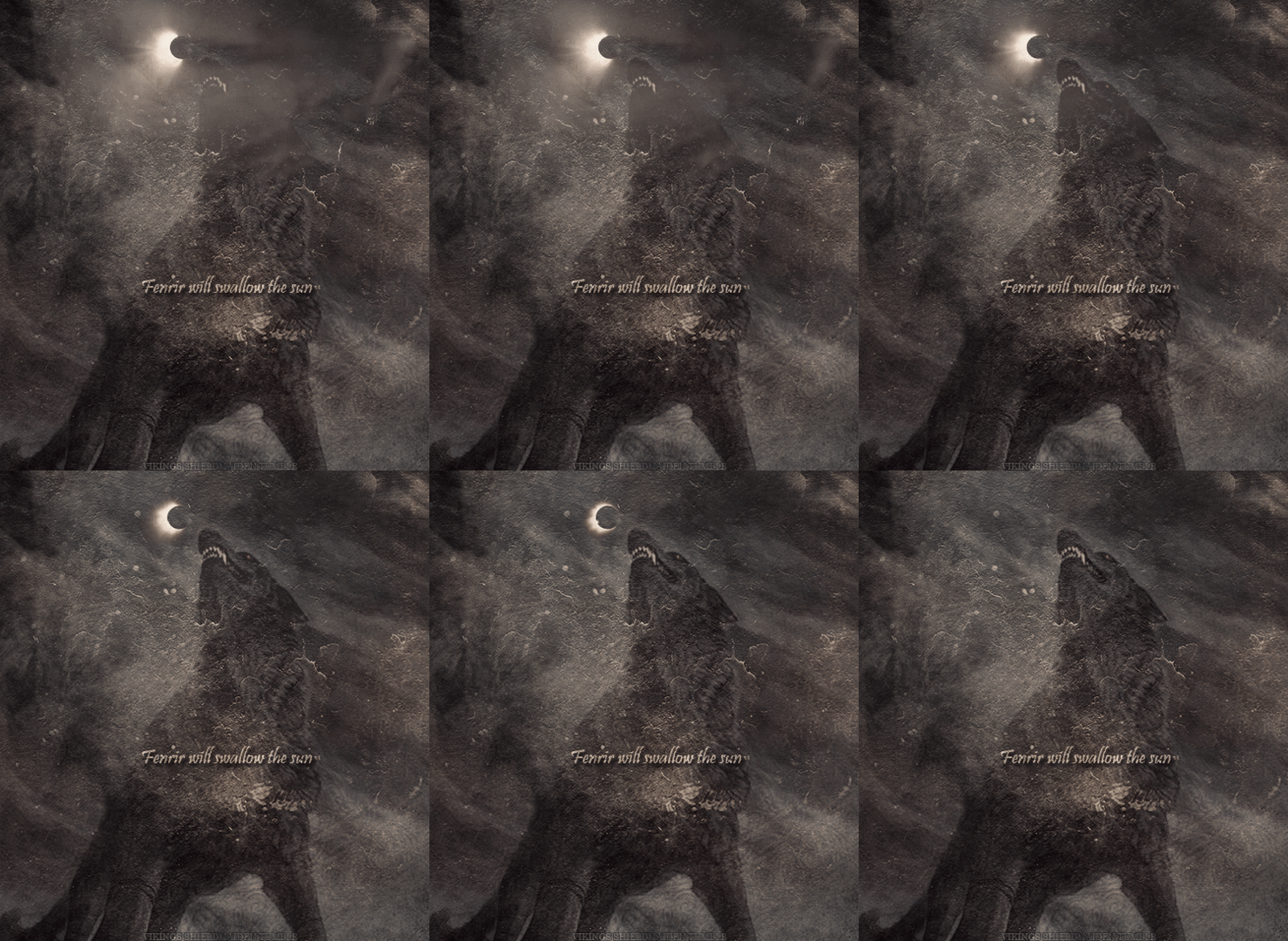
Right after it comes another favourite of mine - Hávamál. A collection of proverbs and wise counsels from Odin. Advices how to live properly, how to aquire wisdom and how e.g. not to act around those who are superior. Actually, this one genuinely provides a lot of useful advices, even for present day people, perhaps because fundamental truths about codes of behaviour never change regardless whether you live in the 12th century or the 21st.
It is simultaneously one of the most puzzling poems of the Poetic Edda and exists in no other manuscript but the infamous Codex Regius.
Okay, sorry, this is a lot of random trivia. Fact is - it is beautiful, useful, and interesting both from the cultural, mythological and literary points of view.
I will not dive into detail about every poem this translation contains but instead mention one more. The Lokasenna.
Basically an exchange of insults between Loki and the other gods and goddesses whose attemps to talk back are rather ineffective. It's hilarious, simply hilarious, okay? Loki has something to say about everyone and what he says is far from flattering, a lot of funny and embarrassing stories of the gods come up and they, of course, get royally pissed off about it.
Of course the Poetic Edda is also interesting to look at from the POV of - how much did Christianity actually influence the poems and myths of the Norse people? What motifs are reoccurring and why? Where can parallels be found and so on and so forth.
The Edda is in every sense a piece of literature worth reading, especially for those who adore Tolkien's works and Epic Fantasy since there are plenty of motifs and occurances taken from the old Norse myths.
Highly recommended.
It is somewhat similar with the Edda. Its influence in literature cannot be put into proper words.
However, the Edda is not a smooth read. In the translation of Bellows one can more often than not encounter archaic words or sentence structures that are unusual not only in English but generally since epic poetry has a unique style one finds nowhere else.
Firstly, one has to get used to it. Secondly, it is necessary to pay attention to the footnotes and process what is said due to the complicated language. Thirdly, it takes time. A lot of it actually, despite the fact that this book is comparatively short.
I still loved it though. From the very first page and until the very last. And after my class where we compared several translations I also feel obliged to note that Bellows translation is among the best in its precision and beauty of language. Several recent translations lack the same charm and attention when it comes to minor details of the poems, so a recommendation - if you want a beautiful and more precise translation of the Poetic Edda read Bellows.
It starts off with the prophecy of the Vǫluspá who talks about the creation of the world, the world-ash Yggdrasil, the fate of the Gods, Ragnarök and the creation of a new, better world.
The Vǫluspá was also one of my personal favourites. Plenty of myths, names, descriptions of the nine worlds that the ash Yggdrasil harbours and in the end a rather epic battle with all kinds of gods and monsters.
Right after it comes another favourite of mine - Hávamál. A collection of proverbs and wise counsels from Odin. Advices how to live properly, how to aquire wisdom and how e.g. not to act around those who are superior. Actually, this one genuinely provides a lot of useful advices, even for present day people, perhaps because fundamental truths about codes of behaviour never change regardless whether you live in the 12th century or the 21st.
It is simultaneously one of the most puzzling poems of the Poetic Edda and exists in no other manuscript but the infamous Codex Regius.
Okay, sorry, this is a lot of random trivia. Fact is - it is beautiful, useful, and interesting both from the cultural, mythological and literary points of view.
I will not dive into detail about every poem this translation contains but instead mention one more. The Lokasenna.
Basically an exchange of insults between Loki and the other gods and goddesses whose attemps to talk back are rather ineffective. It's hilarious, simply hilarious, okay? Loki has something to say about everyone and what he says is far from flattering, a lot of funny and embarrassing stories of the gods come up and they, of course, get royally pissed off about it.
Of course the Poetic Edda is also interesting to look at from the POV of - how much did Christianity actually influence the poems and myths of the Norse people? What motifs are reoccurring and why? Where can parallels be found and so on and so forth.
The Edda is in every sense a piece of literature worth reading, especially for those who adore Tolkien's works and Epic Fantasy since there are plenty of motifs and occurances taken from the old Norse myths.
Highly recommended.

October 23, 2020
The second half of the 20th Century has seen a rise in popularity of Norse mythology through various pop culture entities even though the number of sources were few and knowledge of them not widespread. The Poetic Edda: The Mythological Poems is half of a collection of anonymously written poems arranged soon after the Christianization of Scandinavia that focuses on the Norse pantheon and translated in the early 20th Century by Henry Adam Bellows.
The mythological poems range from the creation of the world to the twilight of the gods to everything in between about the Norse gods most notably Odin, Thor, and Loki. The opening poem “Voluspo” gives a timeline of Norse cosmology that many with barely a hint of Norse beliefs will guess. The cosmology of the Norse was further expounded in “Vafthruthnismol”, “Grimnismol”, and “Alvissmol” through various devices. One of the surprising poems is how much Thor is made fun of by everyone via insult like in “Harbarthsljoth” or put in hilarious situations like in “Thyrmskvitha” which features Thor in drag before getting his revenge, though Thor isn’t a complete fool as will be found in the aforementioned “Alvissmol”. Loki is one of the prime characters in “Thyrmskvitha” and “Lokasenna” though he plays a significant part at the end of the Norse cosmology with himself and his children.
Unfortunately, how much Christianization creeped into these poems by the time they were written down or changed as they were written down is unknown and thus 100% authenticity is not known. Bellows’ translation reads very well, and his footnotes are excellent, the only thing that a 21st Century reader might have an issue with is that instead of spelling Odin as we do now Bellows spells it Othin and there are other words where it seems this is the case as well.
Overall, this is a fantastic translated collection of mythological poems that gives the reader a very good overview of Norse cosmology.
The mythological poems range from the creation of the world to the twilight of the gods to everything in between about the Norse gods most notably Odin, Thor, and Loki. The opening poem “Voluspo” gives a timeline of Norse cosmology that many with barely a hint of Norse beliefs will guess. The cosmology of the Norse was further expounded in “Vafthruthnismol”, “Grimnismol”, and “Alvissmol” through various devices. One of the surprising poems is how much Thor is made fun of by everyone via insult like in “Harbarthsljoth” or put in hilarious situations like in “Thyrmskvitha” which features Thor in drag before getting his revenge, though Thor isn’t a complete fool as will be found in the aforementioned “Alvissmol”. Loki is one of the prime characters in “Thyrmskvitha” and “Lokasenna” though he plays a significant part at the end of the Norse cosmology with himself and his children.
Unfortunately, how much Christianization creeped into these poems by the time they were written down or changed as they were written down is unknown and thus 100% authenticity is not known. Bellows’ translation reads very well, and his footnotes are excellent, the only thing that a 21st Century reader might have an issue with is that instead of spelling Odin as we do now Bellows spells it Othin and there are other words where it seems this is the case as well.
Overall, this is a fantastic translated collection of mythological poems that gives the reader a very good overview of Norse cosmology.

June 2, 2011
Let me disclaim: I have not read this cover-to-cover, because frankly the long poems which are basically lists of names are pretty boring. But there are some seriously choice stories in here, if you're willing to flip through all of it to find the awesomest ones. Aweseomest is now a word, don't argue with me.
The Lokasenna is definitely my favourite -- basically it's a story about Loki, who attends a feast with the gods and gets thrown out for killing a servant. He comes back to tell them all that he thinks very lowly of them, in much graphic detail. He's in the middle of telling Sif that she's a hussy 'cause she slept with him, when her husband arrives and he finally decides he shouldn't be badmouthing Thor's girl.
And while it's supposed to be a result of (and punishment for) his arranging the death of Baldr, I like the idea that when the gods chain him up in a cave with his son's intestines, it's actually because of his smack talking. Them's fightin' words and all that.
So, yes! I have given this four stars not because it is four stars over all, but because if you trawl through and find the really entertaining stories, they're awesome. Go forth and read!
The Lokasenna is definitely my favourite -- basically it's a story about Loki, who attends a feast with the gods and gets thrown out for killing a servant. He comes back to tell them all that he thinks very lowly of them, in much graphic detail. He's in the middle of telling Sif that she's a hussy 'cause she slept with him, when her husband arrives and he finally decides he shouldn't be badmouthing Thor's girl.
And while it's supposed to be a result of (and punishment for) his arranging the death of Baldr, I like the idea that when the gods chain him up in a cave with his son's intestines, it's actually because of his smack talking. Them's fightin' words and all that.
So, yes! I have given this four stars not because it is four stars over all, but because if you trawl through and find the really entertaining stories, they're awesome. Go forth and read!

October 29, 2012
Before reading Bellows' translation of The Poetic Edda: The Mythological Poems, most of my (poor) knowlegde of Norse mythology originated, more or less, from sources like Wikipedia.
Prose Edda or maybe even a moderen day retelling of Norse myths might had been a better choice as an introduction to the topic (recomented by both people and common sense), but screw it, I wanted to read the original poems before I changed my mind.
Totally worth it.
Sure, it was hard to get into and I often had to put it down, but while reading it I found myself, despite the fact that some poems have been preserved only in very poor shape and that the others are not missing on their share of interpolations and gaps, honestly enjoying it.
Everything - Odin (Othin in this translation) pretending to be someone else most of the time, Thor calling other gods "unmanly" (Loki) and "womanish" (his father Odin in disguise), somehow self-contradicting world view of the Vikings, everpresent vision of the end, ..., and hey, even lists of names and events were not that horrible.
Although Norse mythology is not as easily accessible as Greek and the myths are not always preserved enough to be comprehensive, it definitely deserves a chance from any mythology-lover.
Prose Edda or maybe even a moderen day retelling of Norse myths might had been a better choice as an introduction to the topic (recomented by both people and common sense), but screw it, I wanted to read the original poems before I changed my mind.
Totally worth it.
Sure, it was hard to get into and I often had to put it down, but while reading it I found myself, despite the fact that some poems have been preserved only in very poor shape and that the others are not missing on their share of interpolations and gaps, honestly enjoying it.
Everything - Odin (Othin in this translation) pretending to be someone else most of the time, Thor calling other gods "unmanly" (Loki) and "womanish" (his father Odin in disguise), somehow self-contradicting world view of the Vikings, everpresent vision of the end, ..., and hey, even lists of names and events were not that horrible.
Although Norse mythology is not as easily accessible as Greek and the myths are not always preserved enough to be comprehensive, it definitely deserves a chance from any mythology-lover.

May 1, 2020
The Indigenous Germanic tribes passed down these myths through oral storytelling tradition, and I suppose they could be around ten thousand years, old if not older. The origin of them is very complex and shrouded in mystery.
These stories are funny, weird, fascinating, and deeply moving-and were not just stories to these people but their religion and understanding of the world, which is very important to remember.
My favorite version of these myths is Neil Gaiman's Norse Mythology, but another version worth reading, is Henry Adams Bellows translation.
As I was reading through this fascinating and amazing book, I found the virtues of courage, faith and hope, welling up within me, and, like C.S.Lewis, I experienced the sehnsucht joy which led him to Christ, numerous times- that transcendent longing roused by the beauty and glory of nature, music, literature, art, and love. I highly recommend this book.
"If I find in myself a desire which no experience in this world can satisfy, the most probable explanation is that I was made for another world." C.S.Lewis
These stories are funny, weird, fascinating, and deeply moving-and were not just stories to these people but their religion and understanding of the world, which is very important to remember.
My favorite version of these myths is Neil Gaiman's Norse Mythology, but another version worth reading, is Henry Adams Bellows translation.
As I was reading through this fascinating and amazing book, I found the virtues of courage, faith and hope, welling up within me, and, like C.S.Lewis, I experienced the sehnsucht joy which led him to Christ, numerous times- that transcendent longing roused by the beauty and glory of nature, music, literature, art, and love. I highly recommend this book.
"If I find in myself a desire which no experience in this world can satisfy, the most probable explanation is that I was made for another world." C.S.Lewis
April 28, 2022
Really interesting to read. Not sure the translation was perfect, but the links to Tolkien and other writers was fascinating, as was the huge culture shift from then to now.
November 20, 2025
No vienas puses, ļoti bieži garlaikojos un neko nesapratu, jo dzejoļu auditorijai, atšķirībā no manis, jau bija priekšzināšanas par šiem tēliem, kosmoloģiju un stāstiem. No otras puses, esmu tik ientriģēts, ka uzreiz sākšu lasīt Jaunāko Edu (ar kuru labāk vajadzēja sākt).
Nezināju, ka visa tā Zigfrīda un Nībelungu padarīšana aizceļoja no Vācijas uz Skandināviju. Likās, ka tās ir divas dažādas mitoloģijas.
Nezināju, ka visa tā Zigfrīda un Nībelungu padarīšana aizceļoja no Vācijas uz Skandināviju. Likās, ka tās ir divas dažādas mitoloģijas.

August 25, 2011
It's weird to give a star rating to this. In mythological and cultural terms it's like rating The Bible. But hey, despite whatever my personal experiences and thoughts with Christianity, I'd give that 5 stars too.
So yes, 5 stars for cultural relevance, posterity and overall influence.
A must read for any fan of JRR Tolkien, and indeed any high fantasy.
Don't expect to sit back and relax your way through these poems though - most of them don't make a lick of sense to our modern reading practices without some careful picking through. Worth it though.
So yes, 5 stars for cultural relevance, posterity and overall influence.
A must read for any fan of JRR Tolkien, and indeed any high fantasy.
Don't expect to sit back and relax your way through these poems though - most of them don't make a lick of sense to our modern reading practices without some careful picking through. Worth it though.

November 19, 2020
This book is the first half of the Poetic Edda, the “Lays of the Gods”, or, the Mythological Poems. I’ve been looking forward to reading this and the other half, “the Lays of the Heroes”, or the Heroic Poems, for years. I’m on this mind-melting kick right now, having just read the Nibelungenlied and following that with a reread of the Volsungasaga. The Poetic Edda obviously had to be the next stop.
The translation and notes were written by Henry Adams Bellows and are outstanding. The translation is excellent, marvelously preserving the meter and meaning and styles of the original Eddic poems, and the notes and introductions are top notch. There’s a general introduction to the Edda as a whole, which gives a great history of its discovery, its academic and literary and cultural study and significance, what is and isn’t known about its potential authors, discussions of Snorri’s later Prose Edda, and some fascinating examinations of the poetry style and translation decisions.
It also includes a great analysis of the rhythms and meters most of the poems take, like the Fornyrthislag (Old verse), Ljothahattr (Song Measure), and Malahattr (Speech Measure). But each poem also has its own introduction by Bellows, along with plentiful notes on almost every stanza, making this basically two books in one. I’d guess this is why this printing of the Poetic Edda is split into two volumes; together they are over 600 pages. The notes provide a wealth of valuable insights to each poem that should be read in full.
There are fourteen poems in this first half, all dealing with the Norse gods or their activities or significant events in the lore and mythology. The poems are spectacular for many reasons. Their subject matter is incredibly intriguing, which goes without saying.
Voluspo, for example, details many of the most important elements of the Norse mythology history, like the creation of the world, and its end, and what conflicts will happen between the gods and what fates will befall the gods.
The Grimnismol is similar in its encyclopedic scope, but also telling a story of Odin/Othin, in disguise, being tied up and tortured by a king whose son is Othin’s only friend.
Hovamol is a sort of poetic collection of proverbs and philosophies and wisdom and ruminations on charms and runes.
Many are in the form of dialogues, or ballads, like Vafthruthnismol, in which Odin goes disguised (which is how he always goes anywhere) to learn wisdom from a dragon, or Skirnismol, in which Freyr sends his servant Skirnir to win him the giant Gerth’s hand in marriage, or Lokasenna, where Loki gets kicked out of a hall of revelry and merry-making by the gods, and returns only to mock them and ridicule them, ending with his being strung up by his son’s entrails, and tied under snake who slowly drips venom on him.
But as I was saying, they are spectacular not only for their content and varied subject matter, but for their style, their epic meter, their musicality, their humor, their lively, dramatic, fantastical storytelling, their esoteric nature, their histories, their cataloguing of ancient cultural beliefs and myths and figures of legend, and as poetry they have many layers to consider apart from all this. It’s enchanting, that’s right, enchanting, to see ancient poetic forms of communicating larger than life myths, capturing the boundless essence of these ideas and stories that in many cases prose just cannot recreate, at least not in such an economical and elegant way.
The analysis of the poems and the clues that guide scholars in figuring out where and when each poem was likely written are such a pleasure to read. I found myself going down multiple rabbit holes based on the interesting bits in the notes.
This is truly a landmark in world literature, and it is easy to see why this is one of the most important sources of our understanding of Norse and Germanic mythology. It is now time for me to complete the Poetic Edda — on to the Heroic Poems.
The translation and notes were written by Henry Adams Bellows and are outstanding. The translation is excellent, marvelously preserving the meter and meaning and styles of the original Eddic poems, and the notes and introductions are top notch. There’s a general introduction to the Edda as a whole, which gives a great history of its discovery, its academic and literary and cultural study and significance, what is and isn’t known about its potential authors, discussions of Snorri’s later Prose Edda, and some fascinating examinations of the poetry style and translation decisions.
It also includes a great analysis of the rhythms and meters most of the poems take, like the Fornyrthislag (Old verse), Ljothahattr (Song Measure), and Malahattr (Speech Measure). But each poem also has its own introduction by Bellows, along with plentiful notes on almost every stanza, making this basically two books in one. I’d guess this is why this printing of the Poetic Edda is split into two volumes; together they are over 600 pages. The notes provide a wealth of valuable insights to each poem that should be read in full.
There are fourteen poems in this first half, all dealing with the Norse gods or their activities or significant events in the lore and mythology. The poems are spectacular for many reasons. Their subject matter is incredibly intriguing, which goes without saying.
Voluspo, for example, details many of the most important elements of the Norse mythology history, like the creation of the world, and its end, and what conflicts will happen between the gods and what fates will befall the gods.
The Grimnismol is similar in its encyclopedic scope, but also telling a story of Odin/Othin, in disguise, being tied up and tortured by a king whose son is Othin’s only friend.
Hovamol is a sort of poetic collection of proverbs and philosophies and wisdom and ruminations on charms and runes.
Many are in the form of dialogues, or ballads, like Vafthruthnismol, in which Odin goes disguised (which is how he always goes anywhere) to learn wisdom from a dragon, or Skirnismol, in which Freyr sends his servant Skirnir to win him the giant Gerth’s hand in marriage, or Lokasenna, where Loki gets kicked out of a hall of revelry and merry-making by the gods, and returns only to mock them and ridicule them, ending with his being strung up by his son’s entrails, and tied under snake who slowly drips venom on him.
But as I was saying, they are spectacular not only for their content and varied subject matter, but for their style, their epic meter, their musicality, their humor, their lively, dramatic, fantastical storytelling, their esoteric nature, their histories, their cataloguing of ancient cultural beliefs and myths and figures of legend, and as poetry they have many layers to consider apart from all this. It’s enchanting, that’s right, enchanting, to see ancient poetic forms of communicating larger than life myths, capturing the boundless essence of these ideas and stories that in many cases prose just cannot recreate, at least not in such an economical and elegant way.
The analysis of the poems and the clues that guide scholars in figuring out where and when each poem was likely written are such a pleasure to read. I found myself going down multiple rabbit holes based on the interesting bits in the notes.
This is truly a landmark in world literature, and it is easy to see why this is one of the most important sources of our understanding of Norse and Germanic mythology. It is now time for me to complete the Poetic Edda — on to the Heroic Poems.

November 23, 2019
Good. Not as poetic as I expected, but, according to the commentary, it's been difficult to translate the meter of the Norse poetry.

August 8, 2015
How does one rate a collection of stories that were sung or told by word of mouth in the 7th-12th century Scandinavia? This text has influenced culture and Pagans. This text also displays the clash between Paganism and Christianity. One can also see the influence it had on Snorri Sturluson. As well as Anglo-Saxon literature.
Word of caution: The Poetic Edda is not an easy read. It is full of lengthy footnotes. The Poetic Edda is the precursor to Snorri's Edda. If one doesn't know anything about Norse mythology then perhaps starting with an easier version would be better. The introduction discusses spelling, pronunciation, spacing, what the Edda is, and locations where these stories developed.
Below is a summary of each story included in The Poetic Edda:
Voluspo
Odin is disguised as a traveler and meets a volva. A volva is a witch/wise woman/oracle. She is a giant and knows the man is Odin. She informs Odin that Asgard will fall. Typical apocalypse story. Basically it's Ragnarok with a creation story in the beginning and then destruction and chaos.
Hovamol
Odin's failure to romance a giant's daughter thereby making him temporarily bitter toward females. Even though Odin was trying to trick said giant in order to steal the mead of poetry. In addition this story is how Odin gained the knowledge of the runes.
Vafthruthnismol
Odin decides to eliminate an intellectual competitor so that he can be the only omniscient being. He challenges a giant to a mental battle. This giant is the only threat Frigga knows can destroy Odin. Odin pretends to be a human therefore misleading the giant into believing that defeating him will be an easy victory. This is also another creation story with a battle of wits.
Grimnismol
Odin and Frigga are bored and spy on Midgard. Odin wagers that he has more followers than his wife. Frigga decides to take her husband's challenge and wins.
Skirnismol
Freyr is infatuated with a fire giant's daughter. He becomes so depressed that all of Vanaheim begins to degrade and rot. His servant Skirnir decides to woo Gerda in order to bring order back to Vanaheim. Skirnir asks for Freyr's sword and his stealth so he can not be detected in Jotunheim. Skirnir threatens to decapitate Gerda with Freyr's weapon if she doesn't come with him. Ensuring that Gerda will have no choice, but to come with Skirnir to Vanaheim. Hmmm... This seems vaguely familiar. Where have I seen this before? A stubborn, young man willing to please his elder on a mission? Decapitating women. It's Gawain! Or to be more precise,this story influenced Gawain and his stories.
Harbarthsljoth
Thor is on a long journey at sea. He is vexed by the ferryman. An impatient Thor battles the ferryman. The ferryman is actually Odin disguised as a human in order to teach Thor patience and humility. Odin is a troll. And they say Loki is the trickster.
Hymiskvitha
Thor goes fishing. I'm not kidding. This is basically it.
Lokasenna
Loki isn't invited to a wedding on Asgard, he crashes it anyway. Hilarity ensues. Loki discusses the hypocrisy of all the other Deities and they kick him out for speaking the truth.
Thryskvitha
Thor's hammer is stolen by a dwarf. As ransom the dwarf demands the sun, the moon, and Freya. Loki helps Thor get his hammer back. Cross-dressing and gender bending occurs. Who needs social constructs when you're a God?
Alvissmol
Another horny dwarf who wants a goddess. This time it's Sif and Thor's daughter. Thor refuses to give his daughter away. Thor challenges the dwarf to a philosophical debate. Sunlight kills dwarfs. Thor feels bad that the dwarf will die in the morning because he's enjoying the conversation and company.
Baldrs Draumar
Baldr dreams his death numerous times. Frigga scared for her son's safety asks her husband to prevent it. Odin travels to Helheim disguised as a human in order to talk to the Volva. Once again Ragnarok is discussed.
Rigsthula
Establishment of human classes in Midgard.
Hyndluljoth
Freya brags to a giantess about how fantastic her human lover is.
Svipdagsmol
Search for the maiden in the circle of fire. Find the girl. Marry said girl. Svipdagsmol is the premise for Siegfried/Sigurd.
Word of caution: The Poetic Edda is not an easy read. It is full of lengthy footnotes. The Poetic Edda is the precursor to Snorri's Edda. If one doesn't know anything about Norse mythology then perhaps starting with an easier version would be better. The introduction discusses spelling, pronunciation, spacing, what the Edda is, and locations where these stories developed.
Below is a summary of each story included in The Poetic Edda:
Voluspo
Odin is disguised as a traveler and meets a volva. A volva is a witch/wise woman/oracle. She is a giant and knows the man is Odin. She informs Odin that Asgard will fall. Typical apocalypse story. Basically it's Ragnarok with a creation story in the beginning and then destruction and chaos.
Hovamol
Odin's failure to romance a giant's daughter thereby making him temporarily bitter toward females. Even though Odin was trying to trick said giant in order to steal the mead of poetry. In addition this story is how Odin gained the knowledge of the runes.
Vafthruthnismol
Odin decides to eliminate an intellectual competitor so that he can be the only omniscient being. He challenges a giant to a mental battle. This giant is the only threat Frigga knows can destroy Odin. Odin pretends to be a human therefore misleading the giant into believing that defeating him will be an easy victory. This is also another creation story with a battle of wits.
Grimnismol
Odin and Frigga are bored and spy on Midgard. Odin wagers that he has more followers than his wife. Frigga decides to take her husband's challenge and wins.
Skirnismol
Freyr is infatuated with a fire giant's daughter. He becomes so depressed that all of Vanaheim begins to degrade and rot. His servant Skirnir decides to woo Gerda in order to bring order back to Vanaheim. Skirnir asks for Freyr's sword and his stealth so he can not be detected in Jotunheim. Skirnir threatens to decapitate Gerda with Freyr's weapon if she doesn't come with him. Ensuring that Gerda will have no choice, but to come with Skirnir to Vanaheim. Hmmm... This seems vaguely familiar. Where have I seen this before? A stubborn, young man willing to please his elder on a mission? Decapitating women. It's Gawain! Or to be more precise,this story influenced Gawain and his stories.
Harbarthsljoth
Thor is on a long journey at sea. He is vexed by the ferryman. An impatient Thor battles the ferryman. The ferryman is actually Odin disguised as a human in order to teach Thor patience and humility. Odin is a troll. And they say Loki is the trickster.
Hymiskvitha
Thor goes fishing. I'm not kidding. This is basically it.
Lokasenna
Loki isn't invited to a wedding on Asgard, he crashes it anyway. Hilarity ensues. Loki discusses the hypocrisy of all the other Deities and they kick him out for speaking the truth.
Thryskvitha
Thor's hammer is stolen by a dwarf. As ransom the dwarf demands the sun, the moon, and Freya. Loki helps Thor get his hammer back. Cross-dressing and gender bending occurs. Who needs social constructs when you're a God?
Alvissmol
Another horny dwarf who wants a goddess. This time it's Sif and Thor's daughter. Thor refuses to give his daughter away. Thor challenges the dwarf to a philosophical debate. Sunlight kills dwarfs. Thor feels bad that the dwarf will die in the morning because he's enjoying the conversation and company.
Baldrs Draumar
Baldr dreams his death numerous times. Frigga scared for her son's safety asks her husband to prevent it. Odin travels to Helheim disguised as a human in order to talk to the Volva. Once again Ragnarok is discussed.
Rigsthula
Establishment of human classes in Midgard.
Hyndluljoth
Freya brags to a giantess about how fantastic her human lover is.
Svipdagsmol
Search for the maiden in the circle of fire. Find the girl. Marry said girl. Svipdagsmol is the premise for Siegfried/Sigurd.

September 3, 2012
This second volume of Oxford's edition of the Poetic Edda is again the product of Ursula Dronke and contains the Norse texts and English translation of five key mythological poems taken from the Eddic corpus. The poems collected in this volume include Völuspá (Baldrs draumar (is given as an appendix), Rígsþula, Völundarkviða, Lokasenna and Skírnismál.
The texts and translations of the poems themselves only take up 50 or so pages, the rest of the book is taken up by introductions, commentaries and notes to the texts. In these sections Dronke brings the weight of modern critical interpretation, linguistics and comparative studies to her aid in interpreting these poems. The detail in these sections is staggering throughout with Dronke elucidating in minute detail both philological and manuscript problems and then interpreting the meanings and structures of the texts. Just the sheer breadth of Dronke's scholarship in these sections guarantees the work nothing less than five stars. The one that I really enjoyed was Völundarkviða, I loved how she compared and attempts to trace the origins of the legend various comparative versions that are contained in the Waltharius, Thidrekssaga and other medieval texts.
Having said that, the book isn't without some minor issues. Dronke's interpretations can feel a little romantic and forced at times, but nevertheless still intriguing. I'm not sure if I agree with her use of a composite text of the Völuspá, maybe it would have benefited from an edition of all the versions presented separately. Another point I don't fully grasp is how she works out what are interpolations in the text, but I've never fully understood how the practice of an editor singling out certain passages in the text and discarding them as interpolations when all it seems to me is that the text doesn't fit with the editors interpretation. This is a practice long discarded in both Old English and Medieval German Studies and I can't see why it still persist amongst Old Norse scholars. GLOSSARY, where's the glossary?
All in all, this is an excellent work with a few minor issues and then a major issue of a missing glossary.
The texts and translations of the poems themselves only take up 50 or so pages, the rest of the book is taken up by introductions, commentaries and notes to the texts. In these sections Dronke brings the weight of modern critical interpretation, linguistics and comparative studies to her aid in interpreting these poems. The detail in these sections is staggering throughout with Dronke elucidating in minute detail both philological and manuscript problems and then interpreting the meanings and structures of the texts. Just the sheer breadth of Dronke's scholarship in these sections guarantees the work nothing less than five stars. The one that I really enjoyed was Völundarkviða, I loved how she compared and attempts to trace the origins of the legend various comparative versions that are contained in the Waltharius, Thidrekssaga and other medieval texts.
Having said that, the book isn't without some minor issues. Dronke's interpretations can feel a little romantic and forced at times, but nevertheless still intriguing. I'm not sure if I agree with her use of a composite text of the Völuspá, maybe it would have benefited from an edition of all the versions presented separately. Another point I don't fully grasp is how she works out what are interpolations in the text, but I've never fully understood how the practice of an editor singling out certain passages in the text and discarding them as interpolations when all it seems to me is that the text doesn't fit with the editors interpretation. This is a practice long discarded in both Old English and Medieval German Studies and I can't see why it still persist amongst Old Norse scholars. GLOSSARY, where's the glossary?
All in all, this is an excellent work with a few minor issues and then a major issue of a missing glossary.

July 24, 2015
It's a mixed bag. This volume is a collection of (primarily Icelandic, although there are arguments about this) Scandinavian poetry, dating from probably about 900 to as late as 1400. Like most works that arise in an oral tradition, there is a lot of argument about when each piece is actually dated from, and of course the date at which it was composed may not correspond well with the date at which it was written down. Additionally, many of the poems have likely been modified many times over the intervening years, and there are lots of footnotes which try to make sense of these possibilities, and also give context and meaning to the many names and mythological references herein. Constantly referring to footnotes makes reading this less pleasurable than it could be, but it's also true that for the most part, the poetry is not complex, and the particular style of the verses tends to repeat lines over and over and over again in a way that is not my favorite (but is excellent for memorizing poems). My favorite pieces were the Hovamol, a collection of proverbs which seem surprisingly applicable for being 1000+ years old, and the Lokasenna, which features a spry smack-talk argument between Loki and the rest of the Aesir. I want to translate/abbreviate it into modern English in the worst way.

July 9, 2014
This is the collection of oral traditions written between the 9th and 12th Centuries. As such it is the Norse equivalent of the Old Testament and Homer's Iliad. Bellows translation and notes are priceless. It is old, translated in the early 20th Century, but it is encyclopedic. It is a window on a culture that was exactly opposite ours in so many basic ways. It is a must read for anyone interested in Tolkien or any other fantasy epics ie. Potter, Star Wars,etc.

August 5, 2011
If you're really interested in Norse mythology, this is a must-read. However, if you want an easy-to-understand version or are not already familiar with the stories, it might be best to find another book. There are so many footnotes that it can be easy to forget what the footnotes were referring to. I had to reread the whole book before I felt like I remembered anything from it.
March 14, 2021
Not going to lie, I slogged through this. But did enjoy it immensely. It echoes the Poetic Edda (or vice versa) which echoed the summary books I'd read beforehand. This helped, as I think if I'd started here and worked the other direction then it'd have been even more of a struggle. As an atheist coming into modern, reconstructivist paganism, I still don't connect much to Odin (here spelled Othin) because of his treacherous nature. I really like Tyr, because he's badass, and Bragi, because of poetry. And Thor is entertaining.
The style remains grim and gloomy. Not just because of the constant killing, but the ever foreboding awareness of Ragnarok. I'm even more convinced that most if not all of the rebirth narrative ending on that is Christian influence. Ragnarok is a summation of all these different threads coming together in a particularly bloody and bleak fashion, interrupted by flowers and happiness capping off with the arrival of a mysterious unnamed "great ruler", then reverting back to darkness as Níðhǫggr (spelled Nithhog) rises from Nastrond in Hel with corpses on his wings (love it). Definitely seems like a Christian insert to me. I could grant that some survive, as it doesn't account for all deaths, but the resurrection of Baldr and Hoth? Come on. I'll admit that part of it is recognition of human psychology to look for a good wrap up. We can handle individual tragedies ok but not final apocalypses. I actually prefer the bleakness because it better reflects our own universe as scrutinized by science. Life on Earth will eventually become impossible and after that, impossible in the universe as a whole, even if we manage to colonize other systems. We're better off facing that than deluding ourselves with unrealistic fantasies. Don't cower and hide from the truth, discover and confront it.
Quoth:
“Men brave and generous live the best lives, seldom will they sorrow; then there are fools, afraid of everything, who grumble instead of giving.”
“When a real battle starts, you’ll always find that there is no bravest man.”
“It’s a long and crooked walk to a bad friend, even if he lives nearby. But it’s an easy road to a good friend, no matter how long the journey.”
“That is the true mingling of kinship when a man can tell someone all his thoughts; anything is better than to be fickle; he is no true friend who only says pleasant things.”
“Men become friends when they can share their minds with one another. Anything is better than being lied to: a real friend will disagree with you openly.”
“Wolf-time, wind-time, axe-time, sword-time, shields-high-time,”
“It is probable, as Anthony Faulkes suggests, that the pagan religion was never systematically understood by those who practiced it. Different areas of Scandinavia worshipped different gods at different times in the pre-Christian era; the localized nature of cults and rituals produced neither dogma nor sacred texts, as far as we know. Rather pre-Christian religion was 'a disorganized body of conflicting traditions that was probably never reduced in heathen times to a consistent orthodoxy such as Snorri attempts to present'.”
The style remains grim and gloomy. Not just because of the constant killing, but the ever foreboding awareness of Ragnarok. I'm even more convinced that most if not all of the rebirth narrative ending on that is Christian influence. Ragnarok is a summation of all these different threads coming together in a particularly bloody and bleak fashion, interrupted by flowers and happiness capping off with the arrival of a mysterious unnamed "great ruler", then reverting back to darkness as Níðhǫggr (spelled Nithhog) rises from Nastrond in Hel with corpses on his wings (love it). Definitely seems like a Christian insert to me. I could grant that some survive, as it doesn't account for all deaths, but the resurrection of Baldr and Hoth? Come on. I'll admit that part of it is recognition of human psychology to look for a good wrap up. We can handle individual tragedies ok but not final apocalypses. I actually prefer the bleakness because it better reflects our own universe as scrutinized by science. Life on Earth will eventually become impossible and after that, impossible in the universe as a whole, even if we manage to colonize other systems. We're better off facing that than deluding ourselves with unrealistic fantasies. Don't cower and hide from the truth, discover and confront it.
Quoth:
“Men brave and generous live the best lives, seldom will they sorrow; then there are fools, afraid of everything, who grumble instead of giving.”
“When a real battle starts, you’ll always find that there is no bravest man.”
“It’s a long and crooked walk to a bad friend, even if he lives nearby. But it’s an easy road to a good friend, no matter how long the journey.”
“That is the true mingling of kinship when a man can tell someone all his thoughts; anything is better than to be fickle; he is no true friend who only says pleasant things.”
“Men become friends when they can share their minds with one another. Anything is better than being lied to: a real friend will disagree with you openly.”
“Wolf-time, wind-time, axe-time, sword-time, shields-high-time,”
“It is probable, as Anthony Faulkes suggests, that the pagan religion was never systematically understood by those who practiced it. Different areas of Scandinavia worshipped different gods at different times in the pre-Christian era; the localized nature of cults and rituals produced neither dogma nor sacred texts, as far as we know. Rather pre-Christian religion was 'a disorganized body of conflicting traditions that was probably never reduced in heathen times to a consistent orthodoxy such as Snorri attempts to present'.”

October 21, 2025
My honest opinion is that these poems are pretty poor - they're repetitive, list-like, unevocative, often didactic, and often tediously long. They don't feel like poems, but like life advice or broad-strokes history, crammed into a poetic form. Reading this feels like reading the lyrics to 1000-year-old pop songs. However, I think I should give these the benefit of the doubt and say that a) they haven't been perfectly preserved, and b) what has been preserved must have been near-impossible to faithfully translate.
I can't knock the translator because I don't speak a word of Old Norse. He makes clear in the introduction that this edition has been translated for maximum accuracy, and often priorities the rhythm and rhyme scheme over the specificities of what's being said - because the rhythm and rhyme are easier to interpret, whereas the specifics of each line's meaning has been lost to time.
Often the words are accurately relayed, but we've lot the reference points, so it makes no impression on a modern reader - who knows who/what Loddfafnir is, for example? It might as well still be untranslated!
If I was an academic studying the Vikings I'm sure this would be a handy resource, and I'd probably get more out of the poems which rely on prior awareness of various characters and legends. I'm not a Viking professor however, just a fan of poetry, and I'm not sure this book has much to offer people like me. Whatever these poems were like when they were first being performed and shared, they're pretty lifeless now, and won't spark many feelings or imaginations in a modern reader. I think this volume could do with some radical reinterpretation, something less catered to academic interest or historical accuracy, and more interested in reinventing it to appeal to and resonate with a new audience - and after all, isn't this how the poems would have first existed, as living, evolving, word-of-mouth things, before they got written down and turned to stone?
In its current state the Poetic Edda is not a living thing, or a sincere thing - it's museum piece. The poems are dissected, reconstructed, and displayed with annotations. You'll spend longer reading the explanations than engaging with the poems themselves. And while that may be engaging for an academic or history fanatic, it's potentially disappointing for anyone else.
I can't knock the translator because I don't speak a word of Old Norse. He makes clear in the introduction that this edition has been translated for maximum accuracy, and often priorities the rhythm and rhyme scheme over the specificities of what's being said - because the rhythm and rhyme are easier to interpret, whereas the specifics of each line's meaning has been lost to time.
Often the words are accurately relayed, but we've lot the reference points, so it makes no impression on a modern reader - who knows who/what Loddfafnir is, for example? It might as well still be untranslated!
If I was an academic studying the Vikings I'm sure this would be a handy resource, and I'd probably get more out of the poems which rely on prior awareness of various characters and legends. I'm not a Viking professor however, just a fan of poetry, and I'm not sure this book has much to offer people like me. Whatever these poems were like when they were first being performed and shared, they're pretty lifeless now, and won't spark many feelings or imaginations in a modern reader. I think this volume could do with some radical reinterpretation, something less catered to academic interest or historical accuracy, and more interested in reinventing it to appeal to and resonate with a new audience - and after all, isn't this how the poems would have first existed, as living, evolving, word-of-mouth things, before they got written down and turned to stone?
In its current state the Poetic Edda is not a living thing, or a sincere thing - it's museum piece. The poems are dissected, reconstructed, and displayed with annotations. You'll spend longer reading the explanations than engaging with the poems themselves. And while that may be engaging for an academic or history fanatic, it's potentially disappointing for anyone else.

December 24, 2019
Two collections of Old Norse writings are known by the title of Edda. Together they form the most authoritative source for ancient Nordic mythology. The so-called "Elder Edda" or "Saemunder Edda", is more correctly referred to as the "Poetic Edda". It is a collection of 34 Icelandic poems, interspersed with prose. These anonymous poems use alliteration and a simple strophic form as their only formal devices. Most of them deal with Norse mythology and legend. The Poetic Edda can be divided into two sections, a mythical one and a heroic one.
John Lindow, in Handbook of Norse Mythology says:
It has been more than a century since anyone has taken seriously the idea that Saemund had anything to do with the composition of this work, or that it preceded Snorri, but we still call it "Edda": the Poetic Edda. ..."Poetic Edda", which is now preserved in Iceland, was written down toward the end of the 13th century, probably in the years around 1280. ...it seems that some of the poems may have been written down as early as the beginning of the 13th century. These are not, however, the mythological poems.
The manuscript containing this material was discovered in the 17th century by Brynjólfur Sveinsson who mistook it for the work of Saemund the Learned. Between the 13th and the 17th centuries, Snorri Sturlusson's "Prose Edda" was the only Edda. It was Snorri who coined the term "Edda". While some of the poems predate Snorri, the compilation itself and the commentaries written as introductions to the poetry, are much later than Snorri.
The so-called "Younger", or "Prose Edda" (c. 1220) is the work of the Icelandic poet and historian Snorri Sturlusson. It is presumed to have been intended as a handbook for novice poets who wished to become skalds, creators of the sophisticated poetry recited in court. The Prose Edda contains a preface on the creation of the world; mythological stories; sayings attributed to the Norse god of poetry, Bragi; rules governing poetic style; and an analysis of ancient poets. Continue to the next page for more information about the Prose Edda.
John Lindow, in Handbook of Norse Mythology says:
It has been more than a century since anyone has taken seriously the idea that Saemund had anything to do with the composition of this work, or that it preceded Snorri, but we still call it "Edda": the Poetic Edda. ..."Poetic Edda", which is now preserved in Iceland, was written down toward the end of the 13th century, probably in the years around 1280. ...it seems that some of the poems may have been written down as early as the beginning of the 13th century. These are not, however, the mythological poems.
The manuscript containing this material was discovered in the 17th century by Brynjólfur Sveinsson who mistook it for the work of Saemund the Learned. Between the 13th and the 17th centuries, Snorri Sturlusson's "Prose Edda" was the only Edda. It was Snorri who coined the term "Edda". While some of the poems predate Snorri, the compilation itself and the commentaries written as introductions to the poetry, are much later than Snorri.
The so-called "Younger", or "Prose Edda" (c. 1220) is the work of the Icelandic poet and historian Snorri Sturlusson. It is presumed to have been intended as a handbook for novice poets who wished to become skalds, creators of the sophisticated poetry recited in court. The Prose Edda contains a preface on the creation of the world; mythological stories; sayings attributed to the Norse god of poetry, Bragi; rules governing poetic style; and an analysis of ancient poets. Continue to the next page for more information about the Prose Edda.
This entire review has been hidden because of spoilers.

October 2, 2022
The Wanderer Spake:
"Readest thou now in thy bedclothes silken
The tales of gods and mortals?
Hast thou, a man in Mithgard dwelling
Ne'er heard of Othin and Thor?"
Spake I:
"Nay, long-bearded one who speakest with
Wisdom and honor.
I have heard such tales colorfully told,
Yet only in comics and on screens."
The Wanderer Spake:
"I know not the matters of which ye speak
But for all that is no matter.
How came thee to find these legends all old
Unless thou haves't a bard?"
Spake I:
"Snorre, venerable wanderer, who was a poet,
And chronicler great
Hast given these all to men forever,
Thus we read of Othin and Thor."
The wanderer Spake:
"Aye, him I remember well beardless man,
And thankful for him I am.
With pleasure then take up to read these tales,
And tell them to others yet."
Spake I:
"Surely I will Othin, All-Father wise,
For that is who you are.
Your tales and lays great influences are
On all matter of men and age -
(Especially on the man who loved these so,
The don of Oxford, Tolkien.)
"Readest thou now in thy bedclothes silken
The tales of gods and mortals?
Hast thou, a man in Mithgard dwelling
Ne'er heard of Othin and Thor?"
Spake I:
"Nay, long-bearded one who speakest with
Wisdom and honor.
I have heard such tales colorfully told,
Yet only in comics and on screens."
The Wanderer Spake:
"I know not the matters of which ye speak
But for all that is no matter.
How came thee to find these legends all old
Unless thou haves't a bard?"
Spake I:
"Snorre, venerable wanderer, who was a poet,
And chronicler great
Hast given these all to men forever,
Thus we read of Othin and Thor."
The wanderer Spake:
"Aye, him I remember well beardless man,
And thankful for him I am.
With pleasure then take up to read these tales,
And tell them to others yet."
Spake I:
"Surely I will Othin, All-Father wise,
For that is who you are.
Your tales and lays great influences are
On all matter of men and age -
(Especially on the man who loved these so,
The don of Oxford, Tolkien.)
May 22, 2021
Interesting print, a bit small not comfortable to read. Format is new, the stanzas are on top and the explanations are on the bottom. The explanations add more info but it doesn’t necessarily all stay in one page, it tends to continue to next page and I have noticed stanzas do the same. Said explanations are a bit like notes from a researcher. I think the explanations under the stanzas start telling too much info in one paragraph that doesn’t correlate to the current page, it is a bit frustrating. Repetition on the notes is never ending. Even so this book is a reprint, it is important that there’s no bibliography only acknowledgment of people that helped and mentions of history and locations in the introduction. The more I would read the book the more I would feel the effects of the font, at the end I just wanted to finish the book as soon as possible.
Read
April 20, 2021I think it's hard to rate these old poetry/primary source type of books, but it's kind of mandatory reading if you are interested either in the evolution of poetry in Europe and/or the Norse religion.
I wouldn't say this is necessarily fun to get through, although very riveting at times, you have to get into a poetry mode to read it. This is further complicated by the fact that it is a translation and so the cadence, lyricism, etc won't be the same. One tip I do have is to read it out loud, do remember these would have been performed before they were written. I intend on reading the prose and other translations of the poetic edda, so I will be able to better review this edition at that point.
I wouldn't say this is necessarily fun to get through, although very riveting at times, you have to get into a poetry mode to read it. This is further complicated by the fact that it is a translation and so the cadence, lyricism, etc won't be the same. One tip I do have is to read it out loud, do remember these would have been performed before they were written. I intend on reading the prose and other translations of the poetic edda, so I will be able to better review this edition at that point.

August 6, 2018
The story poems are mostly entertaining. The poems that list off runes, names, etc., are interesting only in that they give a good look at the culture of the time. Overall enjoyable but a retelling is going to be much better for most people.
I read the Henry Bellows translation and without his notes I would have been lost pretty often since there are lots of names for many of the gods and constant references to other stories that aren’t further explained.
I read the Henry Bellows translation and without his notes I would have been lost pretty often since there are lots of names for many of the gods and constant references to other stories that aren’t further explained.
April 28, 2025
One of the only books I give 5 stars.
I respect it as a pagan literature. And I can understand why it was salvaged for thousands of years.
It fascinated me how Germanic mythology evolved. It gives me an insight into ancient Germanic culture. They were somewhat barbarian, I can see that really. Especially compared to the Romans. They were somewhat less developed and more adventurous. I need to read more Latin literature so I can compare.
I respect it as a pagan literature. And I can understand why it was salvaged for thousands of years.
It fascinated me how Germanic mythology evolved. It gives me an insight into ancient Germanic culture. They were somewhat barbarian, I can see that really. Especially compared to the Romans. They were somewhat less developed and more adventurous. I need to read more Latin literature so I can compare.
November 16, 2017
It's a tough one to get through. If you're not into the whole, "Let's compare and contrast different interpretations of the Eddas." They maybe jump into a more modern version.
But if you're into it? Bellows is super informative. The footnotes are key for comprehension.
enjoy!
But if you're into it? Bellows is super informative. The footnotes are key for comprehension.
enjoy!
July 22, 2020
Much easier to read and understand than the heroic poems. I think probably because what Bellows had to work with came from things that were much better documented and preserved, and therefore easier to translate. It definitely made it easier to read without the gaps in the narrative.

December 10, 2020
A good translation, albeit a century old one. Some of the myths rely too heavily on notes to be enjoyed on their own but Lokasenna is an ascended experience anyone who loves Norse myth should read. I was also irritated with Bellows' transliteration choices with words like Othin instead of Odin.

January 9, 2026
The poems are wonderful, though they are a little hard to read and understand, though there are notes throughout to help with the understanding of the stanzas and and to clear up any parts that may be missing.
November 16, 2021
4 1/2 stars

October 5, 2023
I can't believe it took me so long to get around to this. Very cool going back and looking at some of the source material for Norse mythology.
November 3, 2023
One of the most impressive features of this edition is the insightful notes and commentaries provided by the translator. A highly recommended read for both scholars and enthusiasts alike!
Displaying 1 - 30 of 46 reviews