

What do you think?
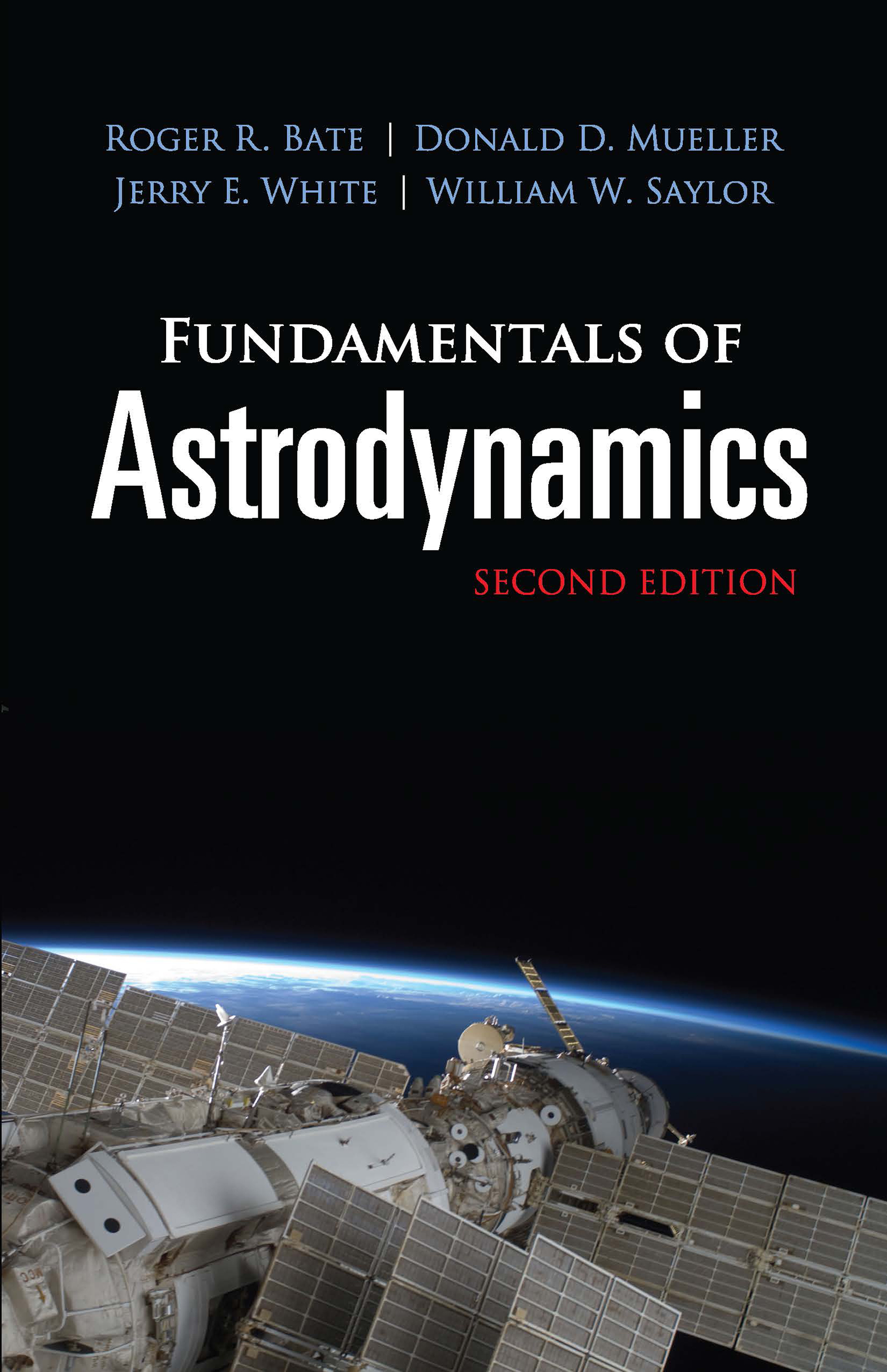
Fundamentals of Astrodynamics
Developed at the U S. Air Force Academy and a bestseller since its original 1971 Dover publication, this teaching text has been widely known and used throughout the astrodynamics and aerospace engineering communities. Completely revised and updated, this second edition takes into account new developments of the past four decades, especially regarding information technology.
432 pages, Paperback
First published June 1, 1971
Ratings & Reviews
Friends & Following
Create a free account to discover what your friends think of this book!
Community Reviews
Displaying 1 - 18 of 18 reviews

November 25, 2017
Exactly what it says on the tin. Covers how to calculate orbits, how to put things into orbits, how to transfer orbits, how to get stuff to the moon or other planets. Very math heavy as you'd expect, I skimmed most of it because I was really just after an outline.
Enjoyed the historical notes, i.e. "this is how newton/kepler did it" which I'm always fascinated by.
Probably should have brushed up on my calculus before diving into this.
Enjoyed the historical notes, i.e. "this is how newton/kepler did it" which I'm always fascinated by.
Probably should have brushed up on my calculus before diving into this.

June 19, 2016
What can I say? There is about 400 years worth of science in this book, a book I bought for pocket change. I do, although, recommend taking differential/integral/vector/multivariable calculus before hand. This book pretty much requires a knowledge of those fields. But, if you're familiar with most calculus, I recommend this book 1) for the price and 2) for a quick reference, especially if you're programming these types of forces in a simulation. Online references are always sufficient, of course, but this book has everything laid out in well ordered fashion.

May 3, 2017
Pretty good for what it is, but way more maths than I expected before I opening this book. Fortunately, the anecdotes and general insights into orbital mechanics are interesting even if you skip most of the formulas and calculations like I did.
My suggestion to other armchair astronauts: you can play Kerbal Space Program for 4-5 hours and get an intuitive grasp of the concepts here much faster than reading the book.
My suggestion to other armchair astronauts: you can play Kerbal Space Program for 4-5 hours and get an intuitive grasp of the concepts here much faster than reading the book.

February 4, 2025
Started before a masters in space engineering, finished after, still don't know what's going on 🍻
December 17, 2025
This book is extremely well written and effectively conveys timeless ideas. This will always be a great reference for fundamentals.
March 9, 2008
The "BMW" book is pretty much the best basic astrodynamics and orbital mechanics book ever. It works just as well if not better than many current edition textbooks as a reference, and it's way cheaper!

January 3, 2010
This is probably THE book for learning the basics of astrodynamics.

September 7, 2010
A great book on astrodynamics. I read nd referred to many times in the course of studies. An subsequently re-read. An easy to follow presentation by experienced instructors.

January 2, 2013
The fundamental text on orbital mechanics. If you need your missile to go ballistic or just want to throw something at the moon hard enough to hit it, this is a must-read.
December 1, 2025
This book like the title is about Astrodynamics. It goes into detail of about two objects in space and how they interact. The most detialed part is the way they track orbits. This book was an absolute slog to read. I thought it would be fun to see the mechanics of space, this book is not for the weak of heart. Other than that the book was well written, explaining information clearly and compactly. Although the book is only 400 pages long and only has a few paragraphs per page it takes forever to read even a chapter. It is cool to see a simulation of space as only equations and proofs. The only thing I could really ask for this book to improve is to maybe have more words, it expects me to be able to read equations like sentences, but that might just be my lack in a physics bacground. If you plan to read this book make sure you have at least highschool math education and associates level physics.
January 27, 2024
For anyone new to aerospace— this book is a great companion and reference. I read it roughly linearly, and i would love to take an online course to actually work all the math as it is intended.
It is a textbook— but richly illustrated and setup in a way that you can really pull knowledge from on demand.
I especially liked the historic background on each section— it lined out who and where in our western and eastern histories made the key discoveries and breakthroughs in understanding.
It is a textbook— but richly illustrated and setup in a way that you can really pull knowledge from on demand.
I especially liked the historic background on each section— it lined out who and where in our western and eastern histories made the key discoveries and breakthroughs in understanding.

May 20, 2022
I read this without any knowledge of calculus, trigonometry, or differential equations (all of which I am now studying). Despite this, the text was illuminating. This is the book that I would recommend to anybody struggling with the idea that the earth might be flat. There could be no more simplified and congenially thorough evaluation and analytical proof of the reality of motion through space.

December 9, 2017
I am not into such science but I enjoy showing that “i know Rocket Science”

July 26, 2018
Quite easy to follow
May 2, 2023
Here I try to keep a list of typos in this edition. (The book is not type-setted in Latex, which is a major drawback)
1. p.8 equation (1-12) and (1-13). The subscript should be i instead of 1.
2. p. 14 in section 1.4.2, bullet point 3, the first appearance of r double dot should be r dot.
3. p.15 in Figure 1-5. Flight-path Angle should be \phi instead of \theta
4. p. 21 right after equation (1-46). "Combining this with Equation (1-44)" instead of stated (1-45).
5. p.22, last line of the page. equation (1-51) should be equation (1-53).
to be continued...
1. p.8 equation (1-12) and (1-13). The subscript should be i instead of 1.
2. p. 14 in section 1.4.2, bullet point 3, the first appearance of r double dot should be r dot.
3. p.15 in Figure 1-5. Flight-path Angle should be \phi instead of \theta
4. p. 21 right after equation (1-46). "Combining this with Equation (1-44)" instead of stated (1-45).
5. p.22, last line of the page. equation (1-51) should be equation (1-53).
to be continued...
Read
July 26, 2023Just finished going through the 1971 edition (edited for accuracy) =)
July 27, 2023
Obviously this is a very technical book which is advised for people with the academic background (advanced mathematics, physics, etc) to appreciate this book.
That said - it is a very good book to study if you want to master orbital dynamics and many techniques used in the space field. It covers all of the important topics in enough detail that you can go on to specialize or you can begin to apply the concepts.
I did take a class with the original book, back in 1981, and have referred back to the original many times. This book is valuable since it includes a number of very good illustrations - many other books have only a few illustrations. The illustrations have been updated and are better than the original's versions - we have far better tools today than in 1971! We will miss the fun photos of radars and Baker Nunn cameras but they did not add much to the book.
This is an excellent update to a very valuable book that will keep it relevant for the next several decades.
That said - it is a very good book to study if you want to master orbital dynamics and many techniques used in the space field. It covers all of the important topics in enough detail that you can go on to specialize or you can begin to apply the concepts.
I did take a class with the original book, back in 1981, and have referred back to the original many times. This book is valuable since it includes a number of very good illustrations - many other books have only a few illustrations. The illustrations have been updated and are better than the original's versions - we have far better tools today than in 1971! We will miss the fun photos of radars and Baker Nunn cameras but they did not add much to the book.
This is an excellent update to a very valuable book that will keep it relevant for the next several decades.

August 28, 2013
Lo sto leggendo e non l'ho ancora finito... è molto bello perché spiega gli argomenti in maniera chiara, senza dare per scontato nulla, è richiesta (per lo meno fino a dove sono arrivato) solamente una conoscenza di base di fisica e di analisi matematica.
Le figure non sono "belle" ma sono molto chiare.
Unico difetto, non del contenuto, è che l'aspetto delle formule non è molto bello, non so come dire ma sono un po' storte... una riscrittura in LaTeX sarebbe bellissima.
Le figure non sono "belle" ma sono molto chiare.
Unico difetto, non del contenuto, è che l'aspetto delle formule non è molto bello, non so come dire ma sono un po' storte... una riscrittura in LaTeX sarebbe bellissima.
Displaying 1 - 18 of 18 reviews