Jump to ratings and reviews
Rate this book
Rate this book
The idea of selecting that certain hour in which a man comes face to face with himself, revealing the temper of his spirit, is one which would only occur to the inspired artist.
In these episodes of high moments and gestures of valour much is demanded of the hero, who meets it with even more than is required.
The style is essentially Cabell, romantic, spirited, ironic.

255 pages, Hardcover

First published January 1, 1916

2 people are currently reading
52 people want to read

About the author

James Branch Cabell

255 books125 followers
James Branch Cabell was an American author of fantasy fiction and belles lettres. Cabell was well regarded by his contemporaries, including H. L. Mencken, Edmund Wilson, and Sinclair Lewis. His works were considered escapist and fit well in the culture of the 1920s, when they were most popular. For Cabell, veracity was "the one unpardonable sin, not merely against art, but against human welfare."

Ratings & Reviews

What do you think?
Rate this book

Friends & Following

Create a free account to discover what your friends think of this book!

Community Reviews

5 stars
2 (10%)
4 stars
11 (55%)
3 stars
6 (30%)
2 stars
1 (5%)
1 star
0 (0%)
Displaying 1 - 4 of 4 reviews
Profile Image for Wreade1872.
812 reviews228 followers
July 9, 2025
Reread
description
description
Continuing my reread of the Biography of Manuel, now in hardcopy.
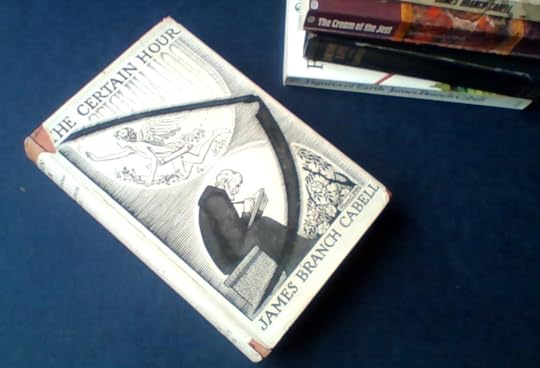
The most expensive item in my collection as its one of only two original hardbacks, both with dustcovers. Worth it, although a little less effective on repeat.

First Read [5/5]
to write perfectly of beautiful happenings

Ok so only 5 stars because i'm grading on a curve but still, i was going to rate each idividual story but found they were all 4 stars except for maybe one which was 3.

It starts with an essay about why its so hard to get good writing published and basically sets out that this work isn't for a general audience, which i would agree with. It also isn't like most short story collections. To put it in musical terms most collections are basically greatest hits, unrelated singles, but this is a proper album where all the songs/stories compliment each other.

The theme is the life of poets and the influence for their work and since Cabell beleives that all poetry is inspired by love/lust, we get a collection of historical romances.
However that description is poor and suggests a lack of variety. I was constantly surprised by the way things went in these tales, theres darkness and realism lurking under the surface of most of the stories and one is flat out supernatural.

Shakespeare and Alexander Pope, are a couple of our protagonists and i spotted William of Orange and a Medici in the background. These would make a great anthorlogy show like 'Urban Myths' :) . I can't speak to the historical veracity but there might be grains of truth here and there.
The last story features John Charteris an entirely fictional writer who appears in various of Cabell's books.

Lyrical, historical, romantic,intriguing, unpredictable, vivid and delightful. The second best of Cabells works i've read to date (behind Jurgen).
Profile Image for Timothy.
186 reviews17 followers
June 26, 2018
The first tale in The Certain Hour (1916), “Belhs Cavaliers,” is set in the England of 1210 A.D., and features a love triangle of

1. the hero, Raimbaut de Vaquiras,

2. the open antagonist, Guillaume de Baut (Prince of Orange), and

3. Dona Biatritz, with a fourth figure added to form a sort of love rhombus, Raimbaut’s servant,

4. the converted Saracen, Makrisi.

“Love prefers to take rather than to give; against a single happy hour he balances a hundred miseries, and he appraises one pleasure to be worth a thousand pangs.” The musings of the hero, at the outset.

The tale appears to be heading for tragedy, but romantic melodrama concludes the foray into doomed love — the doom being a happy ending.

First published in Lippincott’s Magazine, June 1915.

The second tale in the book is “Balthazar’s Daughter.” It is the only tale I had read before the present reading of all the book’s stories. It is quite good. Like all of the tales, it is what in the movies we would call a costume drama. But here we witness an early example of the sly sexual innuendo that would land the author in court and on the bestseller list: methinks the “jewels” that the heroine would like to see at court — and especially of which her interlocutor says the eminent men of the court would be delighted in showing her — might refer not merely to “the four kinds of sapphires, the twelve kinds of emeralds, the three kinds of rubies” etc. mentioned by the tale’s antagonist, Duke Alessandro.

The story first appeared in The Smart Set, May 1913. Cabell turned the story into a one-act play, The Jewel Merchants (1921), which was used as a libretto for an opera, by Louis Cheslock (1941).

The book’s third story is “Judith’s Creed,” which first appeared in Lippincott’s Magazine, July 1915. Our protagonist is none other than William Shakespeare, confronting his Dark Lady. Here is a defense of his modus operandi by the Bard: “The man of letters, like the carpenter or the blacksmith, must live by the vending of his productions, not by the eating of them.” His former lover, his “dark lady,” expresses disapproval of the “paunchy, inconsiderable little man” he has become, and for his lifelong besetting sin, “money-grubbing.” Judith, mentioned in the title, is his daughter; her creed is her much more natural, humble view of the world than contemplated by literary people demanding greatness.

The fourth story was apparently written directly for the volume, and deals with the author of the famous lines “Gather Ye rosebuds while Ye may.” Yes, Robert Herrick is the subject of “Concerning Corrina,” which more than suggests that the poet was an adept of the dark arts. Though technically a mystery-horror story, it is best categorized as a philosophical comedy.

The next is “Olivia’s Pottage,” originally titled “The Second Chance,” published in Harper’s Magazine (October 1909). It is a story I could not properly read. Oh, I read it, every word, but had trouble following it, or caring. Could be my fault. Or it could be the author’s early and quite unsuccessful effort.

“Verse-making,” says the hunchback dwarf Alexander Pope in the sixth story, “A Brown Woman” (Lippincott’s Magazine, August 1915), “is at best only the affair of idle men who write in their closets and of idle men who read there.” The great poet has fallen in love. With a milkmaid. And yearns to be happy. “To write perfectly was much,” our narrator informs us, “but it was not everything.”

Standing in the way of any traditional arrangement for happiness, however, is his own physical construction: “My body is at most a flimsy abortion such as a night’s exposure would have made more tranquil than it is just now.” So he does the honorable thing. And then fate throws in a monkey wrench.

“It is deplorable how much easier it is to express any emotion than that of which one is actually conscious.”

Yes.

“Pro Honoria” saw the light of the reading public’s gaze in 1915, courtesy of McBride’s Magazine. That is all I will say for it. The next story, “The Irresistible Ogle,” is something else again.

Selah.

After many months with this volume misplaced in one of my cluttered rooms, sitting in a corner under a few other books nowhere near as good, I finally got back to this story collection last night. It is two months more than a year after I first opened up the pages of the Kalki edition (1920) of this book, and high time that I plowed through to the end.

It is easy plowing.

“A Princess of Grub Street” is yet another story of a writer and his love life. Normally I get tired of this sort of thing — stories about writers and stories about love. But when Cabell is telling the tale, and wit and elegance are what is paraded before us, not ripped bodices or psychological confessions of an embarrassing sort. This is all very civilized.

But there is a touch of frivolity here, too, and I have to admit something that probably will not please the litterateurs: this story would make a fine “rom-com” for either the silver screen or Amazon Prime, or suchlike. Here we have a tale of Prince Hilary (nicknamed “Prince Fribble”), a young nobleman who, to escape a life of dreary service to the class of royalty and duties of state, fakes his death with the help of his heir and cousin, and flees Saxe-Kesselberg for England, to live a life of poetry, hack writing, and freedom. And of course finds love.

Taking the name of Paul Vanderhoffen, he eventually becomes a tutor to the young charge of Leamington Manor, Mildred Claridge:

Prince Fribble would have smiled, shrugged, drawled, “Eh, after all, the girl is handsome and deplorably cold-blooded!” Paul Vanderhoffen said, “I am not fit to live in the same world with her,” and wrote many verses in the prevailing Oriental style rich in allusions to roses, and bulbuls, and gazelles, and peris, and minarets — which he sold rather profitably.”


But there are complications to Fribble’s plan to live a quiet life of literature and penury. A visitor from Saxe-Kesselberg demands his return to the life of ruling.

“I repeat to you,” the tutor observed, “that no consideration will ever make a grand-duke of me excepting over my dead body. Why don’t you recommend some not quite obsolete vocation, such as making papyrus, or writing an interesting novel, or teaching people how to dance a saraband? For after all, what is a monarch nowadays — oh, even a monarch of the first class?” he argued, with what came near being a squeak of indignation. “The poor man is a rather pitiable and perfectly useless relic of barbarism, now that 1789 has opened our eyes; and his main business in life is to ride in open carriages and bow to an applauding public who are applauding at so much per head. He must expect to be aspersed with calumny, and once in a while with bullets. He may at the utmost aspire to introduce an innovation in evening dress,—the Prince Regent, for instance, has invented a really very creditable shoe-buckle. Tradition obligates him to devote his unofficial hours to sheer depravity——”


Fleshed out, as I say, this would make for great comedy, especially with the final moments of his courtship of Mildren, which he had not been aware he was pursuing. And yes, I would keep in the long, droll, flowery speeches.

The story first appeared as “Prince Fribble’s Burial” in The Red Book (May 1911).

The final tale, “The Lady of All Our Dreams,” first found public view in The Argonaut (November 23, 1912), as “The Dream.” And here we meet one of Cabell’s recurring characters, the author John Charteris, who served as the fictional mouthpiece for Cabell’s first literary manifesto, Beyond Life: Dizain des Demiurges (1919). The tale begins, after the usual Cabellian prefatory verse and fake citations, this way:

“Our distinguished alumnus,” after being duly presented as such, had with vivacity delivered much the usual sort of Commencement Address. Yet John Charteris was in reality a trifle fagged.


And so the All Passion Spent motif serves as a contrast to the passion to come. Charteris characterizes his public speechifying as a “verbal syllabub of balderdash” when confronted by his lost love, Pauline. She expresses her disappointment at what he has become, and is becoming: comfortable.

“So I am going to develop into a pig,” he said, with relish,—“a lovable, contented, unambitious porcine, who is alike indifferent to the Tariff, the importance of Equal Suffrage and the market-price of hams, for all that he really cares about is to have his sty as comfortable as may be possible. That is exactly what I am going to develop into,—now, isn’t it?” And John Charteris, sitting, as was his habitual fashion, with one foot tucked under him, laughed cheerily. Oh, just to be alive (he thought) was ample cause for rejoicing! and how deliciously her eyes, alert with slumbering fires, were peering through the moon-made shadows of her brows!”


We have here Cabell’s recurrent theme: lost love, compromise, artistic egoism, and . . . many of the themes that bubble up on consideration of Cabell’s own twice-married life, ably narrated with enough veracity in As I Remember It (1945). And always there are dreams and regret, with Charteris (Cabell) saying:

Pauline, I haven’t been entirely not worth while. Oh, yes, I know! I know I haven’t written five-act tragedies which would be immortal, as you probably expected me to do. My books are not quite the books I was to write when you and I were young. But I have made at worst some neat, precise and joyous little tales which prevaricate tenderly about the universe and veil the pettiness of human nature with screens of verbal jewelwork. It is not the actual world they tell about, but a vastly superior place where the Dream is realized and everything which in youth we knew was possible comes true. It is a world we have all glimpsed, just once, and have not ever entered, and have not ever forgotten. So people like my little tales. . . . Do they induce delusions? Oh, well, you must give people what they want, and literature is a vast bazaar where customers come to purchase everything except mirrors.


And there is even a question of a past murder — ostensibly perpetrated by Pauline herself — as there was in the biography of young Cabell.

So, I suspect if you want to find about what this author, of the famous families Branch and Cabell, was all about, this tale might be a touchstone. Note, future biographers.

And though this ends with humor, the humor — liquid, you know — flows from the reader’s eyes.

The Certain Hour ends as it begins, in poetry — it is not for nothing that it is subtitled Dizain des Poëtes in the 1920 edition, and all subsequent printings. The prefatory poem, “The Ballad of the Double Soul,” is quite good. Excellent even. But this last one, “Ballad of Plagiary,” is not quite so easy to understand, or is not as profound — or is so profound that I cannot now understand it.

Explain it to me.
Profile Image for Warren Fournier.
842 reviews151 followers
June 11, 2016
I am reading the entirety of the Dom Manuel fantasy series by James Branch Cabell, and thus far, this is the one that resonated with me the least. But the premise is interesting.

In the second book, "Figures of Earth," Manuel creates earthen figures that Queen Freydis then brings to life at a "certain hour," meaning an appointed time in history. All these figures in life are similar to Manuel, and carry on a bit of the story of his "Life."

All of the figures, as they matured in the "real" world, became notable extraordinary characters, some obscure, some famous, some completely fictional. In this book, we witness excerpts from their lives.

Of the obscure figures, my favorite story was the one featuring the real-life 16th century duke of Florence, Alessandro de Medici, called "Balthazar's Daughter," upon which Cabell later on wrote a play for the Little Theater of Richmond called "The Jewell Merchants." The play was later included in the literary pantheon of the Dom Manuel series, included in the Storisend edition of "From the Hidden Way," which featured poems inspired by Medici.

The most famous of the "descendants" of Manuel is Shakespeare himself, and you will read of an interesting historical romance here.

John Charteris is a fictional author who is the last to be brought to life. We are introduced to him in the first book, "Beyond Life," and we learn more of his character in later years in "The Cords of Vanity." In "The Certain Hour," we see him as a much younger character in a romantic adventure.

But this book lacks the memorable quips, turns of phrase, and wit of Cabell's other works. He tries too hard to be artful in his prose, and his stories end up being a little muddled and hard to follow.

So this is not the book to introduce yourself to an otherwise brilliant author, or to a series that is richer than most any work I've read in its potential for the sheer enjoyment of the art of multiple styles of writing, for escapist fantasy and romance, for understanding the 1920s American South, for learning about the mythologies of various cultures, and... well I could go on.

There is some fine writing in this book, and a lot to enjoy, but get to know where Cabell came from and where he was going before attempting this tome.
Profile Image for Kerry.
144 reviews2 followers
November 13, 2025
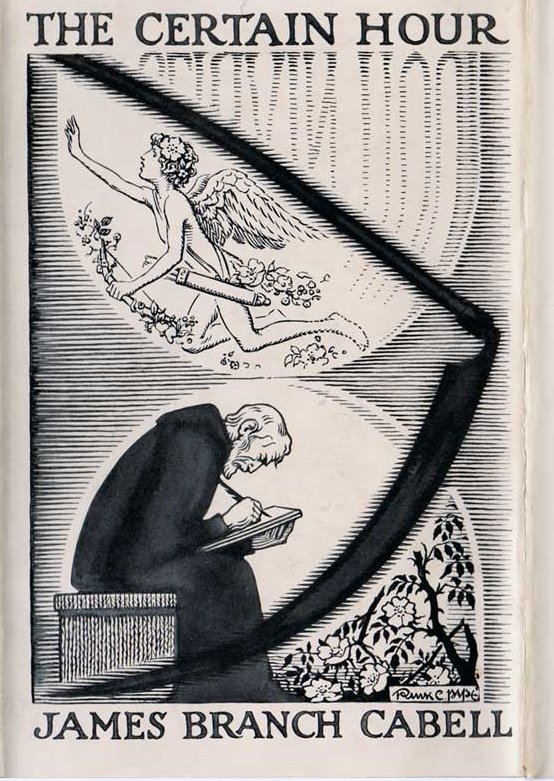
The Certain Hour by James Branch Cabell was first published in 1916, consisting mostly of articles first released in magazines from 1911 to 1915, but also two new stories specifically for this book. Subsequently, in 1929, it became Volume 11 of the Storisende Edition of the Biography of the Life of Manuel. I read what I think is the first British edition, put out by John Lane The Bodley Head in 1931, with dustwrapper design by Frank C. Papé, Cabell's long-time illustrator.

As with most of Cabell's earlier works inserted into the Biography of the Life of Manuel, the actual connection with Manuel of Figures of Earth is tenuous. Manuel's clay figures were animated by Queen Freydis in Figures of Earth and set to wander the world. Ostensibly, these are the characters Cabell writes of in the stories of The Certain Hour, though the texts of the stories make no reference to the magical origins of their main characters.

The Certain Hour is the fourth and last volume of Cabell's short stories compiled from earlier magazine articles, the others being The Line of Love, Chivalry, and Gallantry. The Certain Hour consists of later stories, and while still historical romance, it's much better than the earlier three, in my view.

Cabell's idea with the book is to present romantic liaisons involving writers over the centuries. He starts with Raimbault de Vaquieras in 1210, then Alessandro de Medici in 1533, William Shakespeare in 1609, Robert Herrick in 1674, William Wycherley in 1680, Alexander Pope in 1718, Horace Calverley in 1761, and Richard Brinsley Sheridan in 1795. All these are actual historical figures, of course, and Cabell quotes verses of their poetry before each story—a nice change from the faux medieval French poetry that adorns Chivalry, for example. Cabell rounds off the ten stories with tales of the fictional characters Paul Vanderhoffen and John Charteris. The latter, presumably, is told from the perspective of Cabell's own time.

Cabell will use Charteris in Beyond Life a few years later, in 1919, to present Cabell's own philosophy of life and literature. There is an implication, certainly, that Charteris is an autobiographical character for Cabell; further, there is a sense that the whole of The Certain Hour is somewhat autobiographical. In the introduction, Cabell writes, "Hereinafter, then, you have an attempt to depict a special temperament—one in essence 'literary'—as variously moulded by diverse eras and as responding in portion with its ability to the demands of a certain hour" (p. 15).

The literary temperament was Cabell's, too. He explains, no doubt speaking of himself, "The desire to write perfectly of beautiful happenings is, as the saying runs, old as the hills—and as immortal" (p. 13); he describes The Certain Hour as "the very book which, as a seasoned scribbler, one was moved to write through long consideration of the drama already suggested—that immemorial drama of the desire to write perfectly of beautiful happenings" (p. 17). He reiterates, "Some few there must be in every land of whom life claims nothing very insistently save that they write perfectly of beautiful happenings" (p. 34). Later in the book, Cabell has Shakespeare muse, "For surely—he would have said—to live untroubled, and weave beautiful, winsome dreams is the most desirable of human fates" (p. 106).

In the last story, Cabell introduces John Charteris, his alter-ego, through the following spoof quote: "In John Charteris appeared a man with an inborn sense of the supreme interest and the overwhelming emotional and spiritual relevancy of human life as it is actually and obscurely lived" (p. 235). Charteris himself says, "I have made at worst some neat, precise and joyous little tales that prevaricate tenderly about the universe and veil the pettiness of human nature with screens of verbal jewelwork" (p. 245); "I was born, I think, with the desire to make beautiful books—brave books that would preserve the glories of the Dream untarnished" (p. 249). Certainly, Cabell is speaking for himself. Indeed, much of this is the language that Cabell uses in Beyond Life, and The Certain Hour reads in some ways as a prequel to Beyond Life.

A powerful sense of melancholy pervades most, perhaps all, of the tales of The Certain Hour. Cabell has Charteris lament, "I know now that all the phantoms I have raised are only colourless shadows which belie the Dream" (p. 251). Remember, at this time Cabell was only in his late thirties, he still has the great fantasies to come, starting with Jurgen in 1919. Jurgen, of course, at last brought Cabell great fame and notoriety. Nevertheless, The Certain Hour reads as though some significant phase in Cabell's writing career is coming to a close. Cabell himself is lamenting aspects of love and life he has left behind in his single-focused quest "to write perfectly of beautiful happenings."

The Cabell we deal with in The Certain Hour is not the cynical, sardonic Cabell of his later fantasies. As John Charteris, he writes, "What really matters is that there is so much faith and love and kindliness that we can share with and provoke in others" (p. 250). This is not the voice of Cabell from Jurgen and beyond. The melancholy, truth, and self-reflection of The Certain Hour make it one of Cabell's best non-fantasy books for me—no matter that I'm drawn to Cabell primarily for fantasy rather than historical romance.

Cabell offers a very interesting definition of literature. According to Cabell, "Literature is made up of the re-readable books, the books which it is possible—for people so constituted as to care for that sort of thing—to read again and yet again with pleasure" (pp. 26-27). He continues, "Therefore, in literature a book's subject is of astonishingly minor importance, and its style is nearly everything" (p. 27). The true nature of literature is not defined by academics in universities: literature, in an individual sense, is the books one keeps coming back to because of the poetry, truth, and beauty in them that speaks to you. Cabell writes, being more specific, that he aims to produce literature, "to-day, as always, only through exercise of the auctorial virtues of distinction and clarity, of beauty and symmetry, of tenderness and truth and urbanity" (p. 34). Only in this way, he continues, "may a man in reason attempt to ensure his books against oblivion's voracity" (p. 34).

The Certain Hour is a book by James Branch Cabell that is worth reading even if, like me, you come to his work primarily for the fantasies. It's a book that I would read again, better to appreciate its atmosphere of melancholy, beauty, and truth. For me, it's literature, in accord with Cabell's own definition of the term.
Displaying 1 - 4 of 4 reviews

Can't find what you're looking for?

Get help and learn more about the design.