“Un delitto d’onore” ci riporta agli anni 1920-1922. Gli avvenimenti politici, le violenze del tempo, anche se accennati, sono in realtà la struttura e la cornice entro cui prende rilievo la vicenda di Gaetano Castiglia: una vicenda passionale e feroce. Un frustrato nobilotto terriero della provincia avellinese non ha esitazioni nel premeditare e commettere un crimine a salvaguardia di ciò che egli ritiene il massimo valore spirituale: il suo onore. La lucida rappresentazione del romanzo realizza in pieno il fine che l’autore persegue: denunciare e giudicare uno spietato e stupido pregiudizio morale e sociale. Nessun compiacimento, nessun eccesso polemico, neppure un’ombra di sentimentalismo: il racconto di Arpino è sano, obbiettivo, di un lirismo severo.
Giovanni Arpino was an Italian writer and journalist.
Born in Pula (in Istria, then part of Italy) to Piedmontese parents, Arpino moved to Bra in the Province of Cuneo. Here he married Caterina Brero before moving to Turin, where he would remain for the rest of his life.
He graduated in 1951 with a thesis on the Russian poet Sergei Yesenin, and the following year made his literary debut with the novel Sei stato felice, Giovanni, published by Einaudi. He also took up sports journalism, writing for the daily papers La Stampa and Il Giornale; together with Gianni Brera at the La Gazzetta dello Sport he brought a new literary quality to Italian writing on sport. His most important work in this line was the 1977 football novel Azzurro tenebra. Arpino also wrote plays, short stories, epigrams and stories for children.
In Italy he got to know the Argentinian writer, and fellow sports enthusiast, Osvaldo Soriano and won the Strega Prize of 1964 with L'ombra delle colline, the Premio Campiello of 1972 with Randagio è l'eroe and the SuperCampiello of 1980 with Il fratello italiano. His novels are characterised by a dry and ironical style.
His story Il buio e il miele was made into two films: Dino Risi's Profumo di donna, with Vittorio Gassman, and Martin Brest's Scent of a Woman, which earnt Al Pacino an Academy Award for Best Actor.
Arpino died in Turin in 1987. His links to his childhood town of Bra have been maintained by the establishment of a multi-functional cultural centre and of a prize for children's literature.
La scrittura di Arpino è scarna, quasi minimalista, ma incredibilmente efficace. Non ci sono giri di parole inutili, ogni frase è funzionale alla trama, ogni parola sembra essere stata scelta con cura per andare dritta al punto. Questo stile, che può sembrare distante o “secco” a prima vista, in realtà si rivela perfetto per raccontare la storia di un delitto d’onore, nella quale l’emotività e l’intensità dei sentimenti sono celate dietro una sconcertante e fredda razionalità.
Il romanzo si concentra sulla psicologia del protagonista Gaetano, su come le sue scelte lo conducano a una spirale di eventi che culmina nel delitto. Arpino non indugia in moralismi o spiegazioni, ma fa immergere il lettore nel contesto sociale e culturale in cui il crimine avviene, senza giustificazioni, ma semplicemente raccontando la verità così com’è.
Mia nonna diceva sempre "Nata la creatura, scritta l'avventura" e questo è proprio quello che mi ha colpito di più: la tensione costante che permea il racconto. Nonostante l’apparente semplicità della scrittura, ogni pagina trasuda un senso di inevitabilità, come se l'epilogo fosse già scritto nel destino dei personaggi.
La bellezza di "Un delitto d’onore" sta nella sua capacità di raccontare un dramma complesso con una semplicità disarmante, senza mai abbandonare la tensione psicologica e sociale che è il vero motore della storia.
Leggerò sicuramente altro dell'autore che, in questo 2025, è stato una piacevole scoperta.
As a lot of good literature, the plot does not really matter, and the title gives it away - it is an excuse to paint times and places via the characters in the novel. They provide a portrait of a Italy on the brink of fascism, though the psychology of many of the characters feels sadly acutely contemporary.
The novel is divided in three parts - the first part sets the scene and introduces us to the main character, Dr. Castiglia, and his mother. The second part is concerned with what provides the title for the novel - and the third part is the "after". The strongest for me was the second part, which hits you in the stomach not just for its physical violence, but most of all for the psychological violence and the twisted logic which leads to it and that you come to see as almost inevitable.
The third part adds another dimension to the book, and a fresh perspective to the whole novel. Beautiful prose, at least in the original Italian version.
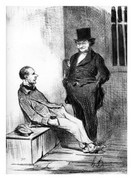
(Honoré Daumier 1808-1879, "Avvocato difensore") Castiglia, le mani affondate nelle tasche [...] si persuase a sedere sullo sgabello
Avevo un incerto ricordo di Giovanni Arpino, attraverso il suo romanzo "L'ombra della colline" (nella vecchia edizione Club degli Editori!), letto ormai diversi anni fa e di cui non serbo tracce, se non la sua lentezza e il mio scarso coinvolgimento. Ma erano altri tempi (miei) e ora, scevra da pregiudizi, avendo avuto tra le mani "Un delitto d'onore", gli ho voluto dare un'altra opportunità. Ed è stata una riscoperta: un Autore sensibile e accurato nella scrittura, attento e pulito nelle descrizioni; coinvolgente e appassionato, ma misurato anche nelle scene più forti; piacevole all' "ascolto"; capace di suscitare nel lettore giudizi, pur senza averne forniti. Un tema d'attualità, il femminicidio, ambientato nella società degli anni Venti del secolo scorso (ma non troppo lontano da noi nel tempo), nella provincia avellinese, in un mondo maschilista (hai il mio nome,... tu non puoi volere. Solo io voglio e non voglio) e di classe (cafoni, non persone). Un omicidio passionale, mascherato da quell'etichetta "d'onore" che non solo giustifica, assolve, protegge, ma addirittura esalta e premia: ...è un delitto, sì, ma nato per una forza sana della natura... a suo modo santa. La vendetta in Eschilo era un grande atto di civiltà. Ma qui c'è di più. C'è il sangue nostro latino, c'è il potere dell'uomo offeso, c'è il sentimento di giustizia insopprimibile; e che, alla fine, fa dell'omicida un "vir". Molto bene impostata, a mio parere, l'esposizione dei fatti nelle tre parti: la preparazione psicologica, la liberazione catartica attraverso l'omicidio, per poi giungere alla parte conclusiva con l'analisi legale e la rappresentazione ben figurata dall'ambiente forense. Non interessa l'atto finale, il responso della "legge": ciò che conta è la rappresentazione della "commedia della vanità" e del prestigio personale.
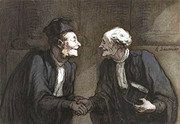
(Honoré Daumier 1808-1879, "Due avvocati si stringono la mano") «Parte civile contro di te...!» e lo spingeva dandogli buffetti allo stomaco. Si ripararono dietro una colonna, si strinsero le mani.
nella provincia di avellino, negli anni che immediatamente precedettero il ventennio fascista, un nobile -che ha pigramente buttato via la sua vita- si innamora di una ragazza del popolo, che vuol trasformare in una signora e sposare nonostante sua madre la disapprovi, ed un distorto senso dell'onore (figlio della mentalità dell'epoca) lo porterà a commettere il delitto d'onore (anzi, i delitti d'onore) del titolo: ed è subito grande cinema italiano del dopoguerra. già, il cinema: "divorzio all'italiana" prese parecchio da questo libro, cambiandone però diversi aspetti chiave, ma non è difficile immaginare che tanti sceneggiatori d'epoca avesso questo romanzo in biblioteca. e arpino da parte sua è assai cinematografico: ogni dialogo e ogni situazione sembrano già una perfetta sceneggiatura, e diversi personaggi (specie la famiglia del protagonista) sembrano nati per venire indossati dai tanti ottimi caratteristi del nostro cinema d'epoca. inoltre la struttura stessa del romanzo sembra prestarsi al cinema: ad una prima parte patetica ne segue una segnata da un crescendo verso i brutali delitti, e ad entrambe ne segue una terza che è pura commedia all'italiana, dominata da un personaggio -l'avvocato russo- che nei suoi ragionamenti su come far condannare alla pena minima (e moralmente assolvere) il protagonista nasconde una satira corrosiva verso la mentalità di quegli anni e -tra le righe-su come un certo mondo culturale lasciò penetrare il fascismo nella società (con un mix tra tolleranza e tentativo di approfittare delle occasioni che i fascisti potevano fornire). un romanzo di alto livello, invecchiato benissimo, che meriterebbe una riscoperta.
Pubblicato nel 1961 (la leggenda narra che perse lo Strega per un soffio, quell'anno toccò a Ferito a morte, infatti), è ambientato nel 1920-22 tra Avellino e Napoli.
Romanzo per cervi versi schizofrenico, visto che sembra quasi siano due romanzi in uno - la prima e la seconda parte sono torbide e ossessive e nerissime e perfino un po' pulp e mi hanno fatto pensare a Capuana, mentre la terza parte ha un respiro del tutto diverso e mi ha fatto pensare a Sciascia.
Mi è piaciuto, mi è piaciuto molto - la scrittura è così densa, a tratti, da diventare materica - ma non posso nemmeno consigliarlo più di tanto, perché a meno che non lo becchiate in qualche bancarella o libreria dell'usato, difficilmente riuscirete a leggerlo.
Written in 1963 and set in Italy during the start of the Fascists regime where there's already a monarchy in place along with the Socialists and the Liberals and, of course, Mussolini all lining up like pawns on a chessboard, waiting like spiders, sucking up to the people who are angry yet hopeful. (Terrifying to me especially since January 6th.)
During this time, a 39-year-old doctor, a mama's boy, falls in love with a 17-year-old barmaid. (Personally, I thought he was looking for someone younger so he could mold her [ala Eliza Doolittle] as well as control her because he certainly could not control his mama.)
After a year and a half, they marry. And, lo and behold, she's not a virgin (actually, she never told him that she was, but in a male dominated society I guess he just presumed it). So he cut her throat.
This story reminded me a lot of Henry VIII and his fifth wife, Catherine Howard. She was about 18 and Henry was 49. Apparently, Catherine wasn't a virgin either, and we all know what happened to her.
Enter a mama-bought, high-powered attorney with a monster ego and an innate ability to turn into a chameleon at the drop of a hat. This man was smooth as silk. (That's why this story also reminded me of the O.J. Simpson trial.)
I was strangely fascinated by this lawyer and his ability to get people to do whatever he wanted them to do and making them believe that it was their idea all along. In a way, he was the main character and what a character he was!
However, the ending totally sucked. There was absolutely no closure. I have no idea how things might have turned out if there had been an ending! But I suppose if we take into account the male chauvinistic times and the book title, we can guess what happened. Right?
Gaetano Castiglia was a distinguished Italian doctor, the son of a wealthy land owner - the very soul of respectability. In his late thirties, Gaetano chose as his bride a girl of seventeen - Sabina - a beautiful peasant girl. Ever the true gentleman, he refused to give her up simply because public opinion was against the match. Even over his own mother's bitter objections, he planned to train Sabina, make her a lady and then marry her. All was proceeding according to Gaetano's intentions...until he discovered something that shocked him to the very core.
This was an extremely intriguing book for me to read. Giovanni Arpino is a new author for me, and A Crime of Honor is a translation from the Italian. In my opinion, this book superbly showcased the changing social mores of Italian society during the time between the World Wars. I give this book an A!
O carte interesantă şi bine scrisă. Schimbări bruşte de stil: o primă parte - romantică, idilică; a doua - şocantă şi crudă, aproape horror; ultima - o satiră rece şi, pe alocuri, un fel de pamflet.
il delitto è descritto così terribilmente bene che ti costringe a leggerlo a intervalli. è così vivido che sembra quasi che sia tu la donna con la gola squarciata in quel letto.