

What do you think?

Red Handed: The Fine Art of Strange Crimes
Welcome to the city of Red Wheelbarrow, where the world's greatest detective has yet to meet the crime he can't solve—every criminal in Red Wheelbarrow is caught and convicted thanks to Detective Gould's brilliant mind and cutting-edge spy technology.
But lately there has been a rash of crimes so eccentric and random that even Detective Gould is stumped. Will he discover the connection between the compulsive chair thief, the novelist who uses purloined street signs to write her magnum opus, and the photographer who secretly documents peoples' most anguished personal moments? Or will Detective Gould finally meet his match?
Matt Kindt operates with wit and perception in the genre of hard-boiled crime fiction. Red Handed owes as much to Paul Auster as Dashiell Hammett, and raises some genuinely sticky questions about human nature.
But lately there has been a rash of crimes so eccentric and random that even Detective Gould is stumped. Will he discover the connection between the compulsive chair thief, the novelist who uses purloined street signs to write her magnum opus, and the photographer who secretly documents peoples' most anguished personal moments? Or will Detective Gould finally meet his match?
Matt Kindt operates with wit and perception in the genre of hard-boiled crime fiction. Red Handed owes as much to Paul Auster as Dashiell Hammett, and raises some genuinely sticky questions about human nature.
272 pages, Hardcover
First published May 14, 2013
Ratings & Reviews
Friends & Following
Create a free account to discover what your friends think of this book!
Community Reviews
Displaying 1 - 30 of 163 reviews

March 26, 2013
My favorite Matt Kindt book so far. Just fabulous. I mean, I am enjoying the Mind Management series, which is a kind of X-Files meets X-Men story, a group of people working for some unclearly outlined cause with different super abilities. But this feels more intimate, in a way, less ambitious, more manageable, though apparently not that manageable, since a glance at the reviews reveals that a lot of people don't seem to get it, or like it, it's too huh???! or something, and I can see that, I really can.
Red-Handed is the tale of a detective who is good at catching criminals, who figures them out. He's compulsive, and it takes over his life. Then we have the criminals themselves, who are equally and sort of similarly compulsive as they commit petty crimes: They steal chairs, take photographs of women's legs or get people to hit them so they can collect huge insurance settlements. All these people are interesting, and kind of funny, and help us, through Kindt's guidance, meditate on human nature, on crime, and compulsion. What do they all have in common? Much of the book feels like a meditation on these things, rather than just a crime thriller, though it does become that, finally, but I won't reveal too much about that, how things get surprisingly linked, though like with any good mystery, it's all there, there are clues along the way!
The feel of the book is of a work that loves and respects mystery and detective stories but also wants to dig deeper into the genre, to see what such stories and people tell us about being human. It goes meta on us. It's a sort of a comics study of the psychology of crime, though even that isn't very straightforward. It's not a textbook. The form has a lot of deliberate and thoughtful fragmentation, a lot of reflection, separate dialogue pages, and some really complex and probably for some people frustratingly baffling aspects to it. Don't just read this if you are interested in Robert Parker, though that IS in here in all its genre requirements, it really is. It's like the description says, Dashiell Hammett meets Paul Auster; it's a postmodern reflection on mysteries. With some David Lynch thrown in. And then, it does come together, finally, as dots get connected in a surprising way, in (thanks Seth Hahne, whose review is the best one I read here) a Twist that the best mysteries require to be satisfying.
The quirky art style fits with the pomo detective blend. Someone that reviewed it said that he could help us differentiate better between all the white people here, and that seems right. But this is a way smart, and challenging book, and for me that means it is even more entertaining. I really loved it. I loved the texture of its telling, all the pieces of the puzzle that really look like fragments visually because of his multiple genre design: Straight dialogues, wordless sections, sections ripped from the local newspaper, and so on. So good. You have to work at it, but it is worth the time.
Red-Handed is the tale of a detective who is good at catching criminals, who figures them out. He's compulsive, and it takes over his life. Then we have the criminals themselves, who are equally and sort of similarly compulsive as they commit petty crimes: They steal chairs, take photographs of women's legs or get people to hit them so they can collect huge insurance settlements. All these people are interesting, and kind of funny, and help us, through Kindt's guidance, meditate on human nature, on crime, and compulsion. What do they all have in common? Much of the book feels like a meditation on these things, rather than just a crime thriller, though it does become that, finally, but I won't reveal too much about that, how things get surprisingly linked, though like with any good mystery, it's all there, there are clues along the way!
The feel of the book is of a work that loves and respects mystery and detective stories but also wants to dig deeper into the genre, to see what such stories and people tell us about being human. It goes meta on us. It's a sort of a comics study of the psychology of crime, though even that isn't very straightforward. It's not a textbook. The form has a lot of deliberate and thoughtful fragmentation, a lot of reflection, separate dialogue pages, and some really complex and probably for some people frustratingly baffling aspects to it. Don't just read this if you are interested in Robert Parker, though that IS in here in all its genre requirements, it really is. It's like the description says, Dashiell Hammett meets Paul Auster; it's a postmodern reflection on mysteries. With some David Lynch thrown in. And then, it does come together, finally, as dots get connected in a surprising way, in (thanks Seth Hahne, whose review is the best one I read here) a Twist that the best mysteries require to be satisfying.
The quirky art style fits with the pomo detective blend. Someone that reviewed it said that he could help us differentiate better between all the white people here, and that seems right. But this is a way smart, and challenging book, and for me that means it is even more entertaining. I really loved it. I loved the texture of its telling, all the pieces of the puzzle that really look like fragments visually because of his multiple genre design: Straight dialogues, wordless sections, sections ripped from the local newspaper, and so on. So good. You have to work at it, but it is worth the time.

October 7, 2014
Combining crime and mystery with abstract meditations on morality, art, and obsession, Red Handed: The Fine Art of Strange Crimes is a very ambitious graphic novel. It is also a rather difficult read, as the story is strangely fractured and often lacks clarity. My first impression is that those abstract meditations are not original and insightful enough to completely justify the significant effort required from the reader, but this is the kind of book that may require several readings to fully reveal itself--generally a sign of quality...

March 26, 2013
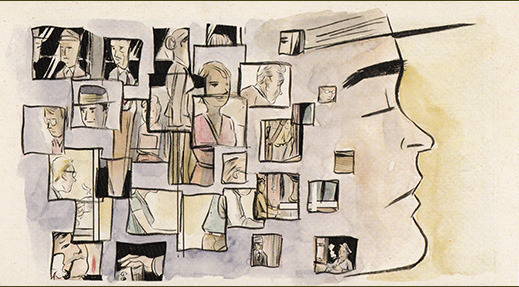
On the back of Matt Kindt's Red Handed, there is a single endorsement for the book: "Matt Kindt is the man." Offered by Junot Diaz, one of the Third Millennium's first crop of kick-ass authors, we aren't given any context for whether this is just a general appraisal or if this was the summary of Diaz' remarkably elegant 2500-word discussion of Red Handed itself. I was a little suspicious (having been born in the early '70s and therefore in the tail-end cutoff for Generation X, suspicion is my natural state). Chalk it up to years of being lied to by marketing and media or maybe just to envy for the fact that Junot Diaz 1) hasn't declared me The Man and 2) likely is so unaware of who I am that point 1) is as likely as winning the lottery without playing. I thought "Matt Kindt is the man" was pretty weak so far as endorsements go. But then I asked my wife what she thought after she finished reading this book a few days ago. She basically reiterated Junot Diaz, albeit using completely different words:
"He's... he's some kind of genius, isn't he?"
And as it turns out, they're both right, Diaz and my wife. Kindt's mind twists and turns in a way that is perfectly in tune with the kind of narrative goodies he regularly delivers in his books. I first encountered Kindt's work with Super Spy , which stands shoulder-to-shoulder in a tie for my favourite piece of espionage fiction with John le Carré's The Spy Who Came in from the Cold. Ever since, I have never been disappointed with the magic he so carelessly weaves through his stories.
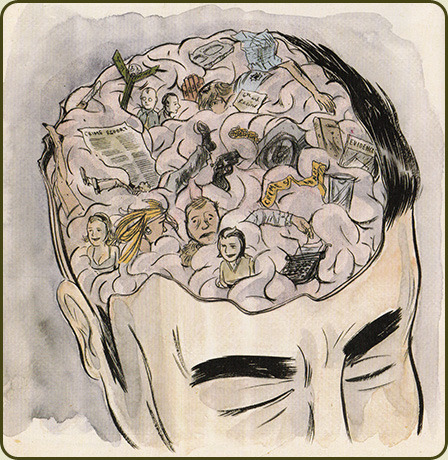
[Matt Kindt includes the inside of his head in this book.]
While very different from Super Spy structurally,1 Red Handed does something similar in terms of taking several disparate threads and weaving them together into a satisfying whole. The stories of strange criminals start and stop, each concluding with the perpetrator being cuffed by the city's super detective, Gould. These are interleaved with artless sections of dialogue. It takes a while to apprehend the pattern—but when one does, it's hard not to stop and think "Heh" or "Little scamp" or "Whoa" in that kind of way that offers a silent congratulations to Kindt for letting us take part in this twisting genius.
Beyond the conceit of the Twist—that moment in the storytelling when the author turns the tables on the reader and turns the story they were reading into another story entirely—Kindt's structure for Red Handed allows him to effortlessly break off from his story and engage in a little bit of philosophical discussion about the nature of crime and law. Often in ambitious literary work, these excursions are narrative cheats that authors use to force-feed some added value into what would otherwise be a pretty mundane set of plot paces. While I was nervous for a time that Kindt had stepped into that common trap, Red Handed vindicates itself and Kindt uses these discussions to inform the story and enrich the reader's participation in its conclusion. In fact, Kindt's finale would be hollow without the ranging conversation that governs it.
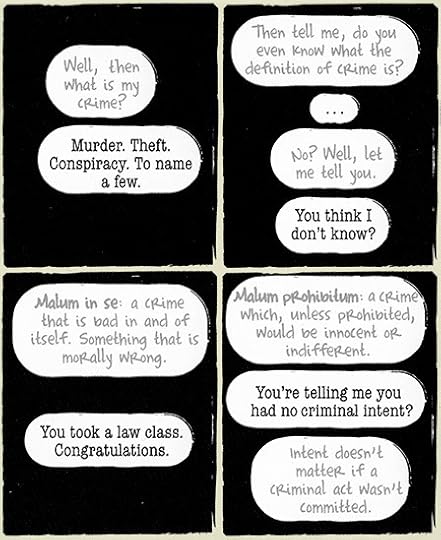
[You know what else isn't a crime? Skateboarding.]
I haven't yet read Mind MGMT (though I'm looking forward to it2), but of Kindt's other works I cannot decide between Super Spy and Red Handed as my favourite. Both are complex, valuable, and worth your time. It's possible that Red Handed may be the more ambitious. I don't know. I'll probably just have to reread both to make sure. And that's not an event I'll dread by any means. Matt Kindt is one of my favourite creators and I can't imagine a time when I stop anticipating what he'll produce next. Because: as it turns out this man really is some kind of genius, isn't he?
A Note about Perfection
While I think Red Handed is a good book, a great book, and maybe even a fantastic book, it is not a perfect book. What is really, I know, right? Still, while Kindt continues to hone his craft, I'd like to talk briefly about his path so far (as presently culminating for the moment in Red Handed).
Kindt, the some-kind-of-genius that he is, strikes me as foremost an Idea Man. Everything he's shown us so far paints him as prodigiously imaginative. He has big ideas for his overarching story, for the forms those stories take, and for some of the intricacies of how his pages and panels will lay out.3 I don't look for any improvement on his part in this area. He has, so far as I'm concerned, arrived. If not perfect for what he's doing, his ideas are close enough that we mere mortals cannot distinguish well enough to complain.
The area where I'd most like to see continued improvement is in the way he uses his art. Before even beginning down this road, I'd like to clarify that I think his art is good and enjoyable. With that, let me flesh this out just a tiny bit.
Kindt's art is indubitably unique to the current expression of the medium. He uses a kind of lumpy brushwork that allows him to stretch perspective and exaggerate anatomy such that he can engage in the kind of forced focus that his idea-play sometimes requires. With a crisper, more defined and realistic style, these visual ideas would break down and the reader would be distracted by the sort of uncanny-valley experience that naturally occurs by bending perspective. I love this about his art and the way he employs it. His style allows him to do things impossible for whole swaths of other creators.
The style does have a weakness, however, in that its looseness means interpreting panels can be difficult. There are times at which, because of the subject Kindt chooses to pursue, more detail is required in order to understand panel progression at a liquid speed with which readers are comfortable. Here's an example:
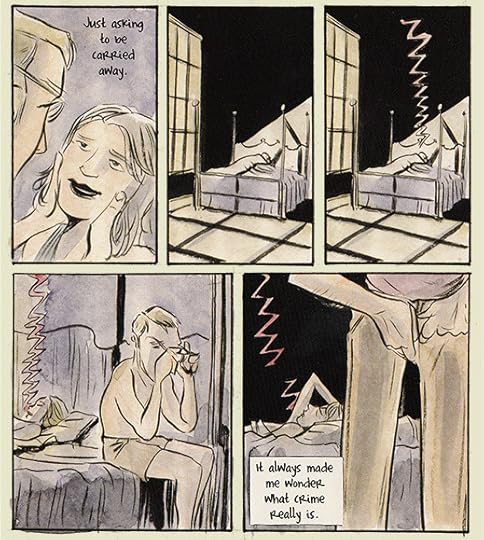
My presumption is that across these five panels we're meant to read a single chronological sequence. You have the man seducing the woman who then falls asleep and then into a deeper sleep and then he sits on the edge of the bed and then dresses. I think that's how we're to read it, but I'm not certain. There are issues with that reading. The chief problem is that in the two panels in which the woman sleeps and then sleeps more deeply (indicated by the stream of Zs incensing up from her head), the woman sleeps alone. The man is not present in the bed with her. Suddenly, he sits in underwear on bed's edge and presumably (under my interpretation) is putting on his glasses. In the next he is dressed, but the woman's position is changed and her elbow is elevated—not usually a position associated with deep sleep.
There are other possible interpretations for what's going on across those panels, but as a reader I'm not convinced that I should pursue trying to make those readings fit the revealed story because I can't be sure these inconsistencies aren't just part of the nature of Kindt's loose style. They do strike me as odd and prompt me to look for a non-sequential reading, but I'd prefer more visual cues to justify exploring that path.
So while I enjoy Kindt's art and style and use of those two expressions to breath life into his stories, I guess I'd like to see more care in how he uses these things to tell his stories. I'd like to see him better govern what makes it into his panels, taking into account the strengths and weaknesses of his chosen style. He's not bad by any stretch. I'd just like to see improvement for the sake of clarity.
A Note about the Cover
 Click for larger]
It's easy to gloss over the design of dust jackets. Generally, they're simply meant to catch an eye and sell a book. Red Handed's cover may be intended for that purpose too, but what I like about it is the story it tells when one compares its front to its back. Specifically, on the frontside we see a woman slip a somethin-somethin' into a man's hot beverage while he reads the paper. On the rear we see the man about to sip from that same beverage and we are tipped by the death's head lifting from the drink's steamy vapour that the man's time will soon draw to a close. His companion is gone by this point and several minutes have passed, since on the front we see the chair-thief arguing with the cook (screwdriver in hand) and on the back we see her carrying her kidnapped barstool.
As well, the book's title and subtitle are presented as being part of the window of the diner in which the couple sits. On the front cover, the subtitle reads The Fine Art of Strange Crimes. On the rear and in reverse since our perspective has shifted to inside the diner, the subtitle changes to How to Commit the Perfect Crime.
None of this is a big deal. Just a bit of trivial fun.
_____________________
Foot Notes
1) In Super Spy, Kindt's framework presented the stories of twenty or so characters chopped up and dischronologized. It's only as you travel through the book that you begin to recognize that the stories of these spies aren't parts of a larger collection of short stories but bits and pieces of one larger tale.
2) I've mentioned it elsewhere, but I no longer purchase comics in their individual chaptered form. Budgetary concerns combined with my lack of patience with serialization means that I only encounter comics stories through collections—and Mind MGMT's first collection is still a month off.
3) One instance on this last point. In 3 Story, Kindt draws a soldier being shot through the eye and uses the comics form to chart the path of the bullet through the topography of the man's head and neck. It was unnecessary but somehow adds to the reader's experience of his death.
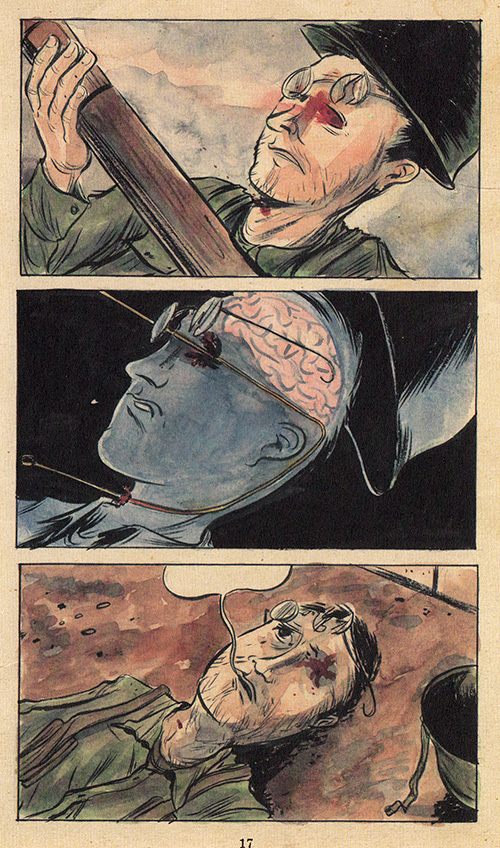
(click for larger)
_____________________
[Review courtesy of Good Ok Bad.]

November 29, 2013
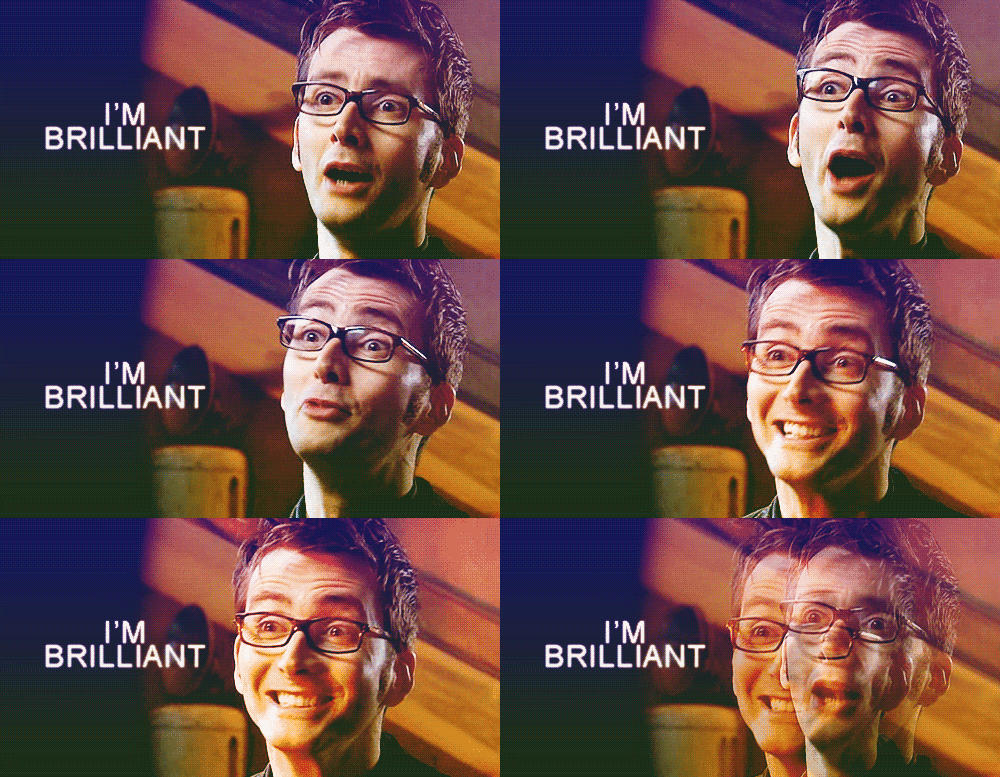
...is what this book tries to scream. It has the classic (sin city/pulp fiction) noir vibe and while the interlude pieces help tie in some chunks of the story---there are still parts that leave the reader a twinge surprised at the twist of events in the conclusion...overall, I'm not really sure what to take away from it.

Absolutely, no idea. I was hooked on these strange crimes as a lot of these egotistical criminals commit crimes that seemed strange and albeit somewhat petty until you met the mastermind. I really would like to talk out the philosophy behind these strange crimes and see if I could work out the themes/messages the author was trying to convey. I really thought this book could have been an absolute stroke of genius, and even though I was hooked and highly entertained----in a philosophical sense.... the anticipation was much better than the actual execution of the book. [no pun intended.]

I have no idea what to really think. That baffles me----so I felt it wrung out enough emotion to deserve some pretty high marks in the literary feeling department.

June 1, 2013
Absolutely phenomenal, and rewards multiple readings. My favourite work from Matt Kindt since Super Spy.

July 11, 2019
Well this may be most creative detective story ever.
What’s it about?
Hard to describe properly. It involves a detective who solves even the most perfectly planned crimes. However there’s a lot more to it, it’s very weird and suspenseful and JUST READ THE REST OF THIS REVIEW AND THE BOOK ITSELF!
Pros:
The story is very interesting. Kindt is very creative with something that at first seems like such a simple plot (it’s not though) and it’s amazing.
The art is very well done. Kindt’s art style suits this book perfectly and it looks fantastic. Very similar to Mind MGMT but actually a bit better (which is saying something considering how much I love the art in Mind MGMT)
The characters are interesting and well written.
There’s some good scenes of intense action.
This book is very suspenseful.
There’s some good, sorta subtle moments of comic relief (example: which I’m not sure if it’s coincidence or not but it’s funny. Also, the “exercise your demons” panel).
The narrative is very well done and creative.
This book is weird but still makes sense.
The message is interesting.
Why not 5 stars?
The ending. No, not when or when that would actually be a solid way to end it. I’m thinking of the very end.
Notable:
The newspaper parts. Normally I’m against mixing formats in a book but in this it’s only some very short snippets and is essential to the storytelling so I’ll give it a pass.
Overall:
So fucking close to 5 stars!
The storytelling and story itself are absolutely fascinating, the characters are interesting the art is fantastic, it’s super suspenseful and has good moments of action and comic relief.
Highly recommended especially if you want a comic that is very different.
4/5
What’s it about?
Hard to describe properly. It involves a detective who solves even the most perfectly planned crimes. However there’s a lot more to it, it’s very weird and suspenseful and JUST READ THE REST OF THIS REVIEW AND THE BOOK ITSELF!
Pros:
The story is very interesting. Kindt is very creative with something that at first seems like such a simple plot (it’s not though) and it’s amazing.
The art is very well done. Kindt’s art style suits this book perfectly and it looks fantastic. Very similar to Mind MGMT but actually a bit better (which is saying something considering how much I love the art in Mind MGMT)
The characters are interesting and well written.
There’s some good scenes of intense action.
This book is very suspenseful.
There’s some good, sorta subtle moments of comic relief (example: which I’m not sure if it’s coincidence or not but it’s funny. Also, the “exercise your demons” panel).
The narrative is very well done and creative.
This book is weird but still makes sense.
The message is interesting.
Why not 5 stars?
The ending. No, not when or when that would actually be a solid way to end it. I’m thinking of the very end.
Notable:
The newspaper parts. Normally I’m against mixing formats in a book but in this it’s only some very short snippets and is essential to the storytelling so I’ll give it a pass.
Overall:
So fucking close to 5 stars!
The storytelling and story itself are absolutely fascinating, the characters are interesting the art is fantastic, it’s super suspenseful and has good moments of action and comic relief.
Highly recommended especially if you want a comic that is very different.
4/5

March 17, 2018
I first became acquainted with Matt Kindt’s work through his eccentric Dark Horse comic Mind MGMT, which I ended up reading compulsively in the last year or so of its original serialization. It had a vagueness to it that heightened its drama. Later, I followed him into Valiant’s Divinity, a kind of next level superhero saga, where it wasn’t superheroics at all that was in question, but the nature of the hero’s existence. It featured a kind of Doctor Manhattan, one of the featured characters of Alan Moore’s famous superhero deconstruction Watchmen. Where Moore questioned the existence of superheroes in general, Kindt wonders what goes on inside the mind of someone like that, period. His judgment has less to do with good and evil, more to do with understanding what is out of one’s control, no matter the power they possess, and why.
And really, that’s what you need to know about Matt Kindt. If there were already movies being made out of his comics, you’d completely understand. He’s the guy making the kind of comics that movies have been doing since about the time M. Night Shyamalan and Christopher Nolan, the inheritors of Quentin Tarantino’s revolution, came around. He isn’t writing stories, he’s writing commentaries on stories. If George Lucas and Steven Spielberg made b-movies popular material, this is storytelling that’s in essence making popular material cerebral.
Because Red Hands is essentially Dick Tracy. Kindt all but makes that clear. He glosses over everything that would make it obvious, because this is not a pastiche, it’s an attempt to find out what it’s all about, what it says about the human condition. It’s the ending, really, what could’ve been the setup for some other story (you’ll see how that’s really what Tarantino, Shyamalan, and Nolan have been doing, now that I pointed it out), that makes it worth it. Kindt’s detective meets his match and makes a fateful decision.
Now, I don’t know. I wish he’d have ended it with that decision, rather than let us see the hero essentially agree that the villain was right. It’s natural, at this point, to expect someone to figure out what happened. The whole story is technically about how he never let anyone get away with crime. He was an outlier, sure, presiding over a ten year streak of solved cases.
Regardless, I think it would’ve made for a stronger ending if that ending had been hinted at in the beginning. Forget whether or not he still gets to get away with it, whether he ends up agreeing with the villain. Classic storytelling is about knowing the whole shape of the story.
Well, the movie would fix that. In the meantime, this is still a great way to experience Matt Kindt.
————
Read this a second time. I still don’t think Kindt nailed it. Less worried about Detective Gould being a Dick Tracy analog. Reads more like a testament to the modern age of mindless ambiguity, where the constructs of order are meant to give way to justifying all manner of selfish activities. And that ending is exactly the kind of summation we’ve reached to this point, even ten years later. So: Yay for humanity, I guess…
And really, that’s what you need to know about Matt Kindt. If there were already movies being made out of his comics, you’d completely understand. He’s the guy making the kind of comics that movies have been doing since about the time M. Night Shyamalan and Christopher Nolan, the inheritors of Quentin Tarantino’s revolution, came around. He isn’t writing stories, he’s writing commentaries on stories. If George Lucas and Steven Spielberg made b-movies popular material, this is storytelling that’s in essence making popular material cerebral.
Because Red Hands is essentially Dick Tracy. Kindt all but makes that clear. He glosses over everything that would make it obvious, because this is not a pastiche, it’s an attempt to find out what it’s all about, what it says about the human condition. It’s the ending, really, what could’ve been the setup for some other story (you’ll see how that’s really what Tarantino, Shyamalan, and Nolan have been doing, now that I pointed it out), that makes it worth it. Kindt’s detective meets his match and makes a fateful decision.
Now, I don’t know. I wish he’d have ended it with that decision, rather than let us see the hero essentially agree that the villain was right. It’s natural, at this point, to expect someone to figure out what happened. The whole story is technically about how he never let anyone get away with crime. He was an outlier, sure, presiding over a ten year streak of solved cases.
Regardless, I think it would’ve made for a stronger ending if that ending had been hinted at in the beginning. Forget whether or not he still gets to get away with it, whether he ends up agreeing with the villain. Classic storytelling is about knowing the whole shape of the story.
Well, the movie would fix that. In the meantime, this is still a great way to experience Matt Kindt.
————
Read this a second time. I still don’t think Kindt nailed it. Less worried about Detective Gould being a Dick Tracy analog. Reads more like a testament to the modern age of mindless ambiguity, where the constructs of order are meant to give way to justifying all manner of selfish activities. And that ending is exactly the kind of summation we’ve reached to this point, even ten years later. So: Yay for humanity, I guess…

January 8, 2014
Kind of like one of those heist movies where the story comes together.
I don't like those movies very much.
They can be fun. The Usual Suspects was a pretty gutsy move in storytelling. But it worked. The Richard Stark novels are a blast.
With this, I don't know. To be honest, I didn't even know that these stories were supposed to wrap up to a big ending. I don't think I'm spoiling anything here. But I don't actually know! That's the whole thing. I'm not sure if it was obvious that there was a big story at play here and I'm just thick, or if that's supposed to be a shock. I can't actually say whether I was supposed to know that there was a setup of sorts going on or not.
Another thing, I think the art is good, but I had some trouble telling characters apart. There were two male characters and two female characters who looked quite a bit alike. At one point I was flipping around trying to figure out whether a character was having an affair or not because I wasn't sure which guy I was looking at.
The mini stories within the story were pretty good. The various weird crimes, that was some interesting stuff. But the connective tissue just didn't do it for me.
I don't like those movies very much.
They can be fun. The Usual Suspects was a pretty gutsy move in storytelling. But it worked. The Richard Stark novels are a blast.
With this, I don't know. To be honest, I didn't even know that these stories were supposed to wrap up to a big ending. I don't think I'm spoiling anything here. But I don't actually know! That's the whole thing. I'm not sure if it was obvious that there was a big story at play here and I'm just thick, or if that's supposed to be a shock. I can't actually say whether I was supposed to know that there was a setup of sorts going on or not.
Another thing, I think the art is good, but I had some trouble telling characters apart. There were two male characters and two female characters who looked quite a bit alike. At one point I was flipping around trying to figure out whether a character was having an affair or not because I wasn't sure which guy I was looking at.
The mini stories within the story were pretty good. The various weird crimes, that was some interesting stuff. But the connective tissue just didn't do it for me.

August 7, 2015
Kindts narrative complexity is a delight, like a complex puzzle. Most graphic novels can be happily consumed at one sitting but this book demands immediate re-reading (and several more in my case). He writes beautifully too. I can't be so enthusastic about his art, which I find shallow and scratchy. And I wish he did not indulge in the faddish cliche of comics inside comics, or faux aging. Still, he is ALWAYS worth reading and I would not say that of many comics creators.

December 18, 2021
Schön verwebte Crime-Story. Episodenhaft erzählt und letztlich greift alles schön in einander. Das Medium „Comic“ hervorragend genutzt.

January 17, 2014
This was an interesting piece that I enjoyed reading, but I'm not sure Kindt pulled it off. Because his characters were all kind of generically drawn, it was hard to distinguish between them and connect the dots in time for the big reveal. (Like, if you're going to have a book full of white people, make the white people different shades of white or give them cute hair or something?) I thought the story would be more interesting in a form other than a graphic novel, though there were several moments that worked especially because of the unusual format. So, what sort of rating do you give to an enjoyable, unworkable graphic novel? I guess I liked it.
Also, nitpicky for sure, but a big issue in readability. The eight pages that were arranged horizontally and across the fold were a pain in the ass. I didn't know which panels to read first. The art slipped into the crease. It was jarring, especially in a book with a relatively ungimmicky layout before and after this section. I didn't see any merit in making the reader turn the book.
It's interesting that the jacket blurb calls this a "fascinating homage to classic detective fiction" as the detective's super detective power seemed to be
Also, nitpicky for sure, but a big issue in readability. The eight pages that were arranged horizontally and across the fold were a pain in the ass. I didn't know which panels to read first. The art slipped into the crease. It was jarring, especially in a book with a relatively ungimmicky layout before and after this section. I didn't see any merit in making the reader turn the book.
It's interesting that the jacket blurb calls this a "fascinating homage to classic detective fiction" as the detective's super detective power seemed to be

January 28, 2013
What do a chair thief, a elevator repairman's stealthy photos, and pick pocket have to do with each other?
Matt Kindt is smart.
All of his books that I've read convey a definite intelligence - a complexity of thought - a depth of meaning. This story is a study of crime - theft, specifically. We witness a series of thefts with a crazy variety of motivations and methods. It all wraps around and connects, and along the way we philosophize about why people steal and when an act becomes wrong and a host of other similar quandaries.
I connected with this much more than the previous works I've read by Kindt. Maybe because as he matures he gets better, maybe because this features art (a pet topic of mine), and maybe because I like mysteries. Literature definitely plays a role at various points as well. The story culminates satisfactorily, and I believe that the more times I read this, the more I would get out of it.
It would make a good TV series. Kindt mixes various methods of illustration together and changes up his panel setup well. The guy's a big name, deservedly.
Matt Kindt is smart.
All of his books that I've read convey a definite intelligence - a complexity of thought - a depth of meaning. This story is a study of crime - theft, specifically. We witness a series of thefts with a crazy variety of motivations and methods. It all wraps around and connects, and along the way we philosophize about why people steal and when an act becomes wrong and a host of other similar quandaries.
I connected with this much more than the previous works I've read by Kindt. Maybe because as he matures he gets better, maybe because this features art (a pet topic of mine), and maybe because I like mysteries. Literature definitely plays a role at various points as well. The story culminates satisfactorily, and I believe that the more times I read this, the more I would get out of it.
It would make a good TV series. Kindt mixes various methods of illustration together and changes up his panel setup well. The guy's a big name, deservedly.

August 26, 2015
Brilliant mystery of events leading up to "the reveal." A woman who steals chairs, an author writing an unusual book, a pickpocket magician, a know-it-all cop. Just fascinating storytelling. I intend to read this again sometime soon.
I'm not one to say "make a movie of this book," but if anyone could do it, I'd love to see the Cohen Brothers make it.
I'm not one to say "make a movie of this book," but if anyone could do it, I'd love to see the Cohen Brothers make it.

October 22, 2021
This is a strange book.
It took a while to get into, and I still don’t think I’ve fully digested all of the nuances of the story… but it was fascinating. I would call this a study of human nature and morality, and how those two concepts interact. The structure took getting used to, but once it clicked for me, it remained securely “clicked.”
The art was also very different… but it’s exactly what the book called for. This was a thought provoking read, and I’ll probably revisit it again some day.
It took a while to get into, and I still don’t think I’ve fully digested all of the nuances of the story… but it was fascinating. I would call this a study of human nature and morality, and how those two concepts interact. The structure took getting used to, but once it clicked for me, it remained securely “clicked.”
The art was also very different… but it’s exactly what the book called for. This was a thought provoking read, and I’ll probably revisit it again some day.

March 12, 2018
Primera vez que en cuanto terminé... regresé a la primera página para volver a leer el libro completo. No porque el final fuera confuso; al contrario: porque habiéndolo comprendido, y con esa información al inicio de la obra, hacía que la experiencia de lectura fuera completamente diferente. La premisa es muy original: ¿Puede alguien ser acusado de un crimen que fue consecuencia de las consecuencias de un acto no criminal o ilegal? Y para hacerlo aún más interesante, mi ejemplar está firmado - ¡y quemado! - por el autor: al terminar de firmarlo, le pidió un encendedor a su esposa, eligió una página concreta, quemó completamente la esquina y me dijo "cuando lo leas, lo entenderás" :)

August 11, 2024
3.75 stars. This book is one thing until you hit a point in the story and then it becomes something completely bigger than what it had been in the best ways. I enjoyed both sides of this story as a fun and interesting way to tell story about crime and mysteries, but the way the story ended shows that this one was much more than just a quick, fun read. I enjoyed the depth here.
September 1, 2024
This fast-paced, twisty graphic novel mystery was a great way to close out of month. I've typically done graphic novel nonfiction or retellings or narrative works, so this was a fun change of pace. I'd definitely read this author again.
Read it because:
Impulse borrow from the library
Read it because:
Impulse borrow from the library
May 22, 2017
this was interesting enough to keep reading after twenty pages even though the art was distracting, by the end of the book it became one of the best mystery novels i've ever read. everything is in this book for a reason, all the stories are part of a larger story. brilliant.

January 20, 2022
I found this book very interesting. I enjoyed the art style and I loved how it all came together in the end.

April 20, 2013
Detective Gould is the greatest detective in the world, there’s no crime he can’t solve thanks to his mind and cutting-edge spy technology. Every criminal in the city of Red Wheelbarrow is caught red handed. But lately...there have been a series of crimes that while solved, leave Detective Gould stumped as to the why behind them. Will he discover the connection between the chair thief, the purloined street sign used to create a literary opus, and the photographer of anguished moments? Or has the great Detective Gould finally met his match?
When I’m sitting down to describe this book the thoughts that pop into my head are old school film noir detective meets a grownup Encyclopedia Brown. Why Encyclopedia Brown? Well just the way Detective Gould goes about catching his man using the tools at hand and his ability to piece together random clues using his intellect. Granted he hasn’t pieced together the biggest mystery, but he’ll get there. Film noir because there’s this great element of old school literary feel to the novel. This isn’t one of those novels where you just get told the story and you figure it out by page 12...no. This is one of those books where you’re handed clues and by the time you’re almost done with the story you’re realizing that everything is connected and it wasn’t what you thought it was at all.
Matt weaves together a great literary story, one that keeps you on the edge of your seat wondering what the signs have to do with a painting and what all that has to do with chairs being stolen. It all seems so random and yet by the end you’re almost left wondering if you could have solved it without being told, so you read the story again and discover there were still things that you missed and you kinda of have to conclude that Matt’s story is almost too good to be true.
Matt’s artstyle is...a bit different. The bulk of the art is done in a soft watercolor palette, almost making it feel like we’re reading a weathered book from the 30’s/40’s when Dick Tracey first patrolled the streets. And it draws you into the story and doesn’t let you go. Then there are other parts, the little side stories like “Tess’s True Heart” where we can still see the blue pencil lines from sketching and it seems like the story is unfinished and it throws me off a bit.
Overall though this is a story that will keep you reading and wondering to the very last page. I give the book 4 out of 5 stars.
ARC provided by Gina at FirstSecond
When I’m sitting down to describe this book the thoughts that pop into my head are old school film noir detective meets a grownup Encyclopedia Brown. Why Encyclopedia Brown? Well just the way Detective Gould goes about catching his man using the tools at hand and his ability to piece together random clues using his intellect. Granted he hasn’t pieced together the biggest mystery, but he’ll get there. Film noir because there’s this great element of old school literary feel to the novel. This isn’t one of those novels where you just get told the story and you figure it out by page 12...no. This is one of those books where you’re handed clues and by the time you’re almost done with the story you’re realizing that everything is connected and it wasn’t what you thought it was at all.
Matt weaves together a great literary story, one that keeps you on the edge of your seat wondering what the signs have to do with a painting and what all that has to do with chairs being stolen. It all seems so random and yet by the end you’re almost left wondering if you could have solved it without being told, so you read the story again and discover there were still things that you missed and you kinda of have to conclude that Matt’s story is almost too good to be true.
Matt’s artstyle is...a bit different. The bulk of the art is done in a soft watercolor palette, almost making it feel like we’re reading a weathered book from the 30’s/40’s when Dick Tracey first patrolled the streets. And it draws you into the story and doesn’t let you go. Then there are other parts, the little side stories like “Tess’s True Heart” where we can still see the blue pencil lines from sketching and it seems like the story is unfinished and it throws me off a bit.
Overall though this is a story that will keep you reading and wondering to the very last page. I give the book 4 out of 5 stars.
ARC provided by Gina at FirstSecond

June 28, 2013
A great visual experience, it is possible that if I read this carefully and then re-read it that I would also be blown away by how the masterful plot all came together, but as it was while I was interested in and enjoyed stretches of it I often couldn't follow it. I'm willing to admit that might be my fault, but still detracted from my own experience with the book.
Red Handed centers around a detective (Gould) who has never failed to solve a crime and a series of "strange" crimes including a woman who steals chairs (including the electric chair from the penitentiary), a woman who steals street signs to compose an epic novel on the wall of warehouses about sentient mice, and a more conventional thief. These all become increasingly related with a plot twist at the end that sort of brings them all together. But it was often hard to keep the different episodes separate (in part due to Kindt's habit of starting new chapters several pages before the demarcation of the new chapter) and to keep the different characters separate.
Some of the writing, however, is very good and visually the combination of pen and ink brushstrokes and the layout of frames, text, etc., was very well executed.
Red Handed centers around a detective (Gould) who has never failed to solve a crime and a series of "strange" crimes including a woman who steals chairs (including the electric chair from the penitentiary), a woman who steals street signs to compose an epic novel on the wall of warehouses about sentient mice, and a more conventional thief. These all become increasingly related with a plot twist at the end that sort of brings them all together. But it was often hard to keep the different episodes separate (in part due to Kindt's habit of starting new chapters several pages before the demarcation of the new chapter) and to keep the different characters separate.
Some of the writing, however, is very good and visually the combination of pen and ink brushstrokes and the layout of frames, text, etc., was very well executed.

first-second-publications
May 8, 2013I love that this book is a graphic novel mystery.
Graphic novels are such an interesting format for mysteries -- because the pictures on the page have more permanence than something in a television show, it's easy to have meaningful visual clues for your readers.
And yet . . . there aren't a lot of graphic novel mysteries. Adventures, yes. Science fiction, yes. Memoir, yes. But mystery? Apparently it is not the favorite genre of the graphic novel readership.
That's one of the reasons we're so pleased to be publishing Matt Kindt's RED HANDED.
(The other reasons all have to do with the fact that it's wonderful! If you're looking for David Lynch + White Collar, this is an excellent choice.)
Graphic novels are such an interesting format for mysteries -- because the pictures on the page have more permanence than something in a television show, it's easy to have meaningful visual clues for your readers.
And yet . . . there aren't a lot of graphic novel mysteries. Adventures, yes. Science fiction, yes. Memoir, yes. But mystery? Apparently it is not the favorite genre of the graphic novel readership.
That's one of the reasons we're so pleased to be publishing Matt Kindt's RED HANDED.
(The other reasons all have to do with the fact that it's wonderful! If you're looking for David Lynch + White Collar, this is an excellent choice.)

January 21, 2014
This was my first try at a full-length graphic novel. I had previously read "To Teach: A Journey in Comics" by Bill Ayers. That appealed to me as a teacher and was given to me by our son, our graphics/comics/books, etc. guru so I had to ready it:-) He recommended this book as I tried it; I liked it!! I'm a huge fan of the true crime and mystery genres so this looked like a good fit for me. After adjusting my glasses for the pages with more text, I was able to "get" the conversations going on here and there. The one thing I didn't like was the newspaper reprints which directed one to a continuation on a page that I couldn't find. Joke was on me! I was a little slow on that one, but finally figured it out. It was a quick read and enjoyable.

May 5, 2013
A bit too weird for my tastes. The story is non-linear, very piecemeal, which contributes to the confusion more than the actual mystery does. I'm not sure it was successful, but it was interesting. I do like the art a lot though.
Full review: http://www.stackedbooks.org/2013/05/r...
Full review: http://www.stackedbooks.org/2013/05/r...

September 9, 2013
Odd, haunting, and complex, this was not the non-fiction collection of true crime tales I'd expected. Instead it was a strange story of odd crimes that are connected in strange ways to the life of a dedicated but dispassionate police detective. The art was very effective in some places and too loose in others, but it didn't detract much.
Recommended.
Recommended.

August 16, 2013
WHile it is not my cup of tea, I respect this book and believe there is a lot here, especially for those inclined to film-noir ponderings. It reminds me of the movie Momento. The minute one finishes it, it is necessary to start again at the beginning and read it through again.
January 12, 2014
Wow
Very original.
Multiple story lines are brought together to reveal an excellent connection and ending. The final event arranged by Tess is certainly a stretch and the art is drab or would have rated it a 5.
A must read for those who are patient and enjoy good story telling.
Very original.
Multiple story lines are brought together to reveal an excellent connection and ending. The final event arranged by Tess is certainly a stretch and the art is drab or would have rated it a 5.
A must read for those who are patient and enjoy good story telling.

May 12, 2014
An interesting book that I flew through, but I am unsure how many teens will want to read about these varied stories. All the crimes tie together at the end and the reader is left with many moral thoughts to consider.

November 20, 2013
Matt Kindt is a fantastic storyteller. His books are like interlocking puzzles that only reveal on the last page. How often do you want to start a book over immediately after you've finished it?

January 18, 2014
A true alternative in the comics medium.
Fast and loose
and yet awkward,
easy to read
and yet subtle and deep.
Clever, ...and original!
Fast and loose
and yet awkward,
easy to read
and yet subtle and deep.
Clever, ...and original!
Displaying 1 - 30 of 163 reviews