

What do you think?

Bo at Ballard Creek #1
Bo at Ballard Creek
It's the 1920s, and Bo was headed for an Alaska orphanage when she won the hearts of two tough gold miners who set out to raise her, enthusiastically helped by all the kind people of the nearby Eskimo village.
Bo learns Eskimo along with English, helps in the cookshack, learns to polka, and rides along with Big Annie and her dog team. There's always some kind of excitement: Bo sees her first airplane, has a run-in with a bear, and meets a mysterious lost little boy.
Here is an unforgettable story of a little girl growing up in the exhilarating time after the big Alaska gold rushes.
Bo learns Eskimo along with English, helps in the cookshack, learns to polka, and rides along with Big Annie and her dog team. There's always some kind of excitement: Bo sees her first airplane, has a run-in with a bear, and meets a mysterious lost little boy.
Here is an unforgettable story of a little girl growing up in the exhilarating time after the big Alaska gold rushes.
288 pages, Hardcover
First published June 18, 2013
About the author
Kirkpatrick Hill
12 books57 followersKirkpatrick Hill lives in Fairbanks, Alaska. She was an elementary school teacher for more than thirty years, most of that time in the Alaskan "bush." Hill is the mother of six children and the grandmother of eight. Her three earlier books, Toughboy and Sister, Winter Camp, and The Year of Miss Agnes, have all been immensely popular. Her fourth book with McElderry Books, Dancing at the Odinochka, was a Junior Library Guild Selection. Hill's visits to a family member in jail inspired her to write Do Not Pass Go.
Ratings & Reviews
Friends & Following
Create a free account to discover what your friends think of this book!
Community Reviews
Displaying 1 - 30 of 247 reviews

March 23, 2022
So yes, the very first thing (and right on page one too) I unfortunately noticed with regard to Kirkpatrick Hill's writing style as it presents itself in her 2013 historical fiction (1920s Alaska themed) middle grade novel Bo at Ballard Creek is that Hill's featured text reads and feels to and for me more than a bit condescending and patronising in scope and narrational tone of voice, and not to mention that there also is a somewhat preachy quality encountered at times in Bo at Ballard Creek, and so much so that both my adult self and my inner child have not at all found Bo at Ballard Creek either enjoyable or in any way reading interest retraining (so that with Kirkpatrick Hill's generally rather overly simplistic syntactic flow, in particular my inner child really has been finding Bo at Ballard Creek majorly annoying, massively frustrating and also thus awkwardly dragging).
And you know, while I of course and naturally do not have any issues at all with Jack, Arvid and little Bo being portrayed by Kirkpatrick Hill as a family with two fathers, an adopted daughter and no mother, I do majorly cringe at how lackadaisically and with no emotion at all, how strangely simplistically and matter of factly in Bo at Ballard Creek, little Bo is told why there is no "Mama" in their family unit. For honestly, even if Bo's mother did abandon her, Jack and Arvid's explanation to Bo that Bo's mother had supposedly been acting just like a female turtle by leaving her, by taking off, it just kind of rubs me the wrong proverbial way and also leaves in my opinion a somewhat negatively charged take and approach towards women in general present in Bo at Ballard Creek, and an attitude that is equally rather young adult but is shown by Kirkpatrick Hill stylistics wise as obviously meant for younger readers, so that indeed, there also is a bit of an issue and question regarding who the intended audience for Bo at Ballard Creek is truly supposed to be. Because let's face it, Kirkpatrick Hill's writing and modes of expression in Bo at Ballard Creek do pretty clearly say and indicate eight to at the maximum ten years of age, but that the themes and contents encountered in Bo at Ballard Creek, well they are often and for me meant more for considerably older readers, for teenagers and beyond.
Finally, but importantly, I seriously also do doubt that readers above the age of ten, that teenagers, that young adults would appreciate and enjoy Kirkpatrick Hill's simplistic and often preachy and talking down to her audience writing style for pleasure reading (and that ALL readers should also in my opinion find the use of the word Eskimo instead of Inuit by Kirkpatrick Hill a bit problematic and in particular so because Bo at Ballard Creek is a novel that was published in 2013, at which time it was already majorly considered politically incorrect to textually make use of the word Eskimo to describe the Native populations of Alaska, the Yukon etc.).
And you know, while I of course and naturally do not have any issues at all with Jack, Arvid and little Bo being portrayed by Kirkpatrick Hill as a family with two fathers, an adopted daughter and no mother, I do majorly cringe at how lackadaisically and with no emotion at all, how strangely simplistically and matter of factly in Bo at Ballard Creek, little Bo is told why there is no "Mama" in their family unit. For honestly, even if Bo's mother did abandon her, Jack and Arvid's explanation to Bo that Bo's mother had supposedly been acting just like a female turtle by leaving her, by taking off, it just kind of rubs me the wrong proverbial way and also leaves in my opinion a somewhat negatively charged take and approach towards women in general present in Bo at Ballard Creek, and an attitude that is equally rather young adult but is shown by Kirkpatrick Hill stylistics wise as obviously meant for younger readers, so that indeed, there also is a bit of an issue and question regarding who the intended audience for Bo at Ballard Creek is truly supposed to be. Because let's face it, Kirkpatrick Hill's writing and modes of expression in Bo at Ballard Creek do pretty clearly say and indicate eight to at the maximum ten years of age, but that the themes and contents encountered in Bo at Ballard Creek, well they are often and for me meant more for considerably older readers, for teenagers and beyond.
Finally, but importantly, I seriously also do doubt that readers above the age of ten, that teenagers, that young adults would appreciate and enjoy Kirkpatrick Hill's simplistic and often preachy and talking down to her audience writing style for pleasure reading (and that ALL readers should also in my opinion find the use of the word Eskimo instead of Inuit by Kirkpatrick Hill a bit problematic and in particular so because Bo at Ballard Creek is a novel that was published in 2013, at which time it was already majorly considered politically incorrect to textually make use of the word Eskimo to describe the Native populations of Alaska, the Yukon etc.).
December 30, 2016
I started reading this book to see if it would be a story my students would enjoy, the cover and illustrations are quite inviting. Unfortunately I put it down a few chapters in. The book is geared for 8-12 year olds, that's second grade to sixth grade, and I don't find it appropriate for my students. There are to many "damns" and "hells" and descriptions of professions "good time girls" that do not need to be explained to elementary children. The author writes well but I cannot in good conscious recommend this book to my students within the classroom setting. If they find it on their own, at the public library, that's a different story. This isn't a YA novel, where I wouldn't be surprised with certain topics addressed, this is a book that is marketed for children. Parents, I recommend that you read this story first before you allow your child/children to read it.
June 25, 2013
This little book is just about perfect. It is simple, straight forward and easy to read. Others have compared it to Little House on the Prairie and I can understand that comparison. For many, Little House feels like home. For me, this novel, set in my childhood home of Alaska, feels like home. It is definitely a book for young readers - probably 3rd to 5th grade, as the action is not very fast paced. But that is okay - not very book has to be action packed. It is quiet and sweet and gives kids an idea what it might have been like to live in a mining camp in Alaska around 1930. The main character is only 5, but that gives her the chance to interact with the other characters in a pure and genuine manner.

August 14, 2017
This is a very odd little book. It is clearly directed at children, probably in the 8-10 range. The cheerful tone, simple language, anecdotal style, illustrations, and young protagonist all support this. However, reading it as an adult, well . . . this is an accurate summary of what happens in the initial chapters with only the wording changed: A prostitute gets pregnant. She has the baby, states explicitly that she is not going to allow her life to be ruined by a child, and abandons the baby through the mechanism of handing the infant to a miner she knows will pass by an orphanage on the way to his new mining camp. She then immediately gets on a boat headed the opposite direction and is never heard from again. The miner, Arvid, a Swede who happens to do side work as a seamstress making clothes, and his "partner", Jack, an African American man who is a cook and appears to have OCD, decide instead to adopt the baby. "That's your baby?" Arvid is asked upon arrival at Ballard Creek. "It's our baby" he states emphatically. Arvid and Jack then proceed to embody the "It takes a village" philosophy raising Bo with gentleness and love and the help of a couple ex-prostitutes, a marshal who's best quality seems to be the ability to turn a blind eye to all the moonshine being made, and the entire population of the small Eskimo [sic] village near the mining camp.
I very much enjoyed the strangeness.
I very much enjoyed the strangeness.

August 7, 2013
Yup, as Wendy promised, this was a delightful book written FOR kids instead of AT them. Hill's authorial eye has the ability to focus on the detail in the scene that is most interesting to a kid, and pull it to the forefront, look at it from several angles, and then move on. I love the setting, I love the time period, but most of all, I love the characters. Some of the background characters sort of blend together, but for the most part each quirky individual shines in their own particular way. Highly recommended.

July 20, 2013
I've never been to Alaska, but this delightful chapter book evoked such a strong sense of place and introduced such interesting characters that I felt as though I'd been there. When I reached the last page, I felt sad to leave the world of 1920s Ballard Creek after the gold rush had died down. The book tells the story of five-year-old Bo, left behind and intended to be dropped off at an orphanage by her mother, one of the good time girls. But two burly mine workers with hearts of gold, Jack and Arvid, simply can't bear to leave her there. Instead, the two become her fathers, and along with the rest of the town, including men and women from the nearby village and the boys who work in the mine, they form a family. Bo is delightfully precocious and outspoken, and she pulls her own weight as well. Readers will be just as charmed by her personality as everyone else around her is. Even in the secluded area where Bo lives, there is always something going on, and the author describes the arrival of the mail bags, Fourth of July celebrations, an encounter with a grizzly, the flight of a plane, and much good food and fellowship. Even the descriptions of how the villagers keep reading the same magazines and coping with extremely cold weather make readers respect these characters even more. The illustrations capture the personalities of Bo and her benefactors perfectly. This title is meant to be shared with a cherished someone.

August 23, 2017
I really enjoyed this one!
Set in 1929, we don't really know how old Bo is. We only know that she is too young to attend school. Set at a mining camp in a small town in Alaska, each chapter is its own little sweet story about what happens to Bo or the various townspeople through the course of a year.
With short chapters and darling illustrations by LeUyen Pham, it's an easy one to read, set down, and read again when one has time. Give this one to fans of Louise Erdrich's Birchbark House series, Laura Ingalls Wilder's Little House series, or those who are fascinated by all things Alaska.
Set in 1929, we don't really know how old Bo is. We only know that she is too young to attend school. Set at a mining camp in a small town in Alaska, each chapter is its own little sweet story about what happens to Bo or the various townspeople through the course of a year.
With short chapters and darling illustrations by LeUyen Pham, it's an easy one to read, set down, and read again when one has time. Give this one to fans of Louise Erdrich's Birchbark House series, Laura Ingalls Wilder's Little House series, or those who are fascinated by all things Alaska.

June 13, 2020
An abandoned baby is raised by two miners in an isolated mining town in Alaska. As she grows, she is curious about all around her, and that way we learn about mining in the winter, sluicing gold in the summer, and the big events in town such as the arrival of the airplane in summer, the mail sledge in winter, and the finding of a little boy whose trapper father has died in the wilderness.

May 26, 2017
The illustrations were absolutely gorgeous and are the reason I picked this book up in the first place. It's too bad the text wasn't as wonderful as the pictures!
This is supposedly geared for kids aged 8-12, but I didn't feel the content was appropriate. I had to edit a lot of this book while reading it out loud to my nieces.
There is quite a bit of profanity (something that I don't like even in adult reads, but is completely unacceptable in a children's book). There are references to "good time girls," cannibalism, and a paragraph stating how much the children liked to look at National Geographic magazines to see the photos of naked people. (Why include this...?)
There is also an underlying anti-Christian theme. In addition to the evolution references and the instances of God's name taken in vain (which aren't terribly uncommon in any book), at one point a character says, "If there's a heaven, which I doubt..." (p.153) And when the school is described, it's contrasted with a Christian school and the author states, "At the mission school, they had learned nothing but the catechism and Bible verses, which they didn't think were very useful." (p. 186)
The book had no plot, but was written more "memoir" style - each chapter was a little story of what happens in Ballard Creek and descriptions of the people who lived there. Normally, I like this kind of book, but I think that they need to have a strong theme that connects the stories, and this book lacked that.
This is supposedly geared for kids aged 8-12, but I didn't feel the content was appropriate. I had to edit a lot of this book while reading it out loud to my nieces.
There is quite a bit of profanity (something that I don't like even in adult reads, but is completely unacceptable in a children's book). There are references to "good time girls," cannibalism, and a paragraph stating how much the children liked to look at National Geographic magazines to see the photos of naked people. (Why include this...?)
There is also an underlying anti-Christian theme. In addition to the evolution references and the instances of God's name taken in vain (which aren't terribly uncommon in any book), at one point a character says, "If there's a heaven, which I doubt..." (p.153) And when the school is described, it's contrasted with a Christian school and the author states, "At the mission school, they had learned nothing but the catechism and Bible verses, which they didn't think were very useful." (p. 186)
The book had no plot, but was written more "memoir" style - each chapter was a little story of what happens in Ballard Creek and descriptions of the people who lived there. Normally, I like this kind of book, but I think that they need to have a strong theme that connects the stories, and this book lacked that.

August 6, 2013
I had to slow myself down to read this book. As a young reader, I skipped the Little House series due to (assumed, by me) lack of diversity and antiquated thinking about "settling" the American countryside (i.e. shoving off the original settlers.) So I was surprised to discover myself reading about Bo, an adopted girl, and her homesteading/mining community in Alaska. It's like Little House snuck around and got me anyway! This story meanders through the seasons and the author treats young readers with great respect as she covers life, death, loneliness, race, community, belonging, and beauty in the 1920s.
The one thing that halts me about this novel is the unexplained use of "Eskimo." The author completely circumvents the controversy around that term (last I checked, we were using Inuit–Yupik). This is especially strange since ethnic and racial diversity is explored throughout the book.
The above aside, straight-forward style and gentle humor make Bo at Ballard Creek the perfect read-aloud.
The one thing that halts me about this novel is the unexplained use of "Eskimo." The author completely circumvents the controversy around that term (last I checked, we were using Inuit–Yupik). This is especially strange since ethnic and racial diversity is explored throughout the book.
The above aside, straight-forward style and gentle humor make Bo at Ballard Creek the perfect read-aloud.

September 3, 2013
Adorable to the zillionth degree. A cozy, feel-good read that's sweet (but never cutesy), and focused on an unorthodox family and a close, caring community. (Also, lots of stuff about gold mining in 1920s Alaska, but very few kids are going to pick up this book for that reason.)
LeUyen Pham's expressive illustrations add additional charm to the story (Bo's grumpy face after having her hair curled is especially priceless), but to me, what stands out about this book is its honest portrayal of a child's emotions: Bo's feelings of sadness, fear, exuberance, and love are realistically rough-edged.
Highly recommended for kids who like slice-of-life historical fiction, as well as for readers of any age who like diverse characters, authentic details, and endearingly simple storytelling.
LeUyen Pham's expressive illustrations add additional charm to the story (Bo's grumpy face after having her hair curled is especially priceless), but to me, what stands out about this book is its honest portrayal of a child's emotions: Bo's feelings of sadness, fear, exuberance, and love are realistically rough-edged.
Highly recommended for kids who like slice-of-life historical fiction, as well as for readers of any age who like diverse characters, authentic details, and endearingly simple storytelling.

October 19, 2017
This book is nominated for a Maud Hart Lovelace award. I probably wouldn’t have picked it up otherwise and I’m glad I did. A fun, adventurous, historical fiction story that takes place in the 1920s at the end of the gold rush. Two men take in an orphan girl and together, with help from the rest of the camp, they raise her. Lots of fantastic characters and interesting storylines in the varied chapters. Kids will enjoy it.

September 21, 2013
This review also appears on my blog, Read-at-Home Mom.
When Bo was a baby, her Mama “walked away”, leaving her to be raised by two burly gold miners, Arvid and Jack. Now she is five years old, and everyone at Ballard Creek is a part of her extended family. She jokes around with “the boys” and imitates their accents. The “good-time girls” dress her up and do her hair. She speaks Eskimo along with English, and enjoys Eskimo foods such as akutaq, which is made from caribou bone marrow and fat. This book takes place over one year at Ballard Creek and tells tales of Bo’s adventures large and small. These include seeing an airplane up-close, being chased by a grizzly bear, catching pneumonia and watching her best friend go to school while she stays home. Through it all, Bo remains a buoyant and carefree little girl enjoying her childhood in late 1920s Alaska.
When I reviewed Ann M. Martin’s first Family Tree book back in April, Ms. Yingling left a comment on my blog which read, “I will have to read this, but I do wish that historical fiction would be more humorous and adventure filled. it is hard enough to get students to read it.” Though I apparently did not reply to her comment, I remember thinking that she was right. My main issue with historical fiction as a kid was that it was depressing and everyone was always getting sick or dying or suffering some other tragedy. This is why Bo at Ballard Creek was like a breath of fresh air for me. This is a kid-friendly historical fiction book that focuses on the day-to-day life of people in a particular time and place without dwelling heavily on hardship.
The age of the main character makes this a difficult book to categorize. Most middle grade readers would probably be turned off by the notion of reading about a character so much younger than themselves, but early chapter book readers don’t yet have the reading skills to tackle much of the vocabulary. While this might make the story difficult to catalogue in libraries, it also makes it a perfect family read-aloud, similar in style and tone to books by Laura Ingalls Wilder, Carolyn Haywood, and Beverly Cleary. Young readers of all ages can enjoy the ups and downs of Bo’s exciting young life, and I think they are most likely to do so when the story is shared in a family context. I haven’t heard of any plans for a sequel, but I think it would be wonderful to have more stories about Bo as she ages, so that, like Ramona, she can grow up along with her readers.
The writing alone makes Bo at Ballard Creek one of my favorite books of 2013, but the illustrations caused me to love it even more. LeUyen Pham, who also illustrates the Alvin Ho series, brings Bo’s world to life in her pen and ink drawings, which are scattered generously throughout the text. She is one of my favorite illustrators, and her pictures for this book are full of life and personality which helps immerse the reader in the unfamiliar but thoroughly interesting Alaskan setting. Pham’s artwork helps the reader keep track of the large cast of characters and also provides the necessary visual context young listeners need to help them stay focused on the story as their grown-ups read it aloud.
Author Kirkpatrick Hill based much of Bo at Ballard Creek on her own personal experiences growing up in Fairbanks, Alaska, which makes the book not just entertaining, but also reliable and authentic. Though I was not previously familiar with this author, I am pleased that she has written several other Alaskan tales for children: Dancing at the Odinochka, The Year of Miss Agnes, Toughboy and Sister, and Winter Camp, many of which look like more traditional middle grade novels. Share Bo at Ballard Creek with boys and girls ages 4-10 who enjoy light-hearted historical adventures, and incorporate it into lesson plans and programs exploring the state of Alaska.
When Bo was a baby, her Mama “walked away”, leaving her to be raised by two burly gold miners, Arvid and Jack. Now she is five years old, and everyone at Ballard Creek is a part of her extended family. She jokes around with “the boys” and imitates their accents. The “good-time girls” dress her up and do her hair. She speaks Eskimo along with English, and enjoys Eskimo foods such as akutaq, which is made from caribou bone marrow and fat. This book takes place over one year at Ballard Creek and tells tales of Bo’s adventures large and small. These include seeing an airplane up-close, being chased by a grizzly bear, catching pneumonia and watching her best friend go to school while she stays home. Through it all, Bo remains a buoyant and carefree little girl enjoying her childhood in late 1920s Alaska.
When I reviewed Ann M. Martin’s first Family Tree book back in April, Ms. Yingling left a comment on my blog which read, “I will have to read this, but I do wish that historical fiction would be more humorous and adventure filled. it is hard enough to get students to read it.” Though I apparently did not reply to her comment, I remember thinking that she was right. My main issue with historical fiction as a kid was that it was depressing and everyone was always getting sick or dying or suffering some other tragedy. This is why Bo at Ballard Creek was like a breath of fresh air for me. This is a kid-friendly historical fiction book that focuses on the day-to-day life of people in a particular time and place without dwelling heavily on hardship.
The age of the main character makes this a difficult book to categorize. Most middle grade readers would probably be turned off by the notion of reading about a character so much younger than themselves, but early chapter book readers don’t yet have the reading skills to tackle much of the vocabulary. While this might make the story difficult to catalogue in libraries, it also makes it a perfect family read-aloud, similar in style and tone to books by Laura Ingalls Wilder, Carolyn Haywood, and Beverly Cleary. Young readers of all ages can enjoy the ups and downs of Bo’s exciting young life, and I think they are most likely to do so when the story is shared in a family context. I haven’t heard of any plans for a sequel, but I think it would be wonderful to have more stories about Bo as she ages, so that, like Ramona, she can grow up along with her readers.
The writing alone makes Bo at Ballard Creek one of my favorite books of 2013, but the illustrations caused me to love it even more. LeUyen Pham, who also illustrates the Alvin Ho series, brings Bo’s world to life in her pen and ink drawings, which are scattered generously throughout the text. She is one of my favorite illustrators, and her pictures for this book are full of life and personality which helps immerse the reader in the unfamiliar but thoroughly interesting Alaskan setting. Pham’s artwork helps the reader keep track of the large cast of characters and also provides the necessary visual context young listeners need to help them stay focused on the story as their grown-ups read it aloud.
Author Kirkpatrick Hill based much of Bo at Ballard Creek on her own personal experiences growing up in Fairbanks, Alaska, which makes the book not just entertaining, but also reliable and authentic. Though I was not previously familiar with this author, I am pleased that she has written several other Alaskan tales for children: Dancing at the Odinochka, The Year of Miss Agnes, Toughboy and Sister, and Winter Camp, many of which look like more traditional middle grade novels. Share Bo at Ballard Creek with boys and girls ages 4-10 who enjoy light-hearted historical adventures, and incorporate it into lesson plans and programs exploring the state of Alaska.

January 30, 2013
Some books are like coming home, and for me reading Bo at Ballard Creek was like being wrapped in a warm, cozy blanket by a parent as I snuggled up for the evening. It’s quite unusual for a book I’ve never read before to give me that feeling, but when something manages to be so utterly in the vein of my childhood love of Little House, while very obviously doing its own thing, I can’t help but enjoy.
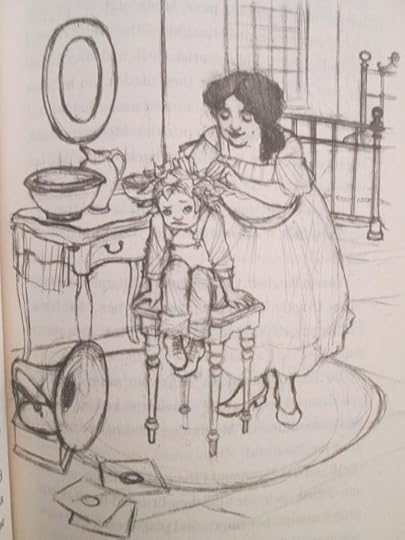
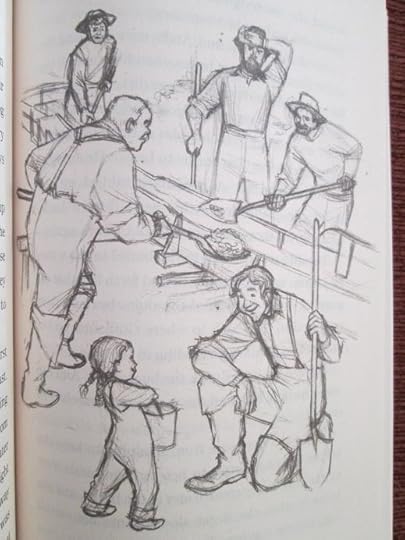
Bo at Ballard Creek is a juvenile title aimed at readers younger than the middle grade titles I usually pick up, but again it called my name from the moment I saw its cover. Filled with the aptly charming illustrations of LeUyen Pham, Bo’s life in a small mining town in 1929 Alaska will leap off of the page and into your heart. Obviously the illustrations below are unfinished and from the ARC, however, I thought you readers might love to see several of my personal favorites from this book: Bo getting her hair done up in curls (which she despises), and Bo helping out at the sluicing.
Bo is a young girl whose parenting has been taken on by two men in the mining camp, Jack and Arvid, who work as cook and blacksmith, respectively. The relationship is very ‘My Two Dads’ in a community where the only women around are either “good time” girls or the women of native Eskimo families, and also reflect diversity in Jack being an African American hailing from Louisiana and Arvid coming from Sweden. Bo’s world is one of community, friendship, and the wild, and through Kirkpatrick Hill’s words I was transported back to a time before great change came to the remote communities of Alaska.
In Ballard Creek, despite the year, there are no automobiles or movie theaters–though tales of such things from the “city” of Fairbanks are well known. Mail is carried by boat in the summer and dogsled team in the winter, and the visit of an airplane marks a momentous occasion in all of the locals’ lives. Bo at Ballard Creek is the wonderful and informative kind of historical fiction that emmerses young readers in the everyday tasks of a lilihood no longer with us, here bringing us into gold mining practices, one-room school houses, and Eskimo traditions. While the small community is almost unrealistically open-armed and generous, this book also acknowledges some of the world’s harsh realities of the time and place, such as child abandonment, wilderness safety, and the need to pick up and move one’s livelihood when a claim was exhausted.
Bo herself is quite the Pollyanna, but in the most charming Hayley Mills sense as opposed to the somewhat derogatory/annoying sense. She is a child who spends her life brightening the existence of those around her, be it her pappas, her Eskimo friends, the miners, or us readers. Through her ever-shining outlook this world that could so easily seem quaint or wrote is instead full of wonder. I particularly loved her visits with the miner who has adopted a slew of animals and her experience with jealousy and sisterhood through an orphaned boy who comes to town.
Again, I realize Bo at Ballard Creek is a bit young for what many of us read, but I assure you that if you’re looking for that comfort read that takes you back to childhood, it’s an excellent choice. Definitely recommended for readers of all ages who enjoy historical fiction and life on the frontier.
Original review posted at Bunbury in the Stacks.
Bo at Ballard Creek is a juvenile title aimed at readers younger than the middle grade titles I usually pick up, but again it called my name from the moment I saw its cover. Filled with the aptly charming illustrations of LeUyen Pham, Bo’s life in a small mining town in 1929 Alaska will leap off of the page and into your heart. Obviously the illustrations below are unfinished and from the ARC, however, I thought you readers might love to see several of my personal favorites from this book: Bo getting her hair done up in curls (which she despises), and Bo helping out at the sluicing.
Bo is a young girl whose parenting has been taken on by two men in the mining camp, Jack and Arvid, who work as cook and blacksmith, respectively. The relationship is very ‘My Two Dads’ in a community where the only women around are either “good time” girls or the women of native Eskimo families, and also reflect diversity in Jack being an African American hailing from Louisiana and Arvid coming from Sweden. Bo’s world is one of community, friendship, and the wild, and through Kirkpatrick Hill’s words I was transported back to a time before great change came to the remote communities of Alaska.
In Ballard Creek, despite the year, there are no automobiles or movie theaters–though tales of such things from the “city” of Fairbanks are well known. Mail is carried by boat in the summer and dogsled team in the winter, and the visit of an airplane marks a momentous occasion in all of the locals’ lives. Bo at Ballard Creek is the wonderful and informative kind of historical fiction that emmerses young readers in the everyday tasks of a lilihood no longer with us, here bringing us into gold mining practices, one-room school houses, and Eskimo traditions. While the small community is almost unrealistically open-armed and generous, this book also acknowledges some of the world’s harsh realities of the time and place, such as child abandonment, wilderness safety, and the need to pick up and move one’s livelihood when a claim was exhausted.
Bo herself is quite the Pollyanna, but in the most charming Hayley Mills sense as opposed to the somewhat derogatory/annoying sense. She is a child who spends her life brightening the existence of those around her, be it her pappas, her Eskimo friends, the miners, or us readers. Through her ever-shining outlook this world that could so easily seem quaint or wrote is instead full of wonder. I particularly loved her visits with the miner who has adopted a slew of animals and her experience with jealousy and sisterhood through an orphaned boy who comes to town.
Again, I realize Bo at Ballard Creek is a bit young for what many of us read, but I assure you that if you’re looking for that comfort read that takes you back to childhood, it’s an excellent choice. Definitely recommended for readers of all ages who enjoy historical fiction and life on the frontier.
Original review posted at Bunbury in the Stacks.

July 20, 2013
Five year old Bo lives with her two Papas--African American Jack from Louisiana, and Arvid from Sweden--in a tiny mining town in 1929 Alaska. The town is truly multicultural, populated by Inuit and miners from all over the world, as well as a couple of good-time girls, a schoolteacher, a few old-timers, and the telegraph operator. In episodic fashion like 'Little House in the Big Woods,' we learn about all the activities during Bo's year, as she visits with all the town people, runs around with her best friend Oscar (an Inuit), gets in a few fixes, and generally loves her life. Even if nothing stays the same forever, she knows she will always have her Papas to take care of her.
I lovedlovedloved this book! It has all the elements that made me love the Little House books--all the wonderful description of life at that time and in that place--but also is a book for our times with all its multicultural characters living happily together, everyone adding value to the community. Bo's two Papas can be read any way the reader wants--they could just be close friends, since apparently many miners paired up with friends to start mines or just to save money, or they could be more than that. Up to the reader, because Bo doesn't care, and neither does anyone else in the village. It's really a book about place, and about love for neighbors, friends, and pets. Utterly charming, and even the explanations of the things that are not so charming (why Bo's mother isn't around, and what exactly good-time girls are) are couched in terms that Bo can understand and accept. The book makes you wish you were a small child in an Alaskan town, except maybe for the mosquitos that always fall in the pie dough. Otherwise, delightful.
I lovedlovedloved this book! It has all the elements that made me love the Little House books--all the wonderful description of life at that time and in that place--but also is a book for our times with all its multicultural characters living happily together, everyone adding value to the community. Bo's two Papas can be read any way the reader wants--they could just be close friends, since apparently many miners paired up with friends to start mines or just to save money, or they could be more than that. Up to the reader, because Bo doesn't care, and neither does anyone else in the village. It's really a book about place, and about love for neighbors, friends, and pets. Utterly charming, and even the explanations of the things that are not so charming (why Bo's mother isn't around, and what exactly good-time girls are) are couched in terms that Bo can understand and accept. The book makes you wish you were a small child in an Alaskan town, except maybe for the mosquitos that always fall in the pie dough. Otherwise, delightful.
January 17, 2014
genre: historical fiction
summary: Bo has two fathers. She calls them both, "Papa". Her mother gave her away as an infant. Instead of taking her to the local orphanage two large, burly mining men decide to raise her as their own. Her papas are Jack (an African-american man from Louisiana) and Arvid (a man from Sweden). The book describes her life in the small mining-town of Ballard Creek Alaska during the late twenties.
notes: the author stays true to the era and the problems that arise without glossing over too much or going into enough detail that would make it inappropriate for a children's book. prohibition is discussed as well as divorce, abandonment, and death without it getting too heavy. in addition two of the women in town (as well as Bo's birth mother) are described as "good time" or "fancy" girls. nothing else is discussed further but adult readers get the point.
for kids who like: Little House series, Sarah Plain and Tall
age group: age 8+
my review: interesting, a little sugar coated but i did enjoy that the author didn't deliberately shy away from certain topics. a lot like Laura Ingles Wilder books...a lot is described but not a lot really happens.
**side note: the besides living together and raising a child nothing is really mentioned about Bo's papas as far as them being in a relationship/gay but for the purposes of the story i feel that whatever the answer....it is not essential to Bo's story. they love each other and they are all family, just like the town of Ballard Creek
summary: Bo has two fathers. She calls them both, "Papa". Her mother gave her away as an infant. Instead of taking her to the local orphanage two large, burly mining men decide to raise her as their own. Her papas are Jack (an African-american man from Louisiana) and Arvid (a man from Sweden). The book describes her life in the small mining-town of Ballard Creek Alaska during the late twenties.
notes: the author stays true to the era and the problems that arise without glossing over too much or going into enough detail that would make it inappropriate for a children's book. prohibition is discussed as well as divorce, abandonment, and death without it getting too heavy. in addition two of the women in town (as well as Bo's birth mother) are described as "good time" or "fancy" girls. nothing else is discussed further but adult readers get the point.
for kids who like: Little House series, Sarah Plain and Tall
age group: age 8+
my review: interesting, a little sugar coated but i did enjoy that the author didn't deliberately shy away from certain topics. a lot like Laura Ingles Wilder books...a lot is described but not a lot really happens.
**side note: the besides living together and raising a child nothing is really mentioned about Bo's papas as far as them being in a relationship/gay but for the purposes of the story i feel that whatever the answer....it is not essential to Bo's story. they love each other and they are all family, just like the town of Ballard Creek

September 2, 2015
"Bo at Ballard Creek" is the 2014 Scott O'Dell Award winner, for good reason, but what I loved most about this book is what a wonderful read-aloud it would be for kindergarten to probably second or third grade. As I was reading, it reminded me of another type of book. Finally, I realized it was "Little House in the Big Woods." I try not to read the back cover of a book until I've finished, because I don't want to be influenced or have any spoilers. When I did, I was surprised and pleased by this Horn Book starred review: "The disarmingly forthright tone is set right at the start ... cheerful. Like "Little House in the Big Woods" but ...more rambunctious."
This is a quiet story. The kind that I think is becoming more rare. It has action in every chapter, but not the driving action that is so demanded by publishers these days. When I first started reading the book, I kept waiting for something dramatic. It took me a while to stop looking for an explosive incident and simply enjoy Bo, her "family,"--which is another important aspect of this book--,and the rhythm of her life in a in a gold mining town in 1930 Yukon.
A final note: At first I was annoyed by the sentence structure: too many gerunds, helping verbs, what appears to be passive voice. I think this may have dropped off near the end of the book, but by then it didnt' matter. I'd just fallen in love with Bo.
This is a quiet story. The kind that I think is becoming more rare. It has action in every chapter, but not the driving action that is so demanded by publishers these days. When I first started reading the book, I kept waiting for something dramatic. It took me a while to stop looking for an explosive incident and simply enjoy Bo, her "family,"--which is another important aspect of this book--,and the rhythm of her life in a in a gold mining town in 1930 Yukon.
A final note: At first I was annoyed by the sentence structure: too many gerunds, helping verbs, what appears to be passive voice. I think this may have dropped off near the end of the book, but by then it didnt' matter. I'd just fallen in love with Bo.

February 4, 2014
When I delved into the first chapters of this book I thought, "well, this is an unusual story line: a baby abandoned by her 'goodtime girl' mother and basically shoved into the arms of 2 big, burly miners". As I read further I thought "Little House meets wild and wooley Alaska" and when I finished my mind was full of wonderful stories, memorable characters and a forthright portrayal of Alaska in the early 20th Century. Throughout the past few days bits and pieces of the book will come to mind and bring a smile. While this book is about a 5 year old girl it is also contains frank (but in no way explicit) explanations of that time and place.
I think the book would appeal to kids 6 (as a readaloud) to 10, and to readers who really enjoy historical fiction. It is unique enough to keep the attention of this adult!
I think the book would appeal to kids 6 (as a readaloud) to 10, and to readers who really enjoy historical fiction. It is unique enough to keep the attention of this adult!

January 24, 2014
Besides showcasing a non-traditional definition of family, I loved this book for its darling illustrations, easy flow and style, and the depiction of multiple cultures. The primary focus is on the small mining town which incorporates a variety of nationalities, but the local Eskimo families are interwoven into the storyline as well. There is a frankness about this book that is unusual: "good-time girls" are frequently mentioned, as is child and spouse abandonment, death, and other realities of living in a mining town in Alaska in the 1930s.
Some aspects would greatly please fans of other strong and imaginative young ladies such as Laura Ingalls, Betsy-Tacy, or Anne Shirley. While Bo is only 5, the audience for this story could be much older.
Some aspects would greatly please fans of other strong and imaginative young ladies such as Laura Ingalls, Betsy-Tacy, or Anne Shirley. While Bo is only 5, the audience for this story could be much older.

May 2, 2013
One of the best middle-grade books I've read in ages. Delightfully unconcerned with what children OUGHT to be reading and only concerned with what they would LIKE to be reading. Alaskan / 1920s setting is fully realized but unobtrusive. Characters, major and minor, are splendid. Recommended all around.
(The only reason I'm giving it four stars instead of five is that I didn't LOVE the second half the same way I LOVED the first half; but it's possible I would have if I'd read it in one sitting.)
(The only reason I'm giving it four stars instead of five is that I didn't LOVE the second half the same way I LOVED the first half; but it's possible I would have if I'd read it in one sitting.)

January 27, 2015
An absolutely charming tale about a spunky little girl in 1920s Alaska who just happens to have two papas: big strapping gold miners named Arvid (the Swede) and Jack (the black blacksmith-cum-cook). Bo's a sweet, loveable little girl who learns both Eskimo and English and gets into a variety of small adventures and scrapes. Jack and Arvid are an endearing, caring pair, and the descriptions of life in the Alaskan wilds are fun and well-seasoned with realism. A Little House in the Prairie for a new generation.

November 23, 2017
What a terrific story for young readers! I loved its cheerful, honest depiction of a little girl growing up in an Alaskan mining camp with the two bighearted miners who took her in as a baby. Fans of "Little House in the Big Woods," are sure to fall in love with it.

November 18, 2013
I loved this! Boisterous and charming with a breath-taking Alaskan landscape. And I learned a lot about Eskimo culture.

March 1, 2022
Sweet without being saccharine.
For the movie in my head, I pictured curly-haired, mop-top Shirley Temple as Bo (illustration: page 75) winning the hearts of Arvid, Jack, and the rest of the Ballard Creek cast of characters. (Dolph Lundgren as Arvid and Michael Scott Duncan as Jack round out the main characters.)
Bo at Ballard Creek is a cute story for the younger chapter-book readers. Other reviewers have compared this to Little House in the Big Woods by Laura Ingalls Wilder. Kirkpatrick Hill has written a portrait of life in an Alaskan mining camp in the 1930's, after The Gold Rush.
(Imo: As Inuits were mistakenly called "Eskimos" during that era, adults should explain that fact.
While its use in the story is historically accurate, Inuits consider the label of "Eskimo" as derogatory and culturally offensive.
Also, the good-time girls, (aka: dance-hall girls or fancy women), while certainly present in the mining camps, do not need their "business" to be explicitly explained, their kindness to Bo speaks for itself.)
The detailed, lively illustrations by artist LeUyen Pham added much to my enjoyment of the story.
For the movie in my head, I pictured curly-haired, mop-top Shirley Temple as Bo (illustration: page 75) winning the hearts of Arvid, Jack, and the rest of the Ballard Creek cast of characters. (Dolph Lundgren as Arvid and Michael Scott Duncan as Jack round out the main characters.)
Bo at Ballard Creek is a cute story for the younger chapter-book readers. Other reviewers have compared this to Little House in the Big Woods by Laura Ingalls Wilder. Kirkpatrick Hill has written a portrait of life in an Alaskan mining camp in the 1930's, after The Gold Rush.
(Imo: As Inuits were mistakenly called "Eskimos" during that era, adults should explain that fact.
While its use in the story is historically accurate, Inuits consider the label of "Eskimo" as derogatory and culturally offensive.
Also, the good-time girls, (aka: dance-hall girls or fancy women), while certainly present in the mining camps, do not need their "business" to be explicitly explained, their kindness to Bo speaks for itself.)
The detailed, lively illustrations by artist LeUyen Pham added much to my enjoyment of the story.

January 26, 2018
This book is a little gem!
Bo is a little girl with two papas that lives in a mining camp in Alaska in the 1920s. To find out how she got be such a lucky little girl and what adventures she had, you will have to read the book!
Bo is a little girl with two papas that lives in a mining camp in Alaska in the 1920s. To find out how she got be such a lucky little girl and what adventures she had, you will have to read the book!

July 31, 2026
Different. I liked it... good, easy, fun book to read before bed.

January 12, 2022
Like Little House set in an Alaskan mining town. Frank, accurate, wholesome, and lovely. Wonderfully illustrated. I enjoyed it and would recommend it for kids 8-10ish. I liked the found family storyline as well.
July 3, 2017
I liked this a lot - it's a sweet story and the perspective (third-person, in the mind of a five-year-old girl) is pretty perfect.
It's true that there is a *tiny* bit of language (hell; damned if I know; Jesus, I'd like to shake your hand), and it's true that Bo refers to some of her grownup friends as "good time girls." YMMV. The phrase isn't explained; the language is part of the everyday of the setting (1920s Alaska mining town).
Because I was watching for the effect of those decisions in the text, they stood out to me. They wouldn't have otherwise, I don't think.
This is a story of a family whose members find each other due to circumstance. They live in a multicultural town where people care for each other as people. Everyone watches out for the kids as needed. And the author grew up in a similar setting (a little more recently), so it's reasonably accurate in that regard. (I do have questions about repeated use of "Eskimo." Would probably be historically accurate, but...)
This book is a Scott O'Dell award winner for historical fiction and a nominee for the Maud Hart Lovelace Award (MN student choice). Because of the things I mentioned in the 2nd paragraph, I wanted to read before buying it for my school's library. Because of the things in the 3rd paragraph, I feel okay about putting it on the shelves.
It's true that there is a *tiny* bit of language (hell; damned if I know; Jesus, I'd like to shake your hand), and it's true that Bo refers to some of her grownup friends as "good time girls." YMMV. The phrase isn't explained; the language is part of the everyday of the setting (1920s Alaska mining town).
Because I was watching for the effect of those decisions in the text, they stood out to me. They wouldn't have otherwise, I don't think.
This is a story of a family whose members find each other due to circumstance. They live in a multicultural town where people care for each other as people. Everyone watches out for the kids as needed. And the author grew up in a similar setting (a little more recently), so it's reasonably accurate in that regard. (I do have questions about repeated use of "Eskimo." Would probably be historically accurate, but...)
This book is a Scott O'Dell award winner for historical fiction and a nominee for the Maud Hart Lovelace Award (MN student choice). Because of the things I mentioned in the 2nd paragraph, I wanted to read before buying it for my school's library. Because of the things in the 3rd paragraph, I feel okay about putting it on the shelves.
July 19, 2017
This book is what I would hand kids to read instead of Little House on the Prairie. Too many things in the Wilder books are dated and painful, while this is not. Taking place in the Yukon in the 1920s, this is a delightful little story about two big, hulking blacksmiths raising a little girl. It's a slice of life in a mining town in Alaska, over the course of a year. The reader learns a lot about life in that environment, including things about the native Alaskans and their culture. Bo and her two "fathers" are great characters, each with depth and interesting quirks which are part of the story. In general, the characters are very well developed, and are the strength of the book.
There are a few problems with the book. One is that it will leave children asking questions about the "good time girls" who hang around mining towns, and why one of them had a spare baby to dispose of. Another is that the story is clearly the start of a longer story, and thus feels a little incomplete.
Still, the next time that someone is telling me how wonderful Little House on the Prairie is, I will show them this book, so that they can see what GOOD historical fiction for children can be like.
There are a few problems with the book. One is that it will leave children asking questions about the "good time girls" who hang around mining towns, and why one of them had a spare baby to dispose of. Another is that the story is clearly the start of a longer story, and thus feels a little incomplete.
Still, the next time that someone is telling me how wonderful Little House on the Prairie is, I will show them this book, so that they can see what GOOD historical fiction for children can be like.

September 1, 2017
I tried but could not get into this book. A few things grated on me:
1. I think Bo's papas, Jack and Arvid are gay. I fully support gay marriage but I wish this book would have handled the subject better. There's a story about how Bo came to Ballard Creek as an orphan and folks asked whose baby she was.
"'That's your baby?' They asked Arvid, because they knew right away couldn't be mine, black as I am," Jack said. 'It's our baby,' Arvid told them."
In my personal opinion, this book is intended for roughly grades 3-6. I wish the author would have found a way to acknowledge that Jack and Arvid are a couple, without it seeming like they're simply friends. Or, perhaps, I've read this wrong and they are friends. I disklike how it dances around the topic.
2. The story seemed drawn out. I suppose it works through a year chronologically, but I found myself getting a little bored.
3. Another reviewer commented on this and I agree: why is the main character of a juvenile fiction book six years old? She's spunky and cute, but I find that often times kids want to read about someone their own age. This book suits kids ages 8-13, not age 6.
1. I think Bo's papas, Jack and Arvid are gay. I fully support gay marriage but I wish this book would have handled the subject better. There's a story about how Bo came to Ballard Creek as an orphan and folks asked whose baby she was.
"'That's your baby?' They asked Arvid, because they knew right away couldn't be mine, black as I am," Jack said. 'It's our baby,' Arvid told them."
In my personal opinion, this book is intended for roughly grades 3-6. I wish the author would have found a way to acknowledge that Jack and Arvid are a couple, without it seeming like they're simply friends. Or, perhaps, I've read this wrong and they are friends. I disklike how it dances around the topic.
2. The story seemed drawn out. I suppose it works through a year chronologically, but I found myself getting a little bored.
3. Another reviewer commented on this and I agree: why is the main character of a juvenile fiction book six years old? She's spunky and cute, but I find that often times kids want to read about someone their own age. This book suits kids ages 8-13, not age 6.
Displaying 1 - 30 of 247 reviews