Jump to ratings and reviews
Rate this book

Cannonball

Rate this book
The Iraq War, two divers, a California family, and within that family an intimacy that open the larger stories more deeply still. Cannonball continues in McElroy's tradition of intricately woven story lines and extreme care regarding the placement of each and every word. A novel where the sentences matter as much as the overall story.

312 pages, Paperback

First published January 1, 2013

14 people are currently reading
1040 people want to read

About the author

Joseph McElroy

32 books234 followers
Joseph McElroy is an American novelist, short story writer, and essayist.

McElroy grew up in Brooklyn Heights, NY, a neighborhood that features prominently in much of his fiction. He received his B.A. from Williams College in 1951 and his M.A. from Columbia University in 1952. He served in the Coast Guard from 1952–4, and then returned to Columbia to complete his Ph.D. in 1961. As an English instructor at the University of New Hampshire, his short fiction was first published in anthologies. He retired from teaching in 1995 after thirty-one years in the English department at Queens College, City University of New York.

McElroy's writing is often grouped with that of William Gaddis and Thomas Pynchon because of the encyclopedic quality of his novels, particularly the 1191 pages of Women and Men (1987). Echoes of McElroy's work can be found in that of Don DeLillo and David Foster Wallace. McElroy's work often reflects a preoccupation with how science functions in American society; Exponential, a collection of essays published in Italy in 2003, collects science and technology journalism written primarily in the 1970s and 1980s for the New York Review of Books.

He has received the Award in Literature from the American Academy of Arts and Letters and fellowships from the Guggenheim, Rockefeller, and Ingram Merrill Foundations, and the National Endowment for the Arts.

Ratings & Reviews

What do you think?
Rate this book

Friends & Following

Create a free account to discover what your friends think of this book!

Community Reviews

5 stars
57 (26%)
4 stars
89 (41%)
3 stars
51 (23%)
2 stars
10 (4%)
1 star
9 (4%)
Displaying 1 - 30 of 47 reviews
Profile Image for s.penkevich [hiatus-will return-miss you all].
1,573 reviews14.9k followers
October 4, 2013
Troubled or still, water is always water… the sameness of the Ocean suffers no change. - McElroy, Annals of Plagiary

The recent war between the United States and Iraq took much criticism both internationally, and from within the US. Growing up during these times of turmoil, with any side of the political opinions firmly entrenched in their beliefs, it was often difficult to separate the truth from the fabrications and elaborations. McElroy exquisitely harnesses these feelings in his 2013 novel Cannonball, graphing the life of narrator Zach through his time spend under the obdurate rule of his swimming coach father while befriending the enigmatic Umo (who crossed borders freely despite his lack of citizenship papers) and across his youthful career as an army photographer during the Iraq war. Across an engaging story riddled with conspiracy and ‘known unknowns’. Cannonball addresses both plot and sentence structure like a divers arc of motion, circling on all axis through a forward progression where you are barely sure which direction is up or down, who you can trust, and what you really know about the world moving in a blur around you.

Joseph McElroy’s mastery over language is simply staggering and the precision and excellence that pours forth from him is overwhelmingly incredible. Instead of describing his personal ‘style’, it is best said that McElroy IS style. He does not adhere to the rules, but wields his mighty pen with such awe-inspiring finesse that the rules bow down and adhere to him, creating an impressive fluidity to his prose where each line is expressed in the exact way necessary to do justice to the weighty load of meaning that he desires to extract from the depths of literature. While it may seem like a friendly caution to interested readers to label his writing as ‘difficult’ or ‘obfuscating’, such words come bearing a negatively connotative weight that is in grave disservice to the book; McElroy is an author that writes at the top of his abilities, enjoying the art of the novel as best as he can, and wishes for the reader to join him in his joy. This may require stepping out of usual comfort zones and taking his hand as you leap into the abyss, but McElroy is the hand you should be holding for this sort of leap, a hand that you can trust will see you through and that together you will witness the glorious sights along the way. It is fitting that Cannonball spends a great deal of time discussing competitive sports, as the closest metaphor I can find to relate the act of reading him to myself is high school cross country; while it might not be comfortable to push yourself beyond your limits, doing so, and realizing you can do so, allows you to achieve a wholly uplifting and personal glory that nobody can take from you as you shatter your preconceived notions about yourself and your present activity. In all honesty, the most difficult part about reading McElroy is not setting the book down to pick up a pen and try to see if you too can write—he is that inspiring.

I should cease gushing and get back to the book at hand. Cannonball is a masterpiece of spiraling language each sentence, like a diver, leaps and twists towards it’s conclusive splash; it is the act of getting to a conclusion that truly matters. This also offers an effect that the narrator is circling away from the hard truths that sum up each sentence or conclusion, as if the horrors he has witnessed and had to endure, or his own personal probing, are too painful to approach directly. The same is true of the plot progression, with McElroy circling around like a diver, twisting, doubling back, and cascading down in an artfully amazing display of talent that keeps the reader wondering where they are headed and which end is up, yet always trusting that McElroy will guide them as they strive to play along and be the best reader they can be.
The dive, its execution some say an infinite series of instants each bringing you somewhere as if you were stopped.
Each scene, appearing as a card pulled from a constantly shuffled deck, always moving out yet always circling back, examines a moment from the plotline like a point on a graph (calculus, and the narrator’s high school math teacher, being a frequent theme in the novel).

If you will allow me a brief pause and digression, it should be stated that a real charm of McElroy’s is his ability to compound multiple meanings into his themes. Each multifaceted idea can be seen and examined from multiple points of view and understanding, granting a very true-to-life nature to the novel (the narration is also a fantastically executed method of showing how consciousness works while trying to use language as a metaphoric expression of human experience). The execution of plot, for example, is a perfect expression of many different themes in the novel, from the diver and calculus, as previously addressed, but also as the underground channels of water that are pivotal to the novel. These channels are like humanity as a whole, one flowing stream of activity that is often examined by accessing life in the singular (such as examining life through the POV of our Zach) much like the way these channels are accessed through the many wells across the landscape. The plot is also accessed similarly, being a flowing body that is viewed as points on a graph, viewed by looking down through each separate well and using the knowledge gained from each individual point, and plotting a continuous arc of the unknown through the points of the known. Interestingly enough, Zach is employed in the army (through a complex web of potential conspiracy) as a photographer—he is a amateur photographer that may not be living up to his duty of capturing patriotic images and is instead producing evidence that the war is the horrorshow that the army does not wish people to believe it is—capturing moving reality into still pinpoints through which we can analyze and make assumptions about the greater flow of life. There is also the idea of doubling, both doubling back and taking one idea and making it into two. This novel features the best investigation of the Biblical Lazarus story since Dostoevsky’s Crime and Punishment, then doubling this idea into the doubled dives of Umo himself.

Especially in the second half of the novel where things approach Pynchoneque conspiracy territory, McElroy gleefully guides the reader through the stressful feeling of grasping for meanings and rationality, for confirmation of suspicions that you know are true yet can’t prove, and the true beauty of the novel begins to shimmer. There is a sneaking suspicion that everything is an elaborate conspiracy with important hands positioning each character like pieces on a chess board, as if their actions were things they were ‘forced to do and had even been set up to play a not very creditable part’. There is enough evidence to lead the reader to certain lines of thinking and plausible rationality, yet McElroy deftly conceals the heart of matters just enough to keep the reader away from conclusiveness. It makes for an extraordinary commentary on the infamous ‘known unknowns’ statement by Donald Rumsfeld (Secretary of Defense at the time of the Iraq conflict during which this novel takes place), and furthers the theme of the US’ justifications of entering into the war in the first place. The ancient Scrolls ‘discovered’ by the army offers a new perspective on Jesus as robust capitalist that preaches hard-line Republican ideals, validating the religious Right’s support of the war and (if the conspiracy holds true) was created to bolster the war effort. Zach’s potential disclaimer on the Scrolls are then ‘an attack on them, and on Why We Are Here’ and the many break-ins and threats on his sister (with whom he showers with affection beyond just a ‘brotherly love’), may or may not be the army protecting their basis of validation. Perhaps he is beset with strife because ‘certain Family Values sat not well with the national community that had gotten behind the war, the Scrolls, this Christian President’ (note that national community is the only noun not capitalized, with McElroy presenting an American nation that places Christian values before the good of a community).
Why did I doubt the other side’s hand here, they were the terrorists. Causes of the war. Christian soldiers right flank harch.

Having myself been in the middle of a American History exam at the moment the towers fell (ironically, when they came over the loudspeakers instructing all teachers to turn on the news, my teachers said ‘Whatever is happening right now will not affect your life as much as this grade will’. One of my close friends was in that class with me, he served in Iraq just a few short years later), I was enthralled and moved to read a book featuring a character about my age undergoing his own coming-of-age during the same time period as my own juvenile floundering. The scene at the enlistment center particularly hit home, as I was once a signature away from an army career myself, fidgeting in a chair as I was told how glorious the decision would be to join now (I've always been someone to do exactly the opposite of what someone says, so I chose to go to college instead and left). I found the music aspects of the book amusing, as the documentary Umo was filming in Iraq featured soldiers listening to classic rock hits like the Rolling Stones or Jimi Hendrix. While this was the type of music I was tuned into in the mid 2000’s, it seems a bit of a stretch to assume the US Armed Forces all had good tastes, unlocking the theme of propaganda McElroy presents throughout the novel. These songs were hit songs during the Vietnam era, and filming modern day soldiers riding the sound waves of these tracks as an escape from the horrors of war does an incredible job of emotionally and aesthetically binding the two conflicts together. Reading this novel brought me back to the days in early college where I’d stay up until near morning to talk to my friends serving over in the desert over email or instant messenger, their commentary and obvious exhaustion and stress resonating in me much deeper than the news stories ever could. Also, there were many allusions to Keruac’s On the Road (not to mention the many allusions and homages to Emily Dickenson found throughout), which particularly charmed me as I was enamoured with that novel during this time period.

Cannonball is a brilliant labyrinth of language and conspiracy that explores the recent war between the United States and Iraq, while further examining all of humanity in the same breath. McElroy is a first-class magician using a linguistic sleight of hand to keep us from ever seeing the whole truth even when it is right in front of our noses, only revealing what he wants us to see and doing so only when it is absolutely necessary. He gives us the equation, lets us plot the points, then, like a the best of teachers that have nothing but hope and confidence for their students, stands back to watch us trace the arc connecting the dots. His games are not to trip us up, but to watch us achieve what he knows we can, to create a beautiful relationship between author and reader where both benefit from one another’s presence and perseverance. Exploring the ‘known unknowns’ and getting in some jabs at the American religious Right along the way, McElroy examines how we often must act only on assumptions, never knowing the whole truth, and often acting out only what we have been positioned ever so carefully to act out as if it were our own decisions. This may have not been the ideal time to read the book, current life tragedies making for slow going and interrupted attention, yet still the joy and sheer genius of McElroy’s writing kept this novel forefront in my mind at all times. While it may be best to have a bit of previous interaction with the great author (having read Night Soul and Other Stories recently, which deals with many similar themes, made me feel better equipped to navigate this one), I would strongly urge anyone to introduce themselves to McElroy through any text possible, and soon. Inspiring and humbling, Cannonball is the sort of novel I wish would come about more often.
4/5

Umo, that series of instants I had hoped to grasp, was each one lessening but not truly interrupting the distance to entry, calculus of friend to friend?
Profile Image for Aloha.
135 reviews384 followers
July 18, 2017
“O, what a tangled web we weave when first we practise to deceive!”
-Walter Scott


Mysterious Scrolls surfacing through wells underneath the Middle Eastern deserts, a talented three hundred and some pounds Mongol Manchurian who makes no splash cannonball dives formed the labyrinthine sea of former diver Zach’s consciousness. The scrolls, “a weapon in the war”, was no less phenomenal than the borderline Chinese named Umo who mysteriously appeared then disappeared in Saddam Hussein’s palace. Joseph McElroy’s signature flow of consciousness writing features Zach’s coming of age and loss of innocence in parallel with the U.S.’s involvement in the Iraq war. Zach’s thoughts meander from when he formed a friendship with the large Umo to recruit him for his coach father’s team to when he became a photographer manipulated by the U.S. government “to be a spy and not know it-witness, but to what?” in a plot to sway public opinion in the war. Unlike the scrolls “arriving then with such long-range accuracy of time and place”, in the sea of Zach’s consciousness, time and place flows back and forth from the young Zach’s high school pool to Saddam’s palace pool of the adult Zach’s memory.

The repeating theme is Zach’s gullibility, limited perception, and eventual insight. When he first encountered the sumo wrestler-like Umo at the high school’s pool, he and his peers cringed at the 300 plus pound figure getting ready to dive but was surprised at the elegant result.

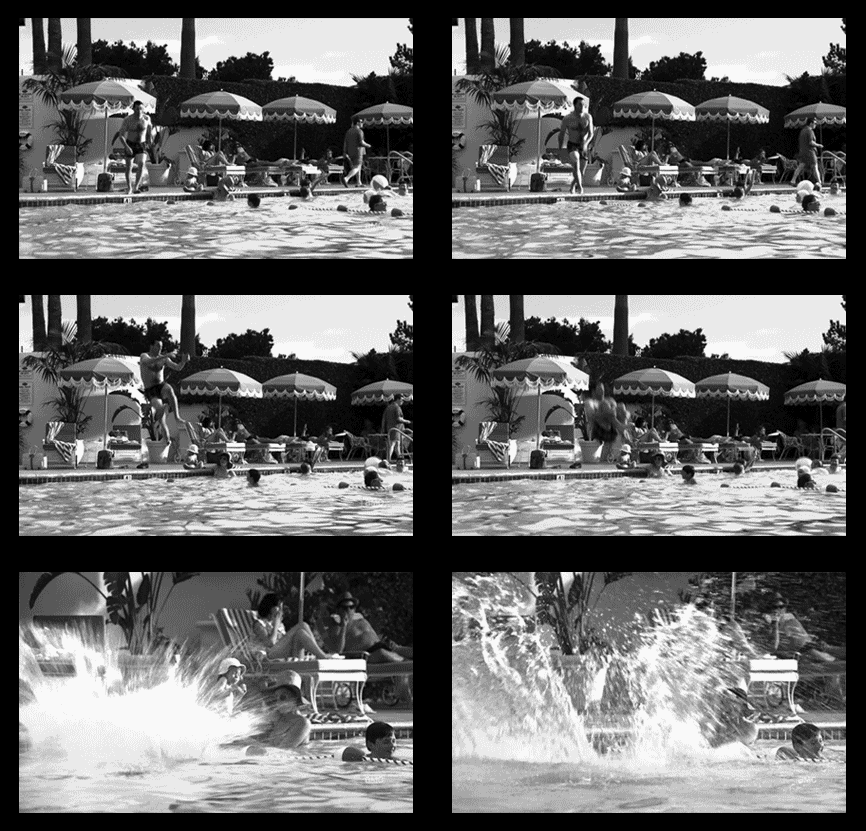
“a cannonball to maybe blast us all out this time, but no: for suddenly the diver, that human bulk, its arms now at its sides, axled a great diameter impossibly greater than the diver himself and wheeled over into a layout somersault and-a-half, not tuck, not even jackknife-pike position but layout more distinguished than any stunt for which mysteriously (if you measure it) there could not have been time but, ...—and no less a cannonball, it came to me—hands, head, shoulders, belly, hips into the water—for no real splash at all...”


After high school when he enlists in the Army, Zach became a photographer who was planted in Saddam Hussein’s pool, “...--and where eez division between what-has-been and what-weel-be?--’a shout in the meedle of the air, eh,’ the Russian adds (not lost on me): and water archaeologist had been drawn to the foundations of this palace as a sinkhole for the net of horizontal wells ‘like secret map across land before even Scrolls were found.’ “


He became caught in the middle of an explosion that looked like it killed his pal Umo, who for some reason followed him to Iraq. During the mayhem a piece of a scroll was handed to Zach from a chaplain. The controversial piece of the Scrolls that will be an alternative to the Gospel and may affect the predominantly Christian public opinion in the U.S.. The story then takes a conspiracy turn of McElroy’s noir flavor as pieces of fact reveal themselves and characters reveal their motives. The web of conspiracy stretched from Zach’s coach father to mysterious figures in connection with the U.S. government. The flow of life giving ancient water turned into a treacherous web from beyond “what-has-been” at Zach’s high school pool to “what-weel-be” in the U.S./Middle East relations.

Although the 300 lb. human cannonball created no explosion, the “Scrolls explosion” spread from the horizontal wells, as it proves that the “American Jesus” approves the ways of “fighter and economist, private entrepreneurials, food-fasting and possibly fast-fooding, sensible take on capital punishment when appropriate, a very early, matching-grant Jesus where if you’re not willing to work forget about it, sloth violates brotherly love...” The Jesus in the newly discovered Scroll is a “virtual CEO.” After the explosion, Zach was driven to investigate the bombing that led to his friend’s death. The plot follows a detective novel’s noir twist as lives were threatened, enemies reveal themselves, and people are not who they appear to be. Even Zach’s dead pal Umo showed up unexpectedly. “To my mind Jesus didn’t have one particular pal, though my candidate was...Lazarus...” Like Lazarus of Bethel, Umo came back from the dead but didn’t really die, only doubled like “the beggar with the sores and the rich man named something.”

After going through satirical hearings where the truth is distorted and the root of the Scrolls became evident to Zach, “noticing a copy of the Scrolls propped open with a mug and a knife between two separate trays”, he realized that the “transaction is done. What is it they trust?” As Alan Greenspan revealed in his memoir, “I am saddened that it is politically inconvenient to acknowledge what everyone knows: the Iraq war is largely about oil.”
Profile Image for Jonathan.
1,009 reviews1,229 followers
December 20, 2013
"I beside her shot on film or tried to his dive but she just as she'd been interrupted passing on to me a weird family yet neighborhood question Corona's Italian wife Bea had put to her as they had biked home the night before through rain divided and gathered and caressed by trees now tonight saw him pull off a two-and-a-half at a public pool under the lights that went out totally for a moment, a breaker fluke that went unexplained, as he left the board plunging us if not my camera into nowhere and came back to reveal him just passing the crest of the yet undisclosed dive now crunched into tuck – as I became aware of the old woman of a year ago with the spotted skin and the veins materialized now as if by the power glitch itself beside me seeming to say hello with a word: for Umo's dive was so busy a somersaulting that when he just came out of it he's someone unaware of you headed somewhere else gone forever, my sister said, or executed, it came to me she had murmured to herself or me, I thought if anything a sucked-downward tongue or perfect loss."

There is nobody out there other than Joe who could write a sentence like this. I mean look at it – even just the start: " I beside her shot on film or tried to his dive " – He is absolutely right that the "I" is first in the experience, and that it is more "true" to write it like that instead of "I, beside her, shot on film (or tried to) his dive", which is possibly easier to parse on first read, but too broken and structured to accurately reflect the experience or, even more "normally" - "I shot his dive on film, or tried to, beside her" - what does it do to us to read it in the original form, rather than this? How does it change the way we are reading?

I count 5 different time periods in this sentence. 5. That is fucking insane.
Profile Image for Ed.
Author 1 book445 followers
November 24, 2018
For this novel I feel one could legitimately justify any rating between one and five stars. The writing is incredible, and the story built on complex, interconnecting and layered metaphors and recurring themes. But the expression of these ideas can be challenging, and the conspiratorial subject matter becomes dense and difficult to parse.

For me personally, there was something about the cadence of the narrative voice that made it difficult for me to fall into a natural flow. I felt distracted, unable to really maintain focus and become involved. I felt disconnected from the characters, and struggled to sustain interest in the intricacies of the plot (though I managed not to lose the narrative thread, thanks to the novel's use of repetition). Maybe this is a personal fault - my experience reading Gravity's Rainbow was similar. File this one under "Appreciated more than enjoyed", or "It's not you, it's me".
Profile Image for Madeleine.
Author 2 books952 followers
October 8, 2013
(This review was originally written for and posted at the Chicago Center for Literature and Photography's site, though I purchased the book well before I knew CCLaP was hiring--which is to say that absolutely no one bribed me for a good review with free books.)


While waiting for my white whale of novel--Joseph McElroy's Women and Men--to emerge from the murky depths of the internet with something akin to a realistic price tag in tow, I've settled for introducing myself to the writer's more readily available works the way one "settles" for Guinness when the bartender has never even heard of Three Philosophers. I finished McElroy's debut novel, A Smuggler's Bible, nearly a month before picking up Cannonball, his ninth and most recent offering: Reading two bookending extremes of a writing career in quick succession produced the effect of watching a new acquaintance transform into an old friend as endearing quirks became welcome habits, as a whisper of what will come crescendoes to a thundering boom of masterful storytelling.

Discernible plots emerge like a developing photograph's slow cohesion: a young man forges a symbiotic friendship with a younger immigrant of incredible talent before enlisting in the Iraq war, only for their paths to cross one more fateful time in that Fertile Crescent; recently discovered scrolls that may or may not be genuine accounts of Jesus from a contemporary's vantage point are revealed to posses great religious or political significance; familial ties are questioned, strengthened and redefined, especially in terms of when a friend becomes a brother, a father becomes a foil and a sister becomes an object of desire.

Cannonball is not written in the most invitingly accessible of styles--the plot is rendered in a first-person narration that initially feels like a shuffling slideshow of non-sequential images and impressions--but it is by no means impenetrable. This is a book that divulges its secrets in ravenous gulps rather than ladylike sips: Patience and greedily lapping up the book in 50-page guzzles are rewarded with a better sense of its pace and disjointed recollection.

McElroy is a writer whose plots and characters exist to move a thesis toward its inevitable elucidation. His books are not simply vehicles transporting his characters in linear, predictable joyrides through personal growth as they hurdle toward the happily-ever-after finish line. That's not to say that this novel is populated by uninspired archetypes who mechanically convey the writer's agenda, because that would be a lie; in fact, McElroy's minimalist approach to exposition proves that a deft hand can show so much by telling so little, as I left this book with a complete image of everyone who lived and died within its pages.

Several of the characters who play significant roles in Zach's life possess the kinds of talents that tend to forgive--nay, willfully gloss over--the perfectly natural failures of character that aren't exactly negated by finely honed skills. It is that mental difficulty in reconciling extremes and other seemingly at-odds elements that is the force propelling Cannonball: This is a book about dualities, how easily they come into existence and how unavoidable they are when no two people can ever see any one thing identically. Once the novel begins to grab hold of and run with this theme, every action becomes more significant, every word is made richer with layered precision, every character develops into something more believably human. We know that Zach is not a perfectly reliable narrator, that he possesses great abilities as well as a great capacity for lapses in judgment, but he is also a magnetically empathetic soul who puts the world together in such a familiar, non-academic way--as if he, too, were groping in the dark without the hand of an omniscient writer guiding him as both the bigger picture and his part in it come into focus--that such flaws make him companionable to a degree that sheer, awesome talent alone cannot.

This is a novel told in symbolic metaphor stemming from Zach himself: He is a gifted swimmer and diver, but it is photography that drives him, and, as the novel barrels ahead, it becomes more and more evident that the commonalities between these two pursuits hold the key to the heart of the story. Which is this: Universal understanding is a myth. No two things look the same to two people, much like a photo and its negative, like a concrete entity and its pallid, rippling reflection on water. Zach, who never had the crucial thing separates a competitive diver from an Olympian, who sees photography more as a mode of artistic expression than factual representation, stands at square opposition to his father, who seeks a champion in the water and a documentarian behind the lens, neither of which Zach is destined to be.

For all its frenetic pacing, Cannonball never feels rushed; there is no hurry to get to the next stop but there are a controlled urgency for understanding and a need for some sense of correlation between seemingly unrelated events that drive the narration. A scene of great chaos and destruction occurs about halfway through the novel that arrives so quickly and is such a turning point for the story that it takes Zach and the reader alike a few seconds to realize what's happening, as is often the case with those moments that change everything. It offers a slow dawning of realization that echoes how such moments of upheaval are processed and later recalled in the real world.

True to the dualities it encompasses, Cannonball is at once hotly emotional and coolly rational, capable of blending everyday humor with routine human tragedy, celebrating true talent and the virtues of incredible heart. Its curiosity is honest without being mawkishly earnest, its questions are sincere without erring toward saccharine sentiment. McElroy challenges his audience with unconventional narration and the occasional up-close look at some uncomfortable realities but he more than generously rewards his readers with a thought-provoking examination of how one things can have so many varied appearances from different angles, with a clearer understanding and through the increasing distance created by the onward march of time.
Profile Image for Paul.
1,474 reviews2,170 followers
March 18, 2022
3.75 stars
It’s been a while since I read any McElroy and I did enjoy Smugglers Bible. This is a more recent novel, published in 2013 and is about the Iraq War, amongst other things: the novel takes place in California and Iraq.
The main character is Zach who is an army photographer and we follow him (sort of chronologically, but this is McElroy) from his teenage years when he is a very good high diver (there’s rather a lot about diving and in his youth McElroy was a diver). His friend Umo pops up periodically, he happens to be an unusually gifted diver, despite what should be some obvious physical limitations. Whilst Zach is taking photographs at a captured palace in Iraq the swimming pool explodes and Zach discovers underneath in a series of tubes/pipes some ancient scrolls. The scrolls contain what appears to be a sort of gospel which extols prosperity and an interview with what appears to be Jesus praising a sort of free market doctrine. Throw in Zach’s sister Em (with whom he has a more then platonic relationship) and a developing conspiracy theory and there you have it. An American Republican style Jesus with the scrolls as “weapons of mass instruction”. The narrative and dialogue are often chopped and disjointed and McElroy employs what is pretty much a stream of consciousness approach.
This is a satire and this is how McElroy himself describes it:
“If I were to put my finger to one cause for the novel, it was anger of the Iraq war that led me to the strangeness of things that happened. Although, I am not a practicing Christian, I was angry at the self-righteousness of the government. They undoubtedly embedded a pretext for entering the war--I made up another kind of pretext for getting into the war. What I made up was partly based upon a big event in archeology back to 1947, the so-called Dead Sea Scrolls that were discovered on the shore of the Dead Sea. I made up whole kinds of new scrolls. Which, in this case, the government concocts, wants to protect, and sets up intent to destruction of the scrolls by terrorists. It is in that situation that the main character is drawn. The burden of these scrolls is that Jesus is not the person we know, but a yuppie with capitalistic acclamations—thus suiting the mindset of the American government as I saw it.”
It’s clever and well written stuff and it takes some effort to follow, but it does hit its targets.
Profile Image for Cody.
994 reviews304 followers
February 27, 2018

You'd think that writing a review about an autotrophic, disembodied brain orbiting the Earth would be harder than one involving a pretty linear narrative revolving around the second Iraq War. You'd be wrong. McElroy is so elusive here--and so goddamn breathtaking--that I would be doing both him and Cannonball a major disservice by trying to tear the thing apart. Featuring extended diving metaphors, a 300-lb. Mongolian Lazarus, a (cough) 'close' brother-sister relationship, and a semi-oblique Slayer reference along side several thousand different elemental strands, there is almost too much to love here. It's likely a better book than A Smuggler's Bible; something to marvel at factoring in the almost 50-years between their publications. Joe has only gained new steps over the years, seemingly unable to lose any report of his whip-crack intelligence.
Profile Image for Serhii Lushchyk.
Author 2 books23 followers
March 13, 2023
Я не вмію плавати. Навіть триматися на воді. Хіба трохи. Тому мені не знайоме відчуття людини, яка виринає із води назовню. І хапає повітря. Багато повітря. Жадібно. Щосили. Особливо після стрибків бомбочкою. Особливо із висоти. Особливо із трампліна. Так тіло поглинається глибше. Архімедовою силою можна знехтувати.

Стрибаючи у текст Джозефа Макелроя, можна втопитися, навіть будучи вправним плавцем, навіть будучи, що тут говорити, олімпійським чемпіоном із плавання чи стрибків у воду, чи будь чого, пов'язаного із водою. Вода. Роман-стихія! Руйнівна (у хорошому сенсі, якщо такий сенс є) сила слова.

Якщо густина (ота грецька буква ро) води становить близько 997 кг у метрі кубічному, то густину тексту "Бомби" неможливо визначити. Тут вийде із ладу будь-яка обчислювальна техніка. I like it! Длубати скалу! Неперевершена мова, багато подій/дій/спогадів (феноменів) - кружляють романом: розбурхано (несучи психотерапевтичний спокій), хаотично (несучи порядок), красиво (і боляче) - і все довкола головного героя - Зака (чи Умо), чи всесвітньої параної, чи посттравматичного стресового розладу. Коли текст-вода тисне, тоді байдуже. Головне - не панікувати. Адже у всій цій стихії - у самісінькому її центрі - в оці циклону - лежить Естетика Тексту. Споглядання її автоматично навчає мистецтву плавби.

Якщо вам хочеться якнайшвидше вибратися із води, але одночасно знаходитися в її товщі якнайдовше - стрибайте у "Бомбу", Джозеф Макелрой створив ідеальні умови для цього. Just do it!
Profile Image for Nathan "N.R." Gaddis.
1,342 reviews1,654 followers
Read
May 20, 2017
Writing about McElroy's books is extremely difficult. Thinking about them is difficult. Reading them is a blessing. I hope to return to some kind of review once I read Cannonball a second time. As a place=holder, a comparison ;; Women and Men is large and one can spread out and absorb and dwell and dawdle just a moment ; the shorter recent novels are dense.
8 reviews8 followers
January 24, 2018
In the early 50’s McElroy used to be in the coast guard, and in many ways he’s still doing that job, for the most part we’re like the stricken boats he undoubtedly encountered, we’re lost out there, our lights poke tenderly at the vast night but reveal nothing more than our own lostness, everything around looks dark and unfamiliar, near but alien, intimidating, McElroy is there not to merely show us the way but to give us hope to venture with our hearts and our minds alive, unafraid, into the darkness.

Story: Set post 9/11 Iraq war era (2002 onwards), the US military are interested in what is meant to be an ancient religious text known as The Scrolls, which is apparently an interview with Jesus detailing “Christ’s work ethic . . . food fasting vision and good sense” (15). The Scrolls are seen as “a weapon in the war” (3) and of huge importance to the powers that b. The Scrolls are in the Middle East for some reason and being transported via a series of convoluted underground wells to a palace in Iraq where they will be collected by US forces.

The narrator, Zach, is a young war photographer who finds himself at the location where The Scrolls will be collected, it’s here where the novel opens, Zach seeing his friend Umo high on the palace’s diving board, an explosion occurring as Umo jumps. It’s this conspiracy involving The Scrolls, Umo, Zach, and the US military that frames this novel although it’s so much more than that.

Umo: Sumo without the S. An illegal immigrant, 300lb springboard diver, Chinese? maybe. “a hoodlum, a bad guy, a crook, and a smuggler” (23). 14 but looks older. Works a number of jobs, already driving, orphaned essentially. One of the best characters in modern lit. Charismatic without being overbearing. “Umo made you want to speak” (33). “Independent, Liz called Umo” (38). Zach brings Umo to his local diving/swimming club thing that is run by his father with the aim of his father noticing Umo’s potential as a competitive asset (noticed by others as an asset or threat to the military?).

Diving: For some reason springboard diving is a thing in McElroy’s work, it’s there in some form or another in all his novels, sometimes minor roles and appearing almost as cheeky nods, other times it’s more conspicuous as is the case with Cannonball. McElroy has talked about the springboard stuff a little before, describing it as a point of departure, and when taking into consideration the influence of Deleuzian Rhizomes in McElroy’s work that seems to make sense as a dive like a rhizome is a leaping off point where narrative doesn’t start or end exactly but is arrived at? no, arrived isn’t a good enough word either, but maybe you get the idea.

A dive is where all the powers are momentarily suspended but there, operating but in a strange kind of equilibrium, gravity and the force of the jump balancing and momentarily suspending the diver in the air, a moment between the dive and the impact on the water’s surface, McElroy is interested not just in moments but in what is between moments, what is in a moment but also outside, what can be seen to contribute and also what can’t be seen but still contributes.

Umo often about things asked what happened after. My sister even when she was younger what came before. (85)


McElroy is also interested in the idea of becoming, how things become, what it means to become and how we are always becoming in one way or another, moments between what is before and after, his earlier novel Plus shows a process of becoming for a brain and consciousness in space and is a more explicit enactment of this idea. A dive is a moment of becoming, again, due to the suspension of forces it’s a more explicit moment of change and potentiality, the elegance of a dive, particularly one involving twists etc and the sort Umo can perform, illustrates the grace of becoming, the manoeuvres and complex routines that contribute towards becoming and thus being.

And no time to check my plunge or midair a gap someone else forms into named unknowns (165)


was a pretty photo of a diving board here in original review somewhere on hearusfalling.wordpress.com

To go from thing to thing, not too afraid – knowing truth has a better chance to trespass sudden and interrupting . . . No Man’s Land – (28) (From Night Soul and Other Stories)


Truth by accident: Zach’s heroism is arrived at accidentally. There’s a notion littered throughout the book about how you find your real job within another, that you arrive at reason and purpose unexpectedly. “Umo, I murmured. He’s luck of some kind, said my sister.” (126) Redemption maybe at the end with the dive in reverse?

Remembered, saw ahead. (89)


Cutting rhizomes: “Any point of a rhizome can be connected to any other, and must be.” A Thousand Plateaus. It’s probably worth reading the introduction of A Thousand Plateaus to gain some insight into how McElroy’s novels function, that’s not to say that he’s consciously taken on D&G’s rhizome model but it does seem to resonate. With a rhizome everything is a jumping off point, a diving board, everything is a means to become, to be, that’s not to say that it’s an origin of something though.

The dive, its execution some say an infinite series of instants each bringing you somewhere as if you were stopped. (121)


In the above quote you can clearly see the rhizome at work through the metaphor of the dive, as series of instants, (worth mentioning how the photography of Zach is a method of capturing and preserving instants), and as mentioned earlier this relates to becoming as the series of instants “brings you somewhere”.

I dunno, this gets tricky without essentially quoting the entirety of that introduction and even then it’s still tricky but Cannonball does seem to push this rhizomatic model to extraordinary lengths as an incestual relationship between Zach and his sister meets a contemptible father and a certain night when he walked in on them kissing and how this relates to his diving accident that left Zach scarred and eventually enlisting in the army and meeting Umo in Iraq and the way The Scrolls and the religious and political implications of Jesus’s words relate to Umo who like Jesus is a man who is thought dead but reappears, alive and not.

but a dive multiplying all your damned questions into some moving, unanswerable statement (154)


Iraq: The novel is partly about how words get corrupted, used for political and socio-economical means by a government or rather the businesses the government and governments of the world represent and how this is all merged and intimately related to war, McElroy’s novel is deeply political, trenchant and inspiring, without being preachy or overly simplistic. McElroy isn’t overtly biased or taking easy shots at any particularl administration or the usual leftist whining over capitalism, clearly he’s critical but as is the often the case in his work he gives you a lot and it’s considered and thoughtful but so is what he leaves out.
Profile Image for Aiden Heavilin.
Author 1 book74 followers
January 24, 2022

I can write with confidence that Joseph McElroy is the most original writer I have ever read. In one were to hide a random paragraph of his among a thousand paragraphs from other books, I could identify the McElroy within seconds, yet when tasked with "description" or "analysis" of his style, I come up short, for the style is both instantly distinctive and genuinely inimitable. Even as I could never predict the next phrase or word, when the word arrives it is the only correct one.

It is hard to discuss McElroy in anything other than the abstract because so much of the meaning in his writing IS the very writing itself. Among my mistakes during the first time I encountered his work was my attempt to divorce the what from the how, for he is an alchemist, crushing together language and subject in some grammatical particle accelerator, forging these almost grotesquely beautiful paragraphs like strange textual temples.

Yet despite this, he is weirdly unpretentious. Even as he writes in this new, elevated grammar, any sense of "showing off" is limited to well deserved climactic moments, as in any good book, for McElroy is capable of a "third gear" register which shares genetics with his average style but also transcends it.

It's also difficult to describe the plot of a McElroy novel in any way that makes it sound interesting, but that's because his stories emerge from the page like lived experiences; the fact that the narrative is comprised ostensibly of fiction hardly occurs to you. His writing is the object itself, not the object's description.

The first act of this book is pitch perfect in every respect, twisted prose evoking the dust of southern California, dark hints of future conspiracy lurking at the edges yet dispelled by a sense of preternatural tranquility, McElroy's fluid writing moving with the grace of an expert cinematographer through time and consciousness, held together by constantly recurring motifs that appear on nearly every page: water, photography, diving, competition, Scrolls Scrolls Scrolls, dimly drawn characters who speak in ambiguous, fragmented phrases. The prose has to be read to be believed, trickling into these vast oceanic paragraphs, hugely satisfying to read. Sometimes McElroy comes up with a phrase or sentence so perfect it's like a knot worked firmly free of your muscles by a deft masseuse. Vague without formlessness, the opening is spellbinding.

The second act of the book (it follows a pretty clear 3 act structure) essentially examines a single moment of calamitous confluence in extreme close up, advancing the reel frame by frame, peering at every possible perspective. A dive remembered from one desert mirrored in another. A crumbling palace. A system of wells. An explosion, confusion, words from a dying chaplain. One fragment of the scrolls. This is McElroy at his most paranoid Pynchonian, working with a great deal more distress than usual in his generally placid storyscapes. Often breathtaking, this act nevertheless stops the story's momentum dead in its track, killing the energy generated by the whirlwind first act. After Zach returns from the war, we count on the finale of the book to tie things together.

Unfortunately, the third act of "Cannonball" represents a massive drop in quality. The writing becomes less intricate, the characters less mysterious, and McElroy weirdly attempts some sort of conventional thriller narrative, complete with an entirely unconvincing two dimensional villain. It's really quite astonishingly bad at times, and leaves you feeling like, without his flashy prose style, McElroy would be left pretty helpless in terms of writing a story interesting on its own terms. (Obviously that's basically saying, "if you remove the good part from the book, the book is no longer good!) but it's a peek behind a curtain into a conspicuously empty backstage. I was massively disappointed by the last 100 pages or so of this book, which completely failed to summon the well developed motifs into any sort of conclusion. At the end of "Cannonball" you can't help but look back on the story and find it severely lacking.

I am all for judging books on their own terms. "Cannonball" is not attempting to be a conventional narrative, yet there IS a conventional narrative here, with a fairly straightforward plot and cast of characters, and by any measure of judgement, they fall pretty flat. The best character here is Umo, and he disappears halfway through. The rest of the characters remain relatively faceless, cropping up or fading away as per the requirements of the plot, no one making much of an impression. The dialogue, when its not chopped to bits, is amateurish. McElroy's truly amazing prose can often distract from these deficiencies, yet after a few hundred pages, the writing can become homogenous. We rarely stray from a few muted tones.

McElroy's most inventive creation here, the long lost interview with Republican Jesus, isn't even that biting in retrospect, especially in comparison to the madness that is current politics. A writer like Pynchon would find so many interesting uses for such an ingenious concept, yet McElroy only gestures to them in a few fragmented quotes. Potential rears its head so many times, only to be Whack-A-Moled away into the sludge.

When I think of "Cannonball" I think of water. Water plays an important role in the plot, yet it is also the best metaphor for understanding his flowing, dreamy prose. We see his characters and hear his dialogue through leagues of water as well, murky, distorted, indistinct. It is effective if not truly powerful. I am left fascinated but cold. The book is filled with promising metaphors that fail to be developed after the first half of the novel, and the last hundred pages provides a flat payoff. Water, perhaps, but stagnant.
Profile Image for Vladyslava.
35 reviews2 followers
Read
August 4, 2024
Книга, яку я однозначно буду перечитувати. Поки з усіх прочитаних книг ця була найважча. Мені подобається як автор використовує повтори (наприклад, фраза "в обмін на що?" повторюється протягом всієї книги, "вибір" тощо), взагалі це мій найулюбленіший прийом в книгах. Тільки в Макелроя таких повторів хоч і доволі багато, але речення настільки насичені, що я багацько такого пропустила, лише при перечитуванні деяких фрагментів помічала їх. Це додає додатковий стимул на повторне читання книги. Загалом, для мене, на даний момент мого читацького розвитку, в книзі я побачила історію про ПТСР, а також критику політики тогочасної Америки.

Дякую Максиму Нестелєєву за переклад, я б ніколи не прочитала її в оригіналі (або дуже нескоро). Сподіваюсь, в нас ще будуть переклади Макелроя українською. В післямові зацікавили мінімум ще 2-3 романи цього автора.

Хочеться ще додати, що читала цю книгу в дуже складних умовах, на згадку собі хочу їх озвучити: аномальна спека (+38), тривалі відключення світла (тільки 4-6 годин було світло на добу), ремонт, а потім ще й моя хвороба. Тож читання затягнулося.
Тим не менш, після останньої сторінки зрозуміла, що, не зважаючи на обставини, книга подарувала мені новий ні на що не схожий читацький досвід, а це безцінно.
76 reviews
July 31, 2017
**SEMI-SPOILERS**

Sadly, I had never heard of Joseph McElroy until a couple months back. Now I find he occupies an elevated space amongst some readerly folks I've come across on Instagram and lo and behold, my McElroy experience started here with Cannonball and it's deeply drawn characters: Zach, our "so ... ironic" narrator, his sister/lover Em (quoting Emily Dickinson no less? Did that happen?), Umo, the Chinese sumo-sized diver who reminds me of my friend Dickie, Zach's dad the swim coach with military/intelligence ties, Storm Nosworthy, the Inventor, Cheeky, Wick, etc.

I don't think I had a clue what was going on for the first 120 pages or so, but once Zach lands in Kut, lands in war, the story rolled down hill picking up pace and clarity. If time weren't a consideration, I'd go right back to the beginning and re-read that first 120 pages.

McElroy's style - the character's dialogue and their inner thoughts - is a style unto itself. Even after 312 pages, I found it was sometimes hard to follow who was talking/thinking and what they were talking/thinking about. I have a four-month old son and was reading Cannonball to him one night and found, as I spoke the words on the pages, that McElroy's flow was easier to follow. A day later, one of those bookish Instagramers I follow, mentioned McElroy was easier to read aloud. It's interesting but it made more sense.

All of the above aside ... I think I probably missed more than I caught of Cannonball. All the doubles, the others, Lazarus/Lazaruses, Em always asking what happened "before," but Umo asking "after." Zach constantly imagining diving in reverse, incest in the least-possible-creepy way, Storm Nosworthy = Storm's not worthy (?), a documentary on soldier's listening habits in a war-torn country, the narrative halved ... I caught things, but missed their meanings. I can posit some ideas, but it'd be probably be better done with someone open to misinterpretations over beers rather than the eager reader looking for insight on Goodreads.

I'll read more McElroy after this. That's enough for me.
Profile Image for Justin Evans.
1,716 reviews1,136 followers
November 7, 2013
I knew very little about McElroy before I started this book; I picked it up because it was short and his name occasionally comes up in discussions of, e.g., Gaddis or Pynchon. A little amuse-bouche before I try the main course, kind of thing.

Well, not sure I'll try to main course. Reading it was frustrating for very straightforward reasons: the plot is simple and fun, the emotional energy behind it clear, the larger issues (about military adventure and the perversion of religion) obvious and important.

Sounds good. Then I realized that I knew exactly what was going on in any given paragraph without thinking about it at all, but if I slowed down and tried to read individual sentences, I had no idea what they were saying.

Now, if McElroy was telling me something difficult or new, I'd be fine with the convoluted sentences: sometimes it's hard to express difficult, new things. But each sentence in Cannonball tells us very little (if you want an example, just open the book; they're too long for me to type out right now). So why the syntactical trickery?

Well, the TLS review explains that "McElroy forces the reader to work in order to highlight his belief that knowledge is not a given." The Daily Beast tells us that "McElroy uses contemporary surfaces to entice us into an epistemology."

Okay. So McElroy is concerned to tell us how 'knowledge' is not a given. If so, either it doesn't exist (= relativism, which is only a worry if you think knowledge just is mathematical), or it's constructed.
If it's constructed, it's either imposed on people by an external agency ('there are WMDs in Iraq'), composed by an individual (relativism again) or composed by people together. Imposition isn't very nice. The construction of knowledge by people together could be, provided that the people doing the constructing recognize what they're doing, and work together as best they can.

And art can be one of the better examples of working together. The writer gives the reader what she thinks is important; the reader sees what she can make of what the writer has given her. But McElroy, and many other quasi-epistemologists, don't appear to recognize that making people 'work for it' is often just as oppressive as force.

I suspect that McElroy's earlier novels are better than this one. I'll give him another shot, for sure. But Cannonball feels too much like a period piece from the '70s for me to feel like I'll ever want to re-read it. But then, I actually studied epistemology, instead of conflating it with politics.
Profile Image for J B.
247 reviews44 followers
December 22, 2023
I appreciate Joseph McElroy for having such lowkey wacky characters that you completely believe in, like a fat Chinese refugee in California who upstages his friend, the son of a diving coach who is our protagonist and enlists in the 2000s Iraqi War and the Chinese diver joins a documentary film crew so that he can be with said friend in Saddam Hussein's palace and both swim in his pool. All of that and I was able to believe all of it, it all felt real. Is that not bravery? And he strings together this absurd situation into a conspiracy-tinged plot that ACTUALLY HAS A RESOLUTION?? This should be five stars just for pulling it off but I found it to be a little over-long.
Profile Image for Kyle.
14 reviews41 followers
March 20, 2017
This is one that deserves a review. I'm at work now, so it'll have to wait, but I know I need to at least attempt to articulate just how much this novel has just changed my outlook on literature. It was certainly a humbling experience.
5 reviews13 followers
September 21, 2016
On the twentieth day of March 2003, the United States invaded Iraq. WMDs, regime change, terrorism: numerous justifications were given. As time passed and more information came to light, the rationale became more and more obfuscated, and as such the conversation changed. Political parties were divided—the nation was divided. Yet still our presence persisted in spite of the mounting suspicions, confusions, and disapproval. It is to this time of conflict—both foreign and domestic—that Joseph McElroy turns his inimitable gaze in Cannonball, his ninth and newest novel.

Competitive diving, photography, undocumented immigrants—Cannonball’s scope is wide, and necessarily so. Central to the narrative is Zach, a war photographer whose diving career was cut short due to an injury sustained as a child, and his unlikely friend, Umo, the corpulent high diving savant of Chinese origin who lacks both valid documentation and anything resembling a stable home life. Writing with a cubist’s command of time, McElroy effortlessly slips between the novel’s present—war-torn Iraq—and Zach’s tense, conflict-ridden high school past, where he struggles with identity and purpose, living under the overbearing gaze of his diving instructor father, and alongside his sister, with whom he shares an uncomfortable intimacy.

It is impossible to talk about a McElroy novel without talking about sentences. For, like Gertrude Stein and Samuel Beckett, no one writes sentences like Joseph McElroy; and just like Stein and Beckett, the sentences are what matter most. But unlike those two modernist masters, who tested the sentence’s ability to withstand tightness and constraint, McElroy pushes the limits of just how much a sentence can hold. At times transitioning among five distinct time periods, while elsewhere containing multiple paragraphs, McElroy’s sentences are neural networks unto themselves. Notwithstanding the prose difficulty, Cannonball contains enough velocity that it often reads more like a page-turning thriller than a close assessment of a society in conflict.

Cannonball gives us McElroy at his most paranoid: A mysterious set of scrolls sought by the U.S. military for their power, and the sometimes preternatural tendencies of Umo’s movements and actions, evoke a mysticism that feels both appropriate and necessary when tackling a topic as multifaceted as the Iraq War. Although the paranoia and the undeniable difficulty of his prose lead many critics to compare this octogenarian to the likes of Pynchon and DeLillo, McElroy’s perspective lacks the bleakness associated with their postmodernism. McElroy’s writing never retreats to black humor, nor does he adopt a detached tone when wrestling with some of the most difficult issues; rather, he writes with the care and closeness of James or Proust, where the nuances of humanity matter more than systemic psychological or societal exhaustion.

Not just a war novel, McElroy here is at home with what he does best: intricately measuring human interactions and, perhaps more importantly, non-interactions to illuminate the complexities created out of a world in flux. We watch as Zach wrestles with loss and discovery, gradually managing to parse out a semblance of belonging, though exactly what he belongs to remains always out of focus.
Profile Image for alex.
33 reviews52 followers
August 13, 2013
Fantastic. One of the best new novels I've read in some time. McElroy's prose is mindboggling, unique and dazzling.
Profile Image for AB.
221 reviews5 followers
November 5, 2024
Shucks, guess I cannot highlight my masturbatory interest in dense, difficult literature on Goodreads with this one!
Profile Image for Heronimo Gieronymus.
489 reviews150 followers
December 3, 2016
Well, the title. You would be excused if you thought the title of Joseph McElroy's sort-of-an-Iraq-war-novel were named explicitly for a weapon of oldschool combat. Not exactly. We are talking instead of a pretty well-known method of entering the water. So there is the relationship between diving, cannonballing, backstroking, underground waterways (through which ancient scrolls are mysteriously trafficked), family (in all its sticky finery), and the whole collapsing civilizational apparatus (sinkhole?). A cannonball wildly displaces a surface that will soon return to its apparently peaceful previous state. We are talking also about a novel written w/ just awe-inspiring skill in the first person. But not in the first person as traditionally practiced. This is far, far away from psychological realism, and the prose are not a direct address, not the kind of thing the narrator could ever be conceived, as we understand him and his psychospiritual genealogy, to sit down and parse out just so. This is narrated from somewhere deeper, by an embedded novelist, somewhere well sub to the ego's terrain. There are the finger prints of the unconscious all over this thing. It is lithe and poetic (in the sense of having a form to it that is elastic and not pedantic about going about the business of imparting meaning), it sings in its gradual build and modulation, and it does things w/ the basic mechanics of language that not only dazzle but practically dare you to try and go out and find precedent. We increasingly go further and further off the grid. Psyche and reality, w/ reality increasingly compromised, but not for the sake of any cornball expressionism. This is rather something more to do w/ that good ol' twentieth-century-and-counting theme of entropy. That ol' saw. This isn't even 'pataphysics, because any mysteries and attendant clues are scattered like birdseed to strong wind. This is a masterful evocation of what it is like to piece together yr world in a world w/ no real world. Total masterpiece. A man in his eighties wrote this. Shout-out to Ghostface Killah and all. Absolutely unbelievable. One of the finest American novels of our time. Doubtless, kid.
Profile Image for ROC.
60 reviews7 followers
June 19, 2015
McElroy is an author that strikes me as deserving far more fame than he's given.
Speed-reading is the easiest way I could understand him, but it also gave a better feeling for his prose.
If you read too slowly you don't fit the thoughts together fast enough and one thought references another you passed a while ago. You go at the temp of his prose, which is thought-tempo rather than speech-tempo.
Reading Cannonball any slower is like listening to a bebop song at reduced speed. You might not process the words fast enough, but you will generally get the correction automatically when you glance the prior line while reading the next.

Cannonball is a staggering work of language and free association, almost completely abstract memory and thoughts.
It reminded me of someone trying to focus a camera lens until it finally reached some sort of stability towards the end.
Definitely a novel I'll reread in the future.
Profile Image for Anton.
56 reviews47 followers
November 11, 2018
"Містер Безкомпромісний" дуже ориґінальний співрозмовник, але після перших двохсот сторінок наша розмова забуксувала, і наприкінці було геть незрозуміло, для чого (і про що) власне ми говорили. Тепер мені страшно навіть уявити "Жінок і чоловіків" або "Картридж". Хоча, зрештою, вимагати від постмодернізму ясності й зрозумілості було б безглуздо. А Макелроєве письмо справді ориґінальне.
Profile Image for Casey.
96 reviews4 followers
January 18, 2024
“I had done my time, it was said, but I didn't believe.”

Hind's Kidnap set me up to believe McElroy would become a favorite. After powering through the middling Women and Men, which had some phenomenal portions scattered throughout an exhaustingly underwhelming novel, I hoped the next McElroy would reaffirm my feelings of my first contact. But here we are with Cannonball, which on paper seemed like a no-brainer. How could this not be something I would love? Instead I got this book: disinterested in characters, detatched, no sense of humor or horror or warmth or anything human, displaying some technical bravado, but from an emptiness that made the experience of reading it torturous. I did my time, I don't believe. No more McElroy for me. If I want to read about a diver involved in a conspiracy who has a weird-incestuous relationship with his sister, I'll just read The Passenger again.
Profile Image for Ellie.
109 reviews38 followers
February 7, 2021
TW: war, incest

Joseph McElroy is a phenomenal writer, though his writing is not anything that could be described as easy to parse. In Cannonball, we are presented with military photographer Zach, and the discovery and mystery surrounding the Scrolls.

Cannonball opens with the inciting incident -- an explosion at a rendezvous point, before returning to Zach's past to give us his coming-of-age story and the chain of events that leads to his joining of the military.

As a character, Zach isn't overly compelling. The characters aren't really the point here: the point is the writing itself, and the themes explored. On a sentence level, the novel doesn't seem to make sense, but after each paragraph, I had a sense of what was happening, and this broad picture carried me through the novel. I would like to revisit this to see if I can pull out more details, but I'm not sure that details really exist in a novel like this.

The relationships Zach has with the different characters in this book were one of the things that kept me gripped. His close friendship/pseudo-brotherhood with Umo, his too-close, mildly incestuous relationship with his sister, the mysterious and villainous Storm Nosworthy, who uses his power over Zach to silence him.

I probably wouldn't recommend this book unless you're particularly interested in postmodernism and the likes of Thomas Pynchon, but I am glad that I read it, and feel like a better reader for it.
Profile Image for Rob Trump.
264 reviews6 followers
October 3, 2016
Extremely strange book. Posits the real reason for the Iraq War as the attempted recovery of a lost gospel known as "The Scrolls," in which Jesus is revealed to be a neoliberal. Except maybe the US government had the scrolls the whole time, or possibly even wrote them, and the entire theater was just that, and our hero Zach was brought in as a war photographer just to take pictures of a false-flag attack made by "insurgents" as the scrolls are recovered. Maybe. I think. This really held me for about the first half, driven by strong supporting characters, especially Umo, an undocumented Chinese immigrant tween with preternatural skills at diving, driving, and working import/export jobs. It somehow gets even weirder about halfway through, to the point where I'm not sure I should attempt plot summary as I might be completely misinterpreting what happened. At the very least interesting, though it lost me when it went from medium-insane to fully-insane.
Profile Image for Nils.
7 reviews
September 14, 2019
Beautifully written, this one gets hella difficult around the midway point, right about when the plot turns conspiratorial—McElroy, more than any other writer I've read, demands that the reader engage with the text: I really had to play with the cadences of some of its syntaxes for even their basic euphonies to emerge. But it's all well worth the effort! Pretty much every sentence contained within is a work of (usually kind of abstract) art, but it's condensed enough that it can actually feel like a page-turner.
Profile Image for Rob.
11 reviews
April 4, 2014
I consider myself a reasonably sophicated reader, but I found this novel very difficult. It is experimental, with a stream of consciousness flow and a minimal, somewhat confusing plot. It is about the processing of thought through language, with the knowledge that language is often insufficent to accomplish the task because it's always slip, sliding away. It is very interesting, but not necessarily enjoyable. Definitely not for everyone or even most readers.
Profile Image for Tuck.
2,264 reviews252 followers
April 21, 2015
california, springboard diving, the iraq war (no, not that iraq war, THAT iraq war) sounds pretty straightforward right? but this is joseph mcelroy so yes, straight on the highspeed rail, hold on becuase this read, this novel won;t stop. but it is interesting and brilliant too.
penkevich has a very nice review of book, other too, one with a cannonball gif , just look. https://www.goodreads.com/review/show...
Profile Image for Luke.
23 reviews
June 12, 2021
¯\_(ツ)_/¯

YMMV, I don't think this is for me. Unless someone wants to explain it or justify it to me. Seems I am too dumb and this style/prose is over my head. I love Krasznahorkai for comparison, but I think I'll stick with Krasznahorkai for now.
Displaying 1 - 30 of 47 reviews

Can't find what you're looking for?

Get help and learn more about the design.