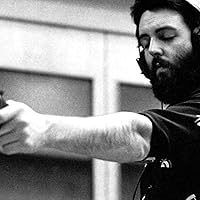
Musician, composer, producer: Brian Eno is unique in contemporary music. Best known in recent years for producing U2's sensational albums, Eno began his career as a synthesizer player for Roxy Music. He has since released many solo albums, both rock and ambient, written music for film and television soundtracks, and collaborated with David Bowie, David Byrne, Robert Fripp, and classical and experimental composers. His pioneering ambient sound has been enormously influential, and without him today's rock would have a decidedly different sound. Drawing on Eno's own words to examine his influences and ideas, this book—featuring a new afterword and an updated discography and bibliography—will long remain provocative and definitive.
Now probably some of you wanted to be a rock star at some point in your soggy unpleasant youth - even if only for five minutes. Come on, that was you with your badminton racquet in front of the mirror pretending to be Axl Rose or Joe Strummer or Celine Dion or George Formby. I saw you! Well, being somewhat English, I didn't go for that rough heavy metal stuff, I used to play air sitar. After I realised I had no talent at all, couldn't even play air sitar. But I realised that someone had also not been able to play anything and still had made really cool records.
Brian Eno.
He was the very lazy boy's rock star. He programmed machines to play the actual stuff then he swanned off with a few intimate companions for a glass of Pinot Grigiot whilst the machines emitted their faint meeping sounds. And he recorded the meeping sounds and issued them on albums and people bought them....
People like me.
Yeah. He had me in his sights.
He had started out slightly conventionally, and had been in an actual band which was Roxy Music, pretending to play keyboards for two albums. Then Brian Ferry, that Noel Coward for the Seventies, realised that there was only room for one ego in the band and that was the kibosh for Eno.
He was momentarily flummoxed. But as he was possessed of a giant intellect, it took him only ten minutes to solve the problem of being a musician who didn't actually play anything. he called it...
ambient music.
It consisted of programmed keyboard phrases played over and over and over again until the listener entered a hypnotic trance and bought the record.
Perfect.
There are quite a few of these ambient Eno albums but the best are Discreet Music, which is an hour plus of this dweebling meeping stuff; there's Music for Airports which is the same but on an actual piano, but played by a computer; and then there's the ultimate Brian Eno ambient album:
On Land
On this album Eno dispenses with instruments, programmed or not, and anything resembling a musical note. He presents us with a series of “soundscapes”. These sound like....
rooms.
With maybe a fridge humming faintly in the corner. But rooms with no people in them. Or they sound like a quiet day in a park, with maybe a hint of birdsong after three or four minutes and background rustling. Or they sound like night falling. It took Eno some years to reach the total perfection of On Land. He started with a lot of very loud music and he gradually subtracted layer upon layer, using techniques he himself invented and has never disclosed. He finally got down to the intimate, thrilling, yet really amazingly dull sounds of life itself – the squelch of blood through the ventricle, the soft patter of the iguana’s feet on the wall two miles away, the gurgle of the unborn marigold. That kind of thing.
Of course when he toured the On land album back in 1984/5 the results were depressing or farcical, depending which gig you attended. Eno spent most of the time on stage asking the audience to be quiet and then asking the stage crew to take all the instruments away. Concert-goers unwrapping sweets during the performance were hustled away by security. The problem was, of course, that the audience could not tell what was Eno’s actual performance and what was the actual ambience of the concert hall. Eno would say things like “that man coughing is not part of this piece” and it would wreck the whole atmosphere.
Anyway, Eno is a true original and of course if you spell Eno backwards, it says
Excellent. The author (who has a Ph.D. in music) applies music theory analysis to the works if a self proclaimed non-musician. (In the epilogue, the author mentions that Eno read the manuscript of the book and learned something about one of his own songs!) Also a fun read because it was written in the late eighties, before the Internet boom, so it serves as a time capsule. (Remember when, if you wanted to hear an album, you had to go to a record store and buy it? Wild!) The epilogue, written a few years later, provides the web address for an Eno discussion group to which one can "dial in." Can't you just hear the "bing bong bing" of a modem connecting to the World Wide Web? (If you're under 40, you probably can't...)
The appeal of this book will certainly be limited to Eno geeks, music theory geeks, and ambient/drone music fans. But anyone who falls into any of these categories will do well to pick it up.
Fantastic book that offers historical context and artistic influences in the making of Eno as a composer. It zooms in on, among other subjects, Eastern philosophical views of music making, the similarities with John Cage and the art-rock persona. The book excellently describes how these subjects shape his compositional process. The book isn't a biography about his youth and such, more of a guide with insides on his equipment, composition techniques, systems and expressions.
I would recommend the book to musicologists and composers of music - production/compositional knowledge and experience is necessary in understanding the book. It is about the craft of music composition and analyses the way he works, which for some, like me, is fantastically interesting.
Put simply, I really enjoyed this book. It introduced me to a whole world of music that lives beneath the skin of modern rock or prog rock. It gives you a set of powerful tools designed to enhance your listening experience of Eno's music that can be applied to all music, and it works!
The book is more a study of artistic craft and form than it is a biography of the artist. I knew that going in and for that I really enjoyed it. It is also evident that this book came from the authors phd dissertation and as a result is a lot more academic in parts than I'd have expected. Some of its thrust and meaning were lost on me because I do not have any formal education or training.
very interesting, albeit very theoretical, account of many aspects of Brian Eno's music in the 70's and 80's. Even when I wouldn't agree with the writer's point of view, I could understand where he is coming from.
"This resolute lack of technique has become an integral part of Eno’s whole philosophical approach to music-making. Whether out of inner or outer defensiveness, or out of honest self-examination, he has come up with a variety of justifications for remaining a 'non-musician.' One is that lack of technique almost forces one to be creative: it makes one confront one’s vulnerability."
Brian Eno: self-described "non-musician"; a geographer of fictional soundscapes; a sound-painter; a virtuoso of the-studio-as-instrument; a curator of undiscovered sounds; an oblique strategist; a composer of "fourth world" music. One can go on, but if you're reading this, you already realize that Eno is all of these things and more. If you're searching for anecdotal and biographical material, look elsewhere. This book, I believe, was written as a dissertation and often reads as such; much of it, namely the passages about music theory and intervals and modes, was above my head. Ironically, the material would probably be above Eno's too. Not because the man isn't intelligent---hell, he's brilliant, professorial---but because he didn't think of music in these terms. Thank goodness. Fortunately, much of the book explores Eno's take on sound: why most synthesizer music is awful; switching the roles of instruments; creating improbable acoustic spaces; integrating synthetics with acoustics and blurring the line between the two; etc. Fascinating stuff even if, like me, you're a recording amateur and dabbler. Brian Eno, and consequently this book, will make you think of sound and music in a different way.
"The conditions before and after science are identical in terms of how people will relate to each other. [...] Right now, although you may have your personal oases of before or after science, the world is in science. I use that word in a limited sense: deification of rational knowledge [...] The Western version of masculinity opposes rational man against intuitive woman. The part of my being that interests me has always been my intuition ... I don’t bother to question my intuition. If I feel like doing something, I do it, and figure that I’ll understand it later. If I had questioned my intuition, I would probably be a bank clerk. In any person’s life, the most important decisions are indefensible." (Brian Eno, quoted in Tamm, pg. 90, from an interview by Arthur Lubow in the New Times, March 6, 1978).
I gave it 4 stars because I really like the music. Mr.Tamm has lots of interesting and insightful things to say about Eno and his music. Some of the musical theory went clear over my head and I confess there were passages that I skipped over as they meant nothing to me at all. The one thing I found disagreeable was his habit of placing individual Eno tracks in oddly named categories, such as: 'strange'. 'assaultive', 'pop/strange' and 'hymn-like'. It seemed entirely daft to me, especially if you're familiar with his music as I imagine most people picking up this book would be. Also now it is very out-dated in regard to music technology and all the different ways we can now listen to music.
You'll have to read this yourself if you want to find out what 'the vertical color of sound' is. But I will say it is a perfect description of Eno's ambient work.