Beit Safafa è il quartiere più ricco di Gerusalemme est. Prediletto dagli Arabi israeliani provenienti dal nord, il quartiere ha prezzi di case, carne e altri generi di prima necessità così alti che nelle panetterie vi sono due tariffari, uno per i locali e un altro per gli immigrati. A Beit Safafa vive l’avvocato protagonista di queste pagine, un giovane procuratore con una promettente carriera da principe del foro gerosolimitano davanti a sé. Vive in una villetta, due piani con salotto spazioso, cucina ultramoderna e due ampie stanze da letto. E ogni giorno raggiunge il centro a bordo della sua elegante Mercedes nera. Insomma, l’avvocato è, come si usa dire, un uomo che ne ha fatto di strada, un bravo ragazzo che ha di certo realizzato il sogno di sua madre, comune a tutte le madri arabe in Israele: avere un figlio medico o avvocato di successo.Tuttavia, ha anche un cruccio che l’affligge non poco. Si vergogna delle sue lacune in fatto di musica, letteratura, teatro e cinema. Lacune rilevanti, visto che suoi colleghi israeliani parlano disinvoltamente di tali argomenti. Perciò, di tanto in tanto fa una capatina in una vecchia libreria a dare una sbirciata ai titoli di narrativa raccomandati da Ha’aretz, il giornale cui è opportunamente abbonato. Un giorno, nel settore dei libri usati della libreria, scopre, e decide di comprare all’istante, una copia gualcita di Sonata a Kreutzer, il celebre racconto di Tolstoj, che sua moglie gli ha una volta stranamente menzionato. La sera a letto, prima di spegnere la luce sul comodino, sfoglia delicatamente il libro e, a pagina centodue, si ritrova tra le mani un minuscolo bigliettino bianco, con un testo scritto in arabo con la grafia di sua moglie: « Ti ho aspettato e non sei venuto. Spero che vada tutto bene. Volevo ringraziarti per la notte scorsa, è stata meravigliosa. Mi chiami domani?». Da quell’istante l’avvocato dismette i panni del professionista illuminato e prende quelli dell’arabo consumato dal sospetto e dalla gelosia. Umiliato nel suo onore, comincia a seguire la moglie per le strade di Gerusalemme, cercando di scoprire il suo tradimento. Si imbatterà in un giovane assistente sociale arabo, che accudisce un israeliano in stato vegetativo dopo un incidente, e cerca anche lui di trovare il suo posto nel mondo.
Sayed Kashua (Arabic: سيد قشوع, Hebrew: סייד קשוע; b. 1975) is an Israeli-Arab author and journalist born in Tira, Israel, known for his books and humoristic columns in Hebrew.
هو كاتب وصحفي فلسطيني إسرائيلي يعيش في القدس ويكتب بالعبرية. ولد سيد قشوع في مدينة الطيرة، مدينة عربية وسط إسرائيل، لأب يعمل موظفا في البنك ولأم تعمل معلمة. هو الثاني من بين أربعة أبناء. حين كان في ال15 من عمره تم قبوله لمدرسة العلوم والفنون في القدس، وهي مدرسة مرموقة، تعمل باللغة العبرية ومعظم تلاميذها من اليهود. بعد انهائه تعليمه الثانوي تعلم في الجامعة العبرية في القدس موضوع الفلسفة والعلوم الاجتماعية. بعد انهائه تعليمه عمل مراسلا للصحيفة العبرية المقدسية "كول هاعير" ("כל העיר") وبعد ذلك تحول أيضا إلى ناقد تلفزيوني وصاحب عمود شخصي في صحيفة هآرتس. كتب قشوع بالعبرية فقط، على عكس غيره من الكتاب العرب في إسرائيل الذين كتبوا بالعربية.
Galeotto fu il libro. Nel senso che proprio aprendo un libro, La sonata a Kreutzer di Tolstoj, e trovando un messaggio che è convinto sia stato scritto da sua moglie, la calligrafia per l’avvocato è la stessa senza ombra di dubbio (come poi confermato da perizia), lui, l’avvocato, si convince d’essere tradito, che la moglie, madre dei suoi due figli, abbia un amante, e da qui si attorciglia in una spirale discendente nel gorgo di una gelosia ossessiva.
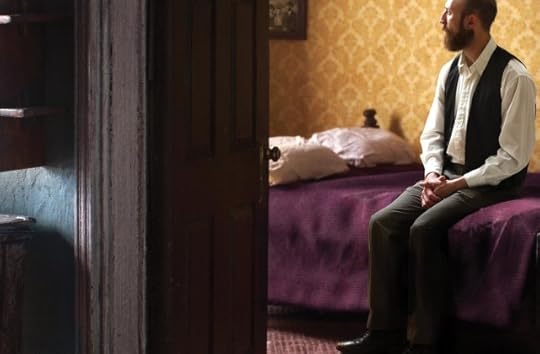
Il diorama di Richard Tuschman usato sulla copertina del romanzo di Keshua “La traccia dei mutamenti”.
Oddio, mi sa che la gelosia sia sempre ossessiva, non è forse uno dei sentimenti più stupidi e inutili? L’avvocato (Kashua lo chiama sempre così) si convince che la moglie gli abbia costruito intorno un mondo di sotterfugi e menzogne, di corna e disonore. Arriva a sperare che si tratti di amante ebreo, sarebbe meno disonorevole di un amante arabo. Come sempre, o solo spesso, ingaggia una lotta rabbiosa con il presunto amante e rivale, su chi tra loro è più bello, chi più atletico, e chi più virile, in questo bypassando la moglie, che tanto, in fondo, è solo una donna, niente di più, niente di meglio. Di colpo si sfalda tutta la sua apertura mentale di marca più israeliana, e quindi occidentale, che araba, viene meno tutto il suo impegno per inserirsi nel mondo ebraico combattendo pregiudizi e intolleranza di entrambe le parti, quella israeliana e quella palestinese, e l’avvocato ritorna agli istinti primordiali.
Trattandosi di gelosia, trattandosi di un’ossessione, la situazione si fa presto claustrofobica, ripetitiva, monotona. Kashua la racconta da narratore extradiegetico e usa una lingua che s’abbina bene alla rozzezza emotiva del protagonista.
Ma per fortuna l’architettura del romanzo è più complessa, e questo è solo il primo binario, metà della storia: l’altra, raccontata in prima persona da un giovane arabo, assistente sociale studente di fotografia, s’innalza, sia come trama che come lingua, introduce personaggi affascinanti (su tutti forse Ruchale, la mamma di Yonatan), tocca corde profonde, inumidisce il ciglio. Qui il romanzo si fa meno umoristico e più profondo e vale tutte le sue quattro stelle. Questa seconda linea narrativa finisce intera nel film Dancing Arabs di Eran Riklis, sceneggiato dallo stesso Kashua, in parte basato sul suo omonimo romanzo d’esordio: ma qui è trattata con più maestria e sottigliezza.
Quante è bella e misteriosa e affascinante la città che accoglie la storia, Gerusalemme, l’est e l’ovest che si respingono e intrecciano. Chi sono i due in uno del titolo, le due anime arabe incarnate dall’avvocato e dal giovane fotografo Amir (molto bello il racconto dell’innamoramento del ragazzo per questa arte, il passaggio dal primo momento in cui tutto oltre il mirino gli appare sfocato per poi man mano trasformarsi in volti, espressioni, rughe, sorrisi, vita impressa sulle sue foto di successo), o sono quella di Amir che assiste il coetaneo ebreo in stato vegetale, che ha deciso di non vivere più senza riuscire a morire? Entrambe le soluzioni sono calzanti, e possibili.
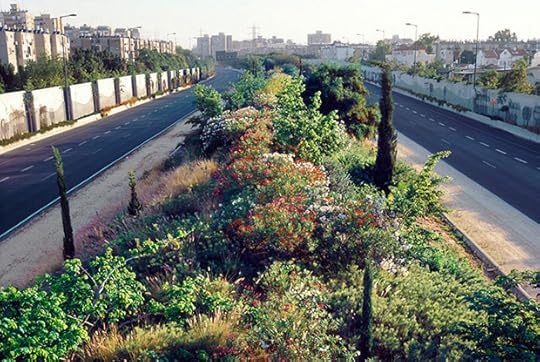
Sharon Ya'ari: Freeway, 2002.
Oggi birra, pensai, guardandomi intorno, oggi voglio essere come loro. Oggi voglio essere parte di loro, entrare nei posti in cui a loro è permesso entrare, ridere come ridono loro, bere senza mettere dio in conto. Voglio essere come loro. Libero, libero di sognare, capace di pensare all’amore. Come loro. Come quelli che cominciavano a riempire la pista sapendo che era loro, che non sentivano il bisogno di giustificare la propria esistenza, non sapevano di dover nascondere la propria identità. Come loro. Senza impegni di fedeltà, senza esami di ammissione, senza paura di sguardi diffidenti. Oggi voglio essere parte di loro senza sentire di commettere un reato. voglio bere come loro, ballare con loro, senza portare il fardello pesante di colui che s’infiltra in una cultura straniera. Sentirmi parte senza sentirmi colpevole o traditore.
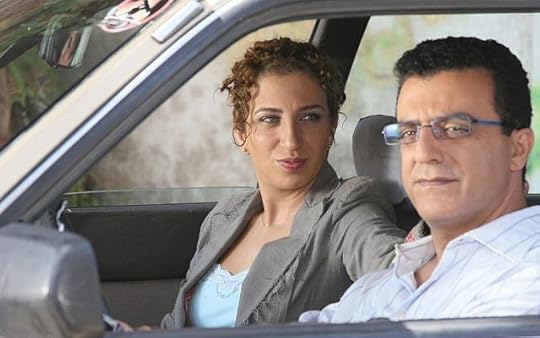
Clara Khoury e Norman Issa in ”Arab Labor”, la sitcom creata da Sayed Kashua.
Wow. A fascinating exploration of Arab identity in Israel (and a very good read too). Reading it, I realized how little I knew about Israel's Arab citizens, and about the frameworks, both legal and cultural, that govern their lives. This isn't a book about ripped from the headlines violence, but rather a book about coexistence in the midst of casual racism and deep seated mistrust, but also cultural envy and material aspiration, as well as the occasional good intentions and actual bonding.
It's also a book about doubling - we have our twin narrators, one an upper middle class lawyer living a bourgeois lifestyle that emulates much of what he sees in Jewish culture around him, while wrestling with feelings of cultural insecurity (and his fate - no spoilers - is both a parody of how the Jews see Arabs, according to Kashua, and a tragic literalization of his own fear that he cannot escape his peasant roots). Our other narrator - our hero? (we feel that way as we root for him, but oh, how problematic) - starts the novel as a bored social worker working hopelessly among East Jerusalem's addicts, and at first seems simpler and more likeable than the lawyer, but then becomes entangled in another even more complex doubling.
What a fascinating, rich work. I didn't learn until after I finished reading that Kashua left Israel a couple of years ago for Chicago, because, as he announced, he no longer believes that peaceful coexistence in Jerusalem is possible. It is a tragic coda to a book, written by an Arab Israeli in Hebrew (originally), that shows us all the deep problems of that coexistence, but also documents it as a living thing, however fragile it is, or was.
This was a selection for my in-person book club, and I would say I was thinking three stars before I had the opportunity to discuss it. At the same time I appreciated the short chapters, the alternating narrators, the sense of a thriller in pace if not always content. Our book club reads tend to be quite serious so this was an attempt at something lighter (we discussed whether or not we succeeded, and I think we agreed we did not!)
We also had someone at our book club meeting who read it in the original Hebrew and is from Israel, and could add a lot to the discussion. It was interesting to hear her perspective and how much difference she places between Arabs and Jews even in such shared spaces in Israel, but that reflects the reality as described by the book.
I really disliked the unnamed narrator, the lawyer character. He was not particularly religious until he suspected his wife was cheating on him, and then it was a jump to honor killings and such. He just seemed so irrational in that arena while he could be so observational of the intricacies of Arab-Israeli society and its hierarchies, all the messages tiny things could send like which place the sushi came from, etc. So it didn't quite fit his character to just lose it and go crazy. At least, that's what I was thinking going into the discussion.
The social worker character, Amir, was interesting, and had some parallels in background with the lawyer. However rather than navigating the difficult roads of Arab-Israeli society, he slowly morphs into being perceived as Jewish, and focusing on his art.
I was more interested in the female characters of the novel and if it had been up to me, I would want to read maybe a second novel about the wife and the sister and the grandmother. I bet they have interesting stories to tell.
A 28-year old paraplegic, Yonatan, is a pivotal figure in Sayed Kashua's novel, "Second Person Singular". The book examines the relationship between Arabs and Jews in Israel as well as relationships among Arabs themselves. The book also raises broader questions about the nature of personal identity: what it is and the extent to which emphasizing it may be valuable or harmful to a person or a society. Sayed Kashua is a Palestinian who lives in Israel and who has a following among both Israeli Jews and Arabs. Originally published in Hebrew in 2010, the book was translated into English in 2012 by Mitch Greenberg, the military correspondent for the "Times of Israel". The book reads lucidly and quickly in translation.
The book tells the parallel stories of two Palestinian men who live and work in Jerusalem. The first is the story of a man identified only as "the lawyer". The lawyer is a successful criminal attorney who defends Palestinians in Israeli courts. He is married to a woman named Leila, a social worker who holds advanced degrees. The couple has two young children. Leila came from a different class of Arab society than did the lawyer, a fact emphasized during Kashua's depiction of their courtship. The marriage appears somewhat tepid as the lawyer and Leila for the most part sleep separately. The lawyer's story is recounted in the novel in the third person.
The other protagonist is a young man, 28, who tells is story in his own words. Rather late in the book, his name is given as Amir. But as the book develops, Amir develops not one identity but several. Amir is trained as a social worker but develops an interest in photography for which he shows marked ability. He comes from a small settlement town in which his mother is an outcast. His father had apparently been killed for collaborating with the Israelis.
The two stories are gerrymandered together through the figure of Yonatan. Amir gets a part-time job caring for Yonatan. And one night, the lawyer, ever seeking to improve himself, buys a used copy of Tolstoy's short novel, "The Kreutzer Sonata". A note falls out written in Arabic in his wife's handwriting that appears to be a love note to another man. Yonatan's name is written in the cover of the book. In spite of his training as a criminal lawyer which encourages skepticism and a careful weighing of evidence, the lawyer is beside himself, thinking that his wife is involved with another man and with a Jewish man at that.
There is a great deal in this book about differing groups of Arab people in Israel and their tenuous, difficult relationship to the country. The best scenes of the book describe the backgrounds of the lawyer and of Amir and their varied attempts to make something of themselves. The story of the lawyer, his insane jealousy, and of how Amir dovetails into the situation is too complex and contrived to be convincing. The story descends into something of a parable.
The characters and the author face questions about personal identity that are most provocatively addressed by two secondary figures, a young Palestinian lawyer Tarik who works with the lawyer and Ruchaleh, the mother of Yonatan. For example, in a scene early in the book, Tarik is invited to a gathering of educated Palestinians who are discussing what they see as a separate Palestinian "narrative" in Israeli schools. Tarik boldly questions his peers on why a "narrative", Zionist or Palestinian, is important at all. The lawyer fleshes out the thought with the elliptical observation: "sometimes I think a tree is a tree and a man is a man."
Although it is marred by heavy-handed plotting and by the use of coincidence, this book offers insight into Israeli Palestinians and into Jewish-Palestinian relationships in Israel. The book also invites the reader to think about the possible limitations in holding to a strong sense of personal identity. The suggestion is that people are not like trees who need their "roots" to survive and grow. Individual identities may change and may be more like one another than sometimes is supposed.
I absolutely adored this book. It was a window into a different world, the real Jerusalem and not the one I see every day in the news, the Jerusalem where Jews and Arabs co-exist, having forged an uneasy truce. I learned so much from this book, without realizing I was doing so. Kashua has a knack of transporting you right into the middle of the action, so I could feel my heart racing while Yonatan's identity was about to be revealed, while the lawyer discovered the note that would change everything, and while reading that masterful ending. Kashua reveals each piece of information slowly, exquisitely taking the reader on a roller-coaster of a ride. The plot is brilliant, the people real. Loved this book that made the impersonal conflict from the news so very real for me.
Romanzo all’insegna della duplicità, a partire dalla stessa struttura ripartita esattamente a metà fra i capitoli che vedono come protagonista “L’avvocato”, non meglio definito lungo l’arco del racconto, e quelli che in prima persona sono narrati da Yonatan/Amir, doppio fin dal nome, l’uno (Yonatan) decisamente ebraico, l’altro (Amir) leggibile con diversa pronuncia nelle due lingue… D’altronde lo stesso Sayed Kashua, come Gerusalemme in cui si svolge quasi tutto il romanzo, presenta parecchi elementi di ibridazione, figlio di genitori palestinesi, ha studiato e vive nella parte ebraica della città e in ebraico scrive in suoi romanzi.
Al centro dell’attenzione è dunque Il tema della mescolanza, ma anche l’opposizione ad essa, con i rigorosi e continui controlli su chi transita da una parte all’altra del territorio, le discriminazioni e le separazioni cui sono sottoposti i personaggi e tutta la cittadinanza, peraltro in un periodo di pace apparente da cui tuttavia traspare un’ossessiva ingiunzione a distinguere caratteri, abitudini, riti religiosi, costumi sessuali fra le due anime costrette a convivere nei medesimi luoghi.
In questo complicato contesto, la vicenda che vede le due storie procedere fino ad intersecarsi in modo piuttosto prevedibile è forse l’aspetto meno interessante del libro, soprattutto nella parte dedicata all’avvocato e alla patologica gelosia con cui accusa la moglie di tradimento (doppiezza) condizionato da un senso di inferiorità che sottende un pressante desiderio di integrazione, in uno sdoppiamento (ancora…!) fra la razionalità dell’uomo di successo che ritiene di porsi al di sopra di pregiudizi e intolleranza e l’istinto quasi primordiale di diffidenza e sospetto che riversa sulla moglie presunta fedifraga.
Più accettabile e autentica nelle sue sfaccettature psicologiche e nella sua introversione la figura del generoso Amir, coinvolto nella sua veste di assistente sociale prima e sanitario poi, in una relazione con la malattia che progressivamente slitta dall’ambito professionale all’intimità con Ruchale e con il di lei figlio ridotto in stato vegetativo, fino ad assumere anche di fatto l’identità di quest’ultimo.
Un romanzo che in definitiva suscita sensazioni controverse, non privo di debolezze soprattutto nei reiterati e un po’ monotoni tormenti interiori dell’avvocato (che perdureranno fino all’ultima pagina, nonostante il dilemma sulla fedeltà coniugale appaia infine risolto), ma capace di slanci di profonda umanità, tanto che per mantenersi in linea col romanzo, nel nostro banale dovere di “voto”, verrebbe da attribuirgli un ambivalente 3/4…
Man mano che si procede nella lettura, il titolo del libro acquista significati diversi e profondi. Sono due storie parallele, quella di un avvocato arabo e quella di un assistente sociale arabo a Gerusalemme, che a un certo punto si intersecano e sembrano fondersi. Sono due vite caratterizzate da un identico desiderio, quello di far parte della comunità, della gente che conta. Non è desiderio di integrazione, semplicemente impossibile, ma di identità: due arabi che vogliono essere ebrei per sentirsi a tutti gli effetti parte di una società in cui gli arabi sono tollerati, ma considerati inferiori. È la storia di due popoli che abitano una sola terra, separati da cultura e tradizioni diverse che ne impediscono la convivenza pacifica. E sono due gli stili narrativi: in terza persona per l'avvocato, di cui non conosciamo il nome e che per tutto il romanzo sarà identificato solo dalla professione; in prima persona per Amir, che di nomi e di identità a un certo punto ne avrà due.
In this book, Kashua deals with the subject he has written on several occasions in his various columns, and also appears in the television series he created, "Arab Labor" ….. The complex reality of an Israeli Arab and the crisis of identity derived from this reality in the State of Israel.
The complexity is tackled at various levels Israeli Arabs vs non-Arab Israelis Israeli Arabs vs Arabs from East Jerusalem Israeli Arabs from different places (for example Arabs from the Galilee vs Arabs from the Triangle) The complexity of being an Arab woman in Israel
While this book mostly takes place in Jerusalem and some of it in the same places I grew up in or lived, it is described from a completely different point of view that I am familiar with.
I found the topics that the book dealt with very interesting, but I was not very impressed with the prose and found the descriptions and scenes very "dry", Technical , and lacking depth and humor.
I remember when I saw "Life is Beautiful" in a small movie theater in upstate New York. The film was in Italian with subtitles which I always find a bit distancing, especially when it comes to humorous moments. That didn't stop the audience from laughing uproariously, though, even when some of the jokes seemed a bit lame, and my cynical side wondered how much of the audience's laughter resulted from the actual humor quotient vs. how much of it came from the sense of superiority that might come from being able to say you enjoyed a foreign film. That speculation comes back to me on those rare occasions when I actually enjoy a book in Hebrew -- was it really a great book, or was I simply excited about my ability to read something in a foreign language and not find it arduous?
Be that as it may, I actually enjoyed reading this book. Some of my enjoyment was curiosity. Living in Jerusalem, I experience a great deal of discussion about the Arab-Israeli conflict but know next to nothing about the day-to-day experience of Arabs living in Israel. This was a novel, of course, and merely reflects an invented experience of imaginary people, but it was still interesting to get Sayed Kashua's perspective.
What's more, the story actually moved and kept my interest. One subplot was much more engaging and believable than the other, but I never minded picking up the book. "Guf Sheni Yahid" is about two Arabs living in Jerusalem; a lawyer who suspects his wife is cheating on him and becomes obsessed with unmasking the alleged culprit, and a caregiver for an incapacitated Israeli boy who ends up stealing his identity and reinventing himself. The two plots end up coming together in an interesting way, although I didn't quite get the ending.
I don't know whether I would have enjoyed this as much in English, but it certainly felt good to move easily through a book in Hebrew. Sayed Kashua must be a pretty interesting guy -- I would love to learn more about his life.
4.5 Una lectura audaz, inteligente, un thriller psicológico que retrata la vida en Israel, de árabes y judíos, y de árabes israelíes. Qué interesante es leer sobre lo que sucede en Israel, el marco perfecto para acompañar esta novela. Por un error mío no entendí que eran dos protagonistas distintos, eso me confundió y le restó .5 estrellas, pero fue mi culpa, no la de él.
Aunque el tema no es novedoso (el marido celoso, tercamente celoso) hay tantos elementos originales que lo convierten en una lectura ágil e interesante. La contraportada habla de un maravilloso sentido del humor, pero yo percibí en cambio, mucho dolor y soledad. Me gustó mucho! Mucho.
Kashua presents a compelling, compassionate yet sometimes chilling, look at identity -- how we see ourselves, how others see us, what others see in us. His is a universal tale, but also unique in its specifics (people & locale). Things are not always as they seem, whether we deceive ourselves or deceive others (or both or neither). Kashua aptly delineates the divides between wanting to stay true to self, yet to change/have what someone else has/grow. His timely commentaries are so fitting in a locale where identity is a huge part of daily existence.
Of partial importance to the storyline is Tolstoy's novella The Kreutzer Sonata (which I read immediately after finishing Second Person Singular). Kashua masterfully worked in many of Tolstoy's themes & ideas (jealousy, relationships between the sexes, the influence of art in life & passion, etc...), paralleling these ideas in his story -- similar themes, just set in a more modern time & with differing religious beliefs from Tolstoy's.
Overall, a beautifully done work that muses on the nature of identity, our ability or inability to change identity, & the impact of emotion/art/beauty/self to impact our lives.
Sayed Kashua has a great sense of humor but I found his latest novel to be totally humorless and even painful to read, in its tale of two unhappy souls. The main characters are two Israeli Arabs. Each has escaped the stifling, small-minded milieu of a home village in the Triangle near the Green Line in central Israel, to settle in Jerusalem. In Jerusalem these men are outsiders to the Jewish majority, whose culture in many ways they aspire to emulate, and also separate from the West Bankers living in East Jerusalem. From this confused and marginal state, they grapple with their identity.
One character, the unnamed lawyer, exemplifies some of the village society’s least laudable qualities. Possessive, patriarchal, and insecure, stuck in a lukewarm marriage that was made according to traditional practices and rules, he becomes furious and paranoid when he stumbles by chance across a note in his wife’s handwriting that suggests that she may not have been faithful to him. His intense, unending paranoia as he wrestles with this alarming possibility (probably intended to be satirical) overwhelms all other aspects of his personality, making him kind of a one-note character.
It’s a credit to Kashua that the second main character’s struggles are so deeply engaging and disturbing. This character, Amir Lahab, a young social worker, is gripped by social anxiety. He cannot handle romantic interaction with the opposite sex or the scrutiny that he fears that male peers are directing at him in social situations. Anxiety so consumes him that he bails out of a date with a social work intern (the young woman who later marries the lawyer) and leaves his job rather than face his male co-workers, who have witnessed this embarrassing episode. Oppressed by job discrimination, social rejection, and condescension from much of the Jewish sector, Amir experiments with “passing” as Jewish to get work. When Amir takes a job caring for a young Israeli who lies in a vegetative state, that person’s previous life becomes the inspiration for Amir’s search for identity and a creative calling, and inspires Amir’s attempt at a radical solution.
I read this a year and a half ago-ish and didn't review it. Something reminded me of it today and I am thinking about it, but don't remember it well enough to write much.
I am pretty sure it's supposed to be a darkly comic social satire, but what I remember most is that I didn't find myself picking up much humor. It was a fascinating exploration of the fluidity and non-essentiality of identity, and a complex snapshot of the lives of two Arab men who have to some degree become cultural exiles and are trying to make sense of their identifications with the "oppressor."
A lot of things in this book reminded me of conflicts revolving around identity and privilege and institutionalized racism in the U.S. (and the very small, inept, inadequate steps taken to make a show of trying to "fix" it).
While there is a lot of criticism in here of Israel there are also notes of confused affection -- what happens when you value a culture's values, begin to really identify with its European ideals (and this may be satirical, or a location for satire), but this same culture with the values you value, or at least have conformed to, does not, as a whole, no matter what you do, value you.
The novel was well-written and engaging, but it felt a bit contrived and something was off tonally. Perhaps it had to do with reading it in translation.
Fascinating novel about identity and the possibility of cultural assimilation. The plot involves two characters, both Arab Israelis who have left their Palestinian villages to pursue a new life in Jerusalem. One is a successful criminal lawyer and the other a social worker turned artist. Their very different lives intersect when the lawyer picks up a copy of The Kreutzer Sonata by Tolstoy in a second hand bookshop. In it he finds a love note written by his wife. He then goes on a relentless pursuit of the recipient of the note.
I found it a very informative read from a political/socio-economic level as it describes life in Israel and the Palestinian territories, especially from the point of view of the Palestinians or Arab Israeli (not sure how to categorize either one). It is also interesting from a psychological level, exploring jealousy, envy, anger. How far will you go to fit in? How much of yourself are you willing to let go? And can a person really become someone else? Can a leopard truly shed his spots? In the case of the lawyer, although he was very successful from a superficial point of view (the Mercedes Benz, the nice house in the “good” neighborhood, his kids in the right schools, intellectual friends etc.), he really never shed many of the backwards attitudes towards women and modern society.
Whereas for the social worker/artist, who never really fit in anywhere, whether it was his family, his village, his job, his only way to happiness was to become someone else.
The author picks up the theme of jealousy and misogyny and religion from Tolstoy’s Kreutzer Sonata and it is interesting to see it applied to the Muslim culture and in a modern setting. Makes me curious about the original.
I liked the writing a lot, although I found his depiction of the women to be very superficial and one-dimensional. The lawyer’s wife for example was not very believable at all. Which kind of weakens the story since she is the common link between the two main characters. I still give it 4 stars because I really enjoyed it and the themes it explored. I also found the translation to be very good.
Sayed Kashua, scrittore - e giornalista e autore di programmi televisivi - arabo israeliano, si adopera attivamente per l’integrazione delle due etnie nello stato di Israele. In questo suo terzo romanzo (avevo letto e apprezzato quello d’esordio, “Arabi danzanti”, del 2003) propone una storia strutturata in due filoni che si incrociano, i cui protagonisti sono - appunto - due arabi israeliani vogliosi di integrazione (uno assume e vive addirittura una doppia identità, ebraica oltre che araba) e dunque critici verso le speculari ottusità di coloro che da ambo le parti esaltano le differenze, e dividono. Nell’intreccio - occorre dire - alcuni elementi chiave appaiono discutibili, tanto da mettere alla prova il patto narrativo, ma la forza del nobile messaggio di Kashua fa senz’altro propendere per una complessiva credibilità: e alla fine il romanzo, oltre che interessante, risulta pure godibile.
Kashua bierze na warsztat literacki swoje własne doświadczenia z życia Araba w Izraelu. Choć sama fabuła jest raczej wtórna, żeby nie powiedzieć oklepana, a większość zwrotów akcji łatwych do przewidzenia dla czytelnika, to najważniejsza w tej historii jest właśnie Arabska perspektywa. Zatłoczona wschodnia Jerozolima, arabskie zapuszczone wioski pełne ludzi bez perspektyw kontrastujące z żydowską częścią miasta. Między tymi dwoma światami żyją bohaterowie powieści, nieliczni z Arabów, którzy chcą odnieść sukces, lub tylko i aż osiągnąć spokój w tym kulturowym tyglu. Autor pisze z wielką wprawą i łatwością, przez co bardzo trudno oderwać się od książki pomimo raczej nieskomplikowanej fabuły, pozostawiając pole do interpretacji dla czytelnika. Bardzo ciekawa lektura, dzięki której można w lżejszy sposób dowiedzieć się co nieco o tamtej części świata.
There is so much to say about this book, I am sure it would be a great pick for a book club. It is a page turner with an intelligent plot set in Jerusalem, but at the same time you learn a lot about modern-day Israel and the relationship between Arabs and Jews. But it is also thought-provoking about more general issues such as identity, role-playing, ethics, morality, love and relationships. I am very happy to have discovered this writer, who I understand is something of a celebrity in Israel but not very well known in The Netherlands.
I'm not one for thrillers. History in itself is often little more than a murder mystery that the status quo refuses to legitimately resolve, and the endless train of whodunnits that I as librarian am in charge of moderating tend to glibly circle the matter in the most superficial sense (no doubt enabling their rampant popularity). So, to find myself looking back on this work and seeing it firmly ensconced in that particular genre, if in an extremely literary sense of the word, is rather startling, but also welcome. For the human is a storytelling beast, and however well my background has equipped me when it comes to predicting the ending, the twist, the character development and the killed off darlings, I do like being engaged in something where the stakes have no real world significance but delightfully entice nonetheless. This particular work centers around the question of identity, and the unusual blend of 'lowbrow' and 'highbrow', the narration of jealous lovers juxtaposed with meditations on disenfranchised Arabs in Israel with a few non-ostentatious references to the likes of Life: A User's Manual and The Notebook, is so smoothly pulled off that, in some instances, is nothing short of brilliant. The non five star rating has to more to do with my own personal disappointment with the ending than anything else (which to be honest really had the potential to build a lot more interestingly on its individual components), but I still highly recommend this to anyone looking for an extremely authentic and highly relevant to the modern day sociopolitical thriller that doesn't sacrifice complexity for intensity but manages to be hard hitting all the same.
The conversation about Palestine is one of boiling crabs and divide and conquer, and unlike Gate of the Sun: Bab Al-Shams, this work isn't going to blow your mind and rearrange your gut instincts from the inside out. What it does, however, is go into the world of Israel without fireworks or pedanticism, and ask simple questions of how truths resolve themselves in the time of artificial inhumanities, where personal choice falls in a landscape of apartheid, what can an individual possibly do when their very existence denies the hierarchical classifications that society so loves to file and fillet its populations within. To be more plainspoken, this story of two Arab men, one almost clownishly bigoted, the other nearly incredibly self-effacing, could very well in a way be described as a murder mystery, replete with a double identity and a vanished corpse. What makes it entirely more interesting is how incisively and pervasively it explores the nature of 'doubling' in a very real time in a very real place that, so long as 'common sense' has its say, will never be overturned or brought to real justice founded on truth, equity, and a shared humanity. It also touches upon Sharia courts, anti-Arab bigotry, misogyny, homophobia, suicidal ideation, the redlining of modern day Jerusalem, and radical compassion in the face of all that, in such a clear sighted yet practical way that it doesn't surprise me that the writer is known for his satire, as these are all the sorts of issues that one (of the community, mind you) sometimes has to laugh at in order not to cry. Again, the ending was a cop out in my view, but for a nearly 400 page work dealing with a highly divisive and deeply complicated contemporary sociopolitical situation without pulling punches or infantilizing issues, the pages veritably flew by, and you'll be left with much to think about long after it's over.
In 2014, Sayed Kashua left Jerusalem for the United States, declaring that his worst suspicions had come true: that it is inconceivable for there to be a world where Arab-Israelis and Jewish-Israelis could live together without conflict. This work, first published in 2010 in Hebrew despite Kashua's primary language being Arabic, was part of decades of work spent trying to showcase the Arab as worthwhile human in the lexicon of Israel, and here in 2022, I have to wonder what the author thinks of the years that have passed and the years to come. I could read his Track Changes (which I'm likely to do so anyway, to be honest), published a year after his immigration and more than a little autobiographical, or track down his teaching in various US universities, but considering how rabid the political climate continues to be in this military industrial complex homeland of mine, I wouldn't blame him at all for being less than honest in order to continue to put food on the table. I have a solution, but it involves similar principles to the concept of 'Land Back' extended across the most status quo continents currently in existence, so in the meantime, I continue my career in library collection development and watch and wait for the next book that will give my patrons a much needed kick in the pants. It's not going to solve ancient traumas inherited from the first half of the 20th century. But it may just give someone the incentive to take their place in the conversation.
Even though I didn't find either of the two alternating male narrators likable, I liked Second Person Singular very much. The novel is very readable (with a bit of a mystery) and thought-provoking as Kashua illuminates the world of these two Israeli Arab men and their insecurities living as "immigrants in their own land."
Oy. I knew this one would be a tough one for me, given the location and situation, and my own strong attachment. I'm really grateful for the opportunity to see Israel and her citizens from a very different angle than my usual.
The translation kept up the flow of the narrative quite well, and Kashua did a lot of interesting things with building up characters and relationships. I learned a lot about the well-to-do Israeli-Arabs in Jerusalem, their social pursuits and self-motivated need for flashy presentation, at least from the perspective of the lawyer and his friends. Amir brought to the forefront a lot of the uncomfortable but relevant discriminations against Arab men in Israel.
I even, mostly, like what he did with the Jews. I think this is the main difference between Kashua and the Jewish authors I've read; Jewish-.Israeli protagonists are often filled with a sense of Purpose. Here, in passing, they're almost allowed to be more real--with normal passions and pursuits, and not a long destiny always trailing them. That being said, I found Yonatan and Rucheleh to be a little flat. They weren't the main characters in their story, but their backstory and later plot progression was so dramatic, and relatively unexplored.
Kashua showed us a world where individual Jews and Arabs got along well, though when talking about each other in general, the claws often came out. Perhaps the most implicitly damning, or maybe this is my own biases again, were the shallow stereotypes that the leftist Jewish-Israeli students dealt in--like yeah, the occupation is bad, but Arabs only care about a primitive sense of honor and only respond to force, yadda yadda. As ridiculous as these attitudes sounded within the narrative, I couldn't help but realize that one of the driving plots of the story revolved around the lawyer finding flimsy evidence that his wife might be having an affair, and immediately fantasizing about killing her or stripping her of everything in a Sharia court. Though to be fair, there's a difference between thoughts and actions. And I think this has less to do with Arab culture than with any patriarchal culture. Still, the lawyer was certainly my least favorite character.
I'll end with what were probably the most harrowing lines for me, concerning Amir talking about his Jewish classmates--"I want to be like them. Free, loose, full of dreams, able to think about love. Like them. Like those who started to fill the dance floor with the knowledge that it was theirs, they who felt no need to apologize for their existence, no need to hide their identity. Like them. Those who never looked for suspicious glances, whose loyalty was never questioned, whose acceptance was always taken for granted. Today I want to be like them without feeling like I'm committing a crime. I want to drink with them, dance with them, without feeling as though I'm trespassing in a foreign culture. To feel like I belong, without feeling guilty or disloyal. And what exactly was I being disloyal to?"
I don't think there's any passage in this book that struck me more as being part of the Jewish experience--in the past, and, in some places, the present. How easy it is, when a certain group gains power of majority, to swing like a pendulum in the opposite direction. I don't mean to cast blame in such a blind and universal way, but I do think this speaks to the human condition; all groups have taken part in victimization and oppressiveness, belonging and being on the outside.
ספר חמוד, לפרקים כתוב היטב, לפרקים משעשע מאוד. סך הכל אהבתי ונהנתי, למרות שהיו שם חלקים שלא היו הגיוניים כלל וכלל. אני חייבת להתלונן על התקציר, מי כותב תקציר שמגלה לך את כל הקטע? מזל שאני לא קוראת תקצירים, אז גיליתי רק אחרי הכל.
הספר עוסק בעורך ערבי מחוסר שם, ובאשתו היפה מחוסרת השם, שחיים חיים נפרדים לגמרי בבית אחד. שחיים חיים חלומיים כלפי חוץ, אבל בודדים מאוד מבפנים. חיים שבריריים, שרמז אחד קטן עשוי להפוך אותם על פיהם. בנוסף, הוא עוסק בצעיר ערבי משכיל, סטודנט, ללא שם, שחולק דירה עם ערבים, אבל גם עובד לצידם של יהודים, ומכיר את החיים היהודים יותר ויותר. איך כל אלו קשורים? והאם יש סיבה שבגללה קשוע בחר לשמור את אנונימיות הדמויות?
יש בספר הרבה התייחסות ליהודים-ערבים ורמות שונות של הקושי ביניהם. הרצון להשתייך לשכבה החזקה, יחד עם הקשר למשפחה, לחברים ולכפר. קשוע כותב בעברית יפה, הפרקים מחולקים בצורה טובה בין שני הסיפורים שנשרגים לעלילה אחת. 3.5 כוכבים מעוגלים ל-4 (בגלל הסןף, אחרת היה לגמרי 4).
Very reminiscent of early-20th century African American literature. (Nella Larson's Passing comes to mind for obvious reasons, as does Richard Wright's Native Son.) By weaving two narratives into one multifaceted story, Kashua is able to deftly portray the complexities of living as an Arab-Israeli. Second Person Singular will likely find a place of prominence in future minority literature classes.
Interesting and thought provoking read, one that almost requires a good discussion before it can said to be completed. So many layers and motives unexplored leaving much to the readers imagination, except it may not be the imagination, it highlights our limited understanding of the subtleties of identity in this land of Christians/Jews/Muslims/Arabs/Arab-Israeli's/Israeli's/Palestinians and more...
Un libro que nos cuenta como viven los árabes en Jerusalén, como es la convivencia con los judíos, que expectativas para educarse tienen unos y otros, cual es el bagaje cultural, sus costumbres. Un libro que me hacía pasar de la tristeza a la reflexión a la rabia (el abogado que cuenta la historia se convierte en un loco cuando sospecha que la mujer le puede estar siendo infiel). https://bibliobulimica.wordpress.com/...
Second Person Singular by Palestinian-Israeli author Sayed Kashua tells the story of two men, both Arabs, living in Jerusalem. Superficially, they have similar histories; they both come from small villages and they both came to Jerusalem to go to university and stayed afterward. One man became a successful lawyer, living in a beautiful house with his wife and two young children, he drives a BMW. He's not in love with his wife, but when he finds an affectionate note in his wife's handwriting, tucked into a used book he just purchased, he becomes consumed with jealously and anger and is determined to find the man the note was intended for.
The other man became a social worker. He's struggling financially but he resists his mother's entreaties to return to the village he left. He works during the day for a government agency providing social services to heroin addicts and at night he is the caretaker for a young man his age who due to an unspecified accident, lives in a vegetative state. When events cause him to quit his day job, he becomes more fascinated with the past of his Jewish patient, reading his books, listening to his music and using his camera.
Second Person Singular is just a fantastic book. While neither man is particularly sympathetic, it's impossible not to be drawn into their lives. How Kashua draws the two men's lives together is riveting. I will be reading more by this author, who is well-known in Israel.
I am SO glad I read this book. It has given me still another perspective that I had not previously been much aware of. I've read a little (very little) about Palestine/Israel relationships, but most of that had been written by people who took a strong stance one way or the other. This novel is written from the perspective of two Palestinians living in Israel not on the West Bank, who seem to be apolitical. One of them is an attorney with resources, the other a social worker with none, which further broadens the perspective. This is a story about identity development of two men living as a cultural minority. There were so many consequences of that that I had not thought about so much. There are the obvious issues of religious differences e.g. stores and businesses closed on someone else's holy day rather than your own. That requires planning. The discrimination also followed the usual patterns of employment discrimination, educational discrimination, neighborhood and real estate issues, etc. At one point it felt to me, from my American experience, that I was reading about a light-skinned person of color in the United States passing as white. The stress of doing so is of course enormous, such as having to hide family ties and background ties as well as language and grammar differences, lack of knowledge about majority values, history, myths, etc. These necessary secrets block the development of intimacy in relationships, which then feeds a vicious circle. As I continued reading I began thinking about other groups living this experience, which happens everywhere, such as Northern Ireland with Catholic vs. Protestant, poor white students with scholarships to U.S. ivy league colleges, women everywhere in a patriarchal culture. Mostly this then became a reminder to me of the ways we humans are similar rather than different, the pains of identity and separation and even discrimination that we all suffer in some way, although not to this extent perhaps. It reminded me that probably most of us "plain people" are not interested in fighting with each other, but more likely it is the political leaders owned by the wealthy that cause the fighting - reminds me it is a class issue more than religious or political. Yeah yeah I know - we let them. It is a very interesting book.
This book takes place in Jerusalem, where two stories happen on their own until they intertwine. I believe it is supposed to be relatable to 48’ Arabs (Arabs that stayed in Palestine after the Nakba and now live under Israel), but I had an irritated feeling throughout the book. One of the two stories is of a man who thinks that his wife is cheating on him. It is not very interesting because the reader knows that the wife did not cheat, and the husband keeps obsessively checking after her and degrading her and humiliating her.
The story about the young Arab man who steals the identity of an Israeli, to ‘fit in’ more and to get better jobs and better education, is also irritating. Supposedly, that story is meant to show the very-real discrimination happening in the apartheid state of Israel, and it does show that. but nevertheless, I had the unshakable feeling that the character has internalized racism towards Arabs and our culture. I saw that in the way that he thinks about villagers from his village, how he many times takes the POV of Israelis, condescending on the morals and traditions of Arabs. At the same time I understand the need to be critical of our own culture to be able to progress towards better days.
Overall, I think this book is not very representative and does not do Palestinians much justice, and it ends with a rather inferior tone. (a note: for reasons beyond my knowledge, the author does not mention the word Palestinian to describe the Arab man)
This entire review has been hidden because of spoilers.
I wish I'd read this book in Hebrew. I've read articles by the author in Ha'aretz magazine and his writing is humorous and honest.
It would be nice to judge the book purely on its literary merits, but as the author is an Arab Israeli who writes in Hebrew, I couldn't help but pay attention to its politics.
I was pleasantly surprised, because the book is so apolitical. There are no heroes or villains, just characters going about their lives - trying to belong, building relationships, questioning their identities.
Since the story takes place in West Jerusalem, the main characters must navigate the challenges of that particular place, where the question of identity - Palestinian, Israeli, Arab, from West or East Jerusalem - is always present.
The story itself is kind of slow. The characters are not interesting enough to make up for the lack of suspense. Nevertheless, I appreciated the story for giving me a glimpse into the life of an Israeli Arab without (seemingly) a political agenda.
The cover of this photo caught my eye in the "new arrivals" section at the library, and I picked it up, hoping for an interesting read. I wanted to like this novel, I really did. I read it within the span of two days, picking it up and setting it down and picking it back up again, hoping that the novel would get better if only I'd continue reading. The lawyer was incredibly agitating. His complete overreaction at such a simple note written by his wife felt extremely unrealistic. His violent thoughts and extreme actions were hard to read, simply because I felt as though no one in their right minds would act in such a way. The plot line was completely built around his extreme overreaction at the note. It was an okay read, but had it not been for the social worker's part of the story, I would have completely abhorred it.