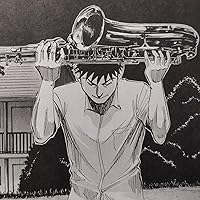
Furari è un’espressione giapponese che sta per “vagare senza meta”, “seguire il vento”: e il piacere del camminare, di opporsi alla furiosa corsa del mondo per concentrarsi sulla bellezza delle piccole cose, è il tema di quest’ultima opera, contemplativa e malinconica, di Jirō Taniguchi. Il protagonista – ispirato al celebre cartografo Tadataka Inō, che tra il XVIII e il XIX secolo mappò per la prima volta il Giappone con tecniche di misurazione moderne – è un cinquantenne curioso di tutto, un edonista che osserva il mondo e con esso si fonde, immaginandosi ora gatto, ora uccello, ora formica, e rallegrando le proprie passeggiate lungo quelle che saranno le future strade di Tokyo con gli haiku: “Sui fiori e sugli alberi / anche nei corsi d’acqua / la pioggia posa il profumo / delle quattro stagioni”. Perché è indispensabile saper vedere le meraviglie attorno a noi, e lasciarsi incantare da esse.
He began to work as assistant of the late mangaka Kyota Ishikawa. He made his manga debut in 1970 with Kareta Heya (A Desiccated Summer), published in the magazine Young Comic. From 1976 to 1979, he created several hard-boiled comics with the scenarist Natsuo Sekigawa, such as City Without Defense, The Wind of the West is White and Lindo 3. From 1984 to 1991, Tanigushi and Natsuo Sekigawa produced the trilogy Bocchan No Jidai. In the 1990s, he came up with several albums, among which Aruku Hito (歩くひと), Chichi no koyomi (The Almanac of My Father), and Keyaki no ki. In 2001, he created the Icare (Icaro) series on texts by Mœbius. Jirô Taniguchi gained several prizes for his work. Among others, the Osamu Tezuka Culture Award (1998) for the trilogy Bocchan No Jidai, the Shogakukan prize with Inu wo Kau, and in 2003, the Alph'Art of the best scenario at the Angoulême International Comics Festival (France) for Harukana Machi-E. His work has been translated in many languages.
Far from the violent storylines often associated with the manga, Taniguchi has developed a very personal style, more adult. Along with other writers, like Tsukasa Hōjō, his comics focus more on the Japanese society and culture, with a subtle analysis of its customs and habits.
This charming graphic novel breaths the graceful spirit of haiku poetry.
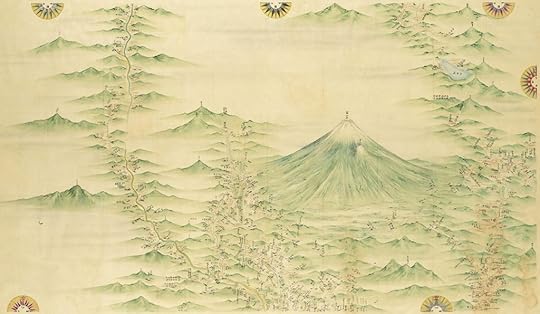
With Furari, Jirô Tanigushi (1947-2017) ) takes the reader to Edo (now Tokyo) at the turn of the 19th century. Throughout the narrative, he literally follows the footsteps of a businessman who retired early to dedicate himself to measuring the town by walking and counting his footsteps. For the creation of this walker Tanigushi took inspiration from an historical figure, Inō Tadataka (1745-1818), a surveyor and cartographer known for completing the first map of Japan using modern surveying techniques. In 1800 was authorized by the Tokugawa shogunate authorized to perform a survey of the country using his own money. Inō spent the remaining 17 years of his life travelling and producing maps, covering the entire coastline and some of the interior of each of the Japanese home islands.
Wandering through the districts of the town, Inō recurrently flows into in a dreamlike state of mind, distracted by an encounter (with animals as well as people), by a view, a detail that draws his attention and hich he marvels about on his itinerary, blending his determination to count accurately with the art of digression. On several moments he falls asleep, dreaming he is having a conversation with a cat or a tree. Plenty are the scenes in which he takes pleasure in food, alone or with his wife Eï or with others. The appreciation and significance of food and eating together was also an important theme in Tanigushi’s graphic novel The Tender Years – and food, at least according to the book on modern Japan I am currently reading, seems still as important in Japan today as in Tanigushi’s 19th century (Washoku, traditional Japanese cuisine has been officially recognized as a UNESCO Intangible Cultural Heritage in 2013;Freek Vossenaar, a Dutch diplomate working in Japan, mentions in his book Kijken in de ziel van Japan that eating is a serious business in Japan and that in a survey of what gives Japanese the greatest pleasure, enjoying a delicious meal was ranked first - sex fifth).
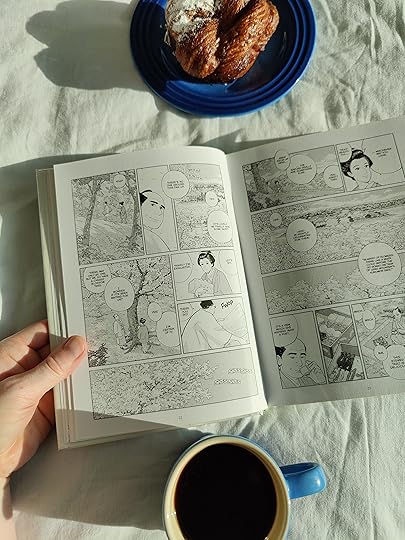
Structured in fifteen chapters, the black-and-white drawings are clear, precise and elegant; big plates offer vista on Edo reminiscent of (and perhaps inspired by) Hiroshige’s One Hundred Famous Views of Edo and Hokkusai’s Thirty-six Views of Mount Fuji.
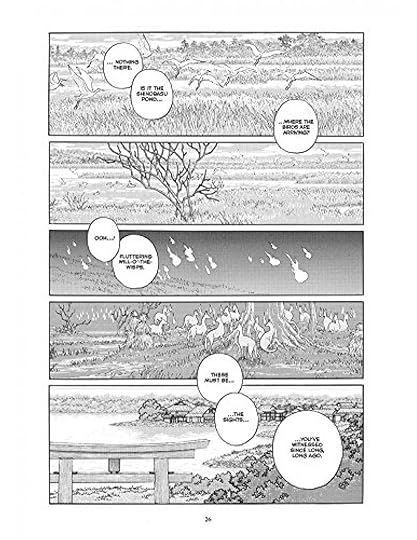
Like in haiku, seasonal references and elements of nature (snow, storm, rain, the moon, the stars, cherry blossoms), often animals (fireflies, ants, a kite, a dragonfly, an elephant, a horse, a cat, a whale, a tortoise) serve as the focal point of attention in each vignette; quite a few of the text bubbles echo the lyrical expressiveness of haiku or are haiku (it is unclear if some of these are written by Tanigushi or if he is quoting one of the haiku Masters (Bashō is mentioned a few times). In a particular moving sequence Inō meets the budding poet Issa (1763- 1828) who just returned from a pilgrimage at the west of the country. Their nocturnal encounter leads to an occasional haiku which Issa writes for Inō (I revere Kobayashi Issa’s haiku because of the gentle touch of humour which is often sensible in them). Watching our two tortoises in the garden brisked up by the heat, I smiled reading the vignette in which Inō buys a tortoise at the market in order to free it in a lake, observing it when it climbs on the land again - warning the tortoise it might let itself be captured and sold again.
Philosophic, poetic, quiet, meditative, brimming with the stirring tenderness and affection between Inō and Eï, Furari resonated deeply with me, perhaps even more than his marvellous A Zoo in Winter and his Les Années douces - Intégrale Jirô Taniguchi’s graphic novel adaptation of Hiromi Kawakami’s novel Strange Weather in Tokyo.
On a lotus leaf resting on a single leg sings a frog
Ah, if I could be a star, a star in the night on this bridge in the deep colours of the maples that wish like a thread between us
“This thou perceiv’st, which makes thy love more strong, To love that well which thou must leave ere long.”
Furari: Go with the Flow
Jiro Taniguchi, RIP (in late 2017), in late life and career, writes a kind of quietly celebratory tale of his beloved country, seen from the perspective of old age, in this graphic novel, couched in a Japan long forgotten. A kind of love letter to Japan. But it’s not strictly autobiographical. He is inspired in his telling by Tadataka Ino (1745 - 1818), who slowly walks through the various districts of Edo, the ancient Tokyo, each chapter lyrically featuring a framing image, most often natural: Turtle, cat, whale, firefly, rain, moon, horse and ant. Sometimes he actually begins to assume the perspective of these animals and other creatures as he walks. The artwork in each piece reflects during aspects of life in Edo, but also imagines these various creature perspectives .
Now retired, the main character in this book surveys, measures—step by step, take it slowly—draws, and takes notes at the same time as he quotes poetry of his country and of the period. As he ages, he seems to love the natural world there even more than ever. In the process, he is increasingly supported by his somewhat bemused and mystified but ultimately loving wife as he takes on his seemingly impossible task (especially in older age):
“I would like to make proper measurements of the topography of this country’s unassuming natural features, and to draw up maps that will be left to future generations.”
So there’s this tacking back and forth between science and poetry as ways of assessing and reflecting on the world that are not in opposition here. And it's less historical fiction than just using history--the past--as one lens for looking at the world, as in science and art.
I have had this book in my tbr queue for many years, waiting for it to be translated, knowing it would be a classic. Had I known I would have had to wait several years, I should have just learned Japanese! But it was still worth the wait. If you want superhero action comics, look elsewhere. This is such a lovingly poetic and muted tale that forces you to do as the main character does: Slow down, and see the world through the eyes of a cat or red dragonfly. Can a manic Western world even imagine the elegant slow pace, and lowered heart rate and respiration of such a tale? I just love it. I have yet to read his Walking Man, but I am sure it is a kind of companion piece, as most of this work is walking in contemplation. Highly recommend!
Furari ("as the wind blows", "aimlessly") is loosely inspired by the life of surveyor and cartographer Inō Tadataka (1745 - 1818). Taking this character as the main motif, the manga explores daily life in Edo under the Tokugawa Shogunate. Our hero meets merchants, a poet, a storyteller, a painter and, ever the daydreamer, often falls in deep contemplation, picturing himself as a turtle, a cat, an elephant, a dragonfly, an ant,...
All of these instant reincarnations allow the master mangaka to display superb viewing angles, reminding me of some of these in A Distant Neighborhood, Vol. 1 and Icare and some from The Times of Botchan, Vol. 2, albeit more rare in this instance. This daydreaming tendency, and his imperfect method causing him to start measuring distances again are traits that made me find him touching and endearing. Another feature I have found nothing short of enchanting: the ukiyo-e-like aesthetic. Finally, what makes all the difference: the true-to-life relationship between the surveyor and his straightforward, brave and supportive wife.
Jiro Taniguchi--the master of the magical mundane.
This is a beautiful collection about a cartographer in the Edo period of Japan. He's retired and wants to create a map of his town, which he achieves by walking through the roads and counting his steps in some ancient metric.
Yep, that's the story, but it doesn't matter. What matters are the experiences of the cartographer and his surroundings--you'll witness the festivals, the wale hunting, the fashion and food and other cultural events of the Edo period.
It's like a subtle history book, and I love it.
The cartographer also has a tendency of falling asleep in the middle of the day. He then dreams of ants, fireflies and dragonflies and sees the world through their eyes, which gives the story a slight surreal touch.
Again, it sounds simplistic, but Taniguchi finds magic in the mundane. He makes little interactions meaningful and compelling, a rare skill I don't see with other artists.
If you like mature manga that's more about moments and experiences than action, this is a work that may suit you. This must be my fifth book by Taniguchi and I can't stop reading.
Volver a leer Furari es volver a viajar al antiguo Japón, al barullo de sus calles, a las tradiciones perdidas y a las que se conservan idealizadas, a esos paisajes recorridos paso a paso, sin prisa porque lo importante no es llegar sino contar cada paso. Volver a leer Furari es volver a disfrutar sus dibujos preciosistas y un ritmo pausado con el que desconectas de todo lo demás.
I Go Out Walkin' Review of the Ponent Mon hardcover edition (June 2017) translated by Kumar Sivasubramanian from the Japanese language original ふらり (April 2011)
I was previously only familiar with the late works of Japanese manga artist Jiro Taniguchi (1947-2017) through his commissioned views of Venice and Guardians of the Louvre. Those oversized and fully colorized editions have perhaps spoiled me somewhat for the earlier, smaller & non-colorized books such as Furari.
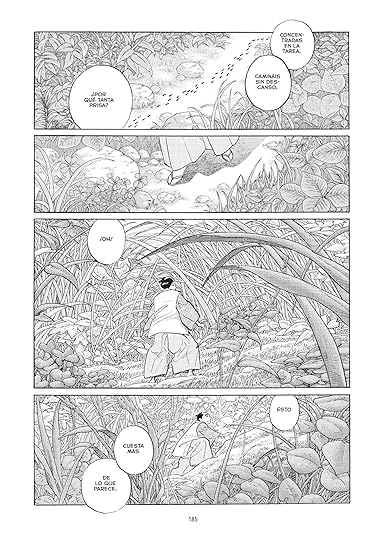
Furari is a historical fiction based on the life of Japanese cartographer Inō Tadataka (1745-1818) who was the first person to map Japan with modern surveying techniques. Through 16 beautifully structured chapters, often inspired by nature in the form of insects, fish, animals and birds, we see Inō gradually gaining inspiration for his massive mapping project under the supportive loving eye of his wife Eï. This is a gradual process which evolves from his retirement habit of counting his paces while walking and exploring his city. The panels sometimes take on a fantastical element as Inō transmogrifies into a bird flying over the land below or an insect walking through a huge jungle of grass. Those latter sections were among my favourites.
It was therefore somewhat disappointing that the book is printed in a rather small size format and is non-colorized for the most part. There is a 4-page teaser section which is colorized, as if to say "look how beautiful this book would be if we coloured it all in?". I'll confess to relying on a magnifying glass many times in order to better appreciate the care and attention that Taniguchi took on these drawings. That is my only reservation in keeping this from a 5 rating which it really otherwise deserves.
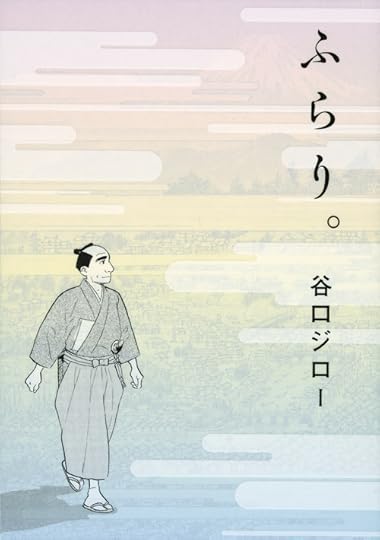
Cover of the Japanese language original. Image sourced from Kodansha Comics Plus.
Trivia and Links Read a superb review of Furari by Ilse (Belgium) on Goodreads here.
“Un viaggio lento tra il tempo e la natura. Con il tratto delicato e contemplativo di Taniguchi, Furari ci invita a camminare senza meta, a respirare il vento, a osservare la vita che scorre. Un manga poetico, silenzioso e profondo — un inno alla meraviglia del quotidiano.
Tienes que ser muy fan de Taniguchi para que te pueda gustar este tebeo; una especie de cruce entre El caminante y El gourmet solitario donde recrea el día a día de un geómetra y geógrafo de finales del siglo XVIII que cartografía Edo y sus alrededores con métodos rudimentarios. En sus recorridos se detiene a observar una imagen romantizada de la ciudad, sus gentes, las celebraciones y los grandes edificios; fantasea con cómo las contemplan diferentes animales que se cruzan en su camino; y hace planes para poder medir el tamaño de la Tierra a partir de su trabajo. Este idealismo que impregna de principio a fin Furari convierte su lectura en una experiencia idílica, muy disfrutable en pequeños sorbos siempre que estés dispuesto a entrar en esa propuesta (a la que yo habría limado algún bocadillo).
241019: this is very like The Walking Man by taniguchi but set in shogunate edo. not much plot, just images. wandering, experiencing, the simple life. each chapter focuses on single elements, not dramatically or more than gently symbolic. this is possibly how to view edo romantically and culturally as essence of japan, in beautiful line drawings, clear composition, still images, minimal dialogue. this is not japan currently known but as nostalgically rendered...
Ugh, I honestly feel bad about this rating because Taniguchi really is a master at his craft, but I base my ratings off of personal enjoyment and this isn't 100% my cup of tea. It's quite beautiful, but a bit too leisurely for my tastes.
I read another review that said Taniguchu is the best at depicting the wonderfully mundane and that is so accurate. Much like The Walking Man, Furari follows a gentleman who finds much joy in walking and enjoying the simple pleasures of the world around him. It's almost meditative but very accessible.
Recommended, but if you're a reader who wants ample character development, you won't find that here - the focus really is on glimpses of the MC's day-to-day.
A beautiful entanglement between the distance of spaces, common traditions and nature's perspective. Hours and days become measurements, people shift their routines for the galaxy and the stars and the moon, how do ants perceive the same land that humans walk, how can we fly and see like a dragon-fly? Freedom means doing nothing, that way we can span our whole environment
How sad that we lost the great manga master Jiro Taniguchi in 2017. How fortunate we are for the beautiful, wondrous works of graphic art literature he left for us all. Including this, one of his final works. As we walk with the lead character through ancient Tokyo (Edo) we are, simultaneously, transformed into being. Being in the moment. Being in stride. And, dreamily, being within the natural lifeforms with whom we share space. It is quite remarkable. As another reviewer described, it is "magic manga"! Taniguchi is such the master illustrator. But also a master storyteller. Exciting with simple joys. The traveler in this story may fall asleep occasionally, but we do not, as we are (slowly) whisked along by the breeze, and gently......go with the flow.
Dit is wel een heel bijzondere graphic novel! Schitterend getekend, een enkele pagina in kleur, de rest zwart-wit. Taniguchi-like, met wederom zeer veel oog voor detail. Bijzonder, omdat het niet één verhaal is; het is opgedeeld in 15 verschillende secties waarbij heel verschillende onderwerpen haast filosofisch worden uitgewerkt, onderwerpen als vlieger, kersenbloesem, regen, vuurvlieg, libelle, bliksem, schildpad, maan, etc. Bijzonder ook vanwege de contemplatieve sfeer die het oproept. Het speelt zich af in het historische Japan in Edo (het huidige Tokyo), ergens vroeg 19de eeuw, door de ogen en geest van een historische figuur, Tadataka Ino (1745 - 1818) die zich na zijn pensionering geheel aan zijn passie de cartografie wijdt. Wat doet hij? Hij telt! Telt zijn stappen ... … 3731, 3732, 3752, 3754 ...: soms zit er een afwijking van 3 stappen met een vorige telling: hoe kan dat?
Zo doorkruist hij dagelijks de stad, van brug naar brug, om met die gegevens Edo in kaart te brengen. En tijdens die omzwervingen maakt hij dingen mee, doet hij ervaringen op en zo ook de lezer...
De tekeningen in dit album geven een prachtige weergave van hoe het straatbeeld er in dat oude Japan moet hebben uitgezien, zonder hoogbouw, 2 verdiepingen max op een enkele pagode na, een tijd waarin het nachtelijk duister nog werd geëerbiedigd. Getekend al die bijzondere Japanse gewoonten, kleding, eten (heel belangrijk, vooral veel en lekker: SLRP!), ontmoetingen met Haikudichters. Soms is hij de weg kwijt, door het volgen van een libelle, soms door een overmatige hoeveelheid saké, dan komt hij in een roes, ís die libelle en beschouwt de wereld door de facetogen van die libelle, hoog boven Edo, op z'n kop, een kaart op zich met slechts daken en rivieren en bruggen en eilanden en op de achtergrond de majestueuze heilige berg, de Fuji. Soms ook is hij een kat en ervaart de wereld vanaf dezelfde daken (en wat je dan al niet tegenkomt).
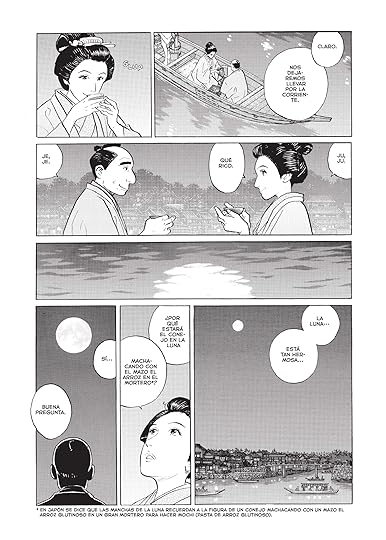
De tekeningen op zich, de kersenbloesems, of nachtelijk Edo een uitstapje op de rivier met honderden boten met mensen die de volle maan tijdens de 15de nacht van de 8ste maand gaan bewonderen, haast een Satori ervaring.
Iets dergelijks had ik gisteren op de fiets, terug van de bioscoop, langs 'mijn' rivier waar het eerste onweer na grote droogte losbarstte en het weerlicht overal om me heen was: boven, onder ... weerkaatst in het water van de rivier ... alleen ... hoe teken je dat??
Soy muy fan de Taniguchi aunque en esta ocasión no disfrute tanto de esta obra, aunque he aprendido cosas y siempre tiene cosas muy aprovechable nunca defrauda, a pesar de que no cumpla al 100 por 100.
What a beautiful graphic novel, both for the story and the incredible drawings.. So deep and emotional, with many "lyrical" moments.. totally recommend it!
Un remanso. La historia de un jubilado que se dedica a medir y cartografiar Edo a comienzos del siglo XIX. Basada en la figura real de Inō Tadataka, topógrafo y cartógrafo conocido por haber elaborado el primer mapa de Japón. Inō camina cada día, y en sus recorridos alterna momentos de meditación con otros en los que se distrae al encontrarse con animales o personas. Las estaciones se suceden, y el libro se convierte en un poema visual. Encontramos haikus y escenas de degustación gastronómica, solo o en compañía de su esposa. Bellísimas ilustraciones, realizadas con detalle y elegancia. Lo leí despacio, disfrutando del arte pictórico del talentoso Taniguchi.
Un cómic que transmite serenidad a un ritmo contemplativo. La esencia del libro es la calma, la observación y el fluir del tiempo. Hay un equilibrio entre la precisión del cartógrafo y la sensibilidad del poeta, algo tan característico de Taniguchi.
Taniguchi stellt hier einen Ausschnitt aus dem Leben des japanischen Kartographen Ino Tadataka dar. Wir begleiteten den Kartographen auf seinen unzähligen Spaziergängen durch das Edo (Tokio) des frühen 19. Jahrhunderts. Durch den Blick des Kartographen erleben wir fragmentarisch den Alltag im damaligen Japan.
Insgesamt erinnert dieses Buch sehr an "Der spazierende Mann", nur eben vor historischer Kulisse. Taniguchi erzählt, wie für ihn so oft üblich, in ruhigen und klaren Bildern. Die einzelnen Episoden sind alle sehr beschaulich, detailliert und werden nur wenig durch Sprache durchbrochen.
Die Poesie findet hier große Beachtung. Immer wieder lässt Taniguchi berühmte Haiku der Edo-Zeit einfließen. Ich kann damit leider gar nichts anfangen und so waren diese Stellen für mich etwas verloren.
Taniguchi es una mezcla entre poeta, filósofo y dibujante. Esta obra es buen ejemplo de ello. Es la historia de un hombre del s. XIX (periodo Edo) cuya dedicación es la de medir distancias a pie. Esto es una buena excusa para poder pasear durante largo tiempo y relatar sus observaciones sobre el paisaje, la naturaleza, los animales, los niños… Siempre con esa mira de hombre perdido en el mundo que le encuenta el sentido a la vida apreciando los pequeños detalles de nuestro alrededor. Pura poesía japonesa.
la leggerezza della vita, tramite i piccoli dettagli di una lunga e spensierata camminata nella Giappone del periodo Edo, la leggerezza di Jirō nel farci vedere l'uomo che si immedesima nella vita di un gatto, di un cavallo, di una formica e anche di un poeta che cambierà la storia della poesia orientale (e molto altro).
Furari er - som de fleste af Taniguchis bøger - et stille, men stærkt poetisk mesterværk. Langsomt, næsten gennem meditation, kommer vi ind under huden på hovedpersonen, Furari, og lærer ham at kende ... og han er et yderst charmerende og sympatisk bekendtskab. Egentlig pensioneret landmåler, men stærkt optaget af sit erhverv. Han går sine ture, tæller skridt, måler afstande ... og bliver distraheret. Han viser sig at være velsignet med en mere end almindeligt veludviklet fantasi og forestillingsevne. Hvad det betyder, skal ikke afsløres her. Det skal opleves.
Dans le Japon du début XIXe siècle, un retraité marche, philosophie, étudie l'astronomie, cartographie. Pas mon Taniguchi préféré mais ses dessins et son univers restent super
Dal punto di vista stilistico, lui è bellissimo! Ma non l'è roba par mi.
Sono storie brevi incentrate sui fenomeni della natura che il personaggio osserva mentre cammina e conta i passi. Ecco, lui cerca di avere il passo sempre uguale e per questo cammina per Edo. E si guarda in giro. A volte, sembra prendere il punto di vista dell'animale che sta osservando e Taniguchi si supera in questo. Le tavole in cui si vede la città dall'altro sono bellissime.
Ma è la storia che è troppo tranquilla e conclude poco. Si cammina e si conta. Si cammina e si conta. E si guarda il mondo.
You see someone with a simple life, a simple goal, an ordered and clean environment, the time he has... goes (slowly) into the satisfaction of his natural curiosity and the quenching of his thirst for beauty. This book was like a good shower for the spirit.
Called Furari in English, this is my first trip into the artistic world of Jiro Kaniguchi and it felt like a discovery. This was one of the most relaxing reading experiences I remembered. More than once I felt a moment akin to a gasp, a sudden intake of breath. The artwork is beautiful in its simplicity and the story of a retired mapmaker in old Tokyo (Edo) fits perfectly. Of the plot there is little to say. Tadataka Ino, cartographer and observer of life's simple beauties, counts his steps through Edo as he waits for perhaps one more commission in his retirement. His task is the creation of maps but his hobby is enjoying the world as it is. He is an old man who sees everything like a newborn, amazed and overwhelmed by every vista, by the little wonders of nature or by the creations of mankind. After a few short pages I found myself sucked into his mindset. Then you can lean back, soak it up and enjoy the details of our world that you might otherwise miss. That is the excellence of Taniguchi's artwork - he makes you aware of the beauty that exists all around us.
True its all very idealistic and certainly Furari won't cut it for those searching for an exciting narrative but I enjoyed this graphic novel as a truly different reading experience, as close to meditation as reading can be. His drawings are calm, pencil sketches with a deceiving amount of details. The flow of the frames is so well poised. Gorgeous double spreads leap out at you at the right moments. Taniguchi also has a wonderful sense of motion in his frames. They tip and sway, turn upside down (as sometimes Tadataka escapes into fantasy, into the mind of a bird or a cat) giving the whole book a swooping, soaring sense of escapism. When Tadataka accepts his last map-making journey we are greeted by a surprising double page bird's-eye view that induces sudden vertigo and puts a lump in your throat as you imagine the old man's lurching, nervous, excited desire to travel. Other moments are small - the appearance of dragonflies, a vista of fireflies, Tadataka falling asleep on the porch while imagining he's a cat exploring the city.
And while there is no plot, Furari is a very good character study. As well as Tadataka we spend some time with his wife, another very good character. One of the best scenes involves the two of them taking a romantic boat ride down the river, the camera shifting from boat to moonlight to water with disorientating and moving fluidity. When Tadataka is given the opportunity to travel there is a softly emotional scene when his wife decided to travel with him. Most of the book is about Tadataka, the voices in his head and his enjoyment of solitude. But he is also fascinated by people and shows a great love for his wife. He also meets other intriguing figures - he spends a day with a famous poet of the day, for example. This allows Taniguchi to reflect on the aesthetics and the art of the day and ties his graphic novel to a tradition of art and poetry. His drawings have the same effect as a good haiku. Of course they are less subtle, showing rather than telling, but the soft black and white lines of Taniguchi's drawings evoke a truly poetic beauty, tempered as they are by the childlike enthusiasm and innocent wonder of his protagonist. Rarely have I felt so attuned to a main character. I wanted to see what he was seeing, I wanted to enjoy it all with his same simple appreciation. This book calmed me. I didn't want it to end and I'm very glad there is a whole body of work by Taniguchi that I can explore. 8
ふらり furari (adverb): aimlessly, going with the flow
Inspired by the wanderings of cartographer Inō Tadataka (1745-1818) as he created the first map of Edo-period Japan with modern surveying techniques – perhaps the most impressive retirement project I've ever heard of – this gently contemplative graphic novel was such a delight to read.
I picked up a copy from my local library as part of a self-led graphic novel reading project, touring a genre I've massively overlooked and celebrating all of the wonderfully contemplative books I've found so far. (In by Will McPhail and Daytripper are two more excellent discoveries.)
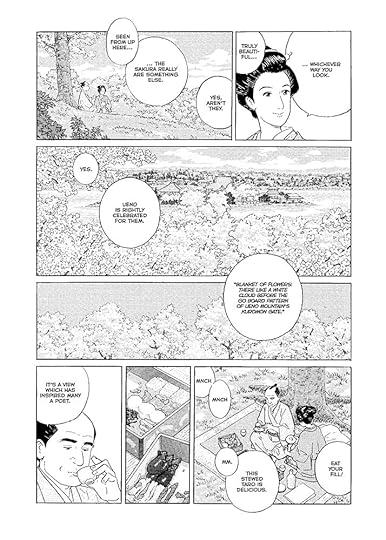
With echoes of Japan's haiku tradition throughout, this slice-of-life story is a perfect match for the graphic novel form - you feel like you're there with Inō enjoying a (drunken) picnic under the sakura blossom, pondering the night sky with a celebrated haiku poet, or watching ants roam the ground from a new perspective. There are so many lovely little moments, all wonderfully described through Taniguchi's delicate combination of illustrations, thoughts, and dialogue.
If you also love meditative and restful books that inspire a slower pace of life, quiet noticing, and thoughtful interactions with the world, you should absolutely read Furari. (Oh, and also watch the Perfect Days movie. And maybe Only Yesterday from Studio Ghibli, too.) The Walking Man by Taniguchi also looks fantastic.
Jiro Taniguchi is truly a master at his craft. I thoroughly enjoyed this read, and I plan on reading this several more times! This story follows a gentleman who is living with his wife in Edo, ancient Tokyo, and is exploring life during the time of retirement in his life. Even in retirement, he takes up the pastime of survey and topography work. This pastime and commitment takes him walking and exploring all over areas within Edo. As a mental health therapist and fan of wellness, I absolutely love how much mindfulness is included in this story! Through his survey work and exploration, he radiates mindfulness, but also has moments of letting his thoughts wander and dream. The daily life and activities of Edo are witnessed through the main senses, and also through the eyes/minds of particular animals that live in Edo. The theme of patience and maintaining progress towards goals are present throughout the story. Overall, an enjoyable and lovely read!
Ho apprezzato molto questa graphic novel, mi ha trasmesso molta calma e serenità. La storia è incentrata sul famoso cartografo giapponese Tadataka Ino, che tra il 1700 e il 1800 mappò per la prima volta il Giappone con tecniche moderne. Il protagonista ci porta con sé suo camminare per misurare le distanze tra un luogo e l'altro, e in questo modo veniamo trasporti nel Giappone dell'epoca e siamo partecipi della quotidianità dei luoghi, delle tradizioni e abitudini del tempo. Per Tadataka mappare il Giappone è una missione di vita, un desiderio che nasce dal profondo e che lo collega strettamente con la natura, con cui si fonde e si immedesima, donando al lettore delle bellissime riflessioni,insegnando l'importanza di cambiare punto di vista sul mondo per scoprirne le bellezze nascoste.
IDEA: A samurai and retired mapmaker travels through Japan, encountering people, places, and creatures. A paean to medieval Japan. Thematically, peacefulness crosses throughout this work, inviting the reader to take a moment, look around, and just ponder. Otherwise, the material is not very ambitious, but the drawings are.
PART OF: my quest to read about Jirō Taniguchi's masterworks. He is a mangaka with strong impressionist influences, wonderful watercolors and precise inking.