

What do you think?

Travis McGee #10
The Girl in the Plain Brown Wrapper
From a beloved master of crime fiction, The Girl in the Plain Brown Wrapper is one of many classic novels featuring Travis McGee, the hard-boiled detective who lives on a houseboat.
He had done a big favor for her husband, then for the lady herself. Now she’s dead, and Travis McGee finds that Helena Pearson Trescott had one last request of him: to find out why her beautiful daughter Maureen keeps trying to kill herself. But what can a devil-may-care beach bum do for a young troubled mind?
“The Travis McGee novels are among the finest works of fiction ever penned by an American author.”—Jonathan Kellerman
McGee makes his way to the prosperous town of Fort Courtney, Florida, where he realizes pretty quickly that something’s just not right. Not only has Maureen’s doctor killed herself, but a string of murders and suicides are piling up—and no one seems to have any answers.
Just when it seems that things can’t get any stranger, McGee becomes the lead suspect in the murder of a local nurse. As if Maureen didn’t have enough problems, the man on a mission to save her will have to save himself first—before time runs out.
Features a new Introduction by Lee Child
He had done a big favor for her husband, then for the lady herself. Now she’s dead, and Travis McGee finds that Helena Pearson Trescott had one last request of him: to find out why her beautiful daughter Maureen keeps trying to kill herself. But what can a devil-may-care beach bum do for a young troubled mind?
“The Travis McGee novels are among the finest works of fiction ever penned by an American author.”—Jonathan Kellerman
McGee makes his way to the prosperous town of Fort Courtney, Florida, where he realizes pretty quickly that something’s just not right. Not only has Maureen’s doctor killed herself, but a string of murders and suicides are piling up—and no one seems to have any answers.
Just when it seems that things can’t get any stranger, McGee becomes the lead suspect in the murder of a local nurse. As if Maureen didn’t have enough problems, the man on a mission to save her will have to save himself first—before time runs out.
Features a new Introduction by Lee Child
336 pages, Paperback
First published January 1, 1968
About the author
John D. MacDonald
585 books1,473 followersJohn D. MacDonald was born in Sharon, Pennsylvania, and educated at the Universities of Pennsylvania, Syracuse and Harvard, where he took an MBA in 1939. During WW2, he rose to the rank of Colonel, and while serving in the Army and in the Far East, sent a short story to his wife for sale, successfully. He served in the Office of Strategic Services (O.S.S.) in the China-Burma-India Theater of Operations. After the war, he decided to try writing for a year, to see if he could make a living. Over 500 short stories and 70 novels resulted, including 21 Travis McGee novels.
Following complications of an earlier heart bypass operation, MacDonald slipped into a coma on December 10 and died at age 70, on December 28, 1986, in St. Mary's Hospital in Milwaukee, Wisconsin. He was survived by his wife Dorothy (1911-1989) and a son, Maynard.
In the years since his death MacDonald has been praised by authors as diverse as Stephen King, Spider Robinson, Jimmy Buffett, Kingsley Amis and Kurt Vonnegut, Jr.. Thirty-three years after his passing the Travis McGee novels are still in print.
Following complications of an earlier heart bypass operation, MacDonald slipped into a coma on December 10 and died at age 70, on December 28, 1986, in St. Mary's Hospital in Milwaukee, Wisconsin. He was survived by his wife Dorothy (1911-1989) and a son, Maynard.
In the years since his death MacDonald has been praised by authors as diverse as Stephen King, Spider Robinson, Jimmy Buffett, Kingsley Amis and Kurt Vonnegut, Jr.. Thirty-three years after his passing the Travis McGee novels are still in print.
Ratings & Reviews
Friends & Following
Create a free account to discover what your friends think of this book!
Community Reviews
Displaying 1 - 30 of 225 reviews

October 5, 2017
"That's because we always want to know why. Not so much how and who and when. But why."
- John D. MacDonald, the Girl in the Plain Brown Wrapper
One of the better MacDonald novels I've read this year. He appears to be unable to escape the bizarrely sexualized, woman-in-peril, sex kitten cliché, BUT for a book that came just 15 years after Playboy and James Bond made their entrance into the Western consciousness, turning women into bunnies and well-oiled sex kittens, some roughness can be forgiven (not overlooked or excused). Generationally, it is understandable, if still hard to really tolerate for more than a couple pages at a time.
Why do I read him if I can't stand MacDonald's attitude toward women? Because there is something there. Because I like his perspectives on a great deal more. Because he isn't just writing crime fiction, but doing a mini-exegesis on the American, male psyche of the 1960s and 1970s. And, each book seems just about to escape the confines of his highly marketable form of misogyny. The bright spot in this book, published in 1968, was his brutal (for the time) honesty about race as it intersected with commerce, law enforcement, sex, and justice.
The dialogues between Travis and Lorette, a black maid at the hotel he is staying at, is almost worth the entire price of admission. I kept reminding myself that this book was MacDonald's 10th McGee novel and published in 1968. That was the year that Johnson passed the Civil Rights Act of 1968 (Fair Housing Act). It was written from the perspective of a white libertarian (Travis McGee) living in Florida. His perspective on race was refreshing and honest, given the time and place. It shows that we have made some strides as far as sex, and some strides with race too. Just not as many or as quickly as many would prefer.
- John D. MacDonald, the Girl in the Plain Brown Wrapper
One of the better MacDonald novels I've read this year. He appears to be unable to escape the bizarrely sexualized, woman-in-peril, sex kitten cliché, BUT for a book that came just 15 years after Playboy and James Bond made their entrance into the Western consciousness, turning women into bunnies and well-oiled sex kittens, some roughness can be forgiven (not overlooked or excused). Generationally, it is understandable, if still hard to really tolerate for more than a couple pages at a time.
Why do I read him if I can't stand MacDonald's attitude toward women? Because there is something there. Because I like his perspectives on a great deal more. Because he isn't just writing crime fiction, but doing a mini-exegesis on the American, male psyche of the 1960s and 1970s. And, each book seems just about to escape the confines of his highly marketable form of misogyny. The bright spot in this book, published in 1968, was his brutal (for the time) honesty about race as it intersected with commerce, law enforcement, sex, and justice.
The dialogues between Travis and Lorette, a black maid at the hotel he is staying at, is almost worth the entire price of admission. I kept reminding myself that this book was MacDonald's 10th McGee novel and published in 1968. That was the year that Johnson passed the Civil Rights Act of 1968 (Fair Housing Act). It was written from the perspective of a white libertarian (Travis McGee) living in Florida. His perspective on race was refreshing and honest, given the time and place. It shows that we have made some strides as far as sex, and some strides with race too. Just not as many or as quickly as many would prefer.

July 2, 2008
If you were a rich widow who was dying from cancer and one of your two daughters, who had been stable and happily married for years, suddenly and mysteriously went bat shit crazy including memory loss and suicide attempts, would you:
A) Pour all your money and remaining time into medical and psychological doctors to try and help while also setting up a safe and protected environment for her?
B) Contact a shady stranger who you had a romantic fling with after your husband died and beg him to help her?
Most people would probably pick option A, but I guess it would have been a pretty short book if the widow hadn't chosen option B.
Travis McGee, the self-proclaimed salvage expert who specializes in getting back money and goods taken through scams, returns after spending weeks out on his boat and finds a letter from Helena, a woman he had helped years before and had a brief romance with. Helena is dying and asks Travis to check on her daughter Maureen who has gone completely nuts. Travis learns that Helena died before he got the letter, and even though he doubts there is anything he can do, he travels to see Maureen who is being cared for by her husband and sister.
After visiting Maureen and talking with her family, Travis thinks she is being cared for as well as possible and is about to leave town. Before he can go, he gets sucked into a murder investigation of one of Maureen’s doctors. Does the murder have something to do with Maureen’s current condition?
As always, you get an interesting character with McGee, and the mystery is intriguing, if a bit wonky. Unfortunately, the inherent sexism of these books written in the ‘60s is pretty awful. But this one is actually a bit better than the previous ones. Yes, every woman in the story is willing to submit to McGee’s wily charms at the drop of a hat, and none of them seem to have a problem that can’t be fixed with McGee’s patented brand of sexual healing. However, they seem a little less like scatter brained props and more like actual characters this time.
A) Pour all your money and remaining time into medical and psychological doctors to try and help while also setting up a safe and protected environment for her?
B) Contact a shady stranger who you had a romantic fling with after your husband died and beg him to help her?
Most people would probably pick option A, but I guess it would have been a pretty short book if the widow hadn't chosen option B.
Travis McGee, the self-proclaimed salvage expert who specializes in getting back money and goods taken through scams, returns after spending weeks out on his boat and finds a letter from Helena, a woman he had helped years before and had a brief romance with. Helena is dying and asks Travis to check on her daughter Maureen who has gone completely nuts. Travis learns that Helena died before he got the letter, and even though he doubts there is anything he can do, he travels to see Maureen who is being cared for by her husband and sister.
After visiting Maureen and talking with her family, Travis thinks she is being cared for as well as possible and is about to leave town. Before he can go, he gets sucked into a murder investigation of one of Maureen’s doctors. Does the murder have something to do with Maureen’s current condition?
As always, you get an interesting character with McGee, and the mystery is intriguing, if a bit wonky. Unfortunately, the inherent sexism of these books written in the ‘60s is pretty awful. But this one is actually a bit better than the previous ones. Yes, every woman in the story is willing to submit to McGee’s wily charms at the drop of a hat, and none of them seem to have a problem that can’t be fixed with McGee’s patented brand of sexual healing. However, they seem a little less like scatter brained props and more like actual characters this time.

September 25, 2012
As the tenth book in John D. MacDonald's Travis McGee series opens, McGee is once again called upon to restore a grieving widow to psychological and sexual health. The grateful woman, Helena Pearson, returns to her normal life, but several years later, she is dying of cancer and calls upon McGee for one last favor. Helena's daughter, Maurie, has become mysteriously suicidal and Helena would like McGee to diagnose the problem and find a solution.
McGee dutifully journeys to Fort Courtney, Florida, where Maurie lives with her husband, Tom, a high-flying local developer. Maurie's younger sister, Bridget, is also in residence, helping Tom look after Maurie. Sadly, by the time McGee arrives, Helena has succumbed to her cancer and so McGee is left to feel his way through a very complicated situation if he's going to be of any help.
As is usually the case in one of these novels, things get complicated in a big hurry. A number of folks seem to be very interested in McGee's arrival; a couple of people will have to die; everyone will be enormously confused and only McGee may be smart enough and devious enough to sort things out.
Like all of the McGee novels, this one is obviously dated, and McGee spends a lot of time philosophizing about the world around him. There's not as much action in this book as in most of the others in the series--things are a bit more cerebral--and there's not a hulking, giant, Neanderthalish brute of an adversary as there often is. The climax beggars belief a bit, but still, it's a fun read and anyone who enjoys the series will certainly want to find this entry.
McGee dutifully journeys to Fort Courtney, Florida, where Maurie lives with her husband, Tom, a high-flying local developer. Maurie's younger sister, Bridget, is also in residence, helping Tom look after Maurie. Sadly, by the time McGee arrives, Helena has succumbed to her cancer and so McGee is left to feel his way through a very complicated situation if he's going to be of any help.
As is usually the case in one of these novels, things get complicated in a big hurry. A number of folks seem to be very interested in McGee's arrival; a couple of people will have to die; everyone will be enormously confused and only McGee may be smart enough and devious enough to sort things out.
Like all of the McGee novels, this one is obviously dated, and McGee spends a lot of time philosophizing about the world around him. There's not as much action in this book as in most of the others in the series--things are a bit more cerebral--and there's not a hulking, giant, Neanderthalish brute of an adversary as there often is. The climax beggars belief a bit, but still, it's a fun read and anyone who enjoys the series will certainly want to find this entry.

June 17, 2013
It’s been a long, long time since I last read a Travis McGee novel. After a few dated cultural references, I checked the publishing date about a quarter of the way into the book – 1968. References to the Pill (Macdonald’s caps, not mine), Walter Cronkite (kids, he was a network news anchor, back when that meant anything), and an antiquated take on sex and race stood out.
He doesn’t treat women “badly”, it’s just that he comes across as Travis, amateur sex therapist, the guy with the answer to every woman’s problems because they dig him so much. The fact that the female characters are a mishmash of genre “types” doesn’t help. When you’ve read enough of this type of fiction, like I have, clichés have a tendency to stick out.
That said, McDonald does play with the detective/mystery conventions a little. There isn’t a dead body until about two-fifths of the way into the book. McGee, for better or worse, goes into these inner monologues on occasion that aren’t your standard mystery/detective fare. Although Meyer, McGee’s economist pal, isn’t in this book much, he is one of the cooler literary sidekicks for this genre.
McDonald’s a fine writer and this is a good read, minor flaws and all.
He doesn’t treat women “badly”, it’s just that he comes across as Travis, amateur sex therapist, the guy with the answer to every woman’s problems because they dig him so much. The fact that the female characters are a mishmash of genre “types” doesn’t help. When you’ve read enough of this type of fiction, like I have, clichés have a tendency to stick out.
That said, McDonald does play with the detective/mystery conventions a little. There isn’t a dead body until about two-fifths of the way into the book. McGee, for better or worse, goes into these inner monologues on occasion that aren’t your standard mystery/detective fare. Although Meyer, McGee’s economist pal, isn’t in this book much, he is one of the cooler literary sidekicks for this genre.
McDonald’s a fine writer and this is a good read, minor flaws and all.

August 5, 2021
Not my favorite John D. MacDonald book. In fact it is my least favorite of all those I've read. The first thirty to forty percent is primarily about relationships, mostly physical relationships. I did not find it at all sensual or erotic. Parts of it read like a research paper on the subject of sex. I have no interest in a description of the feel of teeth making contact with teeth while kissing. Perhaps others do.
There is a mystery. A long, involved, convoluted mystery solved by the application of a lot of luck and guesswork. And the unlikely cooperation of local law enforcement and judicial officers. Travis McGee's off hand remarks about people, society, etc. can't save this one.
There is a mystery. A long, involved, convoluted mystery solved by the application of a lot of luck and guesswork. And the unlikely cooperation of local law enforcement and judicial officers. Travis McGee's off hand remarks about people, society, etc. can't save this one.

March 21, 2019
5 Stars
A very complex and compelling mystery. (Surprisingly, McGee doesn’t actually get laid in this one.)
As usual with my reviews, please first read the publisher’s blurb/summary of the book. Thank you.
The first couple of chapters are a bit of a treasure-hunting story from another time, seemingly tacked on here for some reason, until a letter arrives from an old flame and compels McGee to tilt at more windmills on behalf of an old flame's daughter.
The prose is excellent, the pace is blistering, the mystery terrific, the villains evil, and the climax and ending are poignant.
Only a few quotes from this book -
McGee contemplates the mechanised future -
Nobody looks far enough down the road we're going. Someday one man at a big button board can do all the industrial production for the whole country by operating the machines that make the machines that design and make the rest of the machines. Then where is the myth about anybody who wants a job being able to find it?
-
McGee considers the sad state of race relations and equality -
And so, Mrs. Lorette Walker, no solutions for me or thee, not from your leaders be they passive or militant, nor from the politicians or the liberals or the head- knockers or the educators. No answer but time. And if the law and the courts can be induced to become color-blind, we'll have a good answer, after both of us are dead. And a bloody answer otherwise.
Bonus. From the 1970 "Darker Than Amber" movie starring Rod Taylor, pictures of the producers' ideas of McGee's "The Busted Flush":

Full size image here

Full size image here

Full size image here
And finally, two great blogs about John D. MacDonald, McGee and the rumoured-never-written novel where McGee dies"...
The Birth of Travis McGee (fascinating)
http://thetrapofsolidgold.blogspot.co...
"Black Border for McGee" (rumours surrounding a final book, never published)
http://thetrapofsolidgold.blogspot.co...
A very complex and compelling mystery. (Surprisingly, McGee doesn’t actually get laid in this one.)
As usual with my reviews, please first read the publisher’s blurb/summary of the book. Thank you.
The first couple of chapters are a bit of a treasure-hunting story from another time, seemingly tacked on here for some reason, until a letter arrives from an old flame and compels McGee to tilt at more windmills on behalf of an old flame's daughter.
The prose is excellent, the pace is blistering, the mystery terrific, the villains evil, and the climax and ending are poignant.
Only a few quotes from this book -
McGee contemplates the mechanised future -
Nobody looks far enough down the road we're going. Someday one man at a big button board can do all the industrial production for the whole country by operating the machines that make the machines that design and make the rest of the machines. Then where is the myth about anybody who wants a job being able to find it?
-
McGee considers the sad state of race relations and equality -
And so, Mrs. Lorette Walker, no solutions for me or thee, not from your leaders be they passive or militant, nor from the politicians or the liberals or the head- knockers or the educators. No answer but time. And if the law and the courts can be induced to become color-blind, we'll have a good answer, after both of us are dead. And a bloody answer otherwise.
Bonus. From the 1970 "Darker Than Amber" movie starring Rod Taylor, pictures of the producers' ideas of McGee's "The Busted Flush":
Full size image here
Full size image here
Full size image here
And finally, two great blogs about John D. MacDonald, McGee and the rumoured-never-written novel where McGee dies"...
The Birth of Travis McGee (fascinating)
http://thetrapofsolidgold.blogspot.co...
"Black Border for McGee" (rumours surrounding a final book, never published)
http://thetrapofsolidgold.blogspot.co...

June 16, 2017
Girl in the Plain Brown Wrapper is the tenth out of twenty-one Travis McGee novels. Although sometimes categorized as a mystery series, the McGee series may borrow some ideas from mysteries, but it is a series about as far from the standard PI genre as can be. McGee is not a PI. He’s a salvage consultant. When someone loses something of value and the normal lawful means of getting it back are not sufficient, he figures out how to outfox the conmen and nets a fifty percent profit of the haul. He lives on a houseboat in the Bahai Mar Marina on the Florida Coast. Often, he confronts conmen, swindlers, and just mean ones, but he is about as unofficial and off-the-books as they come.
This entry into the McGee legend follows some of the usual territory with an old flame looking up McGee and asking for his help, but there is nothing to salvage here, except perhaps a woman’s life. He’s asked by an old flame who he cruised with for a season after she was widowed and who has now died of cancer to look after one of her daughters, who is apparently suicidal. McGee isn’t sure how he can go about this, but looks into it and stumbles on a nest of intrigue and con games and blackmailers.
This novel has quite a bit less action than most the McGee books. Most of it is consumed with McGee sorting things out and logically deducing what is going on and who is who and what they want.
What’s really great about it isn’t necessarily the mystery so much as how MacDonald describes people so that, even if you haven’t met them, you know the type he is talking about. MacDonald has great instincts for understanding types of people and personalities and what makes them tick.
This entry into the McGee legend follows some of the usual territory with an old flame looking up McGee and asking for his help, but there is nothing to salvage here, except perhaps a woman’s life. He’s asked by an old flame who he cruised with for a season after she was widowed and who has now died of cancer to look after one of her daughters, who is apparently suicidal. McGee isn’t sure how he can go about this, but looks into it and stumbles on a nest of intrigue and con games and blackmailers.
This novel has quite a bit less action than most the McGee books. Most of it is consumed with McGee sorting things out and logically deducing what is going on and who is who and what they want.
What’s really great about it isn’t necessarily the mystery so much as how MacDonald describes people so that, even if you haven’t met them, you know the type he is talking about. MacDonald has great instincts for understanding types of people and personalities and what makes them tick.

February 16, 2022
Alright, I am actually not going to bother rereading John D. MacDonald’s 1968 Travis McGee mystery The Girl in the Plain Brown Wrapper before posting a review (which I originally read in 1983 and as you can tell from my reading dates, it in fact did take me more than an entire month to complete, to finish with The Girl in the Plain Brown Wrapper, even though with mysteries, it generally takes me at the most three to four days maximum, both now and when I was a younger reader). And while I in fact do not remember all that much regarding the specific storyline and contents of The Girl in the Plain Brown Wrapper in any amount of detail, I do recall that unlike many of John D. Macdonald’s Travis McGee novels I have read over the years (and since I was first introduced to Macdonald during an American mystery unit for my grade eight English class in 1980), I still do totally remember absolutely not liking The Girl in the Plain Brown Wrapper and that the general reasons as to why also render the entire idea of revisiting The Girl in the Plain Brown Wrapper majorly distasteful for and to me.
For one, even though the specific details of The Girl in the Plain Brown Wrapper have faded from my memory and actually went bye-bye pretty soon after my perusal, what has most definitely NOT gone away, what has very much remained is how much I have found John D. MacDonald’s writing and stylistics with regard to The Girl in the Plain Brown Wrapper tedious, dragging and often ridiculously convoluted, with there appearing far far too many frustratingly annoying superfluous characters (and that Travis McGee’s long and drawn out conversations with some small town policeman whose name I do not even recall are just not at all to my tastes and also as such one of the main reasons why it took me such a long time to plough through The Girl in the Plain Brown Wrapper when I read this in 1983). And for two and probably the main reason why my rating for The Girl in the Plain Brown Wrapper is both only one star and why I am not at all interested in rereading, is that with Travis McGee’s sidekick and my literary crush Meyer not really ever making an appearance, no, I just do not at all like this and have no reading interest whatsoever in The Girl in the Plain Brown Wrapper.
For one, even though the specific details of The Girl in the Plain Brown Wrapper have faded from my memory and actually went bye-bye pretty soon after my perusal, what has most definitely NOT gone away, what has very much remained is how much I have found John D. MacDonald’s writing and stylistics with regard to The Girl in the Plain Brown Wrapper tedious, dragging and often ridiculously convoluted, with there appearing far far too many frustratingly annoying superfluous characters (and that Travis McGee’s long and drawn out conversations with some small town policeman whose name I do not even recall are just not at all to my tastes and also as such one of the main reasons why it took me such a long time to plough through The Girl in the Plain Brown Wrapper when I read this in 1983). And for two and probably the main reason why my rating for The Girl in the Plain Brown Wrapper is both only one star and why I am not at all interested in rereading, is that with Travis McGee’s sidekick and my literary crush Meyer not really ever making an appearance, no, I just do not at all like this and have no reading interest whatsoever in The Girl in the Plain Brown Wrapper.

February 11, 2017
Travis McGee receives a letter from a woman he had a brief romance with years ago; she is dying and asks McGee to help her daughter, Maureen. McGee learns the woman died before he got the letter. McGee travels to Maureen and he ends up in a murder investigation of one of Maureen’s physicians. Maureen has gone bonkers. So, does the death have something to do with her condition?
MacDonald is a master story teller and that comes through in this story. He was one of the top pulp writers of the 1950 and 1960s. Typical of the time it was written, the story is racist and sexist. The story takes place in Florida as do most of his books. The language is also typical of the time frame. It is sort of fun to step back in time and see how far society has come, or not.
I read this as a paperback. The book has 256 pages and was published in 1968.
MacDonald is a master story teller and that comes through in this story. He was one of the top pulp writers of the 1950 and 1960s. Typical of the time it was written, the story is racist and sexist. The story takes place in Florida as do most of his books. The language is also typical of the time frame. It is sort of fun to step back in time and see how far society has come, or not.
I read this as a paperback. The book has 256 pages and was published in 1968.

September 3, 2018
COUNTDOWN: Mid-20th Century North American Crime - TOP 50
BOOK 50 (of 250)
AWARD WINNER: Person I'd most like to enjoy a beer with (McGee) on his Busted Flush, Slip F18, Fort Lauderdale Marina. McGee's the kind of guy you can trust, and would be handy in a jam. Not because you'd need ask for help, but because he just would. Cause he is McGee.
The MacDonald/McGee series is arguably one of the best crime series of the 20th century. And it's true: McGee loves the ladies. However, he is surprisingly choosy and often says no, and all in all treats the women in his life with respect. There is an occasional, dated, misstep in this element. That said, this work from the Summer of Love is very good: MacDonald must have been under the influence of something or someone really good.
HOOK=4 stars: McGee learns that a past love has died on the very day he has completed (resurrected?) a marine salvage job. I liked this contrast very much and immediately I want to know more of the dead woman-Helena Pearson-and more about what was salvaged and why it was there in the first place.
PACE=3: During the first few chapters, McGee thinks about Helena and then gets a letter from her, written the day before she died. She is asking McGee for a favor and he moves forward in compliance. In effect he is working for a dead person. Solid going.
Plot=4: Finally, we get to the point of it all: Helena has a suicidal daughter and Travis has been asked to save her. This is such a major plot line of mid-century American crime: a woman/wife/sister/daughter is missing/dead/has run away, etc. Standard for the genre, but MacDonald does it justice, turns up the knob, and delivers.
People=4: McGee is always good, but the backstory of him and Helena is above par and memorable.
Place=5: MacDonald knows about underwater salvage operations and I believed every word of it. There is much action in, on, and around the Keys of Florida, and MacDonald seems to know the area like the back of his hand. A long cruise with McGee and Helena is beautifully done.
Summary: Overall, my rating is 4.0, and this is my favorite in the series so far. If you want a great look at the Keys, and cruising, and salvaging, and southern Florida, this is the book for you. I'd say the PLACE is the star of the book in this, the 10th of the series, and the 10th I've read. It isn't often one takes the time, or needs to take the time (in this genre) to notice the writing itself, but here MacDonald writes some nice things, like "Up early Tuesday...wonder who the hell I am...that is the blessing of morning routines. Each morning you wake up a slightly different person...dreams and the sleep-time rearrange the patterns inside your head." Proust, no less, McGee style. If you read one McGee story, make sure this is it.
BOOK 50 (of 250)
AWARD WINNER: Person I'd most like to enjoy a beer with (McGee) on his Busted Flush, Slip F18, Fort Lauderdale Marina. McGee's the kind of guy you can trust, and would be handy in a jam. Not because you'd need ask for help, but because he just would. Cause he is McGee.
The MacDonald/McGee series is arguably one of the best crime series of the 20th century. And it's true: McGee loves the ladies. However, he is surprisingly choosy and often says no, and all in all treats the women in his life with respect. There is an occasional, dated, misstep in this element. That said, this work from the Summer of Love is very good: MacDonald must have been under the influence of something or someone really good.
HOOK=4 stars: McGee learns that a past love has died on the very day he has completed (resurrected?) a marine salvage job. I liked this contrast very much and immediately I want to know more of the dead woman-Helena Pearson-and more about what was salvaged and why it was there in the first place.
PACE=3: During the first few chapters, McGee thinks about Helena and then gets a letter from her, written the day before she died. She is asking McGee for a favor and he moves forward in compliance. In effect he is working for a dead person. Solid going.
Plot=4: Finally, we get to the point of it all: Helena has a suicidal daughter and Travis has been asked to save her. This is such a major plot line of mid-century American crime: a woman/wife/sister/daughter is missing/dead/has run away, etc. Standard for the genre, but MacDonald does it justice, turns up the knob, and delivers.
People=4: McGee is always good, but the backstory of him and Helena is above par and memorable.
Place=5: MacDonald knows about underwater salvage operations and I believed every word of it. There is much action in, on, and around the Keys of Florida, and MacDonald seems to know the area like the back of his hand. A long cruise with McGee and Helena is beautifully done.
Summary: Overall, my rating is 4.0, and this is my favorite in the series so far. If you want a great look at the Keys, and cruising, and salvaging, and southern Florida, this is the book for you. I'd say the PLACE is the star of the book in this, the 10th of the series, and the 10th I've read. It isn't often one takes the time, or needs to take the time (in this genre) to notice the writing itself, but here MacDonald writes some nice things, like "Up early Tuesday...wonder who the hell I am...that is the blessing of morning routines. Each morning you wake up a slightly different person...dreams and the sleep-time rearrange the patterns inside your head." Proust, no less, McGee style. If you read one McGee story, make sure this is it.

December 16, 2012
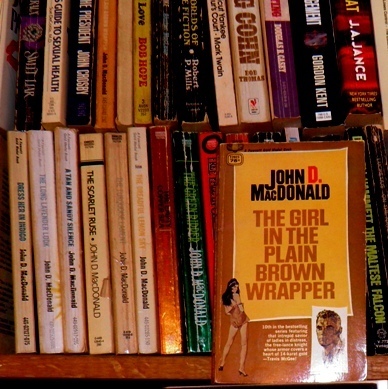
© 1968 for the Wrapped Girl – So be forewarned, Ladies, Travis McGee is not politically correct, judged by 2012 standards. The best rendition of the I HATE TRAVIS McGEE point-of-view may be Amanda’s one star GoodReads review:
http://www.goodreads.com/review/show/...
The gals have their Loveswept, Silhouette & Harlequin tubes-through-the-roof romance novels—the guys have our Phillip Marlowe, Travis McGee & Jack Reacher balls-to-the-wall action novels.
BROWN WRAPPER is half way into the Travis McGee series, #10 I think, when John D. was still pushing the limits of the crime novel, before he became bored with Travis. There is a lot of elaborate back-story here, that may put off readers who want a murder on the first page, a fist fight on page two, and a car chase by page five; but John D. is at the absolute top of his game: the story he has to tell sucks me in and holds me. As usual, Travis goes shuffling and blundering into some potentially criminal situation driven by misguided loyalty or a debt he thinks he owes to someone; in this novel a dead woman. It isn’t until page 59, when Travis is all set to give up on his foolish notion that anyone needs rescuing from anyone, when he discovers that someone has searched his hotel room: BAD GUY ALERT! My guess is I’ve re-read this about 4 times over the years.
By page 72 a man and woman try to drug Travis and question him at gunpoint.
By page 103 Travis is questioned by two detectives—because the woman half of the pair who tried to question him at gunpoint was found murdered, and Travis is the main suspect.
I don’t like the plot for BROWN WRAPPER, but I can’t think of any way to improve anything. And BROWN has some of my all-time favorite scenes of Travis McGee dialogue. And the ending! Oh, baby! I absolutely LOVE the ending.
What I want to know is how John D. MacDonald knew so much about human nature to write scenes that surprise me and awe me with secret knowledge about us critters called humans. Was he tapping random phone conversations? Was he privy to police interrogations? Was John D. listening into shrink/patient conversations?
Oh, s***. The NSA has access to all that now; they’ve read this review before I posted it, before I even saved it to my hard drive: like John D. MacDonald got a read on all of us back in the Sixties. @hg47

May 31, 2021
I've been enjoying the Travis McGee series very much. I finally tried the 1st book back in 2013 and have enjoyed following the series since. The Girl in the Plain Brown Wrapper is of course the tenth in the series by American crime writer John D. MacDonald. In this story we find McGee back in his familiar territory of Florida.
McGee and his buddy Meyer are helping two friends test an invention for raising sunken ships. Their attempt is successful. But the trip reminds McGee of an old friend. Years before he had helped Helena Pearson when her husband died. He had helped sell their ship and he had taken Helena on a cruise to help her adjust to her new life. Of course this cruise did have a physical element to it. Back to the present, McGee, upon returning home with Meyer, he finds a letter from Helena's lawyer. Helena has died of cancer and she asks McGee to come help her two daughters. Maureen, the eldest, is having severe emotional issues after having suffered two miscarriages and Maureen's husband and Bridget are forced to look after her.
McGee travels up the coast to Fort Courtney where he finds a twisted, weird situation. Maureen is basically childlike; with bursts of activity when she can escape her home. She is being treated with medication but also a machine, Dormed, which sends electrical waves into her brain to help her sleep (very strange). The doctor who treated her has committed suicide (maybe). Two people accost McGee at his hotel, thinking he might know something of the doctor's death. More deaths occur. McGee helps a cynical police officer with his investigation. There are extra-marital relations. It's a strange but fascinating story and difficult to describe. You have to read it. And, oh, it has a satisfying conclusion.
I continue to enjoy reading about Travis McGee, the man who takes on the odd case to help with his retirement fun; sailing, partying, spending time with lovely women. But he does like to help those in need and will go to lengths to assist them. He's a bit philosophical, lets his thoughts meander as he tries to resolve issues, using his intuition to come to conclusions. The story is peopled with interesting characters; Lt Stanger, a cop who seems to understand McGee and is willing to work with him; Penny Woertz, the nurse who is in love with a married man, but strikes a chord with McGee and Mrs Holton, another woman whose common sense attracts McGee. It's a fascinating meandering tale that slowly comes together and resolves itself nicely, with some assistance at the end with a neat State's Attorney. (4 stars)
McGee and his buddy Meyer are helping two friends test an invention for raising sunken ships. Their attempt is successful. But the trip reminds McGee of an old friend. Years before he had helped Helena Pearson when her husband died. He had helped sell their ship and he had taken Helena on a cruise to help her adjust to her new life. Of course this cruise did have a physical element to it. Back to the present, McGee, upon returning home with Meyer, he finds a letter from Helena's lawyer. Helena has died of cancer and she asks McGee to come help her two daughters. Maureen, the eldest, is having severe emotional issues after having suffered two miscarriages and Maureen's husband and Bridget are forced to look after her.
McGee travels up the coast to Fort Courtney where he finds a twisted, weird situation. Maureen is basically childlike; with bursts of activity when she can escape her home. She is being treated with medication but also a machine, Dormed, which sends electrical waves into her brain to help her sleep (very strange). The doctor who treated her has committed suicide (maybe). Two people accost McGee at his hotel, thinking he might know something of the doctor's death. More deaths occur. McGee helps a cynical police officer with his investigation. There are extra-marital relations. It's a strange but fascinating story and difficult to describe. You have to read it. And, oh, it has a satisfying conclusion.
I continue to enjoy reading about Travis McGee, the man who takes on the odd case to help with his retirement fun; sailing, partying, spending time with lovely women. But he does like to help those in need and will go to lengths to assist them. He's a bit philosophical, lets his thoughts meander as he tries to resolve issues, using his intuition to come to conclusions. The story is peopled with interesting characters; Lt Stanger, a cop who seems to understand McGee and is willing to work with him; Penny Woertz, the nurse who is in love with a married man, but strikes a chord with McGee and Mrs Holton, another woman whose common sense attracts McGee. It's a fascinating meandering tale that slowly comes together and resolves itself nicely, with some assistance at the end with a neat State's Attorney. (4 stars)

May 17, 2013
A letter from an old friend takes salvage expert Travis McGee by surprise. He hasn’t seen Helena Pearson in five years, and since she recently died from cancer, the letter brings back a lot of poignant memories. In the letter, Helena asks Travis to see if he can determine what’s causing her eldest daughter, Maureen, to repeatedly attempt suicide. To honor her memory, McGee pays Maureen a visit, although he doesn’t really know how he can help. Unfortunately, McGee gets more than he bargained for when he’s attacked his first night in town and finds himself digging up all sorts of secrets and odd behavior concerning people who could be connected to Maureen.
The Girl in the Plain Brown Wrapper is an intelligent, riveting look at human behavior, and written by one of the best crime novelists there ever was. John D. MacDonald’s style is engaging and distinctive, his pacing and plotting marvelous. As someone who reads a lot of crime novels I can usually predict where a story is going, however, the twists and turns in this book kept me guessing. The ending, while not gloriously happy, was truly satisfying.
My only quibble is the confusing opening chapter. The author supplies the directions and names of so many locations within the Florida Keys that they become confusing and therefore meaningless to anyone unfamiliar with the area. Still, I did learn that there is a lot more to the Keys than I thought. This was my first MacDonald novel, but it definitely won’t be my last.
The Girl in the Plain Brown Wrapper is an intelligent, riveting look at human behavior, and written by one of the best crime novelists there ever was. John D. MacDonald’s style is engaging and distinctive, his pacing and plotting marvelous. As someone who reads a lot of crime novels I can usually predict where a story is going, however, the twists and turns in this book kept me guessing. The ending, while not gloriously happy, was truly satisfying.
My only quibble is the confusing opening chapter. The author supplies the directions and names of so many locations within the Florida Keys that they become confusing and therefore meaningless to anyone unfamiliar with the area. Still, I did learn that there is a lot more to the Keys than I thought. This was my first MacDonald novel, but it definitely won’t be my last.

August 12, 2012
David Bowman published an intriguing list of post-Chandler noir novels on Salon a few years back. This was one of his five picks. Bowman sez: "MacDonald, the last literate and unself-conscious pulp writer, was the first to explore the noir possibilities of Florida. All the titles in his Travis McGee series are precious junk. In this one — part John Updike, part “Jane Eyre” — the lethal Florida beach bum/sexual healer attempts to rescue a housewife held captive in suburbia by her hubby’s mind-control drugs."
It's an enjoyable read, slightly clunky and long-winded in places, surprisingly insightful and well written in others, but not as good as the other random McGee title I picked up a few years back: "The Dreadful Yellow Sky." Neither approach the other books on Bowman's list such as "Tapping the Source" and "Children of Light."
It's an enjoyable read, slightly clunky and long-winded in places, surprisingly insightful and well written in others, but not as good as the other random McGee title I picked up a few years back: "The Dreadful Yellow Sky." Neither approach the other books on Bowman's list such as "Tapping the Source" and "Children of Light."

August 22, 2018
Hate to give a Travis McGee novel less that 3 stars, but this one was a little weak for me. It took MacDonald a long time to get to the main story line, and a long time to develop it once he got there. McGee receives a posthumous letter from a woman he befriended five years earlier after her husband's murder. The woman asks McGee to investigate the mysterious suicidal tendencies of the woman's daughter. The request takes him to prosperous Port Courtney, where the daughter's husband, a former stockbroker turned sly land developer, is the big man in town, with most of the local powerful folks invested in his projects. This is familiar territory for MacDonald, who clearly has a bone to pick with the powerful elite who run roughshod over unsuspecting folks and his beloved Florida. As McGee digs in, he begins to smell a rat. But the way he digs in is often implausible.
The plot is convoluted and doesn't become clear until the very end. That's fine for some mysteries, but I think the reader deserves a little more clarity along the way. I've seen some reviews of MacDonald's work that suggest that you don't read the Travis McGee stories for their plot, but more for the philosophical ruminations of the main character. There's plenty of that, as well as McGee somehow becoming a sort of sexual healer. There are also some observations on race here that I think are a first for the series. Hoping for a rebound in Book #11.
The plot is convoluted and doesn't become clear until the very end. That's fine for some mysteries, but I think the reader deserves a little more clarity along the way. I've seen some reviews of MacDonald's work that suggest that you don't read the Travis McGee stories for their plot, but more for the philosophical ruminations of the main character. There's plenty of that, as well as McGee somehow becoming a sort of sexual healer. There are also some observations on race here that I think are a first for the series. Hoping for a rebound in Book #11.

November 10, 2011
Unfortunately, this was a weak book in the series.
This isn't a four star, (most TM series are) it's clearly a three. Weak storyline is why it get three stars from me.
My last read (#2) I gave it a four. I think age is making me a tougher critic! OMG, Katy bar the door!
This isn't a four star, (most TM series are) it's clearly a three. Weak storyline is why it get three stars from me.
My last read (#2) I gave it a four. I think age is making me a tougher critic! OMG, Katy bar the door!

June 25, 2018
Good old Trav!!! This one is a little sad but he lives to carry on !!

September 11, 2018
Best one yet

August 23, 2012
Travis McGee had a wonderful, spur of the moment, love with Helena after her husband tragically died. He was much younger than her and she wasn't looking for a new husband, just a good time. Which Travis was able to give her on his boat while taking her traveling. When she left after that summer of love, they kept in contact through mail, but never saw one another again. When Travis gets a letter from Helena telling him how she is terminally ill and how her eldest daughter is in a bad mental state since her second miscarriage he is shocked by how much the vital woman he knew so well and intimately is now so frail. He is out on a salvage job on his boat when Helena dies. When Travis gets home, he finds a letter from Helena's lawyer telling him he has been given $25,000 as a payment for a job he has done for her. The "job" is then described to him by her in a letter that came with the check. Helena wants Travis to help her daughter Maurie so she doesn't destroy herself. She has tried to commit suicide three times since her last miscarriage and Helena seems to think that Travis would be one that could get through to her and help her recover mentally from it all. What Travis finds after flying in to see the family that he once helped and loved is a scene that is more messed up than even Helena seemed to think it was. Is there more to Maurie's suicides than a depressed woman? As he is trying to make sense of the household she lives in he is almost killed by a couple who thinks he is there because of Maurie's husband Tom and his "business" ventures. This leads Travis to become friendly with the local cops and start an investigation of his own into the live of Tom. When he finds out about a link to a doctor who "committed suicide" with Tom, Travis is in way too deep to just turn and go home. He has to help find out what is going on. His feelings about helping only get stronger when the woman who tried to kill him is now murdered. What is going on in this messed up family and town? Did that doctor, who happened to be treating Maurie, really commit suicide like they say he did? Are the practices and medications being used on Maurie to "treat her mental disorders" really necessary and ethical? What has happened to this family that seemed so put together so many years ago? And can Travis really be of any help to any of them?
I must say this book had a very slow and odd start to it. I almost put it down actually in those first chapters. I decided to push on though and I am glad that I did. It really turned into quite a good book with lots of mystery and things to think about as the plot thickened. I have read a few of the Travis McGee mysteries that were written after this book and I must say that my favorite part of any of them is the wonderful character of Travis McGee. He is a laid back kind of guy who just wants to help others in any way he can if he thinks he can. This is shown greatly in this book. He travels far from home and gets involved in a murder case and a dysfunctional family's affairs all because he was in love with the old mother of the family and because she asked him to help her family and daughters figure things out. The daughters of the late Helena are open to Travis being there to see them because they remember him helping them when their father died and remember that he was good friends with their Mom. Travis endures a lot in this book both physically and emotionally, but comes out the other end a new and better man. This book is well worth sticking with, no matter how the first chapters seem. After is gets moving it is full of family drama, action, adventure, murder, and mystery. I would recommend picking it up to read. The characters are great and the book/plot are very well developed.
4/5 Stars!
I must say this book had a very slow and odd start to it. I almost put it down actually in those first chapters. I decided to push on though and I am glad that I did. It really turned into quite a good book with lots of mystery and things to think about as the plot thickened. I have read a few of the Travis McGee mysteries that were written after this book and I must say that my favorite part of any of them is the wonderful character of Travis McGee. He is a laid back kind of guy who just wants to help others in any way he can if he thinks he can. This is shown greatly in this book. He travels far from home and gets involved in a murder case and a dysfunctional family's affairs all because he was in love with the old mother of the family and because she asked him to help her family and daughters figure things out. The daughters of the late Helena are open to Travis being there to see them because they remember him helping them when their father died and remember that he was good friends with their Mom. Travis endures a lot in this book both physically and emotionally, but comes out the other end a new and better man. This book is well worth sticking with, no matter how the first chapters seem. After is gets moving it is full of family drama, action, adventure, murder, and mystery. I would recommend picking it up to read. The characters are great and the book/plot are very well developed.
4/5 Stars!

August 27, 2011
My husband got this from a Florida bookseller who knew he loved Randy Wayne White. I read it for fun this summer. Also a White fan, I knew I wouldn't be getting the same kind of read even if I was getting another dose of real Florida.
The era was different, but I'd really forgotten HOW different. Travis McGee's a great guy, but this was a lot like reading a pared-down, slightly more thoughtful James Bond. Travis was in and out of bed with three women in the story with several other "encounters" that could have but didn't end up there. More interesting was the way that he uses his considerable sexual expertise to help the women characters overcome problems in their lives. Kind of a PI sex-therapist. Some of the dialogue felt very yesterday, and his view of women and of African-American culture was interesting for the era. He was enlightened by those standards but certainly not by ours.
Having said that, MacDonald's writing and lots of his insights were laudable, even though the story itself wasn't credible. I thoroughly enjoyed delving into this famed series and meeting Travis McGee, but won't be out digging for more selections any time in the near future.
The era was different, but I'd really forgotten HOW different. Travis McGee's a great guy, but this was a lot like reading a pared-down, slightly more thoughtful James Bond. Travis was in and out of bed with three women in the story with several other "encounters" that could have but didn't end up there. More interesting was the way that he uses his considerable sexual expertise to help the women characters overcome problems in their lives. Kind of a PI sex-therapist. Some of the dialogue felt very yesterday, and his view of women and of African-American culture was interesting for the era. He was enlightened by those standards but certainly not by ours.
Having said that, MacDonald's writing and lots of his insights were laudable, even though the story itself wasn't credible. I thoroughly enjoyed delving into this famed series and meeting Travis McGee, but won't be out digging for more selections any time in the near future.

February 12, 2017
I liked this one better than some of the others because it's more of a whodunit. Usually McGee goes into these jobs knowing exactly who the bad guy is. This time he had to figure it out. He also manages to rustle up some sympathy for people of color. Not too bad for 1964.

August 1, 2013
Very Sam Spade. This is a classic “hardboiled” detective story published in 1968. One would never know it was 1968 except for the fact no one mentions a cell phone and there is zero talk of DNA. But then again, there is the audio cassette recorder the cops use, the lovely gold carpeting and one “swinging band”. Race relations are certainly different. Travis McGee, the unofficial detective, is extremely descriptive throughout the novel as he tells the story. (Especially his description of one dead body, plus he loves the ladies) Overall, this story could be modern day whodunit. It’s extremely well written, very entertaining and perfectly narrated. The style of writing reminds me of some of my favorites: Sue Grafton’s Kinsey Millhone, Harlan Coben’s Myron Bolitar or Stephen J. Cannell’s Shane Scully.

November 15, 2013
One of the better McGees.
This one is particularly good at a portrayal of a woman who is losing her mind, and the portrayal of the man who manipulates her. A chilling picture of evil. As I recall it makes much of the perfectness of the man's wardrobe.
It also makes an attempt to address racial matters, as one of the characters is a black motel maid who is also an activist. She sounds a bit too much like MacDonald's other characters, but give him credit for trying on this one. Black folks are pretty much absent from most of the McGees. Good quote here:
"I might see if there's a thing worth knowing. But if there was and I told you and you told somebody I told you, if they come to me about it, they're going to come up onto the dumbest black girl south of George Wallace."
This one is particularly good at a portrayal of a woman who is losing her mind, and the portrayal of the man who manipulates her. A chilling picture of evil. As I recall it makes much of the perfectness of the man's wardrobe.
It also makes an attempt to address racial matters, as one of the characters is a black motel maid who is also an activist. She sounds a bit too much like MacDonald's other characters, but give him credit for trying on this one. Black folks are pretty much absent from most of the McGees. Good quote here:
"I might see if there's a thing worth knowing. But if there was and I told you and you told somebody I told you, if they come to me about it, they're going to come up onto the dumbest black girl south of George Wallace."

June 3, 2018
OK, this was a weaker entry in the series. A little bit convoluted plotline to get to the heart of the matter, wherein Travis is checking in on an old flames daughter just as one of her doctors is murdered. Then, when he stays an extra night, a nurse ends up dead. Obviously, there is something fishy here for Travis to figure out.
This is a lot different than how he usually does things, and it shows in the story that it is a plan that MacDonald isnt used to. Many parts of this were implausible, and the police officer suddenly enlisting Travis' help is just totally far fetched.
Still, we spend some time with Travis and Meyer, and the writing itself is good, so it cant be all bad.
This is a lot different than how he usually does things, and it shows in the story that it is a plan that MacDonald isnt used to. Many parts of this were implausible, and the police officer suddenly enlisting Travis' help is just totally far fetched.
Still, we spend some time with Travis and Meyer, and the writing itself is good, so it cant be all bad.

April 14, 2018
David and Joab were both murderers, but David was penitent and Joab was not. There is a difference in degree but not in kind between the casual, socially-acceptable immoralities of Travis McGee and the criminal immoralities of theft and murder that bring him into play. Perhaps it is MacDonald, perhaps it is just the character, who doesn't appear to recognize the similarities. Nonetheless, MacDonald tells a compelling story.

May 18, 2021
Neither MacDonald nor McGee ever disappoint. You can count on them to scratch that “noir spot” that’s itching.

July 17, 2019
This is one of the best Travis McGee novels I have read by John D. MacDonald. The Girl in the Plain Brown Wrapper starts slowly, as there is a lot of back-story to get across, but once Travis goes to Fort Courtney to help out the suicidal daughter of one of his lovers, things start happening fast and furious.
For most of the book, the number of suspects begin multiplying, and I wondered whether MacDonald could manage to tie everything together at the end. He does, with style.
One thing about this book is that the sex scenes seem more realistic than in most fiction. The only thing that isn't is that Travis McGee is too perfect a specimen of the American Male.
For most of the book, the number of suspects begin multiplying, and I wondered whether MacDonald could manage to tie everything together at the end. He does, with style.
One thing about this book is that the sex scenes seem more realistic than in most fiction. The only thing that isn't is that Travis McGee is too perfect a specimen of the American Male.

July 22, 2021
Bought from Thrift Books on same order as "One Fearful Yellow Eye #8" and "Pale Gray for Guilt #14."
Read "Eye" first because "earliest" number in series, though I don't think that is relevant in the actual publication date sequence.
Read "Wrapper" last because it has "Girl" in the title, and I already knew where that was going - as you can read in the review I just posted about "Pale Gray" moments ago. Yup, it was there.
With that warning, "Wrapper" isn't too bad (and is MUCH better that the dreadful "Yellow Eye." I thought I had the "whodunit" figured out, but MacDonald fooled me (twice) in the end.
But read "Scarlet Ruse" or "Pale Gray" first!
Read "Eye" first because "earliest" number in series, though I don't think that is relevant in the actual publication date sequence.
Read "Wrapper" last because it has "Girl" in the title, and I already knew where that was going - as you can read in the review I just posted about "Pale Gray" moments ago. Yup, it was there.
With that warning, "Wrapper" isn't too bad (and is MUCH better that the dreadful "Yellow Eye." I thought I had the "whodunit" figured out, but MacDonald fooled me (twice) in the end.
But read "Scarlet Ruse" or "Pale Gray" first!

January 13, 2022
I believe this was book five or six that I have read by MacDonald and I am hooked. His stories are tightly written; he has a large cast of characters that he develops very well. He hooks you early in the book and you move with Travis McGee as he questions suspects and pulls clues together. You become convinced of the guilty party, but like McGee, you are not sure you have anything more than a gut feeling that he is indeed the guilty party. This one took a twist I did not expect; maybe next book I will get it right!


December 1, 2024
"He was a thing. Hesrt empty as a paper bag, eyes of coever glass."
Típica historia donde Don Perfecto se ve claramente que está podrido cual uva pocha por dentro. Alargar las páginas por "no saber quién es el malo" es insultante.
Típica historia donde Don Perfecto se ve claramente que está podrido cual uva pocha por dentro. Alargar las páginas por "no saber quién es el malo" es insultante.
Displaying 1 - 30 of 225 reviews