Jump to ratings and reviews
Rate this book

As pessoas que nos batem à porta

Rate this book
With the savage humor of Evelyn Waugh and the macabre sensibility of Edgar Allan Poe, Patricia Highsmith brought a distinct twentieth-century acuteness to her prolific body of fiction. In her more than twenty novels, psychopaths lie in wait amid the milieu of the mundane, in the neighbor clipping the hedges or the spouse asleep next to you at night.

Now, Norton continues the revival of this noir genius with another of her lost masterpieces: a later work from 1983, People Who Knock on the Door, is a tale about blind faith and the slippery notion of justice that lies beneath the peculiarly American veneer of righteousness. This novel, out of print for years, again attests to Highsmith's reputation as "the poet of apprehension" (Graham Greene).

325 pages, Unknown Binding

First published January 1, 1983

34 people are currently reading
840 people want to read

About the author

Patricia Highsmith

488 books5,040 followers
Patricia Highsmith was an American novelist who is known mainly for her psychological crime thrillers which have led to more than two dozen film adaptations over the years.

She lived with her grandmother, mother and later step-father (her mother divorced her natural father six months before 'Patsy' was born and married Stanley Highsmith) in Fort Worth before moving with her parents to New York in 1927 but returned to live with her grandmother for a year in 1933. Returning to her parents in New York, she attended public schools in New York City and later graduated from Barnard College in 1942.

Shortly after graduation her short story 'The Heroine' was published in the Harper's Bazaar magazine and it was selected as one of the 22 best stories that appeared in American magazines in 1945 and it won the O Henry award for short stories in 1946. She continued to write short stories, many of them comic book stories, and regularly earned herself a weekly $55 pay-check. During this period of her life she lived variously in New York and Mexico.

Her first suspense novel 'Strangers on a Train' published in 1950 was an immediate success with public and critics alike. The novel has been adapted for the screen three times, most notably by Alfred Hitchcock in 1951.

In 1955 her anti-hero Tom Ripley appeared in the splendid 'The Talented Mr Ripley', a book that was awarded the Grand Prix de Litterature Policiere as the best foreign mystery novel translated into French in 1957. This book, too, has been the subject of a number of film versions. Ripley appeared again in 'Ripley Under Ground' in 1970, in 'Ripley's Game' in 1974, 'The boy who Followed Ripley' in 1980 and in 'Ripley Under Water' in 1991.

Along with her acclaimed series about Ripley, she wrote 22 novels and eight short story collections plus many other short stories, often macabre, satirical or tinged with black humour. She also wrote one novel, non-mystery, under the name Claire Morgan , plus a work of non-fiction 'Plotting and Writing Suspense Fiction' and a co-written book of children's verse, 'Miranda the Panda Is on the Veranda'.

She latterly lived in England and France and was more popular in England than in her native United States. Her novel 'Deep Water', 1957, was called by the Sunday Times one of the "most brilliant analyses of psychosis in America" and Julian Symons once wrote of her "Miss Highsmith is the writer who fuses character and plot most successfully ... the most important crime novelist at present in practice." In addition, Michael Dirda observed "Europeans honoured her as a psychological novelist, part of an existentialist tradition represented by her own favorite writers, in particular Dostoevsky, Conrad, Kafka, Gide, and Camus."

She died of leukemia in Locarno, Switzerland on 4 February 1995 and her last novel, 'Small g: a Summer Idyll', was published posthumously a month later.

Gerry Wolstenholme
July 2010

Ratings & Reviews

What do you think?
Rate this book

Friends & Following

Create a free account to discover what your friends think of this book!

Community Reviews

5 stars
171 (18%)
4 stars
345 (37%)
3 stars
283 (30%)
2 stars
96 (10%)
1 star
25 (2%)
Displaying 1 - 30 of 107 reviews
Profile Image for Orsodimondo.
2,459 reviews2,432 followers
June 28, 2025
UNA TRANQUILLA FAMIGLIA AMERICANA

description
Foto di Wim Wenders.

Patricia Highsmith non aveva nessuna simpatia per la provincia americana, per l’immenso Midwest, che si porta dietro bigottismo, chiusura mentale e culturale, ipocrisia e intransigenza, più un sacco di altri problemi. Del tempo vissuto in USA, trascorse la maggior parte a New York, per poi trasferirsi in Europa (gli ultimi trenta e passa anni di vita).

Questa storia è ambientata nel Midwest e infatti parla di eccessi religiosi che giungono all’asfissia, alla coercizione, alla repressione, alla costrizione. Alla fine le due anime meno contaminate del lotto si allontanano per quanto possono e vanno a vivere sulla costa est.

description
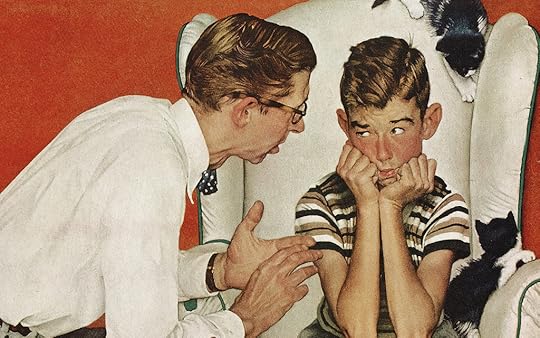
Norman Rockwell

Negli anni settanta a Chalmerston, forse paese immaginario, forse invece nell’Indiana, vive la famiglia Alderman composta dal padre Richard, la madre Lois, il figlio maggiore Arthur (17 anni) e quello minore Robbie (14 anni).
Il capofamiglia fa l’assicuratore, è un tipico rappresentante della middle class americana, calvinista e puritano. La moglie è arrendevole e remissiva; il piccolo di casa introverso, scontroso, ma anche soggetto a improvvisi scoppi d’ira, insomma, con qualche problema caratteriale. L’unico “sano” appare Arthur, il primogenito, che s’innamora di una coetanea (Maggie) e si tiene lontano dagli eccessi bacchettoni paterni.

description
Midwest, USA.

Quando Robbie, il quattordicenne, si ammala in modo che sembra sempre più grave, il resto della famiglia, pungolata dal padre, si stringe in preghiera. Raggiunta la guarigione, è tutt’uno gridare al miracolo. Il padre sente di essere stato ascoltato direttamente da dio, e diventa sempre più fanatico e maniacale, cominciando a spalancare la casa ai membri della chiesa riformata che frequenta, più setta che chiesa (o ‘chiesa’ nel concetto statunitense) – membri che sono ben felici di invadere lo spazio e la vita della famiglia Alderman.

description
Gente che bussa alla porta.

Sono loro la gente che bussa alla porta.
Vengono a portare opuscoli (in cambio di ‘offerte’ in denaro), la ‘buona novella’, la ‘parola di dio’: tutto viene visto sotto la luce premio o punizione divina.
L’unico che non si piega, che non chiede di essere né convertito né redento, è Arthur: non riesce proprio ad abbracciare l’intransigenza fanatica del padre.
Al contrario del fratello minore, convinto d’essere guarito solo per grazia delle preghiere paterne.
La famiglia comincia a scollarsi. Da qui succedono cose che è meglio leggere invece che raccontare.

description
High School

Non so se definirlo thriller, men che meno giallo. In un certo senso lo è, thriller psicologico. Ma forse la Highsmith non era scrittrice di thriller e/o di gialli, rinchiudibile ed etichettabile in questa categoria: era scrittrice tout court, e di razza.
Anche questa volta, mi pare che la storia, la materia sia di un’attualità sconcertante (nonostante pubblicato trentacinque anni fa, nel 1983).

description
Foto di Wim Wenders.
Profile Image for Sarah.
469 reviews88 followers
July 27, 2023
I wish my first love had been a girl or guy as even-keeled as protagonist Arthur Alderman. He’s an all-around helluva good person, embroiled in an average family gone batshit crazy with religion.

In this offering, Highsmith gifts us another terrific novel, though her supposed 1980s setting is indubitably off. Published late in her career, the book arguably portrays “youth” as enshrined in the author’s own recollections, rather than the actual teenage experience of the 80s. The background music is wrong, the high schoolers sipping old-fashioneds with their parents before dinner is wrong, and the dialogue is wrong. Were this set in the 50s, it’d be perfect. 80s? Not so much.

And I’ve intentionally searched out proof the Alderman’s live in the 80s: 1. Arthur references the Jim Jones massacre (1978) as a non-recent event 2. He also references the Moral Majority (founded in 1979) 3. Legal abortion is a thing (Roe v. Wade happened in 1973) 4. There are many casual mentions of rampant coke use (fad peaked in 1982).

Still, I couldn’t put this book down. It’s a departure for Highsmith – ratio skewing more sociologically than psychologically twisted – but I love every character, even the nasty ones. And this is a Highsmith novel, so sociological emphasis aside, you will not escape unscathed. Also, hate to say it, but the fundamentalist religious stuff feels accurate. I’ve gotten an up-close look at this particular socio-demographic, and Highsmith nails its effed-up effects on the best of us.

Book/Song Pairing: Stretched on Your Grave (Sinead O' Connor - Live in Brussels)
Profile Image for David.
764 reviews185 followers
December 10, 2024
Highsmith fans who attempt this late-career work may be scratching their heads somewhat early on. As they make their way through (if they get far enough), some of them may even begin to feel cheated. Highsmith usually makes her intentions with a novel known before too much time has passed. And those intentions usually hinge on the unhinged.

But this novel is different. I'll confess I was thrown at first. I was getting an image not unlike what Hitchcock offers at the beginning of his 'Shadow of a Doubt': a quiet town, with nice people... but maybe someone not-so-nice will... visit.

Turns out I was both right and wrong. Highsmith does eventually get around to one of the things she does best - but that comes late in the novel. (And does it ever!)

Until then, the author explores a different sort of horror: born-again Christianity--a bloodless horror (usually) but insidious as it wends its way in, clutching with its tone-deaf, one-note sermon.

I was impressed by Highsmith's apparent depth of research. She has the behavior of fundamentalists down cold. Oddly (or perhaps not), there's no real judgment at work in the author's mind; she remains coolly detached, clear-eyed in objectivity. She doesn't seem to create a monster this time out - well, not a human one; just the monster of 'hellfire and damnation'... which (here) causes its own undoing.

I was pleased to see Highsmith choosing to work mostly with pleasant characters. I don't think I've seen her do that before. In a way, it's like she purposely decided to outnumber the Bible-thumpers to highlight their minority status.

Highsmith published this book during the Reagan administration. She makes clear the connection of Ronnie's time in office with the end of separation of church and state. Whether or not she felt that a rise in fundamentalism comes in waves, I don't know. But we're experiencing a considerable wave of it again in society... which keeps this novel strangely relevant.
Profile Image for hawk.
473 reviews82 followers
August 22, 2025
I really enjoyed this book, and I think it's taken the place of my favourite Patricia Highsmith novel so far 🙂

having said that, I don't seem to have made alot of notes, or have alot of comment right now, tho a little follows...


🏡🏘👥🏡🏢📚


a nice opening scene with Arthur skimming stones... 🙂

a really nice pace and scene setting - teenage Arthur, his girlfriend Maggie, his brother Robbie, and his parents.
had a small community feel, neighbours 🙂💙

Arthur's father's shifting thoughts and beliefs, and their impacts on his family, and more widely... 😬

Maggie's family play a central role too, contrasted socioeconomic circumstances and attitudes, a level of support and acceptance Arthur doesn't get elsewhere 🧡

reproductive rights, abortion, a woman's choice... 💚💜

the rise of the Christian political right in North America 😬

a really nuanced story of everyday lives, class, opportunity, family dynamics 💔❤


⚔🎚📖🎚⚔


there were some unchallenged social norms of the time, the fatphobia was the hardest to read, and the attitudes and language around sex workers, even if just being used to illustrate local attitudes 😬

I'm often pleasantly struck by the authors inclusion of LGBTQI possibilities in a positive/not-negative way in her novels, not necessarily central but usually there in some way/form - this time a comment in passing, in a way that simply normalised the possibility of someone being LGBTQI 🙂


🌟 🌟 🌟 🌟 🌟


accessed as an RNIB talking book, read by David Rider.
This entire review has been hidden because of spoilers.
Profile Image for Jean-Luke.
Author 3 books484 followers
October 6, 2025
NOT a thriller, despite everyone from the publisher to the library trying to pigeonhole it as such. No, the Graham Greene quote on the cover calling Highsmith the 'poet of apprehension' is not relevant or helpful here. Contrary to popular belief, not every book by Highsmith is a suspense novel, and that really is okay. Having listened to Andrew Wilson's Beautiful Shadow: A Life of Patricia Highsmith recently, I specifically sought it out knowing just what I was getting—an exploration of the societal scourge that is Christian fundamentalism/nationalism, and the zero-accountability violence it incites. I warned you, America.—Highsmith's ghost, probably.

Highsmith is never didactic and the story reminded me of Yates's Cold Spring Harbor or even Winterson's Oranges Are Not the Only Fruit. Both young love and abortion are written about with great tenderness, along with family dynamics complicated by conservatism/religion, and I suspect Arthur might be one of Highsmith's most sympathetic creations. The dialogue, such as when Arthur and Gus sit discussing condoms, is sometimes a oddly formal, along with some of these teenagers' habits, and Robbie, before his sudden maturing, runs around the house like a 10-year-old even though he is nearly 15.

Highsmith did not believe in a higher power, or in an afterlife, and the people who knock on the door are really just people who cannot cope with life, exploiting others just like them. Shocker. There's always some grift, someone trying to whitewash some facet of themselves by punishing others in the name of God, as the last nine months in American politics have demonstrated. Anyway, thoughts and prayers to all the miserable bigots. Sincerely, a pro-abortion heathen. But hey, at least I'm not a brainwashed fucking hypocrite.

Arthur felt like laughing, it was so ridiculous. Was Christ or somebody going to drop sacks of wheat or rice in the middle of a desert in Africa or wherever a million people were currently starving? Arthur had taken a look at Plain Truth, on his father's orders, and found the articles so naive they might have been written for children younger than Robbie.
...
"Yeah, and what they're doing politically is not so funny. They're trying to run the government and they've got a good start. They've got a shit-list for liberals. Making sure they don't get elected, you know? They've even started book-banning. The hell with all of them."
Hmmm. Sounds oddly familiar.
Profile Image for David.
Author 1 book73 followers
April 28, 2023
Being from Bible-Belt Texas herself, Patricia Highsmith would know about how born-agains affect other people's lives. Religious meddling just can't let people lead their own lives.

A similar situation took place at a church I went to as a youth in Pasadena, Texas, when I began dating the niece of our venerated pastor there. The pastor, I'm sure had no involvement in the matter because he was a great friend of the family, but the Sunday School teacher did have such an interest.
In my eyes, that person painted himself as rather perverted for taking a personal interest in our burgeoning teenage love affair.

Highsmith deals superbly with the neurotic Everyman and does again in this book. I enjoyed it because it reminded me of the meddling that eventually led me away from the congregation that I had grown up in and freed me from tight religious restraints.
Profile Image for Carla Remy.
1,063 reviews116 followers
Read
December 6, 2018
from 1983. The last decade of Highsmith's writing (and her life). I am, not reading this. I mean it's very boring. I read a good third of it, and it doesn't seem to have much happening. A teenage boy has a father going born again and a girlfriend getting an abortion. Bad combination, sure, I guess, but not that interesting. I suppose eventually there might be a murder. But how long am I supposed to wait? The title sounds very creepy, but it is actually about people bringing you religious pamphlets.
Profile Image for Oliver Clarke.
Author 99 books2,046 followers
June 11, 2024
As is often the case with Highsmith, this ends up feeling like more than the sum of its parts.
Profile Image for Carol.
537 reviews76 followers
April 2, 2018
I am normally a great fan of Patricia Highsmith, but this is one of her novels I find very lacking.

The story takes place (supposedly) in 1985 but has all the language of 1941!! The teenagers use language like “mightn't” and “stocking feet” and “why are you so down in the dumps?” A 17-year old boy calls a boy three years older than him “Mr.”, listens to Dizzy Gillespie records with his friends and takes his date to the Soda Shop for a fountain drink!

But then, it is also a peculiar place where underage drinking is not only legal but encouraged. Seventeen year olds are constantly being given gin and tonics, offered beers and hot toddies by their parents, neighbors and friends' parents. There is even a high school function where the students are encouraged to bring their own booze!

This is especially troubling because I liked the beginning plot and the religious conflict she created at the beginning.

However, she made the scenerio of the girl's pregnancy and abortion seem like a case of streppe throat with the girls' parents. It was ridiculous. (I am not giving away anything here).

A big disappointment for a Highsmith fan!
Profile Image for Sharon.
16 reviews6 followers
August 29, 2013
Some reviews suggest that Patricia Highsmith is making an overt statement about religion. But that sort of distinctness isn't her style. I don't think religion is the enemy or Arthur is the hero in the classic sense; he is as judgmental and fallible as his father and brother, and Highsmith is showing that disparate thoughts bring out the worst in all people. Through his family's "born again" religion, we find out that Arthur is a nice guy, but also judging and self-absorbed.

I didn't really enjoy this book like I thought I would. It isn't a "classic Highsmith" in the sense that you find the killer relateable in some way. By the time the violence comes, you don't feel anything for either the killer or the victim. It's rather a small event that shapes the ending, but not in a way that you'll really care about.

This is probably my least favorite Patricia Highsmith book so far, I'm sorry to say.
Profile Image for Jody.
227 reviews66 followers
April 8, 2013
First, in all of Highsmith's books, everyone drinks copiously. It's just a given that there will be a gin and tonic offered at every social gathering. And, all of her books do have a 1950's feel, no matter what signs of the times she attempts to add to the plot. It's part of her kitsch and makes it all the more warped.
Picture a son on the brink of death and a dad who is praying fervently by his bedside. When the son survives, the father turns into a hard core born again Christian. His cult-like fixation eventually turns into its own horror story.
This is Arthur's story, though. He's an older teen on the cusp of adulthood. It sounds like a regular coming of age novel, but add the father's zealous beliefs and let the games begin.
Profile Image for Joseph.
Author 4 books43 followers
April 30, 2017
Richard Alderman finds some relief in religious fervor, from the boredom and frustration of his life selling insurance in Reagan's America. His sanctimonious new attitude clashes with one teenage son, and profoundly confuses another. Naturally, this doesn't end well.

Rich subject matter but the dialogue and plot were plodding: too much focus on the one son and his teen love affair, and how he strives to be a decent normal person who believes in science and evolution. The real action was with the father, who was relegated to the role of a caricature and small time villain. I was far more interested in the father's despair, and would have liked to see some scenes with him alone with the prostitute he was trying to 'save', but ended up getting her pregnant. And some scenes with the church folk talking about politics, Reagan etc. Abortion plays a big part in the story but it doesn't hit hard, nothing like what was really going on(and still does) with the fanatics. They're just too nice and polite about it.

Highsmith missed the marks: scene after scene of the one son working, eating pie, drinking beer with his equally good friend, studying, going to the library etc. One reviewer called it Leave it to Beaver. There's a short scene where Arthur, the good son, is in his school lounge and Reagan is on TV, but Highsmith doesn't include any part of his speech; a missed opportunity to add some context,since Reagan's speeches were exemplars of the extreme corniness tinged with menace of Evangelical language and thinking.Highsmith had all the framework set up to really stick it to the Reagan era moral majority types but instead constructed a weak morality tale.
Profile Image for Bruce Beckham.
Author 85 books460 followers
September 9, 2016
If books were mountains, and a Mystery were a frantic scramble up a vertiginous cliff, then a Patricia Highsmith suspense novel would be more like Kilimanjaro – a slow, slightly agonising ascent, the gradient unexceptional and the scenery middling. And where the Mystery delivers a distinct high, Patricia has you coming down before you realise you’ve topped out.

Nevertheless, the classic shape of her narrative carries you with her, never really wanting to give up (in my case only succumbing to fatigue), and always pleased to resume.

Thematically, from the outset I found this quite unlike any other Highsmith I have read – such a mundane and benign tale of American family life that it was hard to imagine affairs could possibly turn nasty.

But, very subtly, the suspense builds. You begin to sense that there are several rather unsettling things that could happen (to the preacher? the prostitute? the preppy?), and that one of them surely will.

Of course, she rarely writes to please the reader – at least as far as the ‘right’ outcome is concerned – so you have to settle for what you get; justice is not her priority. And she is not one to tie up loose ends: a key thread for me in this book was the youthful protagonist’s story, “boy gets girl, boy loses girl, boy gets girl back” – but does he? I’m not so sure!
Profile Image for George.
3,262 reviews
May 21, 2025
3.5 stars. The protagonist, Arthur Alderman, aged 18, lives with his mother Lois, father Richard and 15 year old brother, Robbie. When Robbie nearly dies in hospital with fever and a strep throat, his father believes his prayers were answered. Richard becomes a born again Christian. When Richard finds out Arthur’s girlfriend wants to have an abortion, Richard becomes extremely agitated and tries to stop the abortion happening.

An okay, easy read with a little tension, but not as strong as her more famous crime novels like ‘The Talented Mr Ripley’.

This novel was first published in 1983.
Profile Image for Rachel.
164 reviews1 follower
March 7, 2025
This book is a hidden gem in Patricia Highsmith's bibliography. This book takes on the patriarchal chauvinism, toxicity and hypocrisy of born-again Christians in a way that is uncomfortably relatable to people who have been harassed by or had their life upended by such people. A queer woman tackling this topic in 1983 is a fantastic cultural artifact to encounter, especially as an otherwise slow paced book about a young man transitioning from high school to college, and all the usual heartaches that come with it.
Profile Image for Olaya Diaz Martin.
103 reviews6 followers
November 24, 2017
Cuando la descripción de la historia te atrapa más que la historia en sí. Podría tener una historia magnífica, se intuye que hay un trasfondo brutal e interesante; y sin embargo en lugar de centrarse en eso, en el padre, sus cambios, la gente rara a la que se acaba juntando, o incluso el hermano pequeño y sus cambios de humor y comportamiento precisamente debidos al padre. En lugar de eso, opta por contarte como principal una historia tan poco creíble como aburrida y mundana: unos adolescentes descritos como si hiciera lo menos 30 años que la escritora ni siquiera se hubiera cruzado con uno. Y el lector nota que detrás de todo ello, como si la cámara lo viera pixelado, hay una historia que podría ser muy interesante, pero que se acaba quedando en nada.
Profile Image for Sara Matos.
6 reviews
May 21, 2023
Esperava uma pérola escondida da autora que nos deu Carol mas agora percebo porque é que ninguém fala deste livro
Profile Image for sandraenalaska.
189 reviews24 followers
January 23, 2025
Es imposible darle menos de cuatro estrellas a esta maestra pese a la antipatía que me ha despertado cada uno de los personajes. Highsmith es implacable con ellos. Highsmith es la mejor narradora que conozco.
Profile Image for Judith.
1,675 reviews89 followers
August 22, 2013
"Strangers on a Train" and "The Talented Mr. Ripley" are the two books I read and thoroughly enjoyed prior to this one. Patricia Highsmith is a genius at suspense and believable quirky characters. So I waded patiently through the book till something finally happened, but by then it was too little too late.

A father of two sons becomes a born again Christian overnight and converts one of the sons. This drives a wedge through the family, leaving the other son as a demon and the mother as an ineffective peace-keeper. Then something happens. End of story.
Profile Image for Katy.
284 reviews8 followers
December 24, 2013
There is something a little off about this book. Highsmith's stylized writing works with some of her uptight 1950s characters, but it didn't seem to fit in this book. One very jarring and disturbing element was her VERY unenlightened comments about race. She knows nothing of race-- so she'd have been better off leaving it out. I've read 90% of her books and this is one of the least successful. Still worth a look--but try others first.
Profile Image for Mauberley.
462 reviews
Read
February 26, 2018
Not perhaps the author's best but that doesn't mean that it isn't head and shoulders above most writers' best work. If you read it as a ghost story where the intruders take a surprising form, you should be generously satisfied. It's all told in that deliciously flat tone of hers that I always find so appealing.
172 reviews2 followers
September 10, 2018
My favourite non-Ripley book by PH. A major swipe at fundamentalist Christians which is as savage as it is funny, and proves beyond doubt that she completely transcends (as well as illuminating) the Thriller genre. This is more of a kitchen drama than a thriller, but what style! An ideal Christmas present for any atheist.
Profile Image for Phillip.
432 reviews
May 24, 2021
this is one of the best of highsmith's family portraits that i've read and it's just so great to see her give christian hypocrisy a good thrashing.

conflicts between a father and his teenage sons, his wife, mother in-law, and their church community drive the plot to a tragic end. power struggles within the family and around the alderman neighborhood are fraught with the problems that sparked the 70's women's liberation movement over a woman's right to control her body and its destiny. arthur, the son of born-again richard, goes to war with his dad when he supports his girlfriend's choice to have an abortion. he exhibits a feminist outlook that is anathema to a man who believes he is bible-instructed to control the women in his life. robbie, the younger brother, identifies with his father and longs to be able to control his anxiety and fear of the opposite sex. the complex web of catastrophe that spins as these issues spark a wildfire is the reason i read patricia highsmith. it builds slowly and gradually so it hooks and hypnotizes and then i can't put the book down until her apprehension symphony is complete.
489 reviews
Read
July 5, 2020
When I read People Who Knock on the Door quite a few years ago I saw it as a commentary on fundamentalist religion and its hypocrisies. In some ways the story of the Alderman family and Richard Alderman's born again religiosity lends itself to this assessment: the depiction of the church personnel and their followers; the attitudes over abortion; and the smug assertiveness by Richard of his rectitude in comparison with that of his son, Arthur. After all, when we hear that the church personnel and Richard have on the one hand been 'saving' Irene, a former prostitute, and taking sexual advantage of her; when we look Richard's physically easy job in comparison with Arthur's hard physical labour and then eventual offer of a job as a manager at a young age ; and the way in which Arthur's science bent undermines religious belief the story appears to be quite a simple moral tale. Arthur is a positive character, together with the well meaning neighbour and his grandmother; Lois, Arthur and Robbie's mother is a good person who supports her husband; Maggie (Arthur's girlfriend) and her family are reasonable, enlightened and friendly to 'our hero'. On the other hand, Richard is the repository of religious hypocrisy, failure to provide for his son's education and a gossip; the church personnel are also gossips and smug; Robbie, Arthur's younger brother is erratic, takes to his father's religion with avidity and cannot make friends of his own age, depending on a group of older men for his social life of fishing and hunting.

On my second reading I began to reassess the novel. I think that it far more layered than my original assessment allows. The writing has a great deal to do with my new belief that we are looking at a report of life in America at the time, the variety of attitudes to religion and social mores and a clear eyed assessment of those we might determine heroes or villains. There are none in the novel, just flawed people trying to live as best they can, sometimes making egregious mistakes, and at others just getting through problems with doggedness, not heroism.

Lois is one of the most complex characters. She is a daughter, wife, mother and carer of children in an institutional setting. It is possible that the latter is where she feels most comfortable, certainly a great deal of her thought and time is taken up with the children outside her home. As a daughter, she seems to rely heavily on her mother to support her sons (but not at the price of antagonising their father), galvanise her into refurbishing the house, encourage her though the moral morass of dealing with an unfaithful husband, a child born out of wedlock that has a personal rather than institutional link with her, and death. Lois is not an entirely pleasant character, whatever her obvious concern for others. Her attitude toward Irene is cruel, with little laughs at her expense throughout the episodes of her appearance at the family Christmas with her huge sister, her pregnancy, and the arrival of the baby.

Arthur is the other character whom we are led to initially see as a hero. But is he? A lovelorn youth, who works hard, achieves well academically, and organises his college life after he loses the financial support of his father is not necessarily a hero. Arthur loves Maggie, does a great deal to help her with the abortion, supports his mother as far as possible, loves his grandmother and is reasonable towards his friend Gus. The characters with whom he has no difficulty he treats well. However, it is clear from his mother's and grandmother's comments that he is known to have teased his particularly vulnerable brother (this is also shown, early in the novel); he harbours violent thoughts of the student who replaces him as Maggie's boyfriend; he looks for someone to help him get over her with a somewhat cold approach to human relations; he investigates Robbie's friends, realises their shortcomings, but leaves it at that; he follows up Irene at her current workplace, replicating his mother's derisory attitude towards her. His gossip about her is little different from the gossip he abhored when aimed at him and Maggie and the abortion. Perhaps Arthur's scientific bent is not just academic, but denotes a fairly cold character?

It is possible that the Alderman family has always been dysfunctional, perhaps waiting only for Robbie's near death and Richard's religious fervour to show the chinks. In comparison with Gus's family, large, warm and open with Gus sustaining a loving relationship with his girlfriend from early in the novel to the end, the Aldermans are an uneasy group, lacking in real warmth, living lives that superficially are pleasant but ready to fall at the first encounter with crisis.

As always, Patricia Highsmith gives the reader something to think about. She seems to write almost for herself, leaving us to catch up with her if we can. She is not interested in giving us characters with whom we can identify, love, or even like. On the other hand, unlike some more contemporary writers, she is not lazy in her depiction of characters. None is just dislikable, each is complex enough to make us wonder what she meant the character to convey. Rereading this novel has encouraged me to reassess some of her others. But, the discomfort she leaves behind each reading suggests that this should be done between less demanding novelists' work.
Profile Image for Marita Romo.
88 reviews
February 1, 2025
Se me hizo un libro muy extraño en su totalidad. No por los temas que trata pero la manera que se relacionan los personajes entre ellos, creando vínculos sin mucho sentido, y sus reacciones a las cosas. El personaje principal era unidimensional y rara vez mostraba emociones o profundidad de cualquier tipo.

En su gran parte, no hay una narrativa interesante y es una mera descripción de cosas de día a día. No estoy segura si lo acabé porque estaba intrigada o por el simple compromiso de saber el final.
Profile Image for Phoolani.
122 reviews2 followers
March 25, 2020
Highsmith can surely write and write well, but not this book. Before I start, I should note that I have read and thoroughly enjoyed Carol and The Talented Mr Ripley, to name but two of the Patricia Highsmith books I would totally not trash if I reviewed them. People Who Knock on the Door, however, will not be joining that party. It is, bar the odd line or scene here and there, truly terrible. At times it sails dangerously close to reading like a parody of ‘how not to write a novel’.

tl;dr: A father becomes a born-again Christian who kicks out his son, Arthur, after Arthur gets his girlfriend pregnant and she has an abortion. Cut off financially, Arthur has to attend a lesser, local college. Mum Joan kind of objects to all of this but is completely wet about it. Dad keeps on with his conversion, taking Arthur’s younger brother, Robbie, with him. Robbie, a bit odd to start off with, gets odder. Dad starts ‘counselling’ a mentally-deficient and sexually promiscuous woman, Irene, who he manages to impregnate as a result of said ‘counselling’. Robbie loses his shit at dad’s wanton behaviour and shoots him dead. Robbie gets 6 months in juvie. Arthur and mum may be a bit sad about Richard’s death (or not; you’re going to have to really look to find the grief here), but take the silver lining approach and view his unfortunate demise as an ideal opportunity to re-decorate the study. Robbie will probably go into the army on his release, but it’s unlikely any of the remaining family members will notice.

The novel tells the story of the teenaged Arthur and his family and the effects on them of his father Richard’s conversion to born-again god-bothering. Inconveniently enough, this conversion takes place just before Arthur gets his girlfriend pregnant and dad is not best impressed by the resulting abortion. So unimpressed in fact that any father-son bond that may (or may not) have existed before said abortion and Arthur’s resolute refusal to obey his father and interfere to stop it, goes puff! up in smoke!! (and no, do not get me started on Highsmith’s vigorous exclamation mark usage!!!).

So what’s wrong with it?

Well, the language for a start, specifically the language that is supposed to be in a novel set in the mid-80s but sings like it’s 1955. It’s early on in the book when Maggie needs an abortion and I hadn’t bothered to note when this action was supposed to be taking place. Which means I assumed 1955. So when Maggie says she’s going to get an abortion by the simple means of seeing her doctor then going to hospital accompanied by her parents, I was totes confused. A clean, safe, above board, parent-certified abortion in 1950s America? So archaic was the language of the dialogue, my first thought was I’d managed to get Roe v Wade out of time by a couple of decades. Which, obviously, wasn’t going to happen. Arthur’s language – a large part of the book – is particularly bonkers because he doesn’t just sound like he grew up watching Howdy Doody and was now just waiting for the Hula Hoop craze to hit, he sounds like a 40 year old even for 1955. My mental picture of him included a bow tie which tells you all you need to know.

Arthur’s language isn’t the only problem. He carries a large part of the book, or rather, he doesn’t. He’s boring. He’s pleasant, measured, helpful, polite – and dull as ditchwater. He has no interesting character aspects at all and could be literally any 18 year old pretending to be 40 thirty years earlier. After chapter upon chapter of this soporific boy, I was ready to give up, but there was an up tick in action at Chapter 11, when there was a bit more to-do with his father. Unfortunately, it was fleeting and only lasted until I felt I was too far in to stop reading. In fairness, the only thing that was partially fascinating about the brief bit of action had only been the seeming complete lack of any relationship between Arthur and his father. It’s weirdly compelling. Arthur makes one mistake and wham! dad acts as if Arthur’s somebody he met briefly some years before at a function who irritated him by cutting the nose off the brie. No money, no college, no leeway, no forgiveness. Richard would be wonderful on Twitter.

This sense of the family being, at most, accidental room mates and, at worst, people who have shared a bus stop, is particularly strong when Robbie blasts Richard to death with a shotgun. Arthur and his mother react to the patricide as if a visiting dog has shat on the carpet; it’s irritating and bothersome to clean. The largest part of the conversation between them afterwards seems to be what to do with the mess (Arthur) and which wallpaper to cover it with (Joan). The understatement reads like you’re eavesdropping on a particular upper middle class evening soiree. This weirdness however, is pure joy compared to the perfunctory prose that comes after and closes the book out, which reads like a list of ‘things to stick in before the end’. I haven’t checked, but it wouldn’t surprise me if Highsmith died before fleshing out the last third of this novel. It wouldn’t actually surprise me if she died because of this novel.
Profile Image for Librielibri.
267 reviews113 followers
February 14, 2022
Avevo in lista questo libro da parecchio, ma mi ha deluso, non tanto per la trama quanto per la piattezza dello stile. Poco credibili anche le reazioni dei personaggi all'avvenimento clou del libro (di cui non parlo per evitare spoiler)
Profile Image for Cristian1185.
508 reviews55 followers
June 5, 2025
Gente que llama a la puerta nos permite observar las crudas consecuencias de los discursos y actos que nacen a partir de la ciega creencia en preceptos religiosos que se vuelcan finalmente en fanatismo e intolerancia. Argumentos fundamentalistas que permiten el brote de la locura y la muerte en cualquier tipo de grupo humano en donde se encuentren resquicios por donde puedan colarse. Enfermedad, soledad, disconformidad, falta de pensamiento crítico, necesidad de reconocimiento, son solo algunos de los factores que inciden en la adopción de tales argumentos, argumentos que preceden a actos irracionales y potencialmente peligrosos.

Contrastadas y enfrentadas se encuentran dos posturas éticas durante gran parte del desarrollo de los temas que trata el libro. Una, caracterizada por el pensamiento místico, la intransigencia y el sentimiento de culpa, se enfrenta contra la posición singularizada por el progresismo y el laicismo. Ambas, confrontadas y esgrimiendo sus respectivos argumentos, encuentran diversos espacios y sujetos dignos de disputa. Esto últimos, a ratos deshumanizados por los contendientes, son los que movilizan gran parte de la historia, involucrándonos a partir del interés que suscitan sus vidas y los giros que estas pueden dar.

Gente que llama a la puerta es un libro que nos presenta los riesgos y resultados del fanatismo, tema que a la vez nos permite apreciar los claroscuros de los personajes que se presentan durante el desarrollo de la trama. Los personajes se presentan en perfiles perfectamente reconocibles y caracterizados, pero a medida que se desenvuelven las ideas de la obra, estos comienzan a desdibujarse y perder contornos, devolviéndonos perfiles ambiguos, humanos y desencajados de los tópicos que en un principio se nos presentaron. Es decir, sujetos en donde la verdad y la mentira, lo correcto y lo erróneo se entrelazan continuamente, en un ambiente aparentemente tranquilo y que no augura nada novedoso para una típica familia estadounidense de clase media.
Profile Image for Bill.
1,997 reviews108 followers
September 30, 2016
1. People Who Knock on the Door by Patricia Highsmith. Highsmith writes well but I've enjoyed others of her books more. In some ways I just didn't get her point with this book. Teenager, Arthur Alderman, begins dating Maggie Brewster. They have sex a few times, she becomes pregnant and with the support of her parents, has an abortion. Arthur's father, in the meantime, has found God, as a result of an illness of his other son, Robbie, who is cured, his father thinking it was God's intervention. Arthur's father disagrees with the concept of abortion and does everything in his power to persuade Arthur, Maggie's parents, and Maggie, to change their minds. The incident causes tension in the Alderman family, which builds throughout the story, with Arthur on one side, Richard and son Robbie on the other and Arthur's mom in the middle. The story starts a spiral with a surprising ending, which I won't tell. As I say at the beginning, I'm not totally sure where the story wants to go. Is it a comparison between Arthur's and his father's values and those of the Brewsters? I found the subject depressing but, also realistic, not that I've personally experienced anything like it. As I mentioned at the beginning, Highsmith writes well and I did find myself wanting to see where the story led. Highsmith is interesting especially, that she starts down paths you think the story might be following but then heading in other directions. All in all, not my favourite, but interesting (3 stars)
Profile Image for Anne.
156 reviews3 followers
November 12, 2016
This was a departure from the normal Highsmith: none of the usual menace; no slow building thriller. There was a sense of optimism at the end most unlike her. And a hero rather than an anti-hero! But thoroughly enjoyable. The main character is a wholly likeable young man who is a credit to his family yet they cannot really appreciate it. He holds onto his view of life despite loathsome hypocrites seeking to overtake him and ultimately he prevails. Some excellent scenes and the usual biting, acerbically witty observations and dialogue. Don't read this if you're after a Highsmith chiller but do read it if you're after a great story told in her wonderful dry style.
This entire review has been hidden because of spoilers.
Displaying 1 - 30 of 107 reviews

Can't find what you're looking for?

Get help and learn more about the design.