

What do you think?

Binky Brown conoce a la Virgen María
Clásico perdido del cómic underground, Binky Brown conoce a la virgen María es el retrato de la lucha de Justin Green con la religión y sus propias neurosis. Binky Brown es un joven católico que se enfrenta a los problemas comunes de la adolescencia ?la pubertad, los padres, y el miedo a que el extraño rayo de energía que emana de sus genitales alcance una representación de la virgen María. Profundamente confesional, con un dibujo que oscila frenéticamente entre lo formalista y lo alucinógeno; Binky Brown conoce a la virgen María es una obra maestra controvertida que inventó la novela gráfica autobiográfica.
72 pages, Hardcover
First published March 1, 1972
About the author
Justin Green
79 books8 followersJustin Green (Justin Considine Green) is an American cartoonist who is known as the "father of autobiographical comics." A key figure and pioneer in the 1970s generation of underground comics artists, he is best known for his 1972 comic book "Binky Brown Meets the Holy Virgin Mary."
Ratings & Reviews
Friends & Following
Create a free account to discover what your friends think of this book!
Community Reviews
Displaying 1 - 30 of 64 reviews

May 30, 2022
I suppose this collection of underground comics will have more meaning to those who've had Catholicism foisted upon them. This is disturbing in oh, so many ways.
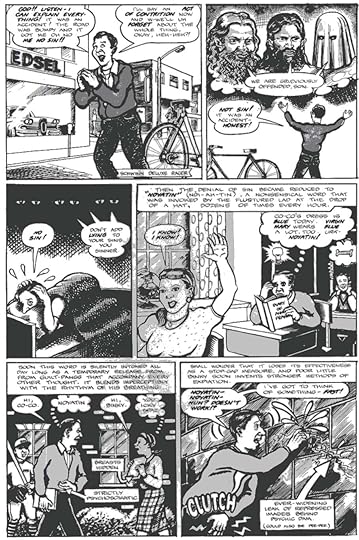
AND, if it's cartoon penises you're looking for, this book has a plethora.
AND, if it's cartoon penises you're looking for, this book has a plethora.

April 26, 2015
RIP Justin Green, who I just learned died in late April, 2022. Alt-comix great, married to Carol Tyler.
This is a memoir from 1972 that is in the territory of Crumb and Seth, by which I mean it is how about sexuality, male sexuality, male adolescent sexuality, which may or may not be nostalgic for men and eh, or annoying/gross for women readers. It's in part about the pervasive dominance of fantasy in every day life, but also about the ways religion and particularly the Catholic religion created for him almost surreal guilt and anxiety obsessions. It's pretty funny in places. And feels very much like a late fifties/early sixties period piece, informed by the artists that he may have read such as Mort Walker and Walt Kelly and going back to Will Eisner… many others, too.
Sketch comics, going for the laughs. And captured in this gorgeous oversized gold lettered hardcover book format that belies the informal/slightly crude contents. But it is an early example of memoir comics, and was good to have experienced it. As an ex-Calvinist man who was a boy shortly after Green was, I could relate to some of it. Great title, too, right, with an intro by Art Spiegelman and an afterword by the author.
This is a memoir from 1972 that is in the territory of Crumb and Seth, by which I mean it is how about sexuality, male sexuality, male adolescent sexuality, which may or may not be nostalgic for men and eh, or annoying/gross for women readers. It's in part about the pervasive dominance of fantasy in every day life, but also about the ways religion and particularly the Catholic religion created for him almost surreal guilt and anxiety obsessions. It's pretty funny in places. And feels very much like a late fifties/early sixties period piece, informed by the artists that he may have read such as Mort Walker and Walt Kelly and going back to Will Eisner… many others, too.
Sketch comics, going for the laughs. And captured in this gorgeous oversized gold lettered hardcover book format that belies the informal/slightly crude contents. But it is an early example of memoir comics, and was good to have experienced it. As an ex-Calvinist man who was a boy shortly after Green was, I could relate to some of it. Great title, too, right, with an intro by Art Spiegelman and an afterword by the author.

March 16, 2020
No es fácil juzgar a los pioneros. A estas alturas Binky Brown conoce a la Virgen María se nos puede antojar demasiado corto, técnicamente pobre o poco original. Lo sitúas sin embargo en su contexto y entiendes que en aquellos momentos nadie o casi nadie había hecho algo de ese estilo (los mangakas japoneses llevaban algunos años de ventaja en hacer tebeos autobiográficos, no obstante). Justin Green no solo se atrevió a hablar de sus propias experiencias cuando eso era una rareza, sino que además hablaba de algo tan difícil de entender para la mayoría, sobre todo entonces, como el trastorno obsesivo compulsivo. Si hago caso a Art Spiegelman cuando afirma que Maus no habría existido sin Binky Brown, o a todos los dibujantes que admiten su influencia, entonces creo que he de aumentarle las tres estrellas con que de otro modo habría calificado este cómic, a cuatro. Sobre todo porque pienso que, a diferencia otros trabajos pioneros, este no ha envejecido demasiado mal.

November 30, 2015
A funny exploration of the weird perversions of puberty and the obsessive-compulsions inherent to religious practice. McSweeney's version is big and fancy, and includes a lengthy afterward by the creator.

May 24, 2020
Zoinks, Scoob. This is the ur-text of my field! I worship it.

October 8, 2023
Damn those pecker rays! :)

September 5, 2023
that was scarring I need soap for my eyes or something 😭

January 22, 2014
This is a gorgeous reprint. McSweeney's decision to print this black-and-white story in color, white-out warts and all, had magnificent results, appealing particularly to a nerd like me (obsessively poring over the artists' techniques as I do).
The story was bizarre and brilliant. It being the first autobiographical comic ever made, I couldn't stop thinking about how this thing in my hands was directly responsible for pretty much my entire career.
The story was bizarre and brilliant. It being the first autobiographical comic ever made, I couldn't stop thinking about how this thing in my hands was directly responsible for pretty much my entire career.

April 18, 2015
it was very bizarre but also kind of fascinating? i read it in one sitting.

October 28, 2022
Woah, this is weird!
And although I did not read the afterword,...
I will perhaps have to check the book out again.
And although I did not read the afterword,...
I will perhaps have to check the book out again.

March 27, 2024
I finally understand why it’s not polite to point

September 6, 2026
This happened to me

October 20, 2012
Raw. Obsessed. Crude. Shocking. Blasphemous. Brilliant. Such pain inked out to the page. Confessional frankness than any religious upbrought person can relate to.Ah adolescence! Spare us the religious perversities we are forced to inhabit. Save us from these religions and their warped lifestyles. Mind you Binky Brown does have 'issues' but then he channels what he gets served up.
Binky si from 1972 and suggested a future for autobiographical comics...but few since are as intimate -- or as savage -- as this one.
"Justin Green is one of the most important artists of the underground movement. Of the nearly hundred comics for which Justin Green has drawn - 'Bijou Funnies', 'Insect Fear', 'Young Lust', 'Sniffy Comics', etc. - he is most noted for 'Binky Brown Meets the Holy Virgin Mary'. An autobiographical comic book, this 1972 confessional is the archetype of the form. Through brilliant use of cultural icon, fetish imagery, ingenious page composition and candid narrative, Justin delivered Binky Brown's battle to unlock childhood chains of dogmatic religious indoctrination and attain mature freewill. For readers who won't read all 44 pages of the comic, Justin provided a one page lesson on the inside back cover which guaranteed "$1500 worth of psychiatric advice for a mere 50 cents." http://www.lambiek.net/artists/g/gree...
Binky si from 1972 and suggested a future for autobiographical comics...but few since are as intimate -- or as savage -- as this one.
"Justin Green is one of the most important artists of the underground movement. Of the nearly hundred comics for which Justin Green has drawn - 'Bijou Funnies', 'Insect Fear', 'Young Lust', 'Sniffy Comics', etc. - he is most noted for 'Binky Brown Meets the Holy Virgin Mary'. An autobiographical comic book, this 1972 confessional is the archetype of the form. Through brilliant use of cultural icon, fetish imagery, ingenious page composition and candid narrative, Justin delivered Binky Brown's battle to unlock childhood chains of dogmatic religious indoctrination and attain mature freewill. For readers who won't read all 44 pages of the comic, Justin provided a one page lesson on the inside back cover which guaranteed "$1500 worth of psychiatric advice for a mere 50 cents." http://www.lambiek.net/artists/g/gree...

September 17, 2015
This is a reprint of a 1972 comic. I have the original in the garage, but when I first read it I was kind of put off by it. It's an autobiographical story of a young boy and his struggles with sexual urges and Catholicism. Now I find his scrupulosity and neuroses interesting but then I just thought he was kind of weird. I just didn’t get it – I was thoroughly in the late 60s – 70s mindset of sex is groovy, guilt is for squares, if it feels good do it, and couldn’t understand the shame and conflicting urges he’s portraying here. I’ve come to feel differently about these things. Art Spiegelman wrote the intro to this edition and worshipfuly opines that Green invented the autobiographical comic. I don't think so - Robert Crumb was way ahead of him - but it's truly a great personal story.
Justin Green has an odd, boxy style that wasn't sure about but have come to really like. Again, it's very personal.
Justin Green has an odd, boxy style that wasn't sure about but have come to really like. Again, it's very personal.

January 11, 2013
Originally published in 1972, this classic of underground cartooning and pioneering work in autobiographical comics is given a deluxe treatment here, including an afterword by Green that takes up almost half the book. Disturbing, funny, profound, this work offers amazing (and groundbreaking, at the time) insight into OCD. Evidence of the seriousness of purpose that can underlie the apparent iconoclasm of the undergrounds. Every serious comics reader should own this book. This edition offers the original art reproduced "as is"--white out corrections and all--which is somewhat interesting.

November 1, 2010
An early auto-biographical cartoon (early graphic novel). The author describes his neurotic issues with his sexuality and the Catholic church. The extensive essay at the end puts this work in context of the counter culture of the 1960's.

November 27, 2018
I found this title in an article about autobiographical comics. I have a morbid curiosity in Chester Brown and I was told that Justin Green was similar. It did not disappoint. Green's story has loads more OCD and is truly fascinating in how it manifests as a child and young man.

February 18, 2024
Justin Green's Binky Brown Meets the Holy Virgin Mary is one of the early autobiographical comics to emerge from the American underground comix movement of the '60s/'70s, and one that fits the bill of being more of a graphic novel of sorts. Green was inspired by Crumb to shift from art school and move into the burgeoning hippie comics collective in the Bay Area. But unlike Crumb's more lewd and raunchy affairs, Green differentiated his anti-establishment attitudes to simply push against the prudish culture of the Catholic Church. There was no excess hedonism here, rather Green focuses his efforts on questioning the repressive attitudes of young men who grow in the controlling environment of the Church.
Binky Brown is a thinly-veiled avatar of Green and this comic serves as an autobiographical account of his own OCD mixing with thoughts of sexual repression brought about the religious doctrine he grew up under. It's highly analytical at times as Green breaks down numerous encounters that begin to bubble up as feelings of guilt and shame. It's heartfelt at times, funny in others, but all done in the visually loose style common amongst the underground cartoonists of the era.
I'm not particularly in love with Green's cartooning, which while dense like the works of Crumb, Spain, Wilson and others, lacks a bit of the control that those other guys were able to incorporate. Instead, I choose to appreciate Binky Brown Meets the Holy Virgin Mary for being more of an unflinching confession on sexual repression in the face of other issues and how it must have inspired other cartoonists to put forth their own accounts into their artwork.
Binky Brown is a thinly-veiled avatar of Green and this comic serves as an autobiographical account of his own OCD mixing with thoughts of sexual repression brought about the religious doctrine he grew up under. It's highly analytical at times as Green breaks down numerous encounters that begin to bubble up as feelings of guilt and shame. It's heartfelt at times, funny in others, but all done in the visually loose style common amongst the underground cartoonists of the era.
I'm not particularly in love with Green's cartooning, which while dense like the works of Crumb, Spain, Wilson and others, lacks a bit of the control that those other guys were able to incorporate. Instead, I choose to appreciate Binky Brown Meets the Holy Virgin Mary for being more of an unflinching confession on sexual repression in the face of other issues and how it must have inspired other cartoonists to put forth their own accounts into their artwork.

August 4, 2022
Binky Brown Meets the Holy Virgin Mary is considered to be the first autobiographical graphic novel. It was first published as an underground comic in 1972. In it author and artist Green confesses to his struggles with sexuality and religion using his character Binky Brown to represent himself in all the raunchy detail that gave underground comix their reputation. At the top right of the original front cover is the warning: “YOUNGSTERS PROHIBITED.” His coming of age story details how obsessive-compulsive disorder combined with the Catholic dogma he learned in school in the 1950s tormented him with wild and frustrating sexual fantasies and compulsive rituals that he used in vain attempts to either avoid or atone for them.
In addition to reprinting the original, this edition also contains an introduction by Art Spiegelman. Referring to Green and Binky Brown Meets the Holy Virgin Mary Spiegelman acknowledges, “…I readily confess that without his work there could have been no Maus. One point of my pentagon-shaped Pulitzer prize belongs to him. ”
Even more informative is Green’s own extensive afterword, thirteen large page filled with autobiographical detail, preceded by a panel titled 37 YEARS LATER, in which the artist reveals his influences, family dynamics, psychological insights, and struggles in narrative prose.
In addition to reprinting the original, this edition also contains an introduction by Art Spiegelman. Referring to Green and Binky Brown Meets the Holy Virgin Mary Spiegelman acknowledges, “…I readily confess that without his work there could have been no Maus. One point of my pentagon-shaped Pulitzer prize belongs to him. ”
Even more informative is Green’s own extensive afterword, thirteen large page filled with autobiographical detail, preceded by a panel titled 37 YEARS LATER, in which the artist reveals his influences, family dynamics, psychological insights, and struggles in narrative prose.

October 4, 2023
Ya ummm this book is a big wow. I liked the message and I think Green does a good job of showing the experience of intrusive thoughts. I appreciate Green and how he calls attention to the fact that intrusive thoughts and/or OCD can be anything under the sun from impulsive thinking about cleaning or germs to intrusive thinking about self harming and suicide to what Green portrays, intrusive thinking about sex. I also enjoyed the additional aspect of religious trauma and I thought the way Green portaryed it was engaging. Now... the reason i rated this comic low is because I just could not handle the obscene imagery. I think Green did a fantastic job and told the story he wanted to tell excellently but the imagery was just way too intimate for me. Message = great. Imagery = serves a purpose but not for me. 2 out of 5.

March 18, 2026
This was one of the first graphic narrative memoirs, and it's about a Catholic boy having the weirdest obsessions and compulsions. Since this is an underground comic, Green doesn't shy away from depicting his bizarre sexual fears in great detail (resulting in more horror/surrealism than titillation). I think it's interesting that this was written by someone who clearly suffered from OCD and scrupulosity. He felt the need to tell everyone every detail of his crimes--or that's what the cartoonist character in the beginning says. It's interesting to me that religion seems to play a much smaller role in the graphic novel memoirs from the last 20 years, but I think that is changing.
I read a copy of this for free on archive dot org.
I read a copy of this for free on archive dot org.

May 28, 2024
Angst in pants, crosses to bear while bare material. Crumb-y and laden with craven/graven/cravin' images. The lost book of Onan? Religion can be one trippy drug. Zippy the Pinhead lived for Green's sin? Or vices versa?
Elevated by the mighty McSweeny book-binding enshrining. a nice intro from a Maus that roared and lengthy post-game chat from the author himself. Earlier today was talking to my son about autobiographical nature of certain comics (graphic novels *and* stand-ups) but we talked more about Bechdel than Binky.
Elevated by the mighty McSweeny book-binding enshrining. a nice intro from a Maus that roared and lengthy post-game chat from the author himself. Earlier today was talking to my son about autobiographical nature of certain comics (graphic novels *and* stand-ups) but we talked more about Bechdel than Binky.

May 5, 2018
This is like Catholic Church Confessionals. It's autobiographical, revealing and neurotic. It also makes a great indie comic from 1972.
It's about Catholicism in the 50/60s. And the Catholic guilt that many experience. Green is irreverent, but I think even-handed and doesn't portray Catholicism in too negative of a life, as he generally had understanding and good priests, and ultimately called the church "well-meaning".
It's largely the experience I had.
It's about Catholicism in the 50/60s. And the Catholic guilt that many experience. Green is irreverent, but I think even-handed and doesn't portray Catholicism in too negative of a life, as he generally had understanding and good priests, and ultimately called the church "well-meaning".
It's largely the experience I had.

January 14, 2023
The early pages of this re-print are awe-inspiring. Dead brilliant full page graphics and smartly paced panels. The story loses momentum as Binky ages and his obsessions get more intricate, but it's still pretty great. "Hey Bink, I just dipped your toothbrush in the toilet." Surely one of the greatest single lines in all of literature. And per the post-script, it was taken from real life. I will be tracking down as many of his titles as I can.

March 14, 2024
4.2 - I understand why the reviews for this book are so mixed. This book is EXTREMELY uncomfortable (cw for abuse, bullying, religious trauma, misogyny, racism and much more). But that is because it is also extremely personal and honest about the author's mental illnesses and faults. If you are a masculine person with any sort of religious trauma or sexual trauma, I think you would find this book quite cathartic and beautiful.

July 15, 2021
The inverse of a Chick tract - the same grotesque simplification, the same fake innocence, the same outrage at society, just from the other side. The difference is that kids were never yet beaten and scared shitless by Justin Green’s punky nonbeliefs. I try not to judge stupid nonconformism; at some point someone really needed to hear it, or to draw it.

November 9, 2018
I’ve never been into these comics where cartoonists work out their past neuroses. Though this was a bit more interesting than most, it’s not anything you haven’t seen countless times as reformed Catholics work out the issues of sexual repression and confusion from their past.

July 11, 2021
I read something that mentioned this and I've been remembering it for years, but didn't know the name. It turns out that this was actually a product of the author's OCD and not just the product of his imagination. Wow.

February 9, 2025
Autobiografía de un puberto obsesivo compulsivo católico gringo en la década de los cincuenta, narrada desde la narrativa gráfica, que logro influenciar de manera directa o indirecta a todos los autores de cómic autobiografíco.
May 9, 2026
No puedo creeerlooooo jajajajajja juro que cuando era niña y todavia no habia pecado, creia que todo era pecado, ME INVENTABA LOS PECADOS me mori de risa con el Binky me senti muy identificada realmente muy bien descrito muy absurdo y extremo, me encanto el desenlace
Displaying 1 - 30 of 64 reviews