What do you think?
Rate this book


...the smell from la boulangerie du coin. And then he noticed a small truck, unloading a piano ... It turned out to be delivering to the atelier of Monsieur Luc Desforges, a piano repairer of the old school. 'Desforges Pianos: outillage, fournitures.' On the small, red felt-covered shelf in the window are displayed the tools and instruments of piano repair: tightening wrenches, tuning pins, piano wire ... the entire facade has a sleepy, 19th-century charm about it.One could say the same of Carhart's book. It doesn't move fast, and it doesn't depend on powerful emotions or dramatic reversals for its effect. It is a quiet and loving meditation on the piano, as it features in French life, and in Carhart's. He recalls his early days back in Virginia with equal vividness, when at the age of eight he took lessons from Miss Pemberton, playing a Chopin ballade or a Mozart sonata "in the warm Virginia evening, with the soft murmur of crickets in the surrounding woods". The whole book is suffused with just this softness, slowness and dreamy eloquence. For piano lovers, an absolute must. For others, a book of tremendous charm and pleasure. --Christopher Hart
256 pages, Paperback
First published January 1, 2000

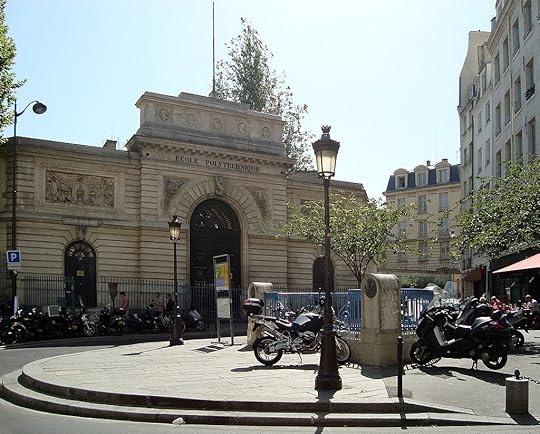
Benjamin Franklin had apparently spent some time within the (former) convent's walls, writing out the preamble to the American Constitution. During the (French) Revolution, the convent was turned into a prison & subsequently used as a cotton mill, then a preparatory school for the "Ecole Polytechnique", until in 1896 it began its vocation as a private school for music, dance & theater. Satie, Debussy, Albeniz & Messiaen had all been associated with the latter school and its philosophy was consciously informal & forward-looking.The author catalogues a litany of pianos, including some still eminent brands such as Bechstein (German), Bosendoerfer (Austrian) & Chickering (British) but also the all but forgotten Pleyel (French) & an extraordinary, newly crafted Italian piano, the Fazioli, seemingly made with space-age technology but very traditional values.
I particularly liked the rationale it advanced for renouncing the tradition of competitive "concours: On ne fait pas de musique contre quelqu'un" (One does not make music against someone else").

In playing, the old man was changed utterly, transformed from a stooped body with a hesitant gait to a vigorous athlete who addressed the keyboard with a boundless urgency. He was not sitting at the piano but was indivisible from it, his hands & feet striking the keys & pedals with a potent, sinuous force. The piano, too, was transformed. No delicate lines now, no strange decorum about the silent object: this was what it was meant to do.
 I don't play an instrument & so some of the minute detailing of various vintage & contemporary keyboard instruments was a bit beyond my grasp but I savored this book nonetheless and recommend it highly to anyone willing to provide it with some space in their imagination. In an odd sort of way, The Piano Shop on the Left Bank by Thad Carhart is rather like a mystery story set in Paris, with the elusive search for pianos with captivating backgrounds serving as primary characters.