[9/10]
“Her stories are white magic,” he said delightedly. “They open up worlds that invite reflection.”
Shahrzad has finished her thousand nights of storytelling, and her anxious father is summoned to the palace of the ruler Shahriyar to be informed that the killing of women will stop and that the storyteller will remain his wife. It is a joyful occasion, but the girl is still wary: has the wolf really changed his bloody ways under the spell of her magic, or is Shahriyar still as volatile and dangerous as in the past?
“He loves you, Shahrzad,” he pleaded.
“Arrogance and love do not come together in one heart. He loves himself first and last.”
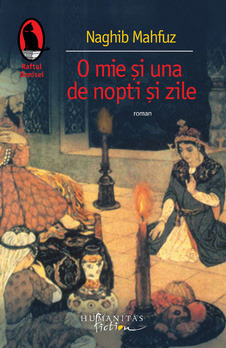
Naguib Mahfouz is not interested here in just a retelling of the classic Arabian Nights fables. He tries to take the tale forward, from the night after Shahrzad falls silent, and into the actual city where she was born and raised. The focus is on the people living in the Quarter, both high-born and those living in poverty, usually meeting with each other at the Cafe of the Emirs, where they exchange news and rumours and deal with their daily tasks and worries. The city is not named, leaving the reader to decide if events takes place in a mythical Baghdad or in Cairo.
The cast of characters is large, but not so difficult to remember because the author takes care to follow a logical progression and to add a qualifier, usually the occupation, to each name. Sheikh Abdullah al-Balkhi is a sort of anchor to the Quarter, a respected elder whose wisdom is passed on to the younger generations and whose Sufi asceticism puts him above the squabbles for power or the sentimental muddles of the inhabitants.
Starting with the tragic tale of Sanaan al-Gamali, a respected merchant who falls under the influence of an evil genie, Mahfouz passes the narrative baton from one character to the next, like in a relay race instead of the traditional nested stories that we are accustomed to. After Sanaan, we follow the story of chief of police Gamasa al-Balti then my memory gets a little less reliable and we meet Sinbad the porter at the Cafe of the Emirs, Nur al-Din the perfume seller, Ibrahim the water carrier, Ibrahim the druggist, Sahloul the bric-a-brac merchant, Ugr the barber, Ma’rouf the cobbler and so on in a parade of fools, as each of them falls victim to either their sins or the machinations of genies.
He began to ask himself. Was it the genie? Was it the dope he had swallowed? Or was it Sanaan al-Gamali?
Starting with Sanaan, who rapes and kills a twelve years old girl, the question of morality becomes the central concern of the narrative. How can we tell between evil deeds and good deeds? and who is responsible for our acts in a world that is, after all, under the eyes of an all-powerful Supreme Being? This is the invitation to reflection that the author hinted at in his opening gambit, the real purpose of the stories we tell.
The stories of the quarters are not pretty. In fact, most of them are about repulsive acts, about crimes and greed and envy and secret yearnings that poison the soul. It is much too easy to blame some evil genie for the crimes, but isn’t this just a cheap and easy way to dodge responsibility? Genies Qumqam and Singam point this out to the chief of police Gamasa when he tries to explain why he follows orders to protect the rich and to punish the poor:
“If you are called upon to do good, you claim you are incapable; and if you are called upon to do evil, you set about it in the name of duty.”
“What does man lack for the enjoyment of the blessing of time and place?”
“That’s what baffles me, brother: has he not been granted an intellect and a soul?”
“You have a mind, a will, and a soul.”
Qumqam and Singam appear in this context as fierce but fair angels of justice. There are though a couple of evil genies coming to the quarter, Sakhrabout and Zarmabaha, whose sole purpose seems to be to tempt the weak and drive them into the arms of the Devil, to sow chaos and destruction. Many of the people of the Quarter succumb, especially among the high-born, and only the intervention of the saintly sheikh or of the ‘madman’ Gamasa can reveal the truth hiding beneath the deceiver’s plans.
There’s also a very high casualty list that keeps growing as we progress through the novel. Justice is not only swift in the realm of Shahriyar, it is also usually terminal for the accused. But I don’t want to get into specifics, on account of spoilers.
I think it is more interesting to remark that, after the constant presence of genies as the catalyst for change, one recurring theme is the secret visits Shahriyar makes at night into the Quarter, accompanied only by a couple of trusted courtiers and pretending to be a visitor from foreign lands. This disguise allows him to learn the truth about the suffering of his subjects and about the betrayals of his own powerful functionaries.
The education started by Shahrzad is continued through these visits to the real world of the Quarter. Some stories even appear familiar to the caliph.
Despite her hidden sorrow, she said smiling, “The fact that stories repeat themselves is an indication of their truth, Your Majesty.”
“Yes, yes – the secrets of existence are splendid and more delicious than wine.”
Has Shahriyar finally understood the purpose of the narrative? I think Mahfouz believes in his redemption, despite the grim details of life in the Quarter we have witnessed.
The falseness of specious glory was made clear to him, like a mask of tattered paper that does not conceal the snakes of cruelty, tyranny, pillage, and blood that lie behind it. He cursed his father and his mother, the givers of pernicious legal judgements and the poets, the cavaliers of deception, the robbers of the treasury, the whores from noble families, and the gold that was plundered and squandered on glasses of wine, elaborate turbans, fancy walls and furniture, empty hearts and the suicidal soul, and the derisive laughter of the universe.
>>><<<>>><<<
The emancipation of Shahriyar and the quest for social justice are framed by two meetings with Sinbad, the first before his voyages, in the Cafe of the Emirs, and the last as he is invited to the palace to recount his adventures and to be asked what wisdom he has brought back from his travels.
Sinbad said defiantly: “I am fed up with lanes and alleys. I am also fed up with carrying furniture around, with no hope of seeing anything new. Over there is another life: the river joins up with the sea and the sea penetrates deeply into the unknown, and the unknown brings forth islands and mountains, living creatures and angels and devils. It is a magical call that cannot be resisted. I said to myself, ‘Try your luck, Sindbad, and throw yourself into the arms of the invisible.’ “
“Nothing is more remarkable in the lives of men than dreams,”
Sinbad has followed his dreams, and has definitely learned a lot of useful lessons in his journeys. The novel spells them out clearly in the final chapters, but I am once again a little shy of spoilers and reluctant to spill the beans here. I do have a couple of favorite quotes, one about self-appointed rulers and one about religion and free-will, that I hope will serve as teasers for the things I left out:
“In our watery kingdom,” whispered Abdullah of the Sea, “we regard a sense of shame as one of ten conditions that must be present in our rulers.”
“Woe to people under a ruler without a sense of shame,” said the madman with a sigh.
“But we are among His instruments with which He brings goodness into effect and eradicates evil.”
This was my first novel by Naguib Mahfouz, but I am now convinced he deserved his Nobel Prize in literature and I plan to read more of his morality plays.