A classic collaboration between two literary giants, The Perils of Certain English Prisoners is a gripping adventure story filled with murder, intrigue, and strong female characters
Following on from the success of The Lazy Tour of Two Idle Apprentices, Hesperus presents another collaboration from close friends and literary giants, Charles Dickens and Wilkie Collins. Their legendary friendship resulted in a number of joint literary ventures, in this case Collins wrote the second chapter under Dickens' supervision. Inspired by events of the Indian Mutiny in 1857, but wishing to distance himself from the context of India itself, Dickens chose to set his novella in Central America. This adventure story takes place on an island near the English colony of Belize, where a silver mine is overrun by pirates, who in turn murder a number of English colonists and take the remaining prisoner. In the diverting narrative that follows, the initiative of intrepid women prisoners enables the captives to escape.
Wilkie Collins was an English novelist and playwright, best known for The Woman in White (1860), an early sensation novel, and The Moonstone (1868), a pioneering work of detective fiction. Born to landscape painter William Collins and Harriet Geddes, he spent part of his childhood in Italy and France, learning both languages. Initially working as a tea merchant, he later studied law, though he never practiced. His literary career began with Antonina (1850), and a meeting with Charles Dickens in 1851 proved pivotal. The two became close friends and collaborators, with Collins contributing to Dickens' journals and co-writing dramatic works. Collins' success peaked in the 1860s with novels that combined suspense with social critique, including No Name (1862), Armadale (1864), and The Moonstone, which established key elements of the modern detective story. His personal life was unconventional—he openly opposed marriage and lived with Caroline Graves and her daughter for much of his life, while also maintaining a separate relationship with Martha Rudd, with whom he had three children. Plagued by gout, Collins became addicted to laudanum, which affected both his health and later works. Despite declining quality in his writing, he remained a respected figure, mentoring younger authors and advocating for writers' rights. He died in 1889 and was buried in Kensal Green Cemetery. His legacy endures through his influential novels, which laid the groundwork for both sensation fiction and detective literature.
Another short story collaboration between Wilkie Collins and Charles Dickinson. It is quite an achievement, writing a short story with a slow start.. I was quite bored the first 60%, before the pirates came and the hustle started.
A little annoying to read also because of the racism towards the native population. This is a product of a time, but that doesn't make it any less rough to read.
First-person "captivity narrative" told by an illiterate, loyal British marine, whose racist thoughts toward the native islanders will make the modern reader uncomfortable. Though an imperialist story, the author does seem to be pointing at least one finger at the pretentious, inept British official for the danger that arises.
Still a huge fan of Dickens, but what was this doing in the middle of a book of Christmas stories? Pirates, treasure, and a daring escape, made for a somewhat suspenseful story but did not belong in this book. I like when Dickens collaborates with Collins, he's done it before, and I'm assuming they took out the chapter because it wasn't Dickens that wrote it. I looked it up and read it anyway. Not a bad story but I'm tired of reading about death and suspense when I was looking toward more of Dickens typical type holiday stories. Overall I was disappointed and although the collaboration was an interesting read, I didn't really find myself enjoying it.
"The Perils of Certain English Prisoners" is a short story is written by Charles Dickens and Wilkie Collins for the Christmas numbers publication but it does not mention Christmas at all. I was expecting a story about criminals who were prisoners so I was surprised and pleased on reading this exciting suspenseful read. The men and women of usefulness depends not of rank or learning but instinct and determination.
Story in short- The English Marines who help with the shipping of silver from the Island of Silver-Store are attacked by pirates.
➖➖➖➖➖➖➖➖➖➖➖➖➖➖➖➖➖➖➖➖➖➖➖➖➖➖➖➖➖➖➖➖➖➖➖
Highlight (Yellow) | Location 219204 This short story was first published as the Christmas number of Household Words on 7 December 1857. Contemporary records show that the number was written by Charles Dickens and Wilkie Collins. Highlight (Yellow) | Location 219210 THE ISLAND OF SILVER-STORE by Charles Dickens Highlight (Yellow) | Location 219213 My lady remarks to me, before I go any further, that there is no such christian-name as Gill, and that her confident opinion is, that the name given to me in the baptism wherein I was made, &c., was Gilbert. She is certain to be right, but I never heard of it. I was a foundling child, picked up somewhere or another, and I always understood my christian-name to be Gill. It is true that I was called Gills when employed at Snorridge Bottom betwixt Chatham and Maidstone to frighten birds; but that had nothing to do with the Baptism wherein I was made, &c., and wherein a number of things were promised for me by somebody, who let me alone ever afterwards as to performing any of them, and who, I consider, must have been the Beadle. Such name of Gills was entirely owing to my cheeks, or gills, which at that time of my life were of a raspy description. Highlight (Yellow) | Location 219251 The Island was occupied by a very small English colony. It had been given the name of Silver-Store. The reason of its being so called, was, that the English colony owned and worked a silver-mine over on the mainland, in Honduras, and used this Island as a safe and convenient place to store their silver in, until it was annually fetched away by the sloop. It was brought down from the mine to the coast on the backs of mules, attended by friendly
Highlight (Yellow) | Location 219254 Indians and guarded by white men; from thence it was conveyed over to Silver- Store, when the weather was fair, in the canoes of that country; from Silver-Store, it was carried to Jamaica by the armed sloop once a-year, as I have already mentioned; from Jamaica, it went, of course, all over the world. Highlight (Yellow) | Location 219258 The Island was considered a good post of observation against the pirates, both by land and sea; neither the pirate ship nor yet her boats had been seen by any of us, but they had been so much heard of, that the reinforcement was sent. Of that party, I was one. It included a corporal and a sergeant. Charker was corporal, and the sergeant’s name was Drooce. He was the most tyrannical non-commissioned officer in His Majesty’s service. Highlight (Yellow) | Location 219272 But, I must likewise confess, that I was not in a particularly pleasant humour, when I stood under arms that morning, aboard the Christopher Columbus in the harbour of the Island of Silver-Store. I had had a hard life, and the life of the English on the Island seemed too easy and too gay to please me. “Here you are,” I thought to myself, “good scholars and good livers; able to read what you like, able to write what you like, able to eat and drink what you like, and spend what you like, and do what you like; and much you Highlight (Yellow) | Location 219276 care for a poor, ignorant Private in the Royal Marines! Yet it’s hard, too, I think, that you should have all the half-pence, and I all the kicks; you all the smooth, and I all the rough; you all the oil, and I all the vinegar.” It was as envious a thing to think as might be, let alone its being nonsensical; but, I thought it. I took it so much amiss, that, when a very beautiful young English lady came aboard, I grunted to myself, “Ah! you have got a lover, I’ll be bound!” As if there was any new offence to me in that, if she had! Highlight (Yellow) | Location 219280 She was sister to the captain of our sloop, who had been in a poor way for some time, and who was so ill then that he was obliged to be carried ashore. She was the child of a military officer, and had come out there with her sister, who was married to one of the owners of the silver-mine, and who had three children with her. It was easy to see that she was the light and spirit of the Island. After I had got a good look at her, I grunted to myself again, in an even worse state of mind than before, “I’ll be damned, if I don’t hate him, whoever he is!” My officer, Lieutenant Linderwood, was as ill as the captain of the sloop, and was carried ashore, too. They were both young men of about my age, who had been delicate in the West India climate. I even took that in bad part. I thought I was much fitter for the work than they were, and that if all of us had our deserts, I should be both of them rolled into one. (It may be imagined what sort of an officer of marines I should have made, without the power of Highlight (Yellow) | Location 219287 reading a written order. And as to any knowledge how to command the sloop — Lord! I should have sunk her in a quarter of an hour!) ❌❌❌❌❌❌❌❌❌❌❌❌❌❌❌❌❌❌❌❌❌❌❌❌❌❌❌❌❌❌❌❌❌❌❌❌❌spoiler alert
Gill Davis has his story written for him because he cannot write and it bothers him throughout his life that he has tried but is not able to learn this. Though he is not a learned man, he is indeed smart and able military man. He tells how his ship to help the silver mine and there he meets Miss Maryon, the sister of Captain George Carton, who he is enamored with her. The natives of the island and especially Christian George King who was supposed to be devoted to the women and children of the town but he ended up being the traitor who helps the pirates invade the island and capture some of the women, children and men by leading the men to chase the pirate decoy with their ship. The ship that is Gill's looks to be sabotaged. Gill was the first on the island to see that Christian George King was a traitor and that an attack is on hand, he was able to wake up his sergeant. The traitor made sure to substitute the gun powder for something useless and the death of some of the people and capture of many so that they will be held prisoners on another island that is very insulated from escaping. Gill had found Mrs. Fisher and Miss Maryon also prisoners very helpful. Sergeant Drooce who did a good job trying to defend on the island after being held as a prisoner starts to lose his mind and is bothered by Tom Packer who Drooce has driven hard has saved him from death. Gill and a sailor, Short when taken to the ruins of a prison on the pirates' island figure out a plan to escape when a river is seen by Short while they are made manual labor to chop wood for the roof of the ruined prison but how to get the women, children and crazy minded Drooce and Pordage (a useless government man looking for papers and orders for action). The bond between the children to others was very heart warming and when the plan was found how to escape and make the rafts by using a poison berry that puts the guards to sleep. They are able to travel days down the river and are found later by the Captain Carton. Carton takes his ship to the rest of the men and women left by the pirates on silver island, where the traitor tries to spy again and is shot and hung. The pirates are afraid and later captured and treasure saved. A bond between Gill and Miss Maryon is established for life though they never marry, Gill on parting with his Lady refuses money but accepts a ring from her which travels by his heart and stays with him years later. Lady Maryon finds him in a hospital years later and nurses him at her brother's home. It seems he might recover and if he does he might marry though they are older, I am not sure his wound is fatal.
Off the coast of Belize, a small island paradise serves as colony and depot for the British silver mine on the mainland. To be sure, reports of piratical depredations up and down the coast have caused quite a stir, which is why His Majesty's sailors and Marines have been despatched to clear up the disturbance. But when the pirates prove craftier than expected, colonists, sailors, and Marines alike will find themselves ensnared in a desperate struggle for survival against hopeless odds.
This collaboration of Charles Dickens and Wilkie Collins is a short, energetic adventure yarn along the lines of "Treasure Island" and "Kidnapped," but written decades before those hoary classics. Tropical paradise, trackless jungle, gunfights, treachery, treasure, beautiful women and innocent children to save: this tale has it all. I was surprised to find that my edition only contained the first and third chapters, because these were the chapters written by Dickens. After a bit of frantic Googling, I tracked down an online reproduction of Collins's second chapter, and glad I am that I did. This chapter is the true heart of the story, a taut and suspenseful and exotic narrative comparable to any modern thriller. Frankly, I think Dickens comes off second-best in this collaboration, so make sure you find an edition containing that critical second chapter if you choose to set sail in His Gracious Majesty's service against the most villainous set of scalawags ever to blight the Caribbean.
This is a book I had read part of in my complete Dicken's Christmas Stories, but it had left out the middle chapter authored by Wilkie Collins (another one of my favourite 19th century authors). I did enjoy it, and I liked the introduction giving the context to the piece (written in part as a response to the Indian mutiny). However, I prefer my industrial England Dickens over colonial Dickens.
A short story about pirates, fair maidens, treachery and a tiny bit of romance. This is a story I could see being enjoyed by those who liked reading the adventures of Robinson Crusoe and Treasure Island.
In order to read the whole story, I had to hunt down the middle section. Other than that annoyance, it was a good story and kept my interest. Any Dickens fan should read this.
A random download from Project Gutenberg many years ago, that I finally got round to reading. This is not your typical Dickens. Basically, it's a dramatic pirate adventure. The second part, the part Wilkie Collins wrote, is pretty much a totally basic Victorian boys' adventure story (with all the condescending racism that this often entails). Dickens' parts have slightly more traces of literary quality, such as character development and Dickensian whimsy. I am tempted to give this only two stars, but still I end up on three.
At some point in the 1890s, someone had the moronic idea of publishing only the parts of this that Dickens wrote, leaving out the entire middle section. Unfortunately, the version that is now to be found on Project Gutenberg is this mutilated version. Fortunately, someone else on this site has posted a link to the missing middle section, so I got to read the whole thing in the end.
This is a tale of captivity and escape. When the pirates attack Silver-Store Island (in the vicinity of the British colony of Belize) aided by the turncoat mulatto native Christian George King, they murder a number of the British colonists before stealing the silver and taking a number of the survivors hostage before retreating to the interior of Honduras. Under the combined initiative of Miss Marion Maryon and private Royal Marine Gil Davis, the captives manage to escape down river. Scanned image and text by Philip V. Allingham.
Written in the same style as Dadbid Copperfield, in the first person, looking back and being reflective. As I read more of Dickens, especially with his short stories, the more I am impressed. Dickens is renowned for a certain styles, topics and issues, fose if Lwayers, wealth, poor houses, the down trodden.
In his short stories, such as this, you see a completely different side to his style, writings and topics. This is quite a swashbuckling story of pirates, battles, imprisonment, escape and silver. To add to the fun if it, the story was set around Belize. In parts, quite similar us style to Robinson Crusoe. During the river and jungle depictions, quite reminiscent of Nick Bougas' 'Bodhu and the lost temple of King Nanchancaan'
1 star - what a fucking depressing way to spend my Valentine’s Day😀. In all honesty the story itself, as a fictional work, was fine. My main issue was in fact the racism throughout the text, and knowing the background to the Indian Uprising of 1857 it reads rather awfully. I can’t speak to the accuracy in relation to the Crimean War but I have no doubt it probably wasn’t done in the most historically accurate sense.
Dickens and Collins are both good writers. Their beliefs were just very shitty.
I like a Wilkie Collins collaboration - he seemed to keep Dickens, and the plot, moving forward. This is a pretty good depiction of just how stupid British imperialism was, in all its racist and classist glory, though Collins and Dickens stop short at being in any way critical of this (with the exception of a sarcastically bestowed accolade to one of the particularly ridiculous dignitaries). Otherwise an alright read.
An extremely mediocre book literally designed to provide a few hours of mild entertainment on a holiday before being used as toilet paper. I’m biased against it because I had to read it for class, though. It’s a simple story with barebones plot and characters
Eh, it was a nice adventure story, a nice tale to read out loud, but the plot was a little underwhelming. I really liked the speaker though, Gill Davis. He's a bit snarky and very self-righteous, and completely unaware of his flaws to the point that it is enjoyable to delight in just how biased of a storyteller he is. It is also interesting to his character develop as a result of the pirate invasion. The story was written as a response to the recent Indian rebellion and the Storming of Seringapatam in particular, and it paints a glorious image of Britain and Empire.



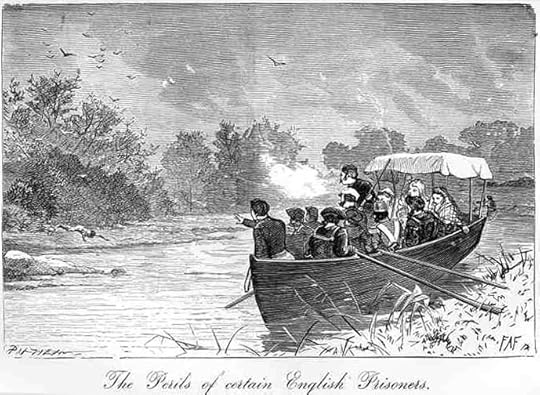 Scanned image and text by Philip V. Allingham.