Ein merkwürdiger Mord in französischer Sommeridylle, eine große Familientragödie und ein verblüffendes Geheimnis – willkommen in der Bretagne!Der erste Fall für Kommissar Dupin, eigensinniger Pinguinliebhaber und koffeinabhängig, gebürtiger Pariser und zwangsversetzt ans Ende der Welt. An einem heißen Julimorgen kurz vor der Hochsaison geschieht im pittoresken Künstlerdorf Pont Aven ein mysteriöser Pierre-Louis Pennec, der hochbetagte Inhaber des legendären Hotels Central, das schon Gauguin und andere große Künstler beherbergte, wird brutal erstochen. Wer ermordet einen 91-Jährigen und warum? Was ist in den letzten Tagen des Hotelbesitzers vorgefallen? Als kurz darauf eine zweite Leiche an der bretonischen Küste aufgefunden wird, realisiert Georges Dupin, dass er es mit einem Fall ungeahnten Ausmaßes zu tun hat. Währendsich der Druck von Seiten der Öffentlichkeit verschärft und die kapriziösen Dorfbewohner beharrlich schweigen, begibt sich Dupin auf die Suche nach dem Mordmotiv – und kommt im Dickicht der bretonischen Verhältnisse einem spektakulären Geheimnis auf die Spur …Ein Kommissar von Maigret-Kaliber; ein Kriminalroman voller überraschender Wendungen, hochspannend, feinsinnig und klug. Durchzogen von hintergründigem Humor und dabei atmosphärisch so eindrücklich, dass man als Leser sofort selbst durch die engen Gassen des Dorfes flanieren, die Atlantikluft riechen und über die bretonischen Eigenarten schmunzeln möchte. Eine Krimisternstunde – nicht nur für Frankreichfans!
The author divides his time between Germany and coastal Brittany, France. Death in Brittany, the first case for Commissaire Dupin, was published in German in March 2012 and sold 600,000 copies, spending many months on the bestseller list. It has been sold into 14 countries.
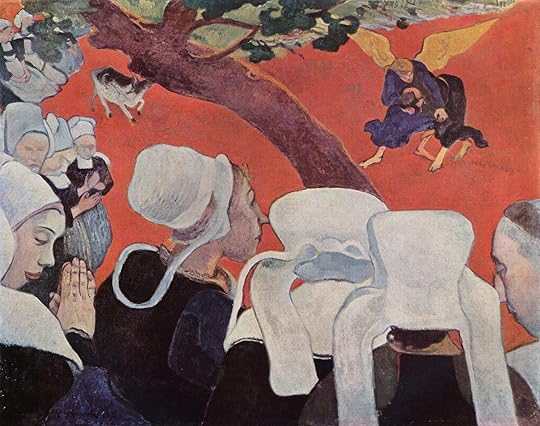
Si parla molto di questo quadro che è conservato alla National Gallery of Scotland di Edimburgo: qui sembra invece alloggiare in Bretagna.
Tutta la storia è ambientata in Bretagna, quella parte di Francia molto celtica che sembra un ponte verso l’Irlanda. Io le visitai entrambe nella stessa estate, innamorandomi di entrambe: ma in Bretagna sono tornato più volte, in Irlanda ancora no.
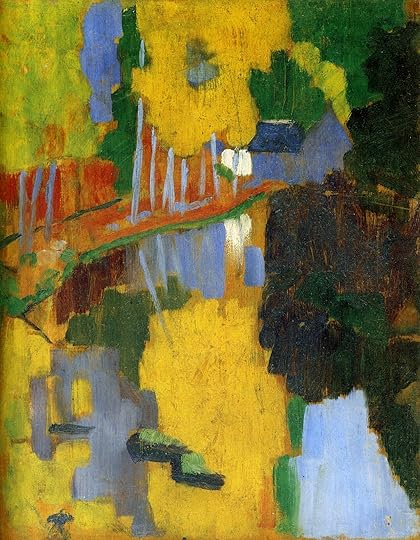
Paul Sérusier: Il talismano, 1888; Parigi, Museo d'Orsay
È una storia che ha come protagonista assoluto l'ennesimo commissario: parigino, trasferito per punizione in provincia perché non è stato tenero con l’allora sindaco, - futuro Presidente de la Republique (Chirac) - da tre anni vive e risolve casi in Bretagna, a Concarneau, che è sulla costa sud della regione, quella più mite.
Chi scrive si firma con pseudonimo francese, Jean-Luc Bannalec, ma è romanziere tedesco (Jörg Bong) innamorato della Bretagna che da trent’anni vive lì o alterna periodi con la Germania, non ho capito bene. E quindi, quel terroir, quella regione così bella e particolare, diventa per forza di cose coprotagonista, in più punti portando via l’attenzione al caso poliziesco e al commissario.
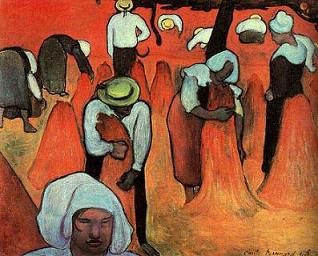
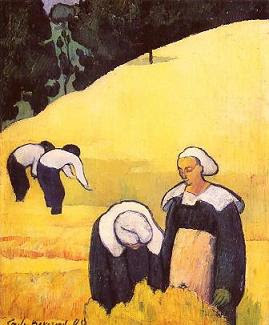
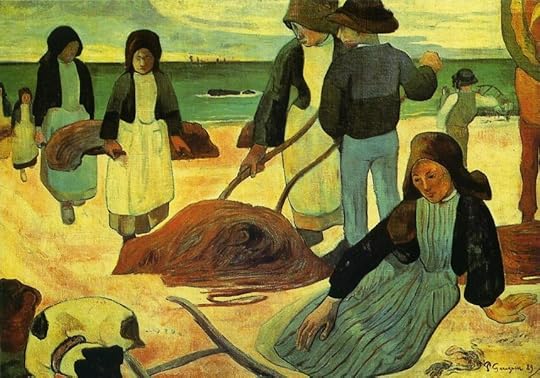
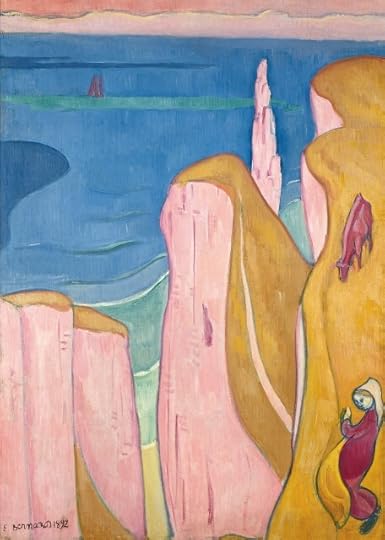
Il caso è risolto in quattro giorni. Proprio come quello di via Poma o di Garlasco o di… Che i poliziotti francesi siano più bravi dei nostrani? È un caso che ha a che fare con Gauguin e tutta la scuola di pittori di Pont-Aven. Tali artisti, guidati da Paul Gauguin, furono: Émile Bernard, Charles Laval, Henry Moret, Maxime Maufra, Paul Sérusier, Charles Filiger, Meyer de Haan, Armand Seguin, Ernest de Chamaillard, l'irlandese Roderic O'Conor e altri. Vivevano e dipingevano e viene da pensare che devono essere stati grandi paesaggisti, mentre invece dipingevano in tutt’altro modo come si vede bene da queste immagini.
Il commissario si chiama Dupin, pensa e riflette, domanda e ascolta, guarda e scruta, spesso cammina per capire meglio; ha spesso fame ma non la mena coi manicaretti regionali, è un consumatore seriale di espresso, sembra avere pulsioni verso il gentil sesso ma a questo giro non combina nulla, getta solo l’amo per la prossima avventura.
I love mystery series that take me to different locations. So Death in Brittany was a natural for me to try. It’s a police procedural with Commissaire Georges Dupin, a former Parisienne detective who’s been sent up to Brittany after a disagreement with his bosses. And he is a prickly sort - brash, intelligent, insistent that things be done exactly his way. I didn’t warm up to him, but I was captured by the descriptions of the scenery, the art history and the twisty plot. Bannalec totally captures the Brittany town of Port-Aven, the landscapes and citizens. The town was the home of an artist colony that included Gauguin and the history is still important to the town.
Dupin might have been there for three years, but he’s still definitely an outsider according to the locals. There’s a subtle humor to the book and this is one of the running themes. The story starts with the murder of a 91 year old hotel/restaurant owner in the hotel bar. It’s not a fast paced story but I was engaged throughout. The plot is nuanced with multiple layers. I recommend this for fans of Martin Walker and Estelle Ryan. I listened to this. Jean Brassard narrates and was great with a French accent that was still easy to understand.
An armchair mystery by a German author with a French pen name, possibly trying to re-create Maigret in Brittany. Pretty boring. We get a bunch of aimless interrogations/interviews, dialogues that consist of many repetitions, a lot of walking and driving around and a fairly uninspired criminal case. Around the middle the plots gets a bit more interesting, but there is a distinct lack of suspense. The solution to the mystery is just as lackluster and one of the pivotal moments towards the end plays out in the off. Not sure why this became a bestseller in Germany.
A great beginning for a series. I really enjoy the Bruno series set in the Dordogne area by Martin Walker, so this was somewhat similar. I don't know a lot about Brittany, and the book descriptions of that the river/coastal area were so well done that I felt I had visited. The murder plot and the history of this area being an artist community was very interesting. Dupin was quite different from most Detective Inspectors I've read, he didn't communicate well at all with his superiors or his team. He reminded me of a French version of Columbo with his 'just one more little question'. I am intrigued enough to read the second book.
Nuestro protagonista, el comisario George Dupín, es un policía amante del buen café y la buena cocina, que ha sido desterrado de París y enviado a la costa Bretona, al pequeño pueblo de Concarneau. Dupín, investigador tenaz e independiente, cuenta con la ayuda de los inspectores Labat y Le Ber y con su eficaz secretaria Nolwenn, capaz de realizar los trámites más enrevesados en un tiempo record. Es una novela policíaca de corte clásico, con una trama sencilla y donde la investigación deja un pequeño hueco para el arte. Además, cuenta con unas buenas descripciones de los paisajes de la costa Bretona. Una novela entretenida y de fácil lectura.
If you’re keen to discover some new French crime fiction, Jean-Luc Bannalec is a real find. Death In Pont-Aven introduces us to Commissaire Dupin, a cantankerous Parisian caffeine junkie, who polices the small Breton village of Pont-Aven, a sleepy community near the sea. Everyone knows everyone else and nothing much seems to happen. However, one morning he is dragged from his coffee and croissant to the scene of a murder at the local Central Hotel. The housekeeper has discovered the 91-year-old manager and owner Pierre-Louis Pennec dead on the restaurant floor.
The very occurrence of such a murder in such a place sends both Dupin and the local community into a state of shock and surprise. However, soon Dupin and his team come up with five viable suspects, including a rising political star, a wealthy art historian, and a long-time friend of the dead man. A mysterious break-in and then another suspicious death only deepen the mystery and as Dupin delves deeper into the lives of the victims and the suspects, he uncovers a web of secrecy, greed and silence at odds with the idyllic surrounds of Pont-Aven.
Bannalec has produced an incredibly character-driven piece, in common with his fellow French and Italian contemporaries. The curmudgeonly and self-deprecating Dupin is the real driving force throughout the book with his idiosyncratic nature, that are endlessly entertaining to the reader, and a source of deep frustration to his more straight-laced and by-the-book colleagues. Everyone knows the tropes of fictional police detectives, and Dupin wryly bemoans the absence of drug dependency, depression, neuroses and broken marriages in his own life. However, with his sharp tongue, cynical nature and a surprising fondness for penguins – yes, penguins! – he proves himself a colourful and interesting character throughout.
Obviously with the stark contrast between Dupin sophisticated backround in Paris, and the very unique and fiercely independent spirit of the Bretons, there is ample opportunity for some earthy humour. Likewise, Bannalec captures perfectly the claustrophobic feel of this small town, but also paints a majestic picture of the overlapping communities both rural and shore-dwelling, and the contrasting lives and mind-sets of the two communities within Brittany.
Fuelled by murder, art forgeries, family resentments and scheming neighbours, the plot is engaging from the start. Injected with Bannalec’s research into the links between the region and some France’s greatest painters, the initial murder mystery is fleshed out and strengthened not only by the careful disguising of the real murderer by a series of red herrings, but by the carefully placed re-imagining of this former community of artists. Along with Dupin, I was completely wrong-footed throughout as potential suspects came to the fore, all with strong motives for their possible involvement in murder and theft.
Death in Pont-Aven is a smart and utterly entertaining read. It its centre is a wonderfully empathetic and engaging detective whose wry humour, fixed ways and generally grumpy demeanour, drive the action and interest. His seemingly haphazard form of detection – constantly interrupted by coffee breaks – frustrate and bemuse both colleagues and potential suspects alike. Compounded by an intriguing and interesting murder plot that really brings the most pernicious aspects of this small community to the fore, it’s a highly satisfying read.
Ich empfand diesen Roman bis zum Abbruch nach gut einem Drittel als ärgerlich. Regionalkrimis sind nicht mein Metier, daher mag es vielleicht unfair erscheinen, wenn dieser Krimi jetzt meinen Unmut abbekommt. Aber es wurden so viele Klischees erfüllt, die meine Augen zum Rollen brachten. Da ist zum einen dieser zwanghafte Versuch, kulturelle Gegebenheiten und Wissenswertes in die Geschichte einfließen zu lassen. Das wird aber nicht en passant getan, sondern manche Absätze lesen sich wie ein Wikibeitrag. Mich interessiert auch nicht, wie die Straßen, die jemand befährt, um im Ort von A nach B zu kommen, heißen. Das mag bei Urlaubern des bretonischen Touristenorts ein freudiges Wiederkennen hervorrufen, mich nervt es (wobei das ein Stilmittel ist, das man in vielen Krimis findet).
Der deutsche Autor mit französischen Pseudonym versucht frankophiles Flair durch entsprechende Begriffe auf Französisch einzupflegen. Auch das nervt. Merci und Bonjour? Und schon habe ich Lust auf Baguette und Vin Rouge. Unser Protagonist wird ständig mit seiner Berufsbezeichnung angesprochen, so dass Monsieur le commisaire insgesamt 163 mal im Buch vorkommt. Nervt auch.
Aber das Schlimmste: das Ganze ist einfach langweilig. Dramaturgisch ganz schwach und auch für mich stellenweise nicht nachvollziehbar. Ein Tag nach dem Leichenfund nimmt der Kommissar die Verwandten ins Kreuzverhör, als ob er die Inquisition persönlich ist. Danach lässt er sich von einer Notarin Auskunft über das Testament geben. Und die plappert auch fröhlich alles aus, als ob es kein Auskunftsverweigerungsrecht für Notare gibt. Dupin hat natürlich auch kein Auskunftsersuchen eingeholt. Die Leiche ist ja noch warm.
Ich wollte einfach mal was Bretonisches lesen während meines Urlaubs vor Ort. Hätte es besser sein lassen.
I was looking for some light traditional police procedural mystery set in an atmospheric location, in the tradition of Donna Leon’s Comissario Brunetti series, and I found it in Jean Luc Bannalec’s Commissaire Dupin series.
Although a bit eccentric and grumpy I found Dupin quite likable (yes, I know, he could treat his coworkers a little bit better 😂) and it’s much appreciated he’s not dragging along some big trauma from his past.
The murder mystery is pretty straight forward and I found the art world context so interesting. I didn’t know much about Gauguin and the École de Pont Aven, so it’s always nice to learn some historic facts while reading for fun.
The setting was quite idyllic and I couldn’t help to google all the picturesque villages that were mentioned. Now I need to visit Brittany ASAP!!
Charming mystery that makes a good starting point for this series.
“Dupin inspirò profondamente. Quella sera al mare aveva un odore intenso: sale, alghe, iodio. Respirare quell’aria faceva apparire tutto diverso.”
Un commissario “grande e grosso, robusto, massiccio” che ricorda un po’ la stazza del celebre Maigret -il padre letterario di tutti i commissari francesi- ma anche goffo e impacciato, al punto che “nessuno metteva mai in conto la rapidità e la fine precisione delle quali era insospettabilmente capace.” Parigino di origine, da qualche anno è stato trasferito a Concarneau, perla della Bretagna, e ormai è completamente immerso nell’humus locale; riferimento costante è la sua perspicace segretaria, Nolween, depositaria dei segreti di un luogo incantevole e di un popolo orgoglioso delle sue radici ma spesso rude e ostico.
Il suo primo caso è l’inspiegabile omicidio di un noto albergatore di 92 anni, custode delle tradizioni di famiglia e amante dell’arte. Siamo nell’ameno villaggio di Pont-Aven, diventato celebre perché a fine Ottocento vi arrivò Gauguin che inventò un nuovo stile e inaugurò una scuola di pittura. L’hotel, fondato da Marie Jeanne Pennec, la nonna della vittima, aveva intercettato i segni del tempo e aveva agevolato in tutti i modi l’atelier del celebre pittore. Ma cosa c’entra tutto questo con l’eliminazione fisica di un vecchio albergatore onesto e inoffensivo ?
Sbrogliare la matassa non sarà compito facile per il nostro commissario che porterà avanti la sua indagine arrovellandosi sulle testimonianze dei familiari e degli amici del defunto Pierre-Louis Pennec. “In tutti i casi, a un certo punto venivano a galla i primi racconti veri; fino ad allora, tutti cercavano di creare superfici scivolose, opache, per non lasciar trapelare nulla delle storie reali. E tutti avevano le loro ragioni per farlo, non solamente i colpevoli.”
Grande protagonista il paesaggio bretone, con la bellezza e la forza di una natura prorompente e indomita.
P.s. È sicuramente imperfetto, ma a me è piaciuto. Perciò continuo…
¡Qué sorpresa más agradable! Tengo muy claro que pienso seguir esta serie: me ha encantado el comisario Dupin.
Lo primero de todo es remarcar la buena ambientación de los lugares donde se desarrolla el caso; no solo de forma descriptiva, sino su historia sin que se haga pesado. Me encantan estos tipos de escenarios: un pequeño pueblo junto al mar, pintoresco y rodeado de vegetación. En mi opinión, ha sido una de las mejores cosas del libro.
Lo segundo mejor ha sido, sin duda, Dupin: el comisario gruñón y solitario. Cada protesta, cada queja, cada vez que abandonaba una habitación o terminaba una llamada para no decir lo que pensaba... me ha sacado más de una sonrisa. Sinceramente es lo que me ha conquistado.
El caso, en cambio, no ha sido lo más de lo más. Un caso sencillo, sin pretensiones, pero muy, muy bien llevado. El hilo no se pierde en ningún momento y el ritmo de la trama es muy bueno.
En resumen, una novela ágil con personajes pintorescos y una trama atractiva.
Mažame Bretanės miestelyje, Pont-Avene nužudomas senyvas viešbučio savininkas. Viešbutis ne tai, kad iš labai klestinčių, bet su istorija – savo laiku jame gyveno ir kūrė nemažai dailininkų, tarp kurių ir pats Polis Gogenas. Tyrimas neblizga kažkokiu ypatingu detektyviniu išradingumu, o galiausiai išvis – vieną pagrindinių žingsnių mįslės įminimui komisaras Diupenas žengia vedamas... intuicijos. Tad jei ši knyga kuo ir žavi, tai neabejotinai – ne detektyvine intriga. O štai Pont-Avenas, mažas kurortinis miestelis Atlanto pakrantėje – nupieštas taip šiltai, kad nejučia užsimanai prasieiti jo gatvelėmis, prisėsti kavinėje su vaizdu į upę ir užsisakyti puodelį juodos kavos ir kruasaną. Ką jau ten – prisipažinsiu, kad net goglinau tą Pont-Aveną. O taip nutinka retai. Bet atmosfera neatperka iki galo silpnoko tyrimo. Tad vargu ar įdėmiai seksiu šią seriją. Trys iš penkių, tarkim.
i guess like all bestsellers, inherently? they appeal to low level reading, and this being an international bestseller, it is universally poor plot, characters, sense of place? anyway, a police procedural set in small towns on coast of nw france...our detective is a renegade but gets down to business in his own way. for better atmospherics, local scenes, and deeper thinkers in detection i like camilleri's books set in sicily Game of Mirrors ; dibdin's in naples Game of Mirrors ; mcilvanney in glasgow Game of Mirrors life's too short to be reading bestsellers?
da un certo punto in poi si dà per scontato che un certo quadro sia stato rubato, senza avere mai parlato di un furto fino a quel momento (c'era stato un dubbio, molte pagine prima), e non è un dettaglio, perché da lì viene tutta la storia. Sono cose che danno sui nervi: ci vuol tanto a rileggersi, o a farsi rileggere da un editor? A parte questo è un giallo onesto, che si legge volentieri anche se molte pagine sembrano più una guida turistica del Finistère che un libro
Smrt u Pont Avenu je jedan od osam kriminalističkih romana o slučajevima komesara Dipena. Autor je Nemac i živi u južnom Finisteru, a piše pod pseudonimom. Pred nama je ubistvo pod vrlo čudnim okolnostima. Vlasnik hotela ubijen je u 91. godini života. Komesar Dipen je zadužen za ovaj čudan slučaj. U toku radnje nailazimo na dosta zapleta, ćorsokaka, novih saznanja koja u početku ne vode nigde, ali se kasnije konačno sklapaju kockice. Ukratko, imamo sve ono što čini jedan roman ovog tipa.
Deskripcija u romanu je odlična. Autor nam dočarava prelepe predele Bretanje. Celokupan predeo i atmosfera su sjajni za čitanje na letovanju, kada želite da se opustite i uživate uz lakšu literaturu.
Knjiga mi je odavala sličan utisak koji imam kada čitam knjige Agate Kristi. Tu ušuškanu, mirnu atmosferu, uprkos strašnom zločinu u pozadini svega. Takva atmosfera vlada i ovde. Likovi su uglavnom zanimljivi i skoro svako od njih je sumnjiv. Glavni lik je interesantan i najviše mi se dopao. Nije jedan od iritantnih likova koje obično nadjemo u ovakvim knjigama, što mi je bilo važno. Upravo suprotno, on je sasvim normalan tip i nema "poroka" koje obično imaju inspektori u kriminalističkim serijalima.
Svi likovi su mi bili sumnjivi kako je radnja odmicala, ali sam pravog krivca saznao tek na kraju. Ovde nećete naći nikakve šokantne delove, ni neke *WOW* momente, ali je priča sasvim zadovoljavajuća i bez toga. Autor je na vrlo pametan i interesantan način osmislio pozadinu svega, a ujedno i razvoj dogadjaja. Neki delovi su bili malo naivni, ali to nije uticalo na celokupni utisak. Pošto je ovo deo serijala, nadam se da se Laguna neće zaustaviti na ovoj knjizi. Voleo bih da pročitam ostale avanture komesara Dipena. Vama ostavljam preporuku da je pročitate ovog leta.
In Port Aven, einem idyllischen Künstlerort an der bretonischen Küste, wird ein hochbetagter, angesehener Hotelier erstochen. Dupin, ein aus Paris strafversetzter Kriminalkommissar, übernimmt die Ermittlungen. Überall trifft er dabei auf die Spuren der bekannten Malerkolonie die den Ort einst berühmt gemacht hat. Der bekannteste von ihnen, Gauguin, wohnte einst in dem Hotel, das nun ein Tatort ist. Und es bleibt nicht bei diesem einen Mord. Das Buch ist eine überzeugende Liebeserklärung an die Bretagne, die wundervolle Landschaft, der etwas eigene Menschenschlag, die Kultur und vor allem die hervorragende Küche. Dieser Lobgesang ist in einen spannend geschriebenen Krimi verpackt mit Dupin als etwas unkonventionellen Ermittler, welcher von interessant aufgebauten Protagonisten umgeben ist. Die Geschichte wird flüssig erzählt, kommt ganz ohne Action und Hektik aus, ist jedoch an keiner Stelle langweilig. Ein toller Einstieg in eine Krimireihe der ich gern folgen werde.
Un libro de suspense entretenido y fácil de leer, con un protagonista, el comisario Dupin, carismático y algo gruñón. La trama no es muy rebuscada, y en ocasiones queda eclipsada por las descripciones de la región, la Bretaña, en donde sucede la historia.
The owner of an hotel gets killed and shortly thereafter follows his son. What can a family run hotel offer any motive when the owner according to his doctor was fatally ill. |Commisioner Dupin transplanted from Paris to Brittany as a policeman will have to find an answer to this question which will shortly change into an investigation whose answer might lie in the past when Port Arven was a place for artists like Gauguin.
JEAN-LUC BANNALEC is a pseudonym for Jorg Bong a German writer. The author divides his time between Germany and coastal Brittany, France. Death in Brittany, the first case for Commissaire Dupin, was published in German in March 2012 and sold 600,000 copies, spending many months on the bestseller list. It has been sold into 14 countries.
The writer does offer an interesting tale and it does not fail to entertain, he does offer a lovely and somewhat romantic view of life in Brittany and its inhabitants. Like quite a few writers these days he does write about a place he loves and that shines through the pages.
I did see an episode of the tv movies made upon the book series, the Germans are quite apt in filming mysteries of krimis as they like to call them.
Bannalec has written a mystery with a marvelous sense of place, complete with some of its fascinating historical background. His descriptions are so vivid it was easy for me to picture the beautiful setting. The mystery is also a good one, with tie-ins to local history and to Paul Gauguin.
What is lacking in Death in Brittany is characterization. It's all about the investigation here. None of the characters come to life. Dupin's two inspectors become mere minions after very brief introductions. Dupin is constantly saying, "We need to talk," but readers are never allowed to hear what they talk about. Part of the fun of reading mysteries is being allowed to be the proverbial fly on the wall. There's none of that here, and it's missed-- as are more fully fleshed characters.
Oldukça hoş bir polisiye hikayesi. Bannalec' den okuduğum ilk eser amma anlatımı akıcı sürükleyici ve ilerde yazarın eserlerini bulursam mutlaka devam ederim. İçinde iki cinayet işlenmiş bir hikaye olsada bana çok sevimli vahşetden uzak gelmesi de ilginç! Komiser Dupin her okuyucuyu kendine bağlar gibi geliyor.
Svi mi koji volimo Ubojstva u Midsomeru, Fjallbacki, Three Pinesu, Shetlandu i sličnim mali, pitoresknim zajednicama, jako ćemo voljeti i serijal "bretonskih krimića" o inspektoru Dupinu koji se bavi opačinama u prekrasnoj Bretanji! 👌 Prva knjiga serijala, "Smrt u Bretanji", kod nas se pojavila nedavno premda ovo nije nešto novo-najnovije, vidim da je naslov prvi put objavljen 2012. Činilo se meni da mi je inspektor Dupin poznat,🤔 ne kao iz kvarta, nego po imenu, naravno, pa sam malo proguglala i otkrila da su već snimljeni i film (2018.) i serija (2014-...). Ne sjećam se da sam gledala, čitala nisam sigurno sve do neki dan. 📖 Ovo bi zapravo spadalo u "cozy crime", ali ne volim to koristiti jer mi je kontradiktoran naziv već u startu; mislim, kako crime/krimić može biti cozy/ugodan, bez u obzira na kako se lijepom mjestu sve to odvijalo, kad u igri imamo (bar jedno) ubojstvo?! Ok, to je tema za raspravu koja pak nije trenutna tema . 📖 Tema je velika preporuka za inspektora Dupina i njegove bretonske istrage!
More like 4.5 stars for me I was fortunate in waiting for available copy of this book that I could also check out the second of this series at the same time. The third I was able to place on hold. I do love finding a new and very interesting police investigator (Commissaire Dupin) who does his own thing in his own way in his own time. A fourth book in the series will come out in Spring 2019. There is also a German television series already made and can be viewed on you tube. How's your German? The author is German, a surprise to me after I googled the pseudonym. He apparently lives part time in Brittany as well as Germany (or so says the internet). Having read the book I now want to travel asap to Brittany. The scenery as well as the villages and even the food scene are described wonderfully in this book. This is a thinking policeman who likes/needs to walk to allow the puzzle pieces to fit together in his analysis. He is given so little information arriving on the scene of a murder in a hotel dining room. It is the body of a 91-year old hotelier, brutally stabbed. His methods include locking up the scene of the crime and keeping it intact for as long as he wishes while interviews and fact gathering proceeds. Very rich art history in the area plays a major role in this crime. Gauguin's work and love of the people and the area are well known. I must admit to loving his depiction of Breton girls in their white bonnets and have a print recently purchased that needs framing. The Chicago Art Institute recently held a rich exhibition of Gauguin's varied works. So...we have Brittany, scenes of rivers and sea, quaint villages, art history and greed to uncover. Excellent read! sample from book to give you idea of descriptive text: "The landscape became more and more enchanting as the narrow little streets at the edge of Pont-Aven gave way to thick woodland. The trees were dripping with mistletoe and ivy, overgrown and moss-covered. Some of the trees here had entwined as they grew, forming a long dark green tunnel. Now and then the Aven shimmered between the trees on the left hand side as though it were electrically charged, a pale silver colour. The last of the day's light bathed everything in its glow, lending the landscape even more of a fairytale atmosphere. By now, Dupin knew this landscape and this atmosphere very well....He always thought that if you were to meet a dwarf or an elf or some other mythical creature in this kind of light, you wouldn't even bat an eyelid."
This wasnt what I was expecting at all. When I briefly scanned a review or comment about this book I got totally the wrong idea. I was expecting an ordinary french village policemen similar to Chief Inspector Bruno , the only policeman in St Denis in the Dordogne in the novels by Martin Walker. Instead I got a sharp Police Commissaire from Brittany who, although a little unorthadox, was a quick witted murder detective. However, the current fashion in the modern police (and other) work to keep everyone up to date with regular 'Team' meetings seem to have passed him by. He is very much a loner and keeps his ideas and discoveries very much to himself. He must be terrible to work for and your heart goes out to his Inspectors.
The book itself took some tracking down and none of my usual sources nor any of the three County Libraries that I use had anything by this author. Reading through some of the reviews on 'Goodreads', I see that some have been lucky enough to received their book in a 'Giveaway' and if anyone knows of any copies going of any other translated later books in the series, I would be very pleased to hear from them.
And so , at last, to the book and a most enjoyable read . It is very obvious from the adjectives that the author uses , that he loves the area as much as I do. We were lucky enough to spend some time in the area in 2015 and were entranced by beauty of this picturesque village in particular. I would love to return again now, not to view the scene of the crime so much as the bars and the restaurants that Dupin has found in his 3 years there.
Possibly, because of my visit but also, because of the authors abilities, I had no trouble picturing all of the locations in my minds eye and the characters were all made real by his penwork.
It took much of the book before the reason for the murder of the much liked 91 year old hotelier/restauranteur was discovered by the Commissaire but the clues were there for the reader to spot. Did I? Of course not and neither did I identify the killer. Perhaps I was too busy reliving the sights , sounds and food of this beautiful corner of France.
Certainly a 4* and so very nearly a 5 of which I have high hopes if/when I manage to get hold of subsequent books of the series.
First in a series that holds promise and I had already acquired #2, so that purchase isn't a waste. Maybe the biggest downside is that I'm sure I butchered what little I remember of my 60-years-ago high school French in trying to pronounce a few of the names and places. The setting feels real and it appears Brittany is a place Bannalec knows and loves.
We know about the murder early. A 91-year old hotelier was found first thing in the morning, apparently having been stabbed to death. Who has done the deed is not apparent. To be honest, I didn't think there were any good suspects. (We know I never would have made a good homicide cop!) It was some time before even a motive began to surface.
This, for me, is the best kind of murder plot and it kept me reading. I had nothing to complain about the writing style. It isn't what I'd rave about (ala Benjamin Black/John Banville), but neither is it bumbling and amateurish. I might have wanted more in the area of characterization, but there is enough of Georges Dupin to think I'll get to know him better as the series progresses.
I very much liked the time I spent with this, so I'm filling in a 4th star, but I might be exaggerating slightly.
Me ha gustado mucho. Llevaba tiempo sin encontrar una novela negra "clásica", por decirlo de algún modo, sin esos giros surrealistas extraños que tan de moda están en las más vendidas de los últimos años. Será menos trepidante así, pero también más realista y con más calidad literaria. En este caso, se entreteje muy bien la trama con la vida en la Bretaña francesa y una curiosa relación con la historia del arte. La resolución final me ha parecido un poquito floja, pero por lo demás... ha sido una lectura buena y entretenida.
Published in 2012, "Death in Brittany," by Jean-Luc Bannalec (which is the pen name of German author Jörg Bong), is the first book in a murder mystery series set in beautiful Brittany, France: the largest peninsula of France, which is also France's northwestern-most region, a hilly landmass featuring a lot of rugged coastline and picturesque views of the Atlantic Ocean.
If you've read "All the Light We Cannot See," you might remember that the walled city of Saint-Malo is featured prominently in that novel (and in its television adaptation, released in 2023). Saint-Malo is one of the many places in Brittany that is extremely popular with tourists.
I've never visited Brittany, but I would guess that the man who recommended this book to me -- an older gentleman in his late sixties -- probably has. He told me he's planning to ride a BMW motorcycle through France this summer (in 2024), as part of a tour group.
Anyway, back to the book.
I assumed that reading the novel would evoke a sense of awe for the setting. But no. I'd recommend people simply watch YouTube videos of travelers touring the area, if anyone wants to armchair-travel this region. "Death in Brittany" has some of the most lackluster setting description I've ever read in a book. The fantastically dull 2021 mystery, "The Last Thing He Told Me," featured more setting description than "Death in Brittany" did.... and that's really saying something.
As to the characters, the protagonist is the classic archetype of murder-mysteries: the gruff, emotionally unavailable hard-boiled detective that this genre thrives on. White, male, able-bodied, neurotypical. You know the drill.
This one's name is Commissaire Georges Dupin. He's crotchety and prone to whingeing, but he's also 'brilliant,' apparently, and always gets his man. Or woman, I should say. One of the mainstays of murder-mysteries is that the great 'plot twist' is usually the Big Reveal at the end that a WOMAN is the heinous killer: SURPRISE! Standard villain monologues, in which the dastardly female 'reveals all' to the stoic detective most often ensue.
For readers who love to see Evil Women being stopped by the Lone White Man of Justice, and then listen to these women spilling their guts about 'why they did it' for no other reason than 'the plot said so,' this book will definitely satisfy.
I honestly struggle to see any appeal in reading this book. Sure, it's a trope-fest, but it's the most lackluster sort of trope delivery I've ever seen.
First, the action scenes are always skipped over, and summarized dully as backstory, despite the fact that there are only one or two places in the entire text in which there was any direct action.
Second, the vast majority of the book is devoted to Dupin whingeing about how hungry and/or thirsty and/or tired he is. This is such a turn-off for me. If you enjoy protagonists who are constantly irritated by life in general, and never take care of themselves, choices which only exacerbate their incessant complaining, this book will be a huge hit.
Third, the dialogue was also unpleasant. This novel read like a shoddy 1950s stage play, most of the time, and also like aliens from a distant galaxy were inhabiting the characters. People in the 2000s do not talk this way. Not in France or anywhere else.
Fourth, I didn't even get some pleasant travelogue material out of this book. Dupin's 'asshole energy' toward everything, including the setting, did not endear me to Brittany. Dupin complained about the weather, the swarms of tourists, the 'inauthentic' restaurants that catered to tourists.... I got the impression that the author owns a second home in Brittany, and wrote this book just to make the whole area seem so unappealing to travelers that they stayed away, so the author would have an easier time finding parking around local attractions.
The best character in this book was Dupin's second in command, a totally great guy named Le Ber. I really wish Le Ber had been the main character. But then the book would read more like a James Bond thriller, and completely lack the crusty hard-boiled detective stuff that lights up the mystery genre.
Madame Cassel felt way too perfect to be real. I could say the same of Le Ber, but his unquestioned devotion to Dupin didn't rub me the wrong way, since they were on the police force together, and Le Ber was always getting paid for his work, whereas Madame Cassel was an unpaid 'helper' turned unpaid employee of Dupin, and doing it all with a smile and constant graciousness. It left a bad taste in my mouth.
But for readers who love to see pretty white women falling all over themselves to serve the lone white detective who must 'get his man' (or Evil Woman) at any cost, then Madame Cassel will go over well.
All of the characters in this book felt like they'd been ordered up from Central Casting, French noir subsidiary. I felt like I was watching a badly written play being staged, and all of these stock characters still had the script in their hands, their delivery was so stiff and unemotional.
"Death in Brittany" is the most paint-by-numbers murder-mystery I've read in a while. It's the kind of book that is so boring and pointless, you feel your life slipping away into the void as you read it.
I'm definitely not the target audience for this genre.
Negative stars, for me personally. I'd rather sit in silence and watch paint dry. I would feel a lot less existential angst wasting my time in that way.
Three stars because I recognize that this book is a super trope-fest, and that means it has plenty of fans. "Death in Brittany" is the first in a series of mystery novels starring Dupin. But my journey with this whingeing male lead ends here.
Pirmas sakinys: Buvo pasakiška vasaros diena, liepos septintoji.
Kelionėje po pasaulį per detektyvus ir toliau sekasi: po XX a. pr. Kalkutos, šių laikų Neapolio, Los Andželo, Švedijos miestelių (šito ir šito) bei Anglijos kaimų suradau ir vietą Prancūzijoje, į kurią norėsiu sugrįžti.
Tiksliau – ne Prancūziją, o Bretanę. Bretonai man patiko iš karto: viskas kepama ant sviesto (jokio aliejaus!) ir labai skeptiškas (kalbant diplomatiškai) požiūris į paryžiečius.
Dar patiko maži miesteliai ir vandenynas, komisaro Diupeno pusryčiai su kava ir pyragėliu, požiūris į maistą (geras kepsnys, jūros gėrybės, desertai; net žuvis skaniai atrodė), vyną, flirtą ir "labai svarbius" asmenis bei jų reikalus (nutildyti mobilaus telefono garsą bei nekvaršinti galvos dėl perskambinimo).
Detektyvinė linija? Silpna ir nelabai įdomi (). Tyrimas? Per daug nuojautų ir spėlionių (, 301 p.). Pabaiga? Su .
Tačiau knygos skaitymas buvo ne mažiau malonus nei komisaro Diupeno gyvenimas.
Pagal romanus apie komisarą Diupeną pastatytas ADR (Vokietijos regioninių visuomeninių transliuotojų organizacija) TV serialas "Komisaras Diupenas" (vok."Kommissar Dupin, vaidina Pasquale Aleardi). Rodomas nuo 2014 m. Dvylikta serija pasirodė 2024 m. kovo 28 d.
Ad se ipsum: Tikrasis Jean'o-Luc'o Bannalec'o vardas – Jörg'as Bong'as (g. 1966 m. Bad Godesberge (dabar – Bonos (Vokietija) miesto dalis)). Tai – vokiečių literatūros tyrinėtojas, redaktorius, leidėjas, rašytojas, publicistas ir fotografas. Rašo esė ir straipsnius didžiausiems Vokietijos leidiniams. Daug dėmesio skiria demokratijai, Prancūzijos ir Vokietijos draugystei ir Europos suvienijimui. Po Jean'o-Luc'o Bannalec'o slapyvardžiu apie komisarą Diupeną rašo nuo 2012 m. Nuo 2018 m. Jörg'as Bong'as – Bretanės literatūros akademijos garbės narys.
4.2/5✰
This entire review has been hidden because of spoilers.
Neko nevaru darīt, patīk franču krimiķi:) un ja vēl gleznotāji, fantastiski Bretaņas apraksti un dīvains izmeklētājs (reālajā dzīvē kaitinātu ļoti), mmmmm! Tāpēc būšu neobjektīva.. Cerams, būs arī pārējās sērijas grāmatas.
Prancūzai moka mėgautis gyvenimu (maistu, bendravimu, grožiu) bei daryti tai stilingai ir neskubant. Būtent toks atsipalaidavęs gyvenimo būdas ir tą reprezentuojantis pagrindinis veikėjas komisaras Diupenas bei atrodanti labai jauki ir graži Bretanė buvo labiausiai patikę dalykai knygoje.
Mažesnį įspūdį paliko pats detektyvinis tyrimas, į priekį daugiausiai vedamas Diupeno nuojautų, kuriomis jis mažai dalinosi ne tik su kolegomis, bet dar blogiau - ir su skaitytoju.
Bet Bretanė graži, Diupenas patiko, todėl mielai į rankas paimčiau ir daugiau serijos knygų (šiuo metu jų yra net 14).