

What do you think?
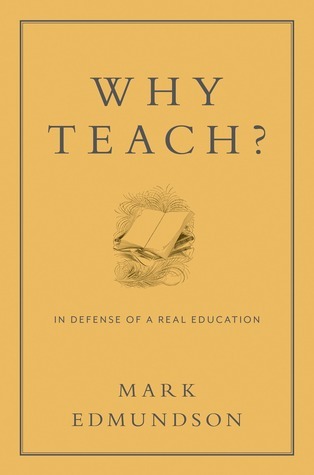
Why Teach?: In Defense of a Real Education
Mark Edmundson's essays reclaim college not as the province of high-priced tuition, career training, and interactive online courses, but as the place where serious people go to broaden their minds and learn to live the rest of their lives.
A renowned professor of English at the University of Virginia, Edmundson has felt firsthand the pressure on colleges to churn out a productive, high-caliber workforce for the future. Yet in these essays, many of which have run in places such as Harper's and The New York Times, he reminds us that there is more to education than greater productivity. With prose exacting yet expansive, tough-minded yet optimistic, Edmundson argues forcefully that the liberal arts are more important today than ever.
Why Teach? offers Edmundson's collected writings on the subject, including several pieces that are new and previously unpublished. What they show, collectively, is that higher learning is not some staid, old notion but a necessary remedy for our troubled times. Why Teach? is brimming with the wisdom and inspiration that make learning possible.
A renowned professor of English at the University of Virginia, Edmundson has felt firsthand the pressure on colleges to churn out a productive, high-caliber workforce for the future. Yet in these essays, many of which have run in places such as Harper's and The New York Times, he reminds us that there is more to education than greater productivity. With prose exacting yet expansive, tough-minded yet optimistic, Edmundson argues forcefully that the liberal arts are more important today than ever.
Why Teach? offers Edmundson's collected writings on the subject, including several pieces that are new and previously unpublished. What they show, collectively, is that higher learning is not some staid, old notion but a necessary remedy for our troubled times. Why Teach? is brimming with the wisdom and inspiration that make learning possible.
240 pages, Hardcover
First published August 20, 2013
Ratings & Reviews
Friends & Following
Create a free account to discover what your friends think of this book!
Community Reviews
Displaying 1 - 30 of 70 reviews

October 4, 2013
Some essays made me grateful all over again that I was an English major. They articulated what it was I found so valuable about it, and why I still hold it sacred, even in the face of so many iterations of "And what will you do with that?"
Other essays made me doubt or question my own teaching, mostly in a productive way, and not a despairing one. Should I really care if my students enjoy the class? Or find it interesting? Am I pandering to that lowest common denominator and making biology into some kind of lite edutainment?
Awfully hard to know. I'm new at this game, and now I see I'll still be asking these questions if I'm doing this in thirty years. Not sure if that's a comfort, or a curse.
Other essays made me doubt or question my own teaching, mostly in a productive way, and not a despairing one. Should I really care if my students enjoy the class? Or find it interesting? Am I pandering to that lowest common denominator and making biology into some kind of lite edutainment?
Awfully hard to know. I'm new at this game, and now I see I'll still be asking these questions if I'm doing this in thirty years. Not sure if that's a comfort, or a curse.
May 1, 2015
Why teach?
Because young people need to learn how to be measurably productive members of our global economy!
I'm joking, of course. No, he did not say that because Edmundson is sane.
Edumndson breaks zero new ground here. None.
Thank goodness.
But he does remind us of what we once knew before we went bonkers.
Thank goodness.
We teach, first, because, let's face it, we are--or were once--thrilled by the questions that drive our field. Also because we want to introduce young people to a world not of their making. But most importantly because what's at stake in our teaching is more or less everything--with "everything" here meaning, more or less, depth of soul.
Because young people need to learn how to be measurably productive members of our global economy!
I'm joking, of course. No, he did not say that because Edmundson is sane.
Edumndson breaks zero new ground here. None.
Thank goodness.
But he does remind us of what we once knew before we went bonkers.
Thank goodness.
We teach, first, because, let's face it, we are--or were once--thrilled by the questions that drive our field. Also because we want to introduce young people to a world not of their making. But most importantly because what's at stake in our teaching is more or less everything--with "everything" here meaning, more or less, depth of soul.

May 14, 2023
Everyone who loves to read/has an opinion on education and higher education specifically should read this.

April 11, 2014
Edmundson's essays, most reprinted from the Chronicle of Higher Education or Harper's, strongly defend the liberal arts while chipping away at the vocational focus of much of higher education. The most famous piece is "Liberal Arts & Lite Entertainment," but others ("The Uncoolness of Good Teachers") are as good. One essay in particular, "A Word to the New Humanities Professor," offers a stunning critique of today's higher education by identifying the skills that it takes to survive as an assistant professor (i.e., to get promoted and tenured).
Note: I taught for years in Teacher Education (social studies ed.), which is where the emphasis on jobs and workforce productivity seem to be the heaviest. My job, it seemed to me, faced two challenges: to provide a vocational path and a more efficient workforce, and to critique the educational process itself and to keep it rooted in an understanding of subject matter. Consequently, Edmundson probably appeals to me more than he would have to most of my colleagues, who were focused on the first function.
Note: I taught for years in Teacher Education (social studies ed.), which is where the emphasis on jobs and workforce productivity seem to be the heaviest. My job, it seemed to me, faced two challenges: to provide a vocational path and a more efficient workforce, and to critique the educational process itself and to keep it rooted in an understanding of subject matter. Consequently, Edmundson probably appeals to me more than he would have to most of my colleagues, who were focused on the first function.

September 27, 2022
Although written about the post-secondary educational world, any high school teacher can see themselves in this book. This book had a Sir Ken Robinson level of shake-up for me, though at a completely different level. It made me rethink my approach to teaching in the classroom and education as a whole. Highly, highly recommend this book and look forward to reading Edmundson's "Why Read?" in the future.

October 4, 2022
Another high order series of essays by a major public intellectual. Education is more that career training. It involves the joy of exploration and discovery.

January 30, 2024
'A world uninterested in genius is a despondent place, whose sad denizens drift from coffee bar to Prozac dispensary, unfired by ideals or the glowing image of the self that one might become.'

August 9, 2019
3.5
In defense of a liberal arts and humanities based education, our author makes many compelling arguments, many of which I agree with whole heartedly. Which, in a nutshell, is the defense of an education that awakens the human spirit, that sets young people up in the quest to discover how to live through reading, reading, and more reading still. This pedagogy resonates deeply with me. This approach to higher education contrasts sharply with paths that primarily prepare students for the bottom line in our corporate and capitalistic society at the expense of learning how to live and exploring universal questions that extend our abilities to imagine other, deeper, and more meaningful ways of being for ourselves and others.
Holding up and teaching the great thinkers and writers of the past, argues Edmundson, are the best mentors for this journey (Whitman, Freud, Plato, Emerson), albeit the best writers and thinkers from Western Civilization. And therein lies the rub for me. He’s fairly critical - edging on dismissive - of multiculturalism, deconstruction (a la Foucault), culture studies, and other perspectives on the masters from a feminist (ie women’s studies) lens. There is no acknowledgement of his privilege or of centering mostly men -all white - save Emily Dickinson. In this day and age, I have little patience for academics who can’t name and own this dynamic.
In defense of a liberal arts and humanities based education, our author makes many compelling arguments, many of which I agree with whole heartedly. Which, in a nutshell, is the defense of an education that awakens the human spirit, that sets young people up in the quest to discover how to live through reading, reading, and more reading still. This pedagogy resonates deeply with me. This approach to higher education contrasts sharply with paths that primarily prepare students for the bottom line in our corporate and capitalistic society at the expense of learning how to live and exploring universal questions that extend our abilities to imagine other, deeper, and more meaningful ways of being for ourselves and others.
Holding up and teaching the great thinkers and writers of the past, argues Edmundson, are the best mentors for this journey (Whitman, Freud, Plato, Emerson), albeit the best writers and thinkers from Western Civilization. And therein lies the rub for me. He’s fairly critical - edging on dismissive - of multiculturalism, deconstruction (a la Foucault), culture studies, and other perspectives on the masters from a feminist (ie women’s studies) lens. There is no acknowledgement of his privilege or of centering mostly men -all white - save Emily Dickinson. In this day and age, I have little patience for academics who can’t name and own this dynamic.

January 9, 2016
The higher education system in this country has devolved into a factory for degrees and accreditations—so postulates UVA lit professor Mark Edmundson in this collection of essays. And he does share some compelling evidence to support the claim. From the disenchanted youths of the ’90s to the overbooked, hyper-involved students of today, higher education no longer challenges the status quo.
The essays range in topic from the benefits and pitfalls of sports to a dystopian peek into corporately structured universities to Edmundson’s own experiences in high school, college, and beyond.
It’s been nearly eight years since I was in a formal classroom, and these essays surely made me miss it. They also led me to reevaluate my own education: Although I loved learning and challenging certain tenets, I was also motivated by grade and performance when perhaps I should have been more concerned with shaking up my soul.
Highly recommend for anyone who wants to think of the bigger questions behind learning. Be warned: It’s motivated me to try to read a book I merely skimmed in college ('Middlemarch') and it’s quite a task—but that’s probably exactly what I needed.
The essays range in topic from the benefits and pitfalls of sports to a dystopian peek into corporately structured universities to Edmundson’s own experiences in high school, college, and beyond.
It’s been nearly eight years since I was in a formal classroom, and these essays surely made me miss it. They also led me to reevaluate my own education: Although I loved learning and challenging certain tenets, I was also motivated by grade and performance when perhaps I should have been more concerned with shaking up my soul.
Highly recommend for anyone who wants to think of the bigger questions behind learning. Be warned: It’s motivated me to try to read a book I merely skimmed in college ('Middlemarch') and it’s quite a task—but that’s probably exactly what I needed.

August 19, 2016
After 6 1/2 years, I thought it was time for a re-read of this series of essays that I had found provocative (and largely agreed with) the first time. Professor Edmundson is still on the faculty of the University of Virginia and is still, no doubt, fighting the battle these essays show he was thinking about and fighting 10 or more years ago. From what I see, hear, and read from universities and students, it is a battle that increasingly needs to be fought. Hopefully at least some of each of his cohort of students -- all primed from early childhood by parents, guidance counselors, the media ..... to live goal-driven, efficient, successful lives and to consider the University as theirs to criticize, evaluate and shape to their desires (Ratemyprof, Ratemyplacement, Ratemyjob -- not to mention all the times websites ask us all to evaluate our experiences, their products etc.) -- will learn from this professor to reflect, to be challenged, to fail and recover and to learn from it all.
Hopefully, also, his readers will do the same. I, for one, enjoyed the challenge.
Hopefully, also, his readers will do the same. I, for one, enjoyed the challenge.

September 22, 2013
Edmundson is a little full of himself -- and maybe even justifiably so -- and there were some parts of the book that seemed disconnected to the others (I didn't realize that many of these essays had been previously published elsewhere), but on the whole there was a lot of head-nodding as I read through it. I particularly loved "The Corporate City and the Scholarly Archive" that takes down shiny private schools (much like the one I work at) as simple "credential factories," where students learn how to make themselves into a salable product in the hopes of being picked off the shelf by a discerning college admissions officer. And it also got me to watch Mario Savio's famous and astonishing 1964 Berkeley speech where he rails against being a "product" and urges his fellow students to lay their bodies on the gears of the machine. Where has that revolutionary student spirit gone? (Off to Yale Law or Goldman Sachs, I'd wager.)

September 4, 2013
The best and worst book I've read on education! I believe this book is meant to inspire a return to a meaningful liberal arts education (as opposed to the job training college has become), but I found it to be infuriating and frustrating. Edmundson hits it on the nose in his discussions of problems in education and society as a whole. I was and still am one of a dying (or dead?) breed of students, and I have no desire to be an educator of the consumer/student of the present. Regardless, I think this should be required reading for all college bound students. And for all educators. American education is in a sad state and this book shows us where we've gone wrong and reminds us what it is supposed to be. In fact, Edmundson has a real sense of what is wrong with American culture and personally, I think it's a pretty scary reality.

December 16, 2013
Just let me quote:
"Good teachers know that now, in what's called the civilized world, the great enemy of knowledge isn't ignorance, though ignorance will do in a pinch. The great enemy of knowledge is knowingness. It's the feeling encouraged by TV and movies and the Internet that you're on top of things and in charge. You're hip and always know what's up. Good teachers are constantly fighting against knowingness by asking questions, creating difficulties, raising perplexities. And they're constantly dramatizing their own aversion to knowingness in the way they walk and talk and dress--in their willingness to go the Lester Bangs route."
(That route being the great coda from Almost Famous: "The only true currency in this bankrupt world is what we share with someone else when we're uncool.")
"Good teachers know that now, in what's called the civilized world, the great enemy of knowledge isn't ignorance, though ignorance will do in a pinch. The great enemy of knowledge is knowingness. It's the feeling encouraged by TV and movies and the Internet that you're on top of things and in charge. You're hip and always know what's up. Good teachers are constantly fighting against knowingness by asking questions, creating difficulties, raising perplexities. And they're constantly dramatizing their own aversion to knowingness in the way they walk and talk and dress--in their willingness to go the Lester Bangs route."
(That route being the great coda from Almost Famous: "The only true currency in this bankrupt world is what we share with someone else when we're uncool.")

September 17, 2014
I seldom recommend a book as a "must read." But if you are--or were or will be--a teacher or student in higher education (especially in the humanities), this book is essential. As a college professor of philosophy, I hear much these days about the technique of teaching and the skills to be taught with relatively little concern for the why and wherefore of a real education. Thus the college/university has evolved into a (rather expensive) form of what I'll call "entertrainment" (entertainment plus training). Edmundson gets to the core of the craft: "It is the character forming--or (dare I say?) Soul-making--dimension of the pursuit that counts."

September 6, 2013
Mark Edmundson is the kind of writer that is loved by those who agree with him and tolerated by the rest of the world. He is often right, just ask him and he'll tell you, but he assumes that every reader shares his opinion. This book's premise is interesting, but the author's paternalistic tone skews the message far too often.

November 16, 2013
This is the sort of book you pick up and read here and there. I found the essay on his favorite teacher interesting. His overall argument appears to be that we go to university to learn how to think about how to live rather than to gain a credential to make money. As a liberal-arts major, I certainly agree, but I'm guessing others have different objectives.

December 22, 2013
Well-written personal essays approaching from different angles the question of what education is and should be, especially considering the distortions of higher education by current university administration economics/politics and by student expectations. Some repetition, but I enjoyed reading this book.

October 21, 2014
I feel like Mark Edmundson just walloped me over the head with his book and then shook me until my teeth chattered together. Although this collection of essays is primarily about the purpose of a good liberal arts education and a good educator, I found it to be a high-stakes master lesson on how to be a life-long student and decent human being.

May 27, 2018
Pedantic. Edmundson reads like an old fuddy-duddy who scorns modernity and wishes for the good old days. He states his opinion and treats it like fact while making broad claims without any, except the briefest of anecdotes, pieces of evidence.

March 21, 2023
Why Teach is the second in the “Why?” Trilogy. It is just as engaging, informative, and plain-speaking as Why Read and Why Write.
Professor Edmundson teaches English at the University of Virginia in Charlottesville. In a series of essays, some of which were published elsewhere, Edmundson reports on the challenges of teaching in our contemporary setting. For example, universities have become consumer and entertainment-oriented entities. One symptom of this is the student evaluation. Edmundson’s discussion about the student evaluation and what it tends to report leads into a fruitful discussion of how the professor must give information in an engaging and entertaining way, but not expect too much retention or critical interaction from the students with the material presented. Instructors that expect students to actually, like, read the material, or who offer necessary candid correction or criticism often leads to unhappy consumers which leads negative evaluations. A concern about negative evaluations inhibits teaching.
Another challenge is for teachers to avoid offering “close readings.” An example of a close reading is interpreting Dickens through the writings of Marx or Derrida. This kind of interpretive analysis takes away from the opportunity of the story itself to impact the student in unexpected ways. The close reading brings judgment and condemnation upon the author rather than truly trying to understand what the author is trying to say through his story or essay.
Edmundson advocates for real education. By this he means, providing students with opportunities to encounter thinking, ideas, values, and historical situations via reading that are different from the students, and, which challenge the student’s normal way of thinking, ideas, values, and expectations. The real education comes through critical thinking and engagement which inspires the student to grow intellectually and spiritually. As Edmundson illustrates, the task of real education is not nearly as easy as it sounds.
I appreciated Edmundson’s observations on teaching, students, and the status of the university in American culture. The one thing that I found missing was an essay about what to teach in humanities classes. Is there a canon that sets the standard? Does each teacher bring his own choices to the class or is there a series of time tested classics that students ought to engage with? Edmundson refers regularly to Plato, Socrates, Dickens, Thoreau, Freud and Schopenhauer. I would like to read his thoughts on the actual content that a humanities student ought to interact with and should this be standardized? Read education is not only about the excitement of being challenged but also having a series of conversation partners to take with you when you continue with life after school.
I think anyone who is concerned about education, teacher or student or parent, will appreciate this book and what it offers.
Professor Edmundson teaches English at the University of Virginia in Charlottesville. In a series of essays, some of which were published elsewhere, Edmundson reports on the challenges of teaching in our contemporary setting. For example, universities have become consumer and entertainment-oriented entities. One symptom of this is the student evaluation. Edmundson’s discussion about the student evaluation and what it tends to report leads into a fruitful discussion of how the professor must give information in an engaging and entertaining way, but not expect too much retention or critical interaction from the students with the material presented. Instructors that expect students to actually, like, read the material, or who offer necessary candid correction or criticism often leads to unhappy consumers which leads negative evaluations. A concern about negative evaluations inhibits teaching.
Another challenge is for teachers to avoid offering “close readings.” An example of a close reading is interpreting Dickens through the writings of Marx or Derrida. This kind of interpretive analysis takes away from the opportunity of the story itself to impact the student in unexpected ways. The close reading brings judgment and condemnation upon the author rather than truly trying to understand what the author is trying to say through his story or essay.
Edmundson advocates for real education. By this he means, providing students with opportunities to encounter thinking, ideas, values, and historical situations via reading that are different from the students, and, which challenge the student’s normal way of thinking, ideas, values, and expectations. The real education comes through critical thinking and engagement which inspires the student to grow intellectually and spiritually. As Edmundson illustrates, the task of real education is not nearly as easy as it sounds.
I appreciated Edmundson’s observations on teaching, students, and the status of the university in American culture. The one thing that I found missing was an essay about what to teach in humanities classes. Is there a canon that sets the standard? Does each teacher bring his own choices to the class or is there a series of time tested classics that students ought to engage with? Edmundson refers regularly to Plato, Socrates, Dickens, Thoreau, Freud and Schopenhauer. I would like to read his thoughts on the actual content that a humanities student ought to interact with and should this be standardized? Read education is not only about the excitement of being challenged but also having a series of conversation partners to take with you when you continue with life after school.
I think anyone who is concerned about education, teacher or student or parent, will appreciate this book and what it offers.

July 16, 2019
I didn't hate this book. I actually wish I could give 3.5 stars on Goodreads; alas, this is impossible at present.
I'm currently doing summer research in my PhD program, and this was one of the books I kept running into quotes from while reading various articles aimed at first-year instructors. I found the first two essays in the book interesting and engaging, though I tended to disagree with Edmundson's assessment of college students during the latter half of the 1990s. Interestingly, I found his information regarding the Millennial generation a bit more interesting, if not altogether accurate (again) in my opinion. As a (technical) Millennial myself I found myself thinking that he is, oftentimes, a biased older white male (I don't think this is an unfair description). That being said, I did agree with much of what he said regarding the ways in which teaching has changed based on the ways in which generations have developed. This is true. I have witnessed this change both as a student, and now as an instructor.
The second section of the book is a collection of open essays to students regarding why they should study what makes them happy (not just what makes them a lot of money), why a college education is important, and how to get the most out of that education. These were interesting enough, but I did find my eyes glazing over a bit in response to repetition of his own thoughts.
The third section was the entire reason I read the book. It's aimed at instructors and gives them Edmundson's honest, often somewhat biased, opinions regarding the field of university teaching. I found it useful enough to add to the research bibliography, but it isn't necessarily something I will commit every word of to memory.
The book is definitely opinion. It's essentially one long op-ed on the topic of teaching. But it's interesting and well-written, even if it is heavily biased and a little bit infuriating (at times) to listen to someone tell you that what they think has to be true because they've seen it in more than one place. It would have been a more compelling argument, in the places where an argument was being made, had Edmundson backed up his claims with any research other than "I saw this happen, therefore it must be so."
Still, the book was worth the read and I would recommend it to my peers.
I'm currently doing summer research in my PhD program, and this was one of the books I kept running into quotes from while reading various articles aimed at first-year instructors. I found the first two essays in the book interesting and engaging, though I tended to disagree with Edmundson's assessment of college students during the latter half of the 1990s. Interestingly, I found his information regarding the Millennial generation a bit more interesting, if not altogether accurate (again) in my opinion. As a (technical) Millennial myself I found myself thinking that he is, oftentimes, a biased older white male (I don't think this is an unfair description). That being said, I did agree with much of what he said regarding the ways in which teaching has changed based on the ways in which generations have developed. This is true. I have witnessed this change both as a student, and now as an instructor.
The second section of the book is a collection of open essays to students regarding why they should study what makes them happy (not just what makes them a lot of money), why a college education is important, and how to get the most out of that education. These were interesting enough, but I did find my eyes glazing over a bit in response to repetition of his own thoughts.
The third section was the entire reason I read the book. It's aimed at instructors and gives them Edmundson's honest, often somewhat biased, opinions regarding the field of university teaching. I found it useful enough to add to the research bibliography, but it isn't necessarily something I will commit every word of to memory.
The book is definitely opinion. It's essentially one long op-ed on the topic of teaching. But it's interesting and well-written, even if it is heavily biased and a little bit infuriating (at times) to listen to someone tell you that what they think has to be true because they've seen it in more than one place. It would have been a more compelling argument, in the places where an argument was being made, had Edmundson backed up his claims with any research other than "I saw this happen, therefore it must be so."
Still, the book was worth the read and I would recommend it to my peers.

March 1, 2018
Edmundson's literary interests aren't as wide-ranging as you would think - he likes the Romantics, Freud, Schopenhauer, Nietzsche, Whitman, Emerson, etc. In the Romanticism class I took with him, all of these thinkers were touched on, with the occasional reference to Beck or the Notorious B.I.G. to appeal to the Gen Xers. I left the class with more to think about, which is a sign of good teaching. I got interested in John Keats especially, who is the least cosmic of the Romantic bunch, but probably the most gifted with language
This lucid defense of the humanities and critique of the corporate university feels weary. We have essentially lost this battle. There are no literary heroes held up by the mainstream to point the way forward. We are much more concerned with the fate of UVa's basketball team than about its soul as academic institution.
I am guilty of having the collector's mindset about my own intellectual pursuits, as evidenced by the relentless cataloguing of everything I read on this website. I have very rarely been transformed by a book, although Dostoevsky gets me there, as does Austen and Dickens, along with a lot of poetry (Dickinson, Yeats, Lowell). The trap in modern society is for easy answers, a Manichean polarization, enmity towards those who disagree. The humanities should be our shared culture, our shared heritage. Unfortunately, the academy has turned the liberal arts into another political battlefield. By doing so, they have muddied the waters and turned education into a political position instead of the process not only of soulmaking but also of citizenship. Everyone in American should read Huckleberry Finn and Invisible Man before they can join the conversation on race.
Let's save literature! Let's save our souls!
This lucid defense of the humanities and critique of the corporate university feels weary. We have essentially lost this battle. There are no literary heroes held up by the mainstream to point the way forward. We are much more concerned with the fate of UVa's basketball team than about its soul as academic institution.
I am guilty of having the collector's mindset about my own intellectual pursuits, as evidenced by the relentless cataloguing of everything I read on this website. I have very rarely been transformed by a book, although Dostoevsky gets me there, as does Austen and Dickens, along with a lot of poetry (Dickinson, Yeats, Lowell). The trap in modern society is for easy answers, a Manichean polarization, enmity towards those who disagree. The humanities should be our shared culture, our shared heritage. Unfortunately, the academy has turned the liberal arts into another political battlefield. By doing so, they have muddied the waters and turned education into a political position instead of the process not only of soulmaking but also of citizenship. Everyone in American should read Huckleberry Finn and Invisible Man before they can join the conversation on race.
Let's save literature! Let's save our souls!

August 13, 2023
I finished this book on the day that WVU--Edmundson's university--announced the destruction of 32 degree programmes and 174 academics. So, it is easy to sympathise with his criticism of the corporate university. However, as a book on 'why teach', this is less successful. It is, much more than Edmundson's other 'why' books, a collection of separate essays, which means a LOT of repetition but, most annoyingly, little about teaching. Most of the essays are more relevant to new students and their parents. It's hard to pin down the author's politics. I guess he is the kind of compassionate conservative that has now pretty much disappeared from American public life. But an eminently readable one, of course.
April 14, 2026
A terrific defense of a humanistic education, both inside and outside the classroom. Literature is a second chance at socialization. To create your own values if the values that one is raised with does not resonate with. Or alternatively to solidify those values if one comes out the journey having encountered alternative worldviews and keeping those initial values intake. If one only knows his or her own side, then he or she does not truly know their own side. Literature can help answer the big questions that young people always ask regarding their identity, marriage, future, past, work, and values. In short, literature is life changing if one allows it to.
Somewhat repetitive since I've read Edmundson's other books but his point deserves re-reading time and time again.
Somewhat repetitive since I've read Edmundson's other books but his point deserves re-reading time and time again.

July 3, 2018
Brilliant essays discussing the importance of a liberal arts education. Edmundson brings a craftsman’s ethos to the idea of a liberal arts education and the value it brings to people of a young age.
I didn’t realize it as I was exploring my interests back in college; I thought I was just taking classes with professors who I liked, but in reality I was confronting and finding a path of self development through literature.
It is unfortunate that fewer college students today will take that journey because of the belief that college is only there to develop skill sets that will be of immediate value in the work place.
I didn’t realize it as I was exploring my interests back in college; I thought I was just taking classes with professors who I liked, but in reality I was confronting and finding a path of self development through literature.
It is unfortunate that fewer college students today will take that journey because of the belief that college is only there to develop skill sets that will be of immediate value in the work place.

August 20, 2018
This is not a researched book on teaching, but it is based on the author's many years of experience. It would be a good conversation starter. I believe that it intends to be provocative. The author plays the role of "crusty old man, set in his ways" in order to tease readers into defending their own attitudes and beliefs. He makes many points about reading, writing, and teaching that are worth considering.
August 31, 2022
There are books which you want to savour and there are books which you want to devour.
This one is both.
There are books which are entertaining and books which are enlightening.
This one is both.
There are books which resonate with you and books which bring a fresh perspective.
This one is both.
I am now going to go on and read anything written by Mark Edmundson.
Strongly recommended !!
This one is both.
There are books which are entertaining and books which are enlightening.
This one is both.
There are books which resonate with you and books which bring a fresh perspective.
This one is both.
I am now going to go on and read anything written by Mark Edmundson.
Strongly recommended !!

April 5, 2021
Excellent! “For a student to be educated, she has to face brilliant antagonists: She has to encounter thinkers who see the world in different terms than she does.” Edmundson tells us to slow the classroom down.
This is the type of book that helps one see why they teach and why for many years it hasn’t seemed like a job.
This is the type of book that helps one see why they teach and why for many years it hasn’t seemed like a job.

June 14, 2022
While I agree with the sentiment that there's so much value in the humanities and truly learning for the sake of learning, this book is unfortunately shrouded in pretentiousness, and I certainly didn't think each point landed. Some points were hard to follow, and Edmundson often contradicts himself.
August 25, 2025
Went into this book sympathetic to his point. Left disappointed. Should've stopped reading when I thought about it during the first essay. There's one or two good essays in there...
Read books. But read books only the way he wants you to. Otherwise all is lost. Don't read works about other writings--except this one.
OK.
Read books. But read books only the way he wants you to. Otherwise all is lost. Don't read works about other writings--except this one.
OK.
Displaying 1 - 30 of 70 reviews