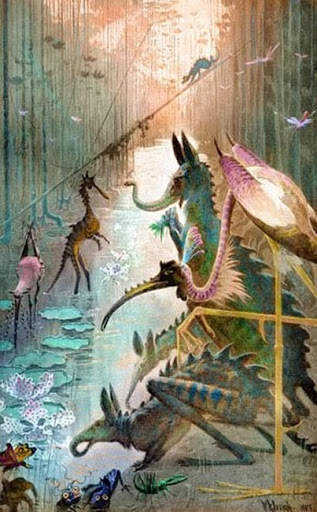
This superlative collection of futuristic tales explores groundbreaking supernatural themes from the founding heroes of the science fiction genre. The short story form is perfect for capturing the atmospheric tension of these legendary stories. The collection includes: The Door in the Wall by H. G. Wells, All Cats are Gray by Andre Norton, A Martian Odyssey by Stanley G. Weinbaum, Victory by Lester del Rey, The Moon is Green by Fritz Leiber, The Winds of Time by James H. Schmitz, The Defenders by Philip K. Dick, and Missing Link by Frank Herbert.
Herbert George Wells was born to a working class family in Kent, England. Young Wells received a spotty education, interrupted by several illnesses and family difficulties, and became a draper's apprentice as a teenager. The headmaster of Midhurst Grammar School, where he had spent a year, arranged for him to return as an "usher," or student teacher. Wells earned a government scholarship in 1884, to study biology under Thomas Henry Huxley at the Normal School of Science. Wells earned his bachelor of science and doctor of science degrees at the University of London. After marrying his cousin, Isabel, Wells began to supplement his teaching salary with short stories and freelance articles, then books, including The Time Machine (1895), The Island of Dr. Moreau (1896), The Invisible Man (1897), and The War of the Worlds (1898).
Wells created a mild scandal when he divorced his cousin to marry one of his best students, Amy Catherine Robbins. Although his second marriage was lasting and produced two sons, Wells was an unabashed advocate of free (as opposed to "indiscriminate") love. He continued to openly have extra-marital liaisons, most famously with Margaret Sanger, and a ten-year relationship with the author Rebecca West, who had one of his two out-of-wedlock children. A one-time member of the Fabian Society, Wells sought active change. His 100 books included many novels, as well as nonfiction, such as A Modern Utopia (1905), The Outline of History (1920), A Short History of the World (1922), The Shape of Things to Come (1933), and The Work, Wealth and Happiness of Mankind (1932). One of his booklets was Crux Ansata, An Indictment of the Roman Catholic Church. Although Wells toyed briefly with the idea of a "divine will" in his book, God the Invisible King (1917), it was a temporary aberration. Wells used his international fame to promote his favorite causes, including the prevention of war, and was received by government officials around the world. He is best-remembered as an early writer of science fiction and futurism.
He was also an outspoken socialist. Wells and Jules Verne are each sometimes referred to as "The Fathers of Science Fiction". D. 1946.
In this case, emphasis on "classic" more than on "great." That's not to say I can't see why they were each included, and they are mostly representative of that "classic" sf era of either rocket jockeys or post-apocalyptic-obvious-moralizing-about-war.
But with the sole exception of H. G. Wells -- who re-impressed me as a strikingly unique talent -- these stories all feel too much a product of their time. Intriguing stories had simplistic fable-like morals or disturbingly colonial assumptions, good action set-pieces had women solely to be saved and explained to, and Andre Norton's potentially good setup with a loner spaceport woman and her cat didn't end up really having any story to go with it, more of a brief anecdote really.
So this book is worth it mainly just for the Wells story, "The Door in the Wall." A man recalls his blissful dreamlike experience going beyond a mysterious door as a young child, and wistfully recounts its repeated re-appearances throughout his life when he has always been too absorbed in other, too immediate concerns to go through it again. It sounds simple, even silly, but is saved by its telling -- which is quite inventive and convincing -- and by the fact that how this story ends up took me startlingly unawares.
The Door in the Wall by H. G. Wells 3/5 All Cats are Gray by Andre Norton 3/5 A Martian Odyssey by Stanley G. Weinbaum 5/5 Victory by Lester Del Rey 5/5 The Moon is Green by Fritz Leiber 4/5 The Winds of Time by James H. Schmitz 5/5 The Defenders by Philip K. Dick 5/5 Missing Link by Frank Herbert 4/5 Narrators' performances 5/5
An interesting collection of some pretty old stuff. Ignore the occasional outdated science, gender roles, and racial perspectives, and there are some fun stories.
I found that this collection of unabridged science fiction stories was very good, and great to listen to on long vacation drives.
The stories in this collection are “The Door in the Wall” by H. G. Wells, “All Cats are Gray” by Andre Norton, “A Martian Odyssey” by Stanley G. Weinbaum, “Victory” by Lester Del Rey, “The Moon is Green” by Fritz Leiber, “The Winds of Time” by James H. Schmitz, “The Defenders” by Philip K. Dick, and “Missing Link” by Frank Herbert, I enjoyed all of the stories, especially the ones by H. G. Wells and Andre Norton.
This was a great audiobook to have on hand, and the fact that the stories were unabridged, in my opinion, improved the quality of the stories.
I don't often read sci-fi, so if I sound awe inspired or look twinkly eyed you know why. The H.G. Wells story was a great start and helped ease me into the heavier, more jargon filled stories that followed. Some of them started out slow but they were all worth the time. I especially liked "The Moon Is Green" by Fritz Leiber, "The Winds of Time" by James H. Schmitz, and "The Defenders" by Philip K. Dick. The Defenders had a great ending, even though it felt a bit predictable.
After reading these, I'm wondering why I've waited so long to plunge head first into the sci-fi genre. It seems like a great collection for someone looking to sample what the sci-fi genre has to offer.
Favorite Quote = “Today we live in a society in which spurious realities are manufactured by the media, by governments, by big corporations, by religious groups, political groups... So I ask, in my writing, What is real? Because unceasingly we are bombarded with pseudo-realities manufactured by very sophisticated people using very sophisticated electronic mechanisms. I do not distrust their motives; I distrust their power. They have a lot of it. And it is an astonishing power: that of creating whole universes, universes of the mind. I ought to know. I do the same thing.” - P.K. Dick
So hard to rate a collection of short stories, some are always good some not. With an audiobook even harder, since the audio could be rated on it's own merits also. Anyhow, here goes:
1) The Door in the Wall by H.G. Wells, 5* Great story by a masterly author. The narrative is presented as a story told to the narrator by a man of his acquaintance about a green door in a white wall which appears and disappears through his life. This door he went through only once, as a child and it led him to a wonderful, magical garden. Marvellous Narration! Really increased the enjoyment of the story. Great story, not SF as we know it today but first published in 1906.
2) All Cats Are Grey by Andre Norton 5* A spooky, but thoroughly science fiction story about a woman a cat and a spaceman who go hunting for the 'Empress of Mars' a luxury space ship which disappeared with all the passengers and crew. They encounter the reason it disappeared in this exciting little story. First published, I believe by Fantastic Universe as Andrew North 1953 Adequate narrations, a trifle annoying at first but the story was interesting enough that one could ignore it eventually.
3) A Martian Odyssey by Stanley G. Weinbaum 4* This one is definitely a classic SF: The first expedition to Mars crowd around the man who's 'rocket ship' grounded forcing him to start walking back to the main ship. Along the way he encounters a variety of weird alien life forms including an Ostridge like intelligent 'Martian', a sand octopus, a silicon based alien, grass that does not want to be walked on and many others. Mars it would seem is teeming with life. The crew are a variety of nationalities and while some of the 'gruff, man's man interchanges have aged badly. And the stereotyping of the different nationalities is a bit wince, still a great classic story with heaps of weird and wonderful aliens encountered as our lost hero travels across the fact of Mars.
Not improved by the narration. The attempts to do accents just made the stereotyping worse. BUT I would call this story a must for everyone that liked old school aliens!
4) Victory by Lester Del Rey – 2* Quite long, rather erratic and I have to say, I found it pretty tedious. If this had not been an audio, I think I would have skipped it. An Earth man (O’Neil?) is returning to an alien plant after fighting a war against the Thrum (or something) and the planet is wrecked. Earth refused to help, only some individuals shipped out to join the army. The planet is decimated Earth is a wimp and the bad guy.
Only! PLOT TWIST O’Neil is being recruited to the secret program that will prevent war ect ect. And it turns out Earth is the good guy. I did wonder a few times as I followed the slow, slow progress of our story and protagonist whether this was meant to be a searing condemnation of war, or of some particular war. However I can’t find that there was any intent except entertainment. Can't even remember the narration.
5) The Moon is Green by Fritz Leiber. 2* Meh. I think it would have been better if not an audio book. Post apocalyptic scenario, people incarcerated in a shelter. A play with a single stage set; tiny poky apartment with lead shutters. The majority is a woman being verbally abused by her husband Hank because she opened the shutters to look out and that might have let in radiation or ‘dust’. When Hank is gone, she opens the shutter and some dude and his cat from outside come in. Dude tells her how lovely it is outside, Hank comes back and yells some more. Very dated, the verbal DV was more than a bit cringe by even the most open minded standard. Now, the narration is, I believe by Katherine Kellgren who was a very well known and respected narrator, prizewinning even. But she started on the stage and in this story she does not read nor narrate so much as voice act. This is not something I love in an audiobook.
6) The Winds of Time by James H. Schmitz 5*
This was both a great story and good narration. A classic SF story we have the captain of a freighter spaceship who has been hired by some mysterious guy to take him to a dead moon, take some mysterious stuff on board. Things go wrong, the ship falls out of 'norm space' into somewhere else. There is an alien, or maybe aliens, with possibly malign intent, there is a boy and girl being chased around the spaceship. Some timey-wimy stuff happens too. Also some spacy-wacy stuff. There is a terrible danger to overcome...
It was a heap of fun! narrated by Stephen R. Thorne who also did several Dr Who villains.
7) The Defenders by Philip K. Dick 5*
An excellent short story, pure SF speculative: mankind had to move below ground in the wake of nuclear war. They now toil underneath the Earth to provide the materials for the 'Leadies' on the surface to continue the war against the Russians. The Leadies are AI-ish without calling them that. Independent manufactured robots? Able to propagate the war effort.
People below ground watch shows on how the war progresses (as people did in WWII). Then something odd about the Leddies triggers the first expedition to the surface. No SPOILERS because here the reveal is really, really good.
This really excellent story confirms me in my opionion that PKD was better at stories than at novels.
8) Missing Link by Frank Herbert narrated by Frank Brick? Brink? Hard to say for this one. I did not enjoy it, but I could not follow it as an audio and I suspect that had to do with the narration which I did not like, and the traffic which kept distracting me. I might look for this one in paper format and give it a second change.
Eight science fiction tales from the pulp era of science fiction, where stories popped from the pages of magazines such as Astounding Tales. Each of the tales provides a different view of of science fiction, some of the stories more satisfying than others, but ultimately enjoyable. The most enjoyable story, Stanley G. Weinbum's "Martian Odessey", involves aliens doing alien things for alien reasons, a concept not investigated by most contemporary writers.
Each story in the audiobook is competently narrated by a different person.
i listened to this as an audio book, and as the title says it contains "classic" science fiction short stories by H. G. Wells, Stanley G. Weinbaum, Lester Del Rey, Fritz Leiber, James Schmitz, Philip K. Dick, and Frank Herbert. The stories are mostly about people coming across weird aliens of various kinds. I prefer more modern sci-fi with futuristic technology and societies. But if you're a fan of these authors you'd probably like this book.
I don't know that I'd call these short stories "great." Many of them were overly heavy-handed, or had themes or other bits and pieces that were treated better in other works. Only mediocre examples of the listed authors' works - even the H.G. Wells short story felt a bit like a watered-down Time Machine variant.
Some great stories by the heavyweights of 20th century sci-fi. Highlights include H.G. Wells' The Door in the Wall, Frank Herbert's The Missing Link, and James Schmitz's The Winds of Time. Andre Norton's All Cats are Grey is the most obviously dated, yet still so much fun.
"The Door in the Wall" and "A Martian Odyssey" are both absolutely brilliant, well-written and creative stories helped by genius narration. In Door, the narrator is earnest yet conspiratorial, makes you feel like he really is telling you the story. It's intimate. In Odyssey, the 1930s American accent and diction are spot-on and have the same effect of completely drawing you in to a great story. "The Moon is Green" also surprised me and was good. The rest were mostly so-so, some interesting ideas but not blow-you-away stories. My notes as I went along:
"The Door in the Wall" by H.G. Wells - Brilliant. Basically an earlier formulation of Every Heart a Doorway and very affecting. The narrator is perfect, combining with the structure to make it seem very intimate and almost conspiratorial. "All Cats Are Grey" by Andre Norton - Very short and didn't have the kind of plot impact I expected, the "twist" about the character's minor disability was very minor indeed. "A Martian Odyssey" by Stanley G. Weinbaum - OMG I LOVE IT. The tone, the aliens that are completely alien, the turn at the end that doesn't really explain anything but made me laugh in surprise and made it somehow feel complete and satisfying. The narrator was perfect too, a perfect 1930s American accent and tone. "Victory" by Lester del Rey - Interesting military space opera, but it's a novella, not a short story, and it should've just been a novel. It reads like a novel with huge chunks of narrative cut out of it. And in an audio collection of short stories it's just SO LONG. "The Moon is Green" by Fritz Leiber - I wasn't impressed at first, but it gradually won me over with lovely imagery and good pacing and an impactful twist. "The Winds of Time" by J.H. Schmitz - Vaguely sexist, but found it strangely like a twisted Doctor Who story and found it mesmerizing for that reason. "The Defenders" by Philip K. Dick - Cool idea, but predictable, and I didn't like how human-centric it was. I was envisioning a majestic robot culture and I got weird baseless "everything will be fine for humans" assurances. "The Missing Link" by Frank Herbert - Didn't get this one at all. What happened that's supposed to be noteworthy?
Great Narration. Awesome read for a long drive. Some of the stories didn't hold up, but there are some real gems in here. "A Martian Odyssey" was one of the best pieces of sci fi I have ever read. The protagonist's entertaining account of befriending and trying to understand an alien named Tweel is amazing and hilarious. At one point they stubble across a silicon based life form, and it's incredibly imaginative writing. The narrator smashes some of the light spores the creature emits, thinking that's how it reproduces. "I smashed a couple in the sand. Would you like to come back in about 10,000 years to see if I planted some pyramid monsters?"
The Door in the Wall by H. G. Wells 2/5
All Cats are Gray by Andre Norton 5/5 - Haunted ship in space. Cool.
A Martian Odyssey by Stanley G. Weinbaum 5/5
Victory by Lester Del Rey 3/5 Victory wasn't my favorite, but worth the read just to hear the name "Queeth, Prince of Sugfarth," and when the wife said "What does a soldier know of war?"
The Moon is Green by Fritz Leiber 4/5 - Not a fan of how ridiculous the woman was portrayed but I really enjoyed the writing and many elements of this one. "You've killed it. You've killed it in me. You've both killed everything that's beautiful, but you're worse! Because he only killed beauty once, but you've brought it to life so you can kill it again!" Poetic response to a douche bag that crushes your only dreams. You
You definitely have to walk into this ready to ignore the sexism and racism if you're going to find any of it interesting. It's pervasive and sometimes explicitly stated. Several of the stories have interesting ideas, but are marred by the blatancy of the opinions at the time.
It's okay if you want to skip this one! Nothing here is truly essential! But I was looking for a few of these icons of early Sci-Fi writing in audiobook form through Libby, and some of them were hard to find at all. This provides a decent sample - Herbert, Dick, Lieber, Norton, Wells, etc. Plus, it provides the short story side of these authors - such a huge part of mid-19th century SciFi culture that is not nearly as pervasive now, and can be hard to find if the author never published their own collection, and many of the zines have folded.
I found all of them to be interesting thought experiments, if nothing else. I enjoyed The Defenders, and a few others. All dealt with an uninhabitable Earth or an Earth that focused its attentions significantly spaceward, with the exception of Wells' strange little story involving strange things happening in utterly mundane settings and to mundane characters.
CW: racism, sexism, off-camera cannibalism and intense starvation and poverty, hints at genocide, war, some violence - between humans and all kinds of other beings. No SA.
Martian Odyssee was playful, Moon is green was thought provoking (and relevant of it's time), Defenders confirmed (once again) that Philip K Dick strikes something between realism and far future with a story that focus more on the hypothetical consequences and following that through (whereas fx Winds of Time used a hypothetical setting to tell an ordinary story). I liked Missing Link as well.. the rest of the stories were mediocre at best. Victory could something but was not quite there. Perhaps it just had an awkward length; long enough to introduced character building but not enough to see it through (and the point could have been told with fewer 'scenes' it seemed). Average rating based on both superior and inferior short stories.
Okay this is composed of eight different stories. In order 1. The Door in the Wall by H.G. Wells 2. All Cats are Gray by Andre Norton 3. A Martian Odyssey by Stanley G. Weintraub 4. Victory by Lester Del Ray 5. The Moon Is Green by Fritz Leiber 6. The Winds of Time by James H. Schmitt 7. The Defenders by Philip K. Dick 8. Missing Link by Frank Herbert
The only one that doesn't really fit is the story by H.G. Wells since, IMHO, its more fantasy story about a man wanting to return to some garden. Its probably here because it is H.G. Wells. An interesting over view of some of the Golden Sci-Fi pulps styles 6of the 1890s till the 1950s.
These were some fun stories to listen to. H.G. Wells' "The Door in the Wall" is like a sci-fi Narnia. I liked the first contact stories "A Martian Odyssey" (Stanley G. Weinbaum), "The Winds of Time" by James H. Schmitz, and "Missing Link" (Frank Herbert). The two post-apocalyptic stories, "The Moon is Green" (Fritz Leiber) and "The Defenders" (P.K. Dick) reminded me how much people of this era worried about atomic war. I wish there had been more background on each author or story. Also, there were two stories, "All Cats Are Gray" by Andre Norton and "Victory" by Lester del Rey that were just strange. They were too long to enjoy and too short to build the world they were going for.
Following 5 hours of reading this sci-fi I fell asleep in my sunroom. I woke at 3 a.m. under the large windows to the idea that I was being watched. As I groggily rose up from my place of rest my eyes caught terror. The reflection of 3 light fixtures in a triangular formation in the night sky sent my heart such a fright that it made a singular attempt to jump straight out my chest ! As I froze in place affixed upon that sight, reason eventually stepped in to proved my folly.... Surely 3 stars is much too high for this read... but I have an active enough imagination to make it so!
If you liked Project Hail Mary by Andy Weir, check out the third story in this, A Martian Odyssey by Stanley G. Weinbaum. I think you'll like it!
The Door in the Wall by H.G. Wells 4/5 All Cats Are Gray by Andre Norton 4/5 A Martian Odyssey by Stanley G.Weinbaum 5/5 (my favorite story in the anthology) Victory by Lester Del Rey 2/5 The Moon is Green by Fritz Leiber 4/5 The Winds of Time by James H. Schmitz 3/5 The Defenders by Philip K. Dick 5/5 Missing Link by Frank Herbert 4/5
Overall this was an interesting selection of sci-fi stories. I hadn’t read any of them before. There were a couple I really liked. The PKD, and Wells stories were ones I expected to like and enjoyed them. I surprised that I liked the Martian odyssey, but It won me over by the end. There are a couple of stories that were either too long, just boring, or not for me. Most however were worth the read.
I liked it overall and it’s been a while since I read sci-fi, so it was a welcome variation. However, i was disappointed that so much of it followed a very similar plotline- stuff to do with atomic warfare that destroys earth and makes it uninhabitable forcing humans to live underground or go to space. Is this all sci-fi writers could imagine in the mid-20th century? Nevertheless, some details were interesting.
Each one reviewed individually. This title would be more accurate at "CLASSIC SCIENCE FICTION" and remove the great. They are all okay, some more than okay, some less. A few of them were my first introduction to the author. All show their age as far as science fiction literature.
The Door in the Wall by H. G. Wells ★★★★ A guy who cant decide if he wants the life of reality or the idyllic life behind a fantasy door
All Cats are Gray by Andre Norton ★★ Two future space salvage experts and a cat take on a derelict ancient treasure ship and its unseen protector
A Martian Odyssey by Stanley G. Weinbaum ★★★☆ A group of Martian explorers hear the tale of one mans adventure on the red planet
Victory by Lester Del Rey ★★★★★ A disenfranchised space Captain returns from war to find things are not well, even for the victors.
The Moon is Green by Fritz Leiber ★☆ Bored housewife lets in the radioactive man in from the haze
The Winds of Time by James H. Schmitz ★★★★ Freighter captain gets taken on a wild ride through space and time
The Defenders by Philip K. Dick ★★★☆ Americans discover the true effects of a nuclear war with Russia and the robots they left in charge before going underground
Missing Link by Frank Herbert ★★★★ Blue space monkeys take on humans
3.5 stars - a good collection of short stories, well worth the read. Diverse sci-fi themes. Established authors. I think it’s been years since I last read short stories. I have mixed feelings. They’re great if you want a quick read, the stories as well written as any good book, but I find that I’d rather immerse myself in a world for a more meaty read. Does that make sense?
I enjoyed the majority of the short stories—although the inclusion of the story All Cats Are Grey and The Moon Is Green makes me wonder whether stories were selected because they are truly considered great or because they were royalty-free. 🧐 I got my first taste of the writing of Philip K. Dick and Frank Herbert, and I’m looking forward to reading Dune and The Man in the High Castle.
Some great writers are included here, but it's certainly not their best work. I wouldn't exactly call these stories "classics." All the stories are dated, so they're "classic" in the sense that they're old, but none of these strike me as being particularly significant or groundbreaking in the scope of science fiction.
Interestingly, the oldest story -- H.G. Wells' The Door in the Wall -- holds up the best, in my opinion. Among all the stories, this might be the only truly "classic" story in that it's archetypical of the mysterious-world-beyond-the-door trope that also explores the value of wonder and regret. Most of the rest of the stories are characterized by a distinct mid-century combination of radiation paranoia, agro science man protagonist, encounters with an alien "other" that feel vaguely racist, and non-existent/emotionally fragile women. All Cats are Grey is an interesting exception. It's not a terribly great story, but it does break the stereotypical mid-century sci fi mold by having an interesting, gritty weirdo cat lady main character in a really bizarre situation. (I'm definitely pro cat lady sci fi. Love it.)
Ultimately though, unless you're super into reading dated sci fi, I'd skip this collection.
Disappointingly most stories are about how clever soldier-type men can be (and one woman). The HG Wells story was not, but that was more magical realism than scifi. There are some interesting scifi concepts in these stories, some about the aftermath of nuceal war, but the way they're conveyed is just very dude-bro-sci-fi and boring.
Some great classic SF, ending with Frank Herbert’s “Missing Link,” a typical, white man good story, that out and out disses, First Nations peoples. Ughh!
Philip K Dick’s “The Defenders” offers an interesting take on ending war forever. Nice!