Magic Beach, the first new book in forty years from the creator of Harold and the Purple Crayon, is the story of a boy and girl who discover the power of words on an enchanted beach. Published in celebration of the centennial of Crockett Johnsons' birth, Magic Beach includes an appreciation by Maurice Sendak, to whom Crockett Johnson was a mentor and friend, and an afterword by Philip Nel, who found the original drawings in the archives of the Smithsonian Institution.
Crockett Johnson was the pen name of the American cartoonist and children's book illustrator David Johnson Leisk. He is best known for the comic strip Barnaby (1942–1952) and the Harold series of books beginning with Harold and the Purple Crayon. [From Wikipedia.]
Two children go to the beach to look for a shell, but find something far more mysterious.
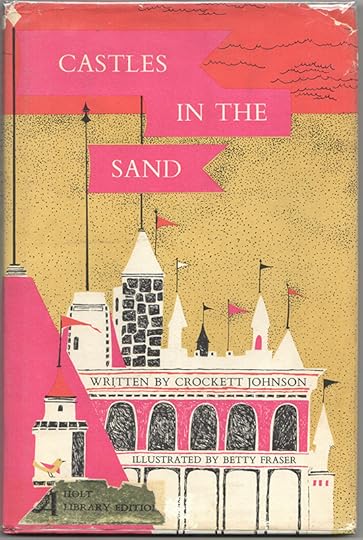
Rejected several times before being finally published under a different name and with very different illustrations by Betty Fraser.
My edition has an introduction by Maurice Sendak, in which I learned that he was mentored by Johnson and his wife Ruth Krauss in his youth and off-and-on lived with them.
دلم میخواست بهش پنج ستاره بدهم. از حسودی است که نمیدهم!
آن و بِن به ساحل میروند تا بِن یک صدف پیدا کند و با آن صدای دریا را بشنود. (دو تا بچه که با کمترین خطوط نقاشی شدهاند و شبیه همهٔ بچههای جهان و با این حال سخت متمایزند) آن فکر میکند اگر توی خانه مانده و داستان خوانده بودند خیلی بهتر بود اما به نظر بن این که آدم خودش کاری را انجام بدهد کیفش بیشتر از آن است که فقط دربارهاش بخواند. کمکم معلوم میشود این یک ساحل معمولی نیست و خیلی ممکن است که آن و بن از دل یک داستان سر درآورده باشند. آیا این داستانی قابل پیشبینی است؟ یکی از آن داستانهای با «پایان خوش»؟ راستش خیلی حسودیام شد! اول به نویسنده که چنین اثر شگرف سهل ممتنعی ساخته و پرداخته! (با آن طنز ظریف که در تاروپود اثر تنیده شده و آن شخصیتپردازی قوی که با کمترین کلمات صورت گرفته. به هرحال جناب جانسون خالق «هارولد و مدادشمعی بنفش» است و خیلی بهش میآید که باز هم مرتکب حرکاتی از قبیل هارولد شده باشد!) اما بیشتر به خود آن و بن! نه آیا که من بایستی در کودکی -و حتی همین الان!- سر از چنین ساحلی در میآوردم؟ به جایش دائم بهم گفته شد: «به آب نزدیک نشو دخترم!» :) :( واللّه که من در گذشته و حال مستحق حضور در چنین ساحل سحرانگیزی بودهام! (املایم هم همیشه خوب بوده! ؛) ) ببینم آینده حق من و خیالورزیام را ادا میکند یا نه...
A Fisher King! It was thrilling, as a secret lover of medieval literature and reader of the romances of de Troyes, to move through Crockett Johnson's book and gradually recognize it as a retelling of the old Arthurian tale as a profoundly imaginative children's story. Not only was it sweet enough to engage and entertain the babes, but it was also a very complex and intriguing meditation on narrative and language itself.
Este cuento habla de la imaginación, de las palabras y de los deseos. Unos niños construyen en una playa un escenario de cuento con solo escribir. ¿Qué otra cosa es la literatura? Es un cuento para los más pequeños y una reflexión para los adultos. Con unos trazos precisos, sin colores llamativos; con frases justas y ajustadas a la edad de los protagonistas, se crea una historia preciosa sobre la imaginación y la capacidad de crear. Los dibujos originales encontrados en el Smithsonian Institution en 2005, y que no se alejan del estilo del dibujante, hacen de esta cuidada edición un libro muy hermoso; las tapas en cartón duro, el lomo en tela...lleva a un tiempo pasado, mágico. En los dibujos se ha hecho el retoque de poner las palabras en español para que el cuento pueda ser más comprensible.Una gran opción para primeros lectores. Preciosa edición de la Editorial Corimbo y una delicada traducción de Ana Galán. Gracias a Babelio Masa Crítica que ha organizado la entrega por parte de la editorial
Ana y Ben se encuentran en la playa deliberando si han hecho bien en ir: Ana preferiría estar en casa leyendo un cuento, pero Ben opina que es más divertido vivir uno mismo el cuento. Hablando de que las palabras son solo trazos en un papel, Ben escribe en la arena y una ola se lleva la palabra, borrándola al instante, pero en el lugar en el que había escrito aparece materializada dicha palabra. Asombrados, continúan escribiendo y la playa encantada les sigue dando lo que piden a través de las palabras en la arena. ¿Tendrá el cuento que están creando Ana y Ben un final feliz?
La playa mágica es un cuento infantil que he recibido gracias a Masa Crítica de Babelio y a la Editorial Corimbo. Con una encuadernación preciosa en cartón y con los dibujos originales del autor, esta historia es una reflexión acerca del poder de las palabras y de la imaginación, así como de la importancia de nuestros deseos.
Esta joya editorial es un regalo perfecto para los más pequeños de la casa en estas fechas tan señaladas, y seguro que va a hacer las delicias tanto niños como de adultos. ღ
La playa mágica, la primera novedad en cuarenta años del creador de Harold and the Purple Crayon, es la historia de un niño y una niña que descubren el poder de las palabras en una playa encantada. Como todas las grandes historias, esta se extiende más allá de las páginas.
Este pequeño libro trae un mensaje ecologista muy importante. Con una narrativa breve y simple, junto a unos dibujos lineales adorables, el autor intenta transmitir la importancia de cuidar nuestro ambiente.
A través de su breve historia, el autor nos muestra las posibles repercusiones de un incremento del nivel del mar, que se tragaría todo a su paso. Al mismo tiempo, destaca la importancia de actuar y no ignorar lo ocurrido, debido a las posibles repercusiones que sufran los afectados.
En su brevedad, esta historia trae un mensaje importante para niños y mayores. Es uno de esos libros de lectura rápida pero que es capaz de calar hondo y ayudarte a reflexionar.
Maurice Sendak's introduction to Crockett Johnson's "Magic Beach" rightly compares it to Beckett's "Waiting for Godot." It is spare and meta and as existential as a Bergman film. The artwork has an unfinished feel, but that serves to reinforce the power of drawing and words that is at the heart of the story.
Like Johnson's more famous "Harold and the Purple Crayon" this tale involves a child-created world that rapidly spins out of control of the creator. The post-diluvian scene toward the end makes biblical comparisons inevitable. The afterword by Phillip Nel points to Johnson's affection for and inclusion of the Fisher King myth as well.
This all sounds pretty pretentious for a children's picture book, but it isn't. It's joyful and whimsical, with deeper undercurrents.
Posthumous edition, w/ unfinished (but still charming) illustrations by Johnson. Apparently it was released earlier with other art, as Castles in the Sand. I'll have to look for that, as I only 'get' little bits of this.
The afterward reveals that Johnson told his publisher that it was something like an homage to The Fisher King, which does not help me as I do not know that story either (and doubt that children would). If you like artsy books that are kinda for kids, check this out from your library, if they have it. Otherwise, imo it's totally skippable.
Crockett Johnson's original sketches are included in this new edition of his story formerly published under the title Castles in the Sand (and illustrated by someone else). The story was designed to be an "I Can Read" book and this is evidenced by the consistent placement of the dialogue on the white spaces of the page. The sketches, though unfinished, allow the reader a glimpse into the author's own vision of the text. The pictures support the text and help young readers to learn to read. The lack of color may make this unappealing to young readers today, but the book provides an interesting look at the development of beginning reader books over time.
I've been reading all day about how there is no such thing as children's books -- books are books for everyone. But that's obviously not true, and children need certain things in their books. I think older children could handle this, but I don't think it will do anything for younger children. I wouldn't begrudge anybody their sharing this with their child. But even as a book for all ages, it is a bit odd, dreary and strange. And there's a magic, but a sad, slow magic there.
The pencil/simple drawings were fun, as were the story, but I keep getting hung up on abrupt endings...I must expect more and just need to enjoy the story and let my imagination not feel stuck...or something! Cute, imaginative story for children. I liked the harder paper in the edition we read.
I enjoyed reading the foreword and afterword. It explained the book and what the author went through to try to get this published. The story has to be read a least twice to see the many things going on, subconsciously and on paper. Interesting.
Well, it is a bit of a darkly imaginative story. I liked it for its imagination, and I have loved Crockett Johnson's other work, and his sweet drawings. I'd like to have a beach like this one, but it sure doesn't last long, does it!
A fun idea, very imaginative especially for young kids as they rend to have no boundary of thoughts and questions. The art is interesting and random at times. I think a beach like this would be great but it could also cause some trouble as kids innocence drifts into adolescence. lol
This was a cute book, but it didn't seem finished to me. It has a cute message of magic and making things happen. It is from the same author that wrote Harold and the Purple Crayon which I loved. This one seemed confusing to me.
Parfois parmi le chalutage – 12 livres – pratiqué hebdomadairement à la bibliothèque on tombe sur une perle. Et quand il s’avère en plus que le livre a une histoire qui mérite d’être racontée, je me dois de prendre la plume.
Il est l’oeuvre de Crockett Johnson – rassurez-vous Crockett est un surnom – qui fut un auteur de livres pour enfants renommés dont le fameux Harold et le crayon rose – je fais le malin, mais je ne fais que répéter ce que j’ai lu, je ne connaissais ni l’auteur ni son livre. Il a écrit de nombreux livres à succès, mais celui qui lui tenait le plus à coeur a été refusé par de nombreux éditeurs. A force d’insister, il parvint à le faire publier, mais l’éditeur a confié les illustrations à une jeune illustratrice. Et le livre paru sous le titre Castles in the Sand.
Il a fallu attendre quarante ans, et le centenaire de la naissance de l’auteur pour que paraisse, La plage magique, la version que j’ai eu entre les mains illustrée par les croquis de l’auteur. Il est important de noter que ce ne sont pas des dessins finalisés, mais de simples croquis retrouvés avec le manuscrit original. D’où venait ces refus ? Quelle était leur cause ?
En toute honnêteté, je dois dire que j’ai lu l’histoire à ma fille avant de lire la préface et la postface qui m’ont appris grosso modo ce que j’ai raconté plus haut. Même sans connaître tout cela, j’avais trouvé l’histoire géniale. Découvrir ce contexte n’a fait que confirmer ma première impression.
C’est curieux parce que je n’ai pas pensé une seconde en lisant ce livre que l’histoire était trop compliquée. Deux enfants sont sur une plage après avoir longtemps hésité entre cette sortie et rester à la maison à lire une histoire. Ils décident donc d’inventer la leur en écrivant des mots sur la plage. Chaque fois qu’un mot est effacé par une vague, ce qu’il désignait apparaît. La réalité et la fiction se mélangent alors. Au lieu de lire une histoire à la maison, ils sont à l’intérieur, ils la vivent. Je ne vois pas ce qui est compliqué jusqu’ici, les enfants font toujours ça. Ils jouent à imaginer des choses, à faire semblant de devenir quelqu’un d’autre, d’être ailleurs. Ici en plus l’auteur évoque le pouvoir des mots et en fait prendre conscience aux enfants.
Personne – et surtout pas les enfants – n’est obligé de relever la référence au Roi pêcheur et au Graal symbolisé par le coquillage. Je vois plutôt ça comme un cadeau fait aux adultes qui lisent l’histoire aux enfants et une preuve de considération à l’égard de ces derniers. Je peux vous garantir que malgré la fadeur des dessins – je le redis ce ne sont que des croquis –, ma fille n’a pas quitté ce livre des yeux jusqu’à la fin de cette longue histoire. Bonus, il y a plusieurs façon de l’interpréter, choisissez simplement celle que vous préférez.
Je suis de ceux qui pensent qu’il ne faut pas sous estimer les enfants. Il faut leur donner de la matière, des histoires de qualité et en voilà une particulièrement intéressante. Ce n’est pas pour rien que Crockett disait ceci:
> La plage magique est de loin la meilleure chose que j’ai faite.
For starters, there's a foreword by Maurice Sendak. THE Maurice Sendak, of "Where the Wild Things Are." Much as I respect him and that powerhouse, deeply original book (which I've FIVE-STAR reviewed, of course, here on Goodreads) never, ever had I read his writing outside of that picture book.
Astoundingly, in his foreword to "Magic Beach," Sendak makes an appearance in prose. All of us Sendak fans can encounter his writing as an adult.
Goodreaders, I was wholly unprepared for the deeply personal, uber-articulate, moving preface Maurice wrote for "Magic Beach." (Published after the passing of the author, Crockett Johnson.)
Most movingly to me, Sendak flagged the sly nuttiness that elevated all the books by Crockett Johnson and his wife-and-partner, Ruth Krauss. Great writers like Sendak and Johnson will do that: With those two words, Sendak lit up the "Harold" books for me as if with a flash of lightning.
OH AND AH AND WOW: IF ANYTHING "MAGIC BEACH" IS EVEN BETTER THAN THAT FOREWORD
Magic Beach is so worth visiting, fellow Goodreaders. The story is uniquely compelling, part imagination and part reality.
Unlike the "Harold" books, the signature tone here is a unique weariness: mixed with sorrow, despair, and resolve to keep on living somehow. I'd call it unique to the generation who fought in World War II, and also shared by those civilians who didn't fight on battlefields but, back home, fought to survive that war.
The surprise to me from reading this book is how I can now look back-feel back and recognize how my parents had this weariness. As did their friends from the war years.
Why did I never see it-feel it before? What matters is that I recognize it now, a byproduct of reading "Magic Beach."
You see, Goodreaders, thanks to this book for adults (and also children) by Crockett Johnson, I was able to hear this signature sound, this grim weariness, for the first time. Hearing this even without the benefit of Ben's seashell.
More than before, I can honor survivors of that devastating world war, devastating in part because of the personal impact on my father and mother, their entire generation. Never did my parents tell me directly about that weariness; both were articulate people, but how could they find words big enough?
I was reading this for the first time to my son last night: he is a huge Crockett Johnson fan. (I like Johnson too, but mainly for the Barnaby comics, which I won't introduce the little boy to until he is much older and I know he won't destroy my copies.) I had read it before on my own but not awarded it five stars at the time, probably due to the sketchy images. When this was originally published in the '60s it was under a different title and with a very different illustrator. This edition, "Magic Beach," restores Johnson's original unfinished sketches, which are not on par with his usual finished work. But reading it again last night, the premise and execution of the story are so good - and lovely, read aloud - that I found I didn't care. And if you think about it another way, the wobbly broken line work gives the feeling of something ephemeral traced in the sand, which is very much in keeping with the story of the "Magic Beach."
Wonderful to see the original drawings from the Smithsonian. Great introduction by Maurice Sendak who spent delightful times with Crockett Johnson and Ruth Krauss, and who says that he "...listened and learned," while with them. These are Crockett Johnson's original sketches for his editor, as Crockett Johnson was not the illustrator for the 1965 edition of the story, which ended up being called Castles in the Sand. In addition, there is an afterword by Philip Nel, a four-page history of the book's difficult history on its way to publication. It's a children's book that people think is over their heads, but it's really not. As for adults, there's plenty to think about here, once you read the Afterword.
Really enjoyed this! The storytelling...and the pictures! If only it had been officially published! The books authors are most proud of, rarely are the favorite books of publishers, alas. *The afterward needs some editing attention.