

What do you think?

Revolutionary Summer: The Birth of American Independence
A distinctive portrait of the crescendo moment in American history from the Pulitzer-winning American historian, Joseph Ellis.
The summer months of 1776 witnessed the most consequential events in the story of our country’s founding. While the thirteen colonies came together and agreed to secede from the British Empire, the British were dispatching the largest armada ever to cross the Atlantic to crush the rebellion in the cradle. The Continental Congress and the Continental Army were forced to make decisions on the run, improvising as history congealed around them. In a brilliant and seamless narrative, Ellis meticulously examines the most influential figures in this propitious moment, including George Washington, John Adams, Thomas Jefferson, Benjamin Franklin, and Britain’s Admiral Lord Richard and General William Howe. He weaves together the political and military experiences as two sides of a single story, and shows how events on one front influenced outcomes on the other.
Revolutionary Summer tells an old story in a new way, with a freshness at once colorful and compelling.
The summer months of 1776 witnessed the most consequential events in the story of our country’s founding. While the thirteen colonies came together and agreed to secede from the British Empire, the British were dispatching the largest armada ever to cross the Atlantic to crush the rebellion in the cradle. The Continental Congress and the Continental Army were forced to make decisions on the run, improvising as history congealed around them. In a brilliant and seamless narrative, Ellis meticulously examines the most influential figures in this propitious moment, including George Washington, John Adams, Thomas Jefferson, Benjamin Franklin, and Britain’s Admiral Lord Richard and General William Howe. He weaves together the political and military experiences as two sides of a single story, and shows how events on one front influenced outcomes on the other.
Revolutionary Summer tells an old story in a new way, with a freshness at once colorful and compelling.
Audible Audio
First published June 4, 2013
About the author
Joseph J. Ellis
39 books1,370 followersJoseph John-Michael Ellis III is an American historian whose work focuses on the lives and times of the Founding Fathers of the United States. His book American Sphinx: The Character of Thomas Jefferson won a National Book Award in 1997 and Founding Brothers: The Revolutionary Generation won the 2001 Pulitzer Prize for History. Both of these books were bestsellers.
Ratings & Reviews
Friends & Following
Create a free account to discover what your friends think of this book!
Community Reviews
Displaying 1 - 30 of 547 reviews
July 26, 2026
⭐️⭐️⭐️⭐️⭐️ A Masterclass in Historical Efficiency and Intellectual Improvisation
Joseph J. Ellis has done it again.
If you’ve ever found yourself intimidated by massive, doorstop-sized histories of the American Revolution, Revolutionary Summer is the perfect place to begin. In just over 200 pages, Ellis captures the turbulent months from May through October 1776 with remarkable clarity and narrative precision.
The more Ellis I read, the more I appreciate his work. One of the biggest lessons I continue to take away is that the Founders were not following a carefully written blueprint. They were reading, debating, arguing, compromising—and often making it up as they went along. They were trying to solve problems no one had ever faced before.
Ellis does an outstanding job stripping away the myth of an inevitable American victory. Nothing was guaranteed. Congress was inventing a national government almost in real time, while the Continental Army was learning how to fight the most powerful military on earth.
One of the highlights of the book is Ellis’s portrayal of George Washington’s growth as a commander. Washington entered the summer hoping for a decisive European-style battle. After the disaster on Long Island, however, he fundamentally changed his thinking. He realized that holding New York was far less important than preserving the Continental Army. From that moment forward, his goal shifted from winning glorious battles to simply refusing to lose the war. That strategic evolution may have saved the Revolution.
Ellis also makes a compelling case that it was only through a remarkable combination of luck—or, if you prefer, divine providence—that Washington and his army escaped New York to fight another day. Had the Continental Army been trapped or destroyed there, the Revolution may well have ended before it truly began.
Another refreshing insight is Ellis’s treatment of the British. Rather than portraying them as an unstoppable military machine, he argues that the Howe brothers understood the limits of British power. No matter how many German mercenaries Britain hired or how many battlefield victories it won, it simply lacked the manpower to occupy and control thirteen sprawling colonies. Winning battles was not the same thing as winning the war.
I also loved Ellis’s treatment of Henry Knox. As a lifelong teacher and bookstore wanderer, I couldn’t help but smile at the story of a former bookstore owner who educated himself through books and suddenly found himself moving heavy artillery across frozen landscapes while building the Continental Army’s artillery corps. It perfectly captures the spirit of the Revolution. Ordinary people, armed with curiosity, determination, and an extraordinary willingness to learn, accomplished extraordinary things.
The Verdict
This is narrative history at its finest—concise, engaging, intellectually rigorous, and impossible to put down. Ellis reminds us that the American experiment was anything but inevitable. There were countless moments when it could have failed, which makes its survival all the more remarkable.
This is also an excellent addition to my America at 250 reading project. Each new book deepens my appreciation for just how uncertain the American experiment truly was. Ellis reminds us that history is rarely inevitable—it is shaped by imperfect people making difficult decisions with incomplete information. That’s a lesson worth remembering, not just about 1776, but about citizenship today.
My thanks to the Northern Illinois Library Consortium for the audiobook loan and to Middles Used Bookstore for the $5.00 first-edition find. Pairing a great audiobook with a well-loved hardcover remains one of my favorite ways to experience history.
Highly recommended
https://substack.com/@lposse1
Joseph J. Ellis has done it again.
If you’ve ever found yourself intimidated by massive, doorstop-sized histories of the American Revolution, Revolutionary Summer is the perfect place to begin. In just over 200 pages, Ellis captures the turbulent months from May through October 1776 with remarkable clarity and narrative precision.
The more Ellis I read, the more I appreciate his work. One of the biggest lessons I continue to take away is that the Founders were not following a carefully written blueprint. They were reading, debating, arguing, compromising—and often making it up as they went along. They were trying to solve problems no one had ever faced before.
Ellis does an outstanding job stripping away the myth of an inevitable American victory. Nothing was guaranteed. Congress was inventing a national government almost in real time, while the Continental Army was learning how to fight the most powerful military on earth.
One of the highlights of the book is Ellis’s portrayal of George Washington’s growth as a commander. Washington entered the summer hoping for a decisive European-style battle. After the disaster on Long Island, however, he fundamentally changed his thinking. He realized that holding New York was far less important than preserving the Continental Army. From that moment forward, his goal shifted from winning glorious battles to simply refusing to lose the war. That strategic evolution may have saved the Revolution.
Ellis also makes a compelling case that it was only through a remarkable combination of luck—or, if you prefer, divine providence—that Washington and his army escaped New York to fight another day. Had the Continental Army been trapped or destroyed there, the Revolution may well have ended before it truly began.
Another refreshing insight is Ellis’s treatment of the British. Rather than portraying them as an unstoppable military machine, he argues that the Howe brothers understood the limits of British power. No matter how many German mercenaries Britain hired or how many battlefield victories it won, it simply lacked the manpower to occupy and control thirteen sprawling colonies. Winning battles was not the same thing as winning the war.
I also loved Ellis’s treatment of Henry Knox. As a lifelong teacher and bookstore wanderer, I couldn’t help but smile at the story of a former bookstore owner who educated himself through books and suddenly found himself moving heavy artillery across frozen landscapes while building the Continental Army’s artillery corps. It perfectly captures the spirit of the Revolution. Ordinary people, armed with curiosity, determination, and an extraordinary willingness to learn, accomplished extraordinary things.
The Verdict
This is narrative history at its finest—concise, engaging, intellectually rigorous, and impossible to put down. Ellis reminds us that the American experiment was anything but inevitable. There were countless moments when it could have failed, which makes its survival all the more remarkable.
This is also an excellent addition to my America at 250 reading project. Each new book deepens my appreciation for just how uncertain the American experiment truly was. Ellis reminds us that history is rarely inevitable—it is shaped by imperfect people making difficult decisions with incomplete information. That’s a lesson worth remembering, not just about 1776, but about citizenship today.
My thanks to the Northern Illinois Library Consortium for the audiobook loan and to Middles Used Bookstore for the $5.00 first-edition find. Pairing a great audiobook with a well-loved hardcover remains one of my favorite ways to experience history.
Highly recommended
https://substack.com/@lposse1

January 28, 2014
There are some reviewers of this book who have stated that Joseph Ellis is retreading old ground here, but I am not sure what they are referring to. The fact that the book covers the American Revolution is similar to Ellis’s other work, but the similarities end there.
Revolutionary Summer covers the time period from about May-October 1776, with Ellis examining the period through his usual method, which involves a political and military lens with a balanced blend of macro- and micro-history, expanding on key people and moments in order to draw conclusions and broaden our understanding of the event as a whole. It is a remarkably succinct analysis, the thesis being that by the fall of 1776, the British could not win the war for political reasons (the unexpected obstinacy of the Continental Congress chief among them) and the Americans could not win the war for military reasons (because the new states, stuck in a mindset of regional loyalties and suspicious of a standing army, refused to supply enough men and money to the Continental Army, keeping them “on the verge of dissolution.”)
The postscript provides an outstanding insight into British national feelings about the war even before its conclusion. The loss of her American colonies shattered the tenuous illusion of unquestioned British superiority, a blow many Britons tried their best to forget. Likewise, Americans attempted to sweep the necessity of the Continental Army under the rug, preferring to believe that the war was won by militia alone and that the republic was born out of “Immaculate Conception,” free from the perceived evils of a standing army. This willful amnesia by both sides is a fascinating aspect of the conflict, one I wish to see expanded upon in another work.
Ellis has always been a master at taking an event which we think cannot be fruitfully analyzed any further and making us look at it in another way, exposing an unexpected angle which allows us a glimpse of new layers of complexity. Revolutionary Summer is proof that there is always more to learn than we thought possible.
Revolutionary Summer covers the time period from about May-October 1776, with Ellis examining the period through his usual method, which involves a political and military lens with a balanced blend of macro- and micro-history, expanding on key people and moments in order to draw conclusions and broaden our understanding of the event as a whole. It is a remarkably succinct analysis, the thesis being that by the fall of 1776, the British could not win the war for political reasons (the unexpected obstinacy of the Continental Congress chief among them) and the Americans could not win the war for military reasons (because the new states, stuck in a mindset of regional loyalties and suspicious of a standing army, refused to supply enough men and money to the Continental Army, keeping them “on the verge of dissolution.”)
The postscript provides an outstanding insight into British national feelings about the war even before its conclusion. The loss of her American colonies shattered the tenuous illusion of unquestioned British superiority, a blow many Britons tried their best to forget. Likewise, Americans attempted to sweep the necessity of the Continental Army under the rug, preferring to believe that the war was won by militia alone and that the republic was born out of “Immaculate Conception,” free from the perceived evils of a standing army. This willful amnesia by both sides is a fascinating aspect of the conflict, one I wish to see expanded upon in another work.
Ellis has always been a master at taking an event which we think cannot be fruitfully analyzed any further and making us look at it in another way, exposing an unexpected angle which allows us a glimpse of new layers of complexity. Revolutionary Summer is proof that there is always more to learn than we thought possible.

August 7, 2021
An Exceptional Book
Without a doubt, “Revolutionary Summer... “Is an outstanding historical reflection on the year 1776.
Joseph J Ellis does a remarkable job of first, explaining the differences and the views of the revolutionary leaders in Philadelphia and George Washington’s troops.
The pace of the book was very balanced and it kept me, the reader, engrossed throughout. This is much different from many other history books that I’ve read.
The references are in the back and well sited throughout the entire book. There are pictures provided in the rear of the book that help supplement the readings.
If you are a history buff, like I am, this book is for you and I highly recommend it
Without a doubt, “Revolutionary Summer... “Is an outstanding historical reflection on the year 1776.
Joseph J Ellis does a remarkable job of first, explaining the differences and the views of the revolutionary leaders in Philadelphia and George Washington’s troops.
The pace of the book was very balanced and it kept me, the reader, engrossed throughout. This is much different from many other history books that I’ve read.
The references are in the back and well sited throughout the entire book. There are pictures provided in the rear of the book that help supplement the readings.
If you are a history buff, like I am, this book is for you and I highly recommend it

August 3, 2013
What a scene! Revolutionary Summer takes you to the months of 1776 that have shaped our destiny and inspired all subsequent republics. The largest invasion fleet in history is sailing into New York City. General George Washington is frantically searching for a strategy that might allow his army to survive the onslaught. The Continental Congress is considering whether or not to unify as States in unique new country. Meanwhile, men and women in each colony are deciding whether they are British or an emergent species called “American.”
This book is the perfect follow-up for Nathaniel Philbrick’s Bunker Hill.
This book is the perfect follow-up for Nathaniel Philbrick’s Bunker Hill.

October 20, 2016
I really enjoyed Revolutionary Summer by Joseph J. Ellis. I've read quite a few books and biographies of the American Revolution time period and this is one of my favorites.
The best thing about Revolutionary Summer to me is its brevity. It focuses on the eventful summer of 1776 and the political and military hurdles overcome by the Americans. While it is brief this is a gem of a book.
On the political side, John Adams comes out as the unsung hero in this story because he was the civilian workhorse in the Continental Congress (working 18 hours a day, per Ellis) that headed up the Board of War. He had to coordinate and scrap together what he could for the continental army when there really weren't enough resources from which to pull.
Ellis illustrates to us on the military side that the eventual American victory wasn't so much what we (the Americans) did as much as what the British didn't do. The British had at least a few missed opportunities to utterly defeat the outmatched Americans but they let it slip through their fingers many times.
If you enjoy American Revolutionary history written pithily, then this is the book for you. This is my favorite Joseph J. Ellis book that I have read so far and I recommend this audiobook version.
The best thing about Revolutionary Summer to me is its brevity. It focuses on the eventful summer of 1776 and the political and military hurdles overcome by the Americans. While it is brief this is a gem of a book.
On the political side, John Adams comes out as the unsung hero in this story because he was the civilian workhorse in the Continental Congress (working 18 hours a day, per Ellis) that headed up the Board of War. He had to coordinate and scrap together what he could for the continental army when there really weren't enough resources from which to pull.
Ellis illustrates to us on the military side that the eventual American victory wasn't so much what we (the Americans) did as much as what the British didn't do. The British had at least a few missed opportunities to utterly defeat the outmatched Americans but they let it slip through their fingers many times.
If you enjoy American Revolutionary history written pithily, then this is the book for you. This is my favorite Joseph J. Ellis book that I have read so far and I recommend this audiobook version.

May 25, 2019
Revolutionary Summer by Joseph J. Ellis looks at the summer of 1776 when some of the most consequential events in the founding of the United States occurred. Leading up to and the actual Declaration of Independence many momentous decisions had to be made on the run while the Continental Congress and Continental Army tried to stay one step ahead of the pursuing British army. The author examines the most influential figures in the colonies at that time including George Washington, John Adams, Thomas Jefferson, Benjamin Franklin for the rebelling colonials as well as Admiral Lord Richard and General William Howe and others for the British. He presents details on the politial and military developments and how one would have influence on the other like two sides of the same story. It does overlap with other books I've read on the American fight for independence from Britain but is more focused on the crucial events and timing during that summer in 1776. I thought it was well written and even with some overlap with other books I learned new information and got a different perspective and some new information.

Read
February 4, 2015Gripping from beginning to end. Howe's attack on Kip's Bay:
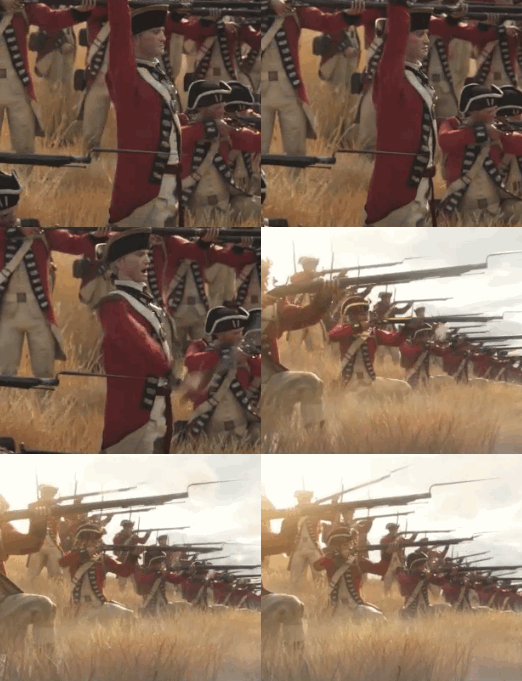
Washington's midnight escape across the Hudson (and Howe's brilliant undocumented response):

Oh yes, and our brilliant retreat, first to Harlem Heights, then to White Plains:
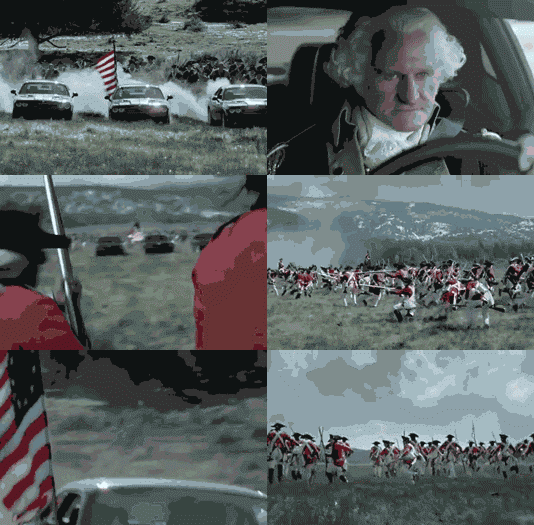
If you're a history buff, don't miss this one.
Washington's midnight escape across the Hudson (and Howe's brilliant undocumented response):
Oh yes, and our brilliant retreat, first to Harlem Heights, then to White Plains:
If you're a history buff, don't miss this one.

May 3, 2026
This was a really nice read. I’ve been on a revolutionary war kick lately and this was a nice look at early on in the war.

August 2, 2019
Joseph Ellis is among a group of historians over the last fifty years who, in my opinion, have rewritten and revised American history, replacing fiction and semi-truths, with facts.
Mr. Ellis' "Revolutionary Summer," is simply another example of replacing fiction with fact. In this book, he takes a short time frame, May, 1776 until October, 1776, to give us a dual perspective of the birth of American Independence. Crosscutting between the Continental Congress and the Continental Army, he gives us the political and the military views of the forming of a nation and the men behind the creation of the American Republic, notably George Washington, Nathanael Greene, John Adams, and Benjamin Franklin; and he also gives us brilliant insight into the thinking of Britain's Admiral Lord Richard Howe and his brother General William Howe whose decisions on the battlefield would greatly affect the outcome of the war.
A note of warning: I would not recommend this book to someone with no knowledge of the 'Revolutionary War' (It is not a starter book) but for anyone with knowledge of that period I would highly recommend.
Mr. Ellis' "Revolutionary Summer," is simply another example of replacing fiction with fact. In this book, he takes a short time frame, May, 1776 until October, 1776, to give us a dual perspective of the birth of American Independence. Crosscutting between the Continental Congress and the Continental Army, he gives us the political and the military views of the forming of a nation and the men behind the creation of the American Republic, notably George Washington, Nathanael Greene, John Adams, and Benjamin Franklin; and he also gives us brilliant insight into the thinking of Britain's Admiral Lord Richard Howe and his brother General William Howe whose decisions on the battlefield would greatly affect the outcome of the war.
A note of warning: I would not recommend this book to someone with no knowledge of the 'Revolutionary War' (It is not a starter book) but for anyone with knowledge of that period I would highly recommend.
August 1, 2013
I am often in the fence about the history of Joseph Ellis. He is an excellent writer, he anticipates some previous knowledge from his readers, and thus never simplifies the subject matter.
In this book Ellis tightens the microscope of his preferred subject, the Revolutionary period, and devotes his entire subject matter to 1776. Telling dual histories we follow the Continental Congress as well as General Washington as he awaits the British Invasion of New York.
The decisions of England's Howe brothers who saw themselves as ambassadors for peace as well as Generals might have done as much to create this country as anything General Washington and his armies ever did.
Trudging through well covered material Ellis brings some very interesting points to light. Ellis theorizes that the fear of a standing army led to a post war glorification of the state militias role in the war. When they were in battle they performed poorly, something we know little of from basic American history. The battles over the "militia" that have led to our 2nd Amendment interpretation questions can be traced back to this fear of a standing army.
And in a rebuke to American foreign policy of today, and yesterday for that matter, when the English army lands and captures Long Island, a delegate to the Continental Congress explains it does not matter. If they as an invader have to fight that hard for every mile to be captured the war will be unwinnable. Something the Brits learned then and we have had to be reminded of a few times in our history as well
Overall a quality short read with some thought provoking theories about a period we all think we know about.
In this book Ellis tightens the microscope of his preferred subject, the Revolutionary period, and devotes his entire subject matter to 1776. Telling dual histories we follow the Continental Congress as well as General Washington as he awaits the British Invasion of New York.
The decisions of England's Howe brothers who saw themselves as ambassadors for peace as well as Generals might have done as much to create this country as anything General Washington and his armies ever did.
Trudging through well covered material Ellis brings some very interesting points to light. Ellis theorizes that the fear of a standing army led to a post war glorification of the state militias role in the war. When they were in battle they performed poorly, something we know little of from basic American history. The battles over the "militia" that have led to our 2nd Amendment interpretation questions can be traced back to this fear of a standing army.
And in a rebuke to American foreign policy of today, and yesterday for that matter, when the English army lands and captures Long Island, a delegate to the Continental Congress explains it does not matter. If they as an invader have to fight that hard for every mile to be captured the war will be unwinnable. Something the Brits learned then and we have had to be reminded of a few times in our history as well
Overall a quality short read with some thought provoking theories about a period we all think we know about.

April 11, 2018
I will always recommend Ellis for those who want to brush up - or learn - basic American revolutionary era history and personas without having to read hundreds of pages to arrive there.
Like Ellis's previous work, this focuses tightly on certain ideas, and while just over 200 pages, does so in such a brief space with a lot of insight and depth. This time, Ellis covers the timespan of May-October 1776, and his focus is Philadelphia and Washington, the first a city and the second the man. While the Convention in Philadelphia inched their way towards declaring independence, Washington was fighting battles that might have been even more important to the birth of the nation. While Philadelphia reached that decision, Washington was retreating from Long Island and Manhattan in order the preserve his army. Although this covers much of the same material of McCullough's 1776, and could be found in larger surveys of the period, my highest ranking arrives because of the absolute compulsiveness I feel when reading Ellis's prose. That raises it from a 4 to a 5 for me. As always, great stuff.
Like Ellis's previous work, this focuses tightly on certain ideas, and while just over 200 pages, does so in such a brief space with a lot of insight and depth. This time, Ellis covers the timespan of May-October 1776, and his focus is Philadelphia and Washington, the first a city and the second the man. While the Convention in Philadelphia inched their way towards declaring independence, Washington was fighting battles that might have been even more important to the birth of the nation. While Philadelphia reached that decision, Washington was retreating from Long Island and Manhattan in order the preserve his army. Although this covers much of the same material of McCullough's 1776, and could be found in larger surveys of the period, my highest ranking arrives because of the absolute compulsiveness I feel when reading Ellis's prose. That raises it from a 4 to a 5 for me. As always, great stuff.

February 2, 2019
A detailed explanation and analysis of roughly May to October, 1776. Ellis dives into the events to explain the sentiments of the Americans, the British, the military players and the principal politicians on both sides. This level of detail illuminates much of how and why the revolution started and prevailed, in a way a wider view leaves unexplained. Mr. Ellis writes with clarity, insight and comparison of known facts to make his point. Any student of American History should read this short but detailed compilation of fact.

August 14, 2017
Revolutionary Summer is a concise telling of the events of the summer of 1776. The writing style is smooth and a lot of information is packed into such a small book. I really enjoyed it - Ellis shapes the individuals vividly and provides you with some insight into each of the key players, both British and American. I would recommend to anyone who enjoys reading about American History.

August 12, 2017
There's a lot that most people don't know about the Revolutionary War. One of the things that never really gets taught in basic history courses is how close the American side came to losing, several times. This book, focusing on the summer and early fall of 1776, shows the early days of the war, and the reasons behind many of the difficulties faced by the Continental Army.
George Washington is rightly remembered as a hero of American history. What isn't really known is the story behind several of his early mistakes. Washington nearly lost his entire army in the various battle around New York City. When just about everything said he should go, he stayed. And really, he should have gone.
But this isn't only about the military. A good bit of the book focuses on the Congress, especially John Adams and a bit on Thomas Jefferson. They, too, had a lot of political hurdles to overcome as a new country was being created from ideas and good intentions. Any political studies major will tell you that's not the best basis for a government.
I've always been interested in the American Revolution, when a completely outmatched band of ragged men beat the strongest army in the world. This book throws some light on the details of some of the early days of that struggle, and the many ways it almost completely fell apart.
Recommended for history fans, especially American History fans.
George Washington is rightly remembered as a hero of American history. What isn't really known is the story behind several of his early mistakes. Washington nearly lost his entire army in the various battle around New York City. When just about everything said he should go, he stayed. And really, he should have gone.
But this isn't only about the military. A good bit of the book focuses on the Congress, especially John Adams and a bit on Thomas Jefferson. They, too, had a lot of political hurdles to overcome as a new country was being created from ideas and good intentions. Any political studies major will tell you that's not the best basis for a government.
I've always been interested in the American Revolution, when a completely outmatched band of ragged men beat the strongest army in the world. This book throws some light on the details of some of the early days of that struggle, and the many ways it almost completely fell apart.
Recommended for history fans, especially American History fans.

December 26, 2022
My first book by Ellis and surprisingly I loved his brevity on a subject that has produced many a dry tomb.
Revolutionary Summer concentrates on just that; the months of May through October 1776 and the dawning of America. I thoroughly enjoyed not re-visiting all the bloody battles. In this narrative Ellis concentrates on the strategy and the main leaders of the armies. What was also refreshing were the excerpts of letters between spouses and friends, when things can be said without the knowledge of others.
"The strategic center of the rebellion was not a place-Not New York, not Philadelphia, not the Hudson corridor-but the Continental Army itself."
As always there "fun facts" revealed: We Celebrate July 4th as the day the Declaration of Independence was signed, Fact: the document was signed, by most, on August 2nd.
Recommended only to true History fans
Revolutionary Summer concentrates on just that; the months of May through October 1776 and the dawning of America. I thoroughly enjoyed not re-visiting all the bloody battles. In this narrative Ellis concentrates on the strategy and the main leaders of the armies. What was also refreshing were the excerpts of letters between spouses and friends, when things can be said without the knowledge of others.
"The strategic center of the rebellion was not a place-Not New York, not Philadelphia, not the Hudson corridor-but the Continental Army itself."
As always there "fun facts" revealed: We Celebrate July 4th as the day the Declaration of Independence was signed, Fact: the document was signed, by most, on August 2nd.
Recommended only to true History fans

April 1, 2013
A good but somewhat superficial study of the summer of 1776 and the events leading up to the Declaration of Independence. Ellis writes very well. Ellis is good at providing portraits of the major figures like John Adams, but I felt he profiled too few of them.
Still, his portrait of General Howe was good. The Howe brothers had insisted on being named as peace commissioners, with wide-ranging powers to grant pardons and offer concessions. They had also, as members of Parliament, opposed many of the more unpopular laws imposed on the colonists. Americans love our historical adversaries to be right out of a movie script: "evil tyrant", "brutal arrogant general", etc. George Washington was certainly not a skilled general and repeatedly found himself bested by Howe. But it is strange how many times Howe failed to follow up his victories and allowed Washington to retreat with his army mostly intact. Washington won only two battles out of eight in the entire war, and spent much of his time retreating, and was rash and over-aggressive. His decision to defend New York against the vastly superior British army nearly lost the war. Washington's offensive plans were overly complicated. Washington was often more concerned about his own reputation than he was about the survival and welfare of his men. When retreats were called, he delegated this responsibility to subordinates, again to protect his reputation.
Interestingly, one of the reasons the Continental Army was able to keep going was due to their own false propaganda. American newspapers never mentioned the defeat at Brooklyn; some even described it as a victory. "Loyalty to 'The Cause', " Ellis writes, "trumped all the conventional definitions of the truth so completely that journalistic integrity became almost treasonable."
Also, similar to what happens in America today, whenever Britain's commanders suffered failure, the public looked for someone in the army or the government to blame. The Continental Congress was not any better in terms of harmony; they knew what they were against, but not what they were for.
Many of the Continental Army's soldiers were idealists, upholding romantic notions of their moral supremacy and the righteousness of their cause: the so-called "Spirit of '76." Washington himself was too much of a realist to embrace this attitude. He had little confidence in his troops or in his own ability to lead them to victory. The spirit of '76 was dying even before the Declaration of Independence came around. As the Declaration itself was passed, the Continental Army was on the verge of annihilation.
Continental Army soldiers were, of course, "citizen-soldiers", a romantic way of saying amateurs. In our own popular imagination, the army was a legion of selfless heroes. In fact, most of them were amateurs, and more loyal to their states than to the "nation"; mainly because service in the state militia paid better than the Continental Army. Many recruits enlisted in one regiment and then re-enlisted in others for an extra helping of bounty money. Recruiting proved difficult; the majority of the colonists wanted nothing to do with the conflict. In most towns, revolutionaries created vigilante groups to intimidate loyalists and force the locals to swear loyalty oaths.
"The idealistic, quasi-religious political mentality suggested by elevated expressions like 'The Cause' and moralistic references to the superiority of American virtue as contrasted with British corruption, " Ellis writes, "had provided a rhetorical platform on which the different and disparate state and regional interests could congregate as a self-proclaimed collective...The exalted and almost operatic character of this mentality was heartfelt but unsustainable. It was the honeymoon phase of a marriage, blissfully romantic but of short duration."
We usually picture the signing of the Declaration of Independence as a single event that took place on July 4, 1776. In reality, the document was presented to Congress on June 28, Congress voted on July 2, and afterwards Congress spent a few days editing what was basically a press release. The document was not ready for publication until July 4, and the actual "signing" took months (John Hancock signed on August 2, and the others followed suit in the tiny space that was left). For some reason, Jefferson claimed that there was a signing ceremony on July 4.
Ellis, unlike other historians of this period, also deals with the question of slavery. The revolutionaries claimed to stand for government by consent, a principle rooted in colonial society and history but blatantly contradicted by slavery: 20% of the colonial population were blacks, and 90% of these were slaves. One of the grievances listed in the original draft of the Declaration of Independence accused George III of inciting slave insurrections.

June 11, 2013
Very good account of the early part of the American Revolution. Very similar to David McCullough's 1776. So much history that took place just a few miles from where I have lived all my life. It is very interesting to consider what would have happened if William Howe had decided to attack Washington in northern Manhattan. He could have destroyed the Continental Army, and essentially ended the Revolution at its beginning. How would history have changed? Very good read for American history buffs, although you probably do not need to read both this one and 1776 like I did :-).

June 5, 2025
After listening to a long Thomas Jefferson biography that glossed over a lot of key Revolutionary War events, I wanted to dig in a little and Revolutionary Summer perfectly met my desires. Covering just the summer of 1776, we get the story of the Declaration of Independence offset with the battles for New York (which basically set the tone for the whole rest of the war).
Good details, good analysis, good big picture reminders. Sign me up for all the rest of Joseph J. Ellis's Revolutionary era books.
Good details, good analysis, good big picture reminders. Sign me up for all the rest of Joseph J. Ellis's Revolutionary era books.

July 4, 2024
Excellent scope and research

June 12, 2026
As July 4 approached, I started a 2-pack of rebellious reads, the first being Joseph Ellis’s Revolutionary Summer. This short book looks at the bulk of 1776 from a seat in congress and the command posts on both sides, with the aim to show how the fights in all three places shaped the later war and led to eventual victory for the Americans.
Ellis achieves his goal, while bringing John Adams out from obscurity to lead the battles in Philadelphia. George Washington’s successes and setbacks in New York dominate the war perspective, but William Howe lurks at every turn of the page.
Much like His Excellency, this book has a much-repeated word that makes me wish the author had a thesaurus. This time the word is hindsight, when it should be plenty obvious that we’re looking backward to 1776 from a book written in 2013.
Now I’m onto David McCullough’s 1776, which Ellis frequently sites. Though this book is a solid work and easy read, a casual reader of the period might be better served by looking for McCullough’s.
Ellis achieves his goal, while bringing John Adams out from obscurity to lead the battles in Philadelphia. George Washington’s successes and setbacks in New York dominate the war perspective, but William Howe lurks at every turn of the page.
Much like His Excellency, this book has a much-repeated word that makes me wish the author had a thesaurus. This time the word is hindsight, when it should be plenty obvious that we’re looking backward to 1776 from a book written in 2013.
Now I’m onto David McCullough’s 1776, which Ellis frequently sites. Though this book is a solid work and easy read, a casual reader of the period might be better served by looking for McCullough’s.

June 22, 2013
Joseph J. Ellis, who deservedly won the Pulitzer for his great “Founding Brothers,” equally deserves that accolade for this excellent “Revolutionary Summer.”
Ellis has done with a crucial moment in our Revolution Story, what Jay Winik did with our Civil War Story to such successful impact in “April 1865.” Each author took a laser focus on a moment in time that was not only a turning point in our collective history but also the convergence point of so many threads and personalities of the underlying complex narrative. Unlike nearly all of our recent historical chronicles of the Revolutionary period, including Ellis’ own work, that tend to tell the story in biographical relief or in chronological survey of either political or military points of view, here Ellis weaves together how each personality across the political and military stage influenced the thoughts and actions of the other. Further, he masterfully unveils standards and norms of the period, like character and honor, which have so drifted from our contemporary consciousness that without this lens many decisions, particularly on the battlefield, become inexplicable.
Perhaps most fascinating is the insight into the two brothers, British Admiral Richard Howe and General William Howe, who, if they had acted differently, if they had less desire to sue for peace with their “unruly brethren,” could almost have certainly crushed the Revolution in its crib. But then again, what is most intriguing of this weaving of the political and the military stories is perhaps that given the politicians commitment to Independence in this summer of 1776, the whole affair had transcended a mere military consequence. A meeting between Continental Congress representatives, Adams and Franklin, with Admiral Howe in early fall 1776 after the overwhelming US defeat at New York, speaks profoundly of this unwavering belief that Independence was inevitable and the military campaigns were simply a barometer of when.
Ellis saves his best work in underscoring this perception of inevitability while simultaneously indirectly giving profound insight into the foolishness of America’s wars of the last 50 years – Viet Nam, Iraq and Afghanistan. In all three, we were the British in an unwinnable war by failing to remember what our founding fathers knew intuitively. Ellis recounts how Adams grew in assurance of this inevitability by his reading of Greek and Roman military histories (imagine a contemporary politician doing likewise). He saw America as the same as the winning ancient underdogs: Thebes against Sparta in the Peloponnesian War or Rome against Carthage in the Punic Wars. “For like Hannibal, Howe would discover that winning battles was not synonymous with winning wars. Conquests were easily made because we achieve them with our full force; they are retained with difficulty because we defend them with only a part of our forces.” Thus, the greater Howe’s victories, the greater were his difficulties. For Adams understood, and history retells for any insurrection on a foreign land, Howe was destined to win his way to defeat. “The British had to win the war, but the American’s had only not to lose it.”
For any student of American history, “Revolutionary Summer” is a must read!
Ellis has done with a crucial moment in our Revolution Story, what Jay Winik did with our Civil War Story to such successful impact in “April 1865.” Each author took a laser focus on a moment in time that was not only a turning point in our collective history but also the convergence point of so many threads and personalities of the underlying complex narrative. Unlike nearly all of our recent historical chronicles of the Revolutionary period, including Ellis’ own work, that tend to tell the story in biographical relief or in chronological survey of either political or military points of view, here Ellis weaves together how each personality across the political and military stage influenced the thoughts and actions of the other. Further, he masterfully unveils standards and norms of the period, like character and honor, which have so drifted from our contemporary consciousness that without this lens many decisions, particularly on the battlefield, become inexplicable.
Perhaps most fascinating is the insight into the two brothers, British Admiral Richard Howe and General William Howe, who, if they had acted differently, if they had less desire to sue for peace with their “unruly brethren,” could almost have certainly crushed the Revolution in its crib. But then again, what is most intriguing of this weaving of the political and the military stories is perhaps that given the politicians commitment to Independence in this summer of 1776, the whole affair had transcended a mere military consequence. A meeting between Continental Congress representatives, Adams and Franklin, with Admiral Howe in early fall 1776 after the overwhelming US defeat at New York, speaks profoundly of this unwavering belief that Independence was inevitable and the military campaigns were simply a barometer of when.
Ellis saves his best work in underscoring this perception of inevitability while simultaneously indirectly giving profound insight into the foolishness of America’s wars of the last 50 years – Viet Nam, Iraq and Afghanistan. In all three, we were the British in an unwinnable war by failing to remember what our founding fathers knew intuitively. Ellis recounts how Adams grew in assurance of this inevitability by his reading of Greek and Roman military histories (imagine a contemporary politician doing likewise). He saw America as the same as the winning ancient underdogs: Thebes against Sparta in the Peloponnesian War or Rome against Carthage in the Punic Wars. “For like Hannibal, Howe would discover that winning battles was not synonymous with winning wars. Conquests were easily made because we achieve them with our full force; they are retained with difficulty because we defend them with only a part of our forces.” Thus, the greater Howe’s victories, the greater were his difficulties. For Adams understood, and history retells for any insurrection on a foreign land, Howe was destined to win his way to defeat. “The British had to win the war, but the American’s had only not to lose it.”
For any student of American history, “Revolutionary Summer” is a must read!

July 3, 2026
There are some helpful insights here about the players and places and happenings of the historic year of 1776, and what made it so. Here are some quotes I liked:
"If you will grant a somewhat expansive definition of summer, then the summer of 1776 was the crescendo moment in American history... There are two intertwined strands to this story that are customarily told as stand alone accounts in their own right. The first is the political tale of how thirteen colonies came together and agreed on the decision to secede from the British Empire... The second is the military narrative of the battles on Long Island and Manhattan, where the British army and navy delivered a series of devastating defeats to an American army of amateurs, but missed whatever chance existed to end it all (p. ix)."
"The battles on Long Island and Manhattan were political contests for hearts and minds more than military maneuvers for territory. Knowing the outcome of the American Revolution has also blinded us to the problematic character of this intense moment, when everything was in the balance, history was happening at an accelerating pace, and both sides... were improvising on the edge of catastrophe (p. x)."
"'How could the British possibly lose?'... 'Was there any realistic chance for them to win?' (p. xi)"
"The core concept in this quasi-chivalric code was character, the notion that a clearly defined set of principles governed a gentleman's behavior at all times, most especially in highly stressful or life-threatening situations (p. xii)."
"Washington is the most conspicuously honor-driven character in our story (p. xii)."
"Allegiances within the far-flung American population remained local, or at most regional, in scope (p. xii)."
"An undeclared war has been raging for over a year, and a huge British fleet is preparing to sail across the Atlantic to deliver a decisive blow that will crush the American rebellion at its moment of birth (p. xiii)."
"While the engagements at Lexington and Concord had been mere skirmishes, the battle at Bunker Hill had been a bloodbath, especially for the British (p. 3)."
"Though most of the military action was restricted to New England and Canada, no reasonable witness could possibly deny that the war for American independence, not yet called the American Revolution, had begun (p. 4)."
"If you widen the lens to include the Continental Congress in Philadelphia, the picture becomes quite blurry and downright strange (p. 4)."
"Washington... let it be known that he had lost all patience with the moderates in the congress who were... 'still feeding themselves on the dainty food of reconciliation' (p. 5)."
"During the early years of the imperial crisis, Dickinson was perhaps the most prominent advocate for colonial rights within the empire (p. 8)."
"Moderates on both sides of the Atlantic were swept to the sidelines, and the obvious compromise became a casualty of war (p. 10)."
"George III had single-handedly undermined the reconciliation agenda of the moderate faction in the congress (p. 11)."
"Nothing in [Thomas] Paine's background marked him as a candidate for greatness (p. 12)."
"Adams entered the Continental Congress in 1774 already convinced that Great Britain's imperial agenda left little room for negotiation or accommodation (p. 13)."
"Paine's pamphlet had certainly helped 'The Cause' on this score, but it was not at all clear that the majority of Americans, especially in the middle colonies, were ready for a break with the crown (p. 15)."
"'If we separate from Great Britain, what code of laws will be established? How shall we be governed so as to retain our liberties? Can any government be free which is not administered by general laws? Who shall frame these laws? Who will give them force and energy?' (p. 16)"
"A formal resolution by the congress to implement the Adams proposal for new state constitutions to replace the colonial constitutions sanctioned under the authority of the British Crown was approved on May 12 (p. 17)."
"Adams immediately sensed that something truly historic had just happened (p. 18)."
"George III's hostile and aggressive actions severed that last link (p. 19)."
"Slavery was the most blatant contradiction of everything the budding American Revolution claimed to stand for (p. 20)."
"Citizenship was not a privilege to be enjoyed only by those with landed wealth, but a right of every adult male, vested in his person rather than in his property (p. 22)."
"Hindsight allows us to see that in the space of a very few months, the entire liberal agenda for the next century was inserted into the political conversation (p. 22)."
"Adams believed that the debate about the kind of republic America wished to become must be postponed until after the war for independence had succeeded (p. 23)."
"The Continental Congress had made a bottom-up decision in the republican way to conduct an open-ended referendum on American independence and what it meant. It was a much messier way of proceeding, but it was also true to the principles the colonists claimed to stand for (p. 23)."
"Although American independence was still not officially declared by the late spring of 1776, it already had a martyr and a hero. The martyr was Joseph Warren, a local physician who was marked as a rising star in Boston politics and who also just happened to be the doctor for the Adams family... The hero was George Washington, the commander in chief of the haphazard collection of militia units now being referred to as the Continental Army (p. 25)."
"Thomas Jefferson was about to declare some rather significant self-evident truths of his own, but for now, and in fact for the entire war, Washington was the towering self-evident truth on horseback, indispensable because he rendered all argument unnecessary (p. 28)."
"The army marching behind Washington might charitably have been called a work in progress (p. 29)."
"They were all volunteers fighting for a cause they believed in passionately (p. 30)."
"The appointment of Greene and Knox as senior officers is usually cited as an example of Washington's uncanny judgment about latent ability (p. 33)."
"As the spring flowers bloomed and the grasses greened along the road to New York, the honeymoon phase of the American Revolution was coming to an end (p. 34)."
"Much in the manner of Washington, the foundation of Howe's military education was laid during the French and Indian War (p. 37)."
"Washington kept an elaborate account of all his expenses for the trip to and residence in Philadelphia but made no record of the all-important deliberations about the defense of New York (p. 45)."
"The resolution passed by the Continental Congress on May 15 was a clarion call to force an up-or-down vote in the colonial legislation on the question of independence (p. 49)."
"When history was happening at such breakneck speed, any effort at management was an illusion (p. 56)."
"Adams convened the committee to draft that document on June 11. The other members were Benjamin Franklin, Thomas Jefferson, Robert Livingston, and Roger Sherman (p. 57)."
"On July 4 the congress approved its revised version, and the Declaration of Independence was sent to the printer for publication (p. 61)."
"The most important occurrence during the editorial debate within the congress was an event that did not happen, another dog that did not bark. Fixated as they were on the long grievances section, the delegates ignored altogether the first two paragraphs of the text... They made no comment whatsoever on the following words: We hold these truths to be self-evident; that all men are created equal; that they are endowed by their Creator with certain inalienable rights; that among these are life, liberty, and the pursuit of happiness (p. 63)."
"What Jefferson had done, albeit inadvertently, was to smuggle the radical implications of the American Revolution into the founding document, planting the seeds that would grow into the expanding liberal mandate for individual rights that eventually ended the property qualifications to vote, ended slavery, made women's suffrage inevitable, and sanctioned the civil rights of all racial minorities (p. 64)."
"As the core statement of America's most elemental principles, the natural rights section of the Declaration has stood the test of time, just as Lincoln predicted it would (p. 65)."
"'The fate of the unborn millions will now depend, under God, on the conduct of this army' (p. 67)."
"'I consider this war against us therefore, as both unjust, and unwise, and I am persuaded that cool dispassionate posterity will condemn to infamy those who advised it; and that not even success will save from some degree of dishonor, those who voluntarily engaged to conduct it' (Benjmain Franklin, p. 68)."
"The Americans were patriots fighting for the noble goal of independence (p. 71)."
"'The Congress have judged it necessary to dissolve the connection between Great Britain and the American Colonies, and to declare them free and independent states; as you will perceive by the enclosed Declaration, which I am directed to transmit to you, and to request that you will have it proclaimed at the head of the army in the way you shall think it most proper' (Hancock to Washington, p. 71)."
"Hindsight was not available to Washington (p. 75)."
"Washington's chief accomplice in managing the cascading array of daily demands was Joseph Reed (p. 76)."
"The view of the American side of the divide was most eloquently expressed by Benjamin Franklin (p. 81)."
"Franklin was... a latecomer to the cause of American independence (p. 81)."
"If Washington was the new American hero, Franklin was the most familiar and famous American of the century (p. 82)."
"Because voting in the Continental Congress remained state-based, Sherman and the other small-state delegates knew that they could carry the day despite opposition by such powerful opponents as Franklin and Adams. And they did (p. 95)."
"Adams had a wholly different temperament and a range of responsibilities within the congress that did not allow him the luxury of indulging his personal feelings (p. 101)."
"If Jefferson was disposed to levitate above the political struggles within congress, and if Adams preferred to embed himself in them all at once, Franklin brought his own distinctive mix of floating engagement to the task (p. 104)."
"The amateur status of the Continental Army had been exposed in no uncertain terms on Long Island, and all the platitudinous incantations about the moral superiority of the American cause had fallen victim to the military superiority of a professional army (p. 128)."
"'In general, our Generals were out generalled' (p. 128)."
"The correspondence of other delegates to the Continental Congress suggests that Adams was not alone in attempting to manage the political momentum (p. 128)."
"All the state governments remained resolute on the question of American independence (p. 144)."
"'We see to be kept in a total ignorance of affairs at New York' (p. 145)."
"The Continental Army needed to expand to at least 60,000 troops, with a majority committed to serving 'for the duration' (p. 158)."
"The visiting committee endorsed all the reforms that Washington and his staff suggested (p. 159)."
"Whether it was demographically, divinely, or historically sanctioned, they regarded the fate of American independence as foreordained. Even if the specific arguments were specious, the underlying faith on which they rested was unshakable. The Howes had badly miscalculated the depth of that faith (p. 165)."
"It was the end of the beginning for the American side, meaning that its army had managed to survive what proved to be the most vulnerable moment of the war (p. 170)."
"The Continental Army would forever remain a kind of awkward orphan, indispensable but suspect, always on the verge of dissolution (p. 171)."
"Though Washington was not a deeply religious man, the early months of the war made him a believer in providence, which meant that on some occasions the gods took matters into their own hands (p. 174)."
"Explaining a defeat is always a more difficult assignment than explaining a victory (p. 177)."
"What we might call the Howe interpretation of the British defeat never received official status. For that matter, the British government never saw fit to conduct an official inquiry into the reasons for the rather monumental debacle, preferring instead to draw a curtain of silence around the entire episode, treating it like a wound that would heal itself over time (p. 182)."
"If you will grant a somewhat expansive definition of summer, then the summer of 1776 was the crescendo moment in American history... There are two intertwined strands to this story that are customarily told as stand alone accounts in their own right. The first is the political tale of how thirteen colonies came together and agreed on the decision to secede from the British Empire... The second is the military narrative of the battles on Long Island and Manhattan, where the British army and navy delivered a series of devastating defeats to an American army of amateurs, but missed whatever chance existed to end it all (p. ix)."
"The battles on Long Island and Manhattan were political contests for hearts and minds more than military maneuvers for territory. Knowing the outcome of the American Revolution has also blinded us to the problematic character of this intense moment, when everything was in the balance, history was happening at an accelerating pace, and both sides... were improvising on the edge of catastrophe (p. x)."
"'How could the British possibly lose?'... 'Was there any realistic chance for them to win?' (p. xi)"
"The core concept in this quasi-chivalric code was character, the notion that a clearly defined set of principles governed a gentleman's behavior at all times, most especially in highly stressful or life-threatening situations (p. xii)."
"Washington is the most conspicuously honor-driven character in our story (p. xii)."
"Allegiances within the far-flung American population remained local, or at most regional, in scope (p. xii)."
"An undeclared war has been raging for over a year, and a huge British fleet is preparing to sail across the Atlantic to deliver a decisive blow that will crush the American rebellion at its moment of birth (p. xiii)."
"While the engagements at Lexington and Concord had been mere skirmishes, the battle at Bunker Hill had been a bloodbath, especially for the British (p. 3)."
"Though most of the military action was restricted to New England and Canada, no reasonable witness could possibly deny that the war for American independence, not yet called the American Revolution, had begun (p. 4)."
"If you widen the lens to include the Continental Congress in Philadelphia, the picture becomes quite blurry and downright strange (p. 4)."
"Washington... let it be known that he had lost all patience with the moderates in the congress who were... 'still feeding themselves on the dainty food of reconciliation' (p. 5)."
"During the early years of the imperial crisis, Dickinson was perhaps the most prominent advocate for colonial rights within the empire (p. 8)."
"Moderates on both sides of the Atlantic were swept to the sidelines, and the obvious compromise became a casualty of war (p. 10)."
"George III had single-handedly undermined the reconciliation agenda of the moderate faction in the congress (p. 11)."
"Nothing in [Thomas] Paine's background marked him as a candidate for greatness (p. 12)."
"Adams entered the Continental Congress in 1774 already convinced that Great Britain's imperial agenda left little room for negotiation or accommodation (p. 13)."
"Paine's pamphlet had certainly helped 'The Cause' on this score, but it was not at all clear that the majority of Americans, especially in the middle colonies, were ready for a break with the crown (p. 15)."
"'If we separate from Great Britain, what code of laws will be established? How shall we be governed so as to retain our liberties? Can any government be free which is not administered by general laws? Who shall frame these laws? Who will give them force and energy?' (p. 16)"
"A formal resolution by the congress to implement the Adams proposal for new state constitutions to replace the colonial constitutions sanctioned under the authority of the British Crown was approved on May 12 (p. 17)."
"Adams immediately sensed that something truly historic had just happened (p. 18)."
"George III's hostile and aggressive actions severed that last link (p. 19)."
"Slavery was the most blatant contradiction of everything the budding American Revolution claimed to stand for (p. 20)."
"Citizenship was not a privilege to be enjoyed only by those with landed wealth, but a right of every adult male, vested in his person rather than in his property (p. 22)."
"Hindsight allows us to see that in the space of a very few months, the entire liberal agenda for the next century was inserted into the political conversation (p. 22)."
"Adams believed that the debate about the kind of republic America wished to become must be postponed until after the war for independence had succeeded (p. 23)."
"The Continental Congress had made a bottom-up decision in the republican way to conduct an open-ended referendum on American independence and what it meant. It was a much messier way of proceeding, but it was also true to the principles the colonists claimed to stand for (p. 23)."
"Although American independence was still not officially declared by the late spring of 1776, it already had a martyr and a hero. The martyr was Joseph Warren, a local physician who was marked as a rising star in Boston politics and who also just happened to be the doctor for the Adams family... The hero was George Washington, the commander in chief of the haphazard collection of militia units now being referred to as the Continental Army (p. 25)."
"Thomas Jefferson was about to declare some rather significant self-evident truths of his own, but for now, and in fact for the entire war, Washington was the towering self-evident truth on horseback, indispensable because he rendered all argument unnecessary (p. 28)."
"The army marching behind Washington might charitably have been called a work in progress (p. 29)."
"They were all volunteers fighting for a cause they believed in passionately (p. 30)."
"The appointment of Greene and Knox as senior officers is usually cited as an example of Washington's uncanny judgment about latent ability (p. 33)."
"As the spring flowers bloomed and the grasses greened along the road to New York, the honeymoon phase of the American Revolution was coming to an end (p. 34)."
"Much in the manner of Washington, the foundation of Howe's military education was laid during the French and Indian War (p. 37)."
"Washington kept an elaborate account of all his expenses for the trip to and residence in Philadelphia but made no record of the all-important deliberations about the defense of New York (p. 45)."
"The resolution passed by the Continental Congress on May 15 was a clarion call to force an up-or-down vote in the colonial legislation on the question of independence (p. 49)."
"When history was happening at such breakneck speed, any effort at management was an illusion (p. 56)."
"Adams convened the committee to draft that document on June 11. The other members were Benjamin Franklin, Thomas Jefferson, Robert Livingston, and Roger Sherman (p. 57)."
"On July 4 the congress approved its revised version, and the Declaration of Independence was sent to the printer for publication (p. 61)."
"The most important occurrence during the editorial debate within the congress was an event that did not happen, another dog that did not bark. Fixated as they were on the long grievances section, the delegates ignored altogether the first two paragraphs of the text... They made no comment whatsoever on the following words: We hold these truths to be self-evident; that all men are created equal; that they are endowed by their Creator with certain inalienable rights; that among these are life, liberty, and the pursuit of happiness (p. 63)."
"What Jefferson had done, albeit inadvertently, was to smuggle the radical implications of the American Revolution into the founding document, planting the seeds that would grow into the expanding liberal mandate for individual rights that eventually ended the property qualifications to vote, ended slavery, made women's suffrage inevitable, and sanctioned the civil rights of all racial minorities (p. 64)."
"As the core statement of America's most elemental principles, the natural rights section of the Declaration has stood the test of time, just as Lincoln predicted it would (p. 65)."
"'The fate of the unborn millions will now depend, under God, on the conduct of this army' (p. 67)."
"'I consider this war against us therefore, as both unjust, and unwise, and I am persuaded that cool dispassionate posterity will condemn to infamy those who advised it; and that not even success will save from some degree of dishonor, those who voluntarily engaged to conduct it' (Benjmain Franklin, p. 68)."
"The Americans were patriots fighting for the noble goal of independence (p. 71)."
"'The Congress have judged it necessary to dissolve the connection between Great Britain and the American Colonies, and to declare them free and independent states; as you will perceive by the enclosed Declaration, which I am directed to transmit to you, and to request that you will have it proclaimed at the head of the army in the way you shall think it most proper' (Hancock to Washington, p. 71)."
"Hindsight was not available to Washington (p. 75)."
"Washington's chief accomplice in managing the cascading array of daily demands was Joseph Reed (p. 76)."
"The view of the American side of the divide was most eloquently expressed by Benjamin Franklin (p. 81)."
"Franklin was... a latecomer to the cause of American independence (p. 81)."
"If Washington was the new American hero, Franklin was the most familiar and famous American of the century (p. 82)."
"Because voting in the Continental Congress remained state-based, Sherman and the other small-state delegates knew that they could carry the day despite opposition by such powerful opponents as Franklin and Adams. And they did (p. 95)."
"Adams had a wholly different temperament and a range of responsibilities within the congress that did not allow him the luxury of indulging his personal feelings (p. 101)."
"If Jefferson was disposed to levitate above the political struggles within congress, and if Adams preferred to embed himself in them all at once, Franklin brought his own distinctive mix of floating engagement to the task (p. 104)."
"The amateur status of the Continental Army had been exposed in no uncertain terms on Long Island, and all the platitudinous incantations about the moral superiority of the American cause had fallen victim to the military superiority of a professional army (p. 128)."
"'In general, our Generals were out generalled' (p. 128)."
"The correspondence of other delegates to the Continental Congress suggests that Adams was not alone in attempting to manage the political momentum (p. 128)."
"All the state governments remained resolute on the question of American independence (p. 144)."
"'We see to be kept in a total ignorance of affairs at New York' (p. 145)."
"The Continental Army needed to expand to at least 60,000 troops, with a majority committed to serving 'for the duration' (p. 158)."
"The visiting committee endorsed all the reforms that Washington and his staff suggested (p. 159)."
"Whether it was demographically, divinely, or historically sanctioned, they regarded the fate of American independence as foreordained. Even if the specific arguments were specious, the underlying faith on which they rested was unshakable. The Howes had badly miscalculated the depth of that faith (p. 165)."
"It was the end of the beginning for the American side, meaning that its army had managed to survive what proved to be the most vulnerable moment of the war (p. 170)."
"The Continental Army would forever remain a kind of awkward orphan, indispensable but suspect, always on the verge of dissolution (p. 171)."
"Though Washington was not a deeply religious man, the early months of the war made him a believer in providence, which meant that on some occasions the gods took matters into their own hands (p. 174)."
"Explaining a defeat is always a more difficult assignment than explaining a victory (p. 177)."
"What we might call the Howe interpretation of the British defeat never received official status. For that matter, the British government never saw fit to conduct an official inquiry into the reasons for the rather monumental debacle, preferring instead to draw a curtain of silence around the entire episode, treating it like a wound that would heal itself over time (p. 182)."

July 31, 2013
Joseph J. Ellis, Revolutionary Summer: The Birth of American Independence (New York: Alred A. Knopf, 2013). $26.95, 240 pages. Hardcover / Kindle
Although the American Revolution can be viewed from many perspectives, history books typically emphasize the political and military ones, and for good reason. The Revolution was a bid for political independence that needed to be secured by force of arms. Revolutionary Summer is the latest history book aimed at a popular readership that tells the story of how political and military concerns interacted from May through October 1776.
During those months, the American colonies—heretofore divided among patriot, moderate, and loyalist factions—coalesced toward independence, coalescence helped along by the British invasion of New York. From a military perspective, the British missed several opportunities to destroy Washington’s Continental Army in New York, misses that were harshly criticized after the war. At the time, however, British military leaders were hesitant to take decisive moves lest they further politically alienate the American colonists.
The colonists faced the opposite problem. Politics were their strength, but the military was their weakness. The Continental Army was chronically underfunded, undersupplied, and made up of militias that were more committed to their states than to the newly declared United States. It would win the war by not losing it. And what kind of union did these states have anyway? A confederation? A union?
Joseph J. Ellis narrates the history of these crucial months, and the answers to these questions, with his typically graceful prose. I read Revolutionary Summer after reading Nathaniel Philbrick’s Bunker Hill, which focuses on the rise and progress of the revolution in Boston in 1775. Both books are excellent examples of how history can be written for a broad readership. And they are useful reminders that, far from a foregone conclusion, the success of the American Revolution was a close-run thing.
P.S. If you found my review helpful, please vote “Yes” on my Amazon.com review page.
Although the American Revolution can be viewed from many perspectives, history books typically emphasize the political and military ones, and for good reason. The Revolution was a bid for political independence that needed to be secured by force of arms. Revolutionary Summer is the latest history book aimed at a popular readership that tells the story of how political and military concerns interacted from May through October 1776.
During those months, the American colonies—heretofore divided among patriot, moderate, and loyalist factions—coalesced toward independence, coalescence helped along by the British invasion of New York. From a military perspective, the British missed several opportunities to destroy Washington’s Continental Army in New York, misses that were harshly criticized after the war. At the time, however, British military leaders were hesitant to take decisive moves lest they further politically alienate the American colonists.
The colonists faced the opposite problem. Politics were their strength, but the military was their weakness. The Continental Army was chronically underfunded, undersupplied, and made up of militias that were more committed to their states than to the newly declared United States. It would win the war by not losing it. And what kind of union did these states have anyway? A confederation? A union?
Joseph J. Ellis narrates the history of these crucial months, and the answers to these questions, with his typically graceful prose. I read Revolutionary Summer after reading Nathaniel Philbrick’s Bunker Hill, which focuses on the rise and progress of the revolution in Boston in 1775. Both books are excellent examples of how history can be written for a broad readership. And they are useful reminders that, far from a foregone conclusion, the success of the American Revolution was a close-run thing.
P.S. If you found my review helpful, please vote “Yes” on my Amazon.com review page.

July 24, 2013
You know, it never hurts to brush up on history. I had begun to worry that I didn't understand the American Revolution and was mixing facts, making stuff up.
No, it turns out, I'm good. I know the basics: the flow of events, the major players, even some of the cities involved. I'm not as knowledgeable as I'd like to be but am probably good enough to be a standard American.
I know that because most of what I listened to, I actually remembered learning in Ms. Morrison's American History class and all the major things have been retained in my haphazard memory, so - yay!
Here's what I liked about this book: It's written in narrative format so it's not as dry and boring as a typical history text. I know, it's sad I have to have things told as a story in order for them to stick but it's not just me. A lot of people are like that. I'm not going to apologize.
Here's what I didn't like: It started going on and on and became as boring as a typical history text. I loved the letters between John and Abigail Adams. I loved Ben Franklin's snotty academic attitude. But then the fighting started after 1776 and I had no idea why I was being told half the things I was told or why I cared about Howe's "trial" in England. I mean, sure, it's a good way to wrap everything up but...one minute, Washington is not sure what he's going to do or how he's going to keep the army alive and the next minute, the war is...well, not-won - the book often mentions the not-winning America did, how it just survived longer than Britain and, therefore, they lost - and Howe has to give a debriefing to his peers, some of whom back him and some don't and THE END.
Yes, it just ended like that. I thought I must have fast-forwarded, skipping an entire section, but no. Trial. End.
So I don't really feel I learned anything but I'd still recommend this to anyone who wants to brush up on the events that happened between the Boston Tea Party (the massacre isn't really mentioned) and September 1776.
Also? This book left me wanting to learn more about Abigail Adams. I'm not sure how she flew under my radar all this time; this book makes her sound fairly kick-ass.
No, it turns out, I'm good. I know the basics: the flow of events, the major players, even some of the cities involved. I'm not as knowledgeable as I'd like to be but am probably good enough to be a standard American.
I know that because most of what I listened to, I actually remembered learning in Ms. Morrison's American History class and all the major things have been retained in my haphazard memory, so - yay!
Here's what I liked about this book: It's written in narrative format so it's not as dry and boring as a typical history text. I know, it's sad I have to have things told as a story in order for them to stick but it's not just me. A lot of people are like that. I'm not going to apologize.
Here's what I didn't like: It started going on and on and became as boring as a typical history text. I loved the letters between John and Abigail Adams. I loved Ben Franklin's snotty academic attitude. But then the fighting started after 1776 and I had no idea why I was being told half the things I was told or why I cared about Howe's "trial" in England. I mean, sure, it's a good way to wrap everything up but...one minute, Washington is not sure what he's going to do or how he's going to keep the army alive and the next minute, the war is...well, not-won - the book often mentions the not-winning America did, how it just survived longer than Britain and, therefore, they lost - and Howe has to give a debriefing to his peers, some of whom back him and some don't and THE END.
Yes, it just ended like that. I thought I must have fast-forwarded, skipping an entire section, but no. Trial. End.
So I don't really feel I learned anything but I'd still recommend this to anyone who wants to brush up on the events that happened between the Boston Tea Party (the massacre isn't really mentioned) and September 1776.
Also? This book left me wanting to learn more about Abigail Adams. I'm not sure how she flew under my radar all this time; this book makes her sound fairly kick-ass.

June 26, 2013
A couple weeks ago I started reading 1775: A Good Year for Revolution by Kevin Phillips but was defeated, as I was in 2000 by The Cousins’ Wars, by the bog of historical detail. Phillips is rarely less than interesting but his research is exhausting.
Joseph J. Ellis, the Pulitzer-Prize-winning historian of revolutionary America, praised Phillips in his New York Times review despite the “rambling character of the middle chapters”:
Now Ellis has published Revolutionary Summer – which focuses on the moment that perfect storm broke over Long Island, and Washington’s Continental Army was almost extinguished by the onslaught of superior British forces. Only a series of improbable accidents (and the hesitation of William Howe) preserved the army to fight another day.
This is the first book I’ve read by Ellis. It’s excellent in all the ways 1775 is not. Characters are sharply defined, events move swiftly, the political and military analysis is perspicacious, and the prose is superb throughout. I’m as cynical as Kevin Phillips about the current state of the Republic and the mendacious mediocrities who govern it – but Ellis caught me up in the excitement of its first spectacular summer.
Joseph J. Ellis, the Pulitzer-Prize-winning historian of revolutionary America, praised Phillips in his New York Times review despite the “rambling character of the middle chapters”:
This is a feisty, fearless, edgy book, blissfully bereft of academic jargon, propelled by the energy of an author with the bit in his teeth.... the story he tells is not neat and orderly because making a revolution is, almost by definition, a dizzy experience that no one at the time fully comprehends. Phillips’s major accomplishment is to recover that sense of excitement, confusion and improvisation as, almost providentially, the perfect storm formed.That is generous and probably just. I'll never know.
Now Ellis has published Revolutionary Summer – which focuses on the moment that perfect storm broke over Long Island, and Washington’s Continental Army was almost extinguished by the onslaught of superior British forces. Only a series of improbable accidents (and the hesitation of William Howe) preserved the army to fight another day.
This is the first book I’ve read by Ellis. It’s excellent in all the ways 1775 is not. Characters are sharply defined, events move swiftly, the political and military analysis is perspicacious, and the prose is superb throughout. I’m as cynical as Kevin Phillips about the current state of the Republic and the mendacious mediocrities who govern it – but Ellis caught me up in the excitement of its first spectacular summer.

November 1, 2016
Joseph J. Ellis described both the political and military atmosphere of 1776 in a well-written manner.
I highly enjoyed to find Washington as hesitant as honour driven character he was, though, being able to take the right decisions and manage own fears for the sake of The Cause when just The Cause wasn't actually sufficient for young, inexperienced militia to confront the glorious British forces led by William Howe.
The plot behind the war covers the Revolution in different scales, e.g. why Thomas Jefferson undertook the dirty work, i.e. drafting the Declaration of Independence ensued by its far-reaching impacts... and the reserved issues that could put the union existence under question as well as the other narratives blended with the writer's excellent sense of humour.
I could not imagine how miserable the Continental Army was despite its somewhat pretentious name and now find it even more impressive that those people managed to win the war luckily, while for those who didn't directly participate in fight it didn't even matter that much whether the Continental Army survives as more washingtons and ordinary citizens could be sent later on...
a must read!
I highly enjoyed to find Washington as hesitant as honour driven character he was, though, being able to take the right decisions and manage own fears for the sake of The Cause when just The Cause wasn't actually sufficient for young, inexperienced militia to confront the glorious British forces led by William Howe.
The plot behind the war covers the Revolution in different scales, e.g. why Thomas Jefferson undertook the dirty work, i.e. drafting the Declaration of Independence ensued by its far-reaching impacts... and the reserved issues that could put the union existence under question as well as the other narratives blended with the writer's excellent sense of humour.
I could not imagine how miserable the Continental Army was despite its somewhat pretentious name and now find it even more impressive that those people managed to win the war luckily, while for those who didn't directly participate in fight it didn't even matter that much whether the Continental Army survives as more washingtons and ordinary citizens could be sent later on...
a must read!

July 24, 2020
I picked it up to learn about how an independent movement had taken shape. So, the origin could take the form of just a book, written by an English-born author. Had a new nation thus formed so easily? No, not even a sense of national ethos was allowed, let alone innumerable unresolved issues. On the benefits of hindsight, did an eventual victory entail victory in every skirmish? Definitely not. One rout should not lead you to defeatism. You never knew when Providence would decide to frown upon you. You never knew that your enemies had not only made one mistake, but three. You never knew the victory had been foreordained.
For "the Cause," you would fight on until you fell. You would one day be joined by gladiators of the most daring kind. At any rate, the only thing you held strongest belief, was the inevitability of the independence.
I like the way Ellis puts it, that Summer '76 marks "the beginning of the end" of British forces, and "the end of the beginning" of the Continental Army.
Never lose hope.
For "the Cause," you would fight on until you fell. You would one day be joined by gladiators of the most daring kind. At any rate, the only thing you held strongest belief, was the inevitability of the independence.
I like the way Ellis puts it, that Summer '76 marks "the beginning of the end" of British forces, and "the end of the beginning" of the Continental Army.
Never lose hope.
February 9, 2025
A phenomenal story of the one of the most pivotal moments in American history. Ellis does a great job at recapping the important sequence of events that evolved throughout the summer of 1776 and how these events shaped the course of the entire American War of Independence. Ellis seamlessly weaves together the political and military sides of the early American story to explain to the reader how both politics and events on the battlefield greatly shaped decisions made by both Washington and the Continental Congress in Philadelphia. In the postscript, Ellis also explores from the British perspective just how important the summer of 1776 proved to be for their Empire as well as the impact that the loss of the American colonies had on the psyche of the British. Overall, this is an outstanding historical narrative that is essential for anyone who is interested in understanding the American revolution in a deeper way.

January 5, 2026
4/5
I found this book by Joseph Ellis to be another good read in a long lists of books he has written on the Revolutionary period. Ellis follows the major events of the summer of 1776 while doing a good job of using primary source material from George Washington, John Adams, Thomas Jefferson, Benjamin Franklin, and others to build his overall narrative. My only criticism of the book is found in the overarching question of: What is the main point? It seems to be to make the argument that the summer of 1776 was extremely important, but there was two issues with this. One, who is contending that it is not? In other words, what historiography is Ellis trying to add to or challenge here? Two, with the brevity of this book, Ellis does not do justice to some of the other events of the summer of 1776 like the Battle of Sullivan’s Island.
In any case, I think this was a good read and worth anyone’s time who wants to learn more about this Revolutionary period.
I found this book by Joseph Ellis to be another good read in a long lists of books he has written on the Revolutionary period. Ellis follows the major events of the summer of 1776 while doing a good job of using primary source material from George Washington, John Adams, Thomas Jefferson, Benjamin Franklin, and others to build his overall narrative. My only criticism of the book is found in the overarching question of: What is the main point? It seems to be to make the argument that the summer of 1776 was extremely important, but there was two issues with this. One, who is contending that it is not? In other words, what historiography is Ellis trying to add to or challenge here? Two, with the brevity of this book, Ellis does not do justice to some of the other events of the summer of 1776 like the Battle of Sullivan’s Island.
In any case, I think this was a good read and worth anyone’s time who wants to learn more about this Revolutionary period.

June 14, 2013
Although I thoroughly enjoyed this week, I found it slightly disappointing in that Ellis seems here to skim over some of the important events of the summer of 1776 to highlight, what he believes to be, the salient points. The book is, to be sure, a wonderful read. And he clearly makes his case about the importance of that particular "revolutionary" summer to the survival of the cause of American independence. In many ways, the eventual American victory was born in the way George Washington managed the many defeats the Continental Army suffered that season.
And Ellis writes very well.
This is a book more for those familiar with the terrain he has covered, aware of the series of events which led to Washington's decision to defend New York, the perfect book to read perhaps after one has finished David McCullough's 1776.
And Ellis writes very well.
This is a book more for those familiar with the terrain he has covered, aware of the series of events which led to Washington's decision to defend New York, the perfect book to read perhaps after one has finished David McCullough's 1776.
Displaying 1 - 30 of 547 reviews