Set in Los Angeles in the early 90s, the novel chronicles the early days of an indie band as they meet, practice, make their first record, and get their first break/big gig. It’s also the story of the the flowering love affair between John and Jenny, the two charming if troubled guitarists/singers in the band. John is by day a misanthropic substitute teacher in the zany, sometimes horrific LA Unified School District; Jenny is an mysterious recovering child prodigy. Along the way, the couple and their bandmates make momentous discoveries about themselves and the Hollywood milieu in which they struggle to succeed, a world peopled by narcissistic actors, wannabe screenwriters, pretentious musicians, weirdo fans, crazy neighbors -- and an emu.
The King of Good Intentions was originally to have been published by Henry Rollins’s 2.13.61 press in 1999. When Rollins decided henceforth to publish only his own work, Fredrick set the novel aside to focus on his musical and teaching career. Now it will finally make its long overdue debut.
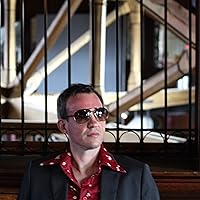
John Andrew Fredrick is the principal songwriter for indie rock band the black watch who have released 17 CDs to considerable underground acclaim. Fredrick received his Ph.D. in English from The University of California at Santa Barbara and has taught in The Writing Program at USC, and the English Departments of UCSB, Loyola Marymount University, and Santa Monica College. He is an avid tennis player (or bum, if you like) and can be found on the courts of Los Angeles (where he resides) at least five times a week.
According to the blurb, The King of Good Intentions is "set in Los Angeles in the early 90s" and "chronicles the early days of an indie band as they meet, practice, make their first record, and get their first break/big gig". Although, really, this is only half the story.
A picaresque novel (if you're one of those people who lives and dies by whether Wikipedia says its true or not, then Wikipedia says this of that: a novel that "depicts, in realistic and often humorous detail, the adventures of a roguish hero of low social class who lives by his wits in a corrupt society"). And what could be more roguishly heroic than being an over educated, underemployed struggling rock musician?
Despite being (I gather) pretty autobiographical - song titles from the fictitious band The Weird Sisters match up with John Andrew Fredrick's actual band, The Black Watch, and the timeline kinda coincides with when TBW's debut album was made) - the novel isn't primarily concerned with the making of said record. No, really, the entire plot is just a framework in order for Fredrick to ruminate of a variety of often tangential topics ... we get chapter-long digressions into teen masturbation, a couple of hilarious chapters taking place in LA parties, and sub-plots illustrating the (ahem) joys of being a substitute high school teacher.
All of which, topic-wise, is up my alley, so to speak. What elevates this particular tome above others of its ilk, though, is Fredrick's dense, wordy and frequently laugh-out-loud (but never LOL) prose. This is highbrow/lowbrow fiction of the highest order.
If there's one suggestion (read: "complaint") to be made, it's that the context of this novel is even better if you're familiar with Fredrick's oeuvre as frontman for the aforementioned The Black Watch. The generally excellent publishing house, Verse Chorus Press, really dropped the ball here ... including a sampler CD, download code for a 'greatest hits' compilation or at least a few of the songs mentioned in the book, or else a reissue of some of the really early, vinyl-only TBW material is really a missed opportunity of the highest order. That being said, if your interest is even slightly piqued as to what the fictional music might have sounded like, scour Amazon.com's marketplace for a copy of either Flowering, Amphetamines or The King of Good Intentions (the album). You won't be disappointed.
Imagine if Ignatius Reilly from A Confederacy of Dunces--post hotdog stand, post pants factory--lived in Los Angeles to pursue a dream of being in a band. Weed, beer runs, babes, the Goth babes of other bandmates and hilarious caricatures of LA prototypes are all in play in John Andrew Frederick's rich novel of a lovable scoundrel and his pre hipster era meanderings into the limelight and straight to center stage.
one of my pet literary theories (superstitions?) is that if you look hard enough every book contains a one-line review of itself. here see p 76: "like reading a letter from an albeit orotund and somewhat sententious friend." narrdude def wears his sententiousness on his sleeve when e.g. critiquing ppl's grammar or arguing that sex w/ someone else isn't cheating if one doesn't come (?!) but there's a lively warm garrulity here that carries it thru. additionally there's an emu. planning to peep the sequel
Expressive, Dramatic, Tender, Brutal, Sweet, and Disarmingly Funny -- A Must-Read! It's hard to stop reading when the pages run out. Can't wait for the second part!
The King of Good Intentions is a wry, tender, and sharply observed portrait of artistic coming-of-age, set against the sun bleached chaos of early ’90s Los Angeles. John Andrew Fredrick captures the peculiar alchemy of an indie band finding its footing those long rehearsals, small epiphanies, and near misses that feel monumental at the time while grounding the story in the fragile, compelling love between its two leads, John and Jenny. Their relationship feels lived-in and believable, shaped as much by shared creative hunger as by private damage and restraint.
Fredrick’s great strength is tone. The novel balances humor and melancholy with an easy confidence, skewering the absurdities of the Hollywood ecosystem aspiring actors, self-serious musicians, eccentric neighbors without ever tipping into cruelty. The LA Unified School District scenes are especially memorable, lending the book an unexpected edge and social texture that deepens John’s misanthropy while revealing his quiet decency.
What ultimately lingers is the book’s generosity. Beneath its irony and wit, The King of Good Intentions is deeply empathetic about ambition, disappointment, and the hope that art might still save you or at least keep you honest. Its long-delayed publication feels less like a curiosity and more like a small act of literary justice: this is a novel that understands how creative lives are actually lived, and it arrives with the confidence and clarity of something that has waited until it was ready to be heard.
John writes ecstatically, it is wonderful to get caught up in the prose, which is often as hilarious as it is exhilarating. The story details getting a band going in LA in the early 90s, whilst working shit jobs, falling in love, and having to deal with all manner of difficult personalities. I am very much looking forward to the rest of the trilogy.
A witty, very funny story narrated by a denizen of the early ‘90s LA indie-rock scene, 'The King of Good Intentions' knows its milieu quite well, since its author, John Andrew Fredrick, has led the LA-based indie-rock band the Black Watch since the late ‘80s. Given that fact, and because the narrator’s called “John,” it’s hard not to read this as a bit of a roman à clef (treble for girl trouble, bass for base intentions inopportunely acted out)–while our narrator John more than once tells us we can’t trust him and that he is, sometimes, a bit of a dick (and he is, sometimes, a bit of a dick). Alongside the humor, though, we get some brightly poetic and emotively charged descriptions of the early stages of a love affair—Fredrick perfectly cuts a tendency toward the purple and recondite with judiciously placed goofball-dude slang—and the sorts of confused dumbassery that can sabotage such relationships (or one’s friendships, or employment, or…).
My only reservations are that sometimes Fredrick does go on: his narrator’s in love with his own voice, and just as that narrator’s numerous descriptions of any number of lovely women make their feminine deliciousness well up from the page, that voice too is quite charming...even if, like your raconteur drinking pal whose endless divagations make you forget what the hell he was actually talking about, plot and any character but the narrator get suspended for several pages on end in service of (oh say) a hilarious story of substitute teaching, or a shaggy-dog baseball metaphor… (that one actually pays off later, though).
I'm looking forward to reading the sequel, 'The King of Good Intentions II.'